Wednesday, February 13, 2013

Pope's Last Sermon

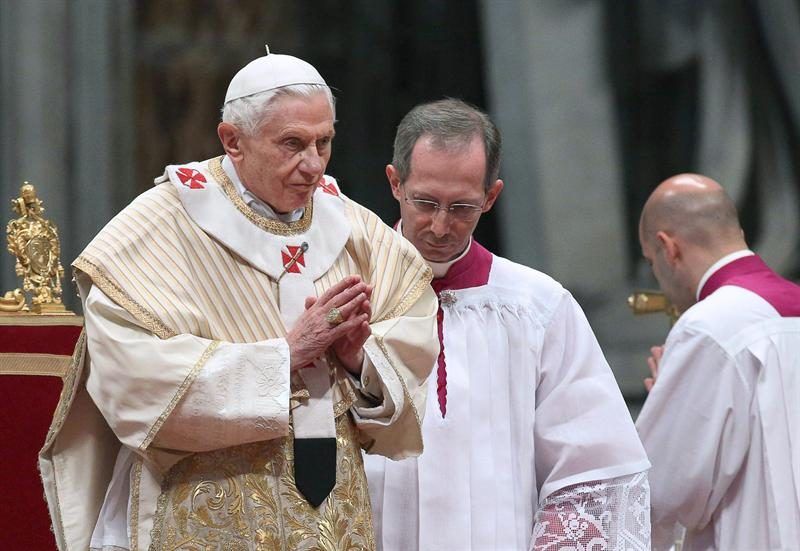
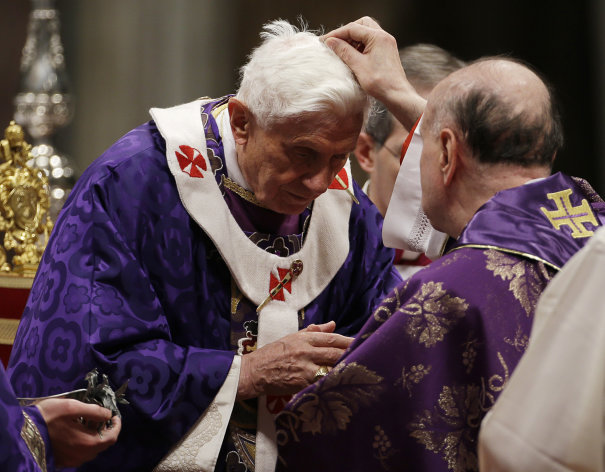
Pope receives ashes at St Peter's Basilica


Venerable Brothers,
Dear Brothers and Sisters!

Today, Ash Wednesday, we begin a new Lenten journey, a journey that extends over forty days and leads us towards the joy of Easter, to victory of Life over death. Following the ancient Roman tradition of Lenten stations, we are gathered for the celebration of the Holy Eucharist. The tradition says that the first statio took place in the Basilica of Saint Sabina on the Aventine Hill. Circumstances suggested we gather in St. Peter's Basilica. Tonight there are many of us gathered around the tomb of the Apostle Peter, to also ask him to pray for the path of the Church going forward at this particular moment in time, to renew our faith in the Supreme Pastor, Christ the Lord. For me it is also a good opportunity to thank everyone, especially the faithful of the Diocese of Rome, as I prepare to conclude the Petrine ministry, and I ask you for a special remembrance in your prayer.

The readings that have just been proclaimed offer us ideas which, by the grace of God, we are called to transform into a concrete attitude and behaviour during Lent. First of all the Church proposes the powerful appeal which the prophet Joel addresses to the people of Israel, "Thus says the Lord, return to me with all your heart, with fasting, with weeping, and with mourning" (2.12). Please note the phrase "with all your heart," which means from the very core of our thoughts and feelings, from the roots of our decisions, choices and actions, with a gesture of total and radical freedom. But is this return to God possible? Yes, because there is a force that does not reside in our hearts, but that emanates from the heart of God and the power of His mercy. The prophet says: "return to the Lord, your God, for he is gracious and merciful, slow to anger, abounding in steadfast love, and relenting in punishment" (v. 13). It is possible to return to the Lord, it is a 'grace', because it is the work of God and the fruit of faith that we entrust to His mercy. But this return to God becomes a reality in our lives only when the grace of God penetrates and moves our innermost core, gifting us the power that "rends the heart". Once again the prophet proclaims these words from God: "Rend your hearts and not your garments" (v. 13). Today, in fact, many are ready to "rend their garments" over scandals and injustices – which are of course caused by others - but few seem willing to act according to their own "heart", their own conscience and their own intentions, by allowing the Lord transform, renew and convert them.

This "return to me with all your heart," then, is a reminder that not only involves the individual but the entire community. Again we heard in the first reading: "Blow the horn in Zion! Proclaim a fast, call an assembly! Gather the people, sanctify the congregation; Assemble the elderly; gather the children, even infants nursing at the breast; Let the bridegroom leave his room, and the bride her bridal tent (vv.15-16). The community dimension is an essential element in faith and Christian life. Christ came "to gather the children of God who are scattered into one" (Jn 11:52). The "we" of the Church is the community in which Jesus brings us together (cf. Jn 12:32), faith is necessarily ecclesial. And it is important to remember and to live this during Lent: each person must be aware that the penitential journey cannot be faced alone, but together with many brothers and sisters in the Church.

Finally, the prophet focuses on the prayers of priests, who, with tears in their eyes, turn to God, saying: " Between the porch and the altar let the priests weep, let the ministers of the LORD weep and say: “Spare your people, Lord! Do not let your heritage become a disgrace, a byword among the nations! Why should they say among the peoples, ‘Where is their God?’"(V.17). This prayer leads us to reflect on the importance of witnessing to faith and Christian life, for each of us and our community, so that we can reveal the face of the Church and how this face is, at times, disfigured. I am thinking in particular of the sins against the unity of the Church, of the divisions in the body of the Church. Living Lent in a more intense and evident ecclesial communion, overcoming individualism and rivalry is a humble and precious sign for those who have distanced themselves from the faith or who are indifferent.

"Well, now is the favourable time, this is the day of salvation" (2 Cor 6:2). The words of the Apostle Paul to the Christians of Corinth resonate for us with an urgency that does not permit absences or inertia. The term "now" is repeated and can not be missed, it is offered to us as a unique opportunity. And the Apostle's gaze focuses on sharing with which Christ chose to characterize his life, taking on everything human to the point of taking on all of man’s sins. The words of St. Paul are very strong: "God made him sin for our sake." Jesus, the innocent, the Holy One, "He who knew no sin" (2 Cor 5:21), bears the burden of sin sharing the outcome of death, and death of the Cross with humanity. The reconciliation we are offered came at a very high price, that of the Cross raised on Golgotha, on which the Son of God made man was hung. In this, in God’s immersion in human suffering and the abyss of evil, is the root of our justification. The "return to God with all your heart" in our Lenten journey passes through the Cross, in following Christ on the road to Calvary, to the total gift of self. It is a journey on which each and every day we learn to leave behind our selfishness and our being closed in on ourselves, to make room for God who opens and transforms our hearts. And as St. Paul reminds us, the proclamation of the Cross resonates within us thanks to the preaching of the Word, of which the Apostle himself is an ambassador. It is a call to us so that this Lenten journey be characterized by a more careful and assiduous listening to the Word of God, the light that illuminates our steps.

In the Gospel passage according of Matthew, to whom belongs to the so-called Sermon on the Mount, Jesus refers to three fundamental practices required by the Mosaic Law: almsgiving, prayer and fasting. These are also traditional indications on the Lenten journey to respond to the invitation to «return to God with all your heart." But he points out that both the quality and the truth of our relationship with God is what qualifies the authenticity of every religious act. For this reason he denounces religious hypocrisy, a behaviour that seeks applause and approval. The true disciple does not serve himself or the "public", but his Lord, in simplicity and generosity: "And your Father who sees everything in secret will reward you" (Mt 6,4.6.18). Our fitness will always be more effective the less we seek our own glory and the more we are aware that the reward of the righteous is God Himself, to be united to Him, here, on a journey of faith, and at the end of life, in the peace light of coming face to face with Him forever (cf. 1 Cor 13:12).

Dear brothers and sisters, we begin our Lenten journey with trust and joy. May the invitation to conversion , to "return to God with all our heart", resonate strongly in us, accepting His grace that makes us new men and women, with the surprising news that is participating in the very life of Jesus. May none of us, therefore, be deaf to this appeal, also addressed in the austere rite, so simple and yet so beautiful, of the imposition of ashes, which we will shortly carry out. May the Virgin Mary, Mother of the Church and model of every true disciple of the Lord accompany us in this time. Amen!


source: Vatican Radio

Monday, February 11, 2013

Silly Man: Pope "Never Had A Chance"


The end of a Papacy is, under normal circumstance, something like the death of a family patriarch for Catholics, for the Pope is a spiritual father to us. Yes, once the Pope is gone we can say "the Pope is gone, long live the Pope," but we still ought to keep the old Pontiff's legacy in perspective and be sensitive to the feelings and faith of Catholics, something John Moody at Fox News is not doing.

While going through the stories on the odd end of the pontificate of Benedict XVI I came across this ridiculous editorial written by John Moody and which is posted on foxnews.com. Not only is this article irreverent, it is callously ignorant is outright wrong!
He never had a chance. [Really? That's your intro?]
From the moment he appeared on the balcony of St. Peter’s on April 19, 2005, to greet the faithful, Benedict XVI faced an insurmountable problem: [The Roman Curia?] He was not John Paul II. [Now get this....]
Benedict’s decision to resign the papacy is being blamed on his age – nearly 86 – and his health – never robust. He might just as well have been diagnosed with a broken papal heart. [He is not resigning because he can barely walk, nor because he can barely speak, nor because his mental powers might be diminishing. He is resigning because he spent eight years in a personal crisis over not being his Polish predecessor.]
Because his nearly eight years on the Throne of the Fisherman never really produced the results he hoped for. [Has any Pope in his lifetime seen the results he wanted?] He did not unite the conservative and progressive wings of the Catholic Church. [He did not see the Church in such American political terms] He did not re-establish its place in Europe, [thats a long-term project, you can't undo WW2 and socialism overnight] the work of a previous Pope Benedict and the reason he took that name. Nor did he expand its foothold in Asia, [that's more debatable, the Chinese usurpation of Church power is not the Pope's fault] cement its dominance in Latin America, or make serious inroads in Africa. And he did not bring to fruition the ecumenical understanding with other major faiths that he hoped would bloom during his reign. [Did he hope for ecumenical flowers?]
Benedict faced nearly impossible odds, even before he was elected. Joseph Ratzinger -- his given name -- was already white-haired [He was white-haired when he attend Vatican II half a century ago!] and stooped when he became pope. He was a German of the World War II generation, and as a boy had served, involuntarily, as a member of the Hitler Youth. [He went to jail for not attending meetings] His last job in Rome as Cardinal Ratzinger was to head the Congregation for the Doctrine of the Faith – the branch of the Vatican charged with enforcing dogma and rooting out dissent. For that, he was dubbed The Chief Inquisitor and The Rottweiler. His idea of a wild night was a single glass of Riesling and an hour of playing his piano – he was an accomplished interpreter of Beethoven and Mozart. [That's more wild that most of my nights. Perhaps he thinks John Paul II was closer to Rodrigo Borgia than Joseph Ratzinger?]
That’s who he is. But what stymied him was who he isn’t. [He's serious!]
His Polish predecessor as Pope, Karol Wojtyla of Krakow, exploded into worldwide prominence and popularity in 1978 as a strong, smiling face for a church that had not elected a non-Italian for nearly 500 years. In combining as his papal name both John and Paul, Wojtyla suggested to the Church that he would follow the prudent style of rule set forth by John XXIII and Paul VI – neither of them firebrands. [The Church's state did not improve very much under JP2's reign. Most vital statistics declined, but no one said JP2 wasn't Paul VI]
Then, John Paul revealed his true nature: a brilliant, conservative theologian, [he was not an accomplished theologian, he was more of a wise pastor if anything] a master politician and historian, a nonpareil philosopher, [The beatification sermon did not even go this far] a polished performer thanks to his youthful acting career, an unapologetic anti-communist, and an inveterate traveler. He also didn’t mind showing off. He skied. He hiked. He canoed. He sported sneakers. He watched bare-breasted African women do traditional dances. [Someone tell Cardinal Arinze! Liturgical dance!] And he never stopped talking, in any of the seven or eight languages he spoke fluently, about how God loves us.
By contrast, Benedict’s meek initial outings were public relations meltdowns. His smile, though genuine, looked somehow sinister, as if he were about to bite his audience. [I have been to a Papal audience and never felt his carnivorous threat] Determined to restore the Church’s luster in Europe, where it is often treated like a dotty old aunt, Benedict gave a lecture in Regensburg, Germany, in 2006 that appeared to denigrate Islam. [Hardly] The non-Catholic world howled; the Vatican cringed and apologized. [Not exactly]
On his first visit to the U.S. as pope, Benedict offered contrite apologies for the Church’s ham-handed treatment of the U.S. church’s sex scandal involving its priests. Even the pope’s humble mien did not satisfy some, who pronounced him cold and unfeeling toward the plight of victims of clergy abuse. [How much can he do to apologize and make amends with those whom he did not harm and still assumes guilt for letting down? Do you think the previous Pope really would have done a bit better?] He joined the Twitterati, but his first attempt was a sterile: “I am pleased to get in touch with you through Twitter. I bless all of you from my heart.” At least he stayed under 140 characters.
In nearly eight years, Benedict issued three encyclicals – direct messages to the faithful that often reveal a pope’s enthusiasms and interests. Benedict’s first – entitled “God is Love” -- is a caressing, simply worded, logic-based reassurance that our Lord loves us. Yet even his writing about love suffers in comparison with John Paul’s towering, intellectual yet intimate canon of work. [Adrian Fortescue was right. The mania with encyclicals needs to desist]
None of which lessens Benedict’s place in the line of Vicars of Christ. His decision to resign was a brave one, based on personal humility, in keeping with his message to the faithful that the things of Earth are transient, but the promise of heaven lasting and infinite.  For that he should be remembered. [What a lovely ending, after railing against the man for being a dotty German carnivore rather than a Polish ski master!]


Pope Benedict XVI Resigns


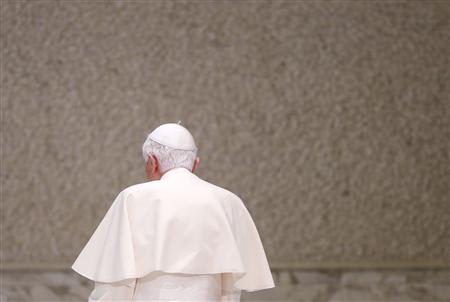
Today during the meeting for the Consistory for Canonizations Benedict XVI announced his intention to vacate the Bishopric of Rome at 8:00PM on February 28th. The text of his address is below, first in Latin (as he gave it) then in English:
Fratres carissimi,
Non solum propter tres canonizationes ad hoc Consistorium vos convocavi, sed etiam ut vobis decisionem magni momenti pro Ecclesiae vitae communicem. Conscientia mea iterum atque iterum coram Deo explorata ad cognitionem certam perveni vires meas ingravescente aetate non iam aptas esse ad munus Petrinum aeque administrandum.

Bene conscius sum hoc munus secundum suam essentiam spiritualem non solum agendo et loquendo exsequi debere, sed non minus patiendo et orando. Attamen in mundo nostri temporis rapidis mutationibus subiecto et quaestionibus magni ponderis pro vita fidei perturbato ad navem Sancti Petri gubernandam et ad annuntiandum Evangelium etiam vigor quidam corporis et animae necessarius est, qui ultimis mensibus in me modo tali minuitur, ut incapacitatem meam ad ministerium mihi commissum bene administrandum agnoscere debeam. Quapropter bene conscius ponderis huius actus plena libertate declaro me ministerio Episcopi Romae, Successoris Sancti Petri, mihi per manus Cardinalium die 19 aprilis MMV commissum renuntiare ita ut a die 28 februarii MMXIII, hora 29, sedes Romae, sedes Sancti Petri vacet et Conclave ad eligendum novum Summum Pontificem ab his quibus competit convocandum esse.

Fratres carissimi, ex toto corde gratias ago vobis pro omni amore et labore, quo mecum pondus ministerii mei portastis et veniam peto pro omnibus defectibus meis. Nunc autem Sanctam Dei Ecclesiam curae Summi eius Pastoris, Domini nostri Iesu Christi confidimus sanctamque eius Matrem Mariam imploramus, ut patribus Cardinalibus in eligendo novo Summo Pontifice materna sua bonitate assistat. Quod ad me attinet etiam in futuro vita orationi dedicata Sanctae Ecclesiae Dei toto ex corde servire velim.

Ex Aedibus Vaticanis, die 10 mensis februarii MMXIII


BENEDICTUS PP XVI
____________________________________

Dear Brothers, 

I have convoked you to this Consistory, not only for the three canonizations, but also to communicate to you a decision of great importance for the life of the Church. After having repeatedly examined my conscience before God, I have come to the certainty that my strengths, due to an advanced age, are no longer suited to an adequate exercise of the Petrine ministry. I am well aware that this ministry, due to its essential spiritual nature, must be carried out not only with words and deeds, but no less with prayer and suffering. However, in today’s world, subject to so many rapid changes and shaken by questions of deep relevance for the life of faith, in order to govern the bark of Saint Peter and proclaim the Gospel, both strength of mind and body are necessary, strength which in the last few months, has deteriorated in me to the extent that I have had to recognize my incapacity to adequately fulfill the ministry entrusted to me. For this reason, and well aware of the seriousness of this act, with full freedom I declare that I renounce the ministry of Bishop of Rome, Successor of Saint Peter, entrusted to me by the Cardinals on 19 April 2005, in such a way, that as from 28 February 2013, at 20:00 hours, the See of Rome, the See of Saint Peter, will be vacant and a Conclave to elect the new Supreme Pontiff will have to be convoked by those whose competence it is.

Dear Brothers, I thank you most sincerely for all the love and work with which you have supported me in my ministry and I ask pardon for all my defects. And now, let us entrust the Holy Church to the care of Our Supreme Pastor, Our Lord Jesus Christ, and implore his holy Mother Mary, so that she may assist the Cardinal Fathers with her maternal solicitude, in electing a new Supreme Pontiff. With regard to myself, I wish to also devotedly serve the Holy Church of God in the future through a life dedicated to prayer.

From the Vatican, 10 February 2013

BENEDICTUS PP XVI


Leo XIII reigned into his nineties as Pope. Benedict was advised by a doctor to cease making transatlantic voyages and to reduce his schedule. One could say a Pope who cannot travel could at least govern the Holy See, run the Papal Household, oversee the functions of the Curia, and perform public liturgies. If Benedict is resigning then he must see himself as no longer able to even perform these functions. Fr Lombardi, Vatican spokesman, said he would move to Castel Gandolfo to set his affairs in order, then retire to a cloister within the Holy See's walls and live out the rest of his natural live, basically as a monk. To the right is a video of Fr Lombardi giving the press conference after the announcement. He is visibly nervous, shuffling papers that are already in neat stacks and fidgeting with his hands.


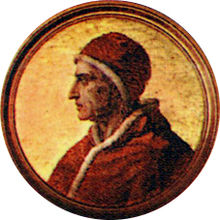
Gregory XII, the last Pope to resign
This creates a very strange dynamic: there will be two inhabitants of the Petrine chair alive at once. The last Pope to truly resign was the 13th century mystic St Peter Celestine, a hermit who was elected by a deadlocked conclave out of the blue, reigned for a few months, became aware he was not "up for the job," and resigned only to be arrested and indirectly killed by his successor, Boniface VIII. There were three claimants to the Papacy (Pope Gregory XII, and his opponents John XXIII and Benedict XIII). All three were deposed of any claims to the Papacy at the Council of Constance in 1415, leading to the election of Martin V. Some rotten skunks were kicked out by the cardinals or the people of Rome in the 9th, 10th, and 11th centuries, usually on account of their personal wickedness. Nothing quite like this has ever happened though.

Usually the previous Pope's death sets things in motion. His rooms are sealed, his seal is destroyed. The Dean of the College of Cardinals says the Requiem Mass and buries the Pope. The cardinals convene in the Sistine Chapel and elect the new Pontiff in secret. The College of Cardinals as a body makes all governing decisions during the sede vacante. The new Pope assumes office and all the governing authorities. I guess the lack or succession here is what troubles me. It will be more or less a transition, given this current Pope still lives, though his health seems to be failing him.

Many commentators long suggested he might resign someday after watching his predecessor slowly and painfully die in the public eye. John Paul used his struggle as a teaching moment, increasing the Church's credibility on life issues to the secular world. Benedict might think himself physically unable to do even this.

Pray for Pope Benedict and ask God to give us a holy pontiff after him.


Good bye, and thank you.


Saturday, February 9, 2013

New England Blizzard!

25 inches on the ground here! Some parts of Connecticut got 36 inches.

The car is outright buried.

Friday, February 8, 2013

Kyrie Eleison!

In the ancient Christian days Mass would begin with a litany, a series of petitions to God, to which the people would respond "Domine, miserere nobis," or "Lord, have mercy on us." This tradition of litanies during the liturgy continues in the Byzantine rite today, whereas it is primarily something done in processions or at ordinations in the Roman rite now. By the pontificate of St. Gregory the Great, who ascended to the Petrine chair in 590 A.D., the litanies had vanished but the response, "Lord, have mercy," remained. St. Gregory, believing the Roman rite should still retain Greek vestiges, changed the response from Latin to Greek ("Kyrie, eleison"). Rather than just a series of exclamations, the "Kyrie" became a series of three invocations, each invocation composed of three petitions. The first three directed to God the Father (Kyrie eleison), the second three to God the Son (Christe eleison), and the last three to God the Holy Ghost (Kyrie eleison).

This remained the tradition in Rome until 1969, but not through all of Europe. The great cathedrals of Spain, Gaul—particularly Rouen, and England—especially Salisbury—began to trope or "farce" the Kyrie's with Latin exclamations and titles of the Persons to Whom they are addressed. I have found one such version which I believe to be of Gaul, given its musical style of "organum," a droning background noise which resembles ancient Byzantine chant whilst a cantor sings the main petition aloud. This style is somewhat like a primitive polyphony in style and was likely brought to the West through the Crusades. This text version is from the 12th or 13th century and most religious and political enthusiasm for the Crusades derived in France, which is my logic for sourcing this rendition from there.


Latin/Greek text:
1. Orbis factor rex aeterne, eleison! Kyrie eleison!
2. Pietatis fons immense, eleison! Kyrie eleison!
3. Noxas omnes nostras pelle, eleison! Kyrie eleison!
4. Christe qui lux es mundi dator vitae, eleison! Christe eleison!
5. Arte laesos daemonis intuere, eleison! Christe eleison!
6. Conservans te credentes confirmansque, eleison! Christe eleison!
7. Patrem tuum teque flamen utrorumque, eleison! Kyrie eleison!
8. Deum scimus unum atque trinum esse, eleison! Kyrie eleison!
9. Clemens nobis adsis paraclite ut vivamus in te, eleison! Kyrie eleison!

Quick translation:
1-Eternal King, Maker of the World, have mercy on us! Lord, have mercy!
2-Great font of kindness, have mercy on us! Lord, have mercy!
3-Expel all our dangers, have mercy on us! Lord, have mercy!
4-Christ, light and giver of life, have mercy on us! Christ, have mercy!
5-Behold wounds made by the art of the devil, have mercy on us! Christ, have mercy!
6-Protecting and upholding believers in You, have mercy on us! Christ, have mercy!
7-Father and You are of a similar light, have mercy on us! Lord, have mercy!
8-One God we know to be three, have mercy on us! Lord, have mercy!
9- Kindly You are with us in the Paraclete that we may live, have mercy on us! Lord, have mercy!

Sunday, February 3, 2013

Candlemas

The Encounter
Source: St. George's in Pittsburg, PA

Yesterday was the feast of the Purification of the Blessed Virgin Mary, commonly called Candlemas in the English-speaking world, or the “Encounter” as it is called in the Byzantine rite. This day commemorates the purification of Our Lady according to the Mosaic Law and all the wonderful events recounted in St. Luke’s Gospel which ensued.

Our Lady, although “full of grace” (Luke 1:28), was still humble. As the human parent, and indeed the sole blood of God-made-Man, it would be sensible to think Our Lady shared many traits in common with Our Lord, namely humility and submissiveness. Our Lady neither sinned nor considered herself above the law of Moses and her ancestors, whose promise from God was fulfilled in her womb, “He hath received Israel his servant, being mindful of His mercy: As He spoke to our fathers, Abraham and His seed forever” (Luke 1:54-55).

Mary’s humility in presenting herself to the Law set the scene for Jesus to reveal Himself to St. Simeon, a holy man who God had promised would not die until he beheld the Christ of God, the Savior of his people. Overwhelmed in the beatific joy only God can bestow, the saint sang a new canticle now so familiar to those who say Vespers (Byzantine rite) or Compline (Roman rite) with any regularity:

Now Thou dost dismiss Thy servant, O Lord, according to Thy word in peace;
Because my eyes have seen Thy salvation,
Which Thou hast prepared before the face of all peoples:
A light to the revelation of the Gentiles, and the glory of Thy people Israel.

The old man St. Simeon had become holy in the sense that Cardinal Newman understood holiness, not the accomplishment of works required by law, but seeing the world as God sees it and wishes for us to see it. Simeon’s only desire was to see Israel’s promise fulfilled and the world again sanctified, a consolation rather than an accomplishment. St. Simeon is unlikely to have lived even into Christ’s public ministry, given his age, but God granted this man to know the purpose of the Christ, which would eventuate spiritual deliverance for Israel and all peoples, not a political liberation for a small tribal nation along the Palestinian coast. The best description I have heard of St. Simeon comes from St. Ambrose’s commentary on the Gospel at Matins for this day, in which the Milanese bishop calls Simeon  just man, confined in the weary prison of the body, desiring to be dissolved and to begin to be with Christ.”

All this came to pass simply because of Mary’s humility in the temple. Where there is Our Lady, there is Her Son doing good nearby.

In most all of Christendom churches bless candles this day. The Byzantine rite calls for a general blessing, while in the Roman rite a church ought to bless all candles used for the entire year at this point. The Roman rite curiously calls for a penitential procession, with the priest vested in violet and the deacon and subdeacon in folded chasubles. Perhaps this procession and penitential spirit preceded the celebration of the Purification, but remained, in an obscure manner, in the rites for February 2nd. One of the delightful quirks of the Roman rite.

I should like to draw attention to the Sarum rite, the liturgy used in the diocese of Salisbury until the Reformation eliminated the Mass and the Latin office in England for centuries. Some priests undoubtedly kept saying Mass in the familiar Sarum rite, albeit furtively, until Jesuit missionaries brought the Roman rite, which remained when the Church returned to public worship in English in the 19th century. The first public celebration (to my knowledge) of the Sarum rite came in 1996 under the Newman Society at Oxford Univeristy, who conscripted Fr. Sean Finnegan, then of the nascent Oxford Oratory, to celebrate Solemn Mass at the Merton College chapel. I do not know which feast was celebrated, but the deed was repeated in 1997 by the same organization and the same celebrant for Candlemas. The Mass has been recorded and is available online. One is struck by the beauty of the music and ceremonies, rites so rich they almost bring the tridentine Roman rite to shame.

Knowing the priest who preached the sermon at the second Mass, I asked him why celebration of the Sarum rite ceased. He told me that they had intended to celebrate it annually during Hilary term, but someone sent a report to a Roman congregation which in turn told them to desist in their celebrations of the rite. Those who put on the Mass formed a small group called the Society of St. Osmond (or the “Donny Osmond Society” according to this priest), investigated the matter, determined that the Sarum Mass was perfectly legal to celebrate, and still obtained permission from the Archbishop of Birmingham. It was quite legal. Rome, however, thought the “Society of St. Osmond” was a newfangled British version of the Society of St. Pius X and immediately panicked! Perhaps there is a lesson in this: liturgy should not be dictated by bureaucrats and legalists.

I have included below a clip from the offertory of the Mass. You will notice the cantors wearing copes, an acolyte in a tunicle, lots of incense, the kissing of the “text,” and a chant tone slightly off from what we know in the Roman rite. The motet after the plainsong, about a minute and a half into the clip, is one of my all-time favorites: Gaude, gaude, gaude, Virgo Maria by John Sheppard.