Thursday, April 13, 2017

Monday, April 10, 2017
Passiontide: The Promise to Abraham
In these finals days of Great Lent the Christian turns his attention away from the themed Sundays of the preceding weeks and begins to consider the sufferings of Christ in earnest, the great acts benefiting us to our regeneration, the Cross, the tomb, and the Resurrection on the third day. The real enemy was not Rome or Babylon, but sin, which caused mankind grief and death and which, by taking on the form of a man and subjecting Himself to sinners, Our Lord expunged the spiritual stain of sin and the eternal consequences of death.
We Christians will consider the nature of sin and how the Resurrection opened the way to its forgiveness in the rebirth of Baptism. We will think about our personal sins, how lamentable they are to God, and how they contributed to Jesus' sufferings; I pray we also consider how fasting and uniting ourselves to His sufferings will purify us of the things that breach our connection to Him. Many would agree that we should not limit our prayers and attempts to attend services during Holy Week by the casual barriers of daily life, but perhaps a less obvious barrier is to meditation. We think of Holy Week as the culmination of a few specific things when it is in fact the culmination of a great many things, among them a series of covenants that began in earnest with our father in faith, Abraham.
God promised to make the ninety-nine year old Abram the father of many nations (Genesis 17:4-5) through which He would make Himself known among men. Abram believed "in uncircumcision", but he submitted to God's command of circumcision and "through the justice of faith" became the heir of the world (Romans 4:10-14). For his submission God made him a new man, no longer Abram, but Abraham. He knew God by faith, but by his submission to the command he was made anew, anticipating how by a greater encounter with Christ we may come to believe, but only by Baptism are we reborn free of sin. In his more Anglican days John Henry Newman observed "Even Abraham was justified by faith, though he was perfected by works" (Intercession).
Abram did not receive Baptism, he received a promise that he would multiply and his children would constitute many peoples. While promises do not change circumstance, they give hope that our lot will be changed. Nations did in fact come from Abraham while "sin reigned unto death." What came after the Resurrection was not a promise, but the fulfillment of a promise and the object of hope. While Abraham's descendants opaquely saw sin in infidelity to the Law, in the fullness of faith we sin as death itself. And yet Christ rose from the dead and "trampled upon death by His death and has given life" to those who were dead. Those dead in sin, if not in tombs, are brought into the Church on Holy Saturday when Christ freed Abraham and his faithful children, sinners that they were, from Hades. "Know you not that all we, who are baptized in Christ Jesus, are baptized in his death? For we are buried together with him by baptism into death; that as Christ is risen from the dead by the glory of the Father, so we also may walk in newness of life" (Romans 6:3-4).
Death is the opposite of giving life. By God Abraham gave life to a multitude; Christ gave life eternal to all who would follow, Abraham's true children.
"The Law was given by Moses; grace and truth came through Jesus Christ" (John 1:17).
We Christians will consider the nature of sin and how the Resurrection opened the way to its forgiveness in the rebirth of Baptism. We will think about our personal sins, how lamentable they are to God, and how they contributed to Jesus' sufferings; I pray we also consider how fasting and uniting ourselves to His sufferings will purify us of the things that breach our connection to Him. Many would agree that we should not limit our prayers and attempts to attend services during Holy Week by the casual barriers of daily life, but perhaps a less obvious barrier is to meditation. We think of Holy Week as the culmination of a few specific things when it is in fact the culmination of a great many things, among them a series of covenants that began in earnest with our father in faith, Abraham.
God promised to make the ninety-nine year old Abram the father of many nations (Genesis 17:4-5) through which He would make Himself known among men. Abram believed "in uncircumcision", but he submitted to God's command of circumcision and "through the justice of faith" became the heir of the world (Romans 4:10-14). For his submission God made him a new man, no longer Abram, but Abraham. He knew God by faith, but by his submission to the command he was made anew, anticipating how by a greater encounter with Christ we may come to believe, but only by Baptism are we reborn free of sin. In his more Anglican days John Henry Newman observed "Even Abraham was justified by faith, though he was perfected by works" (Intercession).
Abram did not receive Baptism, he received a promise that he would multiply and his children would constitute many peoples. While promises do not change circumstance, they give hope that our lot will be changed. Nations did in fact come from Abraham while "sin reigned unto death." What came after the Resurrection was not a promise, but the fulfillment of a promise and the object of hope. While Abraham's descendants opaquely saw sin in infidelity to the Law, in the fullness of faith we sin as death itself. And yet Christ rose from the dead and "trampled upon death by His death and has given life" to those who were dead. Those dead in sin, if not in tombs, are brought into the Church on Holy Saturday when Christ freed Abraham and his faithful children, sinners that they were, from Hades. "Know you not that all we, who are baptized in Christ Jesus, are baptized in his death? For we are buried together with him by baptism into death; that as Christ is risen from the dead by the glory of the Father, so we also may walk in newness of life" (Romans 6:3-4).
Death is the opposite of giving life. By God Abraham gave life to a multitude; Christ gave life eternal to all who would follow, Abraham's true children.
"The Law was given by Moses; grace and truth came through Jesus Christ" (John 1:17).
Sunday, April 9, 2017
Palm Sunday: In the Presence of the Lord (REPOST)
 |
Today is one of the great days in the Church's year, Palm Sunday. Today we re-live and commemorate both the Lord's entrance into Jerusalem and His Passion and death. It is also a day which highlights our personal ignorance of God, in spite of what seems obvious in retrospect. Two millennia later, we safely judge this concatenation of events. At the time their meaning was not so obvious, and would not be until Pentecost. Are we ignorant of the truth of God's actions? Do we recognize Him in our midst? Do we expect of Him merely human things, solutions to our personal concerns?
 |
| Jouvenet's Raising of Lazarus |
Christ asks Martha, "I am the resurrection and the life: he that believeth in me, although he be dead, shall live: And every one that liveth, and believeth in me, shall not die for ever. Believest thou this?" (John 11:25-26). She responds that she does believe. Christ turns to the tomb where Lazarus has resided in decay and rot for days and yells "Lazarus, come out!" And the man who was not near death, but dead, was now alive.
Not quite understanding the gravity of what transpired, but still chocked and interested (John ch. 12), the people came to see and greet our Lord when he finally arrived in Jerusalem. Jerusalem was not a city with a temple, but a temple with a city. It was the center of the Jewish religion and the only place on earth where a meaningful sacrifice could be offered to God. Jews scattered throughout the Roman Empire often sent money to have an offering made at the Temple for their intentions if they were unable to be in Jerusalem. And this is where Christ went, not to make a legal sacrifice on stone foundations, as St. Ambrose reminds us today in Mattins, but to make a sacrifice that would established foundations of faith.
As Benedict XVI pointed out in his second Jesus of Nazareth book, Jesus sent two Apostles ahead to acquire a donkey and a horse, meaning He already had a following in Jerusalem. Other places in the Gospel indicate that outside the Apostles, Christ had a significant entourage, several hundred people or more. These were those who greeted Him with palms and enthusiasm. The rest of the crowd sought a thrill or novelty. Actually, did not the Apostles and other disciples? They knew more than the people of Jerusalem, but they comprehended practically nothing. In my moments of cynicism I cannot help but interpret certain words of Jesus' like "How much longer must I endure this generation?" as "These people are ridiculous." The Church has understood this frustration over the years. St. Leo the Great remarks in a sermon "Let man's weakness, then, fall down before the glory of God, and acknowledge herself ever too feeble to unfold all the works of His mercy."
As Benedict XVI pointed out in his second Jesus of Nazareth book, Jesus sent two Apostles ahead to acquire a donkey and a horse, meaning He already had a following in Jerusalem. Other places in the Gospel indicate that outside the Apostles, Christ had a significant entourage, several hundred people or more. These were those who greeted Him with palms and enthusiasm. The rest of the crowd sought a thrill or novelty. Actually, did not the Apostles and other disciples? They knew more than the people of Jerusalem, but they comprehended practically nothing. In my moments of cynicism I cannot help but interpret certain words of Jesus' like "How much longer must I endure this generation?" as "These people are ridiculous." The Church has understood this frustration over the years. St. Leo the Great remarks in a sermon "Let man's weakness, then, fall down before the glory of God, and acknowledge herself ever too feeble to unfold all the works of His mercy."
 |
| Reading from Exodus at the dry Mass at the Institute of Christ the King seminary in Gricigliano, 2003 |
What was the purpose of the palms? I've always wondered. At some level there is a practical and honorific element to the placing of palms in the path of the Lord, almost saying that the ground on which Christ's donkey walks is unworthy to support the Lord. Yet we ought to recall some typology from Exodus. During the Mass today there is actually a "dry Mass" (Missa sicca) to bless the palms, a ceremony with an introit, reading, gradual, Gospel, preface, Sanctus, and blessing prayers, much like a Mass. the reading from the "dry Mass" is from the book of Exodus, at the moment when Moses and the Israelites arrive at an oasis of twelve fountains and seventy palm trees. The Israelites had left their bondage but would not have made their way out of Egypt without rest, a place of shade, and some water. In short, the palms provided that. As those palms and water provided the Israelites the means of leaving the bondage of slavery, so Christ provides His people with the means of leaving the bondage of death. The third of the five collect prayers to bless the palms contains not a few didactic lines:
The branches of palms, therefore, represent His triumphs over the prince of death; and the branches of olive proclaim, in a manner, the coming of a spiritual unction. For that pious multitude understood that these things were then prefigured; that our Redeemer, compassionating human miseries, was about to fight with the prince of death for the life of the whole world, and, by dying, to triumph. For which cause they dutifully ministered such things as signified in Him the triumphs of victory and the richness of mercy.
 |
| The procession from the aforementioned celebration of Palm Sunday by the Institute of Christ the King in 2003 |
Recall also that in Rome palms are not always used. Often the Roman Church substitutes olive branches given their greater availability in Italy. The olive branch is no less significant. After the Great Flood a dove brought an olive branch to Moses. To he who survived the Flood the olive branch was not a peace-offering, but rather a sign that death had ended and life had begun anew.
Olives branches are especially prevalent throughout the Mediterranean world. It is not unthinkable that the Cross was made from from the wood of an olive tree, making olive branches and palms both types and anti-types of Christ's redemptive work.
Palm Sunday initiates Holy Week, both the most important proper week of the year and a curio in the Roman rite, a week that preserves the most ancient liturgical customs of the Eternal City which fell out of regular use. In the first millennium there would be two Masses in Rome. The first would be celebrated in the presence of the Pope at St. Mary Major, where palms would be blessed and distributed. The focus of this Mass would be Palm Sunday. There would then be a procession to the Archbasilica of Our Savior, the cathedral of Rome, where the Pope would celebrate a Mass of the Passion of the Lord. The current arrangement of a "dry Mass" followed by a procession and a Mass of the Passion is a remnant of that, unless one uses the reduced new rite. The "dry Mass"—with its Introit, collect, Epistle, gradual, Gospel, preface, Sanctus, "consecration," distribution of holy things, and dismissal—is the relic of the former of the two ancient Palm Sunday Masses.
Olives branches are especially prevalent throughout the Mediterranean world. It is not unthinkable that the Cross was made from from the wood of an olive tree, making olive branches and palms both types and anti-types of Christ's redemptive work.
Palm Sunday initiates Holy Week, both the most important proper week of the year and a curio in the Roman rite, a week that preserves the most ancient liturgical customs of the Eternal City which fell out of regular use. In the first millennium there would be two Masses in Rome. The first would be celebrated in the presence of the Pope at St. Mary Major, where palms would be blessed and distributed. The focus of this Mass would be Palm Sunday. There would then be a procession to the Archbasilica of Our Savior, the cathedral of Rome, where the Pope would celebrate a Mass of the Passion of the Lord. The current arrangement of a "dry Mass" followed by a procession and a Mass of the Passion is a remnant of that, unless one uses the reduced new rite. The "dry Mass"—with its Introit, collect, Epistle, gradual, Gospel, preface, Sanctus, "consecration," distribution of holy things, and dismissal—is the relic of the former of the two ancient Palm Sunday Masses.
Glory, praise and honor to Thee, O King Christ, the Redeemer: to whom children poured their glad and sweet hosanna's song.
Glory, praise and honor to Thee, O King Christ, the Redeemer: to whom children poured their glad and sweet hosanna's song.
Hail, King of Israel! David's Son of royal fame! Who comest in the Name of the Lord, O Blessed King.
Glory, praise and honor to Thee, O King Christ, the Redeemer: to whom children poured their glad and sweet hosanna's song.
The Angel host laud Thee on high, On earth mankind, with all created things.
Glory, praise and honor to Thee, O King Christ, the Redeemer: to whom children poured their glad and sweet hosanna's song.
With palms the Jews went forth to meet Thee. We greet Thee now with prayers and hymns.
Glory, praise and honor to Thee, O King Christ, the Redeemer: to whom children poured their glad and sweet hosanna's song.
On Thy way to die, they crowned Thee with praise; We raise our song to Thee, now King on high.
Glory, praise and honor to Thee, O King Christ, the Redeemer: to whom children poured their glad and sweet hosanna's song.
Their poor homage pleased Thee, O gracious King! O clement King, accept too ours, the best that we can bring.
Glory, praise and honor to Thee, O King Christ, the Redeemer: to whom children poured their glad and sweet hosanna's song.
A short clip of the door knocking ceremony with an Old Roman
style Gloria, Laus, et Honor tibi sit.

The prayers at the foot of the altar are the reduced form used in Passiontide, the last two weeks of Lent. This form omits the Iudica me psalm and the Gloria Patri.... doxology, which is also omitted in other parts of the Mass as at a requiem Mass. As Fr. Andrew Southwell, OSB once said, Mother Church "is in mourning."
The Epistle is from St. Paul's letter to the Philippians, in which the Apostle writes that at the "name of Jesus every knee should bow, of those that are in heaven, on earth, and under the earth." Christ's sacrifice on the Cross for man gives Him primacy over all things in God's creation.
The gradual today, as in very ancient days, is a full psalm and not just an excerpt. It is psalm 21, which Christ quoted from the Cross: "My God, my God, why hast thou forsaken me?" The Father did not desert the Son, regardless of what von Balthasar thought, but today the psalm functions as an allusion, as the psalm describes the pains of a just man suffering for the sins of the world. Christ fulfills the prophecy of David. The One with power over death dies.
 |
| Deacons reading the Passion according to St. Matthew |
Then three deacons enter the sanctuary and begin to sing St. Matthew's account of the Passion of our Lord, beginning with the events leading up to the Last Supper and ending just after Christ's death on the Cross, for which there is silence and all present kneel.
The three deacons then leave and the deacon of the Mass asks for the blessing, incenses the Gospel book, and sings in a special chant-tone the burial of Christ. The separation from the Passion reading may not be intuitive, but it is instructive: this is the Gospel reading of the Mass, not the Passion—which is an interpolation into Mass. Christ's death and burial are the point of this Mass, which should clear up confusion for us, as opposed to those who watched these events two thousand years ago with little or no break, and who were left in bewilderment as to what to make of the drear they had just witnessed.
In the video to below, Fr. Tim Finigan sings the Gospel of Holy Tuesday in the same tone used for the Gospel of today. It is sublime.
The Mass continues as normal, with no extra "frills."
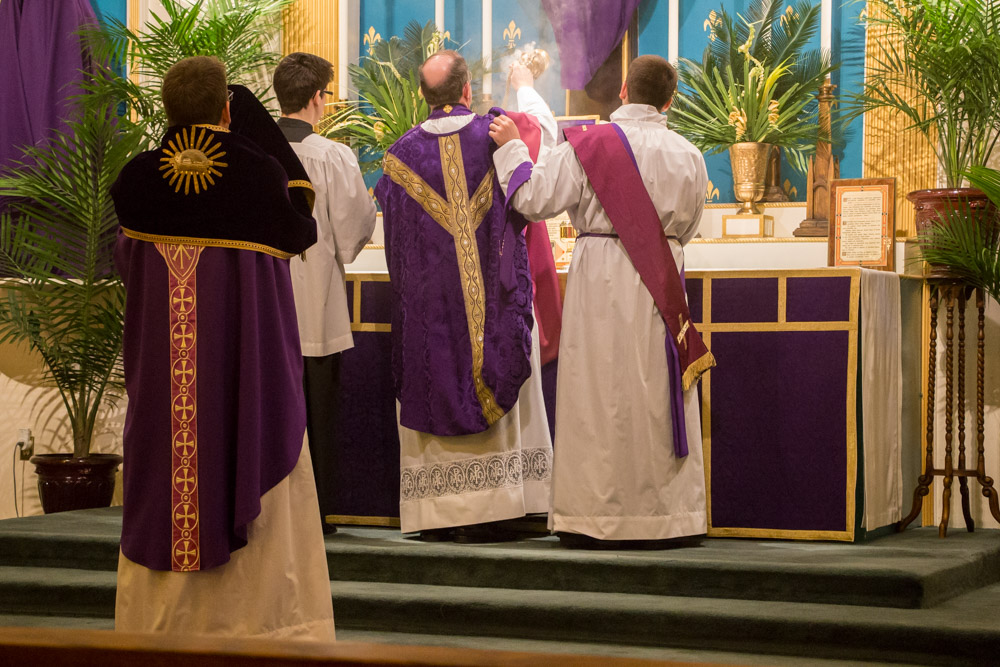
At Vespers the hymn Vexilla Regis is sung, which beings with the words:
Abroad the regal banners fly,
Now shines the cross’s mystery;
Upon it Life did death endure,
And yet by death did life procure.
The hymn makes a conclusive elucidation of the mystery of Palm Sunday, that the Cross is slowly unveiled before our eyes. We do not merely read about it in the Scripture or hear some analysis in the sermon, but we enter these mystical events which are so monumental that they do not know the limits of time. Perhaps one of the great tragedies in the Roman rite in the last century or so is that with the endless stream of reforms begun by St. Pius X, furthered by Pius XII, and concluded by Paul VI, we have lost the notion that the liturgy reveals mystery to us, that it is a method of worshiping God, but also a tool God gives us to understand Him. The raising of Lazarus, the veiling of the Cross, the Old Testament significance of the palms, the restless and lamenting entrance into Jerusalem, and the Cross itself make "sense" to us here. Through the lessons, the Mass, the hymns, and procession today God lifts the veil of ignorance the people of Jerusalem had when they went to see the One who raised a man from the dead and, in their own understanding, turned Him over for death, not realizing His dominion over it.
The textual wealth of the ancient Roman Holy Week reflects the rich austerity of the Latin tradition. Scripture and psalms narrative a liturgy in which the Church stands in the presence of God and revisits events belonging to a place outside of time and space, belonging to eternity. While the Roman rite lacks the explicitly didactic quality of the Greek tradition, the simplicity of the rite—veiled in an odd tongue and a music belonging unto itself—perfectly present the awesomeness of God and the desperate need of the sinner for His forgiveness. With Christ, the sinner enters Jerusalem unwelcomed. The sinner witnesses the Passion again. The sinner proclaims the one wearing a crown of mockery his master. The sinner encounters God in His words and actions.
The textual wealth of the ancient Roman Holy Week reflects the rich austerity of the Latin tradition. Scripture and psalms narrative a liturgy in which the Church stands in the presence of God and revisits events belonging to a place outside of time and space, belonging to eternity. While the Roman rite lacks the explicitly didactic quality of the Greek tradition, the simplicity of the rite—veiled in an odd tongue and a music belonging unto itself—perfectly present the awesomeness of God and the desperate need of the sinner for His forgiveness. With Christ, the sinner enters Jerusalem unwelcomed. The sinner witnesses the Passion again. The sinner proclaims the one wearing a crown of mockery his master. The sinner encounters God in His words and actions.
A blessed Palm Sunday to all.
Wednesday, April 5, 2017
In Praise of Allegory

Interpreting the ceremonies and rubrics of Holy Mass in their allegorical sense (i.e., as symbolic of Christ) has largely gone out of fashion--to put it kindly. The truth is, when I was a seminarian and (perforce) had to take a certain number of "liturgy" classes, the allegorical interpretation of Mass was dismissed out of hand. My professors apparently didn't think any real explanation was needed to justify their airy contempt.
Everything about the Mass was explained according to--let's say--a utility model. The amice may have been likened to the "helmet of salvation," of which St. Paul speaks, but it was the remnant of a cloth to keep the priest's head warm. "Helmet of salvation"? Fanciful imagery added after the fact and nothing more--according to these professors (and those like them).
And so, all the ceremonies of the Mass received (and still do, with most "liturgical scholars") similar treatment: the Gloria in excelsis is not allegorically the Angelic hymn (for instance) at the Savior's birth (and hence placed at the beginning of Mass) but added from the pontifical rite of Mass in Late Antiquity. To explain the origins of a ceremony historically, is to know everything worth knowing about it, from a scientific point of view.
 |
| It's just a bird. |
We can have great confidence--I would argue--in pursuing the allegorical interpretation of the ceremonies of the Mass; that is, we may feel assured that we may see in them something of Christ Himself (i.e., their allegorical sense). And this I would maintain first of all because (as all of us who attended the traditional Roman rite of Mass on Laetare Sunday heard read) St. Paul tells the Galatians:
"But he who was of the bondwoman [Ismael] was born according to the flesh; but he of the free woman [Isaac] was by promise; which things are said by an allegory. For these are the two testaments."
Still, I'd be the first to agree that not all allegorical interpretations of the Mass are equal. Some are forced to the point that they almost seem to contradict the very actions and words they seek to explain: the priest washing his hands, for example, is allegorically the figure of Pilate, even though he is saying silently: "I shall wash my hands among the innocent."
We need, clearly, a good, reliable guide: not merely someone of sound piety and love for the Mass (great and necessary though they are) but learned in the "Sacred Page" and Sacred Theology. Enter the "Angel of the Apocalypse," St. Vincent Ferrer (whose feast is today).

St. Vincent Ferrer, Angel of the Apocalypse
I only wish I could do adequate honor to this truly astounding and amazing Saint. He more than earned his familiar title of "Wonder-Worker" (the only one in the western martyrology, so far as I know, to counterpoise St. Gregory Thaumaturgus). He was, as well, a devoted and esteemed commentator on St. Thomas. His canonization process remains the only one in the history of such things to cease taking evidence of miracles from living witnesses, because the number had grown to over four hundred (to say nothing, of course, of those miracles worked after his death). He boldly proclaimed to the doctors of Salamanca (along with a large crowd) that he was the Angel foretold by the Apocalypse to seal the elect before the Last Day (Apoc. 7: 2) and then silenced their accusations of heresy by raising a woman from the dead in their presence, who then testified that the Saint was indeed the Angel promised by God. Some theologians considered that, had it not been for the life and work of St. Vincent, God would have brought about the end of the world at that time. And so, in effect, the fact that you and I are even in existence may well be due in part to this matchless priest.Closer to home--for the followers of this blog--St. Vincent is said to have celebrated a Missa cantata or solemnis each day, evidently preferring the more solemn form of Mass to the simpler Missa lecta. Accordingly, in his allegorical commentary on the Mass, St. Vincent explicitly states that he is considering solemn Mass with three ministers.
A Work Pleasing and Beloved of God
St. Vincent's essential justification for the allegorical explanation of Mass rests on two precepts of Sacred Scripture. The first is from the Blessed Mother: "Do whatever He shall say to you" (John 2: 5). The second is Christ's own command: "Do this in commemoration of Me" (Luke 22: 19 and I Cor. 11: 23). The Saint would have us note that the command to perform the Sacrament is done not merely in memory of Our Lord's Passion but of His entire life ("of Me"). Accordingly, to see in the ceremonies of Solemn Mass a kind of reflection of Christ's entire being is--he states--a discourse that is "pleasing to God and beloved of Him," as well as "advantageous and meritorious" for us all. Since we have the assurance of a Saint that this is so, let's sample some of St. Vincent's insights, shall we?The work of the Incarnation. This is the first (of thirty enumerated by the Saint) of the works of Christ when he "vested Himself with humanity ... because His divinity is hidden secretly beneath His humanity." Just as all three Persons of the Trinity effected the work of the Incarnation, so all three ministers ("hidden" in the sacristy as Christ was hidden in the immaculate womb of the Virgin) vest the celebrant.
 |
| The Holy Sacrifice: the work of the Three Persons |
The other Mysteries of the Infancy are present (in ways that surprise us nowadays, unused as we are to allegory), says the Saint, in the particular prayers and ceremonies at the very beginning of Mass: the Circumcision in the celebrant's proclaiming himself a sinner (in the Confiteor) as Our Lord presented Himself as a member of sinful mankind in need of circumcision; the adoration of the Magi with their gifts of frankincense (matched with the celebrant's bow at the foot of the altar), gold (with his kiss of adoration), and myrrh (with his making the sign of the Cross).
Interestingly, in St. Vincent's interpretation, the celebrant washing his hands is representative of Christ's baptism in the Jordan, when He sanctified the waters. A much more satisfying allegory than the parallel often drawn with Pilate's hand-washing.
There are many other ingenious and thought-provoking allegories in St. Vincent's exposition. In every case (or "work of Christ," as he divides his discourse), he goes over the event and significance of each part of Christ's life and then draws the parallel with the actions of the celebrant and the sacred ministers during Mass.
Christ's preaching of repentance when He emerges from His fast in the desert (i.e., the long period of the celebrant's silence during the Offertory and Secret prayers) is embodied in the Sursum corda! [Lift up your hearts!] of the Preface. Similarly, His many miracles, proof of His divinity (as St. Vincent emphasizes, good Thomist that he is), are represented by the "Holy, Holy, Holy," since it was through the three Persons alone that Christ's miracles were worked.
Further food for meditation is the Saint's allegorization of the Seven Words from the Cross: "Father, forgive them, for they know not what they do"; "This day shalt thou be with Me in paradise"; and so forth. These Seven Words were well known to our forebears in the Faith because they were so frequently preached on during Lent and especially on Good Friday. (Haydn, among others, composed a series of "sonatas" to be played between each of seven sermons on the Words.) These Seven Words are represented in the Mass when the celebrant sings the seven petitions of the Our Father. In some cases ("Father, forgive them," etc.) there is an obvious correlation with one of the petitions ("Forgive us our trespasses," etc.). In other cases--"Behold, thy Mother"--more thought and meditation is needed.
Finally, the last moments of Christ's life among us (His commissioning of the Apostles and Ascension into heaven) are reflected in the Ite, Missa Est and the last blessing, just as Christ raised His hands in blessing as He ascended into heaven. Even so, after the blessing (in the Dominican rite of Mass), the celebrant and the ministers withdraw from the altar and return to the sacristy.
As with the Rosary, there is something very consoling and heartening about considering the entire life of Christ, and it is--in my view--fortunate that we have in St. Vincent both a learned and devout guide to seeing in the ceremonies of Holy Mass a vivid and accurate representation of Our Lord's coming among us. If this too brief introduction is of some use to our readers and makes it easier for them to see Mass as it truly is--the gift of God, formed and perfected by the Holy Spirit--then it will have been more than worthwhile.
(Spanish and Italian versions of St. Vincent's The Life of Christ Represented in the Holy Mass are available on the internet. Alas, so far I have not been able to locate an English translation.)
Josephology Appendix 4: Age and Debilitation
 |
| (source) |
Above all, the idea that St. Joseph would be an old man of eighty or more years stands in direct contradiction with the requirements of his vocation. Joseph was to appear publicly as the husband of Mary and the father of Jesus, at least to safeguard the honor of Mother and Son. Yet how could a man of patriarchal years be considered capable of fatherhood? A decrepit, senile guardian of Mary would open the door to public suspicion of adultery and illegitimacy. Again, hard work and trying situations of all sorts beset the Holy Family. How could such an old man perform duties that called for a robust provider and protector?Ignoring the rhetorical excess, the main arguments against the plausibility of an elderly St. Joseph are: (1) nobody would have believed that Joseph was the father of Jesus, (2) he would have been incapable of providing for his family in old age, since he was a manual laborer, and (3) his age would have prevented him from fleeing swiftly to Egypt during Herod's slaughter. In answer to these complaints, let us look at the hardiness of the old, Hebrew patriarchal stock from which Joseph sprang.
- Abraham, progenitor of many nations, was 75 years of age when called by God to the promised land. It was after this that he went to war against the enemies of Sodom and Gomorrah to save his nephew Lot. He was over 99 when he brought his son Isaac up the mountain for sacrifice. He fathered Ishmael and Isaac both in his old age; the only concern about his promised seed was that his wife Sarah was barren, not that he was infertile.
- Job was afflicted when his children were old enough to feast and drink wine on their own, and lived afterwards to see four new generations of his children.
- Moses was 80 years old when called by God to deliver his people from the tyranny of Pharaoh. He led all of Israel through the desert until his death at the age of 120.
- Joshua led the military campaign of Israel into the promised land until he was "old, and far advanced in years."
- Joachim, father of the Virgin Mary, was elderly and long childless when an angel appeared and promised him and his wife a child. In the mean time he busied himself with the tending of his flocks, hardly a lethargic lifestyle.
So, to answer the supposed difficulties: (1) elderly men in the ancient past and in the present day have no enormous difficulty fathering children with younger women, so if God's intention was to hide Jesus as the son of Joseph until his ministry (which is itself contrary to some early speculations), Joseph's age would not be an impediment; (2) being a carpenter or artisan, Joseph probably would have stayed physically fit into old age, and if he was unable to personally work, his sons would have provided for him; and (3) since he was probably fit in his old age, the Flight into Egypt would not have been a great burden.
The matter of the Flight into Egypt is also colored by the traditional iconography that shows St. Joseph on foot while the Virgin rides a donkey and carries the Christ Child. I am not sure that any source earlier than the Gospel of Pseudo-Matthew (A.D. 400-600s) describes Mary riding their only beast into Egypt. It may have been the case that they possessed two beasts of burden, and that Joseph rode one instead of walking. The miracles during the Flight attested by the Coptic tradition would have also alleviated many of the journey's difficulties.
Saturday, April 1, 2017
Clerical "Breeding" Grounds
 |
| A more robust sort of religion source: newliturgicalmovement.org |
I once held a more favorable view to the ordination of married men in the Latin Church, as was once a partial practice before St. Gregory VII in the West and still the custom of the East. Latin preference for ordaining continent, older men eventuated the contemporary practice of ordaining single, celibates who would live a quasi-monastic life as priests. In the East continence lost its luster among among married priests and deacons; it is not uncommon to congratulate Father Dimitrios or Father Dmitrievich on his latest family member. Aside from the callousness of telling the faithful priests in the Roman Church that he had needlessly sacrificed family life and informing the parish that they are now responsible for supporting a few more people, there would be an unmitigable mistake in replacing a spiritual outlook on the priesthood that dates seventeen centuries back to fix a contemporary problem. What problem is there now that would make a few of us consider the merits of alternatives to custom? Simply the fact that the priesthood has, in the twentieth century, become a breeding ground for creeps.
Leon Podles wrote extensively about various influences in Church history that, according to the writer, contributed to the effete clergy of today. Among these influences he counts St. Bernard of Clairvaux's bridal mysticism, which the saint developed when he was not promoting the crusader movement. In Phoenix from the Ashes HJA Sire ascribes the ubiquity of homosexuals to modern standards and lax discipline, which he believes began well before Pope John called Vatican II. The same Sire contrasts modern gay jokes about priests with the prior doubt that as a man a priest could be celibate, that Father must be seeing Ms. Whoever in the rectory.
At some level the gay issue is a local problem. It is not restricted to a few dioceses, but certain dioceses are much worse in this regard than others. In one diocese I met one gay priest in two decades. In another I had to go to another town to find one I could be certain was straight. One bishop can change an entire generation of clergy for the worse in a diocese. John Gregory Dunne's novel True Confessions relays a scene in which a Fr. Tracy asks his bishop, based clearly on Cardinal McIntrye, why he has not been made a pastor after twenty years as a priest; the archbishop replies flatly, "Because you're a homosexual."
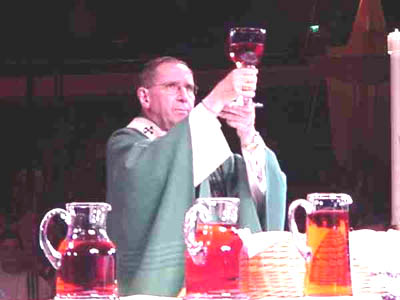 |
| McIntyre's successor, a less robust kind of religion. |
Another possible solution would involve a degree of liturgical reform, or at least sanctions against those who do not cooperate with a tightening of liturgical rubrics. Speaking anecdotally, priests who are "light in the loafers" tend to use the Mass as an opportunity to put on a show, be it an Opra-esque talk show or a sing-'n'-dance. Suppress the various permissions in the GIRM for celebrants to elaborate on the Mass, turn the altars around, and perhaps even add a language—like that one spoken in ancient Rome—that disables the celebrant's chance to extemporize. Cardinal Heenan's prophecy that only women and small children would still attend the reformed Mass was realized in the latter half of the 20th century, and grown, level headed men rarely have an interest in doing female or puerile activities unless they are with their own wives or their own children. Do we expect equilibrated chaps to watch Disney cartoons or sip Cosmopolitans? No, so why should we expect them to spend the entirety of their lives doing something that they knowingly or unknowingly associate at the same level?
Lastly, reform minded bishops might appeal to potential candidates with life experience. This is not to be confused with mediocre professionals looking for second careers. Rather bishops should, as in ancient times, look for mature men with some life experience and a developed sense of self-awareness. Teachers and military veterans have made excellent priests in the United States. Those who enter immediately after high school or college tend to be the proverbial mixed bag, spending seven years juggling an undeveloped sense of self with supercilious liberal formulations and mediocre education. Those further on in life would be exposed to the same thing, but would perhaps have a greater immunity and sense of purpose.
None of these suggestions are full proof, even if practiced in their entirety. A nearby Orthodox priest—married with little ones—would have passed most of these theoretical criteria and he still left his life and ministry for his "husband" in the southwestern United States. Still, while certain ailments require specialized medicine and treatment, general hygiene and immunizations have increased the average expectancy. Extirpating celibacy in the Latin Church is not the remedy for our contemporary malady, but some imaginative steps taken by men with a resolute understanding of their vocation might cure a great portion of this affliction.
Subscribe to:
Posts (Atom)