Showing posts with label book review. Show all posts

Saturday, January 3, 2015

Book Review: A Canticle for Leibowitz


Have you ever wanted to read a sci-fi novel that takes a critical look at the place of science and technology in a world populated by people stained with Sin? No? Well, read the review anyway. A Canticle for Leibowitz tells the story of the Church's decline in influence in an increasingly technological world after having preserved knowledge from the previous era of civilization after a nuclear holocaust later called the "Flame Deluge." Canticle is supposed to be science-fiction, but it takes a strong magnifying glass to the place of science and its themes, even nearly six decades after its Cold War debut, can hardly be called fiction.

Author Walter Miller, who wrote Canticle after blowing up the monastery at Monte Cassino, divided the novel into three sections which could be seen as three separate novellas, each centuries separated from the one before it. Each section, about a hundred pages, reflects the common conceptions and misconceptions about a real life time it imitates. The first section, Fiat Homo, begins six hundred years after the Flame Deluge and takes place during a new Dark Age devoid of substantial knowledge or intellectual endeavors. Reading survives as a purely functional skill rather than an intellectual tool. The story, told almost entirely from the Abbey of St. Leibowitz, has three abbots, each in turn a Catholic product of the age. The abbot during the Dark Age equivalent is very devout, very strict, and less concerned with earthly matters. The abbot in the last segment, Fiat Voluntas Tua, is certainly a good priest, but also invested in earthly cares.

Fiat Homo begins with Brother Francis, an aspiring novice with the Order of St. Albert's priory in the midwestern United States, who is in the desert fasting and praying during Lent in hope of making a solemn profession. Francis meets a feisty old man who he presumes to be a pilgrim. The pilgrim attacks Francis with his walking stick and then vanishes. Francis, dazed after the squabble, finds himself in a nuclear fallout shelter from the Flame Deluge six hundred years earlier. In it he finds a skull, some blueprints, and a scrap of paper with the name Leibowitz written on it. Leibowitz was an engineer who survived the Deluge, but lost his family. He converted to Catholicism, became a priest, and founded the Order of St Albert, a community of monks dedicated to preserving knowledge from previous times in hope that it might benefit a holier society. After the Deluge, an event called the Simplification ensued, a process of de-intellectualizing survivors and extirpating deleterious knowledge, leaving the world without information or learning. Francis' abbot meets his discovery with feigned doubt until New Rome—the old one gone—approves of the find and canonizes St Leibowitz. After the canonization a cadre of two-headed highway men, from a people genetically mutated and deformed by the nuclear holocaust, kill Francis.

Fiat Lux picks up the story centuries later when the various political entities in the region are at odds, leaving the monastery and New Rome in the middle of turmoil. "Mayor" Hannigan wishes to unite North America into one country under his rule and has taken an interest in advancing his position and his technology. Hannigan sends his cousin, Thon Taddeo, to the abbey to investigate their relics of St Leibowitz. Taddeo is the secular scholar incarnate: a blend of Einstein, a romanticized version of Newton, with a little of Voltaire's cynicism and rationalism tossed into the blender for good measure. His mild disdain for religious people is amplified when he discovers one of the monks, without any real theoretical knowledge, manages to recreate the light bulb, which the monk terms Lucifer—a play on the two meanings of the word, the devil and the morning star. Taddeo is intelligent and eager, but also hopelessly vain. He refuses to admit that the people before the Deluge were human because, as the abbot puts it—much as modern cheerleaders for scientism bifurcate the pre-Newtonian world from the post. If people from before the Flame Deluge were human then Taddeo is not a discoverer, but merely a rediscoverer. The abbot flocks to the mountain home of a hermit named Benjamin, the Wandering Jew. Benjamin insists that he is over six centuries and that he knew Brother Francis. If he is telling the truth then he might be the man Francis met in the desert, he might be St Leibowitz, or he might be both. The abbot learns that Taddeo's team is researching not only the relics of the Saint, but also the fortifications within the monastery in the event of a war. The middle segment ends with Taddeo's long elegy for the Dark Age of Fiat Homo and a new warm welcome for the age of a new Enlightenment. The Wandering Jew enters during Taddeo's speech, gazes at the scholar, and says "It's not him." Those familiar with the Wandering Jew myth will understand.

The final section, Fiat Voluntas Tua, greets the reader in a space age under the threat of nuclear war after two cities are destroyed. A U.N. equivalent hopes to stave off the inevitable while the Church makes plans to survive after earth. I will not summarize this part of the book, especially the spectacular and moving ending which can only be understood by a person of faith.

Canticle tells a recurrent history, although not one based on George Santayana's apodictic aphorism about repetition. Canticle tells our own past, present, and future without the cloudy vision of contemporary affairs, politics, and allegiances about who is right and wrong. Instead, Miller's novel narrates the reader through Sin's effort to weave its pattern in the world by tempting men through knowledge and technology while monks of God attempt to temper and tame those things, to make them befitting to a holier world. The powers of the world, be they the Green Star euthanizers of Fiat Voluntas Tua or Thon Taddeo of Fiat Lux or the highway men of Fiat Homo, ignore the Church's wisdom, her knowledge of human nature, and her patience to pursue the best thing for the world in the here and now. The last chapters capture this best, when the abbot deigns without success to convince a woman not to murder her child and herself by euthanasia. He tells them that God does not want suffering, but instead wants them to fight and to preserve the precious gift of life. The desire to better the here-and-now compels the characters outside the monastery to ignore every opportunity for a lesson and sets the stage for the denouement.

Another constant theme is the importance of knowledge. How much is enough? How much is too much? Taddeo abjures the abbot, perhaps rightly, for waiting until men are saints before introducing the abbey's collected information to the world. Could the Church ever really make men fit for the knowledge that could destroy them? If knowledge really a temptation or is it like fire, something good or bad depending on its subjective use? The process is one long temptation in man's attempt to recreate the Garden of Eden.

A Canticle for Leibowitz is well worth a read to anyone interested in the Church, in history, in science, and in ethics. Sci-fi nerds may well be disappointed. Pick up a copy.

Saturday, December 6, 2014

Book Review: St. Lawrence Press Ordo Recitandi & Interview


I am grateful to the St. Lawrence Press for the opportunity to review their Ordo Recitandi Officii Divini Sacrique Peragendi for 2015, as well as for the time spent by the compiler, Rubricarius, to answer questions about the history of the Ordo, provide us with some invaluable history told from experience, and his thoughts on the future of the traditional Roman liturgy. I have never looked at an Ordo other than a quick glance at the FSSPX one while at the Oxford Oratory (more accurate than the LMS), so I cannot compare the St. Lawrence Press version's quality to other ordines, but I think the thoughtful layout and the efficient presentation will speak for themselves. This booklet, which continues the praxis of the early traditionalists in following the 1939 typical edition of the Missal, should be helpful for all gradations of use: laymen, solitary priests, and for public prayer settings. Even non-users might find the Ordo an interesting study in the traditional liturgy's kalendar and commemoration system, although this booklet does deserve to be put to practice.

Part I: Reviewing the Ordo


The first page contains immediately useful information on the dates of the variable feasts of the year and the four sets of ember days. Atop the third page is the proclamation of the variable feasts sung after the Gospel every year on the feast of the Epiphany, which would be helpful to someone working without a form. 


The Ordo, which is entirely in Latin—no Classical word flourishes, mercifully—publishes exhaustive, straight forward, and concise details on such things as external solemnities, titular feasts and the dedication of churches, private and public votive Masses—normal and Requiem, and the guidelines for the Forty Hours devotion, which, despite being eleven paragraphs long, is quite simple and more thorough than what one finds in Fortescue. 


Yes, there can be an external solemnity of the Sacred Heart. The rubrics on the left continue the extensive directions for the Forty Hours.


The rules around Masses for the Dead vary in strictness depending on whether or not the Mass is a sung Mass or not. This Ordo forgets not the finer details of the commemoration system, too, such as the use of the orations for the dead on the first feria of the month at Mass.


When I first heard that the Last Gospel is replaced with another text on some days, I was a bit confused when told that this only occurs when the displaced text is "strictly proper." The Ordo contains a very good explanation that any priest should be able to remember and understand when consulting the Ordo listing for a feast or Sunday which displaces another day.


Guidelines for orations, the Ordinary of Mass, and prefaces in private votive Masses, which differs in many respects from 1962.


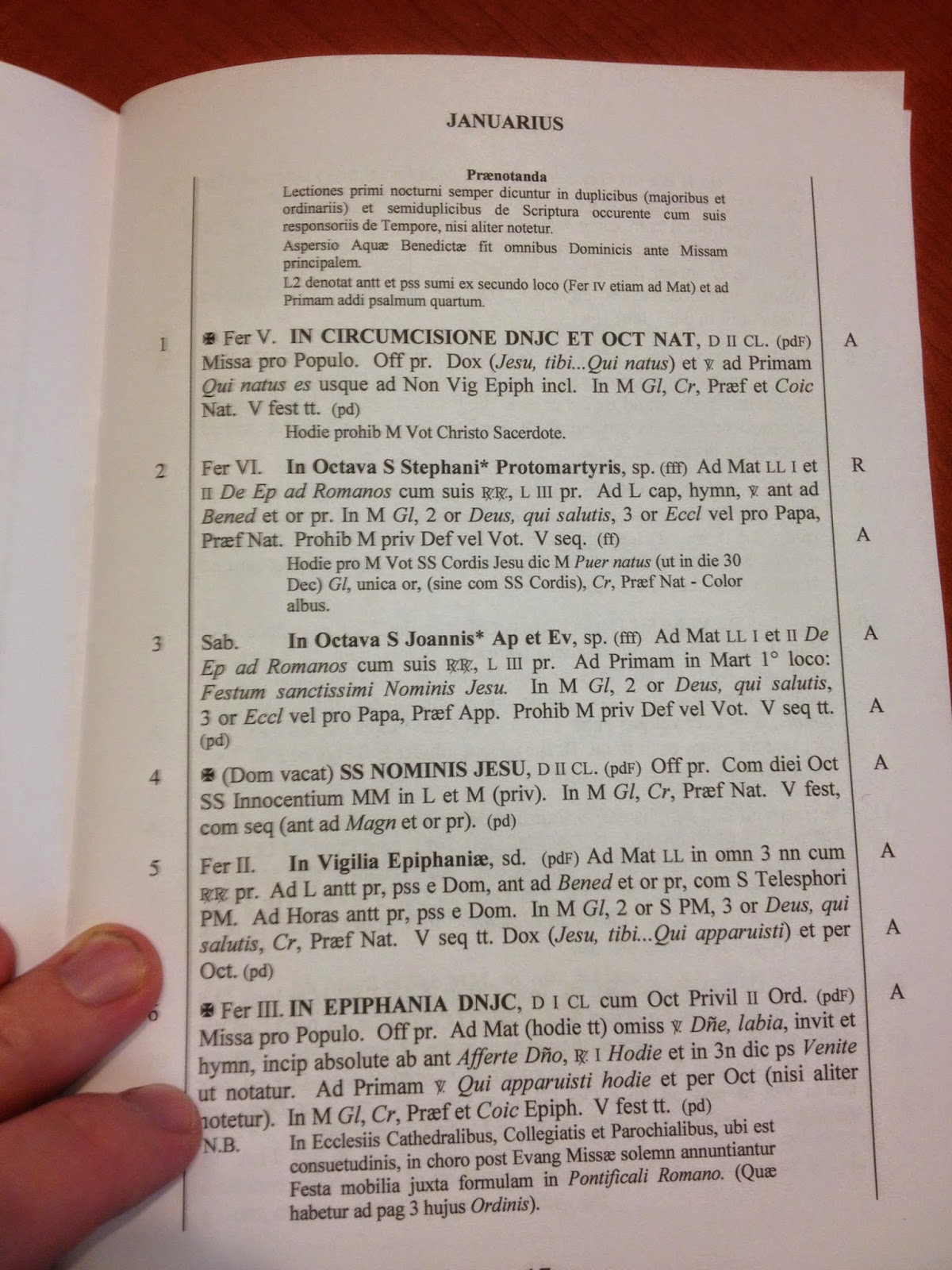
In order to be succinct, the Ordo does not give long explanations like the LMS and FSSPX ordines, but instead employs an abbreviation system. At first all these potential entries look intimidating, but the layout of the pages containing the liturgical orders of the days makes everything more intelligible.


For example, the R next to the octave day of St. Stephen indicates that the Mass and Office of the day are observed in red vestments and with a red altar frontal. The A midway through the entry directs a change to white (albus) for V seq (Vespers of the following day). 


I believe most ordines begin at Advent. The St. Lawrence Press Ordo begins with January 2015 and, considerately, runs to the 10th of January, 2016. 


This page is a nice example both of the clarity of the Ordo and the depth of the old Roman rite. The page is for March. The 23rd is a Lenten Monday which, noted by the X to the right, permits a votive Requiem Mass (as do all ferial Mondays of Lent). At Vespers the color changes to white for the feast of St. Gabriel the Archangel, a greater-double feast. At Mattins, the lessons and responsories in the first nocturne are proper to the feast. The ninth lesson is that of the displaced feria. The feria is commemorated with its Benedictus antiphon and collect at Lauds, as well as with a commemoration and proper Last Gospel at Mass (it is strictly proper). A private Mass may be celebrated of the feria with a commemoration of St. Gabriel and a proper Last Gospel, the prayer super populum per the Lenten feria, and the Benedicamus Domino dismissal, all done in violet for the Mass alone. Vespers is of the following feast of the Annunciation, a double of the first class, with the Incarnation doxology used in the hymns that night and during the hours on the 25th. 


Certain days, such as those of the Triduum, contain long descriptions of unique rites and ceremonies proper to the day. Any church master of ceremonies would already be expected to know this information, but I suspect it would be a very helpful reminder to the sacristan, who might read it over to remember everything he needs to prepare the altar, the vestments, and any other articles necessary for the day. A thoughtful sacristan might even read ahead and ask the priest if he anticipated celebrating a votive Mass or a ferial Lenten day on a feast and then write an emendation in the generous margins. 
This is an excellent Ordo for use and study by both clerics and laymen. I would recommend getting a copy yourself and putting it to some good use. To order the St. Lawrence Press Ordo for 2015, click here. They take PayPal.

Part II: Interview with the Compiler


Herein follows an interview with Rubricarius, the compiler of the Ordo and friend of this blog. He gives us some history about the Ordo as well as some very unique views of the future of the old rite and about Summorum Pontificum which should get the comment box rolling.


Q. Thank you, Rubricarius, for sending me your Ordo 2015 for review. I have long been an avid reader of the St Lawrence Press blog and appreciate its efforts to educate the public on the Roman liturgy as it existed prior to Pius XII and the general process of change. Could you perhaps tell us more about the specifics of your Ordo, such as the year it follows and how that came about?

A. Thank you, Rad Trad for your interest.  The Ordo began back in the early 1970s as the idea of Fr. Peter J. Morgan (the first priest ordained by Mgr. Lefebvre for the Fraternity back in 1971).  Fr. Morgan soon gathered a sizable group of interested clergy and somehow managed to create Mass centres almost out of thin air. He felt it was time to resurrect a traditional Ordo.  What must be born in mind is that the Ordo reflected the liturgical praxis of what the St. Pius Association (the precursor to the $$PX) and other traditional clergy were using at the time.  Fr. Morgan asked Mr. John Tyson, the compilator emeritus, to produce an Ordo for 1973. John is a truly exceptional and talented man and could basically think an Ordo in his head for any given year.  John’s rather difficult-to-read script – it looks very like classical Armenian - was patiently deciphered and typed up on foolscap by the late Miss Penelope Renold and published in three sections by the ‘St. Pius V Information Centre’.  The first volume. ‘Pars Prima’ was clearly somewhat rushed with the cover in Miss Renold’s handwriting.  ‘Pars Secunda’ and ‘Pars Semestris’ followed with typed covers. The two following years saw again a simple foolscap size production but integrated into a single volume.  The current format has its origins in the 1976 edition.


The ‘pre-Pius XII’ rubrics were what clergy and their supporters used at that time.  What is now called the ‘EF’ had, obviously, been used for the couple of years of its existence a decade earlier – but not by everyone I would add - but no one who was supporting the cause of ‘Old Rite’ used it in the UK in the 1970s and it did not make an appearance until a decade later.

Q. Who were the principle people behind the Ordo when it began publication under the St Pius V Information Center? What sort of structure runs the administration of the St Lawrence Press Ordo today?

A. We have covered this, in part, with the first question.  The driving force was Fr. Morgan who channeled the considerable talents and knowledge of John Tyson.  Miss Renold did the typing and, I would conjecture, the posting to interested parties.  The Ordo was published by the St. Pius V Association up to and including Ordo 1978.  Ordo 1979 was published by the $$PX and they continued to publish it up to Ordo 1983.  All this time Mr. Tyson was continuing to exercise his considerable talents.  Since 2002 the Ordo has been published by The Saint Lawrence Press Ltd.  This is a legal entity of a company limited by shares in English Law. It has three directors, including myself, and a company secretary.

Q. How did the St Lawrence Press survive the liturgical about-face of 1983, when the Society of St Pius X reversed its 1977 decision to allow celebrants of the old rite to continue their established custom and imposed the 1962 liturgy on all priests in the Fraternity? Why was the pre-Pius XII rite worth saving, from the perspective of those who continued the St Lawrence Press at the time?


A. If I may answer these questions together Rad Trad?  As I mentioned earlier it was actually the $$XP itself that was publishing the Ordo from 1979 onwards with a considerable number of its clergy using it.  When the trustees of the St. Pius V Association had handed over its assets to the $$PX one of the conditions was that the pre-Pius XII liturgy was to continue to be used.  I understand that one of the original trustees deeply regrets now not having taken legal action when the $$PX reneged on the terms.  Who knows what might have been...   Anyway, as to the ukase to enforce the use of the 1962 books this was a consequence of discussions Lefebvre was having with Rome in the early 1980s.  I have letters from both Michael Davies and Bishop Donald Sanborn – from opposite ends of the Traddieland spectrum - confirming this to be the case.  In his letter Michael Davies states that the indult Quattuor abhinc annos was a direct consequence of these discussions. (We can see the parallels with Summorum Pontificum and Fellay’s overtures to Rome although back in the early 1980s at least Lefebvre was not claiming to be told what to do by putative visions of the BVM).  Lefebvre’s ukase caused great upset, particularly in the NE district of the USA.  Here in England Lefebvre announced this when he came to bless the newly acquired church of SS Joseph and Padarn in London.  A friend of mine, Dr. Thomas Glover, witnessed the argument that took place in the sacristy after Mass between Lefebvre and the then district superior, Edward Black.  Fr. Black put up a spirited defense of the existing practice with both he and Lefebvre getting angrier with each exchange.  The argument took place in French, a language which Dr. Glover is not fluent in.  Dr. Glover tried to interject in Italian and observed that Fr. Black was winning the argument but then, suddenly, just shrugged his shoulders and capitulated.  I am sure you are familiar with Fr. Cekada’s account of what happened in your country and I am sure Fr. Cekada is quite correct in maintaining that if Lefebvre had stayed for the meatloaf the problem would have been resolved. 


Anyway, Fr. Black realised that he could no longer produce the Ordo so he asked two dear friends of mine, now my fellow directors, to produce the Ordo.  This decision was made immediately after Lefebvre left London that fateful day.  So, from 1984 the Ordo was produced by the Saint Lawrence Press – not Ltd – which was what we call in England a trading partnership.  Ordo 1984 caused quite as stir as its cover had the Arms of John Paul II on the cover.


This did cause some upset with customers so 1985 had an absolutely plain cover.


The artist Gavin Stamp was a university friend of Mr. Warwick and drew the cover image for Ordo 1986.  Yours truly came across the $$PX in 1988 and became instantly fascinated by the Ordo.  Despite what had happened five years earlier the majority of clergy were still using ‘pre-Pius XII’ then.  I recall a whole year of Sunday’s without a hint of 1962 – happy days.  The current UK district superior even celebrated the major services of the Triduum at Highclere in 1991 at 10:00am and a Pentecost Vigil at the unearthly hour of 4:30am – or something like that.

As to why it was worth saving I think that is because it was the best thing available at the time and within living memory of so many involved.  A great many people identified this as ‘Old Rite’ as it was what they had experienced before the changes.  What I did notice was that many people I met who were supporting the $$PX had been servers or singers at Fr. Clement Russell’s church at Sudbury which you posted about recently.  I was much influenced by the late, and much lamented, Mgr. Gilbey.  Mgr. Gilbey never used 1962 and saw it as just an intermediate stage in the changes. 

Q. How did the 1983 decision and the 1984 indult influence celebrations of the pre-Vatican liturgy among traditionalists? What sorts of groups, other than sedevacantists, continued the old rite?

A. A very interesting question.  Again, what I think needs to be emphasized is that in the early days 1962 was not being used. Indeed, a very good friend of mine was close friends with an elderly priest from the NW of England twenty years ago.  The elderly priest told my friend that he and a group of other parish priests just quietly refused to adopt the new Holy Week.  “We thought Pius had flipped” he told my friend and that ‘normal’ service would be resumed after Pius’ death.  The Old Rite though never entirely died out in England.  Another friend told me that one could go into the Brompton Oratory in the late 1970s and early 1980s and find half a dozen or so private Masses that all followed the Ordo except one, where the 1956 changes were observed.  Not one of those good men used 1962 though.  Very few sedevacantists used the ‘pre-Pius XII rubrics.  The strict sedevacantists, such as CMRI, follow the 1956 changes but not those of 1962.  A wide range of the spectrum of Traddieland have used, and continue to use, the Ordo and I think it would be difficult to categorise them into any particular group – which is interesting in itself.

Q. Please explain, how you became involved with the Ordo?

A. When I first discovered the ‘old rite’ in 1987 I found it all very confusing as celebrations I attended did not match the ‘Saint Andrew’s Daily Missal’ I had.  When I first met Mgr. Gilbey his Masses matched it perfectly so that set me thinking.  I first attended $$PX Masses in 1988 and soon discovered the Ordo.  I found it fascinating as at the same time I was being instructed by a friend, now sadly departed, to learn the Breviary.  I knew John Tyson of course and remember asking him about (I V) in the Ordo.  I said to him ‘John, I think I have worked out commemorations except the hymn element.  What do you do if the hymn does not have five verses?’  John gave one of his famous chuckles and said ‘You fool, you Tom fool, it is not one to five but of first Vespers.’  Anyway I soon became involved with proof reading the Ordo.  It was all relatively primitive in those days. Although we have moved on from typing the thing it was being produced in WordPerfect which was not a WYSIWYG software programme.  The symbols for holy days and days of devotion were drawn in by hand before the pages went off to the printers.  Then came along Word2 and Word6 and subsequent editions by Mr.Gates and it became much easier.  Eventually, and I do not recall exactly when, sometime in the mid-1990s yours truly was producing the scripts and then took over completely with the Saint Lawrence Press Ltd.

Q. Who are some past or present customers of the St Lawrence Press that our readers today would recognize?

A. Customer details are covered by legislation such as the Data Protection Act, notwithstanding basic morality, and so cannot be revealed without the person’s express consent.  However, a wide range of people from all continents form the current customer base with the majority of customers coming from the United States and from France.  Of the main Traddie groups there has been an interesting change in the customer base.  From the early days when a large number of $$PX clergy took the Ordo the $$PX is now a minority customer.  A decade or so ago there were many orders from members of the Institute of Christ the King but, sadly, they now seem more interested in what they wear than liturgy.  Of the current major groups in Traddieland member of the FSSP take the most Ordines but the majority of sales are to individual diocesan clergy and laity.  A small number of Curial prelates take the Ordo – the fascinating thing is that none of them have any connection with PCED or CDW!

Q. Personally, I find the Roman rite from 1911-1955 far more complicated in rubrics and kalendar than what preceded or succeeded it. How do you deal with the challenges of the Divino Afflatu system?

A. It certainly made the rubrics of the Roman rite far more complicated than they were.  Indeed, if I were into conspiracy theories – which I am not - I think one could be forgiven for thinking it was a deliberate ploy to make life so complicated that any reform would be received with open arms.  My view is that in reality the reform was rushed through and its ramifications only began to be understood in the years that followed.  Clarifications and differing interpretations were appearing in Ephemerides Liturgicae throughout the 1920s and 1930s.  Looking at extant Ordines of the period it is interesting – to compilers of Ordines at least – to see the lack of consistency in interpretation.  A good example was a few years ago when the feasts of St. George, St. Mark and SS Philip and James had to be transferred out of the Paschal Octave.  I consulted four Ordines from 1943, two in my collection and two in the British Library.  None had exactly the same solution: three were similar but one was way off.  After carefully considering the rubrics I decided none were actually correct.  To those of us with an interest in such matters it was an amusing study but life should not be that complex.  As to ‘dealing’ with the system I am afraid that exposure to the ‘Pius X’ rubrics was part of my formative period so I can think the system in my sleep.  Indeed, when I first looked at pre-1911 praxis I found it very hard and it required a lot of effort to understand it, but I did persevere.  It is far superior in my view but we are limited by the lack of availability of books at the moment to promote a serious restoration. 

Q. Have you noticed any change in your clientele or in business to the St Lawrence Press since Summorum Pontificum in 2007? If so, why?

A. There was an initial flurry of interest and indeed I recall one cleric asking if we would now adopt the 1962 rubrics.  Needless to say the answer was strongly in the negative.  What is noticeable is that those with a more serious interest in liturgy see through 1962 quite quickly and look to move to something more traditional.  There is a steadily increasing number of customers – which is much needed because many of the original customers have now passed over to Eternity.  I think that, ultimately, Summorum Pontificum will be seen as something that had a damaging effect on the liturgy but the influence of which faded over time.  Indeed, I expect that Summorum Pontificum will be negated by legislation from Rome but not within Josef Ratzinger’s  lifetime. 

Q. In what direction do you see the future of the old rite headed? 

A. After the period of specious interest following Summorum Pontificum, and I think we really have seen the A to Z of specious interest, I see a period of contraction and confusion – as we see today – that will be followed by an implosion.  I take the view that there will be a more real discovery of liturgical orthopraxis and patrimony but that will take time, a couple of decades at least.  I also believe we will see structural change too – rather like what you have alluded to in some of your posts mentioning the Minster system for instance.  I believe that reform – in a good sense – will be from grass roots upwards, not from the top down. 

Q. In what sort of research does the St Lawrence Press engage?

A. My own research interests are the reform of the Roman rite 1903 – 1963; the reform of the Roman typical editions of the liturgical books from 1568 to 1634, the celebration of Holy Week, liturgical theology in general and the psychology of religion.

Q. Given that the early traditionalists and the St. Lawrence Press stopped at 1939, what would you say in the liturgical legacy of the pope elected that year, Pius XII? 

A. I don’t think the proto-traditionalists thought it terms of 1939 per se but of ‘pre-Pius XII’  As we know men like Evelyn Waugh were totally disparaging about the Pacelli pontificate.  Sadly, what we have seen over the last quarter of a century or so is the development of what a blogger friend of mine termed cognitive dissonance.  There is a steadfast refusal to acknowledge the well document facts of the damage done to the Roman liturgy by Pius XII.  In my own view he as much a showman and narcissist as John Paul II.  The inversion of the axiom lex orandi, lex credendi was an unmitigated disaster and a charter for the modernists.

Q. Some insist that the Pauline liturgical changes assimilated new doctrines and that, by contrast, the Pacellian novelties and reductions are tame, unworthy of attention in the quest to restore the Roman liturgy.  Your thoughts?

A. Well, we have seen the development of a fallacious revisionism whereby any reform before the Second Vatican Council is magically ignored and excised from memory. I recall many years ago that when I came across photographs of Mass versus populum from the 1940s and 1950s my fellow ‘Traddies’ far from being interested hated me for showing them.  There is the creation of a false construct by these people, they loathe Paul VI but adore old Pacelli.  There are the old canards about a) the differences between 1962 and earlier edition being ‘minor’ and b) the radical nature of Paul VI’s 1970 changes.  With respect to the first point if the changes are so minor, so trivial, not to be of any significance or not to be notice then why not just use pre-1962 anyway?  Of course, the reality is very different and the whole point is that the 1962 brigade want to feel superior to everyone else and use legalism as a weapon against everyone else.  As the second point that argument is wildly over made.  What was Mass like the day before Paul VI’s Missal became law?  People, very conveniently forget, that the 1962MR had not been used for almost a decade but the 1967 rite with the new Anaphorae, with various lectionaries and, of course, the vernacular and the fashion of versus populum.

We appreciate your time, Rubricarius, and thank you again for the opportunity to review you Ordo for the impending liturgical year. I speak for my readers in wishing you and the St Lawrence Press the best in your efforts to preserve the old rite and commending our prayers for that same intention.

Friday, July 11, 2014

Book Review: Undermining of the Catholic Church UPDATED

"There are only two books worth reading on the Traddie situation," a correspondent, who knows who he is, wrote me to over a year ago. "Dr. Hull's book and Undermining of the Catholic Church by Mary Ball Martinez."

Traditionalists and all stripes of Catholics have access to volumes upon volumes of material to read, published or online. The best sources are of course Scripture, the liturgical texts of the Church, and the Fathers. These sources tell us not just what to believe, but more importantly how to believe. And there are other useful books, works, and lecture series for understanding theology, liturgy, history, and philosophy. Many of these works have been reviewed on this blog, particularly ones pertaining to liturgy (Dr. Hull's book, Kavanagh's lectures, and Laurence Hemming's works among them). And yet after extensive reading and private research I must agree that, as far as the "Traddie situation" is concerned—the 20th century revolution in the liturgy and the political agenda of the Roman Church—The Banished Heart by Geoffrey Hull and Undermining of the Catholic Church by Mary Ball-Martinez are still the best books to read. Other books touch related material, but only these works address the matters at hand directly.

I have alluded to Martinez's first book, From Rome Urgently, which was a compilation of articles she wrote in the 1970s. Undermining is something of a sequel to From Rome, with greater and clearer rumination on the status of the traditionalist movement and limpid hindsight into the beginnings of the revolution in the late 19th century. 

Undermining, which can be read and downloaded free of cost here, has largely been ignored by all quarters of the Church because its thesis and narrative do not fit anyone's agenda. The liberal crowd may have agreed with its facts and found the result of the revolution positively delightful. The neo-Ultramontanists who we now identify colloquially as the "JP2 generation" would find the criticism of the renewal outright scandalous. And sedevacantists, FSSPX traditionalists, and "indult" traditionalists could not stomach that she exposed Pius XII and the early 20th century Vatican for what they really were. Consequently, her book enjoys a dedicated, narrow following like 1980s "B films."

The Thesis

Martinez's begins on the vigil of Pentecost in Rome in 1971. The Second Vatican Council closed six years earlier. Pope Paul was midway to the end of his tragic reign. Archbishop Lefebvre was not yet ready to declare himself publicly. And Catholics were gathered and praying the rosary by the thousands under the windows of the Apostolic Palace for the return of the old Mass. How did the Church arrive at this odd point? With Mystici Corporis, Martinez says. MC was the first and most vital step in dismantling the legalistic understanding of the Church that dominated the Counter-Reformation and replacing it with a model based on human beings, an opinion shared by Avery Dulles, the Jesuit Cardinal and theologian.  It was the first domino to fall, culminating in the long anticipated Council that would complete a revolution started in 1903.

In 1903, Martinez asserts, Cardinal Rampolla was elected or nearly elected Pope, only to be vetoed by the Polish cardinal under the auspices of an obscure and long forgotten treaty. The cardinals then flocked to the patriarch of Venice, whose first decision as Pope was to rescind all veto privileges. Rampolla, now saddled with the less glamorous position of Secretary of the Holy Office, spent his time training three proteges who would make his humanistic vision for the Church a reality: Giacomo della Chiesa, Pietro Gasparri, and Eugenio Pacelli. Della Chiesa had no sooner been made a cardinal than he was elected Pope Benedict XV and began to undo his predecessor's measures against modernizations, including the dissolution of Pius X's secret informant network. The First World War threw a wrench into the clique's immediate plans. When Benedict XV died prematurely the powers that were found themselves in a debacle. Pacelli was still too young and Gasparri was un-electable. As a solution they elected an aloof academic in Pius XI, hitherto the Vatican Archivist. It was during this papacy that things began to turn.

The Secretariat of State office, run by Gasparri and assisted by Pacelli, promoted policy antipodal to the teachings and desires of the Pope of the time, opposing and undermining Action Francaise and the Catholics in the Spanish Civil War in favor of French secularists at the same time the Pope was talking about the "social reign of Christ the King," a long favorite subject of traditionalists. The most reprehensible betrayal was that of the Christeros, wherein a civilian army fighting against a humanistic and even Masonic (?) president in Calles with no support from the upper clergy achieved absolute victory and were then convinced by Rome to make an un-conditional surrender and subject themselves to slaughter.

During this same period the paradigm shifted within academia and the religious orders, often with tension between the younger and older generations of priests. The Holy See, far from reigning in excesses and deviations from the accepted teachings and outlook, often aided and abetted these digressions. In the case of Teilhard de Chardin the Society of Jesus prohibited him from publishing and obstructed him from going on the speaking circuit. The Secretariat of State however, at the behest of Pius XII, arranged for him to give lectures in occupied France during the rule of the Vichy government. 

During the War Pius XII aided Jewish efforts to escape from the Holocaust and Hitler's death camps, but almost entirely ignored the political difficulties of the Church during this era. His foreign policy consistently stood against authoritarian governments that were either indifferent to Catholicism or in favor of it, but he sided with the humanists and Marxists. He permitted the Vatican to be used an an intermediary point in the War for discussions between the Allies. And he spent copious time during the War smuggling Jews from Italy into British Palestine on the eastern coast of the Mediterranean. After the War the early seeds of liberation theology and the Charismatic movement began to sprout above ground with the support of Countess Pacelli, the Pope's sister.

The time after the War was spent consolidating power and loosening discipline. The Biblicum was created in Rome to give a presence in Vatican academia to the progressive movement. The rules around the celebration of Mass and reception of Communion were relaxed to a point envied today, but risible to previous generations. And the promulgation of the dogma of the Assumption and the creation of a commission to reform the liturgy centralized spiritual authority around the Pope. Martinez at one point boldly asserts that the canonization of Pius X was part of a barter with the baroque-minded Vatican establishment to begin introducing the new liturgy, particularly the new rites of Holy Week.

Aware of his age, the Pope sent his protege to Milan, but died before making his successor a cardinal. The affable Angelo Roncalli took the papacy for a few years before Montini could become Pope in 1963. From that point on the narrative becomes familiar. We all know about the Council, the branching and flowers of the roots planted half a century earlier.

The middle section of Undermining is a series of vignettes, short biographies of the Popes from John XXIII until the then-incumbent John Paul II. Paul VI's segment is especially poignant. He was an early revolutionary, encouraging students in the Red Brigade to oppose Mussolini, who, although a bad man, was tolerant to the Church in ways unseen since before the 1840s. Later in life he may have lamented that the Red Brigade had killed his dear friend Aldo Moro, the product of the center-left political party his father had party and Pius XII advanced decades prior. He died a broken, unhappy man. Also interesting, if only for historical reasons, is her honest biography of John Paul II. She summarizes his education and seminary formation in Poland after the Russian invasion and his time at the Belgian college in Rome dispassionately and with concision. This was revolutionary in 1991 because most people were pretending he was an impoverished miner who studied at an underground seminary amid Soviet persecution. 

The last segment of the book contrasts sharply in certain aspects with From Rome Urgently. Previously she was brimming with excitement about Lefebvre, the militancy of the traditionalists, and the devotion of the faithful. She maintains these qualities in Undermining, but with considerable reservation. She wonders if Lefebvre missed his chance to make a difference in 1976 by obeying the Pope's command to bite his French tongue. The grassroots traditionalist movement collapsed and all that was left was the FSSPX and a few independents—something that will be explored in our upcoming series on the early traditionalists.

Short-Comings

Undermining is not a book without short-comings, the three greatest of which are: the lack of citations, the proclivity for conspiracy-theory language, and a lack of historical perspective.

The lack of citations is the most arrant deficiency in this work. Martinez was a journalist, writing for decades as the Vatican correspondent for National Review, the Wanderer, and other periodicals. She was not a professional historian and did not document her work very well. Much of what she learned could be documented with extensive and painful research though. I came to trust Undermining from personal experience. My first major university research project was on the role of the Holy See during the Second World War. What Martinez surmises about the Pope's efforts against the Nazis and Holocaust I corroborated independently years before encountering her book using primary information sources (journals, news articles, and records) as well as some scholarly polemics. That she recorded this information favorable to Pius XII during a time before a cottage industry for defending his War record emerged (Rabbi Dalin, Sr. Marchione etc) and given her un-favorable view of the man impressed me.

The second issue is also significant. She speaks of "the Masons" and like groups as though they are an organized secret government with a dedicated head—as though the cretins who mangled the Church in the 20th century and who are mangling Western governments and economic policy now are capable of such things. She does at points clarify what she means, but often lapses into conspiracy theories again. At one point she wrote that Pius XII, Paul VI, and Benedict XV should not be considered conspirators in the common understanding of the word. These men did not hold round tables discussions on how to undermine the Church deep within the walls of a lodge. These men acted in accordance with their rearing and education, which involved a different outlook on the Church than the one received. She does claim John XXIII and Pius IX (you read that right) were Masons, but does not expound upon the supposed significance of this too deeply.

The last pitfall is her lack of perspective. Mystici Corporis was a departure from the legalistic, cold understanding and corporate structure of the Catholic Church that emerged during the Counter-Reformation. Where she errs is in stating that the teaching was entirely novel. Indeed, it is well rooted in the letters of St. Paul, the sermons and treatises of the Cappadocian Fathers, and in the ecclesiology of Lateran IV. The footnotes and citations in MC easily verify this. Where she was right was in suggesting that the point of MC was to confuse theologians by introducing an understanding of the Church based on human beings and mysticism. Indeed, the idea of the Church as the Body of Christ bound up in the Sacraments is the teaching of the Church Fathers East and West as well as that of the Greek and Latin liturgies. The idea of the mystical Body of Christ was quite novel, and the focal point of this mystical body would be the Roman Pontiff. Martinez, with more familiarity with the deeper traditions of the Church, might have realized that MC was about spiritual centralization and taming precocious revolutionaries, not about introducing unheard of doctrines.

Final Words

Undermining of the Catholic Church by Mary Ball-Martinez is an essential work to study and parse for those who seek to understand the political changes in the Vatican that wrought decades of internal revolution in the Church of Rome. For all its problems, Undermining is the only book that connects the dots which have been hiding in the plain sight of traditionalists for years.


As an aside, if anyone wants to know how to access her first book, From Rome Urgently, email me.

UPDATE: My email address is theradtrad@gmail.com.

Saturday, March 22, 2014

Book Review: Worship as Revelation by Laurence Paul Hemming


Unfortunately I do not have the time to give this book a proper full length review, but I can provide some insight into the content and value of an excellent little volume by Dr Laurence Paul Hemming, a British academic and a deacon for the archdiocese of Westminster. 

Worship as Revelation begins with a commentary on the rites for the dedication of a new church, a new temple of God. The chapter, titled "I Saw the New Jerusalem," lays the groundwork for Hemming's concept of worship as an encounter with the Divine, a participation in the opus Dei. The central words to the rites often repeated, are "I saw." In the presence of the physical temple we see God and the holy things He has prepared for us. The prayers of the priest for the sins of the people make this place holy, as the prayers of the Aaronic priests sanctified the Temple of Jerusalem. The atoning offering within the church is not a new one, as were the offerings of calves in the old Temple, but a renewed one in a renewed world. The re-dedication of the Temple of Jerusalem following its desecration by Antiochus Epiphanes was celebrated for eight days, a prefigurement of Christ's resurrection and renewal of creation on the eighth day of the week, the beginning of the last era of the world. For this reason the dedication of a church is, or rather was, observed for an octave every year, as were over a dozen other feasts. Secondly, the temple or church is the bride of Christ and where the Bridegroom Christ appears. In doing so He bridges the things of heaven and the things of earth, as one of the Mattins antiphons for the feast of a dedication indicates.

Hemming, a scholar of philosophy, traces the loss of this understanding to a pattern of intellectual decadence originating in René Descartes, who although he recovered his Catholic faith after a brief intellectual crisis, made himself the focal point of existence. All he could know initially was that he existed, and from that he could deduce that God exists. Indeed, for Descartes the existence of God was more certain than the rules of mathematics, but the relationship between God and man was still inverted in this schematic. Hemming hardly pins the burden of problems in liturgical theology on Descartes, but does indicate that the tendency to view God from one's own perspective rather than how He actually is might originate in his line of thought.

To the modern mind a man is what he does. To the Christian mind what a man is sets what he does. A Christian, by virtue of his Baptism, is a participant in the liturgy, in the opus Dei. The 19th century debate in philosophy and politics over the identity of modern man, his new needs, and his sense of judgment traced similar shapes of thought in the Liturgical Movement and its unhealthy obsession with the "pastoral." Lost in all of this was a concept of who the Christian is rather than what he supposedly needs.  In such an inverted order of perspective the liturgy is of man, for man, and about God rather of God, for God, and to the benefit of man.

For such a small book Worship as Revelation covers immense philosophical material related to the liturgy, particularly ideas about time and why the Papal stational churches of Lent paralleled Christ's own path to Jerusalem. Another interesting discussion concerning time is the proper translation of the Greek prologue of St. John's Gospel, which would read something to the effect of "Before all time was  and still is the Word...."

Near the end Hemming reflects on the consequence of privatizing the liturgy, of making mandatory spoken recitation of the breviary for example, often with the unintended consequence of making rarer celebrations of the Office in the temple of God, the church. Even more damaging is the constant change in the Roman rite, change which more often than not erased ancient meanings of gestures and prayers. Hemming finds that the violence against the Roman rite began not with Vatican II, but with Pius X's assault on the psalter and kalendar: "the alterations to the breviary exhibited.... an objectification of the liturgy as a whole—something subject to papal fiat" (143). And while grateful to an extent for Summorum Pontificum Hemming approaches the "hermeneutic of continuity" with a healthy skepticism based on scholarship of the liturgical language used in older and newer editions of the Roman Missal. Indeed, Hemming rightly argues for a wholesale return to the liturgy without any of the 20th century reforms (154). A recovery of proper worship and a more fundamentally liturgical outlook in the Catholic Church would mean discarding the Cartesian objectification of things sacred outside of the self and embracing the encounter and experience (in an orthodox sense) of God in time, of entering into God, from Whom we as Christians gain our identity, rather than going in and out of the Divine at our own wills.

Worship as Revelation concludes in a brief study of the liturgical cycle of Epiphany and Candlemas, the period during which Christ appeared to gentiles, took possession of the rule of the world, was worshipped in adoration by those to whom He had appeared, revealed the mystery of water and wine, confirmed His priesthood according to the line of Melchizedek, commemorated His heavenly birth by being baptized by the Forerunner in the Jordan, and took His place in the Temple before the illuminating figure of His Virgin mother—who would symbolize in her ritual action what Jerusalem could become in her Son. 

I strongly recommend this book for those who wish to approach liturgy from a philosophical perspective and would like to define in more specific terms the suppositions of men like Aidan Kavanagh. The gradual accretion of concepts means one must read this book in order of chapter rather than skipping around from chapter to chapter as one can do in some other more disparate books. It is written in a readable way, without long and turgid quotes. The author's perspective is not quite as fresh as Kavanagh's or Schmemann's, but Hemming's contribution is in giving a well defined Latin shape to their general liturgical views. Get a copy!

Monday, March 17, 2014

Book Review: On Liturgical Theology by Aidan Kavanagh

Liturgy. From 2007 until March of 2013 traditionalists talked of rite, form, liturgy, history, the people, the priest, and the deep inter-connectivity between all these elements of opus Dei. Reformers had the same conversation within their own circles in the early and mid-20th century. But what is rite or liturgy or the point of a priest? Why does liturgical tradition matter in the 21st century, a era in a faster and more rapid rate of motion than any previous period. Why care about liturgy? Aidan Kavanagh's On Liturgical Theology provides some answers.

On Liturgical Theology is a book version of two sets of lectures given by a Benedictine monk, Dom Aidan, in 1980 on "Liturgy and World" and in 1982 on "Liturgy and Theology." Those with even a passing knowledge of liturgy readily recall the now trite misquotation of St. Prosper of Aquitaine lex orandi lex credendi. The misquotation is not insignificant, in that the implied est creates a false equivalency between the two. The proper quotation, which Kavanagh applies at the opening epigraph of On Liturgical Theology, is ut legem credendi lex statuat supplicandi: "....so that the law of supplication might form the law of belief." This aphorism reflects the basis of a truly orthodox understanding of liturgy.

Orthodoxy, or orthodoxia, as a concept derives from the earliest Christian experiences with prayer. As one priest said succinctly, "the Christian is someone who prays." Orthodoxy is "true praise" or "straight worship." Worship for Kavanagh is the manifestation of God to His earthly people. God created the world and He saw that it was good, and the fall of Adam and Eve wounded the world rather than blacken it. "The world is charged with the grandeur of God" wrote Gerard Manley Hopkins. One could similarly say, and St. Athanasius did, that man is charged with being an icon, an image, a lesser but definitive reflection of God. In a like way human society, most perfectly manifest in a city and not in a rural setting, is an icon of the heavenly kingdom of God. There is the City of Man and the City of God, one an imperfect image of the other. The liturgy makes God manifest in Presence, in spirit, in Word, and in the Sacraments to the City of Man, sanctifying it and bringing it closer to the City of God.

In the liturgy, Kavanagh argues, God operates in a worldly manner, using the language, ceremonies, gestures, and ideas of human societies to make Himself know to mankind. St. Prosper's aphorism is "a civil and worldly statement if ever there was one." Through the gradual assimilation of a structured liturgical praxis the various churches came to know God in light of their own cultures, contributing to the Church as large and learning from the other local churches. Kavanagh does not adduce this particular example, but the Grecian concept of logos fits his thesis well. Liturgy is structured and formal because it is a human endeavor, but it should have a strong enough internal force to it such that it brings the Christian to the brink of spiritual violence. And the liturgy is something that happens always and everywhere. "Where there is the bishop there is the Catholic Church," wrote St. Ignatius to the Smyrnaeans. If the bishop's presence effects the Church's assembly then the bishop's presence effects Church liturgy. Those who formed the liturgical praxes of the Church understood the significance of the bishop and brought him throughout the various cities to celebrate the hours of prayer anywhere and everywhere on every day.

The celebration of the Eucharist was special, reserved to feasts and Sundays. The Mass, or Divine Liturgy, is both "Word and Liturgy" to Kavanagh. The "Word" is both Christ's Presence in His words and the actual words of scripture proclaimed to the City of Man in a powerful event. At one point in On Liturgical Theology Kavanagh laments the deleterious influence of printing on spirituality. The abecedarian experience of reading the Bible hardly matches the unique experience of a weekly proclamation of the Gospel or the use of the psalms throughout the Eucharistic celebration. In a twist of irony, the fundamentalist groups who insisted on sola scriptura devolved into oblivion while the more holistically minded descendants of the Apostles retained a moderate perspective on the place of Scripture in the Church.

Kavanagh, having established the purpose and use of the liturgy, then asks what is liturgical theology. It is not, contrariwise to instinct, a theological exposé on the various rites, usages, texts, and ceremonies celebrated abroad in the Church. It is theology done through the liturgy. It is theology done in motion, in worship, in the Presence of God. It is the primary theology of the Church. The more academic brand of theology—forming and testing proposition to create well worded doctrines—is a later and secondary kind of theology, import to say the least, but far from the center of the Christian's life. The primary theology forms the secondary theology, although the secondary theology can enrich the primary theology that is the liturgy.

Through the various forms of liturgy molded in the Holy Spirit and with human cooperation in art, in movement, in writing, and in rituals, people begin to understand and to know Who God is. In understanding God and standing in His Presence He sanctifies them, making people holier and raising them up and He rose on the third day, inaugurating the eighth day of creation, the "first and last day" in the last aeon of the earth. This is liturgical tradition. This is why the liturgy matters. The liturgy is not just a series of texts and movements about God, but rather it is of God. To change the liturgy is to change how people understand God, how they meet, Him, how they come to know Him, and how they relate to the previous inhabitants of the City of Man who have gone to their rest and moved on to the City of God (or the other place): "As Christians have traditionally understood it, their liturgy does not merely approach or reflect upon all this from without, nor does it merely circle this mystery from a distant orbit. Rather, Christians have traditionally understood their liturgical efforts to be somehow enacting the mystery itself, locking together its divine and human agents in a graced commerce, the effective symbol of which is that communion between God and our race rooted in the union of divine and human natures in Christ Jesus."

There is a very thinly dissimulated criticism of the Pope who began to change the Roman Church's liturgy by subverting it to secondary, academic theology and by unambiguously changing the Church's teaching on liturgy, and hence on everything else:
"To reverse [lex orandi lex credendi], subordinating the standard of worship to the standard of belief, makes a shambles of the dialectic of revelation. It was a Presence, not faith, which drew Moses to the burning bush, and what happened there was a revelation, not a seminar. It was a Presence, not faith, which drew the disciples to Jesus, and what happened was not an educational program but his revelation to them of himself as the long-promised Annointed One, the redeeming because reconciling Messiah-Christos. Their lives, like that of Moses, were changed radically by that encounter with a Presence which upended all their ordinary expectations. Their descendants in faith have been adjusting to that change ever since, drawn into assembly by that same Presence, finding there always the troublesome upset of change in their lives of faith to which they must adjust still. Here is where their lives are regularly being constituted and reconstituted under grace. Which is why lex supplicandi legem statuat credendi."
In his last chapter Kavanagh regards the Christian as an abnormally normal person, the person who is living a changed and restored life, a life renewed and put the way God wants it to be lived, coterminously the proper life and the life that most in the world do not want the Christian to life. Chastity is normal, but it is far from common. The grace to do this descends from the Father, through the Son, and in the Holy Spirit—and by the liturgy.

The only criticism I can levy against this book is that On Liturgical Theology is almost entirely theoretical, laying down principles of how the Church does its primary theology through the liturgy and experiences God's Presence. This is inevitably the result of the initial lecture format of the chapters. One could see each chapter lasting about one hour and plus time for questions. Yet some of concepts, particularly on the ubiquity of the bishop and his relationship to the liturgy, could have been fleshed out in the historical record. One thinks, pertinently, of the ancient practice of the Pope celebrating the full Divine Office and Mass at a different parish church in Rome every single day of Lent.

"Like poetry and art," Kavanagh concludes, "liturgy provides us a means of knowing the kind of thing that can only be known transrationally; that cannot be analyzed, taken apart, spelled out and reassembled." The liturgy is what the Church does, what makes the Church orthodox, what gives it its place in the City of Man and the City of God. The liturgy is the Church's "service and mission of the life of the world."

On Liturgical Theology can be summarized in one line sung during Orthros (Mattins) in the Byzantine rite: "The Lord is God and has appeared to us, blessed is He Who comes in the name of the world." The Lord, the Jewish substitute for the fearsome named of Yahweh, denotes an actual person. That person is God, not a god, but God Who created heaven and earth and Who loves both. And He has come to us and "dwelt among us and we beheld His glory.... full of grace and truth." 


Thursday, March 13, 2014

Upcoming Book Review

"It would be foolish not to recognize that placing sacramental discourse prior to, above, and in a role which subordinates theology in the modern academic sense is a difficult if not incomprehensible move to many people. We generally think of the two sorts of discourse the other way around, theology coming first and sacramental discourse very much later as a possibly implied excursus off the former. Sacramental discourse in fact is often thought of as theological adiaphora best practiced by those with a taste for banners, ceremonial, and arts and crafts. It is regarded as an academically less than disciplined swamp in which Anglican high churchmen, Orthodox bishops, and many if not all Roman Catholics and other are hopelessly mired."
"The tradition has never seen the Church as having any purpose or work different from Christ's own. The Church's concerns have always been with the Gospel translated into act, matter, time, and space, with the various cultures the Church has touched being renovated as an inevitable result not directly stiven for. Not only is there little conscious reflection on culture as such in the pre-Renaissance Church, but there is surprisingly little ex professo writing about the Church itself distinct from World and City. Thomas Aquinas, certainly one of the greatest theologians of the Church East or West, wrote no self-contained tract on ecclesiology. Rather, what he does say about the Church is almost wholly contained in the third part of his Summa Theologiae, which is about the sacraments. It is as though until the modern era, the Church was considered simply as the city center of a restored World, occupied with doing the business of God by faith in Christ. It is now necessary to illustrate what this means in practice."
On Liturgical Theology, Fr. Aidan Kavanagh, OSB


Friday, November 8, 2013

Book Review: Brideshead Revisited

source: Wikipedia.org
"But you can't believe things because they're a lovely idea."
"But I do. That's how I believe."
 
Thus replies Lord Sebastian Flyte, half English Catholic lord and "half heathen," to mild-aesthete and agnostic Charles Ryder, the narrator and central figure of Evelyn Waugh's Brideshead Revisited. This novel, written by Waugh during his convalescence following an injury during the Second World War, is a lush aesthetic education, an impossibly nostalgic lament at the decline of a great English family, and a two-decade long memory of the narrator's slow cooperation with God's grace.

Brideshead follows the "sacred and profane" memories of Captain Charles Ryder, a former architectural painter who finds himself "homeless, childless, middle-aged, and love-less" during the Second World War. His company constantly changes locations in England, each move a supposed venture into action in African later exposed as a false alarm. Eventually Ryder and his company find themselves put up in a palatial house called Brideshead, the residence of the Flyte family. Ryder tells his assistance—the boring, modern, tasteless 20th century middleclass vulgarity incarnate, Mr. Hooper—that he has been to the house before. Thus begins a reminiscence twenty years back to Oxford in 1923, and some of the most beautiful post-Victorian prose to be found in English literature:
"Oxford—now submerged and obliterated, irrecoverable as Lyonnesse, so quickly have the waters come flooding in—Oxford, in those days, was still a city of aquatint. In her spacious and quiet streets men walked and spoke as they had done in Newman's day; her autumnal mists, her gray springtime, and the rare glory of her summer days—such as that day—when the chestnut was in flower and the bells rang out high and clear over her gables and cupolas, exhaled the soft airs of centuries of youth. It was this cloistral hush which gave our laughter its resonance, and carried it still, joyously, over the intervening clamor."
The narrator introduces the reader to his dear friend, the charming Sebastian Flyte, a handsome, somewhat dull, but charming young man raised in a strictly Catholic family. Sebastian, who meets Charles by eructating in his dormitory through his window in an inebriated stupor, brings the narrator and the reader into the flamboyant world of the Oxonian aesthetes. Here and at Sebastian's ancestral residence Charles learns to see the world through what is beautiful, although he is not entirely converted to the aesthetes' ways. Charles resolves to become an artist and quits Oxford while his dear friend develops a problem with alcoholism and disappears from the novel for several chapters.

Charles also becomes acquainted with the Flyte family, both in England and abroad. Ryder meets the pious, apparently pharisaical mother; the pious, but doltish brother, who looks like an Easter Island head; the two sisters, one a mildly arrogant and a beauty, the other quite devout and simple-minded; and the father, who, in his detestation of the mother, lives in Venice with his mistress. With this family Charles encounters the Catholic world view and receives it with tremendous difficulty. The mother, the most devout of the lot, is cold and unapproachable, while the warmest of them, the young sister Cordelia, has no imagination beyond the teachings of the penny catechism.


Charles meets the aesthetes

As Sebastian fades his sister, Julia, illuminates and take center stage for much of the rest of the story. Julia eventually falls away from her nominal faith and marries a dubious opportunist from Canada looking to use the Flyte fortune and prestige to launch a career in English politics. Amidst Julia's struggles, Charles has several fallings out with the Flyte family and goes for years at a time without seeing them, although they do give him a start as an artist by commissioning him to paint one of their soon-to-be-demolished houses. Years later, after a long, lucrative, and lifeless career as an artist he re-unites with Julia aboard an ocean liner and begins an affair with her which will run until the end of the novel, at which point Charles' life is finally shocked into sensation again.

Brideshead's structure is non-linear and is told in several gradations of flashbacks. Indeed a New York Times review from 1945 goes as far as to suppose memory is the central point of the novel. There are too many themes in this wonderful novel to enumerate, but memory is certainly one of them.

Another major point is the conflict between genuine beauty and "simple, creamy English charm," a polite imposter for beauty. Charles is sanguine within the walls of the baroque masterpiece of Brideshead, built from the stones of a medieval castle, and within the walls of Oxford. Even his early paintings had a semblance of genuine life and beauty. But eventually his life withers and he reduces his quality to that of crowd-pleasing, highly acceptance, charming work. Sebastian's personality is, if anything, charm through and through. Oppressed by his religious family Sebastian escapes by being charming and likable to others, but also indulges in drink and becomes a dipsomaniac. Both eventually free themselves of English charm and, finally, embrace real human emotion at great personal cost.


Catholicism is not so much preached as it is presented in Brideshead Revisited. The faith, to which Waugh was a mature convert by the time he penned his magnum opus, is the eyeglass through which Charles must see the world at Brideshead. The grace and providence of God is a given, and the reader is given subtle reminders such as an offhand description of a room that has a painting of the Sacred Heart or Seven Dolors hanging on the wall, or a passage of a Fr. Brown novel being read in the background. One passage from Fr. Brown is integral to the entire story: "I caught him, with an unseen hook and an invisible line which is long enough to let him wander to the ends of the world, and still to bring him back with a twitch upon the thread." God is a given, not an intellectual exercise, which agnostic Charles is wont to understand.

A final theme of the book—there are too many to enumerate in detail, like the decline of the aristocracy and rise of the "middle class"—is renewal. The house itself is built of stones from an old castle and is slowly augmented by succeeding generations. During the War Brideshead is conscripted into service by the military and left "desolate" and "brought to nothing." Yet, even Charles finds some genuine renewal at the very end of the novel. Some have suggested this house, which died and was rebuilt and is the place of so much of Charles' slow acceptance of God's grace, is an icon or a type of Christ Himself or of the Church. The house's name entertains such a thesis.

Charles Ryder dines with Anthony Blanche (BBC adaptation)

One real treasure of Brideshead is the cast of secondary characters. Charles is actually a very boring, dim, and unemotional person until the end of the story. He is more a witness to what happens around him. The characters around him, particularly the non-primary characters, add oceanic depth to Waugh's novel. The father's mistress, Carla, coldly analyzes the nature of Sebastian and Charles' relationship from a distance and the disposition of Lord Marchmain, who is hiding in Venetian charm and avoiding the human reality of his failed marriage. Lady Marchmain, initially cold and calculating, eventually becomes a sympathetic character, perhaps a good soul made protective and bitter by the disappointments of her life; she is saintly, but not a saint. And a personal favorite is Anthony B-b-blanche, the eccentric ringleader of the aesthetes who, in the end, is the actual voice of wisdom and reason amidst Charles' descent into a loveless life from which he eventually arises.

The last endearment of this novel is the prose and words and descriptions contained within its very pages. Many of the descriptions are reminiscent of those of James Fenimore Cooper and Walter Scott, although considerably shorter and evoking more specific thoughts rather than merely painting a mental image of a great landscape. Waugh's writing engages the imagination and all the senses through nothing but simple paper. He describes enough to enthrall the reader and gives ample enough dialogue for readers to construe the moods and actions of the characters without narrating every move as many modern works do, no doubt in imitation of modern film. Waugh's sense of humor provides subtle opportunities for laughter in certain moments of the book, often at the expense of Mr. Hooper and the lower classes. Waugh did not confine his humor to class though. At one point, when Charles and Julia begin their affair, Waugh refers to their first sexual encounter in risibly stark words: "Now on the rough waters there was a formality to be observed, no more. It was as though a deed on conveyance of her narrows loins had been drawn and sealed. I was making my first entry as the freeholder of a property I would enjoy and develop at leisure."

Brideshead Revisited is a wonderful story of a man who remembers finding the grace of God, a house in which he is welcomed, and he came there through the efforts and trials and tears of the house's builders. The novel is both romantic and realistic, lush and lugubrious, nostalgic and pressing onward. Buy a copy!

As a post script I would like to note that the clips in this review are taken from the BBC miniseries Brideshead Revisited, possibly the best television program ever made. The miniseries takes no liberties other than compressing some dialogue and is, in effect, a serialization of Waugh's novel. The acting is spectacular and the visuals faithful to the book. Read the novel and then watch the series. All the episodes are available on YouTube.