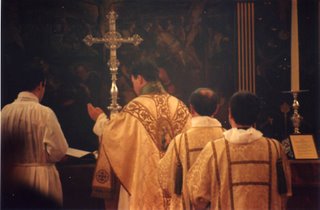
Liturgical theology is, according to Aidan Kavanagh, not a theological examination of the liturgy, but theology done by means of the liturgy. Liturgy is the theologia prima of the Church. When someone asks a Catholic how to learn more about the faith, the believer never directs the inquirer to obtain a copy of Denzinger. Invariably, the believer tells the non-Catholic to go to Mass (and hopefully at a carefully selected location). With this in mind, let us [very succinctly] consider what the Church told and taught us about the Assumption of the Mother of God today.
 |
| Apse of St. Mary Major with mosaic of Mary as Queen of Heaven, crowned by and reigning with Christ. source: Rad Trad's collection |
Mattins—or the "vigil," as Dobszay insisted on calling the first major hour—consists of nine psalms and readings divided evenly into three nocturnes. Contrary to the eccentric and rich local traditions of northern Europe, which created special texts for Marian feasts, the Roman rite retains a primitive and sparse text. The psalms and hymns for the feast are typical of any Marian feast prior to the 1860s when Pius IX issued a unique liturgy for the Immaculate Conception. Where the Assumption stands alone is in the Mattins lessons and the text of the Mass. According to Dom Gueranger:
"the Lord Pope went to St Mary Major, where, surrounded by his court, he celebrated First Vespers. At the beginning of the night the Matins with nine lessons were chanted in the same church.
"Meanwhile an ever-growing crowd gathers on the piazza of the Lateran, awaiting the Pontiff's return.... Around the picture of the Saviour, within the sanctuary, stand twelve bearers who form its perpetual guard, all members of the most illustrious families, and near them are the representatives of the senate and of the Roman people.
"But the signal is given that the papal retinue is redescending the Esquiline. Instantly lighted torches glitter on all sides, either held in the hand, or carried on the brancards of the corporations. Assisted by the deacons, the Cardinals raise on their shoulders the holy image, which advances under a canopy, escorted in perfect order by the immense multitude. Along the illuminated and decorated streets, amid the singing of the psalms and the sound of instruments, the procession reaches the ancient Triumphal Way, winds round the Coliseum, and, passing through the arches of Constantine and Titus, halts for a first Station on the Via Sacra, before the church called St Mary Minor.... In this church, while the second Matins with three lessons are being chanted in honor of the Mother, some priests wash, with scented water in a silver basin, the feet of the her Son, our Lord, and then sprinkle the people with the water thus sanctified. Then the venerable picture sets out once more, crosses the Forum amidst acclamations.... it at least enters the piazza of St Mary Major. Then the delight and the appluse of the crowd are redoubled; all, men and women, great and little, as we read in a document of 1462 (archivio della Compagnia di Sancta Sanctorum), forgetting the fatigue of a whole night spent without sleep, cease not till morning to visit and venerate our Lord and Mary. In this glorious basilica, adorned as a bridge, the glorious Office of Lauds celebrates the meeting of the Son and the Mother and their union for all eternity." (The Liturgical Year, August 15)
All rungs of Roman society paused regular life and joined Christ and Mary in the divine life for a night and an octave, celebrating Mary joining her Son in eternity and anticipating their own union with Christ in eternity. Mary was the first of what Christ wants all Christians to become by the Sacraments, albeit in a lesser degree.
The first three lessons are extracted from chapter 1 of the Song of Songs:
1 Let him kiss me with the kiss of his mouth: for thy breasts are better than wine,2 Smelling sweet of the best ointments. thy name is as oil poured out: therefore young maidens have loved thee.3 Draw me: we will run after thee to the odour of thy ointments. The king hath brought me into his storerooms: we will be glad and rejoice in thee, remembering thy breasts more than wine: the righteous love thee.4 I am black but beautiful, O ye daughters of Jerusalem, as the tents of Cedar, as the curtains of Solomon.5 Do not consider me that I am brown, because the sun hath altered my colour: the sons of my mother have fought against me, they have made me the keeper in the vineyards: my vineyard I have not kept.6 Show me, O thou whom my soul loveth, where thou feedest, where thou liest in the midday, lest I begin to wander after the flocks of thy companions.7 If thou know not thyself, O fairest among women, go forth, and follow after the steps of the flocks, and feed thy kids beside the tents of the shepherds.8 To my company of horsemen, in Pharao's chariots, have I likened thee, O my love.9 Thy cheeks are beautiful as the turtledove's, thy neck as jewels.10 We will make thee chains of gold, inlaid with silver.11 While the king was at his repose, my spikenard sent forth the odour thereof.12 A bundle of myrrh is my beloved to me, he shall abide between my breasts.13 A cluster of cypress my love is to me, in the vineyards of Engaddi.14 Behold thou art fair, O my love, behold thou art fair, thy eyes are as those of doves.15 Behold thou art fair, my beloved, and comely. Our bed is flourishing.16 The beams of our houses are of cedar, our rafters of cypress trees.
Some of these verses are very sensual and even sexual. Let no one say that the medievals were prudish on matters of intimacy! These verses can be applied both as the Church's acclamation to the Virgin, joyfully exclaiming her maternal nurturing of us Christians working out our salvation in fear and trembling. These words can also, with some care and reservation, be interpreted as a dialogue between Mary and her Creator. The first verse "Let him kiss me with the kiss of his mouth: for thy breasts are better than wine" speaks to Mary on a level of intimacy that no man ever knew, but Christ did. He nursed from her, yes, but He, in the Father, also created her in accordance with His divine plan for mankind. The image of the breast conjures immature sexual ideas today, but previous peoples instantly affiliated it with nurturing and familial ties: the affection of the husband, the nurturing of the children—two kinds of love, the second generated from the first, which reflects the Divine Love. At this level of power and privacy did Mary know God, of course without the sexual element. Should the dialogue interpretation continue, Mary is both removed from conventions "I am black, but I am beautiful" and presented as close with God on the level of bride in the King's chamber, as the versicle before the third nocturne says.
The readings in the second nocturne come from St. John of Damascus' second treatise on the Dormition of the Mother of God. These readings replaced the writings of St. Dionysius of the [pseudo] Areopagite —which would have been the lessons read at St Mary Minor—with the Tridentine reforms. St. John explains the typology of the Virgin, her prefigurement in the Ark of the Covenant, which housed the old promise between God and mankind, and its fulfillment in her, who housed the new and eternal promise between God and mankind. And like Christ, she did not refuse death, but embraced it as a path to life away from the death wrought by Adam:
"From her true life had flowed for all men, and how should she taste of death? But she yielded obedience to the law established by Him to Whom she had given birth, and, as the daughter of the old Adam, underwent the old sentence, which even her Son, Who is the very Life Itself, had not refused; but, as the Mother of the living God, she was worthily taken by Him unto Himself."
In the treatise from which the above passage in extracted, the Damascene saint goes on to teach that Mary's body could only be assumed into heaven because its use by Christ consecrated it as a thing of heaven. The treatise goes on to recount the entire event of the Dormition and Assumption of the Blessed Virgin, which ran the course of three days:
"An ancient tradition has been handed down to us, that, at the time of the glorious falling-asleep of the blessed Virgin, all the Apostles, who were wandering throughout the world preaching salvation to the Gentiles, were caught up aloft in the twinkling of an eye, and met together in Jerusalem. And when they were all there, a vision of Angels appeared to them, and the chant of the heavenly powers was heard; and so with divine glory she gave up her soul into the hands of God. But her body, which bore God in an effable manner, being lifted up amid the hymns of Angels and Apostles was laid in a tomb in Gethsemane. There for three whole days the angelic song was heard.
"But after three days, the chant of the Angels ceased, and the Apostles who were present (for Thomas, the only one who had been absent, came after the third day, and wished to adore the body which had borne God) opened the tomb; but they could by no means find her sacred body in any part of it. But when they only found those garments in which she had been buried, and were filled with indescribable fragrance which emanated from them, they closed the tomb. Amazed at this wonderful mystery they could only think that he, who had been pleased to take flesh from the Virgin Mary, to be made man, and to be born though he was God the Word, and the Lord of glory, he who had preserved her virginity without stain after childbirth, should also have been pleased to honor her pure body after her death, keeping it incorrupt, and translating it into Heaven before the general resurrection."
The best sermon this writer ever heard preached about the Assumption, or "Dormition" given the setting, was that of a Melkite deacon. Paraphrasing and condensing ten minutes into a few sentences, "Heaven and earth were not vast enough to hold Gods' glory, but Mary's womb was. Christ received His Divine nature when He was begotten of the Father in eternity. He received His human nature when He was conceived and born of Mary in time. When her earthly course was run, Mary died and her body was taken into heaven by the One Who created her because it was inconceivable that the womb which ore God-made-Man could decay in the ground. But this does not separate Mary from mankind. God became united to mankind through her. Mary was the first. We will never know God as closely as she did on earth, except perhaps when we receive Holy Communion, but we can pray to know Him in eternity because of her."
 |
| The Annunciation by Fra Angelico source: joyfulheart.com |
At the third nocturne we arrive at the Gospel of the day, also used in the Mass of the day. The pericope, Luke 10:38-42, is the same Gospel story applied in the Liturgy of St. John Chrysostom in the Greek tradition for this feast, adding verses 11:27-28. The last verses used in the Byzantine liturgy highlight the entire point of the Gospel for this day: "And it came to pass, as he spoke these things, a certain woman from the crowd, lifting up her voice, said to him: Blessed is the womb that bore thee, and the paps that gave thee suck. But he said: Yea rather, blessed are they who hear the word of God, and keep it." Is any depiction in pre-modern art more popular than that of the Annunciation? Mary became special because she bore Christ. She is a powerful intercessor with Him, indeed the most powerful intercessor with Him precisely for this reason. But also for this reason Mary is not a lone, solitary figure of power. She matters because wherever she is, Christ is nearby. Practically every depiction of the Virgin before the vulgar kitsche artwork of the 19th century showed Mary and our Lord Jesus together. In the various pieta paintings and sculptures, the great paintings depicting the Crucifixion and Norman rood screens recounting the same event, and first millennium holy images—Eastern and Western alike—Mary is with her Son. So let us agree with the woman in the crowd: blessed is the womb that bore the Lord! And then let us turn our attention from Mary to Christ by hearing the word of God and by keeping it.
Culminating with the Mass, the Introit invites us to enter into the heavenly abode of joy, elevated from the earthly joy and instruction in Mattins and Lauds, as well as the rites local to the diocese of Rome described by Gueranger above. In the Mass God's presence begins as a mystic one and elevates into a literal presence that can be seen and touched, a presence similar to the one Mary knew as Christ's mother. The collect of the Mass is among the best in the Roman tradition:
"Forgive, O Lord, we beseech thee, the sins of thy servants: that we who by our own deeds are unable to please thee, may be saved by the intercession of the Mother of thy Son our Lord."
This collect, as Fr. Hunwicke has stated, is the theology of Mary East and West. What words could better express our Lady's place in the plan of salvation? The Mass became the integral part of the Assumption liturgy and, in time, many stunning settings of the Mass were written by the great polyphonic and choral composers. Palestrina's setting of the Ordinary of Mass is a personal favorite. The below sequence of videos has both the proper chants and Palestrina's setting concatenated, as for a Mass.
Lastly, the feast is an octave. This blog has discussed in other posts the concept of the eighth day and the theology of the Resurrection. Christ rose on the eighth day after He entered Jerusalem and He appeared to the Apostles on the eighth day after that, one octave after another. Moreover, the Resurrection constitutes the eighth day of the week, the new day of Creation, or re-creation. Mary's tomb, like her Son's was found empty. While the myrrh-bearing women and the Apostles Peter and John only found a few burial garments in Christ's tomb, Mary's tomb was found full of flowers and sweet scents. Christ's Resurrection brought mystery only clarified with the descent of the Holy Spirit on Pentecost. Mary's Assumption was clear and a fruit of Christ's Resurrection.
 Unfortunately, this historic and gladsome liturgy was altered in 1950 after Pius XII's definition of the Assumption—wherein he says nothing new and clears up none of the controversy stemming from the chirpy immortalist crowd, even if the accompanying letter did in fact say she died. The Office readings were altered severely: the first reading is now taken from Genesis chapter 3 and the next two readings from Corinthians (the same passage used in the Requiem Mass). The Pope's encyclical Munificentissimus Deus replaces one of the lessons from St. John of Damascus. The hymns are new and utterly ghastly. And the Mass is entirely new. The Introit is no longer an invitation to joy, but instead an excerpt from Revelation chapter 12. The collect is banal beyond belief and the Gospel is the account of the Annunciation heard at practically every Marian feast now other than the Immaculate Conception. Of all the changes to the feast in 1950, the insertion of Genesis chapter 3 at Mattins and the new Introit of Mass stand out most. Far from according to a "hermeneutic of continuity" with the previous liturgy, these texts exude the images of plaster statues and devotional lithographs so common in the 19th and early 20th century. Who has not seen a plaster statue of the Virgin, clothed in blue, perhaps with a bulbous baroque crown rimmed in twelve stars, standing on a blue globe and crushing the head of a green snake? The problem that arises from this depiction of Mary as crushing sin and standing above the moon, crowned with stars is not so much what it says as much as what it fails to say. The Mary of these images, pieces of art, and, to some extent, devotions is an aggrandized Mary not entirely dependent on Christ for her importance. There is nothing wrong with these texts doctrinally, but they replace other texts that were more coherent, beautiful, and holistically reflective of the Church's understanding of our Lady. The octave was stripped in 1955.
As with Holy Week, the same people who created the Pauline liturgy restored a few small portions of what they vitiated in the 1950s. The old Gaudeamus omnes Introit is made available as an option. The Mass as a whole is just as bad as the Pian Mass though. The readings are respectively Revelation 12 and the 1951-1969 Mattins readings from Corinthians; the Gospel is again the Annunciation. Mattins The Office of Readings gives Ephesians 1:16-2:10 and again Pius XII's encyclical as the lessons. The mystical understanding of Mary in union with Christ, representing the Church, and the link between the God-Man and mankind is obscured or forgotten. Who can deny that even the most pious of Roman Catholics—far better people than the Rad Trad—only know of Mary through the kitsch statue or as the object of the line "Hail, full of grace"? Again, there is nothing strictly heterodox about this folkish interpretation, but it comes at the cost of the stronger, traditional interpretation of the feast.
On a happy note I know of at least one priest who celebrated the old Mass and kept the old Office for August 15 and the octave! This feast, like so many of the most ancient feasts in the Roman rite, brings the faithful deep into the mens of the Church and her theology of the mysteries of God.
Gaudeamus omnes in Domino!