Wednesday, April 27, 2016

Explaining Concepts

The Rite of Arlington, TX (Bishop Jerry Jones)
Holy Noah, what a storm we are enjoying here in Texas! 

I had the pleasure of feasting with a friend from a mixed-denominational protestant background who is asking questions about Apostolic Christianity, mainly about the significance of the liturgy, something quite foreign to Bible Belt Megachurchdom (and Texas is the belt buckle). It occurred to me that the liturgy is less something requiring a theological explanation than the simplest explanation of the Church's theology. I encourage readers to re-consider this old post on the Liturgy & Tradition: Sensus Fidelium.

We have not touched on things like Apostolic succession or why some Holy Orders are recognized while others are considered invalid. Rather than dive into the specifics of form, matter and intention, would it not be easier to consider the liturgy itself? Leo XIII wrote that if Jesus Christ is the head of the Church, the Holy Spirit is the soul of the Church. Every Sacrament involves the presence of Christ accomplished in the Holy Spirit. Every bishop gains the power to ordain through the reception of the Holy Spirit. Christ became incarnate of the Holy Spirit. Where One acts the Other becomes present. 

In this context it would not be hard to understand the liturgy as the manifestation of the adage "do what the Church does." Traditionalists have spilled considerable ink on this topic since 1968 debating Paul VI's rite of ordination. While sedevacantists presume the invalidity of the rite and mainstream Catholics its validity, we see the strange phenomenon of men like both HJA Sire and Bishop Richard Williamson holding mild doubts because of the rite could be left to the orthodoxy of the ordaining bishop. Unfortunately orthodoxy in this sense means doctrinal soundness, it means whether or not the bishop intends to pass on the sacrificial priesthood as understood in certain manuals and writings. Historically the antithesis of orthodoxy is not heresy but heterodoxy, not erroneous personal beliefs but false worship. Apostolicae Curae could have been considerably shorter if Papa Pecci (the best pope of the 20th century) had asked whether or not the Edwardian ordinal could be interpreted as an honest prayer of episcopal consecration in any way that would have been recognizable five centuries or fifteen centuries ago, whether or not it could be received in accordance with how the Church prays.

When I served Mass years ago I used to meditate on psalm 84 before vesting: Quam dilecta tabernacula tua.
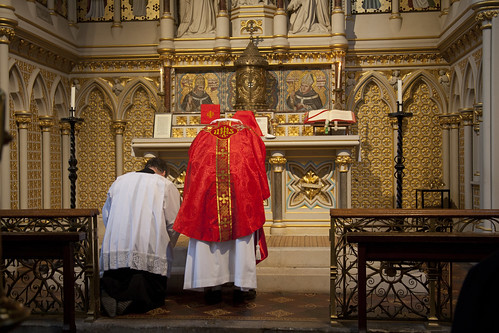
source: lmschairman.org

Monday, April 25, 2016

An April Miscellany

Church Militant
While Mr. Grump has no particular opinion on the unfolding drama of the Wigged Warrior coming out about his sordid past, he does admit to having binge watched the bulk of RCTV’s free videos back when he discovered them. I realized even then that the St. Michael’s Media-produced videos were basically vlogs with a modest budget, but their fairly solid content was appreciated. It would not be at all surprising if the man’s claims about the NY archdiocese are true, although for the sake of the Church I hope they are not. Voris has made many enemies over the years, many of them unnecessarily. Maybe he does not know who his real friends are, and maybe this crisis will make him reconsider some of his policies.
~~~~

St. Mark
Today is the feast of the Evangelist Mark, the little-known disciple and companion of St. Peter. He is believed to have founded the Church in Alexandria, and to have written the second Gospel under the direction of Peter himself. This Gospel has been endlessly deconstructed and reconstruction by biblical scholars for over a century, but it remains potent in its brevity and directness. Tradition says he was martyred by being dragged through the streets of Alexandria. Allegorically he is depicted as a winged lion in sacred art.
~~~

City of God
My reading of Augustine’s City of God continues steadily if slowly. I wish I were the sort of writer who could comment on it as I go, but I cannot do much more than admire the building of Augustine’s literary edifice as he puts it together brick-by-brick. Between the City of God and the Confessions, it is easy to see why his was considered the standard style for spiritual writing in the West for so many centuries. One wishes that style would make a return in earnest.
~~

On Preaching
It was disappointing that the feast of St. George last Saturday was commemorated by a sermon about the Holy Family, rather than a sermon about the great dragon killer. (Did you know that Joseph and Mary didn’t have any children together after Jesus was born? Thank goodness we finally cleared that up.) This is especially surprising since Mr. Grump’s parish hosts a boy’s group dedicated to St. George as their patron. The Sunday sermon also featured a sermon about Mary, originally meant for the month of May, but given early because the priest in question was going out of town for a while. Is it really so impossible to preach on the current feast or season?
~

Et in Arcadia Ego
There is a Japanese Garden attached to the Fort Worth Botanic Garden. During the annual Spring Festival it becomes uncomfortably crowded and noisy, but I have no doubt it would feel calm and cozy at normal times. The garden features structures built in traditional Japanese style, a pond inhabited with large ethnic fish, a narrowly winding walking path, and a small bamboo forest that clicks pleasantly in the wind. Places like these serve as reminders that man was made originally to live in a garden.

Friday, April 22, 2016

An Episode in Clericalism

(Alfred Weber)

Location: Local Tradistani Parish

Occasion: Monthly Men’s Group Meeting During Lent

Mr. B: Any other suggestions for Lenten reading?

Mr. C: I haven’t had the time to read much, unfortunately.

Mr. J (Me): I’ve been reading Dante’s Divine Comedy. It was recommended by the pope! (Polite laughter from the others.) Augustine’s Confessions would make for good Lenten reading, I think.

Mr. B: Well, I have been reading this collection of devotions to St. Joseph. It has a lot of good prayers and novenas you can use.

Mr. J: (Twitching noises.)

Mr. D: Oh yeah, St. Joseph is great! He’s really helped me out with finding a job after I had to leave my last one.

Mr. B: There are some interesting biographical things about St. Joseph in here I had never heard of before. Like how he was from the royal line of David—

Mr. J: (More twitching noises.)

Mr. B: —and how he was actually pretty young when he and the Blessed Virgin were married.

Mr. J: Ahem. Actually, the oldest traditions about St. Joseph were that he was older and widowed at that time.

Mr. B: You know, that’s what I always thought. I don’t know where this writer got his information. He also says that there’s good reason to believe that Joseph was assumed bodily into Heaven, but I can’t figure out where he gets those beliefs.

Mr. J: They were made up in the late Middle Ages, just as the Renaissance was kicking in.

Mr. B: Huh. I was not aware of that. It’s good to know. Oh well, it’s still a decent book if you just stick to the prayers.

Mr. J: (Sigh of relief.)

Mr. D: We should definitely pray to St. Joseph. His intercession is very powerful.

Mr. B: No doubt. Well, unless anybody else has reading suggestions, I suppose we can break for toni—

(He is interrupted as Fr. M walks in. This is the first time Mr. J has ever seen one of the parish priests show up in a Men’s Group meeting.)

Fr. M: I hope I’m not interrupting. I thought I’d pop in since I was done with confessions.

Mr. B: Not at all, Father! We were just talking about reading suggestions for Lent.

Fr. M: Oh, you should all read about Fatima! We’re coming up on the centennial, after all. Our Lady has many important messages for our time.

Mr. B: I was also talking about this St. Joseph book I’ve been reading.

Fr. M: Oh, if you want to read about St. Joseph, you should read The Life and Glories of St. Joseph, by— oh, I can’t remember who the author is.

Mr. J: (Twitching noises.)

Fr. M: But you can find the whole thing online. Joseph is a great saint. He’s the patron of the universal Church! The Life and Glories has lots of great information about St. Joseph, and all the wonderful graces given to him in accordance with his state in life.

Mr. B: Wow, I’ll have to get my hands on that.

Fr. M: You should! It’s very well researched, with many quotes from the Doctors and Fathers of the Church. He even received the grace of sinlessness and of being assumed bodily into Heaven with Our Lady!

Mr. J: I’ve read a lot of Mr. Healey’s book. I can’t say I was very impressed with his scholarship. In fact, he includes some patristic quotes nobody has ever been able to verify.

Fr. M: Oh, I don’t know. He quotes many Doctors of the Church, including St. Francis de Sales!

Mr. B: Well, if it’s online, I’ll have to find it. Maybe we’ll talk about that book in the next meeting.

Fr. M: Oh, that would be wonderful.

Mr. B: All right, let’s break for tonight. Have a good rest of Lent, everybody.

Mr. J: (The twitching noises become eerily calm.)

Thursday, April 21, 2016

For Love of God

source: oberlin.edu
St. Gregory the Great wrote that the altar is the where the flesh of Christ "is distributed for the salvation of the people," where the "quires of angels are present in the mystery of Jesus Christ", and where things "earthly [are] joined with the heavenly". Today I look at parishes, regularly diocesan or "traditional" and see something lacking since Gregory penned his Dialogues.
The Byzantine liturgy helped this writer, and maybe others, understand his native Roman rite, not just textually and historically, but also in the heart, which is where the Christian must live. Starting with a new rite taught me to pray what the prayers said rather than to take them purely as proclamations of intentions or instances of pedagogy. What I discovered was that the liturgy was, in a very person way (in the sense of speaking to a person, not in the sense of privacy), all about God. I knew if factually from the old rite Roman high Mass, but when I first heard the Great Doxology in my own tongue the remaining scales fell from my eyes:
"Glory to You, O Giver of Light! Glory to God in the highest...."
I heard this any number of times in the Roman liturgy without this simple connection, that the hymn directly addresses God the Father, Son, and Holy Spirit. The Eucharist is offered for the adoration of the Holy Trinity and for the forgiveness of sins. Whatever we ask we ask in our own littleness and out of God's great goodness, not out of expectation for reward of our own righteousness. The Roman Canon begins Te igitur, clementissime Pater.... supplices rogamus, ac petimus, uti accepta habeas, et benedicas, not "You gather your people so that a perfect offering may be made, implicitly by us." Prayer always ascends; the Greek litany before Communion petitions "For the precious gifts here offered and sanctified, let us pray to the Lord.... That Our God, Who loves mankind, having received them on His holy and mystical altar in heaven as a sweet spiritual fragrance, may send down in return His divine grace and the gift of the Holy Spirit, let us ask."

By contrast the prevailing modern notion—traditionalist Romans are no different—is that we attend Mass to meet an obligation and to get something out of it ("the graces"—from gratis, suggesting something freely given). This blog often caterwauls the difficulty of getting the faithful into churches for a service that does not include Communion (something for me rather than something God gives), unless it is Stations of the Cross on Good Friday. If I do XYZ (go to Mass on Sundays, go to Confession, practice certain devotions that guarantee my ticket upstairs) then I am saved. Does it really work that way?

Many of the more successful Reform of the Reform parishes during the Benedictine era taught good theology from the pulpit, did not make a further shambles of the Pauline Mass, and had a Christocentric outlook. In the several parishes of this sort I visited during the Ratzingerian papacy I noticed none of them preached "If you only do this, you will be saved" or that the liturgy was a welfare state amenity: file your paperwork and get a piece of the action. Christ gives Himself in the Eucharist out of His own goodness, not owing to our worthy expectation. His sacrifice makes us worthy to partake.
"Since under the former Testament, according to the testimony of the Apostle Paul, there was no perfection because of the weakness of the Levitical priesthood, there was need, God the Father of mercies so ordaining, that another priest should rise according to the order of Melchisedech, our Lord Jesus Christ, who might perfect and lead to perfection as many as were to be sanctified. He, therefore, our God and Lord, though He was by His death about to offer Himself once upon the altar of the cross to God the Father that He might there accomplish an eternal redemption, nevertheless, that His priesthood might not come to an end with His death, at the last supper, on the night He was betrayed, that He might leave to His beloved spouse the Church a visible sacrifice, such as the nature of man requires, whereby that bloody sacrifice once to be accomplished on the cross might be represented, the memory thereof remain even to the end of the world, and its salutary effects applied to the remission of those sins which we daily commit, declaring Himself constituted a priest forever according to the order of Melchisedech, offered up to God the Father His own body and blood under the form of bread and wine...." Council of Trent, Session 22, Ch.1 (before the stuff everyone usually reads)
Geoffrey Hull quotes Aidan Kavanagh's words about the tendency to reduce the liturgy to personal value and rational structure, decrying that "Sacraments diminish as unsettling encounters between presences divine and human in the here and now, to become a rather abstract ritual expression of a pattern set by Christ to give scope to the universal kingdom" (p43).

Monday, April 18, 2016

Apollonius the Compassionate Apologist


Today marks the traditional commemoration of a certain St. Apollonius (one of many bearing that name), a Roman senator sentenced to death under the Emperor Commodus in the late second century after he had been betrayed by a servant. St. Jerome writes a brief hagiography in his De Viris Illustribus:
Apollonius, a Roman senator under the emperor Commodus, having been denounced by a slave as a Christian, gained permission to give a reason for his faith and wrote a remarkable volume which he read in the senate, yet none the less, by the will of the senate, he was beheaded for Christ by virtue of an ancient law among them, that Christians who had once been brought before their judgment seat should not be dismissed unless they recanted. (ch. 42)
Eusebius also has a slightly longer entry in his Ecclesiastical History (V.21). While Apollonius’ Apologia was apparently lost after the patristic age, an account of his martyrdom purporting to be original was discovered and published in the 19th century. It can be read below.


Apollonius is a patron saint, presumably, of apologetics. The Apologia recounted above shows his deep love for Christ, the Faith, and even for his opponents. His accusations against paganism would be echoed later in Augustine’s City of God, as are his more benevolent references to that greatest of pagan thinkers, Socrates. The exchange at the very end also shows his willingness to let go of the argument once his opponent becomes obstinate:
The magistrate said—“I thought that thou wast changed in the night from that mind of thine.”

Apollonius said—“And I expected that thy thoughts would be changed in the night and the eyes of thy spirit be opened by my answer: and that thy heart would bear fruit, and that thou wouldst worship God, the Creator of all, and unto Him continually offer thy prayers by means of compassion; for compassion shown to men by men is a bloodless sacrifice and holy unto God.” (43-44)
There is a wide gulf between the Christian defense of Apollonius and the bloodlessly logical approach to apologetics in today’s Anglosphere. The Randian “A is A” will convert no one but heartless pedants, and them only in the most shallow manner.

Unrelated image.

Sunday, April 17, 2016

Gregory the Great: Hour of the Sacrifice


"For this sacrifice doth especially save our souls from everlasting damnation, which in mystery doth renew unto us the death of the Son of God: who although being risen from death, doth not now die any more, nor death shall not any further prevail against him: yet living in himself immortally, and without all corruption, he is again sacrificed for us in this mystery of the holy oblation: for there his body is received, there his flesh is distributed for the salvation of the people: there his blood is not now shed betwixt the hands of infidels, but poured into the mouths of the faithful. Wherefore let us hereby meditate what manner of sacrifice this is, ordained for us, which for our absolution doth always represent the passion of the only Son of God: for what right believing Christian can doubt, that in the very hour of the sacrifice, at the words of the Priest, the heavens be opened, and the quires of Angels are present in that mystery of Jesus Christ; that high things are accompanied with low, and earthly joined to heavenly, and that one thing is made of visible and invisible?" (Dialogues IV:58, St. Gregory the Great)

Friday, April 15, 2016

Life Is Worth Living, Still

"Congratulations, dad! It's a boy!" I called a friend two days ago to issue these congratulations moments after he sent me a "text message" announcing the awaited arrival of his son. The Rad Trad is to be the godfather and, thankfully, will not have to join the Successful Italian Businessmen to do so.

A coworker returning from maternity leave said her new son is "a bag of organs" until he develops some more engaging characteristics, presumably like the ability to fight her for his dignity. A newborn child is an unwitting explorer, finding and absorbing everything anew, a Romantic and an adventure seeker. What adventurers will this child go on? What lessons will he learn. He could be a great man of the world; he could be a good man, with a steady job and a family of his own; he could be a complete scoundrel and reject all his rearing; he could kill someone; he could be mediocre. He could be a saint; he could squeak into heaven at the end; he could be lost to hell. He really could be anything.

He will sop up everything he can, but also leave what he cannot take in behind. His mind is a paper towel drying up excess water after a spill. Something that makes us different from the lower creatures is our memories. They seem to learn from what happens to them, which trains them for their states of existence, be it house dog potty trainer or a tiger cub on a first hunt; their encounters are purely didactic. We do not just have memories, we have experiences of mind, soul, and body with ourselves and with others. Our experiences can be reminisced, rejected, lamented, considered, recalled, decried or assimilated. Learning is a sensory act of punishment in military service, but not always in civilian life. Our experiences and our rumination creates self-awareness and eventually hints to us that we are distinct from the large and small fuzzy creatures, that our souls resemble He Who is above us rather than the animals below with us.

I learned of my godson-to-be's birth the same day yet another article on the impending integration of Artificial Intelligence with human life appeared on the news wires. Futurists are wildly optimistic that dynamic A.I. will replace most human functions and free up our time to do.... something.... I am not in the understandable minority that sees A.I as a threat to human existence. The very reason Artificial Intelligence captures the imagination betrays its limits, that it is bound to a linear, formulaic concept of intelligence with inputs and results that can think for itself if thinking equates merely with finding solutions to parameters of problems. Perhaps A.I. could even learn to multiply its presence, but what it cannot seem to do is value itself inherently or to realize even that it exists in a qualitative way similar to humans. Perhaps the real threat of A.I. is that it could eliminate practically all jobs and render those who do not own the robots penurious; the Industrial Revolution did not cause that much social harm in contrast.

Artificial Intelligence would not have been created if not for creators who see the human mind as a purely sensory computer, reacting to various inputs and stimili, a cross between a dog and a Windows machine. Technocrats would use their inventions to lighten our already white collar burdens and free our time for the bars and our live in girlfriends. We live more and more the lives the the low creatures, roaming from one amenable sensation to another. It sounds pathetic, but it is much worse. Society continues to automate and alienate itself until it reaches a place not seen since the Fall of Adam and Eve, when man who once knew God fell away, losing not only the Divine presence, but even the intuition for God. Difficulty did not cause the separation of God and man; it was the result of the great divorce. Confusion will continue to reign and life generally to become more mechanical, less human. Perhaps the average millennial will be able to take a vacation to the Caribbean in their 50s, provided they do not discharge their savings too soon. Otherwise, we have little to look forward to.

God and friendship are the two most important things in life, friendship being an image of the love of God. Society is withdrawing from God and from its component pieces. But life is still worth living. Msgr. Fulton Sheen ran a television program in America decades ago called "Life is Worth Living". We can love ourselves until we find there is not much there to love if we do not add to our lives. Love of God and love of neighbor fills one much more than a successful career. No one has ever said at a funeral, "Stan could reconcile the entire ledger and calculate EBITDA by close of business. He will be missed. What's that? The recruiter's calling with candidates. Sorry, I have to take this."

Eventually God made man for Himself. Man is a little child, currently having a centuries long tantrum and hiding in the yard. Father slowly approaches. While the rest of society waits for Father to come to him, I hope my godson comes out of hiding and looks his Father in the face.