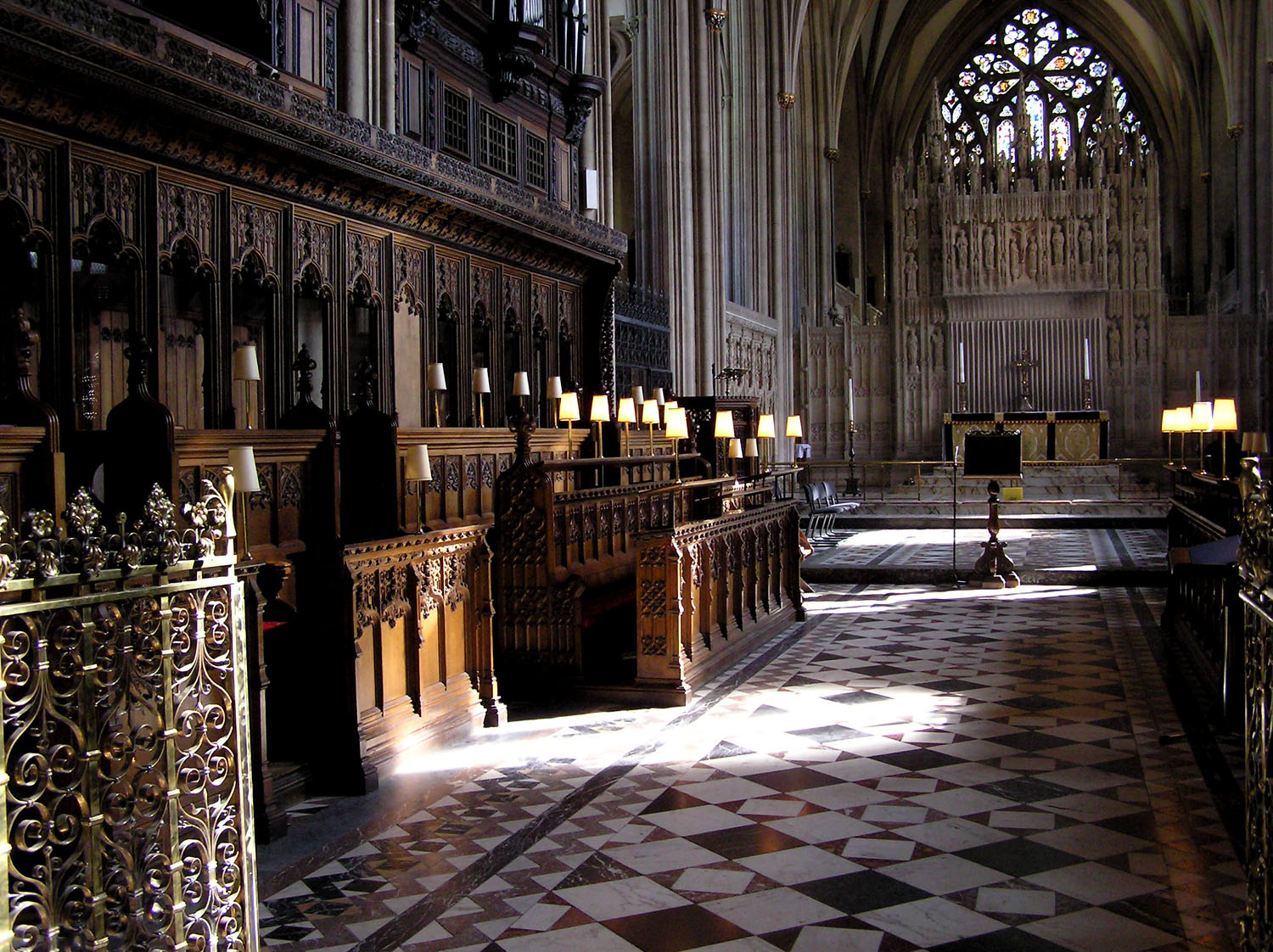
Catholics owe the utmost respect to sacred music, both in its composition and its proper implementation. Music often saves a troubled parish, whereas the 1962 liturgy may not. The English Oratories, St. John Cantius in Chicago, and St. Mary's in Norwalk all have notable music programs which revived meddling parishes and imbued into the faithful an understanding of what is beyond our three dimensions and five senses.
Above all sacred music must be humble, and not pretend to be something it is not. The Roman Church nearly decided against polyphony during the Renaissance, when most composers—notably the Venetians—wrote to the same rhythmic patterns of contemporary dance music. Polyphony can be beautiful, however it is easily overdone and makes the wrong impression when sung underwhelmingly. Chant should be the normal music of the parish church: it is easily singable, possessive of a changing quality according to feast and season that is palatable to man's need for variety, does not require any special talent to sing respectfully, and is a music uniquely owned by the Church. Chant can be sung, screamed, hummed or stuttered by anyone; it began in the basilicas of the great metropolitan sees, adapted to medieval parishes, and crystallized under its daily use by monks whose talents reflected the full gamut of vocal ability. The conventional Roman Masses (I, IV, VIII, IX, XI, and XVIII) are all quite usable and no parish with a regular sung Mass should not be able to sing the seasonal chants; the Missa de Angelis every week is inexcusable. However, polyphony should still have a place in the musical life of the Church.
I recently had the opportunity to attend a performance of Rachmaninoff's setting of the All-Night Vigil in the Byzantine Office. A local chorale held the concert at a protestant church and provided transliterations of the Slavonic. I found myself singing Sviatey Bozhe, Sviatey Kripkey during the Great Doxology between instances of smoke irritating my eyes. At the Polyeoleos, or whatever the Slavs call it, several singers unconsciously began to sway from side to side as they sang Praise the name of the Lord, alleluia/Praise Him in the heights, alleluia. Chant is the normative music of the Church because it is singable. Polyphony should only replace chant when it can render the faithful speechless. Unless this writer finds himself in Moscow he is unlikely to hear this opus ever sung in its proper context, yet his second time hearing Rachmaninoff's Vigil in viva voce reminded him that polyphony must be humble enough to capture the nature of texts they vivify; polyphony cannot be reduced to ornamental fluctuations and descants.
There is even a place for very simple music. Who can speak ill of the little parish that draws 60 or 70 souls and, bereft of a proper music proper, sings the standard tones? This sort of music deserves more honor than the overreaching choir we have all heard, for it does not feign to be something it is not.
Music can be many things: a key to opening up more of the liturgy than just the Eucharist, an injection of life into a dire parish, or portal into the unseen element of what transpires in a church.
"What state can be more blessed than to imitate on earth the choirs of angels? to begin the day with prayer, and honor our Maker with hymns and songs? As the day brightens, to betake ourselves, with prayer attending on it throughout, to our labors, and to season our work with hymns, as food with salt? The consolation from hymns produces a state of soul that is cheerful and free of sorrow."—St. Basil the Great




.jpg)


