Wednesday, December 31, 2014

More on Friendship
John R has posted on one of my favorite subjects, friendship. Like so many, he laments the decline of strong male bonds in the modern day, when hyper-masculinity substitutes for the real thing and close ties between men are either implausible because of vacillating circumstances or seen as potentially homosexual. A dear friend of mine took the day off from work and we strolled through the Fort Worth Botanical Gardens, musing as one point that a few of our friends "would probably think we're gay, chatting and walking through a garden together." John gives a few potential reasons in his post for the decline in what I termed "Romantic Friendship." I would add one which is the false concept of romance between men and women which reigns in the modern day.
Not a married person, I am fearful of disagreeing with the married man John in saying that I think a spouse should be one's best friend because after children and physical changes friendship might be the enduring bond of commitment. This modern idea that people marry for "love" (a blend of lust and spontaneity) is utterly bonkers. The wedding vows used either in the old Roman Mass or in the county court house ask if the spouses will promise to love and care for each other until death, not whether or not they love each other right now. Marriage is a commitment for the long haul, not a satisfaction for current infatuations. Love and attraction are of course good starting points for marriage, but marriage should not proceed merely from those things. Friendship need not exist at the start of a marriage, but should it not naturally grow out of it once age has retired sexual attraction and the kids have moved out? I was madly in love with a girlfriend three years ago, yet I decided to break up with her because I asked myself if I could see myself marrying her and having children with her. Although I think she will be a great mother one day and although she is still my closest friend, I could not see myself married to her.
Basing marriage and inter-personal intimacy on attraction sets the parties up to fail ab initio. People will lose interest and the relationship will fail which means personal closeness will fail. If the modern parody of love called sexual attraction is the basis for emotional intimacy with another person, then of course it will not be feasible between two men without seeming "gay." Similarly, if those relationships are inherently unstable and prone to fail—as are 50% of marriages—then spending the time to share one's soul with another will be deemed a folly of a venture, if not effete and weak.
Good friendships are rare. Keep them when they come!
Silent Anaphora
 |
| source: lmschairman.org |
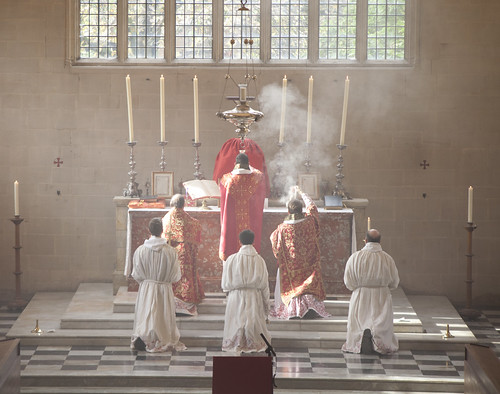
I am curious what readers think about the spoken, silent anaphora. I cannot speak for the non-Byzantine oriental rites, but within the Latin and Greek traditions it has become acceptable for the celebrant to pray the anaphora in entirety or part in spoken silence under the sung parts of the congregation. In the Roman rite the Canon was sung by the celebrant in the same tone as the preface, signalling a continuation from the preface (maybe the origin of the Te igitur at the beginning which caused fits for the impious critics of the Canon). At some point in the 9th or 10th century the celebrant began to speak rather than sing the Canon and furthermore commenced it at the start of the Sanctus rather than after. A similar practice arose in Constantinople, perhaps inspired by the Latin habit, in the early second millennium. The celebrant says the pray after the preface dialogue while the people sing the response "It is proper and just" until they are finished, at which point he picks up the pray singing. When I first witnessed this the first words I heard were "six winged, many eyes soaring on their pinyons...." The congregation sings the Holy, Holy, Holy and the celebrant starts the anaphora, again switching from spoken to sung tone when the hymn has ended, usually at "Take, eat, this is my body" etc. The culminating moment of epiclesis cannot be heard over the singing of the "We praise You, we bless You, we give thanks to You, and we pray to You, O Our God." The priest will resume the aloud part at "especially for our most holy, pure...."
Under the influence of restorationist scholarship, many Byzantine Catholic eparchies in the United States have directed priests to sing the entirety of the anaphora, although mercifully the Melkites allow some of the anaphora of St. Basil the Great to be spoken. We all know what happened to the Roman rite in the 1960s. Within the Byzantine context, this writer has never been bothered by either the spoken parts or the practice of singing the anaphora entirely aloud, aside from the length of the anaphora of St Basil (difficult to maintain attention). I know the anaphora of St John Chrysostom and so have never felt excluded on the occasions when I have seen celebrants retain the practice of continuing the prayer in recitation while the congregation sings its responses. In the Roman rite, as with many others, I dislike the practice of an aloud, spoken Canon, although I have heard the Canon sung in the Pauline rite with success. The silent Canon climbs a long peak in a quiet mountain range. The Roman rite, far from the ritual eccentricity of the Byzantine tradition, is highly meditative and textually focused. The silence of the Canon contrasts with the flow of singing and focuses concentration on Christ's work before us. The Greek practice, either of singing in entirety or of switching between the two, creates a pace to the second half of the Divine Liturgy. The Roman rite's silence upholds that tradition's ruminative qualities. In any of these I have never felt excluded because I know the content of the prayers, I know the priest's place, and I know my place as a layman; I am certainly capable of praying with the celebrant in principle, even if not in word. The spoken, aloud practice in the Pauline rite, however, I find quite disengaging. One wonders if celebrants use Eucharistic Prayer II because they know their drowning tongues will only carry attention for so long?
 |
| Always EP2! |
The various ways of doing the anaphora in tradition demonstrate the Church's long wisdom as a spiritual psychologist. I wish she would return to her own prescription. What think ye?
Sunday, December 28, 2014
'Twas the Night Before Christmas

A bit late, but I still wanted to publish this:
‘Twas the night before
Christmas, and in St. Martha’s House
Not a creature was
stirring, not even a mouse;
The Cardinals crammed for
wooden seats in Paul VI Hall,
In front a humble throne
the color of a funerary pall;
The press were smug and
held their stead;
While heterodox headlines
danced in their heads;
The Ultramontanes rejoiced
that the Traddies had snapped,
And then settled their
brains for pontificate-long nap,
When out atrium there
arose such a clatter,
The Curia rose to curtsy
attention’s center.
He wore a white cassock
with a coat of arms,
And black trousers which
contained his Peronist card.
Of the Renaissance
frescoes above his head,
He made known that we
should share his dread.
Then he took to his
humble throne,
And the Argentine bishop
peered down his Italian nose,
If the press knew he was
hardly New World,
They would have cried
tears to fill a Salvation Army bowl.
More rapid than eagles
his acolytes they came,
And he howled of new
mercies, and called them by name:
"Now, Marx! now,
Kasper! now Schonborn and Cupich!
On, with Rahner!
on, with Martini!—not the stiff drink!
To the top of the edge of
the Leonine wall!
Let us announce our newly
merciful and humble Church to all!"
“He shut down the
Franciscans and will crush Peter’s priests, too,”
“But,” says another, “his
meeting with Bernard Fellay went through.”
“He gets blessings from
protestants,” bewails the traditionalist,
“You don’t get it,” says
the Zed “He’s just another Benedict.”
The penitent recalls 247
and 254 in the encyclical he read,
The priest replies, “Have
your evening prayers been said?”
As the faithful keep
their parishes in peace,
The Argentine perturbs them
with news of unease.
“We should ignore him and
not let ourselves be irked
Or delude ourselves in
hopes of the rebellion of Raymond Burke.”
“He is the Pontiff,”
retorts the wife, “He is guaranteed by the Godhead,
St Robert promises that
if he changes doctrine the Lord with strike him dead.”
With some concerns how
could the holidays be merry?
Would we lose the
Ratzinger reform and be at the mercy of Fr. Larry?
Poor Guido Marini, he is
broke without baroque,
Bereft of fiddlebacks and
mitres high as telescopes;
Even midnight Mass could
not be borne on the silver screen,
And a picnic table now
stands in the Chapel Sistine;
Obsessed with the
Pontiff, the neo-cons hound,
And through their
households the Mercy, not the Pater,
resounds.
The Martinian cardinals
lamented their success knowing their ideas were sterile,
No one believed them,
while the Traddies reproduce by the bushel;
“You’re too organized,
too structured, and spiritually cold,
You must toss up the
papers and be impoverished and bold.”
Dolan of the Big Apple
chuckled elate:
“When before was the
Curia accused of working too late?”
The scarlet men rose
irate when the Argentine took his leave,
And they all breathed a
sigh of relief;
He vested for Mass and turned
to the sacristy door,
Then turned again to the
Basilica, perhaps to say no more.
But I heard him exclaim,
ere he walked out of sight—
“Someday you’ll hear the Spirit, and know I’m right!”
Saturday, December 27, 2014
Forgive Peter Jackson, For He Knows Not What He Does
 |
| 30 minutes into the movie |
Tonight I went to see Peter Jackson's final installment of The Hobbit with family, having seen the previous films together the last two winters. Rumors circulated that the third and last film stretched the book's final chapters with some gratuitous material borrowed from other Tolkien sources, which worried His Traddiness, but I decided the eight dollars could hardly be spent on much else that would occupy me for three hours. What a mistake. Only New York State wine could have been a worse entertainment purchase for eight dollars, although the wine would dull my ability to think about films as bad as this one.
Fifteen minutes into the film the dragon was dead, the denouement unraveled, I remembered the novel from fourth grade and said to myself, "This is where the book ended. What could they do from here on?" Make it up. Make it all up.
I know two of my readers are Tolkienophiles and that many of the rest will at least hold the Oxonian philologist in high esteem. I enjoyed The Hobbit when I was young and read The Lord of the Rings books once, but claim no expertise over the broader material that constitutes "middle earth." Still, I could not shake the feeling that Peter Jackson, or his bosses at the studios, were simply amalgamating bits and bobs of reference material from other Tolkien books to excuse the remaining 135 minutes of pseudo-Nordic warfare and slapstick inspired combat scenes. Genuine story and dialogue was substituted with vague, formalistic addresses to "X, son of Y, heir to Z" about fleeting, superficial ideas about friendship, love, and loyalty.
I liked the first Lord of the Rings film, Fellowship, and, aside from mercifully eliminating Tom Bombadil, it was faithful to the original story. Viggo Mortensen said last year that the first movie was the best in the series because it allowed the actors to bond as a fellowship and create the chemistry to make Tolkien's fellowship of the Ring a reality. The movie had a very organic feel and, while it was violent, the fight scenes never seemed self-indulgent. By Return of the King all those good traits were gone. The complex and confusing character of Denethor is made into a mere madmen so we can watch Gimli and Legolas squabble with ghosts.
Forgive Peter Jackson, for he clearly knows not what he does. Let us hope that there is nothing else he can bring to the big screen from Tolkien's bibliography.
Thursday, December 25, 2014
In the Fullness of Time

Christ came in the "fullness of time", wrote St. Paul to the Galatians. The sermon preached during the vesperal Divine Liturgy last night began with an explanation of this unusual phrase. Modern readers will see "fullness" and assume it means something like "fulfillment," something positive that ends a process. The phrase means nothing of the sort. It is a Greek idiom which could be translated literally as "when something is so filled up it explodes" and dynamically as "when the stuff hits the fan" or "hitting rock bottom."
The Jews of Christ's time long ago hit rock bottom. Christ came to earth during the pax Romana, the Roman peace that pervaded the Empire and made it "the most civilized portion of mankind" in the words of Gibbon. Modern admiration of the pax Romana misses the point of the peace. The Romans accomplished their peace by smashing local governments and cultures, dissolving their governments, inserting puppets, and assimilating the people to the Roman culture. Rome's servant Herod ruled from Jerusalem without the slightest regard for religion or state welfare, killing the Holy Innocents and two of his own sons. The priests of Temple, the center of Jewish life, were "on the take." Above all, the people suffered the consequences of ignoring the prophets for a millennium. The Maccabean Revolt was the "last hurrah" for devout Jews, but the Revolt itself spawned Pharisaical Judaism, the tradition of favoring the letter of the Law over its spirit. Jewish life was sterile politically, culturally, and religiously. Jerusalem Jews tended not to believe in an afterlife or soul, writing off both as Hellenistic intrusions. This is the world Jesus entered.
In coming He did not perform any of the imagined Messianic tasks. He did not restore the presence of God in the Temple, nor did He drive out the Roman masters, nor did He unite the people of Israel. If one lived twenty miles outside of Jerusalem, one could conceivably have been born before Christ and lived after Him having never known of the carpenter-turned-rabbi. The angels sang "Glory be unto God in the highest and on earth peace to men of good will," but nothing approaching an earthly peace, a Jewish version of the pax Romana followed. Christ planted a seed with twelve men, one Pharisee, and a few women which would flourish throughout the world. It has not yet taken root throughout the world and the world has done its best to trim the branches back, but it persists in growing. Followers congregated around the Apostles a few at a time until there was a church in a town. The churches grew locally until Christianity constituted nearly half the Empire and many communities in the far east. If in the age of Athanasius the world "groaned to find itself Arian" then in the age of Constantine it awoke to find itself Christian.
The peace Christ brought and of which the angels sang at His birth in Bethlehem is the reign of God everywhere, in the heart, in the household, in the parish, in the community, and in the world at large. It is not the absence of war. This peace only perfectly exists in heaven, however it can exist in a great way on the micro levels and occasionally appear on the macro level. Yet none of this happens instantaneously. The saints we remember during Christmas season—Mary, Joseph, the Magi, Elizabeth, John the Baptist, Simeon the Just—did not endeavor to restore the Davidic kingdom or the Temple as it existed during the reign of Solomon. They were people singularly focused on doing what God wanted them to do as best they could. The Virgin's shock and confusion at the Annunciation reflects a very normal daily life in her household until she conceived by the Holy Spirit. Simeon, who carried our Lord in the Temple, prayed for such a favor all his life; he did not enjoy casual acquaintance with the supernatural. A lifetime of devotion seems to culminate in one definitive act of cooperation with the great, well paced and slow Divine plan for mankind. The same was true of Christ Himself one could say.
We are all worried about the Church and its sixty, one hundred, five hundred, or two thousand years of malaise. Do not worry. Realize that Christ came in the "fullness of time" to bring a peace that we can welcome by doing what He wants. In doing so we will serve the Church that only He can "fix." Like peace, the Church can be in a better or worse state on earth, never perfect until reaching heaven, His ultimate goal for us.
Tuesday, December 23, 2014
Merry Christmas: Christ is Born! Glorify Him!

If you are looking for some spiritual edification beyond Mass, look no further. Here are the Mattins lessons for the feast of the Nativity of Our Lord Jesus Christ as well as the Introit, my favorite in the Roman rite, for the third Mass of the day. As they say in the East, "Christ is born! Glorify Him!"
From Isaiah:
1 At the first time the land of Zabulon, and the land of Nephtali was lightly touched: and at the last the way of the sea beyond the Jordan of the Galilee of the Gentiles was heavily loaded.
2 The people that walked in darkness, have seen a great light: to them that dwelt in the region of the shadow of death, light is risen.
3 Thou hast multiplied the nation, and hast not increased the joy. They shall rejoice before thee, as they that rejoice in the harvest, as conquerors rejoice after taking a prey, when they divide the spoils.
4 For the yoke of their burden, and the rod of their shoulder, and the sceptre of their oppressor thou hast overcome, as in the day of Median.
5 For every violent taking of spoils, with tumult, and garment mingled with blood, shall be burnt, and be fuel for the fire.
6 For a child is born to us, and a son is given to us, and the government is upon his shoulder: and his name shall be called, Wonderful, Counsellor, God the Mighty, the Father of the world to come, the Prince of Peace.
1 Be comforted, be comforted, my people, saith your God.
2 Speak ye to the heart of Jerusalem, and call to her: for her evil is come to an end, her iniquity is forgiven: she hath received of the hand of the Lord double for all her sins.
3 The voice of one crying in the desert: Prepare ye the way of the Lord, make straight in the wilderness the paths of our God.
4 Every valley shall be exalted, and every mountain and hill shall be made low, and the crooked shall become straight, and the rough ways plain.
5 And the glory of the Lord shall be revealed, and all flesh together shall see, that the mouth of the Lord hath spoken.
6 The voice of one, saying: Cry. And I said: What shall I cry? All flesh is grass, and all the glory thereof as the flower of the field.
7 The grass is withered, and the flower is fallen, because the spirit of the Lord hath blown upon it. Indeed the people is grass:
8 The grass is withered, and the flower is fallen: but the word of our Lord endureth for ever.
1 Arise, arise, put on thy strength, O Sion, put on the garments of thy glory, O Jerusalem, the city of the Holy One: for henceforth the uncircumcised, and unclean shall no more pass through thee.
2 Shake thyself from the dust, arise, sit up, O Jerusalem: loose the bonds from off thy neck, O captive daughter of Sion.
3 For thus saith the Lord: You were sold gratis, and you shall be redeemed without money.
4 For thus saith the Lord God: My people went down into Egypt at the beginning to sojourn there: and the Assyrian hath oppressed them without any cause at all.
5 And now what have I here, saith the Lord: for my people is taken away gratis. They that rule over them treat them unjustly, saith the Lord, and my name is continually blasphemed all the day long.
6 Therefore my people shall know my name in that day: for I myself that spoke, behold I am here.
From St. Leo the Great, Pope of Rome:
Dearly beloved brethren, Unto us is born this day a Saviour. Let us rejoice. It would be unlawful to be sad to-day, for today is Life's Birthday; the Birthday of that Life, Which, for us dying creatures, taketh away the sting of death, and bringeth the bright promise of the eternal gladness hereafter. It would be unlawful for any man to refuse to partake in our rejoicing. All men have an equal share in the great cause of our joy, for, since our Lord, Who is the destroyer of sin and of death, findeth that all are bound under the condemnation, He is come to make all free. Rejoice, O thou that art holy, thou drawest nearer to thy crown! Rejoice, O thou that art sinful, thy Saviour offereth thee pardon! Rejoice also, O thou Gentile, God calleth thee to life! For the Son of God, when the fulness of the time was come, which had been fixed by the unsearchable counsel of God, took upon Him the nature of man, that He might reconcile that nature to Him Who made it, and so the devil, the inventor of death, is met and beaten in that very flesh which hath been the field of his victory.
When our Lord entered the field of battle against the devil, He did so with a great and wonderful fairness. Being Himself the Almighty, He laid aside His uncreated Majesty to fight with our cruel enemy in our weak flesh. He brought against him the very shape, the very nature of our mortality, yet without sin. His birth however was not a birth like other births for no other is born pure, nay, not the little child whose life endureth but a day on the earth. To His birth alone the throes of human passion had not contributed, in His alone no consequence of sin had had -part. For His Mother was chosen a Virgin of the kingly lineage of David, and when she was to grow heavy with the sacred Child, her soul had already conceived Him before her body. She knew the counsel of God announced to her by the Angel, lest the unwonted events should alarm her. The future Mother of God knew what was to be wrought in her by the Holy Ghost, and that her modesty was absolutely safe.
Therefore, dearly beloved brethren, let us give thanks to God the Father, through His Son, in the Holy Ghost: Who, for His great love wherewith He loved us, hath had mercy on us and, even when we were dead in sins, hath quickened us together with Christ, that in Him we might be a new creature, and a new workmanship. Let us then put off the old man with his deeds (Col. iii. 9); and, having obtained a share in the Sonship of Christ, let us renounce the deeds of the flesh. Learn, O Christian, how great thou art, who hast been made partaker of the Divine nature, and fall not again by corrupt conversation into the beggarly elements above which thou art lifted. Remember Whose Body it is Whereof thou art made a member, and Who is its Head. Remember that it is He That hath delivered thee from the power of darkness and hath translated thee into God's light, and God's kingdom.
From St. Gregory the Great, Pope of Rome:
By God's mercy we are to say three Masses to-day, so that there is not much time left for preaching; but at the same time the occasion of the Lord's Birth-day itself obliges me to speak a few words. I will first ask why, when the Lord was to be born, the world was enrolled? Was it not to herald the appearing of Him by Whom the elect are enrolled in the book of life? Whereas the Prophet saith of the reprobate Let them be blotted out of the book of the living, and not be written with the righteous. Then, the Lord is born in Bethlehem. Now the name Bethlehem signifieth the House of Bread, and thus it is the birth-place of Him Who hath said, I am the Living Bread, Which came down from heaven. We see then that this name of Bethlehem was prophetically given to the place where Christ was born,.because it was there that He was to appear in the flesh by Whom the souls of the faithful are fed unto life eternal. He was born, not in His Mother's house, but away from home. And this is a mystery, showing that this our mortality into which He was born was not the home of Him Who is begotten of the Father before the worlds.
From St. Ambrose, Bishop of Milan:
Behold the beginning of the Church. Christ is born, and the shepherds watch; shepherds, to gather together the scattered sheep of the Gentiles, and to lead them into the fold of Christ, that they might no longer be a prey to the ravages of spiritual wolves in the night of this world's darkness. And that shepherd is wide awake, whom the Good Shepherd stirreth up. The flock then is the people, the night is the world, and the shepherds are the Priests. And perhaps he is a shepherd to whom it is said, Be watchful and strengthen, for God hath ordained as the shepherds of His flock not Bishops only, but also Angels.
From St. Augustine, Bishop of Hippo
Lest thou shouldest think all things mean, as thou art accustomed to think of things human, hear and digest this The Word was God. Now perhaps there will come forward some Arian unbeliever, and say that the Word of God was a creature. How can the Word of God be a creature, when it was by the Word that all creatures were made? If He be a creature, then there must have been some other Word, not a creature, by which He was made. And what Word is that? If thou sayest that it was by the word of the Word Himself that He was made, I tell thee that God had no other, but One Only-begotten Son. But if thou say not that it was by the word of the Word Himself that He was made, thou art forced to confess that. He by Whom all things were made was not Himself made at all. Believe the Gospel.
A Very Merry and Blessed Feast of the Nativity to All!
Subscribe to:
Posts (Atom)