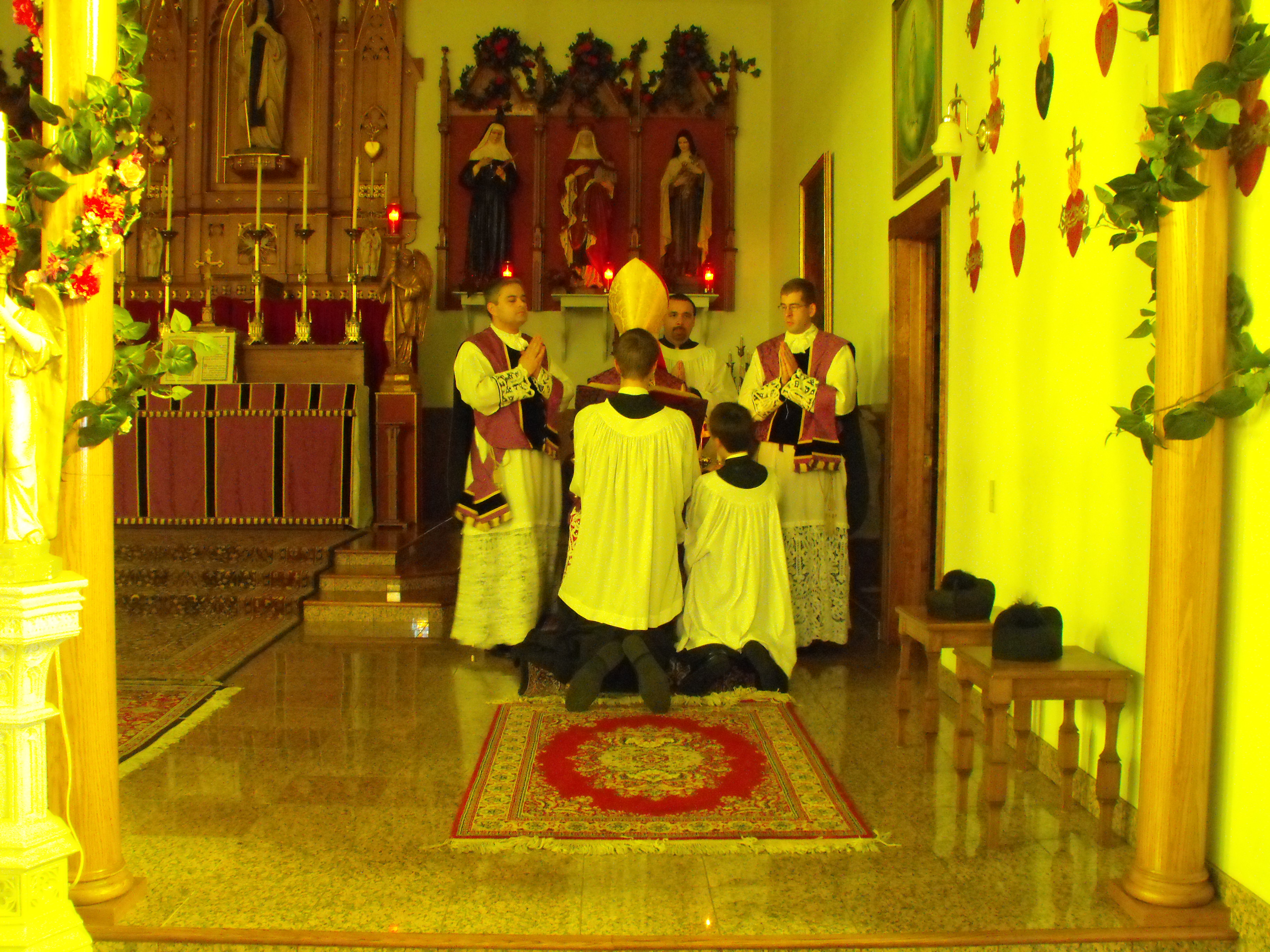
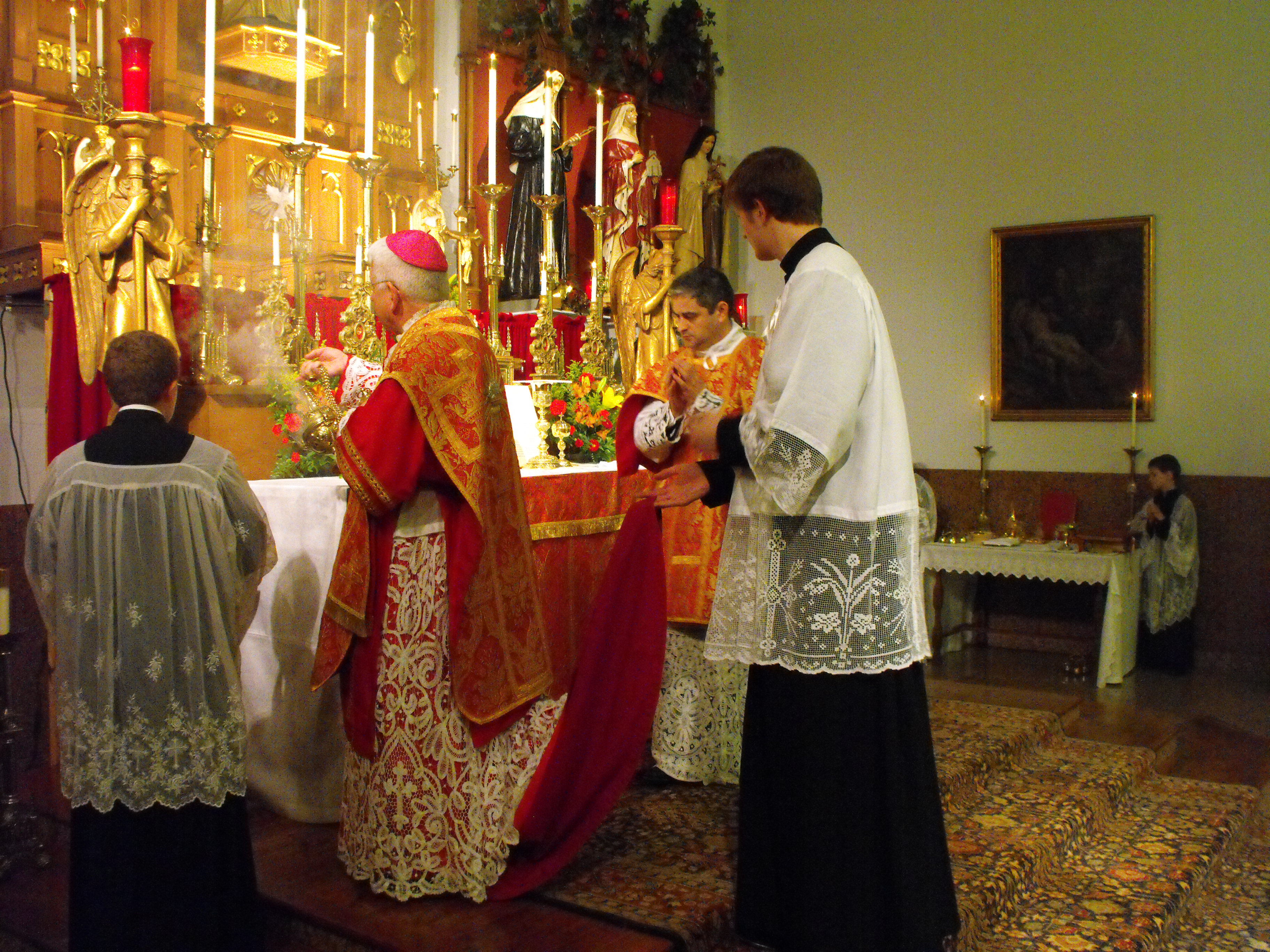
The wedding went off without too many hitches, the Mass very a well sung Missa cunctipotens Genitor Deus, and Arcadelt's Ave Maria graced the offertory. As a silver lining, we did not have to endure a sermon! The Mass did have one tiny feature that I have only seen at nuptial ceremonies conducted by the FSSP, that of inserting "admonitions" into the liturgical texts of the Nuptial vows and votive Mass.
I have attended several pre-1970 wedding Masses and the three or four I have heard at FSSP parishes are the only ones which contain this particular practice. Indeed, it is somewhat hard to equivocate what this practice is because it varies a little every time I attend a wedding in such a setting. This past wedding, a solemn high Mass, the "admonition" was a speech or instruction read from a print-out prior to the vows laid out in the Rituale Romanum. It contained the familiar "Dearly beloved, we are gathered here today....", the secular "If anyone knows any reason why these two should not be joined....", a some good words on the nature of marriage as a Sacrament of God and for His own ends. Then followed the straightforward exchange of vows, the blessing of the ring[s], and the solemnization by the priest dictated in the Rituale. As a preface to the actual rites of marriage and as a means of sprucing up the rather bare Roman rites of nuptial, one could do worse. On the other hand, one could do more.
During another wedding at the same parish, a low Mass celebrated by a different priest, the same opening "admonition" was read before the vows. Then prior to the blessing of the bride which follows the Pater noster yet another vernacular admonition was read. Then came the blessing for fecundity following the Placeat tibi, which was again preceded by several paragraphs of vernacular admonitions—textually forgotten to this writer. Yet another wedding attended months early had an even different pattern.
Consultation with a 1910 Missal, a Baronius hand Missal, a 1945 St. Joseph Missal, the Ecclesia Dei (RIP) hand booklet, and the Paul V and Pius XII editions of the Rituale Romanum reveals no mandate or precedent for this practice. The closest thing is a warning that contracting marriage prior to denouncing heresy does not invalidate the union. Interestingly, pastors were warned against marrying cohabitants, but were allowed to marry the homeless under certain conditions.
So are extensive "admonitions" a tradition, an elaboration of the Nuptial rites, or an outright abuse?
Sunday, June 28, 2020

Friday, June 26, 2020
Should You Fall in Love?
Should you love your fiancée? Most people think you should these days, although what that entails is somehow less clear. Adducing the Angelic Doctor's obvious belief that love is "to will the good of another" falls like a cymbal on the ears of the faithless and even on some of the faithful.
Tomorrow I have the unique opportunity to attend a marriage that was neither arranged nor the result of a protracted period of dating and wooing. In short, it fits into neither the modern nor historical modes of contracting a bond to a significant other. The two parties have decided that their union is a matter of spiritual welfare, of necessity for both to live out their lives meaningfully. In some sense they have followed the millennial tendency to look for "relationships" rather than to "fall in love". But is this right?
It would be hard to fault millennial for refusing to repeat the sins of their parents and grandparents in the realm of marriage. Despite their general proclivity for supporting homosexual unions, they statistically are less promiscuous than the prior two generations and are less apt to divorce. As children of the Great Recession and ex-students burdened with crushing student loan debt, they marry later than the previous generations if they wed at all. While miles off the ideal, they have sought stability rather than the impulse of "falling in love," and for that they deserve some small degree of commendation.
But is it right to seek a "relationship" instead of "love"? A "relationship" today is a functional arrangement. Both parties have compatible values, they have similar or non-conflicting goals, they can lean on each other for emotive comfort. This is in contrast to those who just "fall in love."
"Falling in love" has its roots in the wealthier medieval city states, places with robust mercantile classes who needed neither the family alliances of the nobles nor the stable expectations of the feudal vassals. They could afford to marry because they wanted to marry. One might assume that the Montague and Capulet families of Romeo and Juliet were members of this class rather than the landed aristocracy.
Some centuries into the future post-War American children are compelled to marry at the youthful ages of their parents and yet they are disposed to listlessness owing to an historically unprecedented wealth and security. Teenage angst isn't real, it was invented in the 1950s along with Rock & Roll and songs about puppy love, "unconsummated lust" as Harold Bloom called it. The Beatles, Beach Boys, Elvis, the Isley Brothers, Four Seasons, Phil Spectre, and every other recording outfit beamed tunes to the same theme as And Then He Kissed Me: boy meets girl, girl likes boy, girl loves boy, boy marries girl. This generation discovered that unlike their parents' initial meetings in churches and familial settings, lusting after someone at prom was not a substantial basis for marriage.
Today's "relationship" outlook on dating is much more in accord with the arranged unions and familial ties of past times. It does not mean these people did not grow to love each other and did not become genuine partners in life. It does mean that marriage includes a vow to love another and does not codify existing attractions. In this sense marriage is much more difficult than we like to imagine. Unions in which the husband and wife are best friends, lovers, and parents are really rare and always have been. By contrast, the "blessed continence" and consideration of the "blessed life" extolled by Saint Augustine as much easier to follow faithfully than the long term consequences of "And then he asked me to be his bride/ And always stand right by his side/ I felt so happy I almost cried/ And then he kissed me". Like all things with our fallen nature, there is no perfect formula, but there is the power of God within the Sacraments to make it work.
Saturday, June 13, 2020
In Octavam
We are in the midst of yet another octave, the third in four weeks and the first, depending on which kalendar you use, of four in the coming weeks. June is a celebratory month in contrast to the starkness of the following month of July, perhaps intended by the Church as a gradual easement into green season after the timely joy of Paschaltide.
The octave we now hold, that of Corpus Christi, is generally like most other octaves in the traditional kalendar and somewhat unlike the three retained in the 1962 kalendar. The Mass and Office are repeated every day that is not a feast of nine lessons, and the octave is commemorated when such a feast does fall within the octave. On the eighth day the Mass is resumed with solemnity and no unnecessary commemorations and the Office returns to a Duplex formula. It concludes the festivity by re-iterating the feast itself in most cases, although there are exceptions such as the unique Mass on the Octave Day of Ss Peter & Paul, retained in the 1962 Missal at least as a votive Mass of the Saints.
Our three most unique octaves, however, which survived Papa Pacelli's scissors, really do not follow this pattern very well at all. Pascha and Pentecost admit no feasts whatsoever. The Nativity octave need not concern itself with this since it is already both de tempore and sanctoral. What is most extraordinary is that their octave days resemble the feast very little.
White Sunday is a privileged Double with the Dominical Office of 18 Mattins psalms, the return of hymnody, no Victimae paschali laudes at Mass, and no Alleluia appended to the dismissals. At first glance it might appear that the Holy Saturday Mass and is in fact more Paschal than the Paschal Octave Day. In fact in these eldest rites the eighth day marks a point of departure in bringing the character of the feast back into normality. By contrast, the Holy Saturday Mass anticipated the Resurrection without explicitly making it present.
In a like manner, the last day of the Christmas octave synthesizes the Nativity of Christ, the Circumcision, and the motherhood of Our Lady. The Office is completely different from that of the preceding Nativity days and those of the comites Christi, instead following the psalmnody of a Marian feast. Only the collect of Mass, however, reflects this Marian character. The Introit is that of the third Mass of Christmas day, but the readings are of Christ's circumcision. The hymns are not those of the Nativity itself, but the purpose of the feast is clearly the end of celebration of His birth.
Pentecost does not appear to have a proper octave day, although Trinity Sunday could reasonably be considered a crowning point of the Holy Spirit, the fullness of the life-giving Trinity now revealed and manifested. The compunction of Alleluias from Paschaltide is gone as is the Regina coeli. Indeed, the Byzantine rite also ends its Pentecost—on Sunday—with a transition back to normality with "kneeling" Vespers, reviving the prostrations in the Office and after the epiclesis during the Liturgy. And yet in the Byzantine rite the week following Pentecost is not an official extension of the feast, but it is called Trinity Week and fasting is banned.
Perhaps those Orientalizing, archaeologizing vitiations weren't so wise after all?
The octave we now hold, that of Corpus Christi, is generally like most other octaves in the traditional kalendar and somewhat unlike the three retained in the 1962 kalendar. The Mass and Office are repeated every day that is not a feast of nine lessons, and the octave is commemorated when such a feast does fall within the octave. On the eighth day the Mass is resumed with solemnity and no unnecessary commemorations and the Office returns to a Duplex formula. It concludes the festivity by re-iterating the feast itself in most cases, although there are exceptions such as the unique Mass on the Octave Day of Ss Peter & Paul, retained in the 1962 Missal at least as a votive Mass of the Saints.
Our three most unique octaves, however, which survived Papa Pacelli's scissors, really do not follow this pattern very well at all. Pascha and Pentecost admit no feasts whatsoever. The Nativity octave need not concern itself with this since it is already both de tempore and sanctoral. What is most extraordinary is that their octave days resemble the feast very little.
White Sunday is a privileged Double with the Dominical Office of 18 Mattins psalms, the return of hymnody, no Victimae paschali laudes at Mass, and no Alleluia appended to the dismissals. At first glance it might appear that the Holy Saturday Mass and is in fact more Paschal than the Paschal Octave Day. In fact in these eldest rites the eighth day marks a point of departure in bringing the character of the feast back into normality. By contrast, the Holy Saturday Mass anticipated the Resurrection without explicitly making it present.
In a like manner, the last day of the Christmas octave synthesizes the Nativity of Christ, the Circumcision, and the motherhood of Our Lady. The Office is completely different from that of the preceding Nativity days and those of the comites Christi, instead following the psalmnody of a Marian feast. Only the collect of Mass, however, reflects this Marian character. The Introit is that of the third Mass of Christmas day, but the readings are of Christ's circumcision. The hymns are not those of the Nativity itself, but the purpose of the feast is clearly the end of celebration of His birth.
Pentecost does not appear to have a proper octave day, although Trinity Sunday could reasonably be considered a crowning point of the Holy Spirit, the fullness of the life-giving Trinity now revealed and manifested. The compunction of Alleluias from Paschaltide is gone as is the Regina coeli. Indeed, the Byzantine rite also ends its Pentecost—on Sunday—with a transition back to normality with "kneeling" Vespers, reviving the prostrations in the Office and after the epiclesis during the Liturgy. And yet in the Byzantine rite the week following Pentecost is not an official extension of the feast, but it is called Trinity Week and fasting is banned.
Perhaps those Orientalizing, archaeologizing vitiations weren't so wise after all?
Thursday, June 4, 2020
Dealing with Urban Questions
No, not the self-inflicted chaos hitting most American cities, but rather some more relevant to our season of Pentecost.
Urban VIII's classicizing revision of the Latin hymns has received more attention in recent years thanks to examples on New Liturgical Movement. The Michaelmas hymn was so altered that it adapted to an entirely different meter and verse structure. The hymn for the octave of Pentecost, Veni, Creator Spiritus, received a more modest revision, with hardly anything changing until the Doxology.
The choice to revise this hymn at all is curious in light of the changes Urban's committee of Jesuits, priests unbound to the communal Office, decided to make. Almost all the changes, except for one line, were to word order and not to vocabulary or verse. Why, for instance, change "donum Dei altissimi" to "altissimi donum Dei"? In the older order the shift from donum to Dei coincided with the melody, making a more seamlessly singable text than the slightly awkward result for that line. The only noticeable difference was the change of "dexterae Dei tu digitus" to "digitus paternae dexterae".
Then comes the doxology. According to the generally reliable, but not always current, Catholic Encyclopedia the Congregation of Sacred Rites did not decide until 1899 that the Paschal doxology would be used on all occasions for this hymn. The oldest doxology given for this hymn ("Sit laus Patri cum Filio / Sancto simul Paraclito / Nobisque mittat Filius / Charisma Sancti Spiritus") fell out of use during the Middle Ages. Certainly the Congregation for Rites' decision was not very innovative, as 19th century laymen's books generally note the Paschaltide ending is always used.
As an interesting aside, the 1875 Serving Boy's Manual and Book of Public Devotions gives the pre-Urban proper doxologies for all hymns. With Gregorian chant out of style in favor of polyphony and choral music throughout the Counter-Reformation and Baroque ages, the older texts may have benefited from the fact the better music of those styles was generally written before Papa Barberini. Much like Pius XII's psalter, Urban's hymnody may have been more widely ignored than most are aware.

Urban VIII's classicizing revision of the Latin hymns has received more attention in recent years thanks to examples on New Liturgical Movement. The Michaelmas hymn was so altered that it adapted to an entirely different meter and verse structure. The hymn for the octave of Pentecost, Veni, Creator Spiritus, received a more modest revision, with hardly anything changing until the Doxology.
The choice to revise this hymn at all is curious in light of the changes Urban's committee of Jesuits, priests unbound to the communal Office, decided to make. Almost all the changes, except for one line, were to word order and not to vocabulary or verse. Why, for instance, change "donum Dei altissimi" to "altissimi donum Dei"? In the older order the shift from donum to Dei coincided with the melody, making a more seamlessly singable text than the slightly awkward result for that line. The only noticeable difference was the change of "dexterae Dei tu digitus" to "digitus paternae dexterae".
Then comes the doxology. According to the generally reliable, but not always current, Catholic Encyclopedia the Congregation of Sacred Rites did not decide until 1899 that the Paschal doxology would be used on all occasions for this hymn. The oldest doxology given for this hymn ("Sit laus Patri cum Filio / Sancto simul Paraclito / Nobisque mittat Filius / Charisma Sancti Spiritus") fell out of use during the Middle Ages. Certainly the Congregation for Rites' decision was not very innovative, as 19th century laymen's books generally note the Paschaltide ending is always used.
As an interesting aside, the 1875 Serving Boy's Manual and Book of Public Devotions gives the pre-Urban proper doxologies for all hymns. With Gregorian chant out of style in favor of polyphony and choral music throughout the Counter-Reformation and Baroque ages, the older texts may have benefited from the fact the better music of those styles was generally written before Papa Barberini. Much like Pius XII's psalter, Urban's hymnody may have been more widely ignored than most are aware.

Traditional Text
|
Urban VIII Revision
|
Veni, Creator Spiritus,
mentes tuorum visita,
imple superna gratia,
quae tu creasti pectora.
Qui Paraclitus diceris,
donum Dei altissimi,
fons vivus, ignis, caritas,
et spiritalis unctio.
Tu septiformis munere,
dexterae Dei tu digitus,
tu rite promissum Patris,
sermone ditans guttura.
Accende lumen sensibus,
infunde amorem cordibus,
infirma nostri corporis
virtute firmans perpeti.
Hostem repellas longius,
pacemque dones protinus:
ductore sic te praevio,
vitemus omne noxium.
Per te sciamus, da, Patrem,
noscamus atque Filium,
te utriusque Spiritum
credamus omni tempore.
Gloria Patri Domino,
Natoque, qui a mortuis
surrexit, ac Paraclito,
in saeculorum saecula.
Amen.
|
Veni, Creator Spiritus,
mentes tuorum visita,
imple superna gratia
quae tu creasti pectora.
Qui diceris Paraclitus,
altissimi donum Dei,
fons vivus, ignis, caritas,
et spiritalis unctio.
Tu, septiformis munere,
digitus paternae dexterae,
Tu rite promissum Patris,
sermone ditans guttura.
Accende lumen sensibus:
infunde amorem cordibus:
infirma nostri corporis
virtute firmans perpeti.
Hostem repellas longius,
pacemque dones protinus:
ductore sic te praevio
vitemus omne noxium.
Per te sciamus da Patrem,
noscamus atque Filium;
Teque utriusque Spiritum
credamus omni tempore.
Deo Patri sit gloria,
et Filio, qui a mortuis
surrexit, ac Paraclito,
in saeculorum saecula.
Amen.
|
Saturday, May 30, 2020
The Vigil of Pentecost
Pentecost is too big, too vast, too intimidating for any singular explanation, but the Roman liturgy's rich vigil for this feast nurtures the faithful with some food for thought. Let us consider the liturgy of the Roman rite for this great feast, second only to the Sunday of the Resurrection in importance.
 |
| source: traditionalmass.org |
The second prophecy is an extraction from Exodus 14, wherein the Pharaoh's forces chase the Israelites through the desert and into the Red Sea, which St. Moses has just parted by the Lord's command. The Lord then tells Moses to close the Sea and drown the Egyptians, which he does. The tract continues the passage:
"Let us sing to the Lord, for He is gloriously magnified: the horse and the rider He hath thrown into the sea: He is become my helper and protector unto salvation...."These two prophecies speak of the same thing, Baptism. Water is a symbol of creation and the essential ingredient of all that lives. Yet water is also uncertain, difficult to control. Genesis chapter 1 speaks of water roaming the earth before it had form. God used water to protect the Israelites from the Egyptians. Egypt itself is a type, a parallel, an example of sin and loss and here God saves His people—fulfilled and most perfectly expressed in the Church—through water. Through water He will "multiply thy seed as the stars of heaven," only He will no longer multiply Abraham's progeny through obedience, but Christ's Church through Sacrament. The second collect of the vigil demands this interpretation:
"O God, who by the light of the New Testament hast made clear to us the miracles wrought in earliest times, prefiguring unto us the Red Sea as an image of the sacred font, and Who in the deliverance of Thy people from the bondage of Egypt, hast foreshadowed the sacraments of the Christian dispensation; grant that all nations who have merited by faith the privilege of the children of Israel, may be born again by partaking of Thy holy Spirit."The third prophecy, take from Deuteronomy 31, compares and contrasts closely with the Ascension of Christ. Moses, nearing death, has taken care to write down his encounters and history with God. He abjures and confronts his fellows Israelites for their infidelity to God, "For I know that, after my death, you will do wickedly, and will quickly turn aside from the way that I have commanded you." The scripture, excluded from this passage, goes on to tell us that his bones were never found. This is extraordinary. Moses joins Elijah, Enoch, and the Blessed Mother among those whose bones have not been found and the others were taken bodily by the Lord, Elijah in a chariot of fire and our Lady after her death in Jerusalem. Moses, a prefigurement of Christ who leads God's people out of bondage, many believe, Jews included, was also taken up by God. Should he have been assumed by God then an strong parallel with the Ascension presents itself. Christ of course was not assumed into heaven, but rather ascended through His own power as God. Moses brought people forth from human bondage and Christ from spiritual bondage. Both died and were raised, so to speak, and rebuked their followers for their lack of faith. Moses's followers would continue to fail God, even if they would eventually reach the promised land and create a kingdom of Israel. Christ, in a marked contrast, promises something perfect that will never be lost, a "Helper" (meaning of the word Paraclete) to preserve the faithful "in all truth." He ascends telling the Apostles to "baptize all nations in the name of the Father and of the Son and of the Holy Ghost.... For I am with you always, even until the end of the world." Moses's deliverance from slavery is made perfect in Christ's words.
The fourth prophecy again anticipates the inception of the Church in the Baptism of its members, "the Lord shall wash away the filth of the daughters of Sion, and shall wash away the blood of Jerusalem out of the midst thereof, by the spirit of judgment, and by the spirit of burning" (Isaiah chapter 4). At this point perhaps the faithful should consider what Baptism is. It is the movement of water over a person's skin with a Trinitarian formula, yes, but it is so much more, too. "Baptism" derives from a similar Greek word meaning "to immerse" or "to plunge." To be "plunged" into Christ and in the name of the Trinity is more than to enter a visible community or lose a sentence of punishments condine to one's sins. To be "plunged" into Christ is to be immersed and filled with the very life of Christ given by the Holy Spirit, Who, St. Gregory reminds the Church of Rome during Mattins of the feast, is the love of God Himself. The Holy Spirit, to be simplistic, is God's love working and doing something, creating or renewing. The Holy Spirit accomplishes this rebirth in Baptism through water, the physical essential in life and the material, again referencing Genesis chapter 1, which formlessly covered the earth before creation. Water is also like the Holy Spirit, or "Holy Wind" to take a very literal translation, in that water is not easily contained, limited, narrowed, or defined. It enters through crevices unseen and can also be lost by poor care through other unanticipated openings. It is this in water that Christ, through the Holy Spirit, renews His creation. It is for this reason so many commentators have adduced the psalm from the Vidi aquam "I saw water flowing from the right side of the Temple, alleluia; and all to whom this water came were saved...." Therefore the Church uses as her last prophecy in the vigil Ezekiel 37:1-14:
"Thus saith the Lord God, Come, spirit, from the four winds, and blow upon these slain, and let them live again. And I prophesied as He had commanded me; and the spirit came unto them; and they lived; and they stood upon their feet, an exceeding great army.... Thus saith the Lord, I will open your graves, and will bring you out of your sepulchres, O My people, and will bring you into the land of Israel.... and you shall have put My spirit in you, and you shall live, and I shall make you rest upon your own land; saith the Lord almighty."
 |
| source: traditionalmass.org |
After the baptisms all who have been "baptized into Christ" on earth sing the Litanies of Saints, imploring the intercession of those in heaven who are the perfection of God's promise to Abraham, "multipl[ied] as stars of heaven." The saints, together with those on earth baptized into Christ, form the Church and carry that same Spirit and fire found on Holy Saturday. Pentecost makes the Resurrection permanent on earth, preserved in the Church unto ages of ages.
 |
| source: traditionalmass.org |
In a rare moment the Byzantine tradition has a far simpler and more understated take than the Roman Church. The Greek theology of this feast can be found in the troparion of Penteost, which I heard today at Divine Liturgy and last evening at Vespers:
"Blessed are You, O Christ our God, You have filled the fishermen with wisdom by sending down the Holy Spirit upon them, and Who through them have caught in Your net the whole world. O Lover of mankind, glory to You!"
Thursday, May 28, 2020
Taking Leave
Holy Week occupies a place of supreme importance in the Christian life, even if it is but seven days of 365 in one year. Similarly, the first week of May, also a victim of the machinators and pseudo- reformers of the mid-20th century. Amidst Good Friday and Joe the Communist day the more prevalent losses to the kalendar felt throughout the year are less apparent until days like today.
Octaves are a Latin observance, but the idea behind them is common to some Eastern Churches, too. In my Byzantine parish we were blessed to resume Vespers yesterday, a complicated affair that involved pooling the texts of the after-feast of the Ascension, the after-feast of the Fathers of the Nicene Council, of Saint Nicetas, and plain Wednesday.
Much like the old Roman rite, the Byzantine Horologion observes the great feasts for more than just the day of the feast itself. Again, like the Roman rite, the texts are usually only proper on the greatest of the great of feasts, like Pascha. For our recent liturgical service, we were often repeating the texts and chants of the feast itself, much as the Roman Mass and Office do for the Ascension and unlike the octave of Pentecost.
Great feasts of the Byzantine rite last a full week in the case of Candlemas, the Dormition, and the Transfiguration. They count the entirety of Paschaltide, from the Sunday of the Resurrection until the vigil of the Ascension, as one long observance of the feast. Some are shorter, lasting only four days in the case of Our Lady's Presentation.
The Ascension is unusually a day longer than most, its "leave taking" falling on the second Friday after the feast. This puts the Byzantine practice in accord with the pre-Pian Roman liturgy, which observed the Ascension as a feast for an octave, but repeated the Office on the open Friday after the Ascension (provided no feast of nine lessons fell on that day) and Saturday morning, changing the texts and colors at None for the Pentecost vigil.
All the more reason to "take leave" of the 1962 books for the entirety of the year.
Octaves are a Latin observance, but the idea behind them is common to some Eastern Churches, too. In my Byzantine parish we were blessed to resume Vespers yesterday, a complicated affair that involved pooling the texts of the after-feast of the Ascension, the after-feast of the Fathers of the Nicene Council, of Saint Nicetas, and plain Wednesday.
Much like the old Roman rite, the Byzantine Horologion observes the great feasts for more than just the day of the feast itself. Again, like the Roman rite, the texts are usually only proper on the greatest of the great of feasts, like Pascha. For our recent liturgical service, we were often repeating the texts and chants of the feast itself, much as the Roman Mass and Office do for the Ascension and unlike the octave of Pentecost.
Great feasts of the Byzantine rite last a full week in the case of Candlemas, the Dormition, and the Transfiguration. They count the entirety of Paschaltide, from the Sunday of the Resurrection until the vigil of the Ascension, as one long observance of the feast. Some are shorter, lasting only four days in the case of Our Lady's Presentation.
The Ascension is unusually a day longer than most, its "leave taking" falling on the second Friday after the feast. This puts the Byzantine practice in accord with the pre-Pian Roman liturgy, which observed the Ascension as a feast for an octave, but repeated the Office on the open Friday after the Ascension (provided no feast of nine lessons fell on that day) and Saturday morning, changing the texts and colors at None for the Pentecost vigil.
All the more reason to "take leave" of the 1962 books for the entirety of the year.
Sunday, May 24, 2020
Looking for Perspective III: A Church or The Church?
In our last look on the crisis of confidence orthodox Catholics face we looked at the "chatter machine", the religious bad news industry which makes writers' livings by stirring up the mixed emotions of the faithful and, inadvertently, weakening their resolve. That is the media creating side of this equation, but what about the media consuming side?
For those of us who neither make the news nor filter it for benighted readers we are left to take whatever is out there and let it take hold over us. Even if the news is untrue it influences public prejudices and sentiments, which are very hard to break even after reality is exposed (cf. Russiagate). It is for this reason that we Catholics struggle against the chatter machine.
We endure bad news, but we will keep our faith. Or will we?
In our post-Modern, post-Enlightenment world we perceive truth to be a relative thing, even if we profess Truth, the person of Jesus Christ, to be an absolute reality upon which every human person depends for salvation. So when the chatter machine finally gets to Mrs. Dithers or young Jack, both are left with a variety of options as to where they can pursue that absolute Truth.
Our infinite optionitis abounds. I once met an Anglican after Lessons & Carols at the Church of the Incarnation (Anglican) in Dallas who professed that the Catholic Church was the true Church of Christ and that she had maintained the integrity of Apostolic teaching. What was stopping him from making a change? "You guys gotta get rid of that Novus Ordo Mass." Yes, we do, but your parish offers a "modern" and "relevant" rock and roll service in a function room led by a clergyman wearing black trousers and a clerical collar rather vestments. "Yes, but I don't have to go to that, whereas if I was a Catholic I might have to go to a new rite Mass at some point."
Lapsed Catholics abound. While most fall away as the remnants of the Christian culture fade into history some leave fairly good situations. A fellow I knew during my post-university years left the Church to become Greek Orthodox, convinced that liberalism would never take hold there. After a year he was disillusioned, hopped through progressively more reactionary Orthodox settings until landing in ROCOR, and attends a parish where the women dress like 19th century Russian peasants while the men pretend they want to be there.
All of this betrays the underlying relativism available to us today. To one shaken by current affairs, especially as given to us by the chatter machine, the Church becomes a Church, something the great reforming saints of the past would never consider nor would the rich and the poor, the educated and the simple who supported their efforts. Saint Francis de Sales did not believe he had the moral option to become a Calvinist, or a secularist, or an Old Believer, or a night-club patron even if he did in fact have the social ability to become at least two of those choices.
We can be anything—quite literally—imaginable except a confident, stable person who adheres to sure ideas. Confidence is not the same as close mindedness, a reactionary attitude nor is openness an amenability to any and every possibility. Never before have we had so many options to determine what "I am the way, the truth, and the life" means for us, because what it means is actuality is less important to most of us than it ought to be.
Christ gave each and every human person a conscience and He gave to the Church His own authority through the succession of Apostles. One thinks of the example of Newman, who first came to dissent from prevailing Anglican teaching after years of study, but upon being received by Dominic Barberi into "the one true fold" looked upon the Church as his teacher rather than as the place where similar opinions were held.
For those of us who neither make the news nor filter it for benighted readers we are left to take whatever is out there and let it take hold over us. Even if the news is untrue it influences public prejudices and sentiments, which are very hard to break even after reality is exposed (cf. Russiagate). It is for this reason that we Catholics struggle against the chatter machine.
We endure bad news, but we will keep our faith. Or will we?
In our post-Modern, post-Enlightenment world we perceive truth to be a relative thing, even if we profess Truth, the person of Jesus Christ, to be an absolute reality upon which every human person depends for salvation. So when the chatter machine finally gets to Mrs. Dithers or young Jack, both are left with a variety of options as to where they can pursue that absolute Truth.
Our infinite optionitis abounds. I once met an Anglican after Lessons & Carols at the Church of the Incarnation (Anglican) in Dallas who professed that the Catholic Church was the true Church of Christ and that she had maintained the integrity of Apostolic teaching. What was stopping him from making a change? "You guys gotta get rid of that Novus Ordo Mass." Yes, we do, but your parish offers a "modern" and "relevant" rock and roll service in a function room led by a clergyman wearing black trousers and a clerical collar rather vestments. "Yes, but I don't have to go to that, whereas if I was a Catholic I might have to go to a new rite Mass at some point."
Lapsed Catholics abound. While most fall away as the remnants of the Christian culture fade into history some leave fairly good situations. A fellow I knew during my post-university years left the Church to become Greek Orthodox, convinced that liberalism would never take hold there. After a year he was disillusioned, hopped through progressively more reactionary Orthodox settings until landing in ROCOR, and attends a parish where the women dress like 19th century Russian peasants while the men pretend they want to be there.
All of this betrays the underlying relativism available to us today. To one shaken by current affairs, especially as given to us by the chatter machine, the Church becomes a Church, something the great reforming saints of the past would never consider nor would the rich and the poor, the educated and the simple who supported their efforts. Saint Francis de Sales did not believe he had the moral option to become a Calvinist, or a secularist, or an Old Believer, or a night-club patron even if he did in fact have the social ability to become at least two of those choices.
We can be anything—quite literally—imaginable except a confident, stable person who adheres to sure ideas. Confidence is not the same as close mindedness, a reactionary attitude nor is openness an amenability to any and every possibility. Never before have we had so many options to determine what "I am the way, the truth, and the life" means for us, because what it means is actuality is less important to most of us than it ought to be.
Christ gave each and every human person a conscience and He gave to the Church His own authority through the succession of Apostles. One thinks of the example of Newman, who first came to dissent from prevailing Anglican teaching after years of study, but upon being received by Dominic Barberi into "the one true fold" looked upon the Church as his teacher rather than as the place where similar opinions were held.
Subscribe to:
Posts (Atom)