Sunday, August 11, 2013

Re-Visiting the Mass of Paul VI Part II: Consilium's Revenge!

Circumstances once again forced your humble writer to skip the regular Melkite Divine Liturgy to which he has become so accustomed and again attend a rendition of the Pauline Mass. The Rad Trad noticed three available Masses at the nearest parish, an octagonal-shaped building with a fountain that doubles as a baptismal font in the center of the nave. He picked the 8:00AM Mass, the second of the three, thinking that it was early enough to dissuade the more enthusiastic madness that sometimes accompanies the new liturgy. Oh boy, was he wrong.
 
Upon entering the "worship" part of the parish, as opposed to the large complex of offices occupied by various lay "ministers of XYZ," the Rad Trad was of two minds as to where he ought go:
  1. Pick a chair/pew spot: despite the low attendance, about 100 or 150, most people were seated at the aisles, meaning entering a pew, none of which faced the altar squarely (we will find out why in a moment), and exiting in a pinch would be impossible. He would have to seat in the middle.
  2. The Blessed Sacrament chapel, hidden behind the main entrance to the church proper: bingo!
Even this arrangement betters what was seen today
Before actually entering the Blessed Sacrament chapel the Rad Trad had a quick look at the architecture of the place. The "sanctuary" is comprised of a square wooden table (legs exposed, aside from two liturgical-green strips of cloth draped off the right side for effect and two candles of uneven height on the left side) and an ambo. The two objects occupy symmetric space and neither is at the dead center of the sanctuary from the center aisle or the entrance to the church. The focal point is Fr. Someone's elevated presidential throne.
 
The Blessed Sacrament chapel was a wholly oriental affair, and I do not mean Byzantine or Syro-Malabar! The chapel itself is formed by enormous wood and paper Japanese screen walls. The tabernacle, if you can call it that, was a wooden-framed box about two feet high and eight inches wide. The rest of the "tabernacle" was glass. Within was a "ciborium," a very large metal (gold or brass) dish with a lid on it. I resolved that, despite the absurdity, it was better here than "out there" in the nave and that for the foreseeable future this chapel would be Fortress Rad Trad. Still, horror struck when during Mass a man approached the tabernacle, produced a pyx, opened the door of the tabernacle, popped the lid off the ciborium and placed it on a conveniently placed glass shelf above, and took a Host or two! Off in the distance the Rad Trad was still interrupted from his rosary, Our Lady's consolation in his hour of desperate need, by pertinent bits of information such as "Our opening song will be number whatever-the-hell in the Gather Hymnal, Alleluia, Sing to Jesus'." Lord, have mercy! Enter the solo guitar!
 
During the reading of the Holy Gospel the Rad Trad ventured out of the chapel to show a little attention to the Words of Our Lord Jesus Christ. During the Gospel (Luke 12 today) the priest kept staring up from the pages of the lectionary for long periods of time, possibly to gauge the crowd's reaction. I marveled at the shapelessness of the church while hearing the words "What sort of steward, then, is faithful and wise enough for the master to place him over his household to give them their allowance of food at the proper time?" proclaimed from the ambo. What sort of liturgical function was this? Do the people who produce this sad bit of theatre realize with what they are entrusted?
 
"And the Lawd said unto Moses...."
The Rad Trad actually likes his sermons to be based on the Scriptures of the day and wishes more Ecclesia Dei/SSPX type groups would follow that path once in a while rather than an instruction or mini-lecture on whatever general topic amuses the priest that week. Conversely, scriptural sermons in the Pauline rite, outside of very few places in my experience, take the lowest, cheesiest, least interesting, and most agreeable approach to the Word of God. Today was no exception. Today's Gospel passage lends itself to all sorts of interesting possibilities for a sermon much needed in today's Church: God's call to holiness, stewardship of one's gifts, our eventually accountability before God for said gifts, or even a relevant sermon on yesterday's glorious saint, deacon Lawrence of Rome, who was custodian of the Church's gifts and intermediary with the poor. Was anything near this preached? No. Instead the priest, a man in his late 20s or early 30s, spoke of treasure hunts when he was a child and how God just gives us wonderful stuff. The more serious material need not be preached in a dry, Scholastic fashion which condemns every plausible fault a person might have, but surely we could do better than this!
 
The "bidding" prayers, totally unrelated to the litanies of the ancient Church or the prayers before the Rood screen in Sarum, were mostly impromptu. People called their intentions allowed. Two teenagers in shorts, the only excited ones in the building, jumped from their seats to grab a tray of hosts and a carafe of wine and walked them up to the priest. Rad Trad does not recall what ditty was belted out during the Presentation of the Gifts, as he was too busy debating the canonical requirements for Mass attendance:
  • New rule: Mass attendance defined as the Gospel through the people's communion
  • Old rule: offertory through priest's communion
The Rad Trad considered abrogating the new rule unilaterally, but decided to see how things played out as some poor, miserable looking teenage boy placed five (!!!) chalices for consecration on the table. Canon II was used in an expedient fashion. Rad Trad found himself standing next to the usher. During the Our Father the congregation locked hands and raised them high! Not only families, but the entirety of the people present held hands, locking across aisles! The usher, finding the Rad Trad un-compliant, extended her hand across the Rad Trad's front side, leaving it in his line of sight. During the handshake of peace people jumped across the aisles. The poor boy who was recruited to serve the Mass leaped into the bleachers to see his family. Then a mob of half a dozen old ladies in pant-suits got their hand-sanitizer and gathered 'round the table, chit-chatting about whatever old ladies discuss while the priest fractured the Sacrament. At this point the Rad Trad decided to employ the hermeneutic of continuity and merge the old and new Mass attendance rules. Rather than leaving immediately after the priest's communion or waiting for the laity to finish communion entirely, the Rad Trad would make his way to the door after the priest's communion, during which time some of the not-so-extraordinary ministers (a.k.a. the laity) would receive, hence completing a generous interpretation of the Sunday obligation.
 
At my last visit to the Mass of Paul VI I witnessed the new liturgy done as best as can be expected at most American parishes, which is not a very high standard at all. As lacking as it was there were still some minor attempts to create reverence. Here no such pretensions existed. It was all about the laity. At the last parish almost all the congregation was white-haired. Today a majority were. There were three or four families with children who looked bored out of their minds. Today's insight was into how disinteresting young people find the new rite. Back in elementary school and high school the Rad Trad held to the faith devotionally and intellectually, but Mass and the Sacraments just never "clicked" in practice until he found the old rite. The old rite is inherently didactic. Once when attending Mass in Oxford a small child yelled at the elevation "Look, it's Jesus!" The Rad Trad did not mind the interruption. What is the future of this parish? What of the diocese? This particular Mass is actually the norm in the diocese, aside from a few scatted once-a-month 1962 Masses and a Feeneyite center in the middle of no where. Eventually the structure of a diocese like this will implode. As much as people complain about closing parishes, why keep a parish with only a few hundred people open and extend a priest over several locations? Why pay the bills and a staff for three poorly attended parishes instead of one moderately attended one? It will not only be the passing of the old that eventuates the collapse of the old diocesan structure, but the fact that most youth, outside of very sane circles, have not received the faith in any meaningful way and will probably lapse in college or after moving out of home. This last point is particularly depressing, as it endangers the souls of many, but it is the reality.
 
The Rad Trad actually thinks that in a generation or two the oratory system, not necessarily the Congregation of the Oratory, might be conducive to a revival at the diocesan level. Both Oratories and, in the Boston area, friaries have been very successful in getting people to pray regularly, publically, and reverently every day. These communities are also successful because a decent number of clergy means confession can be held daily, which conduces people to think more about sin even when it is not preached from the pulpit. It also means daily Masses or celebrations of the Office when people are on lunch break or heading home from work. It even means enough people to head groups geared towards different age groups: the elderly, catechesis for young people, Legion of Mary, a service group, and a group for men—which is very important in keeping the faith masculine and robust. Yet this is the complete opposite of what happened today. The current order is somewhere between aging and death. But how long before re-birth? How painful will the death be when, in a generation or two, the old order and diocesan arrangement does collapse? Who "steps in"?
 
Some of this is meant to be cathartic, not bitter towards anyone. But the questions asked above are all serious.
 
Questions. Questions. Questions.

Friday, August 9, 2013

On the Validity and Legality of the Mass of Paul VI

JohnR, a friend of this blog, recently alluded to something in a comment on the previous post concerning Fr. Anthony Cekada's thesis in The Work of the Human Hands: A Theological Critique of the Mass of Paul VI that the new Mass is invalid. His opinion is ubiquitous in sedevacantist-ville while the opinion that the new Mass is likely valid but certainly illegal was, at least once, popular in SSPX-land. The premises for both these opinions are utterly banal and without theological, historical, or legal merit, yet they exist and the Rad Trad, being in a devious mood, would like to look into them a bit more.

Validity

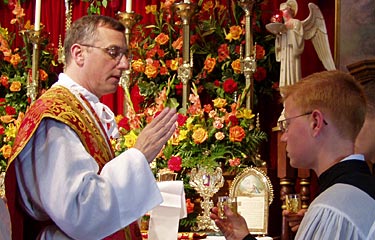
Fr. Anthony Cekada celebrating Mass very Romanly
Toward the end of Work of Human Hands Fr. Cekada argues on Thomistic grounds that the Order of Mass promulgated in 1969 is absolutely invalid in Latin or vernacular. Some hardline SSPXers used to argue that the common mistranslation of pro multis invalidated the consecration of the chalice; taken to its logical conclusion, there would be no Mass in that case and the consecration of the bread, since the Church does not consecrate outside of Mass, would also be invalid. But back to the more general validity issue. The reason Fr. Cekada gives is that the institution narrative in the new rite is treated as just that: a narrative, as opposed to a consecration formula. The words in the new rite, he says, do not contain the intention to consecrate and hence no consecration is possible, even if a validly ordained priest who intends to consecrate speaks the narrative words with the proper intention. Your eyes are not under the spell of glaucoma. You read it correctly. A validly ordained priest with the right intention speaking the words of consecration, which are the same in the new and old rites, cannot consecrate validly. So, is Fr. Cekada right?
 
His invalidity stance rests on intention within the "form" of the consecration. The old rite gradually builds up the priest's intention, from the sacrificial offertory prayers, through the thanksgiving prayers early in the Canon, transitioning into prayers for the living and dead, and concluding the Canon with an act of offering the Victim to God (Per ipsum....). The new rite certainly lacks this continuous flow, but I think Fr. Cekada would concede that it is not absolutely necessary. His position is specifically concerned with the consecration itself. At this point a little bit of history goes a long way.
 
When does the consecration happen? At Hoc est enim corpus meum and Hic est enim calix sanguinis mei? That has certainly been the prevailing teaching since the Scholastic era in the high Middle Ages, but it is not as clear cut as one may think. Around the 11th or 12th century priests, at the behest of the faithful often yelling from the nave, elevated the host and chalice during the Canon for their benefit and view. Some say this form of piety was a soft substitution for actual reception of the Blessed Sacrament, owing to the infrequency of reception that arose in the Dark Ages and which continued for centuries afterward. It is also at this point when scholars and theologians begin to question the specific moment of the "change." We are so accustomed to seeing those specific words of the priest as the formulation for the change that we read the rest of the Canon of Mass around it. But consider this: five centuries earlier the same Canon was sung, without pause, aloud in the tone of a preface in its entirety. A preface tone indicates that the prayer is concerned with blessing or consecrating something. The various signs of the cross and gestures made throughout the Canon differed diocese to diocese, sometimes greatly. Sarum, for example, has very few reverences (later genuflections) and a very different series of actions at the Per ipsum. For whatever reason at the end of the first millennium priests began to recite the Canon rather than sing it aloud and the gestures flourished as private signs of devotion in a private prayer. A consequence of these gestures was the partitioning of the Canon, in the priest's experience, into varying parts. The institution of the elevation of the elements had the same consequence, making the institution narratives a unique segment of the Canon.
 
Yet, without these gestures and motions we could read the Canon's text straight through and see that that institution narrative may well have been seen in earlier times as just that, a narrative. It is the justification, within the text of the prayer, for why the Church celebrates the Mass. It is hardly a story time, but rather is a public supplication to God on the grounds that we are obeying His Only Begotten Son's precepts. In those days one would of course agree that the change had taken place by the end of the Canon, although today we pinpoint it at the institution narrative. Months ago the Rad Trad published an appendix from an English translation of the Ordo Romanus Primus which contains a replication of what a Paschal Mass celebrated by the Pope may have looked like around the year 800 here. As readers will see the celebrant continues through the Canon unabated, without any special notice.
 
How does this influence our view of Fr. Cekada's thesis? The Rad Trad readily acknowledges that the change, the transubstantiation, happens at the narrative. Why? Two reasons: (1) the priest is given the power to consecrate and he intends to consecrate at this moment and (2) because the Church has agreed for a millennium to treat this particular point as the moment of transubstantiation. What the Rad Trad cannot do, and what the sedevacantist theory does do, is ignore the first ten or eleven centuries when the moment of change is at best vague or a little iffy. The Church, in her kindness and respect for tradition, cannot and does not uproot and ignore the prayers, beliefs, or intentions of previous generations of the faithful. It is for this reason that the Addai and Mari rite is valid. Liturgical historicity takes precedent over, admittedly Church sanctioned, Scholastic theology concerning forms. By ignoring this principle and by ignoring the history of the Canon itself one looks away from a legitimate reading of the narrative as a narrative. Hence the idea that somehow treating this part of the Canon as what it originally was invalidates it on defect of form is myopic.  Also, need the function of the institution words as a narrative and as consecration formula clash?
 
I have never met a priest or lay person who has read the narrative and thought any other intention other than consecration is latent in the words contained therein. One would think someone other than Fr. Cekada had caught on to the structural defects supposedly present in the altered Canon or new Eucharistic prayers.
 
Yes, it is very valid.

Licit?

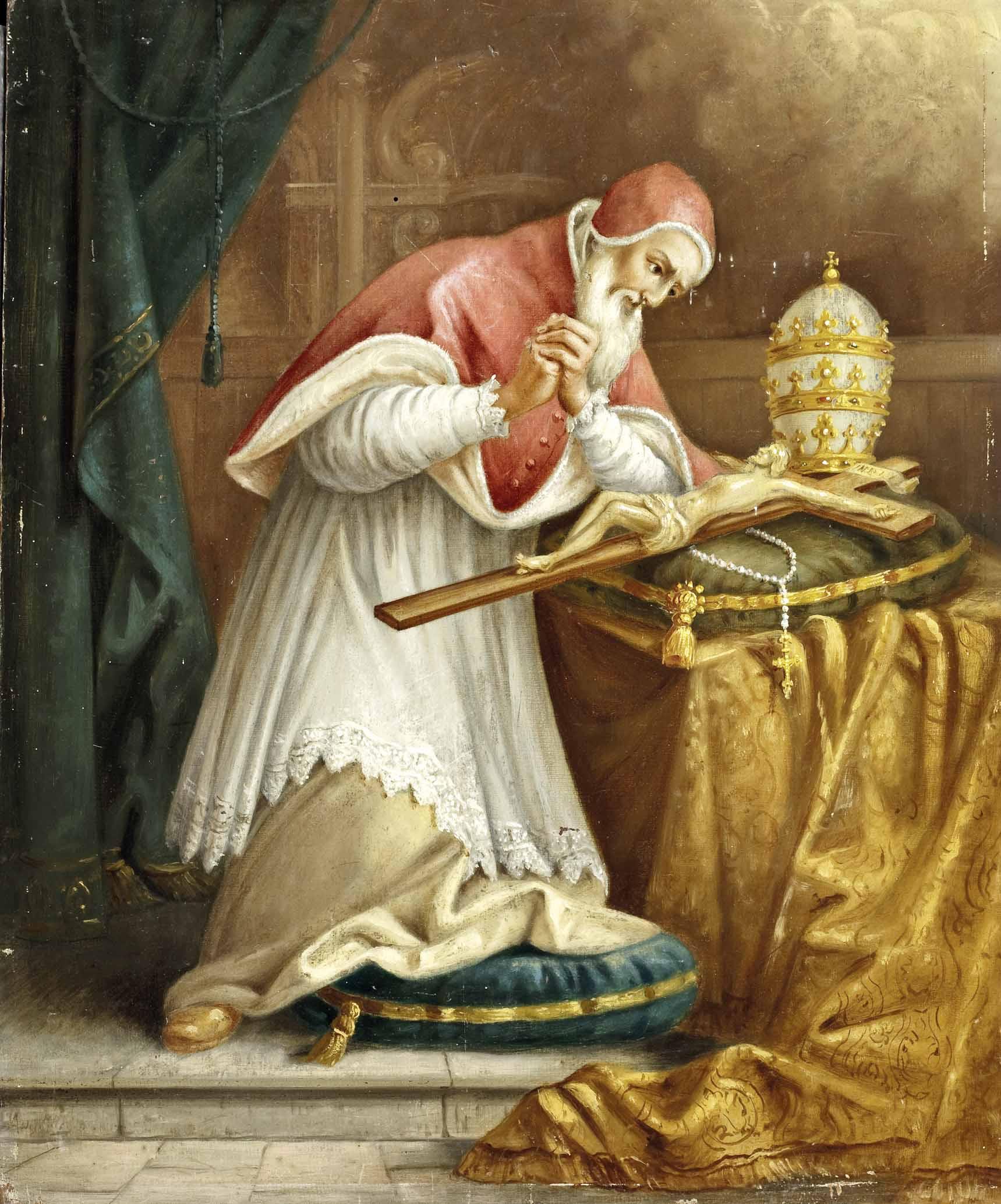
St. Pius V, Pope of Quo Primum
Part of the fallout within the Society of St. Pius X over Bishop Fellay's failed attempt to give his institution canonical standing was Rome's demand that the Society sign on to the "legitimacy" of the new rite. This sounds odd, but it really just means the legality. In short, was the "new Mass" promulgated in a valid, legal action by the proper authority? Some apparently say no. Others, like one Paul Kramer in his article Legal Status of the Tridentine Mass, argue that since Quo Primum is a dogma of the faith Paul VI avoided going into schism by merely publishing, rather than promulgating, the new Mass.
 
First, we will discuss Quo Primum. Both of these positions are really variations of each other and they rest on the principle that St. Pius V's bull Quo Primum made the 1570 Missal, or at least the Ordo Missae within it, a dogma of the faith that cannot be violated and which guaranteed that it could never be taken away. This is wrong at two levels:
  1. Quo Primum is primarily a legal document promulgating use of a certain liturgical book within the Latin Church. As a legal and administrative act it cannot bind a successor of equal status should he take the proper steps to depart from it.
  2. Neither Pius V, nor any following pope, thought it was such. Two years earlier the same Pius V published Quod a nobis promulgating a Roman Breviary for general use which contains the same rules of use and prohibitions against alterations and threats of Divine retribution as Quo Primum. Urban VIII did not go into schism or heresy by changing the hymns and no one has suggested the 1911 breviary changes were illegal or invalid (although they were unwise).
Confusion over this point may have been compounded when Benedict XVI wrote that the 1962 Missal was never abrogated, which begs the question: how is any following liturgy legal? Were priests who held out in the 1970s and onward justified in their use of 1962? The Rad Trad, no canonist, does know of one distinction in Canon Law that could serve us well here and which may not, legally at least, justify those who adhered to 1962 after the promulgation of the 1969 Ordo. In Canon Law there is a taxonomy of "derogation" and "abrogation." The former is the partial removal or replacement of the existing law while the latter is its outright suppression. To abrogate the 1962 Missal, Paul VI would have had to issue some sort of legal document explicitly prohibiting use of that Missal. This was clearly never done. The "extraordinary" rite was never abrogated. All well and good? New Mass illegal? Not so fast.
 
The Pauline liturgy was not introduced to the Latin Church by the abrogation of the "traditional" liturgy. For example, John XXIII compressed festal categories into Class I, Class II, and Class III, not abrogating the old calendar entirely, but derogating the ranking system within it in his Rubricarum Instructum. The same holds true for his changes to the breviary lessons, not abrogating the [not so] old Mattins, but derogating the particular way of picking lessons in place in 1955 (both changes were ultimately made by Pius XII, although John XXIII pulled the trigger on the 1960 set). Similarly the 1962 Missal was not abrogated with the publication of the 1965 Missal, but anything in it that differed from 1965 was derogated (use of Latin in readings, the Introibo prayers, the "doubling" of certain texts, ordinary of the first half of Mass in Latin, the communion formula, the Last Gospel, and some other details). 1962 was not strictly "abrogated" but it was by no means usable. The 1967 document Tres abhinc annos introduced further changes by derogating what was different in the 1965 Missal: optional use of a weekday lectionary, optional use of different orations, the Canon was not abrogated but the rubrics governing the priest's actions during it were derogated and replaced, the entire Canon is said aloud, and other alterations; interestingly, IV.17 in that document is the first official instance, to the Rad Trad's knowledge, of a rubric that assumes Mass facing the people could be ordinary and normal outside of a few Roman parishes. On the feast of the Assumption in 1968 the new Eucharistic prayers (2-4) were introduced, again not replacing the entire existing liturgy, but replacing and derogating certain rules and rubrics, this time governing the Canon, therein. A new Pontificale came about that same year.
 
Here comes the 1969 change. Paul VI did not introduce a new Missal or a new Mass in 1969. He introduced what was mostly a new text for the ordinary of the Mass. The Canon and Eucharistic prayers, lectionary, rubrics, calendar, and Divine Office remained unchanged from the previous year. Even some parts of the ordinary itself were unchanged, given the significant alterations in 1964-8. Perhaps the most dramatic different between 1968 and 1969 is the contrasting offertory prayers, but most everything else matches. The Missal introduced by Paul VI in 1970 again did not "abrogate" 1962 or even whatever was used in 1969, but de facto derogated whatever differed from it: the old sacramentary and [again, no so] old lectionary was replaced. Otherwise, 1970 and 1969 match up very closely.
 
The idea that the new liturgy is somehow canonically illegal or that the 1962 liturgy was abrogated relies on the view that the Pauline rites were introduced and imposed instantaneously rather than gradually and under transitional, derogation-based legal auspices.
 
Thank you for reading a such dry and disinteresting post,
The Rad Trad

Wednesday, August 7, 2013

Update

The Rad Trad has had a very unpleasant last week or so. He combatted a nasty cold while preparing for a job interview that took place today, only to discover that the position was basically an IT job when the Rad Trad's background is in Finance! Preposterous! This Friday or Saturday there will be a post on the ascetical treatises of St. Isaac the Syrian and soon there after my [over due] review of Dr. Hull's Banished Heart.
 
As a quick preview of Banished Heart, I do not know what sort of reviews the work received in 1995 when the first edition was released, but the latest edition went somewhat un-noticed aside from a review in the Usus Antiquior journal. It is worth asking why the book has gone un-noticed outside of more scholarly circles while Fr. Cekada's well-researched Work of Human Hands and Michael Davies' elementary Pope Paul's New Mass continue to get traction. The Rad Trad firmly believes that most of the traditionalists of the 1970s-1990s are, or were, ultramontanists in search of Pius X and hence were wary of criticizing the Pope, Papal authority, or the actions preceding the introduction of the new liturgy (which readers of this blog hopefully realize by now was a very gradual process). An example of this attitude is a story Msgr. Fellay tells of Cardinal Journet, having read the infamous #7 of the 1970 GIRM, storming into Paul VI's office and showing the Pontiff the troublesome excerpt; the Pope then breaks down in tears, revealing that he had not read the text before signing it. This is ridiculous.
 
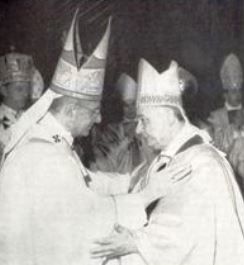
Pope Paul VI. He knew what was going on!
Banished Heart, thus far, tells of an over-extension of Papal authority into other liturgical traditions, both East and West, and the legalistic view of the Church that resulted from it. Anything that was not Roman was to be suspected of heterodoxy. Early in the book Dr. Hull asks questions such as "Is validity everything?" Some uber-traddies, such as sedevacantists, curtail the moral argument here by suggesting that the new liturgy is somehow invalid. Yet it is a serious question. Do a low Mass and a solemn Papal Mass with full ceremony not have different value? I think readers see where this is heading. Banished Heart does not play into the conventional narrative that Vatican II and Bugnini, a possible Mason, crept out of the shadows to destroy the liturgy and replace it with a primarily ecumenical service. Thus far my only criticism of Dr. Hull's work is that it contains no working definition for the traditional Roman liturgy which, given the book's subtitle, Origins of Heteropraxis in the Catholic Church, might be relevant.
 
The book presents challenging questions to Roman Catholics of all backgrounds, to Eastern Catholics, and to the Eastern Orthodox, whose separation from the Apostolic See in Rome is given a very different light than the one usually shone upon it by mad Romanists or by culturally-rooted Eastern prejudices.
 
Lastly, I am sorry for ignoring your comments, some of which have asked me direct questions. I will try to reply to a few of them in due course.
 
The Rad Trad, over and out.

Friday, August 2, 2013

Apologies

The Rad Trad apologizes to his readers for such a long period of inactivity. He has had computer issues. Soon enough the Lesser Known Fathers series will continue with the ascetic writings of St. Isaac the Syrian and a, hopefully, thorough review of Dr. Geoffrey Hull's Banished Heart: Origins of Heteropraxis in the Catholic Church 

The Rad Trad also joyfully anticipates the feast of Our Lady of the Snows on Monday. For some reason he has always had a soft spot for this low key Marian celebration.

God bless,
The Rad Trad

Monday, July 29, 2013

Ancient Roman Office

Herein we shall have a very brief history and synopsis of the ancient Roman Divine Office, which was preserved into the thirteenth century in the major Papal basilicas of Rome until Pope Nicholas III, a Franciscan, imposed the books the Franciscans used, meaning the books of the Roman Curia. This is fitting, given that a Franciscan pope caused liturgical trouble in the Church of Rome and now today the pope of Rome causes liturgical trouble in a Franciscan order! First, we should endeavor to understand how the idea of singing the psalms and lessons according to the hour of the day came about in the first place.

The general consensus, according to Pierre Batiffol a century ago, is that a vigil of prayer preceded the celebration of Mass/Divine Liturgy in churches every Sunday. The origin of this practice is itself obscure. Some theorized that Christians merely extended the Paschal Vigil, what St. Augustine of Hippo called the "mother of all vigils," throughout the year. As one might surmise from the etymological origin, vigilare, a vigil is a watch of prayer before something important, in this case the Eucharist of Sunday, the Lord's day. St. Jerome supposes that the evening vigil reflects the Apostolic expectation of the return of Christ, itself an anti-type to the evening exodus and liberation of God's people, the Israelites, from Egypt (Commentary on Matthew 4).

source: newbyzantines.net
Some like Batiffol expect the vigil on Sunday began at cockcrow, while some others, less popular, might sympathize with the medieval practice of beginning the vigil at midnight. The vigil itself varied drastically from place to place, but we can say that it involved the reading of the psalms, of other holy books (remember the Canon of Scripture was not codified until the end of the fourth century, so we cannot just assume they were "reading the Bible"), and some sort of responsorial prayers—adopted from the Jewish practice of chanting an invocation to which the people would respond with a doxology such as Amen. The Gloria Patri.... is a sort of prayer ending of this variety, albeit used for the psalms rather than for the more variable prayers. The psalms appear to have been recited or chanted by a single reader or cantor in a monotone. St. Athanasius in the fourth century ordered readers to fluctuate the tones of their voices for the benefit of the laity in attendance. Ss. Athanasius and Augustine attest to deacons chanting the psalms alone, which persists in the choral practices of the Byzantine rite and which remained in various usages of the Roman rite—such as Good Friday in the Lyonese use—until the twentieth century. Between the verses of the psalm the choir would chant antiphons, which became increasingly elaborate in time, giving rise to a "responsorial psalm" (the reformers of the twentieth century misread this as a popular part of the liturgy which died off in a fit of clericalism and "restored" it in the Pauline Mass; the responsorial psalm was a clerical part from the beginning). This practice originates not in Rome, but in Antioch. St. John Chrysostom brought it to Constantinople, where it became popular and eventually traveled from the new capital in Asia Minor to the old capital in Milan. Rome, as we shall see constantly, was very slow and wary in adopting this practice, only taking on choral responsorial chant in the fifth century, a century after monastic-influenced Africa and Byzantium.

St. Lawrence outside the Walls
source: penitens.blogspot.com
Eventually vigils became more and more common. The Church in Constantinople had a vigil every single night. In contrast, St. Jerome remarks, Rome held the vigils only on Sundays and the nights anterior to great feasts. Here we see a very local part of Rome's liturgy. The idea of a "stational church" originates in the vigil. For feasts of local martyrs and saints the vigil was in ancient times held at the cemetery were said saint was buried, or at least in a proximate house. When churches were constructed they were built on the sites of these cemeteries or burial spaces, St. Peter's basilica being the most famous example of this. The vigil then would not take place in every church of Rome, but the Pope and the clergy of the stational church, perhaps St. Lawrence outside the Walls on the night between August 9th and 10th, would hold the vigil and the following Mass in that particular church. Rome eventually came to the practice of the rest of Christendom and had daily vigils, as St. Benedict instructs other monks to observe in his Rule (13).

Enough about the timing and frequency of the vigil. What was the vigil? The vigil consisted of three parts: an evening service, a night time service, and a morning service, which are equivalent to Vespers, Mattins, and Lauds today. This is not very difficult to see in the names within the services. Vespers, from vesperae, meaning shadows or darkness. Mattins, from matutinus or "early," is comprised of nocturns, from the word nocte or "night." And Lauds is from Laudate, the opening word of two of the three integral psalms in the pre-1911 psalter. Easy! Vespers might begin around 4PM in the presence of the bishop, who would leave and rejoin the congregation later in the night, or early in the morning if you will, for Mattins. Lauds became seen as so important during the latter half of the first millennium the presiding cleric would often, depending on the time of year, signal all present to cease Mattins and head straight into Lauds the moment the light of the Sun entered the church.

Monks of Bethelehem
source: news.ripley.za.net
Outside of Rome, in the mid first millennium, we see a rising tension between the secular clergy and monks, who are often imposing their psalmody on parishes to the annoyance of the local bishops. Yet there developed, in Rome and abroad, a middle ground between hermetical monks and the regular laity. Since the age of martyrdom was more or less over, the very devout, often celibate or virgin, took to singing psalms together in community during the daytime without the presence of a cleric. Imitating the Jewish practice of observing the daytime hours, they prayed at the third, sixth, and ninth hours—terce, sext, and none. Parts of these daytime hours as practiced in ancient times remains in the unreformed Holy Week as it existed before St. Pius X tinkered with the psalter and made the little hours variable. The psalms did not have "doubled" antiphons nor did they have hymns nor introductory rites. They were simply sung beginning with the sign of the Cross and ending with some prayers.

Yet at late as the sixth century the little hours of the devout laity were just that, for the devout laity and not part of the "Office." The hours of Prime and Compline came last, in the fourth century among hermetical monks of Bethlehem. The leaders of monastic communities noticed that the monks had far too much free time to sin between the beginning of the vigil with vespers and Mattins later in the night, and between Lauds and Terce, so they imposed prayers to be sung during those period. For this reason we often call Prime  and Compline "chapter" hours, hours sung by the monks in common outside of a liturgical setting. One wonders why the reformers axed Prime on the false grounds that it was a mistaken repeat of Lauds but kept Compline as "night prayer" as though it was somehow more authentic. As with Lauds, the psalmody chosen for Compline reflected its character, in this case nocturnal. The lingering darkness and uncertainty of night made psalm 90, which speaks of the Lord encompassing us in His shoulders, a source of constant succor.

Back to the Roman vigil. Even in the time of St. Jerome in the late fourth century Rome still sang psalms straight through, without a "choir" concept we have today. Within a century or so we have antiphons sung in between the verses of psalms by the choir, while a deacon or subdeacon chants the psalm itself. There are lessons at Mattins, three from Pascha until late September, and then four lessons from late September until Pascha, when the night is longer. The lessons could be taken from any number of sources according to the parish or monastery's means. Whatever Scripture was available might be read, such as an Old Testament book or a Pauline epistle. The reading was not very exact in length and would end whenever the presiding cleric had heard enough. These readings could be quite long. The Abbey of Cluny, full of very eccentric monks, boasted of restoring the ancient Roman lesson length to the point where they could read the entire book of Genesis at Mattins in just a week; certain monks were ordered to walk the choir stalls and wake any others who had fallen asleep during the onerous readings.

Lessons started to come from non-Scriptural sources as well. St. Gregory the Great recommends that at Mattins his friend, Marinianus, ought to read the pope's commentaries on the psalms at Mattins rather than his writings on Job.

We can also guess that by this time the structure of the Office had become more or less set. Mattins would have three or four lessons on a ferial day and nine on a feast day, with twelve variable psalms on a feria and nine on a feast. The offices began with the sign of the Cross and psalm 69 followed by a doxology and then the proper psalmody of the day. Finding this too long, the Curia eliminated psalm 69 but kept two lines of it and the doxology at the end (Deus in adiutorium.... Domine ad adiuvandum.... Gloria Patri....). In the first half of the first millennium the readings were done in a ferial tone by the senior-most clergy, a place of honor. By the seventh century ornate Roman chant had become so developed that children often sang the lessons as liturgical ministers. Popes Leo II, Benedict II, and Sergius I entered the clerical life as choir boys who read at Mattins.

Batiffol at this point draws attention to an interesting phenomenon: without Imperial aid, churches in Gaul, the Frankish kingdom, and even England sought to imitate the Roman Office practiced at the Lateran Cathedral and St. Peter's basilica. Perhaps one source of variation between the Roman rite and local uses was the limited resources available for transmission, beyond basics like the psalter. Antiphons with their ornate chants were bound in a separate book, as were the Scriptural lessons (perhaps several book). Even if the psalter and texts could be carried from Rome to York the tones of the psalms and the ceremonies surrounding the Office would inevitably vary.

Also unique to Rome were the ornate and long responses after the lessons at Mattins, often two or three lines long. They are usually attributed to St. Gregory I, but are more likely the collective work of Popes centuries before and a century after Gregory the Great. The responses at Mattins, and antiphons for the rest of the Office, become more or less fixed by the eighth century in St. Peter's basilica, the main pilgrimage destination and liturgical envy of Europe. One contribution Gregory the Great did certainly make to the development of chant was his establishment of monasteries at the major churches of Rome. St. Peter's basilica had no less than three monasteries in the first millennium. Monasteries were eventually supplanted by chapters of canons, but their musical influence endured.

At this point it is worth saying something about the ceremonies surrounding the main hours in the ancient Office. The Pope would enter the church in a chasuble—no choir dress and copes were more like rain coats at this time—and go through the ceremonies of an episcopal visit; he would then preside from his throne behind the altar, facing the people, surrounded by the canons or monks of the church in order of seniority, with hundreds of candles lit nearby; cantors, deacons and subdeacons, would take their place at ambos on either side of the altar and a lecturn would be installed for the reading of the lessons, either facing the altar from the apse or facing the altar and Pope from the opposite side. The nature of the ceremonies was a balance of congregational and monastic, whereby clerics performed the liturgy, but directed the more didactic parts of it to the laity.

The Office of St. Peter's took on a special importance to Europe and became the golden standard of Roman liturgy. As Msgr. Batiffol reminds us, Benedict Biscop, teacher of St. Bede the Venerable, managed to convince Pope Agatho to lend him a few monks from St. Peter's to teach his English monastery the Petrine Office. The long and elaborate scriptural responses of Mattins became popular in the Frankish lands and a mainstay of the Offices of diocese and monasteries on those areas. People used the Roman Office because they wanted to do so, not because they were obliged. In utilizing the Roman Office as far as possible, clergy created a localized expression and began local customs in liturgy that would help them perform and express their adoration for God in a way unique to them while remaining substantially united to Rome in the essence and text of prayer. Unique variations developed in the late first millennium outside of Rome. For instance in the lessons at Mattins at the end of each nocturn Gallican clergy would recite the Pater noster while at St. Peter's in Rome they would pray a short absolution. What comes to us today is a merger of both practices.

Perhaps curious to us is that the ancient Office did not commemorate the saint of the day. Pope Gregory III is said to have constructed small shrines in St. Peter's basilica with short offices in honor of the saint of the day to be prayed in those places. Eventually the two became fused as monks shirked this extra duty.

In the eighth century scholae are established everywhere from Rome to Rouen according to the rites of St. Peter's basilica, effectively snuffing whatever might have been done in the Gallican practices. The long, subtle Roman Office triumphed in Europe, but outside of St. Peter's it was not immune to fluctuations and changes.

The old St. Peter's basilica, bastion of the old Roman Office. Note the Leonine wall to the south.
source: wikipaintings.org
Another variation that arose was in the translation of the psalter. Ever notice that the antiphons in the Office and the proper chants of Mass differ a bit from the psalm texts in the Vulgate? There are many examples of this. For instance erue me versus eripe me in translating psalm 42. The Church in France under Charlemagne and his successors used the "Gallican" psalter of St. Jerome, the saint's third translation of the psalms, while at St. Peter's in Rome they used an earlier translation of Jerome's, which was just a minor revision of the Latin texts he received. Therefor proper texts like antiphons and chants, which one reads prepared in a book, would be static while the most familiar psalm text might just be sung in a tone.

The repetition of each antiphon after a psalm verse died a slow death outside of Rome, but remained until the turn of the millennium at some places like Cluny or among the Canons of St. Martin of Tours. Similarly, the Gallican psalter supplanted the Roman psalter outside of the Lateran and St. Peter's.

Another feature that seems to have changed is the "chapter," the very short scriptural lesson after the psalms in each hour. The monk Amalarius, a student of Alcuin, has lessons at the minor hours, including Compline. What the hours might have looked like in the old Roman Office can be found in the pre-1911 Offices for Holy Week: each hour is begun with the sign of the Cross and an antiphon; the psalms and antiphons are sung straight through with no lesson, only a response, at the end; depending on the hour there might be a canticle; then a closing prayer functioning like a collect (although not taken from the Mass, the texts of the Mass and the Office did not overlap as much as they did after the 13th century).

The lessons, as mentioned earlier, went on as long as pleased the presiding cleric, often an abbot or the Pope himself. The practice of reading Scripture, which seems impromptu, dates only to the late 700s, but became a fixed part of the Office, albeit in a reduced form outside of Rome and Cluny. I wonder, are the Tenebrae lessons of the Triduum abbreviated for Curial purposes from longer originals? It seems possible.

Perhaps an important factor in the reduction of the core of the Office and addition of hymns and collects from Mass outside of the major churches of Rome is the number of books necessary to pray the Office: a Bible, or collection of Scripture books; a psalter; an antiphonary; a book of homilies for the lessons; and, later, a Sacramentary. This books could take years to make and consumed precious resources. It was much easier, for instance, to shorten the Wisdom selections for August and protract their reading than to speed through them and be out of books, forcing repetition. We read, in the mid-700s, Pope Zachary donating books to St. Peter's basilica from his private library for the public Office. Even the main center for pilgrimage in Europe was not immune to a shortage of funds for these expensive liturgical resources!

Fr. Finigan doing it the rite way in Blackfen
(Zephyrine, you lucky duck!)
Another point of interest is the kalendar. The Sundays of Advent were not penitential, but joyful in the ancient Roman Office. Batiffol examines the Mattins responses for the first Sunday of Advent, which you can read for yourself elsewhere. The concept of Advent as a penitential season seems to be of French origin rather than Roman. The great O antiphons sung as the Feast of the Nativity approaches, corroborate this hypothesis. The mid points in Lent and Advent, Laetare and Gaudete Sundays, were also great days of the year which merited the Pope's public celebration of the entire liturgy as late as the Middle Ages.

Moreover, according to Pope Hadrian I and later sources on the great feasts of the year there were two celebrations of Mattins at the stational church on a given night. The first, without the elaborate introduction, would be the ferial Office. Later in the night would come the festal Office and the rest of the day would follow as normal. Simple-ranked feasts were compromises between the festal and ferial Office. They were important enough to celebrate, but too local for the same treatment as universal feasts like the Nativity or St. John the Baptist. So the ferial psalms, aside from Lauds, were sung but with festal antiphons on the canticles and prayers pertaining to the saint of the day at the end of the major hours.

So, how did the "traditional" breviary/Office we have today, or had until 1911, come into being? Certainly the groundwork for it should be visible to my more liturgically oriented readers. In 1241 Gregory IX gives the Minorites (now colloquially called the Franciscans) the use of the "modern" Roman Office, which begs the question: what the heck is that?
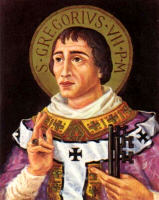
St. Gregory VII, a monk, was
not a fan of reduced Offices
The "modern" Office was a variation of the Roman Office used by the Curia in the Lateran Palace, although not cathedral, from around the time of St. Gregory VII onward. It has many influences from outside Rome, particularly from France. The "modern" breviary, for instance, utilizes hymns before or after the psalms, depending on the hour. Hymns were not a complete innovation, although hymns as we know them did not take liturgical flight in either Rome or in the Eastern Churches. St. Benedict, although generally following the Roman way, prescribes hymns in his Rule the same way we sing them now. "Ambrosian" hymns, following a specific sort of meter attributed to the patron saint of Milan, became very popular in monasteries and in France. The international nature of the Curia and the re-emphasis on monasticism from St. Gregory VII throughout the high Middle Ages imported elements from priories and foreign cathedrals into the Papal Court. Somehow the Lateran Cathedral managed to resist hymns in their Office until the 12th century! Even the other local churches of Rome had long ago taken on the newer practice.

A tension between the Roman Office and the Curial Office arose in the 12th and 13th centuries, during which the Curia, outside of public Papal celebrations, used their Gallicanized, modern Office exclusively. Innocent III lamented that the Curia only used the true Roman Mass and Office on the feast of St. Peter's Chair in Rome. The Mass, unrelated to this article, may have differed too. Example: at Papal Mass a cardinal deacon and the local sacristan would arrange the burse, chalice, and bread on the altar during the Creed. The Tridentine practice—wherein the deacon of the Mass prepares the burse during the Creed and the subdeacon prepares the matter for the Eucharist during the Offertory—was a Curial adaptation for smaller spaces and less elaborate liturgies. In his own time Gregory VII blamed shortening and simplification on laxity among the clergy. One wonders what he would think of the Liturgia Horarum, which one can recite, for the entire day, in 30 minutes or less! John Beleth wrote in the 12th century "How many of us are found joyfully to rise with the Sun to say the Divine services?.... How many are they who conscientiously recite in due course the Office of the day? Few indeed, and very few, if the real truth be told."

Another point of note is that the Office, among the Curia, was now more frequently read than sung. St. Leo IX is recorded, in the 11th century, to have piously recited the Office in private daily, a proof of his holiness and sanctity. Given the need for books outlined a few paragraphs ago, we must ask: did a "breviary," an abbreviated version of the Office text without musical notation, exist even then? If not it certainly existed two centuries later. The word "breviary," from the Latin breve, means "brief" or "shortened" and is directly linked with the Franciscans, who wished to carry the modern Curial Office around in a single volume. Thus the breviary for private recitation was born. The Rad Trad, who has no firm scholarly ground for this assumption, guesses that parish priests outside of cathedral cities, probably just recited psalms with a Pater noster at the end rather than an entire Office, with hymns and antiphons, every day.

Nicholas III, Franciscan and
liturgical dissident
At the same time the Papal Court slowly drifted away from the Roman Office as devotion to the Virgin and prayers for the Church Suffering in Purgatory increased. Clergy of the major cathedrals and collegiate churches of Europe would sing the Little Office of the Blessed Virgin on days with three lessons at Mattins and perhaps also the Office of the Dead. The Office of the Dead would, at least, be recited on Fridays of Lent. It was not inconceivable that on a Lenten feria, between the Office of the day, the Office of the Virgin, the Office of the Dead, the seven penitential psalms, the Mass of the feria, and, if it occurred, the Mass of a feast, a canon or monk might spend near ten hours singing. This was truly onerous (compare that with the 1975 Pauline Office!). Inevitably canons and monks viewed this schedule of prayer as a burdensome daily grind rather than as God's praises. Liturgy became a grueling obligation, which is perhaps why when Pope Nicholas III completely suppressed the ancient Roman Office he met no major opposition in doing so.

In 1223 the Franciscans obtained the Roman breviary books and may or  may not have "corrected" some aspects, such as which psalter was used. The order was permitted to celebrate local feasts where ever they lived, but had to fit each feast into the relevant Common and never rank it above semi-double. As a result the kalendar took on a lot of extra European saints with little international or distinctly Roman importance. The Rad Trad cannot verify, but guesses some of these feasts were "scrubbed" by St. Pius V in the aftermath of the Council of Trent.

And there it is. The reduced Office for Curial use which made Innocent III lament, himself a former canon of St. Peter's, became the Office of the Franciscans, which in turn became the Office of Rome, which in turn became the Office of Europe. Although the communal nature and structure of the ancient Office died with the clerically focused Curial Office, vestiges of the older Office remain, for instance, in the old Triduum Offices and from Pascha through Low Sunday. The psalm schedule remained and the psalm translation for antiphons and propers of Mass stayed, too. The effect of the impositions of Nicholas III and Trent was an abbreviation, but not a complete loss or change. If there is a real tragedy in all this, it is that the Office used at St. Peter's was the golden standard of the Latin Church and remained for so long, only to be eventually seen as an unneeded weight on lethargic clergy. The popular element of the Office, which incorporated local feasts, interaction with the bishop (in this case the Pope), and participation of parish clergy, was lost for a convenient minimalism.

Of course, as the Rad Trad has suggested earlier, there is no "going back," but we can learn the lessons of liturgical history, lest we traverse the roads of worship with only the most plain and un-detailed maps of the Divine cult.

Saturday, July 27, 2013

Old Believers

Some readers might be aware of a Russian, and to some extent, Romanian, Orthodox group called the "Old Believers." Their's is a fascinating case study in liturgical upheaval's most extreme consequences. The Patriarch of Moscow in the mid-17th century, Nikon, noticed differences between the Greek and Russian Church liturgies in some very basic matters: the direction of a procession, how to say the Creed, how to make the sign of the Cross, and even Our Lord's Holy Name. Nikon, in a bout of wisdom from Solomon, assumed that whatever was Greek must be older and hence more authentic. He imposed many major liturgical changes (so much for those who think the Byzantine rite is super ancient and un-altered) and, with the help of an Orthodox synod in the 1660s, even anathematized the older Byzantine liturgical practices with the czar's approbation. Many who refused the changes, the "Old Believers," suffered violent consequences, including Feodosia Morozova, whom they esteem as a sort of martyr for her death-by-starvation in a jail cell. The resulting schism endures to this day.

Many Old Believers have dispersed throughout Eastern Europe in small droves and even into Alaska, where one community frequently attracts the attention of the press, which sees the Old Believers as a quaint, Amish-like group of benign persons. Most tragic about the Old Believers is that they were probably more in the right than Nikon was, who just assumed whatever was Greek must be better. I do not know much about mid-second millennium Byzantine liturgy, but as a former student of medieval history I can say that as a center of trade and the delta of several currents of ideas from Latin Europe, Arab North Africa, the Holy Land, and the former Greek Empire, the Constantinopolitan liturgy would be especially susceptible to alterations and changes. Moreover, the wealth of Byzantium, until its fall in 1453, meant both institutions and individuals could afford the creation or copy of books, fostering many opportunities for typographical errors and the machinations or copyists. Russia, as a poorer and geographically desolate place, would be better suited for the preservation of written and oral liturgical traditions.

This should be a lesson to those who wish for immediate liturgical changes. Even enthusiasts for the old rite ought to realize that an outright and instantaneous change in the Latin rite would do more harm than good.


Tuesday, July 23, 2013

Winchester Cathedral

No, not the Geoff Stephens song. The actual Cathedral in Winchester, England. This post is somewhat inspired by Marko's comment on a previous post which called attention to a pair of Latin Masses in Anglican Churches. I made an offhand comment about a "reverent informality" for the Divine things that often existed in the Middle Ages. I hope that a quick look into one of the finest churches of the Middle Ages could provide some insight as to what I meant.
 
Two quick points: (1) the Rad Trad purports no expertise concerning Winchester Cathedral, so he will only be relaying his impressions from a personal visit and his poor knowledge of the liturgy; (2) except for the floor plan, all images are from the Rad Trad's collection, so no copyright issues.
 
The diocese of Winchester dates to the seventh century and boasts many great English saints, most notably Swithun and Birinus. The enormous cathedral that comes to us today dates from only 1079. The building's foundations, built on a wetland, only go a few feet into the ground. At the turn of the last century the cathedral was actually sinking in some parts, though this problem seems to be resolved. Many famous events took place at Winchester, including the marriage of Queen Mary Tudor to King Philip II of Spain. Author Jane Austen is buried near the entrance. I am tempted to repeat something an English priest once said about the presence of her tomb, yet I think in the interest of taste I shall hold my tongue.
 
The layout is a classic medieval cruciform shape, although no baptistery exists off the side, as one might expect. I am unsure if perhaps it was destroyed or simply never existed, given the date of the cathedral's construction.
 
source: Wikipedia
The purpose of medieval architecture was to create a convergence between heaven and earth, to blur the lines between where men lived and the altar that the Son of God deigned to visit. The cathedral is gathering place for the believers of a city, and also the place where, until Trent, the bishop would instruct the people in the faith. Lastly, cathedrals were temples of God, places where sacrifice was offered to the Father in fulfillment of the Sacrifice of the Cross.
 
For all these purpose cathedrals like Winchester took on a general style adjustable for local needs and local character. The cruciform shape recalls the Latin emphasis on the Cross, as opposed to the generally round Byzantine churches which are more reminiscent of the Imperial Court. Many cathedrals, notes Dr. Laurence Hemming, were built on water, reminding us of that psalm that substitutes for the Asperges during Paschaltide: "I saw water flowing from the right side of the temple...."
 
Out of necessity the buildings were naturally luminous. Enormous portals of light washed Winchester in an albescent effulgence reflective of the un-caused energy and light of God reveals to Peter, James, and John on Mount Tabor.


Yet despite the natural necessity of large windows, the builders felt no constraint in making a theological expression of the Divine nature in the arrangement of these windows. Typically the lower windows of a cathedral are large and of stained glass in the nave, emitting a rich floral array, but clearer towards the top, basking the upper part of the building in white light which better illuminates any depictions of heavenly things on the ceiling.

A variation, seen in the transepts of Winchester and more prominently in the nave of the abbey church at Cluny, augments the size of the windows either as one approaches the altar (Cluny) or as one raises the eyes upward (Winchester). The effect is an understanding of the celestial powers over the temporal.

The view to the right, which is of the North transept of Winchester Cathedral, details this last point rather splendidly. Places like Winchester did not become temples of God only by virtue of their consecration by bishops, but by the very nature and intentions of their builders to create a reflection of heaven where the faithful could carry on their conversation with the Trinity and the Saints: "But our conversation is in heaven; from whence also we look for the Saviour, our Lord Jesus Christ, Who will reform the body of our lowness, made like to the body of his glory, according to the operation whereby also he is able to subdue all things unto himself" (Philippians 3:20-21). One does not come to a building like this for merely formal worship, but to become immersed in the spiritual, to commune, to pray perpetually, to gather in the rites of the Church, but also for private devotion.

This point held true for the priests as much as the laity. When concelebration died out in the Latin Church in the Middle Ages, private Masses began to take its place. Consequently altars began appearing in places normally reserved to private devotion. In this instance the private Mass was the priest's private devotion. Priestly monks and canons not assigned to the conventual Mass of the day would go to their customary chapel with a server, usually an apprentice (now a seminarian), and would pray a votive Mass particular to the day of the week unrelated to the feast or feria of the day. Mass could be done a little differently at each altar and the rubrics began to mix with pontifical Mass to create some of the unique ceremoniale of a given local rite.


The above chapel, below the Choir and Sanctuary on the North side, should end any notion that medieval religion was dark, dreary, and desolate. This chapel was once ensconced in images of the Divine mysteries, images which time and neglect have sadly faded from contemporary view.

Tilt your head to the right and see what looks like Christ the Pantocrator
Yet the image of Christ, similar to the Pantocrator icon above the Holy Places of Byzantine churches, watches the place where a priest once prayed daily Mass. Laity might enter this place around 7:00AM, an hour or two before the conventual Mass, and find a few dozen Masses hidden in the various chapels, chanted in either a simple tone or a monotone. Lay persons, in attending, might "hear' the whole of the Mass or only remain for the elevations and leave. Such was medieval piety. The elevations of the Sacred Species were themselves innovations of medieval piety.


The focus of the cathedral is entirely vertical. We expect this tall and narrow view on our neo-gothic American and English churches, but it is hard to appreciate without the massive scale of a place like Winchester.


The Choir of the cathedral is where the monks and canons would spend several hours a day, beginning very early in the morning, singing to and about God. Like the chapels, each monk or canon would have his own choir stall. Although not a social arrangement, the proximity of those in choir to each other, the conversational arrangement of the choir stalls (one across from the other), the social hierarchy (the episcopal throne closest to the altar, followed by the rector and senior-most canons), and the relatively enclosed space engendered a certain degree of familiarity with what was going on in the Choir from day to day.


Because of the communal arrangement the lessons at Mattins, the antiphonal chants of all the Offices, the propers of the Mass, and the readings of Mass, were sung from a lecturn in the middle of the Choir. The Tridentine arrangement of, for instance, singing the Epistle a few feet away from the altar directly behind the priest is the result of imposing a Missal with rubrics suited to office staff praying Mass in a limited chapel space. Entirely different game here. I see no good reason why the traditional choir arrangement could not be resurrected in the setting of the Roman books. It was probably done in the Roman basilicas for most of Rome's Christian history.
Another one of those lovely side chapels

Side chapels and Choir arrangements, far from separating the congregation from the enclosed clergy, figured prominently in the Sunday worship. I remember once reading of a saint who suggested those that attended low Mass on Sunday cheated and failed to meet their Sunday obligations. A "real" Sunday obligation was met by waking up before the crack of dawn and attending Mattins and Lauds. During the interstice between Mattins and Lauds and the Mass the laity would visit the various chapels and pray to the saints honored therein. Or perhaps they would pray for the dead, either those of prominence buried within the cathedral or deceased family in humble graves. The Office of Prime, a "chapter" hour, would not likely be chanted within the Cathedral. This meant the congregation had dedicated time to their private devotions and practices. One advantage of this era is that most dioceses had their own saints canonized through local devotion in the first millennium rather than those recognized by Papal bull, which imbued some of these shrines and altars with a distinctly local character.

Where the shrine to St. Swithun once stood. This place, located behind the Choir and Sanctuary
was in medieval times where the foremost saint of a diocese would be buried (Becket at Canterbury,
St. Osmund at Salisbury etc.) The bronze tent unfortunately obstructs the "hole" leading under the
altar where the faithful would crawl to be nearer St. Swithun's tomb.
A better view of the "hole"
Before the main Mass on Sundays the canons and monks would sing the hour of Terce and then lead a procession around the cathedral, visiting each altar and singing hymns and prayers to the saints honored there.

The faithful, depending on their interest level, might continue to pray unmolested at their private places within the cathedral and "absorb" the chant and prayer resonating above or they might participate in the procession. Some wealthier and more literate members in attendance, normally nobility, would pray the Little Office of the Blessed Virgin Mary during the time before Mass. The "bidding prayers," which in content more resembled the old rite intercessions on Good Friday than the "For everyone getting along and feely gushy, let us pray to the Lord" material heard in most modern parishes, were prayed in vernacular before the Rood Screen. The clergy would vest either at the main altar after the procession or in the Lady chapel before the procession.

The reredos and altar are, to the Rad Trad's knowledge, not original, but re-constructions done
in the 19th century by a High Church bishop
Despite the enclosure of the Rood Screen, in this case a restoration and not original, the ceiling really unites those in the Choir to the rest of the building.


A few peculiarities of Winchester's reredos are the very Romanesque-looking Roman saints, given the influence of branch-theory in the 19th century, and the post-medieval, Renaissance-like vividness of the statuary.

The Rad Trad found this specific depiction very surprising and very powerful
After the conventual Mass on Sunday people would go their separate ways. Some might revisit the chapels to make thanksgiving or to witness private Masses. Others would spend time with their families and finally break the fast. Many would then return in the evening for Vespers and another round of saintly devotions.

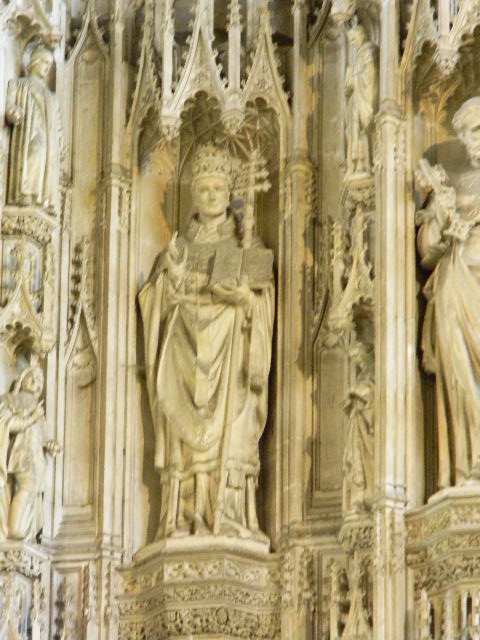
A very Popish-looking Pope!

Such was liturgical life before the Reformation, when the Latin Church became very minimalistic. If anything the line between private devotion and public prayer became more formalized and strict. The public prayer was reduced to bare essentials (a valid priest using a rite approved by the Congregation of Rites in Rome) and devotions were seen as a legitimate substitute for formal liturgy, rather than part of it or an addition to it. Something I have noticed in the Byzantine rite, which was in my mind when reading Marko's comment on informal reverence, was that no one thinks twice about taking time out during Mattins to light a candle or kissing the icon of the Virgin who carried Christ after receiving communion. Call me crazy, but do pews (and the modern GIRM) not prevent this sort of thing in the Roman rite? Everyone has a space to which they feel constrained for the next hour or so. If one leaves the assigned space and visits a chapel to pray during communion or to get closer to the sanctuary during the Gospel one arouses at best unwanted attention or at worst draws the stern eyes of the liturgical police. Yet this is precisely the reverent informality that existed once, and still does in many places, in the Latin liturgy. The entire experience of being in a cathedral, or a lesser parish, should be a continual interaction with God.

On days with three lessons at Mattins the Choir would pray the Officium Defunctorum and the Little Office of the Blessed Virgin in the Lady Chapel, invariably at the back of the cathedral in the Middle Ages.

The Lady Chapel of Winchester Cathedral
While visiting Winchester's Lady Chapel the Rad Trad had a memorable experience indicative of post-modern Western religion, otherwise known as stupidity. Here is an image on the wall:


.... and this is what the picture guide said about it (number 2):


Needless to say, this particular chapel is neither original nor a period reconstruction.

Woodsmen worshiped on tree stumps!
The ceiling successfully conveys the irreducible complexity and awe of the Divine, yet the design is actually very practical—the opposing arches support each other.


Many Requiem Masses were hopefully offered for this man, Cardinal Beaufort, thrice Chancellor of England, bishop of Winchester, and the man responsible for St. Joan of Arc's martyrdom. While laying in bed, minutes from judgment, he offered death all the treasury of England for more time.

Sic transit gloria mundi
A few quick exterior images:


From the approaching path:


On Palm Sunday the procession would visit the various corners, including the cemetery, around the cathedral while a few cantors would exchange chants from the roof with the choir below.


English readers fear not! The Rad Trad did visit the Round Table.


I did not know how to explain this concept of reverent informality, so I endeavored to demonstrate it by describing what the faithful did, and still do, and where they did it. I hope I have done that much.

The Rad Trad