Saturday, July 5, 2014

It Just Won't Go Away

Feeneyism. It is a minority opinion. It always has been and, unless it finally dies out, it always will be. 

Feeneyism, for the uninitiated, is a reading of Extra ecclesiam nulla salus that denies the Roman concepts of Baptism through blood and through desire, and in turn renders a highly legal reading that restricts salvation to those who have undergone the Baptism rite and are in a visible, conscientious union with the Pope of Rome. Fr. Leonard Feeney was a literature professor at Boston College and a priest of the Society of Jesus in the 20th century. When he was not going on about "the Jews" and Msgr. Ronald Knox, he was pushing his reading of "the dogma" in such a fashion that it then-Archbishop, later Cardinal, Cushing, who was at the time ingratiating himself with the ambitious Kennedy family. Cushing arranged for Feeney's excommunication, which was upheld by Pius XII or by someone in his name. Feeney may have been reconciled at his death.

Historically speaking Feeney's opinion is utter rubbish. Of the three Papal documents supporters of Feeney quote, none of them are directly applicable. The first instance of the "thrice defined dogma" (suggesting that the first two were insufficient?), from the Fourth Lateran Council, states "There is one Universal Church of the faithful, outside of which there is absolutely no salvation." What they neglect to quote is the preceding text based on the Creed, which teaches that the Church and Christ's priesthood descend from the Godhead. It is a spiritual definition, not a legal canon. The second "definition" is Boniface VIII's Unam Sanctam, one of the most misunderstood bulls in history. The oft-quoted line about the necessity of union with the Roman Pontiff is less a definition than it is a thinly disguised threat of damnation to Frenchmen who paid their taxes to the despicable King Philip IV instead of to the despicable Pope who threw his saintly predecessor into prison. The last one, Cantate Domino, is by far the strongest as a teaching, although it does not necessarily lend itself to the Feeneyite interpretation. I do not know enough about how the document was interpreted at the time, so I will hold my electronic tongue, but I suspect the records of the Council of Florence might illuminate us a bit.

"The dogma," as they call it, is the result of objectifying theology, of making it an object of play, of personal manipulation, an idol to which the facts must conform rather than the other way around. I will grant to the Feeneyites that the concept of Baptism by desire is vapid. At what point is one baptized by desire? How conscious must one be of this desire? The Church cannot judge on this matter because it could only be private and subjective. What is outright mad is the denial of Baptism by martyrdom. I recall once singing Vespers on the feast of the Greek martyr St. Epimakios. Living in New Hampshire, both the priest and I were aware of the Feeneyite community an hour's drive away. One of the stichera on the psalms I sang was "Then you were baptized in your own blood, o Epimakios...." Afterward I mentioned it to the priest, who burst into laughter saying, "Oh yeah, that guy definitely went to hell." There are other examples of the Church upholding as saints those who did not undergo Baptism by water, among them the fortieth of the martyrs of Sebaste, Emerentiana, Alban, and the younger brother of Felicity. 1239 of the old, defunct Code of Canon Law stated those who died in the catechumenate are to be counted among the baptized and given a full Catholic funeral service. When these facts do not conform to "the dogma" such nonsense as angels descending to baptize those about to be martyred creeps into speculation and the journey from reality to myth is complete. Faith as this point is not so much revealed as it is reasoned.

And why is this done? To ensure that as few people enjoy the Beatific Vision as possible? If the Feeneyites were allowed to adjust the Byzantine rite, the Divine Liturgy might begin:
Limited and generally inaccessible is the Kingdom of the Father and of the Son and of the Holy Spirit, now and ever and unto the ages of ages. Amen

In tremor, let us pray to the Lord. Lord have no mercy!
For fear from on high and the damnation of most souls, let us pray to the Lord. Lord have no mercy!
Oddly, Feeneyism has a broad appeal. The local FSSP church has a Feeneyite or two, although to be fair the congregation and clergy as a totality do not hold the position. One can find a diocesan priest or two in London who hold it. The FSSPX will not touch it with a thirty-nine and a half foot pole.  Some independents hold it. Sedevacantists generally do not, clinging to true pope Pacelli's condemnation of Feeneyite. Some more extreme elements like the Dimond brothers do hold it. A friend of mine was baptized by arch-Feeneyite Fr. James Wathen of Who Shall Ascend fame. Much like Coca-Cola, Feeneyism can be had on any occasion. 

I only bring up this topic because some chap has been polluting Dr. Shaw's LMS Chairman blog with Feeneyism for the past few weeks. The United States is probably the only place where Feeneyism could get an ear, if for no other reason than that Fr. Feeney was a central figure for a while in American Catholicism during its transition from something Old World into something modern and politically palatable in a multi-cultural democracy. The topic is too obscure for much more consideration, but it gives foreign readers something to consider.

For more on Fr. Feeney and his one time meeting Evelyn Waugh, click here.

Friday, July 4, 2014

Understanding American Foreign Policy


A Church in Houston


I was last in Houston for Pascha, visiting my mother and attending the Hajme, Mattins, Lauds, and Divine Liturgy with the nascent Melkite community there. I was back in Houston to see my mother and father for Independence Day and to re-connect in general. On a whim I decided to go to Confession at nearby Christ the Redeemer Church.

Christ the Redeemer reflects much of what I have seen in Dallas: large communities with considerable wealth; bland modern styling; separate chapels for daily Masses and Confession; communitarian arrangements; offices for full-time paid lay staff; and a mixed congregation of second generation Mexicans and third generation Republicans.


As with St. Francis of Assisi in Frisco, Christ the Redeemer has architectural potential that goes unfulfilled, although I think it has less potential than the Romanesque St. Francis. It is an odd blend of Spanish missionary style with a Greek dome. Sharp edges run along un-ornamented walls, which frame some colored glass at the center of this strange structure.

The church was locked, so Confession was held in a room just off a hallways running along the back of the daily Mass chapel. There was a sign on the wall immediately to the right after entering which read something like "We are Catholic Christians who believe that we become one family in Jesus together and we have a great commitment to Social Justice."


The daily Mass chapel was plain, but inoffensive. The statues beside the altar may date to a previous church. At the back of the chapel was a book where one could sign up for a part in a daily Mass. I noticed that a deacon had sign up for the "Bread" for the next several weeks. I photographed a blank page to safeguard the identities of any parishioners.


During Confession I was told to use the Sacrament less often (I wonder if the daily communicants are told the same thing?) and to "let the grace work within you." 

On the whole this parish just felt a bit odd, the sort of place where the finances and demographics uphold the official party line and renewal spirit that is dis-functioning everywhere else in the Roman Church. How long until time catches up to Texas?—or will the influx of immigration from the Spanish speaking Americas and from the rest of the USA give Texas a reprieve?

All most surreal....

Wednesday, July 2, 2014

Modern Church Architecture (1930s edition)


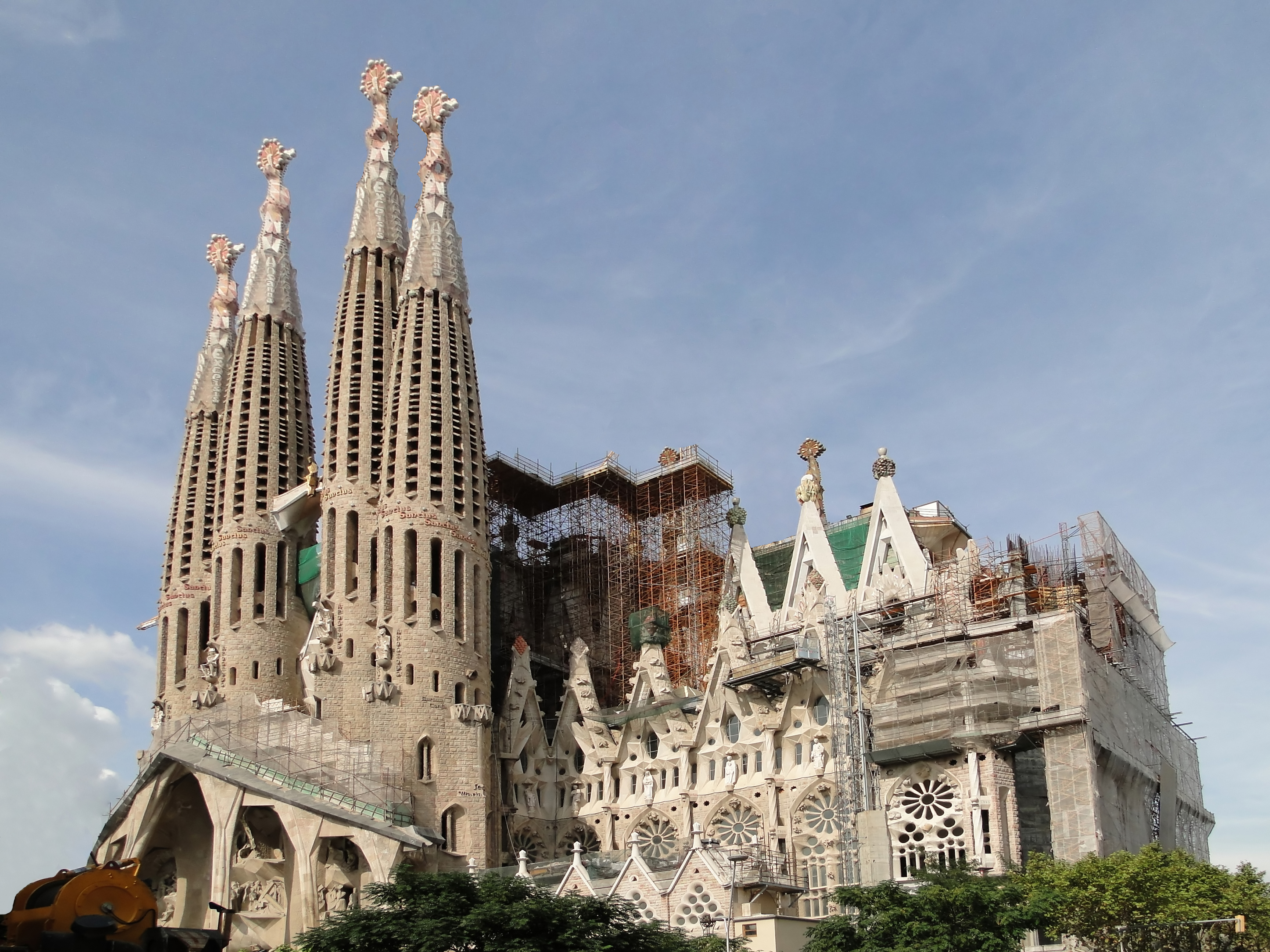
"I went to have a look at the cathedral—a modern cathedral, and one of the most hideous buildings in the world. It has four crenellated spires exactly the shape of hock bottles ... I think the Anarchists showed bad taste in not blowing it up ... though they did hang a red and black banner between its spires" - George Orwell on Sagrada Familia in Barcelona, found in Homage to Catalonia

End of a Very Religious Experience

Today I deigned to make the drive from Dallas to Houston, a pleasant drive that breaks the topographic monotony of northern Texas, offering grassy plains, rolling hills, odd trees, and wild flowers over the course of roads that wind like some quaint English rivers. It is all very rustic and enjoyable. Except at night.

I intended to leave at 5PM and arrive around 9PM, when the last light disappears during Texan summers. Unforeseen circumstances and stops put by departure at 6:30PM and my arrival at 11PM. I had to make the last two hours on back roads and byways with 70 mph speeds and impatient people riding my @$$. The roads have no lighting whatsoever. The state does not seem to maintain these roads very well either, given that the stripping and reflective strips have all but vanished over time. All I could do was try to make out the grooving in the asphalt. Gas stations and stores only pop up every twenty miles. Combine all this with a red warning light on the instrument panel—which happily turned out to be nothing—and one has considerable incentive to start singing litanies and the Jesus prayer over and over and over again.

Happy feast of the Visitation to all!

Monday, June 30, 2014

Joe the Communist & Bad Wine

Last night I attended a small dinner gathering and got to chatting with a like-minded fellow about a range of things from Evelyn Waugh's Vile Bodies to hobbits. Somehow we came upon the topic of S. Ioseph Opifex, the feast of "Joseph the Worker," or, as more adept people have called it, Joe the Communist. The discussant, who attends Mass at the local FSSP parish featured in a previous post, recounted a feeble attempt to pray the 1962 Lauds on a day that happened to be May 1st. He had to quit, so he told me, before even finishing the psalms because the antiphons were so remarkably bad. Here are the Lauds antiphons for the displaced feast of Ss. Philip & James and then the antiphons for the Apostles' Red Replacement:
  • Lord, show us the Father, * and it sufficeth us. Alleluia.
  • Philip, * He that hath seen Me hath seen the Father. Alleluia.
  • Have I been so long time with you, and yet hast thou not known Me * Philip, he that hath seen Me hath seen the Father. Alleluia.
  • If ye had known Me ye should have known My Father also, * and from henceforth ye know Him and have seen Him. Alleluia, Alleluia, Alleluia.
  • If ye love Me, * keep My commandments. Alleluia, Alleluia, Alleluia.
The new feast:
  • God, maker of the world, * has stationed man to dress and keep the earth, alleluia.
  • Christ, the Son of God, * deigned to work with his hands, alleluia.
  • The craftsman, * holy Joseph, faithfully exercising his trade, shines forth as a marvellous example of work, alleluia.
  • Faithful servant, * and prudent, whom the Lord hath appointed over his family, alleluia.
  • O Joseph, holy workman, * defend our work, alleluia.
When I told the same fellow what the Mattins lessons were for the new feast his reaction was one of understandable incredulity. Here is the fifth lesson
"The same Pontiff supplied a new proof of the Church's solicitude for labor organization, when, upon the occasion of a convention of workingmen held in Rome on the first of May in the year 1955, he took the opportunity of speaking to a large multitude gathered in the square before St. Peter's Basilica, and commended most highly the instruction of workingmen. For in our day it is of prime importance that the workers be properly imbued with Christian doctrine in order that they may avoid the widespread errors concerning the nature of society and economic matters. Moreover, such instruction is needed that they might have a correct knowledge of the moral order established by God as it effects the rights and duties of workers, and which the Church discloses and interprets, so that by partaking in the needed reforms they might work more effectively toward their realization. For Christ was the first one to promulgate in the world those principles which he delivered to the Church and which still stand unchangeable and most valid for the solution of these problems."
My night ended with a horrific viticultural experience. Older American readers may remember Paul Masson commercials featuring Orson Welles, the film maker who produced the greatest movie ever made at age 25 and whose career only declined from there. Welles was often inebriated during commercials, but revealed in an interview he never drank Paul Masson wine. Clearly he was bringing his own stuff. The motto for Paul Masson wine was "We will serve no wine before its time." Out of morbid curiosity a friend just had to buy a bottle jug. 

He poured me a quarter of an inch of this so-called wine in a tumbler. I smelled it. The scent was like that of very, very ripe apples. The sugar and fruitiness overwhelmed me. I gave it a swish and found it had no body of any kind. The scent, on a closer sniff, was positively pungent. I then put the liquid in my mouth where it committed first degree assault on my taste buds. I then spat it into the sink, which is when this experience became even worse. This so-called wine leaves an aftertaste I have only encountered with one other product, Robitussin cough medicine. When was this wine's time?


Editing was able to salvage this from the above takes:


Sunday, June 29, 2014

More Dallas Churches: Mater Dei

Today I was compelled by a friend to attend the Missa Cantata at Mater Dei church in Irving, TX, a parish staffed by the St. Peter Fraternity under diocesan auspices. The parish was jammed wall to wall with adults and children. A polyphonic Mass was sung. Sunday was commemorated, but the Last Gospel was In principio. The sermon was an instruction on some manualist theologian's five criteria for rebuking people fraternally. The Rosary was prayed prior to Mass. My friend, Mr. "Lord of Bollocks," grabbed me and took me out of the church during the recession to avoid Faith of Our Fathers.

From what I understand the building was once an Asian Baptist church before the FSSP purchased it to escape the chapel of a cloistered Carmelite convent where they had previously celebrated Mass.


The decor has some positives, namely the stenciling, but other parts seem
to conform a bit too much to 1950s architecture.


Although difficult to see, there are actual choir stalls used
by the acolytes during Mass and by the clergy during Tenebrae.

In my opinion the altar design does not work very well. Too many
bulbous bits and gradines. A table altar with a metal tabernacle in the center
and the candles on the altar would look better. Perhaps also so color, either
in the form of paintings or mosaics. The statues next to the altar give an entirely
new meaning to "We who mystically represent the cherubim...."


There is a true baptistery, with an octagonally shaped room and font!


My friend opined that the plaster statues on the side altars
need to be replaced with crucifixes and some source of color.
I couldn't agree more. Still better than more churches in the
Dallas area.


Not sure what is happening with the windows. Is it
stained glass or is it a printed plastic sticker?


Hymnals compliments of the FSSPX and Bishop Richard Williamson.