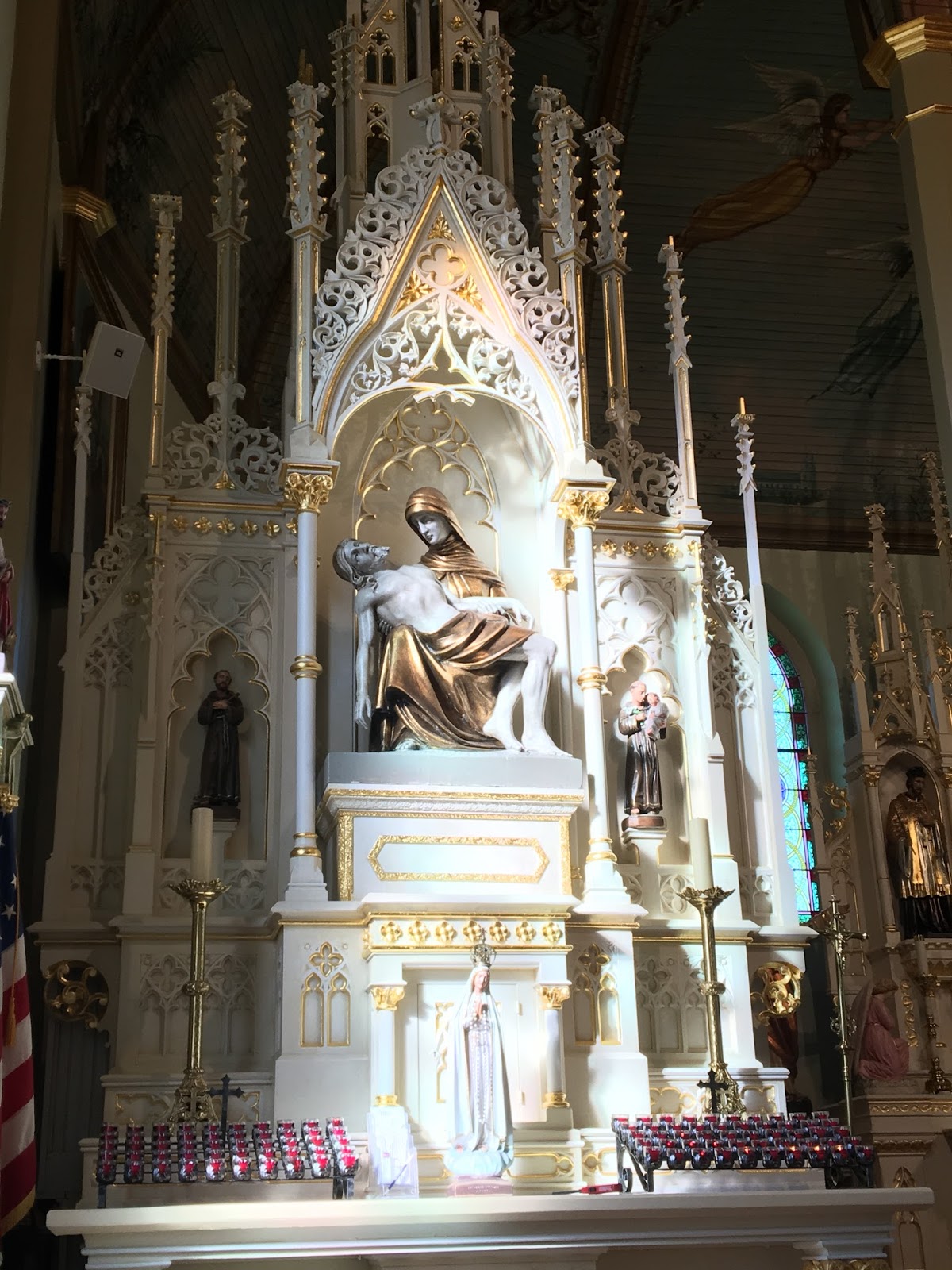
We prayed Saturday Vespers (first Vespers of Sunday might be more appropriate) according to the Tridentine arrangement. Given the emptiness of the church after visiting hours, we decided to sing everything from the Magnificat onwards aloud and in Latin, quite an exuberant thing to do!
Monday, February 6, 2017
Painted Churches of Texas III: St. John the Baptist
The church of St. John the Baptist in Ammannsville, TX may have been the smallest temple of God we visited during our excursion. Once again, the building was completed in the early 20th century (1919) for Slavic Americans and it was not the first structure for the community, the first and second churches having been destroyed ten years earlier by a hurricane and fires respectively. It is as wide as the two St. Mary parishes, but was not divided into aisles, giving it a very baroque openness. The pale pink color gives the church a unique tint in contrast to the airy cheer of St. Mary of the Assumption and the seriousness of St. Mary's of High Hill.
Saturday, February 4, 2017
Come Friendly Bombs
Poetry has become something of a post-modern cultural statement, wherein the only two guidelines are that a poem should not rhyme and that it should mention one's demographic disadvantage. It's all drivel, not even doggerel! Poetry did once have high forms that crowned the best ideals of cultural, but there was also a more vulgar (in the proper sense of the word) poetry that caustically commented on contemporary culture while providing some amusement. My own grandfather was fond of a slim volume called The Spell of the Yukon and Other Verses. A Scandinavia-born coworker recently brought John Betjeman's Slough to my attention. Slough, famous in modern times as the setting for The Office, was a center of industrial park culture in early and mid-20th century England, and Mr. Betjeman had little use for it. Enjoy.
Come friendly bombs and fall on Slough!
It isn't fit for humans now,
There isn't grass to graze a cow.
Swarm over, Death!
Come, bombs and blow to smithereens
Those air -conditioned, bright canteens,
Tinned fruit, tinned meat, tinned milk, tinned beans,
Tinned minds, tinned breath.
Mess up the mess they call a town-
A house for ninety-seven down
And once a week a half a crown
For twenty years.
And get that man with double chin
Who'll always cheat and always win,
Who washes his repulsive skin
In women's tears:
And smash his desk of polished oak
And smash his hands so used to stroke
And stop his boring dirty joke
And make him yell.
But spare the bald young clerks who add
The profits of the stinking cad;
It's not their fault that they are mad,
They've tasted Hell.
It's not their fault they do not know
The birdsong from the radio,
It's not their fault they often go
To Maidenhead
And talk of sport and makes of cars
In various bogus-Tudor bars
And daren't look up and see the stars
But belch instead.
In labour-saving homes, with care
Their wives frizz out peroxide hair
And dry it in synthetic air
And paint their nails.
Come, friendly bombs and fall on Slough
To get it ready for the plough.
The cabbages are coming now;
The earth exhales.
Friday, February 3, 2017
Painted Churches of Texas II: St. Mary's of High Hill
The next painted church from the rural ring around Austin, TX is Saint Mary's of High Hill, built to serve the German community. Like St. Mary of the Assumption, the community is 150 years old, but the current structure is a few decades newer. St. Mary's of High Hill is not on a high hill; rather the builders picked the name to recall the rolling topography of their native land.
Locals call St. Mary's of High Hill the "Queen of Painted Churches" on account of its varied colors, considerable imagery, and slightly larger scale when contrasted with the neighboring parishes. Stained glass from the older, 1869 church adorns the current building. Unlike the gilded Czech church in Flatonia, the softer, darker wood create a more somber mood.
The style follows the 19th century fashion of Marian and Josephite altars with a Sacred Heart statue somewhere near the altar. The baptismal font has been relocated according to the Pian-Pauline novelties.
The greater size of the church permits a greater variety of statuary, images, and nook for devotion. Statues of Roman virgin martyrs (Cecilia and Agnes come to mind) grace the northern columns inside the church while medieval mendicants (Francis, Anthony) stand over the south pillars. Saints became more modern towards the front of the parish.
"I will go to the altar of God, God Who makes joyful my youth" was inscribed in the German tongue in the narthex of the church. One must not neglect to remember the role of Germany in vernacularizing the Roman Mass, originating the dialogue Mass and obtaining the first legal concession to read the lessons in the local tongue from the altar (the French had been doing it outside the rubrics for some time).
While a more impressive church than its cohort in Flatonia, this author prefers the cheery openness of St. Mary of the Assumption. Still, who knew Texas had such gems?
Locals call St. Mary's of High Hill the "Queen of Painted Churches" on account of its varied colors, considerable imagery, and slightly larger scale when contrasted with the neighboring parishes. Stained glass from the older, 1869 church adorns the current building. Unlike the gilded Czech church in Flatonia, the softer, darker wood create a more somber mood.
The style follows the 19th century fashion of Marian and Josephite altars with a Sacred Heart statue somewhere near the altar. The baptismal font has been relocated according to the Pian-Pauline novelties.
The greater size of the church permits a greater variety of statuary, images, and nook for devotion. Statues of Roman virgin martyrs (Cecilia and Agnes come to mind) grace the northern columns inside the church while medieval mendicants (Francis, Anthony) stand over the south pillars. Saints became more modern towards the front of the parish.
While a more impressive church than its cohort in Flatonia, this author prefers the cheery openness of St. Mary of the Assumption. Still, who knew Texas had such gems?
Thursday, February 2, 2017
Sarum Candlemas
The medieval Church had its shortcomings in administration, leadership, and theological imagination, but it made up for it in the perfection of the Latin liturgy and the saints it inspired.
A happy feast to all!
Tuesday, January 31, 2017
Painted Churches of Texas I: St. Mary of the Assumption
Ecce quam et quam iucundum habitare fratres in unum!
This past weekend a group of friends, His All Traddiness included, ventured down to something called Austin, TX, a town famous for drunk escapades on 6th street, Whole Foods, and for fifteen years the home of Rick Perry. Its rural surroundings—possibly the only hills in the barren state of Texas—quietly hold a treasure of delectable barbecues and painted churches.
Readers will recall J's post on St. Peter's, the "painted" church of Lindsay, TX. Painted churches are not an historical anomaly in central Texas, which saw a remarkable settlement of Slavic and German migrants from central and Eastern Europe. They built modestly sized parishes and furnished them in baroque fashion to the best of their ability. Statues and ornate reredros graze the sanctuaries, but when of the ceilings, walls, cornices, and other crevices that would be gilt and covered in 18th century masterpieces in the old world? These immigrants took brushes to the plain Texan wood and created something quite extraordinary in these little low Mass chapels.
The first church in this series is St. Mary of the Assumption in Flatonia, TX. The community dates to 1865, but the current edifice is a few decades newer. As with all the painted churches we saw, there is an adjacent cemetery; one would be baptized, married, communicated, and buried in the same tradition and among the same people, a contrast to our mobile society not lost on my cadre.
| A side altar. St. Joseph has some grey streaks. The Infant of Prague reflect the Czech origin of the parish. |
| The parish doors look to be candidates for "renewal." |
| The pulpit has a sounding board to carry the echo. |
Thursday, January 26, 2017
Te lucis ante terminum
Through the miracle of time I have rediscovered the office of Compline. Although it was the first hour I really learned to say on my own accord I fell out of the practice of saying it in the years since finishing school and finding my life regulated by the daily and monthly pulse of American corporate finance, month end close, and quarterly reports to the Street. I began Vespers several years ago and anticipate Mattins and Lauds for Sundays and major feasts, but the non-major hours (horae minores are during the day???) rarely appear in my life, save Sundays and long vacations.
I was introduced to the old Latin liturgy long ago in the form of the "Traditional Latin Mass," but did not discover the Divine Office until 2011, when I went to Oxford and found the Office to be the pulse of St. Aldate Street. The Dominicans said the full Liturgy of the Hours in English daily while the Oratorians, where my shadow haunted for latria, used the 1962 Vespers for Sundays and the eve of major feasts. At some level I grew to love the Office more than the Mass if only because the Mass is required out of obligation, whereas a layman only attends the Hours out of devotion. Upon return to the States I began saying Compline according to the Tridentine form before going to bed. For a tired mind looking for an evening blessing, Compline is more focused than "Bless mommy, bless daddy, good night, Lord."
Compline is an altogether different sort of Office, both in structure and purpose, from the rest of the hours in the Roman breviary. The major hours (Vespers, Mattins, Lauds) descend from the vigil of psalms and readings that took place at night before the Eucharistic sacrifice in ancient days and which solidified in their extant, pre-1911 form by the age of St. Benedict, if not earlier. The daytime hours (Terce, Sext, None) grew out of non-cleric devotion in the major Roman basilicas by those who wished to pray and sanctify the entire day; because those who sang it were commoners unable to print book on demand, the psalter remained fixed for these hours. Prime and Compline have their origin in the monasteries around Jerusalem and functioned as "fillers" for gaps in the day when a monk might lapse in his prayer. St. John Cassian remarked during his 382 AD visit to Bethlehem that Prime had not yet been adopted everywhere in the East. Similarly, he knows nothing of the tradition already practiced by St. Basil of reciting psalm 90 (Qui habitat in adiutorio) before bed. When Benedict left Rome and brought the basilica psalter with him, he may have brought a newly settled custom of praying other psalms with psalm 90 before sleep.
Compline's distinction in structure and repetition in text makes it an easy hour to commit to memory and hence very suitable for those tiresome moments before bed when creative thought and reflection fail. The words themselves carry a weight of reassurance and tenderness:
Compline represents a marvelous entry point into the Roman Office and deeper liturgical prayer. This prayer for a safe rest under Our Lord's watch, like an "apple to His eye", is approachable in its brevity and constancy while being less mundane than the horae minores of the day: a Confession, a few psalms, a short hymn, a canticle, and a prayer to Our Lady; most remarkable to me, at least in the Tridentine Office, is that the last words on the Christian's lips before sleep are the Pater, the Ave, and the Apostles' Creed. Seven Office sanctify the day, but only one the night!
I was introduced to the old Latin liturgy long ago in the form of the "Traditional Latin Mass," but did not discover the Divine Office until 2011, when I went to Oxford and found the Office to be the pulse of St. Aldate Street. The Dominicans said the full Liturgy of the Hours in English daily while the Oratorians, where my shadow haunted for latria, used the 1962 Vespers for Sundays and the eve of major feasts. At some level I grew to love the Office more than the Mass if only because the Mass is required out of obligation, whereas a layman only attends the Hours out of devotion. Upon return to the States I began saying Compline according to the Tridentine form before going to bed. For a tired mind looking for an evening blessing, Compline is more focused than "Bless mommy, bless daddy, good night, Lord."
Compline is an altogether different sort of Office, both in structure and purpose, from the rest of the hours in the Roman breviary. The major hours (Vespers, Mattins, Lauds) descend from the vigil of psalms and readings that took place at night before the Eucharistic sacrifice in ancient days and which solidified in their extant, pre-1911 form by the age of St. Benedict, if not earlier. The daytime hours (Terce, Sext, None) grew out of non-cleric devotion in the major Roman basilicas by those who wished to pray and sanctify the entire day; because those who sang it were commoners unable to print book on demand, the psalter remained fixed for these hours. Prime and Compline have their origin in the monasteries around Jerusalem and functioned as "fillers" for gaps in the day when a monk might lapse in his prayer. St. John Cassian remarked during his 382 AD visit to Bethlehem that Prime had not yet been adopted everywhere in the East. Similarly, he knows nothing of the tradition already practiced by St. Basil of reciting psalm 90 (Qui habitat in adiutorio) before bed. When Benedict left Rome and brought the basilica psalter with him, he may have brought a newly settled custom of praying other psalms with psalm 90 before sleep.
Compline's distinction in structure and repetition in text makes it an easy hour to commit to memory and hence very suitable for those tiresome moments before bed when creative thought and reflection fail. The words themselves carry a weight of reassurance and tenderness:
Procul recedant somnia,For a brief while I attempted the Divino Afflatu rendition of this hour, but found the variable psalms and antiphons antithetical to the very purpose of this Office. Indeed, Compline helped me realize that Pius X and Paul VI's overhaul of the Roman Office was far more radical than what the latter did to the Missal.
Et noctium phantasmata;
Hostemque nostrum comprime,
Ne polluantur corpora.
Compline represents a marvelous entry point into the Roman Office and deeper liturgical prayer. This prayer for a safe rest under Our Lord's watch, like an "apple to His eye", is approachable in its brevity and constancy while being less mundane than the horae minores of the day: a Confession, a few psalms, a short hymn, a canticle, and a prayer to Our Lady; most remarkable to me, at least in the Tridentine Office, is that the last words on the Christian's lips before sleep are the Pater, the Ave, and the Apostles' Creed. Seven Office sanctify the day, but only one the night!
Wednesday, January 25, 2017
St. Joseph the Burly
The following photo (not for the faint of heart) appeared recently on Christopher West's Facebook page, with the author's usual semi-disturbing commentary. Mr. Grump thinks that Joseph looks more like a blacksmith than a Roman occupation-era carpenter, or like I imagine Beorn from The Hobbit, but that's what happens when I am not consulted on these matters. I suppose we can thank our lucky stars that the art student did not also see fit to make the Virgin look like an American pop star.
Subscribe to:
Posts (Atom)