|
| Christos anesti! |
St. Gregory of Nyssa wrote On the Soul and the Resurrection following the death of his brother, St. Basil the Great, archbishop of Caesarea in Cappadocia. Gregory was very unlike his brother, the great Cappadocian bishop. Basil and Gregory came from a family of about nine children, half of them recognized as saints. Basil, at the behest of his sister, the monk St. Macrina, embraced the ascetic life. Gregory married a woman named Theosebia and took a career in rhetoric, though serving as a lector in the Church. In 371, likely after Theosebia's death, Gregory, under his brother's influence, was elected bishop of the newly created episcopal see in Nyssa. St. Basil died in 379, prompting a grieving Gregory to visit his sagacious sister, Macrina, who died the very next day herself. Shortly thereafter St. Gregory composed On the Soul and the Resurrection, possibly as a means of coping and possibly as a way to continue to interact with his brethren "who here or elsewhere lie asleep in the Lord." On the Soul and the Resurrection, which would probably generate an interesting reaction from many more traditional Roman Catholic priests today, is written in the Greek dialogue style, using the author as the emotional and unsure enquirer and his saintly sister Macrina as the logical and wise respondent.
 |
St Macrina, sister of the author and
respondent in the dialogue. |
The first section of On the Soul constructs the reason the soul exists and, in passing, on why one can expect it to be immortal. The first necessary construct is the existence of God. All Creation, says Macrina, points toward the existence of the Creator Himself just as "cloth suggests a weaver." The error of Epicurus and his followers was to look at physical matter as it was and to look no further. Under this scheme of philosophy man is a physical arrangement of particles, and one in decay at that. If the soul exists though, and is part of the human person, who decays, does not the soul die with the body? Does it dissolve? Even if it did, Macrina observes, it would be akin to a shattered pot, whose shards still suggest the makings of the original pot. More important to Macrina is the Greek belief that like attracts and reflects like. The human person is a reflection of the larger Creation, of which he is a part. He has a physical aspect like the earth and the stars and the mud, but has the soul as well, just as the Universe has God. Far from the soul being an alternative to God, the soul, in Greek philosophy, is a microcosm of God within the human person, an icon (although St. Gregory does not use this terminology). When one understands this one understands the Incarnation as conceived by Ss. Athanasius (On the Incarnation) and John of Damascus (Three Treatises on Icons): that the human soul, as an icon of God, was so precious God could not allow it to continued in corruption and decay.
St. Gregory attempts to ascertain of Macrina a definition of the soul. Macrina makes a convincing materialistic case against the soul and then turns the entire argument in favor of the soul (Ch 2). The soul is an intelligence that has latent thought and some sort of knowledge, she contends. She asks Gregory how he can understand the illumination and phases of the Sun and Moon without the soul? Here the "soul" she has constructed is really analogous to the brain's consciousness as modern science would conceive of it. The "soul" is really just a means of processing and applying information gathered from a lifetime of observation. However, she continues "Is it not clearly proved by what we can see that there is in man a mind, something else beside what we can see? By the invisible intelligence of its own nature the mind makes such plans by thoughts within itself; then, as we have described, through material assistance it brings into the open the concepts which exist within." Her primary example is "art"—by which she includes engineering. Art is a creative faculty which, although it uses knowledge of physical matter, re-arranges matter in a higher and better state, much like the God of Whom the soul is a microcosm.

Is not this apophatic approach without merit, asks Gregory. What is the use in defining the soul based on negative principles (the soul is
without a body, the soul is
without physical properties etc). His sister in dialogue upbraids him: "We make cowardice known by calling it 'unmanliness'." To deny the non-physical would be to deny God Himself. It would also mean the denial of ideas or of thought. Moreover, precisely because the soul is
not part of the body it can survive after death. Were the soul physical it would break up, as a wrecked ship, after death. But instead it can be present at any place without losing any of its essence or form. This point touches on a type of knowledge apparent to the ancient Platonists and their Christian successors, of which St. Gregory is one, but which our materialistic philosophers neglect. Sometimes things, like ideas, are not easily categorized as part of physical phenomena, such as brain activity. A classically Platonic example might be the concept of a sphere; someone may only see oblong objects all his life, but he will know what a perfect sphere is and that oblong shapes are not it. A similar epistemology is at work in
On the Soul.
Are not emotions an obstacle here? How does one taxonomize the mind, the soul, and simple impulses? Herein enters a distinction between the Passions, sinful impulses, and simple emotions which are proper to physical nature. Passions, although the word is used sparingly, are impulses that are not of God and therefor
not proper to the soul, as the soul if of God. One example St. Gregory, in the person of Macrina, gives is anger. None of the saints were angry people. What about Moses? Chapters 2 and 12 Exodus surely state otherwise. But no, Macrina controverts. Anger is the unholy desire to cause harm to another without just provocation (ch. 3). Emotions of their own are of no harm, but it is meet for them to be subjected to the intellect and to the soul (between which St. Gregory hardly makes a distinction). Animals have all the physical qualities and emotions as persons, but lack the acumen and consciousness of humans. For this reason man is called a "rational" animal in Greek thought. Macrina illustrates this ordering of personal properties using the Platonic Chariot from
Phaedrus. The soul and mind are the charioteer while the emotions are the horses. Were the mind not in control the human person would become entangled and crushed in emotion and impulse as the charioteer would in the reins of his horses were he not directing them in their paths.
 |
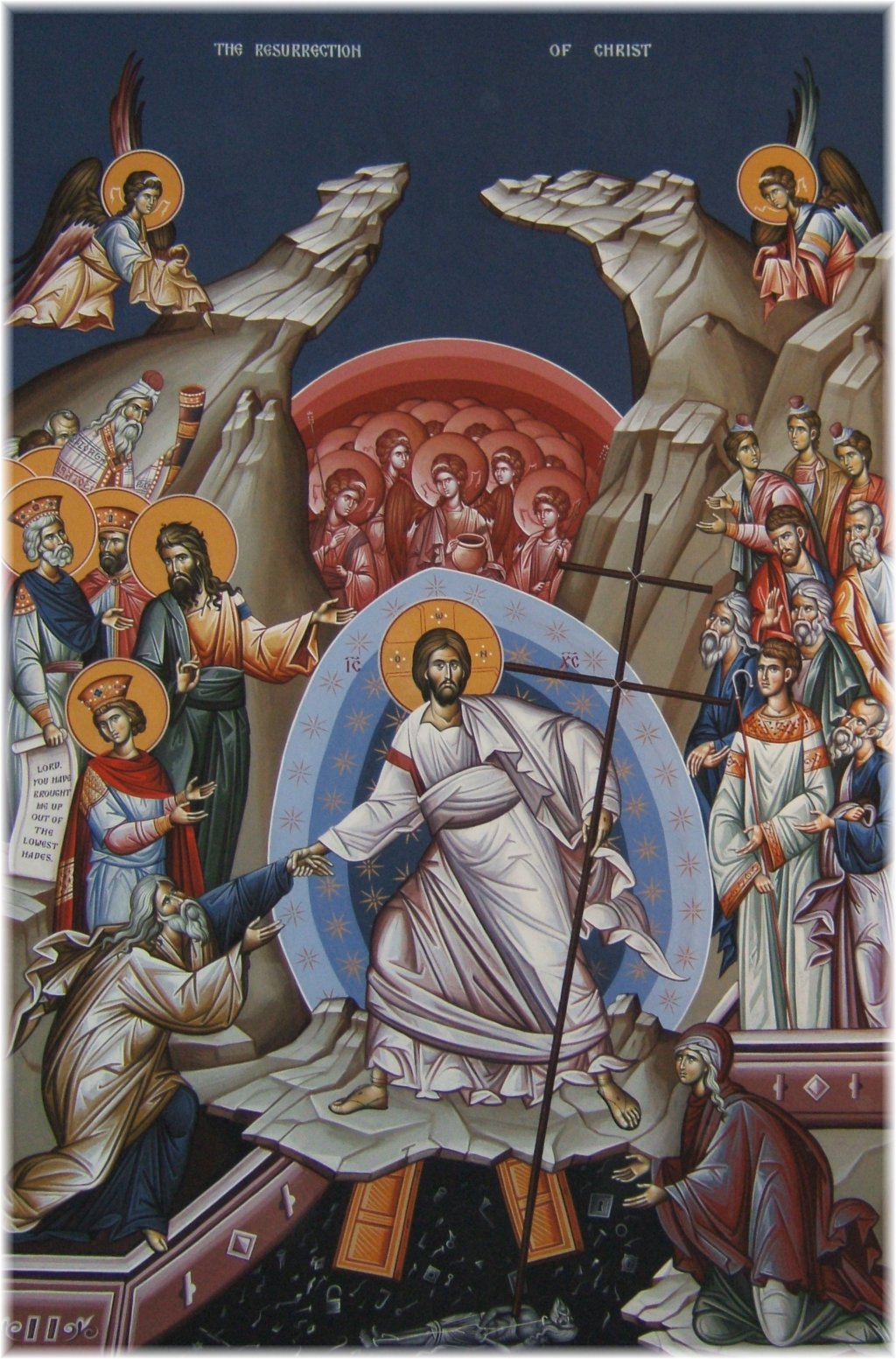
| The Harrowing of Hell (Descent into Hades) |
In chapter 4 Macrina uses the geocentric astronomy of the time to prove that while the soul is immortal it does not go to a physical "place." The "infamous" word of "Hades" suggests something more to Macrina. The character of Gregory objects to this doctrine on the basis of St. Paul's epistle to the Philippians, which, in chapter 2, the Apostle says that at the "name of Jesus every knee must bend, of those above the earth, on the earth, and under the earth." Macrina corrects Gregory and proves that by this Paul meant those in different states of being: those pure and in heaven, those still attached to flesh on earth, and those who let their Passions consume them and who have been subsumed by the things of the earth. On the whole, St. Gregory's willingness to engage in contemporary astronomy and ideas of being impresses the reader in this chapter and makes him appreciate the work of serious scholars who attempt to do the same with the faith today.
 |
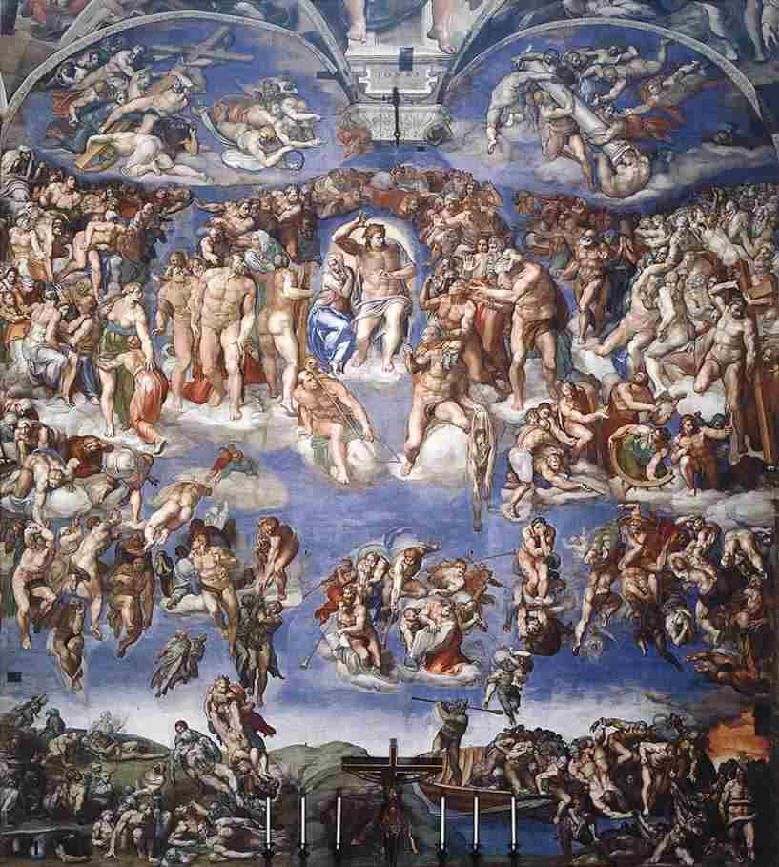
Michelangelo's racy depiction of the General
Resurrection and Last Judgment |
St. Gregory—in Macrina—finally makes a formal, and long overdue, distinction between the intellect and the soul in an allegory about the General Resurrection. The character Gregory ponders how the soul can go on without a body and how it can continue without a body to recognize (Ch. 5). Macrina draws a parallel to mixing hues of paint, such as black and red, which form a new hue, but which can—with great difficulty—be separated into their previous forms, still known to the artist. The same is true of God, and His knowledge and ability to "re-mix" the human bodies justify the Church's faith in the General Resurrection at the end of time. Then in what state does the soul exist between death and the General Resurrection? How does the soul not exist corporeally as suggested in the parable of the Rich Man and Lazarus? Was he not taken "into the bosom of Abraham" (Luke ch. 16)? "Bosom," retorts Macrina, suggests a place of proximity or closeness to home. "Bosom" was a term for the land near a bay in the Greek language likely spoken by the Evangelists. Abraham was the first to be joined to the covenant that would bring the Savior into the world, and so residence at his "bosom" points toward a proximity to Christ's work (might present a problem for the hardline EENS party). Here we stumble upon two issues which have been present in the background thus far: 1-the soul is certainly incorporeal and when it enters eternity it does so immaterially (which makes sense, as modern science tells us time and "space"—material—are bound together) and 2-this work, although a treasure, has a vagueness in terminology that can tend toward confusion concerning the soul. This last point has troubled scholars of St. Gregory for years.
Continuing, why does the Rich Man still show concern for his kin and friends while Lazarus does not? Macrina gives Gregory another wonderful image. Consider a man who spends considerable time in a place infested with a foul stench. He may emerge into clean air and enjoy the improvement of his affairs, but some of the onerous odor will linger with him until time and the breeze take it away. This conflict between the Divine transformation of the person and past sins is the source of shame (Ch. 6). A Christian seeking to improve his life by God's grace will progress along the Divine path, aided and motivated by hope, but find himself tugged backward and discouraged by memories of the past: "And thus a civil war is established in the soul, in which memory fights with hope, accusing it of fighting our choice badly. The feeling of shame clearly interprets some such meaning, when the soul is stung by the result. The soul attacks the thoughtless impulse with repentance as with a whip and enlists forgetfulness as an ally against the source of grief." This is overcome by "purification," a process by which a person gradually separates from the things of the world, the Passions in Eastern theology, that restrain one from God. A purified person does not lose his "impulses," Macrina assures Gregory, because all good impulses flow from God. Instead the impulses more or less cease because the person no longer needs to desire God, having attained purification and having become more like Him: "If the soul has no desire because it has no lack of anything good, it would follow that the soul which has no insufficiency also casts out from itself the desiring impulse and disposition, which occurs only when something wanted is not present."
 |
Met. Alfeyev contemplates purgation.
source: datum.org.ar |
The separation from the things of the world is accomplished by purification, in this life or after death if necessary. The procession of purification was later called "Purgatory"—for purgation—by Pope St. Gregory the Great and gained the lasting association with fire. The Byzantines have a less lucid approach to the matter. If someone dies and does not go straight to heaven that person is said to be in the "intermediate state" and in need of prayers. It is also unclear in this theology if Hell is closed, given that Russian Orthodox Metropolitan Hilarion Alfeyev
stated that the Orthodox view of Hell corresponds to the Catholic idea of Purgatory—drawing on Origen's belief that even the Lucifer will be redeemed, a belief condemned by Pope Vigilius (Denzinger 209 & 211). Gregory takes a more grounded approach while implicitly suggesting all might be saved. He appeals to both God's mercy and His justice. God purifies each sinner proportional to the amount of evil committed by that person and to which he remains attached just as a goldsmith may have to melt down metals in different way to extract gold. "So the divine judgment," Gregory in character elucidates, "as it seems, does not primarily bring punishment on sinners. As our discourse has just shown, it operates only by separating good from evil and pulling the soul towards the fellowship of blessedness. It is the tearing apart of what has grown together which brings pain to the one who is being pulled" (Ch. 7). Gregory alludes, but does not argue, to the limited nature of punitive measures, that the "punishment fits the crime." What finite crime is worthy of eternal punishment? Even the man who is punished in the parable of the debtors (Matthew 18) is only tortured until "he pays back all that he owes." The Saint's greater concern is not punishment, but the pains of purification. The Christian must seek to avoid occasions of sin and places of evil influence lest he suffer the torments of purification. Here Gregory shies away from the obvious question of free will: "Freedom consists in becoming like that which has no master and is under its own control." In the end, evil
will suffer total defeat: "In this the apostle seems to me to teach the complete annihilation of evil. If God will be in everything that exists, evil obviously will not be among the things which exist; for if one should supposed that evil existed, how would it remain true that God is 'in all?' If evil is excluded, not all things are included. But He Who will be 'in all,' will not be in what does not exist."

The Saint devotes the entirety of chapter 8 to the refutation of contemporary pagan beliefs, among them the diverse narratives of reincarnation and other "nonsense." Chapter 9 is more intriguing. Macrina concludes that, owing to the order of Creation, the soul originates with the body—opposing Origen's doctrine of the soul's pre-existence—but that it also flourishes as the body grows until death, wherein it can neither grow nor become corrupt as it can on earth; it becomes stable as physical phenomenon, once it ceases to grow or decay, becomes stable. The emergence of the soul with the body is in accordance with Creation, given that God created the universe
ex nihilo, the soul included. This Christian doctrine controverts the pagan belief that the universe is actually a formulation of pre-existing, eternal matter. Fascinatingly, 19th century atheists promoted this very teaching in order to undermine the possibility of a Creator; Einstein himself implicitly believed in it because he believed in a static universe, until Fr. Georges Lemaitre convinced him otherwise with the Big Bang theory, which many scientists at the time wrote off as Catholic nonsense. Oddly, Stephen Hawking now uses that same Catholic nonsense to
discourage the idea of a Creator and the eternality of the matter which comprises the universe. Some errors never die. Macrina, seeking to avoid a pagan belief that could not be disproved until the advances of 20th century physics, wholesale denies the materiality of matter! According to her color, shape, and other features create matter, not elements.
On the Soul concludes with a discourse on the General Resurrection itself. Just as God breathed life into the material to create and animate life, so will His Spirit do the same at the General Resurrection. The gift of life is one that comes from the Holy Spirit, as the book of Genesis tells us. Yet Resurrection is accomplished and eventuated through the person of Jesus Christ. Although the Spirit gives life, Christ is the one Who resurrects the dead in the Gospel, including Lazarus, who had been dead and decomposing for four days. Here Gregory introduces some objections to the Resurrection, from both the perspective of a doubter and from the perspective of a secularist. The doubter questions how the Resurrection, with the same physical body as people had in life on earth, should be viewed in light of suffering. Many live with great ailments and deformations; others die old and decrepit; others still die as children. The secular objection doubts the physical aspect of the Resurrection. What use are certain organs if they will no longer be used? What of the condition of the resurrected body? How will it appear? Macrina condemns these objections as deceitfully crafted rhetoric void of merit upon learned and patient consideration. Macrina returns to the theme of purification. Physical pain and ailment were brought into the world by sin. Purification from sin and attachment also means detachment from the physical punishments condign to sins. the human body will no longer appear as it did on earth, but rather as it should have before the Fall of Adam and Eve. At this point the words of St. Paul will come true: corruption will put on incorruption, and mortals will put on immortality (1 Corinthians 15).
St. Gregory, through Macrina, takes the Temple of Jerusalem as a type of the renewed life of the resurrected. In the Temple the Holy of Holies was so sacred only a priest could enter it, and only once a year at that. The next part of the Temple was reserved for those chosen as priests. The next after that belonged to the followers of the Law. The part beyond that was more generally accessible and did not require people to take actions or make merits. And the gate was accessible to regular Jews or anyone else. All those barriers and gradations will be gone at the General Resurrection after purification. Man will see God as He is and be at home. At the end of
On the Soul and the Resurrection St. Gregory writes "So when such things are cleansed and purified away by the treatment through fire, each of the better qualities will enter in their place: incorruptibility, life, honor, grace, glory, power, and whatever else of this kind we recognize in God Himself and in His image, which is our human nature."
St. Gregory is certainly the most Greek of the Fathers featured thus far. His philosophy and outlook relies much more on Hellenistic thought than the Eastern ascetics and Latin Fathers presented in prior installments. Many of his conclusions are unique or foreign to us, but we ought not discount them out of hand, as they give us spiritual food for thought. Next in the series, St. Theodore the Studite.
St. Gregory of Nyssa, pray for us!