Showing posts with label Jansenism. Show all posts

Wednesday, November 11, 2015

The Jansenist Church

The Synod of Pistoia
Fr. Ray Blake has an interesting article about the place of individual holiness in the Church universal, replete with all its sinners and misfit characters. Although he does not state it explicitly, the tone of his article underlines the spiritual influence of Jansenism in the heart of the contemporary Church. 

Although, we must concede, there was a prevailing belief that only monks and nuns could be holy—laity and secular priests lived in a mediocrity by contrast—the "old" spirituality of the Church permitted an ambiguous contiguity between herself and the sinner. It was an age of "literary converts" from sinful pasts (think Oxford before integration), where those with prolonged states of sin could feasibly come to the hospital of the soul and hope for an eventual cure. Then came the "universal call to holiness."

Holy Communion was probably under-received prior to the 20th century. Canon Law mandated at least an annual reception; Lateran IV called for at least biannual communication. Now the tables have completely reversed. The most poignant line for this reader was this:
"In practice, if everyone is to receive the Eucharist, does it means that there is no room for the prostitute or the gay man or adulterer unable to control his sexual desires or the alcoholic or the wife beater or the paedophile or the murderous God hating gangster, or the simply confused, or just plain ordinary sinner with a divided soul who loves the idea of God but is too damaged to fully embrace him."
The prevailing communitarianism of modern Roman Catholicism presumes a positive opinion of His people—the "people of God"—by the Almighty. How many inane hymns from the popular blue Gather books are about the congregation? In a Mass with friendly handshakes, the ashamed and lost sinner who wants to be left alone has no place of welcome. I myself had the unique experience of attending Mass on Pascha with my un-baptized girlfriend in Buffalo, NY. My sweetheart and a pew of middle-aged Italian men (decked in pinstripe suits and wearing pinkie rings) were the only ones not to approach for Communion.

The antiquarianism of the reformed Roman liturgy and the obsession with the activities of the congregants, since 1964, almost amounts to a neo-Jansenism, an assumption of a pure, God pleasing Church. The original Jansenists, in their zeal to imitate the life and times of St. Augustine of Hippo, discouraged frequent Communion because of the certainty of unworthy reception. These vicarious Augustinians also wanted to simulate the presumed bareness of the patristic liturgies, reducing the priest to an overseer. The recent Roman liturgical reforms accomplished much the same things and, despite what Michael Davies may have thought, the case for a visible protestantization of the Roman rite is a difficult one to make, all things considered. The changes more reflect a concern for the people, simplicity, and a pseudo-patristic experience than anything to do with Cranmer or Luther. While the Reformers created large portions of their own rites ex nihilo, new reformers cobbled their's together with new pieces, but also old elements of first millennium sacramentaries, prefaces, and books of blessings. However, the original Jansenists made their changes when a sense of sin still prevailed. Without sin, when the priest decreases, the people must increase—and how they have.

While Fr. Blake is right that some Orthodox churches see infrequent Communion, this is not entirely true. Here, at least, Communion is near-total at Greek Orthodox churches and the same at Eastern Catholic churches. The Slavic Orthodox tradition of Confession the night before Communion probably decreases the number of receptions. At Tradistan, nearly everyone goes up.

While in the first eight centuries or so, everyone in the church went to Communion, not everyone who assisted at the liturgical celebration stayed for the anaphora. The Romans expelled non-communicants after the Gospel. The Greeks did so with "The doors! The doors! In wisdom, let us be attentive!" There was no difficulty in leaving. Frequent reception is not a bad thing at all, but the manner in which it is now done certainly does not welcome repentance. Nothing is more awkward for a lapsed Catholic at Christmas Mass than watching everyone else but him go up to the altar.

Newman described Purgatory as a "hospital for the sick," a phrase adapted several paragraphs ago for the entire Church. A hospital the Church must be. Communion may be the medicine, but the patient must first accept the diagnosis. Unfortunately, the neo-Jansenists have not read a medical degree.

Note: for a brief overview of the original Jansenist movement, reader this monograph by Dr. Hull.

Friday, August 1, 2014

Last Gallican Post: The Use of Rouen

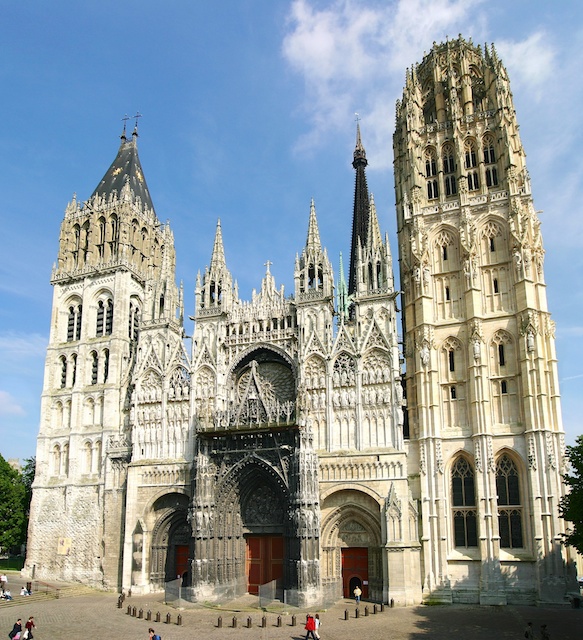
Cathedrale Notre Dame de Rouen, famously painted by Monet
source: frenchmoments.eu
Initially we intended only to review the local French uses of the Roman rite prayed in the dioceses of Lyon and Paris during the Counter-Reformation, right until their suppression in the 20th and 19th centuries respectively. The supposed defect of the rites of France was that the Jansenists, French Catholics who followed Calvin's cruel reading of St. Augustine's writings on free will, tainted these liturgies with their detestation of saints, preference for starkness in ritual and kalendar, and insinuation of their theology into the prayers of the Mass and Office.

These rites do often differ from the Roman rite, particularly the Parisian rite, which in the year 1300 was textual very close to the Roman rite. Without any copies of their Breviaries to review, we focused on the Missals. Our, admittedly brief, examination revealed no firm traces of Jansenism whatsoever. What we found were very lavish liturgies replete with rich texts and ritual symbolism. The strongest shortcoming of these rites is that they differ in many places from the Roman rite where they once resembled it (cf. Parisian Mass for Pascha or use of the Gallican psalter for the propers). This suggests that the French government, often staffed by bishops and cardinals in matters of administration, may have influenced a de-Romanization of these rites which were culturally absurd, but hardly unorthodox and beyond correction. 

The only concession to Jansenist culture we found was the Parisian rite's octave of St. Augustine, the favorite saint of the Jansenists, in the same Missal which has no octave for Ss. Peter & Paul, the integral saints of Rome. Even this can be explained as a cultural matter than a theological one. The propers and orations of that Mass, indeed of all the Missals, present a strong literary culture among the clergy and a French church focused on sin, penance, and redemption—all things long pre-destined and beyond choice in the minds of the Jansenists. 

We will discuss the very basic features of the Missale secundum usum Ecclesiae Rotomagensis, the Missal according to the use of the Church of Rouen. We will be using the 1759 edition.

Kalendar and Rubrics

The kalendar retains many of the papal martyrs of the first few centuries as simple feasts, as in the Roman rite, but also adds many obscure French saints to the kalendar as simple or semi-double like St. Bathild or promotes others like Martin of Tours to patronal status. The ranking of feasts if quite odd: Solemnity, Triples of the first and second class, greater and lesser doubles, semi-double, simple, vigil, and ferial. The gradation is not explained in the Missal nor is the status of these Masses with relation to Sunday. All Saints in a Solemnity, the Assumption is a Triple of the first class, and most Apostles have a greater double. The rules for commemorations, marriages, Masses for the dead, and multiple Masses in collegiate churches are virtually the same as in the pre-1911 Roman rite. There is a provision for moving the Double feasts to Sundays, but the same rubric requires a sung Mass of the Sunday in addition to that of the feast, quite until the "external solemnity" rules in the EF and Pauline liturgies. Should May 1st occur on Paschal Saturday, a private Mass may be celebrated of Ss. Philip & James, but the Office and feast must be transferred outside of the Paschal octave.

Ordo Missae


The Order of Mass is word-for-word, action-for-action the Roman Mass. Even some of the musical tones are the same such as the intonation of the Gloria and dismissal during Pascha. The beginning of the Credo (excluding Credo III) in the Roman is also the same as the beginning of the Credo in Rouen for Greater and Lesser Doubles. And the dismissal from the Missa de Angelis is the dismissal for Triple feasts of the first class! Some of the dismissals are so long and winding, one wonders if they ever were actually sung by clergy who were not trained musicians. After the last Gospel, the prologue of St. John, the Benedicite is sung during the recession as a thanksgiving.

Propers


The propers show the most signs of trouble, not heresy, but lamentable tampering and poor copyist work. For instance the epistle readings for Holy Saturday and the Sunday of the Resurrection are reversed, with Paul telling the Corinthians to "purge out the old leaven" on Saturday and the Colossians that they "must rise" with Christ on Sunday when Christ is already risen. 

As in the Parisian and Lyonese rites, and as in Sarum, there are alternative weekday lessons should a ferial day occur and the Sunday Mass warrant repetition. Unlike the other Missals from France, this one retains the old Roman psalter for the propers. One test I have used is the Introit for the third Mass of Christmas day which in the Roman psalter begins "Puer natus est nobis" while the Gallican psalter of St. Jerome, utilized in the other books, renders "Parvulus natus est nobis." The Rouen use is quite remarkable in this regard. The loss of the folded chasuble and the use of only one deacon for the Passion are the only visible de-Romanizations. Holy Week is almost exactly the pre-Pius XII Roman Holy Week only with four readings on Holy Saturday and no distinct Gospel ceremony following the Passion. One wonders if the removal of strongly Roman features was more prominent in the major sees (the capital city of Paris and the primatial see of Lyon). 

As with the other uses, there are more "commons" for saints than in the Roman Missal. The common for one woman, not a martyr follows the same Gaudens gaudebo introit as Pius IX's Mass for the Immaculate Conception, perhaps revealing some textual inspiration.

The Missal contains more sequences than in the Roman rite, but they lack the theological insight and beauty of the Parisian ones. Below is the text for the third Mass of the Nativity.


Conclusion


On the whole the rite of Rouen, like the rite of Paris, is mild variation of the Roman rite, adding local saints and condign Masses for them as well as some additional texts for great feasts, but unlike the other French rites its de-Romanization is limited to some rubrical matters. We would classify Rouen and Paris as "neo-Gallican" liturgies, changed from the basic Roman text whereas the rite of Lyon suggests an older, more independent tradition.

We hope readers and boutique fetishists have enjoyed our exploration of the rites of France used in the 17th, 18th, and 19th centuries. With the curtain coming down on the last act of this Gallican drama we will be moving on to another French story, the origins of the Traditionalist Movement and a series of exposés on its less recognized figures. The first post in that series will either be on Fr. Bryan Houghton or Msgr. Alfred N. Gilbey. Again, thank you for reading.

Friday, March 14, 2014

The Lyonese Missal Part I: Ordinary of Mass & Prefaces

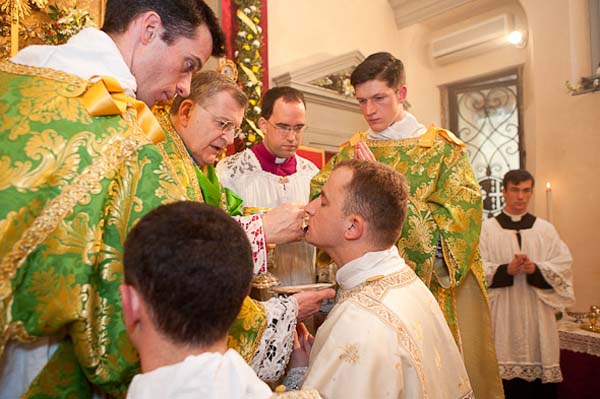
Archbishop Angelo Roncalli celebrates Mass in the Lyonese rite. As Papal nuncio,
much like Msgr Lefebvre as Apostolic delegate, he had certain privileges normally
reserved to cardinals, such as permission to pontificate from the throne outside of Rome.
In the second of two phases in our brief study of the alleged influences of Jansenism in the local rites of France we will examine the Missal used in 1846 by the France's primatial see, the venerable Church of Lyons. The date of the Missal, a century prior to its suppression by the cruel and heartless liturgical reformers of the 20th century, should be allow for any Jansenistic influences to shine from the pages, as Jansenism would have been thriving for two centuries and Dom Prosper Gueranger had only begun to demonstrate the defects of non-Roman liturgical rites.

As a quick refresher on Jansenism let us surmise that this heresy over-emphasizes human depravity after the ancestral sin of Adam, so alienating his nature that he could not even decide to accept God's grace, and that God's grace, when offered, cannot be resisted. It is a Calvinistic reading of St. Augustine of Hippo, a Church Father very popular in France during the Counter-Reformation.

Part I: Rubrics

The rubrics of the Missale Lugdunensis are far simpler than the loquacious rules surrounding the Missal of Paris. The rules themselves are very similar to those of the Roman rite, stating such obvious things like that the Mass of the day must correspond to the Divine Office of the day. The local ordinary had to give permission for votive Masses to be celebrated on Sundays, as is common during devotional events such as Forty Hours.

There are four gradations of feasts:
  • Ferial
  • Simple
  • Semi-Double
  • Double
All correspond in meaning to the Roman rite, but Semi-Double and Double differ in that they do not come in classes as in the classical Roman rite. The Palm Sunday in the Roman rite is a Semi-Double, but of such a rank that no feast could supersede it. Similarly, in the Roman rite a Double feast supersedes a Sunday Semi-Double and a Double I Class exceeds a regular Double or a Greater Double or a Double II Class. For example if one's parish was named for Ss. Fabian & Sebastian, the octave day would compete with and replace the feast of St. John Chrysostom, and both would replace the Sunday de tempore. The Lyonese rite has fewer distinctions, calling Doubles and Semi-Doubles "greater" and "lesser." Uniquely, Sundays are always of Double rank. Octaves, although un-ordered as in the Roman rite, are understood to be different from each other; the octaves of Pascha and Pentecost admit no feasts or votive Masses. The Mass of Sunday must be resumed on ferial days and, as in is common in French liturgies, readings for Wednesday and Friday are provided that are similar to those of the Sunday and clearly related to the rest of the Mass.

Votive Masses for the Dead may be celebrated for funerals and on anniversaries, but not as ad libitum replacements for the Mass of the day. Solemn votive Masses for the Dead may omit Dies irae—likely as a time saver—but private Masses must use it as well as commemorations for benefactors and all deceased.

On Solemnities (ex. Pascha, Ascension, Nativity) there are never commemorations of any feasts. Greater Doubles admit commemorations of Sundays, Octaves, other Doubles, Semi-Doubles, and superseded privileged feriae. For lesser feasts and Sundays the commemorations mirror the Roman praxis. Also, like the old Roman rite, should multiple Masses be sung in the same church over the course of a day with numerous possible Masses, all Masses are celebrated without commemorations. For instance the Vigil of the Ascension always overlaps with Rogation Wednesday. In a cathedral, collegiate church, or monastery both the Vigil and Rogation Mass are sung and with only the prescribed orations. General Rubrics II.91 demands that the prayer for the King is always sung under the same ending as any votive prayers or commemorations of the day, or under the normal oration, after Communion.

At Pontifical Mass the bishop gives the pontifical blessing in place of Pax Domini sit semper vobiscum, again as per the medieval French usage. In this case the celebrating bishop gives no blessing after praying the Placeat at the end of Mass, nor does he go to the Gospel corner and begin the prologue of St. John, but rather he recites it without introduction on his way back to the sacristy. Indeed, if the Mass be sung the Last Gospel is almost always recited without introduction as the celebrant returns to the sacristy. The exception is when the Last Gospel is proper to the day (ex. Trinity Sunday requires the Gospel for the first Sunday after Pentecost to be read at the end), in which case it is said at the altar with an introduction.

Mass is celebrated after Terce on Sundays and feasts, but after None on penitential days. Votive Masses for the Dead come after Prime and private Masses after Lauds.

The vestments for the ministers of Mass are the same as in the Roman rite and, unlike the Parisian use, do not indicate anti-Romanism. The Parisian use always utilizes dalmatics for the deacons, whereas Rome and Lyon use the folded chasuble during penitential times. There is mention of the ministers wearing collars around their necks as in the picture to the right. At pontifical Mass there are seven subdeacons (one of whom carries the two-bar archepiscopal crucifix), seven deacons (the senior most carries the pastoral staff), six "concelebrating" priests (implying that the bishop is the perfection of the priesthood and hence the seventh), two senior priests in copes who carry the gremial in front of the celebrant (a large blanket likely used for warmth once upon a time), any number of cantors in copes, and chaplains to manage the Missal, the candle, the mitres, and the maniple. Seven acolytes carry large candles—once affixed to an enormous balustrade in front of the altar—reminiscent of the the seven stars in the heavenly liturgy described in chapter 1 of St. John's Apocalypse (the Ordo Romanus Primus mentions the same practice in the first millennium Roman rite).

The colors used are more similar to the Roman rite than to Sarum, Paris, or any other medieval use. White is used for most all feasts. Red for martyrs, feasts and Masses of the Holy Spirit, for St John at the Latin Gate (white in Rome), the Mass of the Lord's Supper (again white in Rome), and for Masses per annum, including the Vigil of the Nativity. Green only appears for feasts of the translation of the relics of St. Just, of priests, abbots, and monks; oddly, it is also used for the fourth Sunday of Lent; white may substitute for green on any day. "Ash" colored vestments are utilized from Ash Wednesday until the Mass of the Lord's Supper exclusive. Where Ash is not available violet is used. And black comes out of the sacristy for Masses of the Dead and Good Friday. A parish could survive on only three or four sets of vestments.

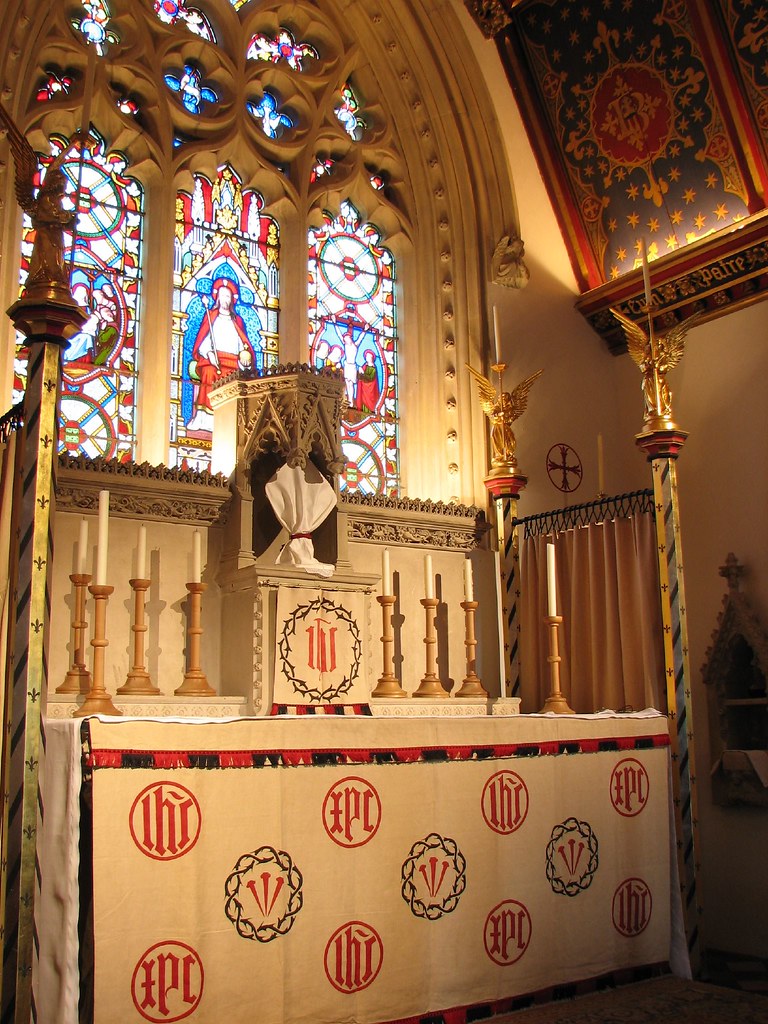
The altar is vested according to the color of day. Upon it is a crucifix with six candles on Doubles, four on Semi-Doubles, and two on all other days as well as for private Masses. In the primatial cathedral on each side of the altar is an additional crucifix commemorating the attempted "Graecorum schismatis extinctum" that took place in that building in 1274 (see image below). In a nod to good taste, absolutely nothing not pertinent to the sacrifice of the Mass is permitted on the altar.


Three sets of notes and rules are given for celebration of Mass in the rite of Lyons: private Mass, solemn Mass, and Pontifical Mass. In examining the Ordo Missae we will consider only the norm, Pontifical Mass.

Part II: Ordo Missae

The cantor and precentor, wearing copes, receive the Lord Archbishop at the door of the cathedral and provide him with lustral water to sprinkle as he is making a formal episcopal visit. He proceeds with his assistants to the sacristy of St Stephen. The throne, behind the altar, is decorated for Mass and the Archbishop reads the vesting prayers in the sacristy. During this time the choir sings the hour of Terce.

Vested, the Archbishop leaves the sacristy with his ministers and approaches the altar. The precentor intones the Introit, which the choir continue it. The acolytes with their seven candles stand on either side of the Archbishop while he and his ministers line up parallel to the altar and pray the preparatory prayers, which differ from the Roman ones. There is no Iudica me psalm and there are more versicle prayers, including Confetimini Domino familiar to the Dominican rite. The Confiteor is the same. At the absolution he puts on his maniple and "kisses the text," likely meaning the Missal held by the chaplain. After the Aufer a nobis the celebrating archbishop continues to his throne. He does not kiss and incense the altar, upon which rests the book of Gospels, as in the Roman rite. 

Sitting at the throne between his two assistants, mitred and covered with the gremial, he reads the Introit and recites the Kyrie in alternation with them. He then rises un-mitred and intones the Gloria. Near the end of the Gloria the senior most subdeacon kisses the Archbishop's ring, takes the lectionary, and goes to the place where the epistle is sung. The Archbishop greets the congregation Pax vobis and sings the collect[s] of the day as in the Roman rite. Then everyone sits. The subdeacon reads the epistle sitting while a young subdeacon holds the lectionary for him. After the epistle the subdeacon returns to the Archbishop for a blessing while the choir sings the Gradual. During the Gradual five of the acolytes take up their candles and stand on either side of the altar, leaving two in front of it, again similar to the Norman liturgical rites.

At this point the acolytes take their candles and escort the senior subdeacon (carrying the chalice), the senior deacon (carrying a vial of wine), the sacristan, and a canon of the cathedral (carrying the burse) to the Lady Chapel on the epistle side. The canon opens the burse, spreads the corporal, and places the sacred vessels upon it. He prays one of the offertory orations over the host Dixit Iesus discipulis suis: ego sum panis vivus etc. Someone tastes the wine and if it is proper the deacon pours it into the chalice saying De latere Domini...., and rebuilds the assembly. He then gives it to the subdeacon and all return to the sanctuary. The subdeacon replaces the chalice with wine upon the altar of St. Speratus, which is behind the main altar and doubles as a credence table.


The deacon then asks the lord Archbishop for a blessing and receives it: "Corroboret Dominus sensum tuum et labia tua, ut recte pronunties nobis eloquia sua secundum Evangelium, et pax tecum sit, in nomine Patris...." The celebrant blesses incense and the deacon takes the Gospel book from the altar, kissing both and praying "Pax Christi, quam nobis per Evangelium suum tradidit, conservet et confirmet corda et corpora nostra in vitam aeternam. Amen." A processional cross precedes the Gospel book and is incensed by the deacon. The tone for both the epistle and Gospel are the same. While the music tones for Paris and Sarum differed from the Roman ones, they were still pleasant. I find the Lyonese tones remarkably banal.

After the Credo the Archbishop begins the Offertory much as in the Roman rite. At the altar the Archbishop offers the host and chalice with Quid retribuam Domino and then blesses both. He places the host directly on the corporal in front of the chalice and puts the paten to the side. The clergy gather around the altar according to dignity and the celebrant incenses the gifts and altar reciting the first verse of psalm 140. He then washes his hands saying the first verse of psalm 25, returns to the center of the altar, again prays over the oblation, says the Suscipe Sancta Trinitas and then turns to the people saying "Orate pro me fratres...." Then follows the secret[s] and preface.

The anaphora is the Roman Canon. In a twist the Libera nos after the Pater noster is sung aloud. The  deacon turns to the people and tells those gathered to bow their heads. The Archbishop receives the mitre and crook, turns to those gathered, the clergy kneel before the altar, and he blesses all present: "Et pax + eius sit + semper + vobiscum. Et cum spiritu tuo." He then continues Mass as normal. During the Agnus Dei the communicating priests, deacons, and subdeacons approach the altar through the doors on either side of the railing [once] surrounding the altar. After the first communion prayer the celebrant begins the kiss of peace.

The Missal, like Paris and unlike the Roman rite, contains instructions for the administration of Holy Communion during Mass, a severe blow to the accusations of Jansenism, a philosophy that discourages frequent Communion and would not likely approve of providing for lay communication at every Mass. All kneel and recite the Confiteor. The Archbishop gives the absolution prayers and Communion is given as in the Roman rite. Communicants kiss the Archbishop's ring before reception.

The ablutions are done in the normal way. After the post-Communion comes the dismissal: Ite, missa est on days when the Gloria is sung, Requiescat in pace for Requiem Masses, and Benedicamus Domino on all other days. The celebrant prays the Placeat and, should the Last Gospel be normal, he and the rest of the clergy process to the sacristy, Mass concluded.

Part III: Prefaces

The prefaces are again more or less those of the Roman rite, but with a few exceptions. There is the preface of Advent, popped into the Roman rite by Pope John XXIII in 1962. There is a unique preface for the Presentation and Purification of the Blessed Virgin Mary, which vividly says that Our Lord is now offering Himself as a victim after so many victims were previously offered, and that the new mystery is now unfolding. There is a preface for the Mass of the Lord's Supper which is quite succinct and reflects the traditional theology of the Cross as a place of victory. There is a short preface of the Incarnation and Annunciation which differs from that of the Nativity and the content of which is rather unspectacular. There is the preface of the Blessed Sacrament, also in the 1962 Missal and also rather dullish in content. There is a unique local preface for Ss. Pothin and Irenaeus, ancient bishops of the Lyonese see. There is a very nice preface for the Nativity of St. John the Baptist which recounts his life and his distinction among the prophets. The Missal also contains the more recent preface for the dedication of churches.

There is an interesting preface of "the Saints" to be used on All Saints, for titular saints, and a few other days. It says that we rely on the "Communion of the consort" of saints and their intercessions and asks that we may join in their "unfading crown of glory."

A vivid preface for nuptial Masses teaches that an end of marriage is "the growth of the Church" (don't tell Cardinal Kasper!). 

Lastly, there is a preface for the Dead.

Conclusion

The sheer grandeur of this rite already causes one to doubt Gueranger's accusations of Jansenism, an ideology that alleges the irresponsibility of grace and the deep depravity of mankind. In such an ideology those with grace are certainly different from those without it, suggesting an exclusivity in the aesthetic of the movement not in conformity with the clear communitarianism of a rite like this. Some of the prefaces are dramatic in their language, but do not fall into the realm of Jansenism. The only defect thus far is the insipid tone for the readings.

Monday, October 21, 2013

The Parisian Missal III: Sundays Per Annum

We again resume our inspection of the neo-Gallican missal used in Paris until the 19th century Ultramonantist movement succeeded in suppressing its use in favor of the Roman rite on the pretext that the Parisian usage was mucked with the Jansenist heresy. The previous installments in this series have found no strong traces on Jansenism. There have been elements of dramatic language found, some of insipid and uninspiring and some of it quite beautiful.

Looking very Roman
source: mulier-fortis.blogspot.com
In part II one commenter noted that in earlier editions the folded chasuble was used during the same periods as it is used in the Roman rite and the other local usages, suggesting an intentional departure from the Roman praxis at a later point. One possible explanation is the political mood of the time. France may have intentionally attempted to assert a higher degree of spiritual independence from Rome than tradition allows and manifested this attempt by excising certain Romanesque vestiges; one would be hard pressed to find a vestment or liturgical item more Roman than the folded chasuble. But by this does not denote heresy (otherwise the 1962 and 2002 Roman Missals would be heterodox). It merely recommends us to notice political undercurrents fought on a liturgical battlefield.

To reiterate, here are the criteria used for Jansenism, from New Advent's encyclopedia (precepts of Jansen condemned by Innocent X's bull Cum occasione in 1653):
  • Some of God's commandments are impossible to just men who wish and strive (to keep them) considering the powers they actually have, the grace by which these precepts may become possible is also wanting
  • In the state of fallen nature no one ever resists interior grace
  • To merit, or demerit, in the state of fallen nature we must be free from all external constraint, but not from interior necessity
  • The Semipelagians admitted the necessity of interior preventing grace for all acts, even for the beginning of faith; but they fell into heresy in pretending that this grace is such that man may either follow or resist it
  • To say that Christ died or shed His blood for all men, is Semipelagianism (it is condemned because Christ did die for the sake of all)
With these points in mind, let us undertake the next data for our investigation, Sundays per annum. We have examined Holy Week and Pascha, and will now look to Sundays throughout the year, as these ought to be most indicative of what the faithful heard at a given Mass. We shall have a peak at:
  • The first Sunday of Advent
  • The second Sunday after Epiphany
  • The third Sunday of Lent
  • The tenth Sunday after Pentecost
  • And the last Sunday after Pentecost
The selection of these Masses is intentionally random, so as to ensure an unbiased sampling.

First Sunday of Advent


Advent is the richest, more beautiful and lively season of the liturgical year in the Latin liturgy. According to Gregory Dix Advent is of Gallic origin and came to Rome in the latter part of the first millennium. The Sundays of Advent have the twofold purpose of recounting the plight of the world before Christ while also looking forward to the joy of His coming. The Masses are repeated throughout the week. Certain friends of God quite relevant to the Nativity arise throughout Advent. St. Nicholas of Myra, renowned for his charity and his defense of the Word Incarnate athwart the arch-heretic Arius, appears, as does the Immaculate Conception of our Lady (or the Conception of the Blessed Virgin if one prefers St. Pius V's Dominican adjustments). The season intensifies with the "O" antiphons, layered in Old Testament typology, and concludes with the birth of God made Man.

In the Roman rite the first Sunday of Advent has three concurrent themes:
  • Creation: the liturgical year re-lives the Divine revelation, making the first day of the year also the first part of the human story. Man, mired in his sins, cries to the Lord for redemption: "To Thee have I lifted up my soul: in Thee, oh my God, I put my trust" (Psalm 24, Introit of the Mass).
  • Awakening: spiritual awareness for the birth of the Lord. "Brethren, knowing that it is now the hour for us to from sleep. For now our salvation is nearer than when we believed. The night it passed and the day is at hand" (Roman 13, epistle of the Mass).
  • The Second Coming: when the world ends, Christ will come again, not as an infant, as He did in Bethlehem, but in fully glory. "Heaven and earth shall pass away, but My words shall not pass away" (Luke 21, Gospel of the Mass).
How does the Parisian rite compare?

The Introit is nearly the same, except the versicle, also from psalm 24, differs ("Be mindful of me, oh Lord, according to Your mercy and your goodness" instead of "Show, oh Lord, Thy ways to me and teach me Thy paths"). The collect is the same as in the Roman rite, with a choice of votive orations to add, recommending Ecclesiae tuae and the commemoration of the Blessed Virgin. The epistle differs by a few words ("knowing that" is omitted and St. Paul's concluding remark added "and make not provision for the flesh in its concupiscences"). Does this difference reflect Jansenism's disregard for the body and favor of external disposition towards grace condemned by Innocent X? Only if St. Paul was a Jansenist. The Gradual is not taken from psalm 24, but from Isaiah chapter 62; this choice picks up nicely on the Gospel text about the Second Coming and the seasonal theme of the Incarnation ("Behold the Lord has made it to be heard to the ends of the earth, tell the daughters of Sion: behold, the Savior comes, behold his reward is with him, and his work before him"). The Gospel pericope comes from the same place as in the Roman rite, but is somewhat longer, extending beyond Our Lord's admonition about the longevity of His teaching to the point where He commends His Apostles to prayer, lest they become ensconced in the snares of those who confuse the faithful. The offertory verse is from psalm 24, but not the same as in the Roman books. Although different, the secret conveys the exact same message. The preface is the neo-Gallican Advent preface found in the 1962 Missal. The communion verse and post-Communion prayer are non-descript.

From the weekday lessons after
the first Sunday of Advent
Perhaps more suspicious to the Roman authorities than banal propers was that the Missal prescribes the Sunday Mass to be repeated on weekdays, but offers proper readings for Wednesdays and Fridays. Jansenists famously echoed the demands of their ancestors in heresy, the Protestants, in demanding more Scripture in the liturgy. So surely this is an example, no?

Not exactly. The Sarum rite, which one could argue dates to the late eleventh century, follows the same pattern, although with different readings. The rite of Lyon, also French and much older than the rite of Paris, follows the same pattern and with the same readings. These variable weekday readings for repeated Sundays throughout the year seem to be a feature of the Norman liturgy. Unlike the modern Roman liturgy, which has three years worth of daily readings, the proper readings in this rite seem deliberate and limited so that they might link with the repeated Sunday Mass and provide coherent instruction.

When considered in its historical context, the first Sunday of Advent displays both common material with the Roman rite and some local variations descended from the rites of northern France, which were sparsely used by the 19th century.

Second Sunday after Epiphany


The second Sunday after Epiphany begins with a different, and less cogent, Introit than the Roman books. The Roman rite recounts the earth's rejoicing at the Lord (psalm 65), Who made and commands it, very fitting given that Jesus manifests His dominion over matter in the Gospel account of the Wedding Feast at Cana. The Parisian rite merely asks "Who is like Our God" (psalm 76). The collect is the same and the epistle in the Parisian Missal begins one sentence prior to the Roman Missal's pericope. The Gradual is different, but similar in theme (God as the Almighty protector of Israel). The Gospel lesson is exactly the same. The offertory, from psalm 85, speaks of the Lord's unique works and that all people shall adore before Him, again departing from the Roman rite's terrestrial theme in the propers. The secret, very fittingly, asks the Father to transform the bread and the wine, as His Only Begotten transformed water into wine at Cana. Finally the Mass heeds God's sanctification of the physical. While is differs from the very simple Roman secret of the same day, it conveys the same idea present in the Roman proper chants. The Communion verse is an odd choice ("If I do my Father's work, believe in this work, that you may know and believe that the Father is in me and I in Him" John 10) compared to the Roman rite's (John 2:7-11). The post-Communion oration is the same. Again, there is an option to use a different set of readings should the Sunday Mass be repeated on Wednesday or Friday.


Third Sunday in Lent


This day's Mass is remarkably like the Roman Mass of the day. The Introit, collect, Epistle, and Gospel are exactly as in the Roman rite. The Gradual asks that the Lord "confound those who seek my soul" (psalm 34) rather than the Roman rite's excerpt from psalm 9. The tract borrows from psalm 124 instead of Rome's psalm 122. Both versions follow the theme of the Lord as protector as adumbrated in the Introit. The offertory chants differ, but not in a way worthy of note. The secret follows the same intention and structure as the Roman rite, but with different wording; the prayer, which asks God to expunge the sins of the people, is hardly the substance of a sect who believes in irresistible interior grace. The Communion verse, which calls God the "tower of strength in the face of the enemy," is more aligned with the theme of the Mass than the Roman rite's text. A cunctis nos is the post-Communion oration in the Roman rite. Paris opts for a more dramatic prayer, beseeching the "infusion of blessing" upon the people, which repels the "diabolical snares." This prayer differs from the Roman Mass's, but in some sense, again, maintains the theme of the Mass more effectively.

Tenth Sunday after Pentecost


Dominica per annum
source: papastronsay.blogspot.com
The Roman Mass for this Sunday teaches the faithful about Christian humility and the littleness of man before God, for good works are inevitably the work of the Holy Spirit. The epistle, taken from St. Paul's first missive to the Church in Corinth, reminds the Christians there that "dumb idols" had them lost, but by the Holy Spirit they were converted unto Christ and that all good deeds and gifts they now exercise emanate from that same Spirit. St. Luke's Gospel recounts the parable of the Publican and the Pharisee; the former left justified because he acknowledged God's place over him, while the Pharisee was blinded by his arrogance and left unfulfilled. The Communion verse is fittingly borrowed from psalm 50 and the post-Communion oration petitions God to grant aid to those "whom Thou dost not cease to renew by Thine divine Sacraments."

The first half of the Parisian Missal is almost exactly the Roman text for this day. A mix of texts from psalms 114 and 137 as well as the prophet Isaiah comprised the chant. The line from psalm 137, "[He] recognizes humility," is quite reasonable for this day. The offertory, from chapter 9 of Judith, continues the theme of humility whereas the Roman pericope from psalm 24 speaks of trust—though trust in a higher power of course is an expression of humility. The secret, as has been the case in prior Masses, is more germane to the lessons than in the Roman rite: "We beseech You, oh Lord, that by the merit of this sacrifice, you abundant blessing may come upon your faithful people," that they may receive the grace they desire. Again, desiring grace is hardly a Janesnistic petition. If anything a Jansenist would hold that grace is narrowly accessible. The post-Communion oration is odd, and perhaps suspicious, in that it divides the "sinners" and the "just" in a way unlikely to be found in the Roman rite: "Grant us that by these sacraments, oh God, humility and sincerity of heart, by which You reform sinners to justice and promote the just to glory." This curious composition is actually somewhat new. After consulting a scan of a Parisian Missal (thanks for the link Protasius) from 1300 and comparing it with the Sarum books, I found that both shared an older post-Communion, Tui nobis Domine. This odd prayer may be the most serious "red flag" in the Parisian rite thus far, although given the surrounding prayers it is hard to justify a strictly Jansenistic reading of this oration.

Last Sunday after Pentecost


This Sunday represents and anticipates the end of the world, the general resurrection, and Judgment. Both the Roman and Parisian books utilize Colossians 1:9-14 and Matthew 24:13-25 for the lessons. Whereas the Roman rite reuses the proper chants from the previous Sunday, the Parisian rite has proper propers. Indeed, even the collect and secret match today. The post-Communion prayer in the Roman rite asks that the Sacraments heal whatever is corrupted in our minds, while the Parisian prayer asks that God, the "cause of our good merits," to increase His mercy over us. The chants in the Parisian rite are far more Apocalyptic than the Roman rite, but far from heterodox. The Introit is composed of verses from psalm 118 "blessed are they who walk in the law of the Lord." The Gradual borrows from Revelation 10, "And I saw a great throne...." tying in very nicely with Our Lord's foretelling of His Second Coming at the end of time to "judge the living and the dead," as the Creed affirms.

Conclusion and Next Installment


Aside from one very strange oration in the Tenth Sunday after Pentecost the Parisian Missal, both dramatic and unique, displays no innate signs of Jansenism or heresy. Indeed, many of its local features it shares with Lyon and Salisbury.

Next we shall have a look at two great feasts' Masses and two Masses from the "Commons" used so often throughout the year. We will conclude with one last installment on the votive prayers and then switch to the rite of Lyon.

If readers have any suggestions for which of the great feasts they would like examined, feel free to leave a comment.

Wednesday, September 18, 2013

The Parisian Missal I: Ordinary of Mass & Prefaces

As part of our endeavor to "test" Dom Prosper Gueranger's thesis that the liturgical books of France, particularly the "neo-Gallican" books like those used in Paris, were rife with Jansenism, we shall examine the Parisian rite Missal and the Lyonese rite Missal in depth, parsing the rubrics, Ordo Missae, prefaces, Holy Week rites, votive orations, and 10 random Masses (5 will be from Sunday). The series commences with the Parisian Missal. Our source is the 1766 Missale Parisiense found here. Given that it was in use a century before Gueranger's influence and a century after the death of Cornelius Jansen, any un-purified Jansenist detriti should be visible.

For the sake of simplicity we shall say the Cornelius Jansen was bishop and theologian in the 17th century who held ideas on free will and grace which he believed reflected those of St. Augustine. His views, which minimized free will and man's relationship to grace to a near-Calvinistic level, inevitably brought his followers into an exclusivistic, communitarian mindset, one which often sought to minimize Papal authority. From New Advent's encyclopedia, here are the precepts of Jansen condemned by Innocent X's bull Cum occasione in 1653:
  • Some of God's commandments are impossible to just men who wish and strive (to keep them) considering the powers they actually have, the grace by which these precepts may become possible is also wanting
  • In the state of fallen nature no one ever resists interior grace
  • To merit, or demerit, in the state of fallen nature we must be free from all external constraint, but not from interior necessity
  • The Semipelagians admitted the necessity of interior preventing grace for all acts, even for the beginning of faith; but they fell into heresy in pretending that this grace is such that man may either follow or resist it
  • To say that Christ died or shed His blood for all men, is Semipelagianism (it is condemned because Christ did die for the sake of all)
We shall use these condemned statements as criteria for Jansenism throughout our investigation into the French local rites.

Part I: Rubrics


The rubrics of the Missal are very much like the Missale Romanum as it existed before the pontificates of Pius XII and John XXIII. There are some notable exceptions. V.3 mandates commemorations of ferial days when a votive Mass is celebrated. V.2 also seems to mandate proper last Gospels for ferial days (wonder how that worked). A marvelous local custom, in Advent feriae orations for the Incarnation were sung (VI.16). In Masses for the dead Requiem aeternam.... is prayed in place of Gloria Patri.... as in the Roman rite. As one reads through the rubrics one understands that this Missal, unlike the Roman Missal of the same time, was intended to be used at sung liturgies in communal settings. The instructions on how many Masses are to be sung on overlapping days and why they do not have commemorations is very clear. The instructions also dictate that lessons, for instance, on certain feriae are to be sung at the normal place. The Roman Missal of the same period, descended from the 1474 Curial Missal, envisioned a lone priest as the norm, likely due to the setting and needs of the celebrants of the 1474 rite. The Parisian Missal was meant for canons of Notre Dame and of other collegiate churches. For instance, when a votive Requiem Mass is sung, it is sung after Prime, is to be followed by Terce and the festive Mass of the day, and then by Sext and the ferial Mass of the preceding Sunday (VIII). The men who used this rite were busy bees.

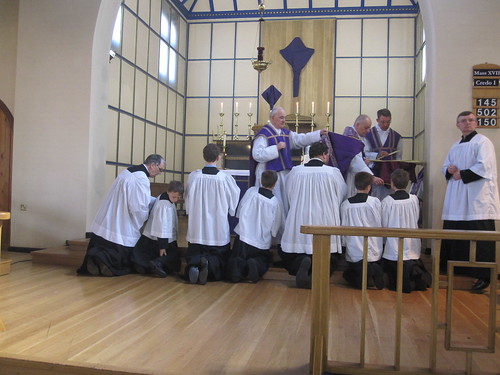
A classically Norman Lenten array at
St. Birinus in Dorchester on Thames.
White is used as a liturgical color on the same major feasts as in the Roman rite, but also throughout the Paschal and Pentecost Vigils. Red gets the nod on Mandy Thursday, Trinity Sunday, Corpus Christi and its octave, and Sundays throughout the year, as well as on many Roman feasts. Green is used for the consecration of bishops and for the anniversaries of such events. Violet is used in Advent and Septuagesima, but "ash" is used from Ash Wednesday until Passion Sunday, wherein black invades until the Paschal vigil Mass (and black is also used for the blessing of ashes on Ash Wednesday). "Ash" probably has its roots in the dull greyish white used in the Norman rites (from which Sarum is descended and which many parishes in England still use); the point was to make Lent colorless, a departure from the visual overload of the older rites per annum. Substitutions for different colors are allowed—for instance, blue for violet—probably as a pastoral provision for parishes without much means. Such was life before mechanized weaving and sewing. Thus far, no heresy!

For those who like the "big six" on your altar, you may not like the Parisian rite. The number of candles prescribed are as follows:
  • Feriae and Simples: two
  • Semi-doubles: four
  • Lesser Doubles: six
  • Greater Doubles: eight
  • Solemnities: ten
  • Great Solemnities: twelve (!!!!)

There is a rubric stating two is the norm for private Masses, however. One wonders what the Parisians thought of Rome's modest six on all semi-doubles or higher and Sarum's constant two! Who said the Latin liturgy was always sparse?

On feasts the priest carries a cross with him on his way to the altar, which the deacon places upon the altar and toward which the ministers pray the Confiteor. Instructions for the Mass proper dictate that incense is to be used at the beginning of Mass only at "great" (solemn) Masses. The ceremonies of the first half of Mass are like those of the Roman rite. The subdeacon sings the epistle while the celebrant and deacon read it and the gradual from the Missal. There is an interesting provision in section VI (on serving the Mass, not the general rubrics) that permit a lector vested in alb, amice, and cincture to sing the epistle without a maniple if there is no subdeacon. Perhaps outside of Rome there were more gradations of Mass than just Low, Sung, and Solemn as we have them today. Either way, the epistle is sung from an ambo or in medio choro, but facing the altar. Another oddity, at least from the Roman view, is that the choristers who sang the Alleluia needed the celebrant's permission when the setting was the archbishop singing Mass from the throne. The Gospel is also read from an ambo. If there are two ambos, then the epistle and Gospel are sung from different ones. At the Gospel an acolyte carries the same cross the celebrant brought to the altar at the beginning of Mass. At solemn Mass the acolyte holds the paten in a veil, receiving it from the subdeacon with a kiss. The Canon is basically done as it is in the Roman rite. The fraction precedes the Agnus Dei as in the Roman rite, in contrast to the older rites of the area. At the Pax the celebrant says to the deacon "Peace to you brother, and to the Holy Church of God."

Communion is given after the ablutions, but not after Mass. The rubrics outright state "the priest does not delay [the communicants] until after Mass without necessity." Was this a hint of Jansenism? Perhaps in the eyes of some the idea of making Communion of the Faithful a prescribed part of Mass was Jansenism. Devotion to the Blessed Sacrament and fear of unworthy communication became so strong during the Middle Ages that Communion of the Faithful ceased because so few received. Priests and deacons would administer Holy Communion after Mass. Yet here it is near-demanded as a part of the Mass for those who wish to receive. Perhaps this was a Jansenist influence. Or perhaps it was just common sense returning. Communion is given the medieval way. The subdeacon holds the paten while the deacon carries a chalice of unconsecrated wine and water as a chaser to make sure everything goes down. When you think about it this made our current fears of people taking the Blessed Sacrament and doing horrible things to Our Lord impossible.

The acolyte holds the paten under the veil at a Sarum rite Mass
source: newliturgicalmovement.org
Another rubrical feature that may have disturbed the Roman establishment is the prominence of the acolyte, de facto irrelevant in the Roman rite. He carries a cross at the Gospel, can sing the epistle under the right conditions, holds the paten during the Canon, and gives the Pax to the choir. In short, he is a minister of the Mass and not just a man with a candle! This was, again, the medieval praxis!

The rest of the Mass continues as in the Roman form.

The rubrics are followed by prayers for before and after Mass, many of which are found in the Roman Missal. The tones for the various chants of Mass are also found in this section. Singing them to myself, even with my own voice, I notice that while they differ from the ancient tone in the Roman rite, they are not unpleasant.

Part II: Ordo Missae


The Ordo Missae of the Parisian rite is very similar to the Roman form. Stunningly similar actually. The first half of Mass, the "Fore Mass" or "Mass of the Catechumens," is word-for-word the same as in the "Tridentine" Roman form. At the offertory, the prayers and actions (including the incensing of the gifts and altar) are exactly the same as in the Roman rite with one exception. The priest, before offering the bread with the Suscipe Sancte Pater blesses it with the words: "Lord Jesus Christ, Bread of Angels, Living Bread of Eternal Life, bless worthily this bread [these breads], as You blest the five breads in the desert, that all who taste of it [them] may receive health of soul and body." This one deviation is as orthodox a prayer about the Eucharist as there is. Perhaps its lack of exclusive focus on sacrifice worried those who favored the Roman liturgy's narrowly sacrificial language, which many regarded as a fortress against the insistence of Protestants that the Eucharist is a meal's food. Would the same also apply to the communitarian approach of the Jansenists? Possibly, but it seems a tenuous connection.

The text of the Canon is precisely that of the Roman Canon. At pontifical Mass sung by the Archbishop after the fraction and the Per Omnia saecula saeculorum but before the mingling of the Host and the Precious Blood the deacon announces a blessing ("Bow yourselves for the blessing"). The archbishop then sings "May his peace with you always" as he mingles the Sacred Elements, in place of the conventional "May the peace of the Lord be with you always."

The rest of the Mass is, word-for-word, the same as in the Roman Mass. Again, no heresy.

Part III: Prefaces


The Parisian Missal contains almost all the Gallican prefaces added to the Roman Missal by Pope John XXIII in 1962, except the Preface of St. Joseph. There are also three additional prefaces not in any post-1570 (and pre-1970) edition of the Roman Missal:
  1. Preface for Mandy Thursday and Votive Masses of the Blessed Sacrament: calls Our Lord the "True and Eternal Priest" and "the only Priest without the stain of sin" Who instituted the Holy Sacrifice for our benefit.
  2. Preface for the feast of Ss. Dionysius, Rusticus, and Eleutherius: a wordy preface that asks the Lord to strengthen us, who He assumed from darkness in His mercy, and to keep the work He has done in us, particularly through his martyrs, who are not even named in the preface.
  3. Preface for Nuptial Masses: speaks of the bonds of marriage and asks that God, in His Providence, may grant the renewal of the Church. The exclusion of this preface from the 1962 Missal, at a time when the reformers were adding prefaces and tinkering with the rubrics of the Nuptial Mass, speaks volumes for its literary and theological value.
In short, nothing out of the ordinary other than Gallican literary eccentricity and some dull prefaces.

Conclusion

Thus far the Parisian rite appears to be a descendant from the Norman liturgical family which adopted the Ordo Missae of the Roman Missal, albeit with a few local tweaks. The unique prefaces reflect the loquaciousness of French devotion, but are doctrinally sound. As of post one, the Parisian rite withstands Dom Gueranger's condemnation.