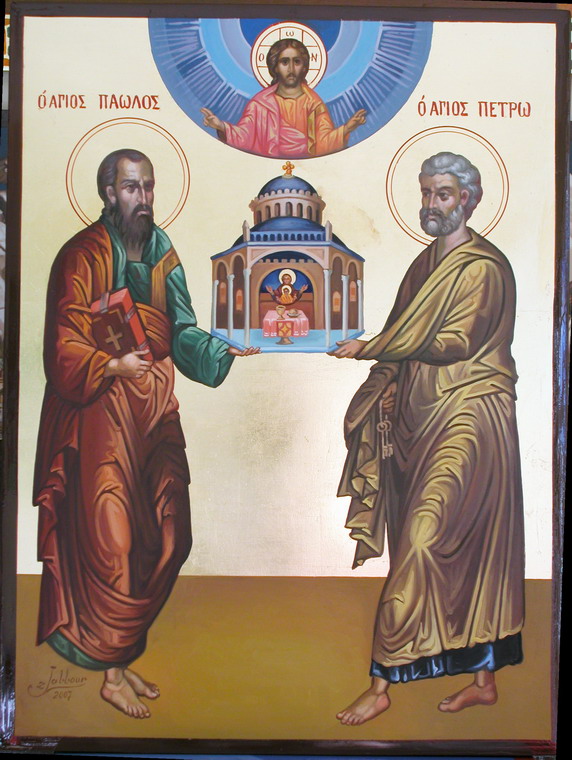
Today at Lauds I read the collect for the Commemoration of St Paul followed by the antiphons, versicles, and collect for St. Peter. Whenever the feast of one arrives a commemoration is always made of the other in the various pre-Conciliar rites, but why on this day is St. Peter commemorated rather than the octave of Ss. Peter and Paul? Better yet, why is there a day called the Commemoration of Saint Paul when there was a feast of Ss. Peter & Paul yesterday?
The answer is actually missing in the texts of yesterday's Offices and Mass. On the feast of Ss. Peter & Paul there is hardly any mention made of St. Paul in the Mattins readings (other than allusion by St Leo), the antiphons on the Major Hours, and none at Mass save for the collect. This underscores a subtle oddity in the liturgical history of the Eternal City: June 29th was not the single feast of Ss. Peter and Paul, but it was the feast of both Saint Peter and Saint Paul, two feasts in one day.
As Pierre Batiffol recounts in his History of the Roman Breviary, feasts in the first few post-Nicene centuries were often unique to the churches of Rome and celebrated in honor of the saints whose relics were contained there. By the time of St. Gregory the Great Rome had declined to a meager population of about 30,000 from its Imperial peak of a million. Yet the devout in his small population could ambulate through the vast city to churches that held the relics of saints and celebrate the vigil and Mass with the Lord Pope of the City with relative ease, the origin of the "stational churches" of great feasts, vigils, and fasting days that are still observed during Lent to this day. As such, feasts of multiple saints usually pertained to the saints buried in a given church. Sancti Apostoli in Rome holds the bones of Ss. Philip and James, and so the transfer of their relics to that church elicited their feast on May 11. The same would have been true earlier this week for Ss. John and Paul. But this feast of two saints is precisely what would not have happened on June 29th or 30th....
Instead, the Basilica of Saint Paul Outside the Wall and the Vatican Basilica of Saint Peter would each have observed the feasts of their patronal saint whose relics rested beneath the main altar. In times of old the Pope would begin the evening at the Basilica of Saint Paul Outside for the vigil (Vespers, Mattins, and Lauds) and continue until day break, when he would travel to Saint Peter's on the Vatican Hill for the celebration of the Mass. Because the Mass took place at the Vatican Basilica the Missal texts that come down to us are for the patronal feast of that particular church just as any pre-John XXIII hand missal gives St. Peter's as the station for June 29. The 10th century Gregorian Sacramentary gives June 29th as the feast of St. Peter, despite mentioning both Apostles in the oration, and June 30th as the feast of St. Paul. By the Middle Ages June 29th was conceded as the feast of both Saints, in accordance with ancient prerogative, and the uniquely Pauline Offices and Mass of June 30th were rebranded as the Commemoration of Saint Paul giving the Doctor Gentium the due he would one have received on June 29th in the Basilica that assumes his name.
"These twain be thy fathers, these be in good sooth thy shepherds, these twain be they who laid for thee, as touching the kingdom of heaven, better and happier foundations, than did they that first planned thine earthly ramparts, where from he that gave thee thy name took occasion to pollute thee with a brother's blood. These are they who have set on thine head this thy glorious crown, that thou art become an holy nation, a chosen people, a city both Priestly and Kingly, whom the Sacred Throne of blessed Peter hath exalted till thou art become the Lady of the world, unto whom the world-wide love for God hath conceded a broader lordship than is the possession of any mere earthly empire. Thou wast once waxen great by victories, until thy power was spread haughtily over land and sea, but thy power was narrower then which the toils of war had won for thee, than that thou now hast which hath been laid at thy feet by the peace of Christ."
Pope St. Leo the Great, first sermon on the feast (second nocturne of Mattins)
"This is my first time wearing a green stole," said the gleeful deacon, recently ordained on St. Joseph's day during Lent. It was the Monday after Pentecost Sunday and a deacon, priest, and his all Traddiness were in the sacristy of an English church preparing for Mass. "I like Ordinary time," he continued.
"There is no such though," I rebutted.
"Now don't get me started!"
"Gentlemen," interjected the priest, "it is time for Mass now."
To this day I do not believe in "Ordinary time," that prolonged green season turgid with readings that have no natural cycle to them and which, somehow, masks all but a few feasts. Recently we relaxed our festivities after the fifty days of celebrating the Resurrection and then the octave of Pentecost. Now we should be returning to a more general consideration of the mysteries of Christ and a penitential spirit. Personally I interpret the kalendar differently from most traditionalists and reformers. In my view the temporal and sanctoral cycles could be eschewed as categories in favor of "Time of Christ" and "Time of Mysteries." The period from the first Sunday of Advent until Pentecost Sunday re-live the actual life and ministry of Christ, His salvific work on our behalf, His Incarnation, Passion, Resurrection, Ascension, and the sending of the Spirit. The second part, the "Time of Mysteries"—a poorly concocted and spontaneous title—is the time to reflect on what the things Christ did actually mean and how they should influence us. The Church does not return to strict penance and fasting after None on Ember Saturday, but rather begins the celebration of Trinity Sunday, finally celebrating the Godhead completely revealed to mankind. The Jews knew God, but only as one person and not as a Father. Christ revealed Him as a Father and, after the Resurrection, was known to His Apostles as God. And through the Holy Spirit the Triune God became known to the entire world. Of course the Trinity was revealed at the Baptism in the Jordan, but the Trinity was not comprehended or realized until some time later, after the Ascension.
Then we came to Corpus Christi, the feast of the Body of Christ. The Church is a Sacramental body, the "Body of Christ" as St. Paul wrote to the Church at Corinth. The Eucharist is, more than bricks and mortar, the fabric of the Church.
Now, only two weeks removed from Pentecost, we are asked to celebrate and consider St. John the Baptist. Pentecost, as I wrote here, is a feast concerned with baptizing people into the Risen Christ and diffusing the Church through the whole of the world. With John the Forerunner we return to Baptism. St. John is, more than any other saint I think, the archetype of what the Christian should be. He was given a name different from his father's, one that was to be special to God. St. Ambrose wrote:
"His name is John that is, it is not for us to choose a name now for him to whom God hath given a name already. He hath a name, which we know, but it is not one of our choosing. To receive a name from God is one of the honours of the Saints. Thus was it that Jacob's name was no more called Jacob but Israel, because he saw God face to face. Thus was it that our Lord Jesus was named before He was born, with a name not given by an Angel, but by the Father. "
He was a holy man from the womb, proclaiming the presence of Christ before birth and continuing to do so more perfectly after. And above all he pointed those attracted to him towards Jesus. Is this not our lot?
We did not proclaim Christ in the womb perhaps, but at Baptism we became saints, "holy ones," in a new birth, having been reborn of "water and the Holy Spirit." At Baptism and Confirmation we are given names used before God and the Church. In our Baptism we are called both to repent, as was John's call of baptism, and to live a new life sanctified by the Resurrection of Christ, as is the Baptism of Trinity. And above all we must point to Christ for others. Most of us will not have particularly interesting or noteworthy lives. Our spiritual battlefield is the office, the classroom, the home, the restaurant. There are myriad ways to show God in these settings if only we have the fortitude to ask for the opportunity. Before Christ rose from the dead and gave us the Trinitarian Baptism, St. John showed us what Baptism does, completing his place as the Forerunner to our Lord Jesus Christ.
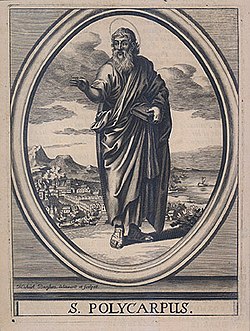
Given the "proof text" approach of many Catholic apologists today, using the writings of the Apostolic and Church Fathers against protestants, only certain Fathers are read. St. Justin the Martyr is useful in "proving" the Eucharist. St. Ignatius of Antioch is useful in "proving" the idea of the Catholic Church. St. Cyprian is useful in "proving" the papacy. Yet what of great Fathers who are not so easily weaponized? Today they are forgotten by those who call nineteen century old writers to arms against Legion and his megachurches, but they are not forgotten by all. Some of us still find edification in the pastoral writings of the Fathers, as much so as in the doctrinal writings of other Fathers. One such Father who I find fascinating is St. Polycarp of Smyrna.
According to tradition Polycarp was taught by "St. John," who ordained him a bishop of the city of Smyrna. I put John in quotations because a few dispute whether his teacher was John the Apostle—writer of the Johannine Gospel, the first epistle of John, and the Apocalypse—or whether it was John the Presbyter—likely writer of the second and third epistles of John. Polycarp, who lived until the mid-second century, is remembered in his surviving letter to the Church at Philippi, where St. Paul "accurately and steadfastly taught the word of truth in the presence of whose who were then alive" (Ch. 3). The epistle is an exhortation to the laity and clergy to ignore the worldly temptations which have seduced some of the church and to return to the faith given to them by Paul and Ignatius. At some point Polycarp visited St. Anicetus, a fellow Syrian and at the time Pope of Rome. He fell asleep in the Lord in 155.
The epistle begins with a veritable Pauline greeting: "Polycarp, and the presbyters with him, to the Church of God sojourning at Philippi: Mercy to you, and peace from God Almighty, and from the Lord Jesus Christ, our Savior, be multiplied." The tone establishes that this missive has a personal connotation and not a formal one. He is acquainted with these believers and greets them in the spirit rather than in social respect.
The saint initiates the body of his letter with a reminder of that church's sufferings, "diadems of the true elect of God and our Lord." Mere works do not save, but faith. How is suffering not a "work?" Are the Christians of today to read Polycarp and surrender to the modern dichotomy between "faith" and "works?" This is not what the saint means: "[know] that by grace you are saved, not of work, but by the will of God" (Ch. 1) and "But He who raised [Jesus] up from the dead will raise up us also, if we do his will, and walk in His commandments, and love what He loved" (Ch. 2). One is saved by the will of God, not personal merit. Yet if one loves God one is united to the will of God and does what He wishes out of love for God—what we now call Sanctification or Theosis. This holiness in which one unites to the will of God is found in suffering, for Christ "suffered for own sins unto death" (Ch. 1) that "we might live in Him" (Ch. 8, 1 John 4:9). One does not suffer alone for Christ. The Christian suffers with Him as did the Apostles, who are "in their due place in the presence of the Lord, with whom also they suffered" (Ch. 9).
This same call to virtue displays ante-Nicene Trinitarianism. St. Polycarp establishes order and communion between "God" and the Son "Jesus Christ." The separation of the two persons of the Trinity as "God" and "Jesus" should not trouble us, as this terminology survives in the traditional Roman and the Byzantine liturgies, wherein God the Father is sparingly called "Father" directly, indeed perhaps only in the Our Father. "God" raised Jesus, glorified Him, sat Christ at His right hand, and gave Him the power of judgment; all these things are proper to the Godhead. Polycarp is using the ante-Nicene vocabulary for talking about the Divine inherited from the Jews which survives in the Church's liturgical life.
Chapter four opens with a famous aphorism, "But the love of money is the root of all evils." From here Polycarp gently indicts the priests, deacons, and laity of the church for losing their focus and then tries to re-direct this wayward church. What utility, the saint questions, is to be found in alternatives to virtue or the presentation of false virtue? God "clearly perceives all things, and that nothing is hid from Him, neither reasonings, nor reflections, nor any one of the secret things of the heart" (Ch. 4). God is not mocked, even in private. The saint gives a general warning against various kinds of that most powerful kinds of private sin, the sexual:
"For it is well that they should be cut off from the lusts that are in the world, since every lust wars against the spirit; and neither fornicators, nor effeminate, nor abusers of themselves with mankind [doesn't sound terribly fond of gay marriage] shall inherit the kingdom of God, nor those who do things inconsistent and unbecoming. Wherefore, it is needful to abstain from all these things, being subject to the presbyter and deacons, as unto God and Christ. The virgins also must walk in a blameless and pure conscience." (Ch. 5)
Sexuality is not necessarily a bad thing. Indeed it is quite good. The chastity outlined negatively above is one found in behaving according to one's place in life.
Perhaps priests would do well to read this letter particularly the sixth chapter, which outlines the saint's expectations of the presbyters and other clergy of the Church:
"Let the presbyters be compassionate and merciful to all, bringing back those that wander, visiting all the sick, and not neglecting the widow, the orphan, or the poor, but always providing for that which is becoming in the sight of God and man.... If then we entreat the Lord to forgive us, we ought also ourselves to forgive; for we are before the eyes of our Lord and God, and we must all appear at the judgment seat of Christ, and must every one give an account of himself. Let us then serve Him in fear, and with all reverence, even as He Himself has commanded us, and as did the apostles who preached the Gospel unto us, and the prophets who proclaimed beforehand the coming of the Lord."
In short, the priest is the fearful instrument of Christ God's mercy. The end.
Polycarp places the greatest emphasis of faith on the Resurrection and Last Judgement. Here is the strongest insight yet into how the early Church believed. Christ was the first fruit of His own work, a work from which we shall in time benefit or suffer from abusing. Reality in changed by this one event, the rising of a man—Who is God—from the dead. We are partakers in that Resurrection and will be held to account for it. Those who deny this are the "first born of Satan" (Ch. 7). Oh how does this concept of death survive for us today in the Requiem Mass of All Souls' Day! In the epistle of that Mass St. Paul warns the Corinthians that those who lived in Christ will come to the "resurrection of life," but that those who did evil will awake in the "resurrection of judgment." Death and judgment. Could any two topics be less popular? In my own family mention of either is tantamount to scandal.
After another exhortation to virtue St. Polycarp writes harsh words that should carry weight with every Catholic who sins in public, who dissents from the Church in public, and who does not practice virtue: "Be all of you subject one to another having your conduct blameless among the Gentiles, that you may both receive praise for your good works, and the Lord may not be blasphemed through you. But woe to him by whom the name of the Lord is blasphemed! Teach, therefore, sobriety to all, and manifest it also in your own conduct" (Ch. 10).
The author winds down his letter in lamentation, regretting the loss of the priest Valens and his wife to bad faith. Evidently they fell in matters of "covetousness." Polycarp finds the loss of the two particularly painful given St. Paul's praise for the church of Philippi. He begs the Philippians not to be too harsh on Valens and his wife: "And be then moderate in regard to this matter, and do not count such as enemies, but call them back as suffering and straying members, that you may save your whole body. For by so acting you shall edify yourselves" (Ch. 11).
The saint concludes in telling the Philippians that he is sending copies of St. Ignatius of Antioch's epistles with the messenger and even divulges the name of the scribe who wrote the letter, a man named Crescens, who will pay the Philippian Christians a visit with his sister! Personally I find the human elements of these letters calming, as I do in the Pauline epistles. Modern readers can read these ancient texts and think them remote, saccharine, or even impossible. These letters were written by and for people who, like we today, must run our course in the faith and do so with the same union to the will of God and the same humility to which Polycarp exhorted the church of Philippi.
Interesting Historical Notes
Although a disciple of St. John, he rarely quotes John in this letter. The few times he does refer to John, such as in Chapter 8, are in reference to union with God—Theosis—indicating that this is a trait of the Johannine tradition. Also, in light of this, I would side with those who say Polycarp's John was the Evangelist and not the Presbyter.
He is very familiar with most all of the Pauline letters and quotes them more than any other text considered Scripture. He especially favors Philippians, Galatians, Timothy, and Ephesians. This indicates that Paul's letters, which most now agree were written in the 50s, had been in wide circulation beyond the local churches for quite some time.
Again, despite being from the Johannine tradition, Polycarp refers exclusively—at least in this sole surviving letter—to the Gospel according to St. Matthew and occasionally to St. Luke's account. These references are most often made to the Sermon on the Mount. The implications of this should be problematic to 20th century Biblical scholars who seek to drive a wedge between the Johannine tradition and the Synoptic texts. Evidently the bishop of Smyrna, a follower of John, saw no conflict or incongruity between the Synoptic narrative and the one he received. This could be explained by a theory that the account in St. John's Gospel draws to attention not a different Christ or different tradition, but different events and teachings not mentioned in the Synoptics. There is one Gospel and four accounts of it.
From this I think we must conclude that the New Testament texts were more broadly circulated and more widely accepted than we often realize.
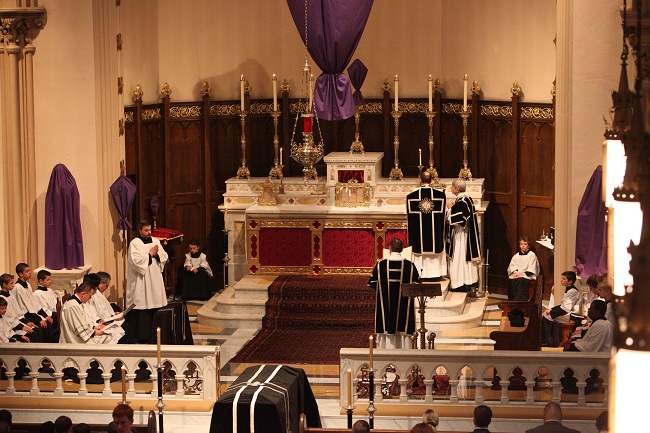
I just returned from Tenebrae, over two and a half hours of psalms and lessons. Really the depth of the old Triduum Office is beyond comprehension. The psalms are about battle, liberation, forgiveness, and defeat of one's enemies. The first lessons are the Lamentations of Jeremiah for the fall of the chosen people, of Jerusalem. The second are of St Augustine on how God can redirect evil for the good. And the first are form St Paul on the Last Supper and the Eucharist. The responsories paint the darkness of Judas' betrayal behind the broader themes of the night and contrast strongly with the festive, celebratory nature of the Mass of the day. And of course the extinction of the candles, leaving us in darkness and the "earthquake" (smashing books) that ends the night. It made quite an impression on myself and many others.
During the strepitus a friend bashed a book containing hymns such as Holy God We Praise Thy Name while I took out my rage lamented Christ's betrayal with a 1962 Missal, possibly damaging the spine.
Tomorrow off to the Maronites for Mandy Thursday, the washing of feet, and a night of Confession. Good Friday Vespers with the shroud burial and Jerusalem Mattins of Holy Saturday the following night. And Divine Liturgy of Pascha with the Melkites in Houston Saturday night/Sunday morning.
Today is the feast of the Dedication of the Basilicas of Ss. Peter and Paul, two of the four patriarchal basilicas of the Roman Church. The current buildings are fairly recent (St. Peter's is a 16th century replacement of a 4th century basilica and St. Paul's is a 19th century reconstruction of the original, which burned and imploded). The Rad Trad did not get to St. Paul outside the Wall during his visit to Rome, but did manage to spend a full day in St. Peter's Basilica. The current building has very little to do with the one which preceded it, other than that it too houses the relics of the Prince of the Apostles. For more on the previous building have a look here (and watch the video at the bottom, it is quite something).
I have re-posted some older material, a photo tour of the current basilica, for readers' edification. As stated on our previous post for the feast of the Dedication of the Lateran, these photos are perhaps better than what one will find online because they were taken during a progression through the church and hence give a clearer impression of the arrangement, scale, and style of the place. Some photos towards the end show the Rad Trad in personal horror (not a fan of heights).
The second lesson in the second nocturn of Mattins today seems to be based upon the fictitious Donation of Constantine (did Benedict XIV not want to rid us of this sort of thing?), but concludes with the interesting, and more historically feasible, statement that the consecration of a stone altar by St. Sylvester, Pope at the time, marked an official point of transition from wood to purely stone altars.
Happy feast!
Approach from the square
Sneak by the Swiss Guards
Our Lord watches this place
Where we hear "Habemus Papam"
Friends of the Rad Trad awaiting entry into the nave
First altar on the right contains the Pieta
Peering through the right-side door
A rather ugly statue of Pope Pius XII, among many statues of saints and popes
Looking back from the first chapel. This place is big!
A shot across to the altar of the Presentation
The baptismal font is enormous. Scale dominates this place
The dome over the baptistery
The coffered ceiling
Tomb of St. Pius X
The domes under the side chapels are quite colorful
The chapel of the choir, south of the high altar, which contains relics of St. John Chrysostom
Tomb of St. Gregory the Great. The Pope once vested for Solemn Mass here
while the schola sang terce
Apse of a transept
The baldacchino over the high altar is over 70 feet in height,
the largest piece of bronze work in the world
St. Andrew. There are many statues in the nave, but none of Apostles or Our Lady.
Those of the Apostles are to be found around the (ill-defined) sanctuary.
The entrance to the tomb of St. Peter and the Clementine chapel
St. Peter presiding at the basilica. A line of people wait to kiss his foot.
Confession in 22 languages from 7AM to 7PM
Looking from the altar to the nave
A friend of mine, who is over six feet tall, for size comparison
St. Gregory the Illuminator, disciple to Armenia
"I saw water flowing from the right side of the temple...."
The altar at the Petrine Throne with the Holy Ghost descending upon it.
It makes much more sense to see this during a Mass, which we did!
Saints watch and keep vigil
As we depart....
Later that day the Rad Trad visited the dome
The Rad Trad does not like heights
The Rad Trad really does not like heights.
Grabbing the cornice for dear life!
The Four Evangelists at the corners of the sanctuary
The inside of the dome
That ant below is a person! We were well over 200 feet above the floor
Ss. Peter and Paul sharing a rather unlikely embrace
"Dearly beloved brethren, in the joy of all the holy Feast-days the whole world is partaker. There is but one love of God, and whatsoever is solemnly called to memory, if it hath been done for the salvation of all, must needs be worth the honour of a joyful memorial at the hands of all. Nevertheless, this feast which we are keeping to-day, besides that world-wide worship which it doth of right get throughout all the earth, doth deserve from this city of ours an outburst of gladness altogether special and our own. In this place it was that the two chiefest of the Apostles did so right gloriously finish their race. And upon this day whereon they lifted up that their last testimony, let it be in this place that the memory thereof receiveth the chiefest of jubilant celebrations. O Rome these twain are the men who brought the light of the Gospel of Christ to shine upon thee These are they by whom thou, from being the teacher of lies, wast turned into a learner of the truth.
"These twain be thy fathers, these be in good sooth thy shepherds, these twain be they who laid for thee, as touching the kingdom of heaven, better and happier foundations, than did they that first planned thine earthly ramparts, wherefrom he that gave thee thy name took occasion to pollute thee with a brother's blood. These are they who have set on thine head this thy glorious crown, that thou art become an holy nation, a chosen people, a city both Priestly and Kingly, whom the Sacred Throne of blessed Peter hath exalted till thou art become the Lady of the world, unto whom the world-wide love for God hath conceded a broader lordship than is the possession of any mere earthly empire. Thou wast once waxen great by victories, until thy power was spread haughtily over land and sea, but thy power was narrower then which the toils of war had won for thee, than that thou now hast which hath been laid at thy feet by the peace of Christ.
"It well suited for the doing of the work which God had decreed that the multitude of kingdoms should be bound together under one rule, and that so the universal preaching of the Gospel should find easier entry into all peoples, since all were governed by the empire of one city. But this city, knowing not Him, Who had been pleased to make her great, used her lordship over almost all nations to make herself the minister of all their falsehoods and seemed to herself exceeding godly because there was no false god whom she rejected. But the tighter that Satan had bound her, the more wondrous was the work of Christ in setting her free." (Second nocturn of Mattins, from the festive sermon of St. Leo the Great)
On the altar are two Papal tiaras to the Epistle (right) side and two episcopal mitres to the Gospel side (left). Seven candles adorn the altar, with the crucifix in the center, and another row of candles in front of the altar over the tomb of St. Peter. Relics of Saints are often placed on the altar, as are two small statuettes of Ss. Peter and Paul. The Pope and the ministers of Mass arrive at the main altar of St. Peter's Basilica, with the sedia gestatoria left right behind the Pope, as it will be needed momentarily.
The cardinals who are not ministers of the Mass or acting as chaplains to the Pope at his throne go to their choir stalls in the apse of the Basilica. Their choir dress for Papal Mass is something of a remnant of ancient concelebration mixed with the dress of Canons: They wear a red cassock with a train, a rochet, their pectoral cross, the mitre, and, depending on rank, a dalmatic, chasuble, or cope—for cardinal deacons, cardinal priests, and cardinal bishops respectively.
Cardinal Deacon
Cardinal Priest
Cardinal Bishop
The Pope and his ministers pray the normal prayers at the foot of the altar, with the Iudica me psalm and the two Confiteor prayers, putting on the maniple after the Indulgentiam. At this point the Pope turns from the altar and sits again in the sedia gestatoria. The pallium, a woolen scarf-like vestment adorned with crosses and worn by all major bishops, is retrieved from the altar and the three cardinal bishops of Albano, Porto, and Ostia pray over the Pope:
God, who are present without distinction whenever the devout mind invokes you, be present, we ask you, we and this your servant, __, who to the summit of the apostolic community has been chosen as the judge of your people, infuse with the highest blessings that he experience your gift who has reached this point.
We supplicate you, Almighty God, effect your customary devotion and pour out on this your servant, __, the grace of the Holy Spirit that he who is constituted at the head of our church as the servant of the mystery, you would strengthen with the fullness of virtue.
God, who willed your Apostle Peter to hold first place in the inner fellowship of the apostles, that universal Christianity overcome evil, look propitiously we ask on this your servant, __, who from a humble position has suddenly been enthroned with the apostles on this same principal sublimity, that just as he has been raised to this exalted dignity, so may he likewise merit to accumulate virtue; in bearing the burden of the universal church, help him, make him worthy and for thee who are blessed may merits replace vices.
Then the senior-most cardinal deacon would place the pallium on the Pope's shoulders saying: "Accept the pallium, representing the plenitude of the Pontifical office, to the honour of Almighty God, and the most glorious Virgin Mary, his Mother, and the Blessed Apostles Peter and Paul, and the Holy Roman Church." (Coronation Rites, Reginald Wooley [Cambridge, univerity Press; 1915] 160).
Paul VI reads the Introit and Kyrie at a Papal Mass in 1964.
Here begins a normal Pontifical High Mass. The Pope incenses the altar during the introit (Si diligis me, "If thou lovest me, Simon Peter, feed my sheep"), then he is incensed, makes his way to the throne at the back of the apse with his ministers, and reads the opening texts during the Kyrie. He intones the Gloria in excelsis Deo, which the choir sings. At the end he greets the congregation with Pax vobis ("Peace to you) and prays the collect found in any Missal "pro Papa," though adjusted for the difference in who says the prayer ("me famulum tuum... da mihi...."). He says another prayer for himself privately.
Here another difference from an ordinary Pontifical or Papal Mass arises. Cantors from the choir, wearing choir dress and copes, go into the confessio, the entrance to St. Peter's tomb, and intone a litany asking the Saints to pray for the Pope; all remain standing. Rather than the customary response "Ora pro nobis" or "Ora pro eo" the response to the invocations to the Saints is "Tu illum adiuva" ("Grant him aid").
The litany beings at 1:28
A neat note: the Greek and Latin subdeacons and deacons do not sit to the side or with the Pope but, per the primitive practice at Papal liturgies, on the steps of the altar.
Pius XII listens to the Gospel at Mass
from: newliturgicalmovement.org
The Epistle, taken from the first letter of St. Peter, is sung by the cardinal Latin subdeacon and then by the Greek subdeacon according to the language and full ceremonies of the rites to which they belong. They then kiss the Pope's feet and receive his blessing while the choir sings the Gradual. During the Gradual the Pope reads the Gospel quietly as the Greek and Latin deacons make their own preparations to read the text aloud. During the Gospel procession seven candles, instead of the two at any non-Papal Mass, are carried. The Latin cardinal deacon sings the Gospel, taken from the 16th chapter of St. Matthew, after the Dominus vobiscum. He is followed immediately by the Greek deacon who sings the text in Greek, again with the introduction and full ceremonies accorded to the Byzantine rites. This is a wonderful example of the full extent of the Papal ministry, which is not limited to the Latin Church, although it also respects the traditions, history, and privileges of the Eastern Churches. As per the Byzantine custom, only two candles are present during the Greek reading of the Gospel, so five candle-bearers leave.
Greek reading of the Gospel
The Latin and Greek subdeacons bring the Pope Latin and Greek Gospel books to kiss, and then the Pope is incensed. He immediately intones the Credo.
Archdale King describes the remarkable measures taken against poison from here until the Pope's communion:
"Precautions are taken against poison, and a pregustatio ceremony for the tasting of the bread and wine takes place at the offertory. After Et homo factus est has been sung in the Creed, the cardinal bishop and apostolic subdeacon wash their hands at a credence, and then unfold a linen cloth, edged and divided with gold lace, over the mensa of the altar. The cloth originally served as a corporal and covered the oblata. The subdeacon in a humeral veil brings up the burse and corporal, two purificators and a silver box of hosts. The burse and hosts are received by the deacon, who spreads the corporal. In the meanwhile, the sacristan in a humeral veil carries the chalice, paten, purificators and gold spoon to the papal credence on the gospel side of the altar, accompanied by an acolyte with two empty cruets and a small vase. The sacristan assisted by the cup-bearer or pantler, then purifies the sacred vessels, spoon and cruets with wine, and the water cruet with water. A small quantity of wine and water are poured into a vessel, and consumed by the cup-bearer: the remainder put into the cruets and given to the acolyte. The sacristan in a humeral veil places the vessels on the altar. Then the cardinal deacon takes the three hosts, and lays them on the paten: with one of them he rubs the paten, and with another touches the inside and outside of the chalice. These two hosts are consumed by the sacristan with his face turned towards the Pope; while the third serves for the Mass. The testing of the oblations is concluded by the cardinal deacon pouring a little of the wine and water into a vessel, which the cup-bearer immediately drinks. The deacon pours enough wine into the chalice for three people, and the subdeacon adds the water with a gold spoon. If the occasion of the Mass should be a canonisation, candles, bread, wine, water, young turtle-doves and two other small birds are offered to the Pontiff after the Creed.
Eight prelates carry torches for the elevation, but there is no bell either then or at any other time in a papal Mass. The use of a small bell has never been introduced, even for a Mass said in the presence of the Pope.
Aside from these measures, the Mass is quite standard until the consecration, except no bells are rung, as they were never introduced to Papal Mass. The honor guards kneel—and salute—during the consecration, as do the ministers of Mass, but the Greek deacon and subdeacon only make a profound bow—as is the norm in their rite. During the elevation of the Blessed Sacrament and the Chalice the Pope turns in half circles, so as to show Jesus Christ to each point of the compass. During the elevations the baroque jazz section that gave us so much grief earlier redeems itself by playing a lovely piece called the Silveri Symphony.
Canon from John XXIII's coronation. Start at 2:35
Paul VI communicates from the chalice via the fistula in 1964.
After fracturing the host following the Pater Noster the Pope says the communion prayers and retires to his throne. At this point a deacon would again consume part of the Host, this time consecrated, to test for poison. The Latin subdeacon receives the Blessed Sacrament on a Byzantine styled plate with a covering called an asterisk and brings the Sacrament to the Pope at the throne for communion. The Latin deacon brings the Chalice with the Blood of the Lord and a gold straw called a fistula used to communicate from the chalice but not risk spilling anything, as there are no altar cloths to sop up any potential accidents.
The Pope then gives communion to the Latin deacon, standing, and subdeacon, kneeling. Both kiss his ring before receiving communion. No one else receives communion at Papal Mass, coronation day or otherwise. The Pope then gives the Kiss of Peace, the pax, to the deacon and subdeacon and ablutes his fingers in a small chalice. He then resumes his pontifical gloves and returns to the altar, blessing the cardinals and canons in choir as the passes them.
At the altar the Pope reads the communion verse, "Tu es Petrus et super hanc petram aedificabo ecclesiam meam" ("Thou art Peter and upon this rock I shall build my church), then greets the people and sings the post-communion prayer aloud. The dismissal, "Ite, missa est," is sung by the deacon behind him. As the altar of St. Peter's is both ad orientem and versus populum neither the Pope nor deacon turns when they make their greetings. The Pope then gives the standard three-part pontifical blessing of any bishop, but without the mitre on his head, and says the prologue from St. John's Gospel, the "Last Gospel," on the Gospel side of the altar. During the blessing the "Auditor of the Roman Rota," a legal counselor who works in the Holy See, holds the Papal processional cross next to the Pope. The Pontiff then gets re-mitred, returns to the sedia gestatoria, and is taken in procession to the place of the coronation, accompanied by more of those damn horns (you thought you escaped them when Mass started, did you not?). Were this not a coronation Mass, the Pope would take off the pallium and maniple following the Mass and leave them at the altar, as shown below.
Pius XII after a Papal Mass in the 1940s. By 1950 his health was in rapid decline and he began using low Masses or had cardinals celebrate public Masses in his presence





.jpg)
.jpg)

.jpg)
.jpg)
.jpg)
.jpg)


