Showing posts with label basilica. Show all posts

Sunday, November 18, 2012

A Quick Tour of St. Peter's Basilica

Approach from the square


Sneak by the Swiss Guards


Our Lord watches this place


Where we hear "Habemus Papam"


Friends of the Rad Trad awaiting entry into the nave


First altar on the right contains the Pieta


Peering through the right-side door


Pius XII, among many saints and popes


Looking back from the first chapel. This place is big!


A shot across to the altar of the Presentation


The baptismal font is enormous. Scale dominates this place


The dome over the baptistery


The coffered ceiling


Tomb of St. Pius X


The domes under the side chapels are quite colorful


The chapel of the choir, south of the high altar, which contains the relics of St. John Chrysostom


Tomb of St. Gregory the Great. The Pope once vested for Solemn Mass here
while the schola sang terce


Apse of a transept


The baldacchino over the high altar is over 70 feet in height,
the largest piece of bronze work in the world


St. Andrew. There are many statues in the nave, but none of Apostles of Our Lady.
Those of the Apostles are to be found around the (ill-defined) sanctuary)


The entrance to the tomb of St. Peter and the Clementine chapel


St. Peter presiding at the basilica. A line of people wait to kiss his foot.


Confession in 22 languages from 7AM to 7PM


Looking from the altar to the nave


A friend of mine, who is over six feet tall, for size comparison


St. Gregory the Illuminator, disciple to Armenia


"I saw water flowing from the right side of the temple...."


The altar at the Petrine Throne with the Holy Ghost descending upon it.
It makes much more sense to see this during a Mass, which we did!


Saints watch and keep vigil


As we depart....


Later that day the Rad Trad visited the dome


The Rad Trad does not like heights


The Rad Trad really does not like heights.
Grabbing the cornice for dear life!


The Four Evangelists at the corners of the sanctuary


The inside of the dome


That ant below is a person! We were well over 200 feet above the floor


Friends delighting in the Rad Trad's fears


One last shot of the altar


Dedication of the Basilicas of Ss. Peter and Paul

In the older calendar today is the commemoration of the dedication of the basilicas of St. Paul Outside the Wall and of St. Peter's on Vatican Hill.

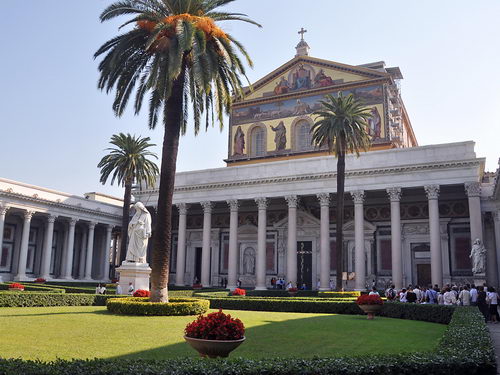
The Papal Basilica of St. Paul outside the Walls
(photo from Ferrell's Travel Blog)
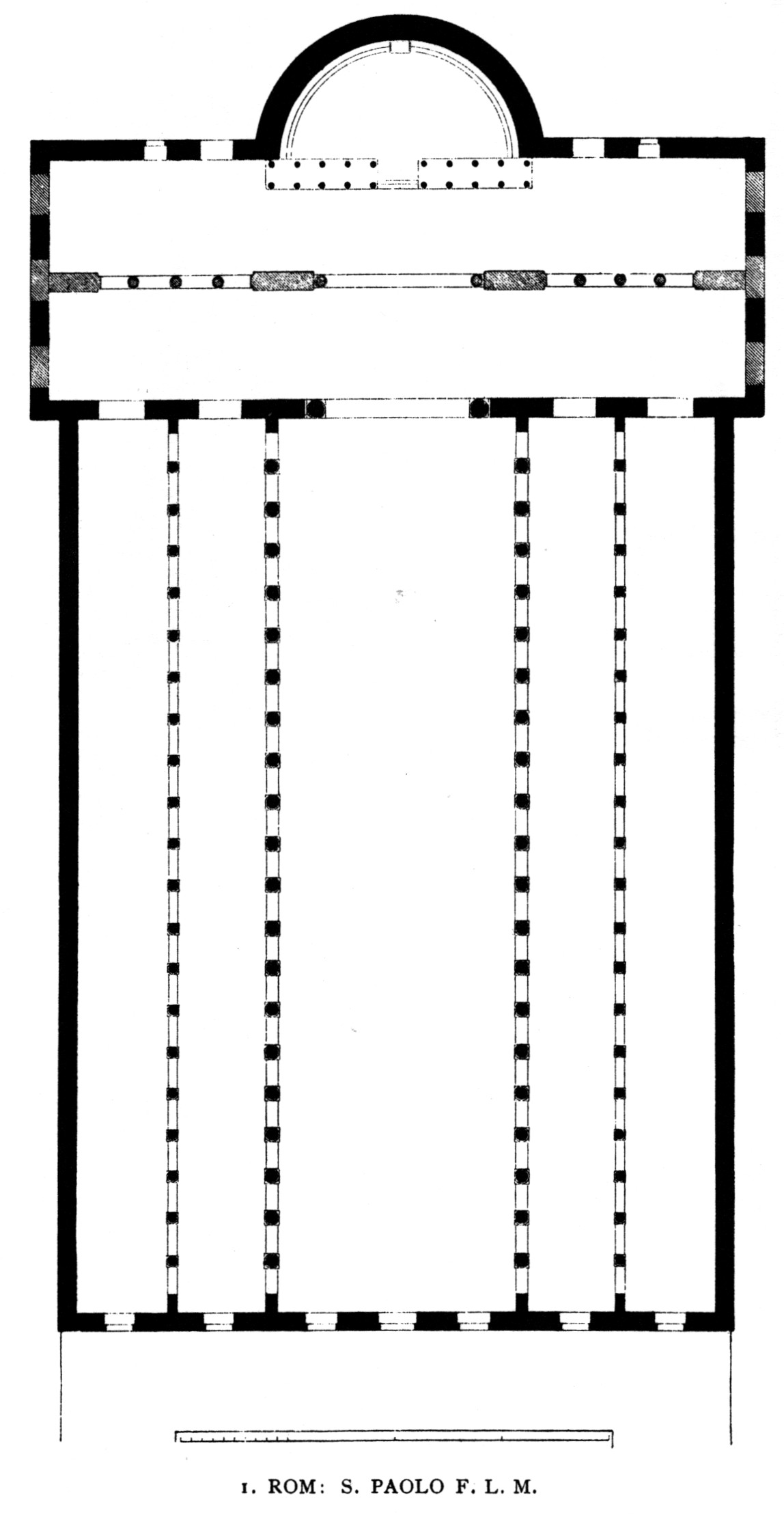
Layout of St. Paul's (from wikipedia)
St. Paul's looks much as it did centuries ago, but the structure itself is not original. A fire in the nineteenth century caused the roof and much of the structure to implode, only to be rebuilt. The layout is distinctly old-Roman. The aisles are long and straight, a larger aisle in the middle with smaller aisles on the side for the congregants to stand during the consecration. The altar is upon an elevated sanctuary and opposite a chair from which the Pope may pontificate.

The ancient Roman Christians venerated this site as the place of St. Paul's beheading and burial. As a Roman citizen the great apostle to the gentiles was spared the agony of crucifixion. His head now rests in the Roman Cathedral, but his body still resides in a tomb beneath the main altar of the basilica.

St. Paul outside the Wall remains the only Papal basilica I have not visited, so I will refrain from commenting any further.

On the other hand, I spent two days in st. Peter's and have quite a bit to say, but people tend to like pictures as much as words, so I will make this into a visual post very shortly.

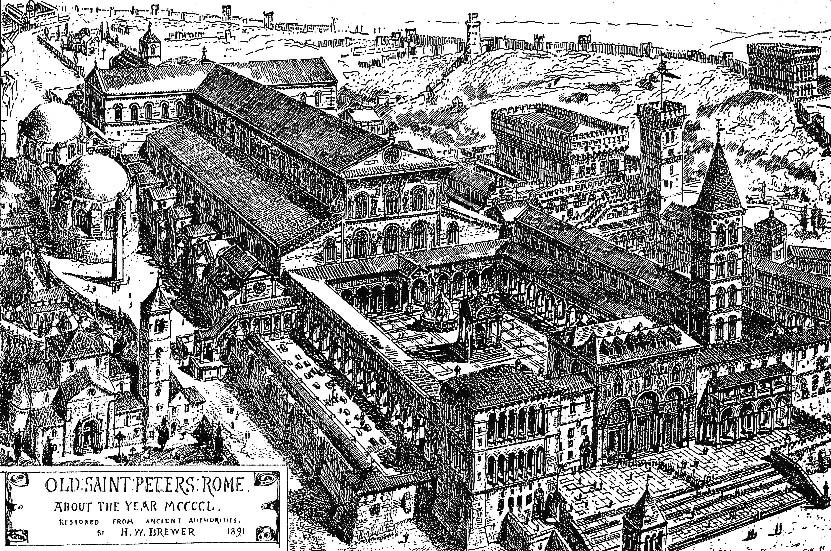
The original St. Peter's basilica was begun by Emperor Constantine over a shrine on Vatican Hill here Christians had venerated what tradition tells us was the place of St. Peter's burial since the first century—St. Peter's bones were not actually discovered until the reign of Pius XII. The basilica was completed in 360, but constantly remodeled. Originally the tomb of the first Pope of Rome was in the apse of the basilica, behind the altar. Tidal flow of pilgrims necessitated switching these two. A more elaborate throne for the Pop was constructed, as consecration of the Bishop of Rome became more usual at St. Peter's at the cost of the Lateran Cathedral, papal tombs, and a series of ninth century invasions by Saracens. One such remodel, around the time of Leo IV, led to an altar embroidered in precious stones, ambos and doors of silver, and mosaics taken from the finest Eastern churches. Like most Roman basilicas, there was a group of canons attached to the church and a cloister preceding the entrance.

St. Peter's basilica around the year 1450
(taken from wikipedia)

A cross-section of the old basilica
(from saintpetersbasilica.org)
Neglect during the Avignon papacy left the Roman basilicas in ruins, St. Peter's included. The roof of the basilica and its re-enforcement were both wood, which had long rotted. Instability eventually caused the walls and foundations to crack and, although many maintained the basilica was still usable, the decision was made to replace it in 1505 by Pope Julius II. The decision rightly sent Romans into uproar, as the old church had been used by the City and by saints for twelve centuries.

Inside the old St. Peter's notice the elevated altar surrounded by the twisting
arches. St. Peter's tomb was below. Above is the fatal ceiling.
(image taken from jamesbrantley.net)
The fate of much of the original basilica is unknown. Elements of the portico survived, as did the Papal tombs. St. Peter's tomb received its own chapel, named for the Pope who built it. The high altar was retained and en-capsuled in the new altar. The altar sanctuary had been walled from the nave by winding pillars, supposedly taken from the Temple of Solomon. They were destroyed, although their design is retained in the new basilica.

Another long view inside the old basilica
Below is a reconstruction of how the sanctuary would have looked during the Middle Ages. Note the wall and doors, much like an iconostasis, betwixt the sanctuary and nave. The semi-circular benches around the Papal throne were for the canons of the basilica, the seven deacons of Rome, the archpriest, and the cardinals.

From New Liturgical Movement
Note the side altars, where the Roman low Mass as we know it was formed. Also, the entrance to St. Peter's tomb from doors under the stairs.


Below is a video from the same source showing a detailed view of the old basilica. I always found the old pine cone funny. It is a pagan bronze work dating to the first century and which resided in the Vatican square for no reason other than its pre-dating the basilica.