Showing posts with label corpus christi. Show all posts

Sunday, May 29, 2016

Lost Octaves Series: Corpus Christi & Musings


A correspondent wrote to me confessing a slight faintness with the gravity of Catholic teaching on the Eucharist, that Christ is not merely present in a spiritual sense after Anglo-Catholic fashion, but is really present in His Flesh on the altar:
Verbum caro, panem verumverbo carnem efficit:fitque sanguis Christi merum,et si sensus deficit,ad firmandum cor sincerumsola fides sufficit. 
The choice of the word "flesh" comes to us from Holy Writ, not handmedown concepts of oblation inherited from Roman paganism or Judaic sacrifice. "Unless you eat the flesh of the Son of Man and drink His blood," Our Lord teaches, "you shall not have life within you" (John 6:54). A spiritual presence straddles a fine boundary between mystical and symbolic. A fleshly presence accepts a spiritual presence while adding a more immediate one to it. The Eucharist must be a physical and spiritual reality precisely because the Church is both a physical and spiritual reality, as a remarkably long and un-monitored comment box on EENS demonstrates. The Church is not bound by the sharing of the Eucharist among its numbered members, but in Christ absorbing the faithful into Himself by giving His flesh over to them ut unum sint. St. John Chrysostom says as much during Mattins for Saturday within the octave:
"Dearly beloved brethren, it behoveth us to learn the miracle of the Mysteries what the Gift is, and why It was given, and what is the use thereof. "We, being many, are one body," saith [the Apostle Paul, 1 Cor. x. 17, and again] "We are members of His Body, of His Flesh, and of His Bones." Eph. v. 30.Only the initiated will now understand what I say. That this union may take place, not by love only, but verily and indeed, we ought to mingle our own with His Flesh. And this is done by eating that Food Which He hath given unto us, being fain to manifest that exceeding great love which He beareth to us-ward. To this end He hath mingled Himself with us, and infused His Body into our bodies, that we may be one together, like as the limbs of a man and his head are all of one body. Such union do they long for that love much."
The Archbishop of Constantinople continues in Monday's Mattins:
"In this mysterious Sacrament Christ doth mingle Himself with all and each of His faithful ones. They are His children, and He nurseth them Himself, and giveth them not over unto another, herein again assuring us that the Flesh He hath taken unto Himself is ours. We then, who have been deemed meet to be treated with such love and such honour, let us be wakeful See ye not how eagerly the sucklings seize on the breasts, how readily they fix their mouths on the paps Let us, with like eagerness, draw nigh to that Table, and suck at that spiritual Cup. Yea, let us prize that gracious Food as the suckling doth its mother's breast, and hold it the great woe of life to be cut off from that Banquet. Here there are set before us no works of man's power He That worked at that Last Supper, the Same worketh the same here still. As for us Priests, we hold the place of His ministers, but He Which halloweth and changeth is He. Hither let there draw nigh no Judas, nor covetous one this is no Table for him. But he which is Christ's disciple, let him come for the Lord saith "I will keep the Passover with My disciples," Matth. xxvi. 18. This is that Passover Table, and it is all Christ's what is wrought there is not some of it Christ's work, and some of it man's work, but it is all His work and not another's." 
The eagerness of the faithful to "suck at that spiritual Cup" is obscured on our reformed 20th century rites. With very few exceptions anyone who attended a Latin rite parish today experienced an "external solemnity" of Corpus Christi Thursday Sunday. This is unfortunate and a consequence of the reduction of octaves under Pius XII and the availability of celebrating major feasts in place of the Sunday Mass. In the traditional Roman rite today would have been the Second Sunday after Pentecost, Sunday within the octave, complete with white vestments, commemorations at Mass and the office, and the preface of the Incarnation during the Mass. The gospel passage comes from Luke chapter 14, in which Our Lord makes a parable of a rich man who holds a banquet only to find that all the invited guests have made their polite excuses. The rich man then tells his servants to go into the streets and invite everyone they can find to the banquet. The Sacrament of the Lord, the glue of the Church, is open to all who do not reject it. The Jewish people were granted the revelation of God to man ("Salvation is from the Jews" John 4:22) and the unique place of being His "people" in the world; in declining Christ, to Whom the fullness of revelation was offered in Christ, the faith was then opened to the entirety of the world. The Temple sacrifices besought the forgiveness of the sins of the Jewish people and bound them under God's command. The Memoriale mortis Domini actually accomplishes the forgiveness of sins within the Church and binds the Church visibly under the Son of Man's own flesh.

Sunday Gospel as an antiphon

The feast of Corpus Christi is quintessentially Roman in its texts, direct yet with heuristic, subtle wordplay from St. Thomas Aquinas. The fleshly presence of Christ in the Eucharist finds itself expressed in many texts and actions throughout Eastern and Western liturgical history; long before monstrances the Sacrament was carried in a pyx by the celebrant and heralded by boys dressed in sack cloth as "prophets" in the Sarum form of Palm Sunday. The Sacrament extends Christ's presence on earth without dividing Him. 

And yet there is an odd extension of Eucharistic piety that personifies the Sacrament to a level that the Church has never traditionally understood. There have been some pious additions in Eucharistic devotion in the Latin Church that frankly give not a few of us the "heebie jeebies." I recall one fine Sunday morning breaking the fast at Brown's on Woodstock after the 8AM Mass at the Oxford Oratory. A gathering of us discussed the long road ahead to getting the old liturgy a permanent foothold in the mainstream Church. One of our number commented that one difficulty was the odd focus on the Blessed Sacrament itself outside of the liturgy, which distracts from the fact that the liturgy exists to confect the Sacrament. "What, pray tell, do you mean?" I asked. "Well, Rad Trad," he dilated, "I recently ran into a friend on his way to the Oxford chaplaincy to pay a 'visit' to the Sacrament. All well and fine to me, but when I asked why he did not just pop into the Oratory or Blackfriars, nearer his college, he gave me a queer reply. Do you know what he said? 'He's lonely.' Well, of course He's 'lonely'! He's God! He's the Only One!" 

A blessed continued octave of the Body of the Lord to all!


Wednesday, June 3, 2015

Corpus Christi: "Being Himself Man So That Men Might Become Gods"


"He that eateth My Flesh, and drinketh My Blood, dwelleth in Me, and I in him." To dwell in Christ, therefore, and to have Him dwelling in us, is to "eat of that Bread and drink of that Cup," and he which dwelleth not in Christ, and in whom Christ dwelleth not, without all doubt doth not spiritually eat His Flesh nor drink His Blood, although he do carnally and visibly press the Sacrament with his teeth but, contrariwise, he " eateth and drinketh damnation to himself," because he dareth to draw nigh filthy to that secret and holy thing of Christ, whereunto none draweth nigh worthily, save he which is pure, even he which is of them concerning whom it is said " Blessed are the pure in heart, for they shall see God." St. Augustine of Hippo 26th Tract on John (third nocturne of Mattins)

Wednesday, January 22, 2014

The Parisian Missal VI: Votive Orations & Conclusion

Rite of Versailles, another neo-Gallican use of the Roman rite.
source: wikipedia.org

Before concluding this series on the Parisian Missal let me quickly share a pair of interesting points I discovered within its pages today.

The first is the unique Gospel tone for the Vigil of Epiphany. In some sense it is reminiscent of the Dominican rite's Gospel tone for the Nativity. I cannot speak for other rites of the Norman liturgical family.


source: Order of Preachers, Province of St Joseph
Interestingly there is a Sunday "between the Circumcision and Epiphany" given in the Missal. The instructions direct that this Mass be said on the 2nd with a commemoration of the Octave day of St Stephen should it occur then; that it is ignored if it occurs on the 3rd, favoring St. Genevieve; it may be celebrated on the 4th as normal; and that should it fall on the 5th, the Vigil of the Epiphany, if is anticipated on the 4th so that the Vigil may be unobstructed. 

source: sarumuse.wordpress.com
My second discovery is that of the Parisian treatment for the feast of Corpus Christi. Unique readings are given for each of the ferial days within the octave and entirely unique Masses for the Saturday and Sunday within the Octave. Should the feast have fallen on a Friday the first set of ferial readings would have been used on Monday. What a pity that the reformers of the Roman rite did not investigate the ferial readings, based on Sunday and festive Masses, used in the Norman and Gallican rites when they sought to expand the use of Scripture within the Roman rite.

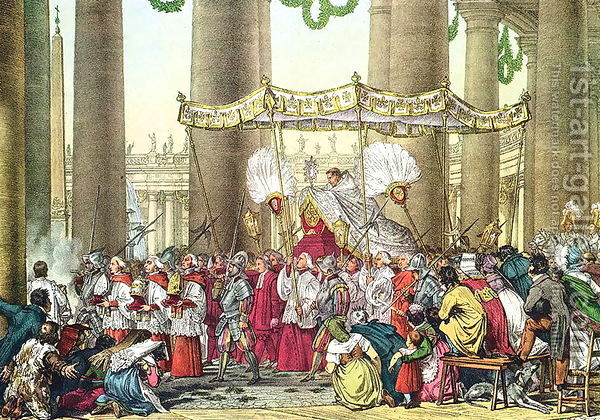
Given that the feast of Corpus Christi began, in a way, in Liege the high profile of this day in the Missal ought not surprise any readers here. The above image, lifted from Fr Anthony Chadwick's blog, shows a neo-Gallican Corpus Christi procession in the 19th century. Personally I find the two altar boys lighting candles in the bottom right corner positively cute!

On to the votive orations.

The Missal divides the sets of votive orations by intention into the following categories:
  1. Ad poscenda: things to be petitioned
  2. Ad postulandam: spiritual virtues requested
  3. Tempore famis: in time of famine
  4. Loose prayers of various intentions not confined to the above categories
Ad poscenda includes many prayers that will be familiar to anyone familiar with the Roman Mass or the Roman Office, such as A cunctis nos and Deus omnium fidelium. This last prayer caught my attention because I have contended previously that the real fault of the Parisian Missal is not Jansenism, but anti-Romanism. The prayer for the Pope, unlike in the Roman books, is not prescribed, but is given as an option (along with numerous other orations) for semi-double, simple, and ferial days. The days which prescribe Deus omnium fidelium in the Roman rite usually prescribe the prayer for the Church Dirige Domine. Other prayers in this section include petitions for Peace and Unity of the Church, for All Orders of the Church, for Persecutors of the Church, for the Church of Paris (an elaboration of Ecclesiam tuam), for the Lord Archbishop, for Prelates and their Congregations, for All the Clergy, for Ordinands, for Ordinands during the Mass of Ordination, for the King, for the King and his family, for the Dauphin (heir to the throne), for Children for the King, for the King and his Army, for the Assembly of Estates, for the City and Towns, and for Community and Family. Much ado about French political power (and it needed all the help it could muster) and nothing ado about Jansenism, free will, and types of grace.

The second second contains prayers for exclusively spiritual purposes, such as "for faith" and "for hope," virtues of faithful Catholics. One prayer, for humility, is quite indicative of the Parisian collects in its wordiness and also its emphasis on modesty:

"God, Who resists the proud and gives grace to the humble, grant unto us the virtue of true humility, which Your Only Begotten showed the faithful in the form of Himself, Who lives and reigns with You in the unity of the Holy Ghost, God for ever and ever. Amen."

This section also contains prayers pertaining to good works (certainly not Jansenism), the repulsion of evil maladies, patience, and the gift of tears.

The third section, entitled Tempore Famis, covers a broad array of needs pertaining to the people: famine, war, peace, pestilence, rain, and other similar phenomena. The prayer concerning Famine is longingly beautiful:

"Oh God, Who physically whips Your servants as they progress in mind, give us for our sins, for which we are afflicted by hunger, to wash them away by tears of penance, that we rebels who have provoked Your wrath may be subdued by mercy and humble minded. Who lives and reigns...."

The final section contains prayers for the anniversary of receiving Baptism, for sinners and penitents, for religious orders, for friends, for widows, for women in their various needs, for sailors, captives, for the suffering sick, an for the living and dead.

Many prayers match their Roman counter-parts and some are unique.

Conclusion


The Parisian Missal, as it existed in the 18th century, textually and ceremonially reveals no traces whatsoever of Jansenism, a sort of Catholic Calvinism which supposedly infiltrated the diocesan rites of the French church and made those forms troublesome, justifying Dom Prosper Gueranger's crusade to replace these local usages with the Roman books.

The real original sin of the Parisian rite is not that it is Jansenistic, but that it is not Roman enough. As covered in a previous post the Parisian Missal manuscripts of 1300 reveal a use very similar to that of Rome, with some variation. In the intervening centuries the diocese of Paris scrapped many uniquely Roman features (folded chasubles, the Octave of Ss. Peter & Paul, certain Mass formulas, the Gospel ceremonies for the Passion on Palm Sunday and Good Friday) and coterminously recovered many features of the Norman liturgy that one would find in the uses of Salisbury, Rouen, and York (ferial readings, choir ceremonies, sequences). In many places what came about was entirely new, such as the sequences and certain Mass formulas for the great feasts of the Church year. These texts are often spiritually exuberant and linguistically rich, reflecting a vibrant Catholicism among the clergy of France. Many of the new Collects and Introits, beautiful as they are, came at the cost of the existing Roman Collects and Introits. At a time when the Kings of France wished to have greater authority over episcopal selections, the mobility of bishops, and the spiritual decisions of the Church in France, the liturgy departed from Roman practices. Many of the Norman traits to be found are not direct restorations of texts, but of concepts; ferial readings rarely match up between Sarum and Paris, but they follow the same principle of expanding on the previous Sunday Mass. The bishops of France, eager to curry favor with the Court at Versailles or frustrated with the Popes, may have permitted or encouraged liturgical developments as long as some of them drifted from the Roman praxis.

A simple trimming of excessive departures from the Latin Church's liturgical tradition—like the use of dalmatics and tunicles during Lent—would have sufficed to re-align the Parisian Missal with that of other local uses. There is no question of the orthodoxy of the Missal. There is even little doubt about the heteropraxy of it. The choir ceremonies, for example, and the adaptability of the rubrics of sung Mass to the parish level better preserve some of the Roman rite than the actual Roman Missal (which assumes a private Mass as the norm outside of Holy Week).

The Parisian Missal was a liturgical flower which bloomed late and was trimmed far too early and too deeply.

Saturday, June 1, 2013

Sunday with the Octave of Corpus Christi


from: vultus.stblogs.org
I wanted to write something about the Octave of Corpus Christi, but I fear I would not have anything better to say than David Forster of Liturgia Latina. I would encourage you all to read his post on Sunday with the Octave of Corpus Christi here. He reads the Old Testament typology of the prophet Samuel through the eyes of St. Gregory the Great in order to consider the idea of God feeding man. Fittingly, the Gospel reading on this Sunday is from chapter 14 of St. Luke, wherein Jesus speaks a parable of a man who has prepared a great feast, but all the invited excuse their absence. The actual Thursday feast of Corpus Christi is laden with Incarnational undertones (the doxologies, the preface of the Mass, the hymn Pange Lingua to some extent). Earlier I even posted an excerpt from St. Gregory of Nyssa's catechism concerning the Eucharist, which takes an "organic" approach. Point being, there is a great wealth of typology, ecclesiology, theology, and liturgy to consider when trying to understand the Eucharis. This is why the Church gave the feast an octave in the 15th century. It is for our benefit.

Wednesday, May 29, 2013

Corpus Christi

 
From St. Gregory of Nyssa's Catechism:
The question was, how can that one Body of Christ vivify the whole of mankind, all, that is, in whomsoever there is Faith, and yet, though divided amongst all, be itself not diminished? Perhaps, then, we are now not far from the probable explanation. If the subsistence of every body depends on nourishment, and this is eating and drinking, and in the case of our eating there is bread and in the case of our drinking water sweetened with wine, and if, as was explained at the beginning, the Word of God, Who is both God and the Word, coalesced with man’s nature, and when He came in a body such as ours did not innovate on man’s physical constitution so as to make it other than it was, but secured continuance for His own body by the customary and proper means, and controlled its subsistence by meat and drink, the former of which was bread,—just, then, as in the case of ourselves, as has been repeatedly said already, if a person sees bread he also, in a kind of way, looks on a human body, for by the bread being within it the bread becomes it, so also, in that other case, the body into which God entered, by partaking of the nourishment of bread, was, in a certain measure, the same with it; that nourishment, as we have said, changing itself into the nature of the body. For that which is peculiar to all flesh is acknowledged also in the case of that flesh, namely, that that Body too was maintained by bread; which Body also by the indwelling of God the Word was transmuted to the dignity of Godhead. Rightly, then, do we believe that now also the bread which is consecrated by the Word of God is changed into the Body of God the Word. For that Body was once, by implication, bread, but has been consecrated by the inhabitation of the Word that tabernacled in the flesh. Therefore, from the same cause as that by which the bread that was transformed in that Body was changed to a Divine potency, a similar result takes place now. For as in that case, too, the grace of the Word used to make holy the Body, the substance of which came of the bread, and in a manner was itself bread, so also in this case the bread, as says the Apostle 1 Tim. iv. 5., “is sanctified by the Word of God and prayer”; not that it advances by the process of eating. Seeing, too, that all flesh is nourished by what is moist (for without this combination our earthly part would not continue to live), just as we support by food which is firm and solid the solid part of our body, in like manner we supplement the moist part from the kindred element; and this, when within us, by its faculty of being transmitted, is changed to blood, and especially if through the wine it receives the faculty of being transmuted into heat. Since, then, that God-containing flesh partook for its substance and support of this particular nourishment also, and since the God who was manifested infused Himself into perishable humanity for this purpose, viz. that by this communion with Deity mankind might at the same time be deified, for this end it is that, by dispensation of His grace, He disseminates Himself in every believer through that flesh, whose substance comes from bread and wine, blending Himself with the bodies of believers, to secure that, by this union with the immortal, man, too, may be a sharer in incorruption. He gives these gifts by virtue of the benediction through which He transelements.

I am not usually a fan of Thomistic theology, but I do love the Saint for his devotion and understanding of the Eucharist. Indeed, in my opinion his greatest contribution to the Church is not the Summa but the Corpus Christi Office, Mass, hymns, and benediction. Very similar language and description of St. Gregory's understanding of the Eucharist can be found in St. Thomas's Pange Lingua: "Verbum caro, carnem verum/ Verbo carnem effect."
 
This feast is an opportune moment to remember that the Church is the Body of Christ in a very literal way, and that the Eucharist, along with Baptism, is the means by which Christ makes that happen. The Church is God sharing Himself with mankind, a loving condescension that should make us blush, but not be scandalized.
 
I will save you from my poor observations, but I have put the antiphons for first Vespers of Corpus Christi below in English. They are worth some meditation (hint: pray Vespers tonight here).
 
Psalm 109: Christ the Lord, being made an High Priest for ever after the order of Melchisedech, hath offered bread and wine

 
Psalm 110: He hath made His wonderful works to be remembered; the Lord is gracious and full of compassion. He hath given meat unto them that fear Him

 
Psalm 115: I will take the cup of salvation, and offer the sacrifice of thanksgiving
 
Psalm 127: Let the children of the Church be like olive-plants round about the table of the Lord
 
Psalm 147: The Lord, That maketh peace in the borders of the Church, filleth her with the finest of the wheat


Sunday, May 26, 2013

Anticipating Corpus Christi

from: eucharistia.us
....With St. Augustine:

By use of meat and drink men would fain that " they shall hunger no more, neither thirst any more," and yet there is but one Meat and one Drink, Which doth work in them that feed thereon that " this corruptible must put on incorruption, and this mortal put on immortality," namely communion with that general assembly 2 and Church of God's holy children, who are "kept in perfect peace," and are "all one," fully and utterly. And therefore it is, as men of God before our time have taken it, that our Lord Jesus Christ hath set before us His Body and His Blood in the likeness of things which, from being many, are reduced into one. In one loaf are many grains of corn, and one cup of wine the juice of many grapes. And now He giveth us to know how that which He spake cometh to pass, and how indeed " this Man can give us His Flesh to eat," and His Blood to drink.
He that eateth My Flesh, and drinketh My Blood, dwelleth in Me, and I in him." To dwell in Christ, therefore, and to have Him dwelling in us, is to "eat of that Bread and drink of that Cup," and he which dwelleth not in Christ, and in whom Christ dwelleth not, without all doubt doth not spiritually eat His Flesh nor drink His Blood, although he do carnally and visibly press the Sacrament with his teeth but, contrariwise, he " eateth and drinketh damnation to himself," because he dareth to draw nigh filthy to that secret and holy thing of Christ, whereunto none draweth nigh worthily, save he which is pure, even he which is of them concerning whom it is said " Blessed are the pure in heart, for they shall see God.
As the living Father hath sent Me, and I live by the Father, so he that eateth Me, even he shall live by Me." This is as though He said: The Father hath sent Me into the world and I have emptied Myself [and taken upon Me the form of a servant, and being found in fashion as a man], I have My life from the Father, as One That is greater than I. He that eateth Me, even he, by thereby taking part in Me, shall live by Me. It is as having humbled Myself that I live by the Father, but he that eateth Me, him will I raise up,and so he shall live by Me. It is said "I live by the Father " that is to say, He is of the Father, not the Father of Him, and yet not so, but that the Father and the Son are co-equal together. Also it is said "So he that eateth Me, even he shall live by Me," whereby He showeth the gracious work towards His people of Him Who is the " one Mediator between God and man," and not that He Which is eaten and he which eateth Him are co-equal together.—26th Tract on the Gospel of St. John

Thursday, March 7, 2013

Angelic Doctor

from: wikipedia.org
Today is the feast of St. Thomas Aquinas, the Dominican friar who jumped from the window of his family's castle, ran to the nearest priory, and proceeded to write some of the most memorable theological tracts of anyone who has breathed the air of the Christian world.

Aquinas was particularly influential from the era of Trent until Vatican II, a time when theology had to be rational yet accessible to those studying in newly formed schools called seminaries. More recently, the Church seems to have embraced a more Augustinian view (Benedict XVI) or a more Eastern view. Yet the "Angelic Doctor" has enjoyed a consistent following and something of a resurgence of interest in the last decade.

Personally I never enjoyed reading St. Thomas's theology or found it particularly insightful. In many cases I even disagree his his views, specifically on the "form" for the consecration at Mass. Yet I respect him and see, under the brutality of his rationalism and his Aristotelian outlook, a great mystic. One only need read the sequence Lauda Sion or the hymn Pange lingua, which the saint wrote at the request of Pope Urban IV for the newly instituted Feast of Corpus Christi, to understand the profundity of his relationship to God and to His life in the Sacraments. St. Bonaventure, who had also been commissioned by Urban IV to write texts for the new feast, ripped his papers to shreds upon hearing Thomas's hymns.

Aquinas regularly submitted his works to the altar before circulating them abroad, where they would reach audience throughout Europe, including the Papal Court. On one such occasion the figure on the crucifix said, "You've written well of me, Thomas. What would you like?" to which the Saint responded "Only you, Lord."
St. Thomas's vision

Towards the end of Part III of the Summa, his greatest and most enduring effort, Thomas had a vision, and a stroke, during Mass and fell into a short ecstasy. Upon returning to a normal state he forfeited his theological work, deeming that any attempt to explain the great mystery he had seen was a frivolity.

He died en route to the Council of Lyon on this day in 1274. When considering his canonization some in the court of John XXII asked what miracles Aquinas had to his credit. One cardinal devoted to the friar's work suggested that he had as many miracles as there were articles in the Summa.

St. Thomas, pray for us!