Showing posts with label nostalgia. Show all posts

Saturday, April 1, 2017

The Pride of Life

("The Temptation of St Anthony," by Joos van Craesbeeck)

“I know I’m not quite the same kind of Catholic as you anymore,” Thomas said, “but I still believe that we are all in need of some kind of redemption.”

“No one ever said you needed to be exactly the kind of Catholic as me,” I said. “I don’t care if you don’t go to Mass at Tradistan or if you don’t get along with the people there. Even I don’t get along with them half the time.”

“Sorry, I know it’s a touchy subject.”

“More for you than for me, I think. You’ve been hesitant to talk about it.”

We took a short break and sipped our espressos. The crowd at Café Preténse was light, so our theological disagreements were not likely to bother too many people.

“Well, it has also always bothered me that the Tradistani priests don’t care anything about science. They treat it like it’s the plague of the Devil, and they always misrepresent it.”

“What does that have to do with the Church as a whole? You know full well that most Catholics have a nuanced appreciation of scientific research, even though some of us keep a skeptical view of its more dogmatic assertions.”

“That’s why I’m planning on switching parishes. I’m not likely to get the same kind of grief at St. X about a lot of things as I am at Tradistan.”

“I suppose you’re not. You do realize that there are some aspects of Catholic teaching that are universal, quite apart from the ‘science’ stuff? That certain morals are basic teachings everywhere and always, regardless of how wishy-washy the priests may be in the confessional?”

“I don’t think I need to toss out my many years of liberal education because of some priest who failed his basic science courses in college, is all.” Thomas took a larger swallow of his drink and set it down loudly. “Be right back.”

As my friend walked to the back of the café, I took a moment to sigh, and let my eyes wander around the drinking space. I noticed a familiar hat, and cleared my throat loudly and knowingly. The figure in the hat perked up and turned around in a faux-dramatic gesture.

“Hello, Wormwood,” I said.

“Why, Mr. Grump!” replied the vintner of boxed wine for the damned. “It has been a long time, indeed!”

“I don’t suppose you know anything about what’s been eating at my friend Thomas, here? You did once admit that you were hard at work deconstructing Tradistan from within.”

“Little ol’ me?” He hid a grin with his plastic iced coffee cup, but the twitch of his tail gave his mood away. “I suppose I may have pushed him a little here, pulled a little there, but it wasn’t all that hard.”

“No? I have to admit I thought better of his resolve and intellectual honesty when he was received into the Church.”

“Some people don’t need much, and your friend Thomas always had two major flaws: intellectual pride and nostalgia.”

“Intellectual vanity, sure, but nostalgia?”

“He is obsessed with the past, clings desperately to the most emotional times of his life.” He removed his hat and placed it on the table. “Fury at injustice is a powerful hook in the souls of the needy. They cannot fathom new emotional experiences as strong as the righteous indignation they felt in their youth, for instance, and seek out reasons to feel it anew.”

“I suppose we are all attached to the emotions that once burned the most brightly,” I admitted.

The devil continued. “And even when he made his profession of Faith, he only half-submitted his intellect to the mind of your church. His learning has been broad—broader than most—and he was always unwilling to admit that much of that learning might have been in vain.”

“Even if it actually was not.”

“Of course. As usual, it is the pride of the matter that drags him towards Our Father Below, not his errors as such.”

“One can be in error while still being open to correction,” I mused, “and material error can coexist with humility.”

“You needn’t blame me for this.” He put his hand over his heart in a gesture of mock offense. “Your good friend here was never willing to substantially change. It was easy to poison his conversion through his habitual doubt.”

I thought of a sharp retort, but reconsidered. The devil guzzled his iced coffee and scratched his horns while my anger subsided into sadness. “There’s nothing for it but to try to get him outside of himself, to pull him out of his narcissism long enough to see that his perspective might be more fallible than he’s willing to admit.” The absinthe-reeking demon had grown curiously quiet, but his tail moved intentionally, like a large cat on the hunt.

“Well,” he very deliberately took up his hat and stood, “I suppose I must be going. There’s much work to do at the wine press tonight, and Crumplehead simply cannot be trusted to produce the necessary volume. He is too much of a snob, and would have our legions of tempters go thirsty so that a few could refine their palate. Sad, really. Not much of a team player.”

“And here I thought we were still toasting to good taste.”

He tipped his brim slightly. “Until next time, Mr. Grump.”

“Until then.”

I watched him stalk out to the parking lot and heard Thomas walking back. I breathed in, took up my drink, and prepared again to do battle against the pride of life.

Thursday, November 19, 2015

Sympathy for the Devil


“You drank the port?” His Traddiness’ eyes widened as the truth sank in. “All of it?”

“I didn’t think you’d miss it,” was my reply. “You entirely forgot about the bottle of F—.”

“You drank that? I’m never leaving a bottle at your house again!”

“Fine, I’ll buy the next bottle of Chartreuse.”

“Darn straight you will!”

“It will be the yellow one, though.”

"What?" His Traddiness snapped.

The little lady sniffed at us and rolled her eyes. The three of us were sitting on the outside patio of Café Preténse, enjoying the last warm spurts of autumn before Texas decided to welcome Old Man Winter.

“You know, Rad,” she said, “you could just buy cheaper wine.”

We both watched as His Traddiness’ face turned a few shades of wine-dark, and laughed through a brief chill wind. I turned towards her and admired the frothy latte that sat so smugly superior to the tea on the other side of the table. I decided to defuse the situation with another bomb.

“Did you hear the most recent about Fr. Facile?”

“No, what did that little pipsqueak do now?”

“Apparently he’s been doubling down on his pseudo-mercy talk. He’s gone almost Full Kasper in his Sunday sermons. The Church is changing, didn’t you know? We are now welcoming the perverts and the homewreckers without exception. Anyone who’s not on board is going to fall behind the March of History.”

“Oh, joy.”

“I wonder how soon before he comes out?”

“Of which closet?”

“Hard to say. Heaven save us from the wicked clerics. You know, I was accosted by a fellow parishioner at Tradistan the other day about needing to pray for our wicked leaders.”

“Not a bad idea,” chimed in the little lady.

“Sure. But mostly I pray for their destruction. That seems like a worthy cause.”

“Not their conversion?” she asked sweetly.

“I suppose I must,” I admitted. “But I draw the line at praying for the repose of the souls of those who died as public enemies of all that is good and holy. This is November, the month we’re supposed to pray for the faithful departed. I don’t feel the need to pray for the faithless.”

“What’s got that bugaboo up your posterior?” asked His Traddiness.

“The lady and I knew a fellow who went to a local Catholic university. By all accounts he was quite the academic and literary modernist, although I know nothing in particular about his spiritual life. He had a young wife, a very young daughter, and another child on the way. He murdered himself in the middle of the night about a year ago.”

“Wow.”

“The worst of it, though, is the sympathy and nostalgia surrounding the whole ordeal. All of his close friends are heartbroken, of course, but they insist on not thinking badly of him. It took me weeks of sorting through Facebook comments to even get a hint that he had taken his own life.”

“To do that to a wife and child!”

“Exactly the point. I don’t deny that he may have had some psychological problems, but surely they cannot have rendered him invincible to the demands of familial justice, nor to the tugging on the heart by the ladies in his life. All his friends say that he doted on his daughter, but I suppose not enough.”

“Remember what Pius the Third said in response to a request that a Requiem Mass be said for the repose of his predecessor, Alexander the Sixth?”

“What’s that?”

“‘It is blasphemous to pray for the damned.’”

Just then a familiar vintner of damned souls walked out of the front door, saw us, and waved.

“How goes the quest to eliminate lukewarmness?” the devil asked, with a tip of his hat to the lady. His horns showed for a moment.

“Making progress one good drink at a time.” I raised mine. “To your utter failure.”

He smiled toothily and walked to his car. I was disappointed to see that it did not sport a darkly humorous customized license plate.

“That wormy bastard wouldn’t know good taste if it hit him in the face,” mused His Traddiness. “Based on the financials going back and forth in his emails, he could easily afford a Rolls but, like most evil men, prefers a Mercedes.” The devil put-putted away in a cloud of noxious green exhaust.

“I wonder sometimes if I should pray for all my ancestors who died outside of the Church,” I said once the fumes had cleared. “A lot of them were Protestants who hated Catholicism. Quite a few others were staunchly non-religious their whole lives. The New-Springtimers say that charity demands prayers for all the dead, except at their funeral Masses, but I have to wonder. Isn’t it reasonable just to assume that those who die in manifest sin are damned, and to cover your bases by praying regularly for all the poor souls? At least that way everyone who can be covered is covered.”

“Wouldn’t you want someone to pray for your soul in particular,” asked the lady, “even if you seemed to die in evil circumstances?”

“It would be nice, but at the expense of public scandal? Perhaps not! In that case I might have to satisfy myself with the scraps that are tossed out commonly to all the purging souls. Better to be in Purgatory and buried in unconsecrated ground than in Hell and buried behind the rectory. In any case, I’ll be planning in my will for private Masses to be said for my soul by some helpful religious orders.”

“You’d better hope those orders hold up their end of the bargain,” she said. “Lots of them are simply dropping all the old charges they held for praying for the dead.”

“That’s a sobering thought. I’d better die in some saintly way! Perhaps the martyrdoms will begin soon, and I can get that done and over with.” She sniffed again at that.

His Traddiness sipped the rest of his tea and began to recite from memory, “In paradisum deducant te Angeli; in tuo adventu suscipiant te martyres, et perducant te in civitatem sanctam Ierusalem. Chorus angelorum te suscipiat, et cum Lazaro quondam paupere æternam habeas requiem.”

“And may the devil get his due,” I added.

“Amen.”


Thursday, May 14, 2015

On Nostalgia, Apologetics, and Apostasy

“I don’t think this was covered in Mass Confusion.”
“We remember the fish that we ate in Egypt freely: the cucumbers come into our mind, and the melons, and the leeks, and the onions, and the garlic. Our soul is dry, our eyes behold nothing else but manna.” (Numbers 11)
In addition to his series on nostalgia, His Traddiness has brought up the strange case of Michael Coren’s recent apostasy. This is assuredly a sad event and one for which we ought to offer up our prayers and fasts. It is also part of the ongoing statistical trend of Catholics leaving the Faith, or at least the practice of it, that has been happening for decades. Cradle Catholics are leaving because they are too smart not to perceive the irrelevance of what they see and hear from their prelates every week. Converts leave for these and many other reasons, not the least of which is the budding suspicion that they have been seriously deceived by the apologists who argued them into the Church.

Not all converts come in through the agency of apologetics. Some marry into the Faith, others are entranced by the beauty of our art and music, and a few just want to be a part of the same philosophical school as Thomas Aquinas. For all these, apologetics plays a secondary role, and the arguments for and against the minutiae of the Faith are not terribly worth considering. One thinks of Rex Mottram’s impatience with Fr. Mowbray’s attempts to catechize this poor, simple fellow in Brideshead Revisited.

I have indeed imparted my opinion to His Traddiness that the Catholic Answers crowd and their countless imitators on EWTN and other publishing imprints do a poor job keeping discontented Catholics in the Church. Back when I was yet unconfirmed, I must credit Catholic Answers particularly for clearing out a lot of the heretical rubble that had been keeping me from understanding what the Church actually taught. I appreciate what their staff writers and speakers did for me all those years ago, so I criticize them with no small measure of sadness.

Karl Keating, founder and occasional president of Catholic Answers, shrugged off Coren’s apostasy in a recent article, saying, “I’m not surprised to see people bouncing from one religious position to another. I’m not surprised about it, and I don’t get worked up about it.” Well, why get worked up about the loss of one of the ninety-nine sheep? All that really matters is the truth, not people: “I do get worked up about truth in advertising,” he says.


Keating is a cradle Catholic, and as such does not have a feeling for the pull that Egypt has on those who have left that pagan nation for the Promised Land flowing with milk and honey. The version of the Catholic Church promised by today’s apologists is basically the Arcadian land of 1950s triumphalism, with plenty of Vatican II quotations added in for good measure. The ur-text for Catholic Answers and other apologists is Frank Sheed’s Catholic Evidence Training Outlines, a 1925 manual with extensive instructions about how to speak publicly and deal with hecklers (easily modified for radio shows and blogging), followed by even more detailed outlines of the kinds of subjects a Catholic soapboxer in Hyde Park would have had to opine upon. The Outlines take some inspiration from St. Francis de Sales’ tracts written against the Calvinists back when that heresy was young. When Mr. Sheed was arguing petulant Anglicans into the Catholic fold, they were being received into something solid and stubbornly unprotean, with a community of fellow believers who knew what they knew and knew what they were doing. When Keating and his staff use the same arguments to push the indecisive into the twenty-first century Church, these converts are left unprepared for the pandemonium and disorientation that is about to confront them.

What happens when these CA-converted rabble call in to the radio show to point out the very obvious ecclesiastical problems, well-nigh begging for clarity and encouragement? All too often the caller is told that the priests or bishops in question are “trying their best” to deal with modern problems, that said caller should take comfort in this fact, and thank you for your call. This passive-aggressive, “Everything is Fine” approach to the confused borders on the wicked. These apologists make vocations out of the spiritual works of instructing the ignorant and counseling the doubtful (outside the Church), but fail to comfort the afflicted and counsel the doubtful within the Church.

Is it any wonder that Catholic converts apostatize, that close to one-half of them leave the Church within a year of their confirmation? The Keating answer is simply, “Oh, well. They knew the truth, and couldn’t handle it.” But in reality, these converts are undermined at every step by their parish priest, by their bishop, by their fellow Catholic, most of whom don’t believe even half of what Catholic Answers has triumphantly claimed to be the teaching and practice of the Church.

When our apologists are little more than truth-bots doling out programmed responses to every possible query, then Catholic apologetics have truly reached their final disintegration. All head and no heart, the apologist shrugs as the apostate limps back through the desert to Egypt, bruised and bloodied from the beating his supposed friends have given him. The convert nostalgically remembers his old life—being asked over to dinner to someone’s house every week after church, charitably arguing about the interpretation of some obscure Bible passage with friends at the coffee shop, not being scowled at by all of his relatives—and wonders why he is settling for scraping manna off the ground while Aaron comes by every five minutes to kick him in the ribs.

The Israelites in the desert were scourged for their own infidelity and idolatry. The Catholic convert is scourged to cover up the infidelity and idolatry of others.


Saturday, May 9, 2015

Nostalgia Part II: American Pie?

In Nostalgia or Tradition? I portrayed nostalgia as a yearning for a golden age that never was, exemplifying the vagrant communities of Old Believer Russian Orthodox who focus not primarily on the unreformed Byzantine liturgy, but on safeguarding against electricity, the sowing machine, and the gas oven. There is another kind of nostalgia, though: yearning for a golden that can really be remembered, or at least imagined.

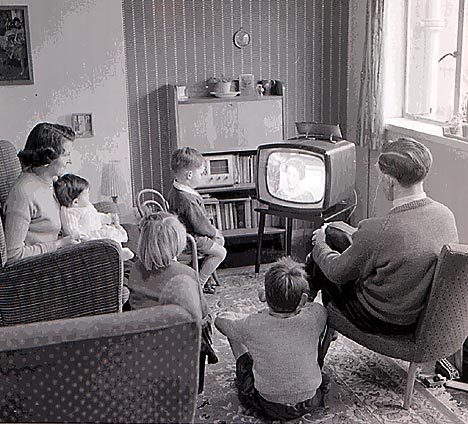
My father is not a Baby Boomer (thank God). He was born two months before the Japanese bombed the United States into the Second World War. His life's perspective within the United States can be summarized in Don McLean's enduring folk tune, American Pie (for international readers: American Pie, about the death of three singers in a plane crash in 1959, is one of the most popular songs in American history). Although he dislikes the length of the song, he finds the content sympathetic. Life in 1950s America retrospectively seems idyllic, happy, optimistic, and yet, somehow, settled. We had won the War with our social structure seemingly preserved. We could be confident going forward that we were the good guys and the Red Ruskies were the bad guys. Our forebearers watched those dashing chaps from Harvard and Yale get all the good jobs, but now the GI Bill will allow us to go to college, get those jobs, and start families. The technology boom during the War and the industrial culture which resulted meant less hard work and more money for leisure going forward. The Church had enormous prestige and the Pope was the chaplain to the United Nations. And of course that new style of music, Rock 'n' Roll, added some spunk to the well-behaved high school danced attended by our exemplary children. Then it all faded.


The "music died" was when Buddy Holly, Richie Valens, and JP Richards went down in a plane piloted by an unqualified man and America was never the same. Without its own music and culture, we greeted with open arms the Beatles, the Rolling Stones, and the rest. They brought with them Europe's rebellious youthful attitude, their socialism, their tendency towards mocking old forms of order, their detestation of War—even though they were all born after the War—and their nihilism. McLean's religious imagery in his song is the culture version of an icon, a glimpse into another world or reality. One gets the impression that McLean and those like him no longer believe in the ideas of the 1950s generation because they watched them fail, but wish they still could because they did not like what came afterward:
Did you write the Book of Love
And do you have faith in God above
If the Bible tells you so?
Do you believe in rock and roll
Can music save your mortal soul
And can you teach me how to dance real slow?
Or was it really an ideal era lost? Is it a false nostalgia? The America that survived the War retreated into a uniform, bakelite form of existence in Sears-built factory houses, shiny cars, newfangled televisions, and other forms of living that curtailed original thought and encouraged a sedentary existence predicated on entertainment. The old social norms and behavioral expectations remained externally, but long ago cleaned itself inside with Brillo. Much like the 1990s to my generation, the peaceful and well-mannered decade after World War II was a break from history because people were growing tired of the old way and were not quite ready for the new. Was it a better era than what succeeded it? Of course. However, much like the Church during the same period, the firm shell eventually betrayed that the egg inside was going bad. It is with great nostalgia that people said "Bye, bye Miss American Pie", but they did.

Perhaps cognizant that the 1950s were not a golden era, after America got over its hipster phase it did not seek to return to the bye-gone lifestyle still within living memory. They voted for Nixon, Carter, and Reagan in subsequent elections. Like McLean and my father, they missed what they had, but realized they could not return to it. The damage of the music's "death" on them had changed them, too. They no longer had their religion, social norms, and sense of responsibility. They enjoyed material culture and were not political radicals. Little else. These were the children of the '50s, America's bygone golden age.

As Catholics, we can take a lesson from this. The kingdom of heaven is upon. It is not a past age that ended in 1789 or 1962—although certain years are certainly watersheds for the de-Christianization of society. The kingdom of heaven is perpetual and not of this world. Although we cannot built it, we can make room for it in this world. Perhaps then we will not be nostalgic, but appreciative of what God has given us now.