"My beloved: Every best gift, and every perfect gift, is from above, coming down from the Father of lights, with whom there is no change, nor shadow of alteration."—James 1:17, Chapter for Fourth Sunday after Pascha
Sunday, April 28, 2013
The Father of Lights
Tuesday, April 23, 2013
Reasons for the Reform of the Roman Rite Part VI: Centralization
Today's post, the penultimate "reason" before our conclusions, focuses on centralization in the Roman liturgy which followed the Council of Trent and eventually facilitated the reforms of the Roman rite during the papacies of St. Pius X, Pius XII, John XXIII, and Paul VI, as well as the legislation of John Paul II and Benedict XVI. Aside from providing a means for the reforms to present themselves to the Church, centralization changed the mindset of the Church of Rome and of her clergy toward the worship of God.
Following the Council of Trent, St. Pius V issued two papal bulls Quod a nobis and Quo primum, promulgating a Divine Office and a Missal which, although not always obligatory, could be used by any priest in the Latin rite of the Church without exception. To the modern reader this hardly seems shocking. The revised English translation of the new rite of Mass came at Rome's behest, the diocesan bishops, at least in the United States, liked the old translation, even the erroneous "for all" in the consecration of the chalice. We can easily lose sight of how drastic a change this was.
![]() |
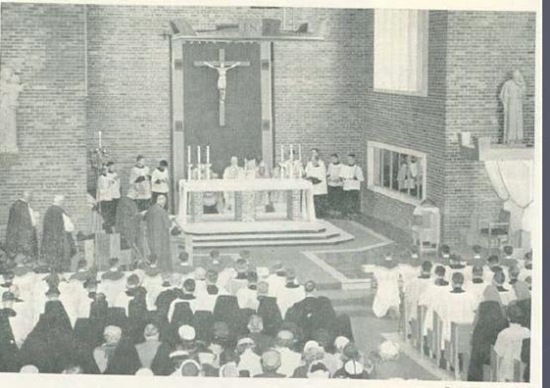
| Paschal Mass in the Lyonese rite, some very different texts from Rome's Resurrexi. |
From the earliest days of Christianity in the West, the liturgy developed at a local level and took on the characteristics of both the people who celebrated it and of the rites of major churches within the same area. In Europe, the city of the Rome was the most influential church "in the same area." I suspect this is what so many modern day commentators mean when they discuss "organic" development. Charlemagne accelerated a process already underway, whereby bishops would seek to emulate the liturgy as it was practiced in the city of Rome. This meant following the Latin language, the basic structure of the Mass, the schedule of the hours of the Divine Office, the structure of the Office, loosely the arrangement of the psalms, and many of the prayers. Yet no one diocese had the same exact rite as another. Indeed, within the city of Rome the Divine Office varied by church. In some cathedrals each priest might say a slightly different private Mass in his chapel. Yet, any observer of a Mass in Cluny, St. John Lateran, or the Cathedral of Canterbury would recognize that the same ritual, spirituality, faith, and objectives were being followed. The late Laszlo Dobszay, whose work I find myself constantly recommending, notes that the neo-Gallican graduals are almost all the same text as in the "Tridentine" Roman rite, although this did not come to pass by legislation. Rites gradually converged as ideas and rites spread, but the Roman Canon and the Roman structure remained the barometers of liturgical order.
The immediate effects of Pius V's actions were two-fold:
- The bottom-up problem: local rites, unless they were more than two hundred years old, died immediately and could no longer contribute to the development of the liturgy in the Church. Even some older rites did not last. Rome attempted for centuries after Trent to suppress the local usages of France, particularly the Parisian rite. Anyone interested can find at least one edition of the Missale Parisiense on Google Books. The rites of Braga, Lyons, and Milan were similarly targeted, but managed to survive until the Second Vatican Council.
- The top-down problem: the Roman liturgy becomes a product under corporate management and subject to quality tests.
First, the bottom-up issue. The suppression or de facto extinction of local usages and variations of the Roman rite was not immediately troublesome, but blurred the character of local churches—and each church is a unique Christian community—and removed their own expression of belief. Aside from the personal investment people had in worshiping as their fathers had, people had grown accustomed to singing hymns to particular chants and in local tones, to distinct ceremonies and rituals—especially during Holy Week, and the liturgy of the cathedrals revolved around these communal celebrations, led by the bishop and his convened chapter. All of this either vanished or became a tolerated exception under the bulls of 1568 and 1570.
Local uses of Rome disappeared almost immediately, although a few oddities, like the Lateran Cathedral's refusal to sing Dona nobis pacem for the third invocation in the Agnus Dei remained. Why does this matter? Roman churches each celebrated the liturgy somewhat differently. Hymns and chants are great examples as to how. Local churches would often repeat the same hymn from day to day, or from feast to feast, and utilize simple melodies so that the ignorant could sing along and memorize these chants through repetition. The uses of the Carmelites, Dominicans, and Carthusians better preserve this principle than the rite of 1570.
![]() |
| Ecce lignum crucis.... |
While considering this point, we ought to meditate on the 1570 Missale Romanum. The 1570 Missal and 1568 Office are trimmed down versions of the same books used in the Roman Curia a century earlier. The Henry Bradshaw Society reprinted the 1474 Missale Romanum a few years ago, should any of you wish to purchase a copy. St. Pius V specified some rubrics, explicitly added the Last Gospel (formerly said in procession rather than at the altar), deleted Gallican prefaces and sequences, slashed a few feasts (including of Ss. Joachim and Ann), and adjusted other points in the Office which elude me. The reformers of the post-Tridentine period purported that this Missal represented the liturgy of the time of St. Gregory VII. It may well have been the liturgy as it was practiced by the Papal Court in the eleventh century, in fact it was probably very close, but no closer than any of the other local usages to the essence of the Roman rite as a liturgy diffused throughout Europe.
Here comes a secondary negative effect. The Missal of the Roman Curia was made for small scale, simple, timely celebrations by bureaucrats who had other work to do. The Pope, until 1964, had his own rite of Mass very befitting the dignity of his office. The Curia, on the other hand, was a body of priests and cardinals, who operated in chapels rather than large churches, who did so in the presence of similarly educated people, aided by professional singers, and who wished to make these rites as succinct as possible. These rites were consequently very simple in ceremony and sometimes stark in text compared to the larger Roman liturgy spread throughout Europe.
For example: on Good Friday in the 1474-1955 Roman Missals, the deacon gives the priest a veiled crucifix, who exposes it in three moments, lays it on a pillow, and the choir sings the "reproaches" (Trisagion, Pange lingua etc) while those present adore it. In the Norman and neo-Gallican rites we see more clearly the function of the reproaches. The deacon brings the veiled crucifix through the church, or more likely, cathedral, whilst the choir sings the Trisagion: Agios o Theos! Agios ischyros! Agios athanatos, eleison imas! At the altar, the priest would then do the three familiar un-veilings and lay the crucifix down for adoration, during which the choir would sing Pange lingua and the subdeacon would "comment" by singing antiphons between the verses, antiphons which described Christ. Clearly, the Roman liturgy on Good Friday was a simplification made to suit a particular brand of practitioner.
Now we come to the second effect of this post-Tridentine centralization, the "brand" of the Roman liturgy.
| Palm Sunday according to the rite of Braga, but actually in Rhode Island. source: newlitugicalmovement.org |
We have made the case that prior to Trent local dioceses based their liturgy around what Rome generally did and use Rome as an enduring standard. Now Rome did not nurture the liturgy, but actually imposed it from afar. Liturgy was something given to the clergy of the Roman rite, even if they were originally of another rite or use, by Papal decree. The Sacred Congregation for Rites, erected in 1588 by Sixtus V, managed the Roman liturgical books on the Pope's behalf, except when the Pope felt inclined to intervene, for instance when Urban VIII published his new and improved hymns.
The Roman Church became like McDonalds. The Pope was CEO, the cardinals formed a board of directors—each with his own congregation or department, bishops were the franchisees, and priests were restaurant managers who had to sell their product to the faithful customers. The product, the liturgy, must meet a given standard. Falling short of or exceeding the standard are not options.
This analogy is facetious, but contains some truth. Priests had to do whatever was in the books imposed by the Pope, no more, no less. If he celebrated, or said, Mass and recited the Office as instructed then he was, on one count, meeting expectations.
During the centuries after Trent no one paid too much attention to the liturgy outside of the cathedrals and monasteries. Theology, doctrine, devotion, and art dominated the Counter-Reformation and baroque epochs. Few seem to have bothered to adopt local customs, music, or ceremonial to the Roman liturgy, perhaps due to the phenomena examined in our posts on low Mass culture and Devotionalism. Local expression, even in a highly centralized liturgical setting, is not impossible. The Church of Antioch, after having the liturgy of Constantinople forced upon it, rejected ceremonies pertaining to the Byzantine court and continued to administer Holy Communion without the spoon. Not until the 19th century did clergy think about the liturgy, but by then popular perceptions of what constituted or created the liturgy had changed.
Most clergy accepted the 1911, 1955, and 1960 liturgical reforms without batting an eyelash. The right authorities promulgated these changes. Consideration of the merits of these changes was frivolous, perhaps even disobedient. Divino afflatu uses similar language to that of Pius V's decrees centuries earlier. When the more visible changes came through in 1964, 1965, 1967, 1968, and finally the new rite of Mass in 1969 and new Office in 1975, priests and bishops were expected to accept any changes because they came from Rome. Cardinal Ottaviani, who in his private "intervention" with Pope Paul VI wrote that the proposed new rite was a "striking departure from the Catholic theology of the Mass as it was formulated in Session XXII of the Council of Trent," eventually learned to accept the new rite in spite of his intuition. Ditto for Cardinals Bacci and Siri.
The legal authority Rome found itself possessing after Trent made a drastic overhaul somewhat inevitable. No longer were the Latin rites guarded by tradition, but they were given by a congregation in central Italy. This meant that whoever controlled that office or whoever had the Pope's ear could essentially have his way with the liturgy of western Christendom. It was only time before a large number of people from the Liturgical Movement found themselves in that position. Moreover, Rome no longer guards the liturgy. Rome is neither the aggressor nor the victim in the war over the liturgy. Rome is the battlefield.
This last point represents a problem for the "brick by brick" crowd, as they often rely on exercising the most conservative legal options when celebrating the Mass of Paul VI. What is the point of celebrating the Mass of Paul VI ad orientem and in Latin if one has to give Holy Communion in the hand? An Oratorian high Mass and an American suburban low Mass both follow the prescribed rules.
Rome must also find this phenomenon problematic. Benedict XVI's Summorum Pontificum stated that the Missal of John XXIII was never "abrogated." It may never have been explicitly suppressed, but after Inter oecumenici in 1964 priests could not have expected to be able to follow 1962. If 1962 is legal, are not 1967 and 1920?—two very different Missals. As Joseph Cardinal Ratzinger, the previous Pope wrote many commentaries on "organic" liturgy. He even sat on a commission with Cardinals Hoyos and Stickler which found the old rite perfectly legal for use. Question: which Missal was found legal for use? The 1962 rite? The "Tridentine" Mass? The "Mass of St. Pius V?" The "old rite?" Indeed, the choice of 1962 is now commonly acknowledged to be that of Archbishop Marcel Lefebvre, not of the Vatican. Still, why pick a year? I personally think Benedict XVI was aware the rites of Paul VI represented a departure from the established tradition of the Roman rite and wished to find some way of stating that the Church would never suppress her tradition, that its use was always legitimate. 1962 was the year most commonly used by "traditionalists," so that is the rite he declared was never "abrogated."
Perhaps the saddest consequence of this legalism and liturgical centralization is that decline of people's view of Rome as the spiritual center of the Church and of the Pope as the spiritual father. The Pope is just the man who makes the rules and the Vatican processes them. If in the early 13th century, I asked a priest in Canterbury Cathedral if Pope Innocent III had the power to depose King John, the priest would probably at least entertain the question: political power comes from God and the Pope is His vicar on earth. If I asked him if the same Pope could dictate every word and action of the Mass he just celebrated, the same priest would think me mad. Yet, I wager the same priest would not dare to change a punctuation mark in the Roman Canon, much less write a series of new anaphoras.
Thus ends my proposed list of causes of the reform of the Roman liturgy. In our next post, the last in this series, we will give a brief summation of what we have found, make a few conclusions, and, since I prefer to be part of the solution and not part of the problem, present some ideas for the future.
God bless.
Friday, April 19, 2013
Interesting Article on Old Holy Week
Many readers have viewed our page of images explaining the traditional Mass of the Pre-Sanctified on Good Friday and the old Vesperal Mass of Holy Saturday. Interest in the older rites, which pre-date the 1962 liturgy, is clearly on the rise in the Roman rite of the Church.
| Good Friday sepulchre in Jerusalem |
It behooves us to be aware of the history of these rites and their continued usage beyond 1956. After the introduction of the Pauline rites in 1969, 1970, and 1975, many clergy at or near retirement age switched back to the old Mass and, even though they technically old had permission to use the 1967 rites, used those rites practiced before the pontificate of Pope Pius XII, when the modern liturgical reform gained steam. Anyone who remembers the early days of the Institute of Christ the King or the Society of St. Pius X recalls that they normally used the traditional Holy Week, too. I would not be surprised if some local clergy even continued using the old Holy Week, confident the Pian books were a passing fad. Pope John XXIII celebrated the old Good Friday at least once, in 1959, and ordered certain traditional practices, like the hymn Vexilla Regis, to introduced into the Pian Holy Week. It begs the question: was John XXIII even using the Pian rites as Patriarch of Venice?
But there is one church in Latin Christendom that observed the old Holy Week until the 1990s without interruption: the Church of the Holy Sepulchre (or of the Resurrection, if you prefer) in Jerusalem. I came across a news article from 1998 detailing the first practice of the new Holy Week rites, with photographs. The majority of the article details the new rites, neither describing nor depicting the old, yet there is an explanation of why the old praxis continued. Apparently internal bickering with the other residents of the Church, the Greek Orthodox and the Armenian Oriental Orthodox, prevented the implementation of the reforms. An indult to continue the old practice was granted and a commission to install the new ceremonies did not form until 1986! The actual new rites were not observed until the next decade when, in 1997, the old rites were celebrated for the last time. You can read the article here.
The difficulty in effecting the change does not surprise me, nor should it surprise anyone appraised of the disputes that transpire in Christendom's most sacred site. Franciscans ran the Church during and after the Crusades, only to cede most of it back to Eastern Churches who, when they do not dispute with the Latins, dispute with each other. The Greeks and Armenians typically have one big brawl a year, normally utilizing the most noxious of ancient weapons: the broom. The Immovable Ladder summarizes the past and current state of affairs.
I would be interested in knowing how the old rites were practiced after the last changes legislated by Paul VI, namely the new Mass and Office. Did they hold the new Easter Vigil at 9am? Did they read all the texts and perform all the ceremonies in the old order, with the new Mass at the end?—and with the Pauline Vespers? Was it the "Tridentine" arrangement outright? Fascinating for liturgical history buffs.
Wednesday, April 17, 2013
Reasons for the Reform of the Roman Rite Part V: The Liturgical Movement
| Dom Prosper Guéranger, founder of Solesmes and of the Liturgical Movement |
Today's topic is the most loaded and hence the most difficult for us to explore with confidence, but I feel up to giving a concise account of the Liturgical Movement's origin, its phases, and its eventual diffusion in the 1950s and 1960s.
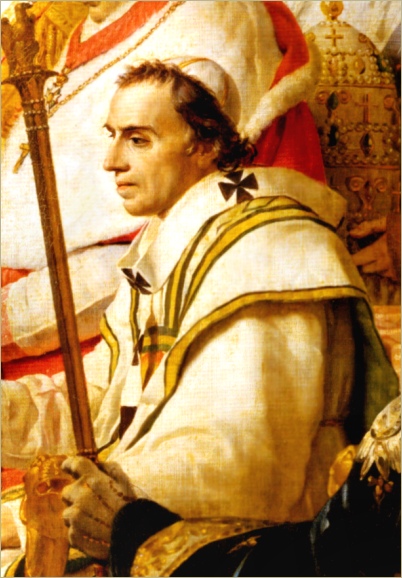
| Pius VII, bored by Napoleon's self-coronation. The artist forgot the fanon. |
The origins of the Liturgical Movement are usually traced to the diocesan priest-turned-monk Dom Prosper Guéranger, who founded the monastery of Solesmes. The four major contributions of Solesmes to what would be called the future of the Roman rite and the Liturgical Movement are:
- A new interest in liturgical scholarship
- An interest in the complete liturgy, as opposed to the simple Mass, including the Office and various ceremonies as it existed in the Middle Ages
- A restoration of the more ancient, pre-high Middle Ages, notation for plainsong
- And the suppression of the local rites of France.
The Movement in its nascence sounds very "right wing," especially in regard to the last point. Dom Guéranger's ultramontanism involved a compulsion to imitate all things Roman, not merely to accept doctrinal decisions from the Papal Chair. His Roman zeal led to the suppression of many local, "neo-Gallican" rites which Pius VII recognized as legitimate after his treaty with Napoleon, although these local rites were more often just usages, the Roman Mass and Office with variations in the psalm arrangements, propers of the Mass, and orations. Indeed just a few centuries earlier Bishop Pierre de Gondy of Paris was confronted by his cathedral canons' refusal to adopt the Roman Office, preferring their own liturgy. Solesmes' early efforts resulted in centralization and ultramontanism throughout the newly formed branch monasteries, but these features would not endure. Indeed, one under-appreciate result of Solesmes' effort to restore monasticism is that it created a network through which many would be able to undermine liturgical orthopraxis and spread their ideas.
The first phase of the Liturgical Movement had two distinct trends: (1) an effort to renew liturgical practice in the Latin Church through the use of the Roman rite and by the exercise of the Papal Office and (2) a trend among monastic and diocesan clergy to ignore all things Roman and to implement a curious mix of an imagined liturgical past with perceived pastoral needs of modern man. The latter led to many members of the early Liturgical Movement to be considered doctrinally suspect, even if this was not always the case.
![]() |
| St. Pius X celebrated the 50th anniversary of his ordination at a Papal Mass in the Sistine Chapel. |
I have mentioned Fr. Antonio Rosmini before and will mention him again, as his life and works, condemned by the Holy Office after his death until his beatification by John Paul II last decade, reflect the fundamental issues which the Liturgical Movement confronted. Renewed interest in patristic and liturgical scholarship, often perceived by Rome as an effrontery to scholastic theology, coincided with a growing frustration with the "low Mass culture" mentioned in Part II of our series. The first chapter of Rosmini's Five Wounds laments the insufficiency of formulae and rites, good things in themselves, in teaching the laity, suggesting that instruction might be preferable—and even notes the suitability of the Latin language to this purpose. Still, Rosmini notes a separation between people and clergy in liturgical rites (Ch1. XX) which undermines the celebration of the Divine Mysteries. At the end of the first chapter, the priest concludes that solutions can only be achieved by the clergy, thus the Liturgical Movement, popular among the priests and a mystery to the laity, came to one form of expression.
The more centralized approach contrasted sharply with the previous approach, which often demanded more simplified rites and popularly accessible ceremonies. The centralized outlook, which only lasted until World War I, was most potent during the papacy of St. Pius X. Papa Sarto favored a return to ritual, particularly in musical form, but also seemed to believe that such a return was most possible through simplification. In his first motu proprio, Tra le sollecitudini, Pius affirmed the primacy of Gregorian chant, condemned the use of female voices and vulgar instruments in liturgical music, and emphasized the importance of frequent Confession and Communion. The last of these resulted in the curious practice of un-Confirmed persons communicating at Mass, something Eastern Catholic and Orthodox Churches find most puzzling.
The centralized approach found its strongest expression in the re-organization of the Divine Office, promulgated by the bull Divino Afflatu in 1911. Not only did the changes to the psalms, antiphons, and hymns radically alter the Office, but the reforms set a precedent, that the right authority had the right to sweep away tradition with the swipe of a pen. I wish the Pope took St. Pius V and Benedict XIV's approach by reducing the number of Double feasts, but instead the Pontiff removed and explicitly banned the use of the old psalter. The Liturgical Movement's left side eventually came to agree with the right side on one critical point: the highest authority can do whatever he wishes with the liturgy.
Benedict XV, a curial diplomat before his elevation to the Archbishopric of Bologna, was not a very liturgically-minded man and issued a missal in 1920 which followed his predecessor's changes, but did not go much further.
![]() |
| Fr. Karl Rahner, S.J. |
Around this time the first phase of the Liturgical Movement, comprised by parish priests and monks, died and gave way to a new phase of the Movement, which engulfed the major religious orders and occasionally merged with the variety of questionable opinions called "Modernism."
The Jesuits were among the chief players in the new phase of the Movement. Fr. Pierre Teilhard de Chardin, something of a pantheist, used the internal connectivity of the Society of Jesus to circulate his heresies after Rome prohibited him from publishing work for popular consumption. Fr. Karl Rahner, S.J. followed the same vein, albeit in a less radical stance. The Order of Preachers experienced similar problems. At the heart of the heterodoxies circulating in the religious orders in the post-World War I phase of the Movement were an openness to non-Catholic and non-Christian ideas and a desire to adjust liturgy and theology to meet the needs of a Europe quickly losing its observance of faith.
Conterminous with the theological trends of the orders was a new interest in liturgical scholarship and history. The Jesuit Fr. Josef Jungmann's history of the Roman liturgy ranks among the most influential works of the Liturgical Movement. More important than Jungmann's scholarship was his place among other would-be reformers of the Roman rite. In his Work of Human Hands Fr. Anthony Cekada spends some time highlighting a convention Jungmann held at Banz Abbey in 1948. At the conference Jungmann advocated for the use of vernacular, use of a presider's chair for the first half of Mass, the abolition of the old offertory prayers, a reform of the Canon, an increase of readings, and a reduction of ceremonial. While these suggestions demonstrate some concurrence with the earlier phase of the Liturgical Movement and the influence of the theology of Rahner and his ilk, one must ask: do these changes really address the causes of the poor state of the liturgy that followed the Council of Trent? After having the new rites, the outcome of these propositions, in place for several decades I am persuaded to answer in the negative.
Fr. Jungmann served as a consultant to a newly formed commission to study the question of reform of the Roman rite. The original intentions of that committee are unknown, but the man who created it, Pope Pius XII, must have had some intentions beyond changing the time of the Holy Saturday liturgy. Here Jungmann came to know Msgr. Anniable Bugnini, the object of much controversy, and Fr. Ferdinando Antonelli O.F.M. These men would influence, and indeed write, a new series of rites for Holy Week, begun in 1951 and accomplished in 1956. The controversy around the new rites of Holy Week have become well known in recent years, so I will not consider them here. Additional changes involved a simplification of the calendar, the compression of semi-double feasts into simples, a reduction of patristic texts in the Office, a reduction of the priest's role in the first half of Mass, the suppression of the Vigil of Pentecost, and other changes less obvious to the average person in the pew. These alterations to the Roman liturgy in the 1950s became the basis for the greater changes of the 1960s. Some deny this, but some honest commentators who favor the changed, like Fr. Robert Taft, S.J., openly correlate the two series of reforms.
Here we see the most important difference between the first and second phases of the Liturgical Movement. The "right wing" of the first stage was ultramontane and the "left wing" was a disorganized band of of priests, monks, and scholars who paid little attention to Rome. The new phase of the Liturgical Movement learned something from the "right wing" of the first phase: he who holds power can institute whatever changes he wishes. The 1951-1960 changes to the Mass and Office were followed by Msgr. Bugnini's authorship of Sacrosanctum Concilium, the Second Vatican Council's document on the liturgy.
The liturgical constitution is remarkable for its vagueness, demanding introduction of the vernacular and the retention of Latin, an increase in scriptural readings, and other obscure statements such as the affirmation of Gregorian chant's place of "honor." Bishops by this time must have become aware of the poor state of the liturgy, but were perhaps suspicious of people like Jungmann and his cohorts. The vagueness of this document placated their concerns: whereas the affirmation of Gregorian chant meant to most gathered a return to a form of Church music mostly suppressed by the low Mass culture, to the reformers it meant that chant was one of many kinds of music acceptable in the liturgy.
![]() |
| Msgr. Annibale Bugnini years after Vatican II as an archbishop. |
Thinkers from other religious organizations, such as the Oratorian Fr. Louis Boyer and the Benedictine monk Fr. Vagaggini—who did great violence to the Roman Canon, joined the institutional presence of the Liturgical Movement at the Council. Pope Paul VI, himself something of an enthusiast for reform, appointed Msgr. Bugnini and many others to a commission called the Consilium, which would be responsible for eventuating the instructions of Sacrosanctum Concilium. This commission, which acted with greater authority than even the Sacred Congregation for Rites, issued changes to the existing form of Mass in 1964 with Inter oecumenici and in 1967 with Tres abhinc annos. Both sets of changes claimed to be restorations of the ancient practice, even though the changes were actually very dubious in their historical foundations.
Without drawing too much on a matter that could fill several books, the changes purported to be a return to a better liturgical past. The most famous instance of this antiquarianism is Eucharistic Prayer II in the Pauline Mass, fashioned after the Canon described by St. Hippolytus—who may have only been recounting the structure and intention of the Canon of ancient days and not its literal content. Another trait was the removal of anything medieval and the selective partial restoration of anything that was presumably ancient.
The document Sacrosanctum Concilium may have less reflected the active will of the Second Vatican Council than it reflected the will of the reformers from the Liturgical Movement who learned that they needed legal and institutional precedent to justify their changes.
Our purpose in this post is not to consider the antiquarianism, theological views, and personalities of the Liturgical Movement. Our purpose is to consider the Movement's roots, its development and institutional expression, its transition into a mainly "left" wing trend in the Church, and how it came to be the agent of the reform of the Roman Rite. I hope we have accomplished as much. I welcome critiques and further information below!
Next: centralization!
"Centralization grows and goes madder every century."—Fr. Adrian Fortescue writing to Fr. H. Thurston SJ, November 5th, 1910
Post script: I am aware Fr. Anthony Cekada is a sedevacantist and while I do not share his view on the occupancy of the Petrine Chair or of Eastern theology, I see no reason to dismiss the honest history described in his Work of Human Hands, which has been warmly received by canonically regular clergy like Dom Alcuin Reid and Msgr. Andrew Wadsworth of ICEL.
Tuesday, April 16, 2013
Suggested Reading
My next post in our series on the Reasons for the Reform of the Roman Rite is immanent, worry not. In the meantime I thought I would meet some readers' request for reading suggestions in matters pertaining to the liturgical reform. All but the last two may be read or downloaded online for free:
- The "Restored" Holy Week by Msgr. Léon Gromier: a well-grounded critique of the Holy Week reforms by Pope Pius XII in 1956. This is not actually an essay, but a translation into English of a conference given in French in 1960, so it will read awkwardly at times—although not due to Fr. Chadwick's translation work.
- An Introduction to the Reform of the Roman Breviary 1911-1913 by Mr. Paul Cavendish : this article presents a very detailed summary of how the Roman rite breviary worked before the pontificate of St. Pius X, as well as the problems presented by the inflation of Double-ranked feasts, which I only briefly touched here. The numerous tables compare the old Office with the monastic Office, the suffrages (which I particularly miss), the various ranks and commons used, the votive offices of the Dead and of our Lady, and other rubrical issues. Few realize how deep the reform went. The article refrains from making a strong opinion and functions mostly as an instruction.
- The Proto-History of the Roman Liturgical Reform by Dr. Geoffrey Hull: a compelling, succinct case that Western European trends such as Jansenism and Ultramontanism influenced the reform of the Roman liturgy far more than Protestantism, which many in the English-speaking world assume.
- The Bugnini-Liturgy and the Reform of the Reform by Mr. Laszlo Dobszay: detailed analysis of the new rites in depth, going deep into the Office and the propers of the Mass. Whereas most analysis tends to focus on the ordinary of the new and old Masses, this 218 page book considers the Office, the arrangement of the psalms, the Office structure, and the use of music during the Mass. His fears of contrasting high and low church culture are prescient. Well worth the read. Download the pdf and save it. One can read the chapters separately rather than sequentially.
- Of the Five Wounds of the Holy Church by Fr. Antonio Rosmini: an early call for liturgical reform, but without many specific calls as to where or how. A tremendous influence in the early days of the Liturgical Movement.
- The Mass of the Roman Rite by Fr. Joseph Jungmann, S.J.: went through several editions before the Second Vatican Council started. The writer, the main intellectual force in the later days of the Liturgical Movement, influenced the criticism of the traditional rites and the creation of the Pauline rites more than is commonly realized. Many of those on the Consilium were his intellectual progeny.
- Shape of the Liturgy by Gregory Dix: best, most holistic liturgical history written available in English. Considers all the rites, in their history, their changes, their character, and their continued usage. Dix clearly favored some sort of renewal, but does not step into the spotlight and state his mind on the matter. This book is marvelous, but does have a few amusing internal inconsistencies: for example he laments the disappearance of far Eastern rites, about which we know virtually nothing, and condemns those who put two candles on the altar at Mass rather than six as antiquarians.
The Roman Rite in Transition
Many have come to believe either than Vatican II changed the Roman Mass in a particular instant, in say 1965, or that Pope Paul VI's rite was imposed upon a liturgically pristine Church in 1969. This was not quite the case, although the changes most visible and dramatic to the laity did occur between 1964 and 1969.
Here are some photographs of the Roman rite in Transition.
The one immediately to the right shows the consistory of 1965, at which Paul VI created new cardinals for the Roman Church. The legendary Enrico Dante, the long time Master of Ceremonies for the Papal Court, was among those elevated. Readers will notice the odd practice of wearing a biretta with Mass vestments, something prelates typically only did at low Masses. The design of the vestments is stunningly bad, as though someone ripped the fabric from a 1950s American living room sofa, cut it in a conical shape, and draped it over the nearest priest. Still, the maniple survived through 1965 as an optional vestment. These designs had become popular in the United States and central Europe after World War I, but not throughout the entire Roman rite until Paul VI began using them after his election to the Petrine Chair. Why are they wearing Mass vestments? Surely there was no concelebration, outside of ordination ceremonies, before 1969! Oh yes there was!
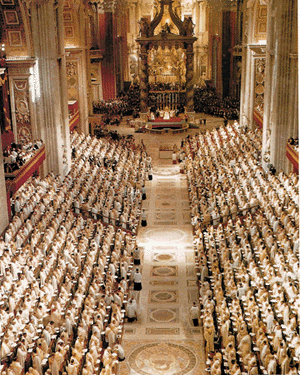
This photograph is from a Mass at St. Peter's Basilica in May of 1969. The instructions given at the time demanded concelebration only involve a reasonable number of clergy, those who could fit around the altar. Paul VI expanded the altar and added a platform over St. Peter's tomb (still there) and conjoined a symmetrical table to the original. This is Mass according to a somewhat revised version of the Tridentine ordinary of the Mass. The new rite did not "kick in" until Advent that year. For a while each concelebrant got his own bread and chalice of wine to consecrate. By 1969 the rules reduced the number down to only what was in front of the main celebrant.
![]() |
| credit: St Bede Studio |
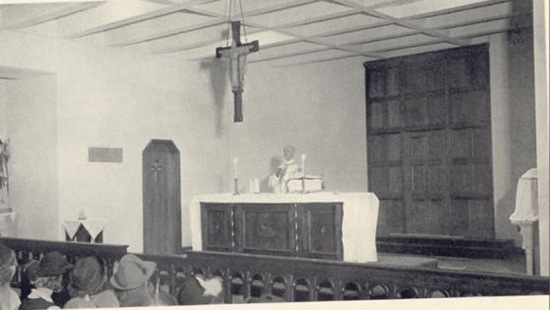
Some [very] daring priests even began to celebrate Mass facing the people, which required a relocation of the tabernacle. This was popular in some circles in post-World War I Europe and in post-World War II America, particularly on the east coast. Service time as chaplains during the war and the influence of Collegeville, Minnesota doubtlessly formed the tendencies of American clergy. Perhaps most startling is this: priests need permission and funding approval from their bishops to remodel their parishes. "Wreckovations" were more popular before 1969 than most think, and they were executed with episcopal approval.
| Latin School in Indianapolis, 1965. Versus populum was common but not explicitly legal at this point. |
![]() |
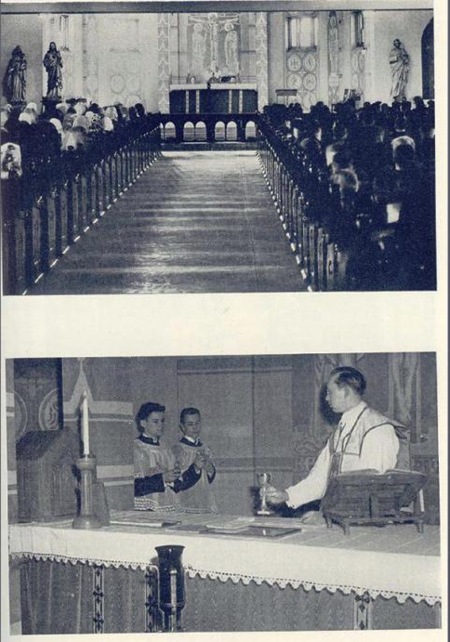
| A Mass celebrated by Archbishop Howard of Portland, Oregon in 1947. |
Another in the same vein:
![]() |
| Archbishop O'Hara of Kansas City celebrated the Feast of Christ the King in 1954. |
![]() |
| An "offertory procession" of the President and First Lady of the Philippines in 1965. One can easily find similar images from New York City in the 1940s. credit: catholicphilippines.blogspot.com |
These practices did not appear out of thin air in 1969, or even in 1965. They had been on-going in many communities for decades by the time the Second Vatican Council and Paul VI popularized them.
Sunday, April 14, 2013
Doctor on Trial for Disgusting Abortions
| Dr Kermit Gosnell from: theweek.com |
Dr Kermit Gosnell is being tried to murder after aborting several babies after delivering them. Needless to say, the American press, unwilling to publicize anything concerning abortion that does not fall under "women's rights," is generally ignoring the indictment of a man whose practice would not have passed very basic health inspections. The man induced labor so he could execute the children. Under law, it is only a "late term" abortion if the child is not out of the womb. Seven got out and did not make it far from his cold, cruel scissors.
Subscribe to:
Posts (Atom)