Herein we shall have a
very brief history and synopsis of the ancient Roman Divine Office, which was preserved into the thirteenth century in the major Papal basilicas of Rome until Pope Nicholas III, a Franciscan, imposed the books the Franciscans used, meaning the books of the Roman Curia. This is fitting, given that a Franciscan pope caused liturgical trouble in the Church of Rome and now today the pope of Rome
causes liturgical trouble in a Franciscan order! First, we should endeavor to understand how the idea of singing the psalms and lessons according to the hour of the day came about in the first place.
The general consensus, according to Pierre Batiffol a century ago, is that a vigil of prayer preceded the celebration of Mass/Divine Liturgy in churches every Sunday. The origin of this practice is itself obscure. Some theorized that Christians merely extended the Paschal Vigil, what St. Augustine of Hippo called the "mother of all vigils," throughout the year. As one might surmise from the etymological origin, vigilare, a vigil is a watch of prayer before something important, in this case the Eucharist of Sunday, the Lord's day. St. Jerome supposes that the evening vigil reflects the Apostolic expectation of the return of Christ, itself an anti-type to the evening exodus and liberation of God's people, the Israelites, from Egypt (Commentary on Matthew 4).
 |
| source: newbyzantines.net |
Some like Batiffol expect the vigil on Sunday began at cockcrow, while some others, less popular, might sympathize with the medieval practice of beginning the vigil at midnight. The vigil itself varied drastically from place to place, but we can say that it involved the reading of the psalms, of other holy books (remember the Canon of Scripture was not codified until the end of the fourth century, so we cannot just assume they were "reading the Bible"), and some sort of responsorial prayers—adopted from the Jewish practice of chanting an invocation to which the people would respond with a doxology such as
Amen. The
Gloria Patri.... is a sort of prayer ending of this variety, albeit used for the psalms rather than for the more variable prayers. The psalms appear to have been recited or chanted by a single reader or cantor in a monotone. St. Athanasius in the fourth century ordered readers to fluctuate the tones of their voices for the benefit of the laity in attendance. Ss. Athanasius and Augustine attest to deacons chanting the psalms alone, which persists in the choral practices of the Byzantine rite and which remained in various usages of the Roman rite—such as Good Friday in the Lyonese use—until the twentieth century. Between the verses of the psalm the choir would chant antiphons, which became increasingly elaborate in time, giving rise to a "responsorial psalm" (the reformers of the twentieth century misread this as a popular part of the liturgy which died off in a fit of clericalism and "restored" it in the Pauline Mass; the responsorial psalm was a clerical part from the beginning). This practice originates not in Rome, but in Antioch. St. John Chrysostom brought it to Constantinople, where it became popular and eventually traveled from the new capital in Asia Minor to the old capital in Milan. Rome, as we shall see constantly, was very slow and wary in adopting this practice, only taking on choral responsorial chant in the fifth century, a century after monastic-influenced Africa and Byzantium.
 |
St. Lawrence outside the Walls
source: penitens.blogspot.com |
Eventually vigils became more and more common. The Church in Constantinople had a vigil every single night. In contrast, St. Jerome remarks, Rome held the vigils only on Sundays and the nights anterior to great feasts. Here we see a very local part of Rome's liturgy. The idea of a "stational church" originates in the vigil. For feasts of local martyrs and saints the vigil was in ancient times held at the cemetery were said saint was buried, or at least in a proximate house. When churches were constructed they were built on the sites of these cemeteries or burial spaces, St. Peter's basilica being the most famous example of this. The vigil then would not take place in every church of Rome, but the Pope and the clergy of the stational church, perhaps St. Lawrence outside the Walls on the night between August 9th and 10th, would hold the vigil and the following Mass in that particular church. Rome eventually came to the practice of the rest of Christendom and had daily vigils, as St. Benedict instructs other monks to observe in his
Rule (13).
Enough about the timing and frequency of the vigil. What was the vigil? The vigil consisted of three parts: an evening service, a night time service, and a morning service, which are equivalent to Vespers, Mattins, and Lauds today. This is not very difficult to see in the names within the services. Vespers, from vesperae, meaning shadows or darkness. Mattins, from matutinus or "early," is comprised of nocturns, from the word nocte or "night." And Lauds is from Laudate, the opening word of two of the three integral psalms in the pre-1911 psalter. Easy! Vespers might begin around 4PM in the presence of the bishop, who would leave and rejoin the congregation later in the night, or early in the morning if you will, for Mattins. Lauds became seen as so important during the latter half of the first millennium the presiding cleric would often, depending on the time of year, signal all present to cease Mattins and head straight into Lauds the moment the light of the Sun entered the church.
 |
Monks of Bethelehem
source: news.ripley.za.net |
Outside of Rome, in the mid first millennium, we see a rising tension between the secular clergy and monks, who are often imposing their psalmody on parishes to the annoyance of the local bishops. Yet there developed, in Rome and abroad, a middle ground between hermetical monks and the regular laity. Since the age of martyrdom was more or less over, the very devout, often celibate or virgin, took to singing psalms together in community during the daytime without the presence of a cleric. Imitating the Jewish practice of observing the daytime hours, they prayed at the third, sixth, and ninth hours—
terce, sext, and
none. Parts of these daytime hours as practiced in ancient times remains in the unreformed Holy Week as it existed before St. Pius X tinkered with the psalter and made the little hours variable. The psalms did not have "doubled" antiphons nor did they have hymns nor introductory rites. They were simply sung beginning with the sign of the Cross and ending with some prayers.
Yet at late as the sixth century the little hours of the devout laity were just that, for the devout laity and not part of the "Office." The hours of Prime and Compline came last, in the fourth century among hermetical monks of Bethlehem. The leaders of monastic communities noticed that the monks had far too much free time to sin between the beginning of the vigil with vespers and Mattins later in the night, and between Lauds and Terce, so they imposed prayers to be sung during those period. For this reason we often call Prime and Compline "chapter" hours, hours sung by the monks in common outside of a liturgical setting. One wonders why the reformers axed Prime on the false grounds that it was a mistaken repeat of Lauds but kept Compline as "night prayer" as though it was somehow more authentic. As with Lauds, the psalmody chosen for Compline reflected its character, in this case nocturnal. The lingering darkness and uncertainty of night made psalm 90, which speaks of the Lord encompassing us in His shoulders, a source of constant succor.
Back to the Roman vigil. Even in the time of St. Jerome in the late fourth century Rome still sang psalms straight through, without a "choir" concept we have today. Within a century or so we have antiphons sung in between the verses of psalms by the choir, while a deacon or subdeacon chants the psalm itself. There are lessons at Mattins, three from Pascha until late September, and then four lessons from late September until Pascha, when the night is longer. The lessons could be taken from any number of sources according to the parish or monastery's means. Whatever Scripture was available might be read, such as an Old Testament book or a Pauline epistle. The reading was not very exact in length and would end whenever the presiding cleric had heard enough. These readings could be quite long. The Abbey of Cluny, full of very eccentric monks, boasted of restoring the ancient Roman lesson length to the point where they could read the entire book of Genesis at Mattins in just a week; certain monks were ordered to walk the choir stalls and wake any others who had fallen asleep during the onerous readings.
Lessons started to come from non-Scriptural sources as well. St. Gregory the Great recommends that at Mattins his friend, Marinianus, ought to read the pope's commentaries on the psalms at Mattins rather than his writings on Job.
We can also guess that by this time the structure of the Office had become more or less set. Mattins would have three or four lessons on a ferial day and nine on a feast day, with twelve variable psalms on a feria and nine on a feast. The offices began with the sign of the Cross and psalm 69 followed by a doxology and then the proper psalmody of the day. Finding this too long, the Curia eliminated psalm 69 but kept two lines of it and the doxology at the end (Deus in adiutorium.... Domine ad adiuvandum.... Gloria Patri....). In the first half of the first millennium the readings were done in a ferial tone by the senior-most clergy, a place of honor. By the seventh century ornate Roman chant had become so developed that children often sang the lessons as liturgical ministers. Popes Leo II, Benedict II, and Sergius I entered the clerical life as choir boys who read at Mattins.
Batiffol at this point draws attention to an interesting phenomenon: without Imperial aid, churches in Gaul, the Frankish kingdom, and even England sought to imitate the Roman Office practiced at the Lateran Cathedral and St. Peter's basilica. Perhaps one source of variation between the Roman rite and local uses was the limited resources available for transmission, beyond basics like the psalter. Antiphons with their ornate chants were bound in a separate book, as were the Scriptural lessons (perhaps several book). Even if the psalter and texts could be carried from Rome to York the tones of the psalms and the ceremonies surrounding the Office would inevitably vary.
Also unique to Rome were the ornate and long responses after the lessons at Mattins, often two or three lines long. They are usually attributed to St. Gregory I, but are more likely the collective work of Popes centuries before and a century after Gregory the Great. The responses at Mattins, and antiphons for the rest of the Office, become more or less fixed by the eighth century in St. Peter's basilica, the main pilgrimage destination and liturgical envy of Europe. One contribution Gregory the Great did certainly make to the development of chant was his establishment of monasteries at the major churches of Rome. St. Peter's basilica had no less than three monasteries in the first millennium. Monasteries were eventually supplanted by chapters of canons, but their musical influence endured.
At this point it is worth saying something about the ceremonies surrounding the main hours in the ancient Office. The Pope would enter the church in a chasuble—no choir dress and copes were more like rain coats at this time—and go through the ceremonies of an episcopal visit; he would then preside from his throne behind the altar, facing the people, surrounded by the canons or monks of the church in order of seniority, with hundreds of candles lit nearby; cantors, deacons and subdeacons, would take their place at ambos on either side of the altar and a lecturn would be installed for the reading of the lessons, either facing the altar from the apse or facing the altar and Pope from the opposite side. The nature of the ceremonies was a balance of congregational and monastic, whereby clerics performed the liturgy, but directed the more didactic parts of it to the laity.
The Office of St. Peter's took on a special importance to Europe and became the golden standard of Roman liturgy. As Msgr. Batiffol reminds us, Benedict Biscop, teacher of St. Bede the Venerable, managed to convince Pope Agatho to lend him a few monks from St. Peter's to teach his English monastery the Petrine Office. The long and elaborate scriptural responses of Mattins became popular in the Frankish lands and a mainstay of the Offices of diocese and monasteries on those areas. People used the Roman Office because they wanted to do so, not because they were obliged. In utilizing the Roman Office as far as possible, clergy created a localized expression and began local customs in liturgy that would help them perform and express their adoration for God in a way unique to them while remaining substantially united to Rome in the essence and text of prayer. Unique variations developed in the late first millennium outside of Rome. For instance in the lessons at Mattins at the end of each nocturn Gallican clergy would recite the Pater noster while at St. Peter's in Rome they would pray a short absolution. What comes to us today is a merger of both practices.
Perhaps curious to us is that the ancient Office did not commemorate the saint of the day. Pope Gregory III is said to have constructed small shrines in St. Peter's basilica with short offices in honor of the saint of the day to be prayed in those places. Eventually the two became fused as monks shirked this extra duty.
In the eighth century scholae are established everywhere from Rome to Rouen according to the rites of St. Peter's basilica, effectively snuffing whatever might have been done in the Gallican practices. The long, subtle Roman Office triumphed in Europe, but outside of St. Peter's it was not immune to fluctuations and changes.
 |
The old St. Peter's basilica, bastion of the old Roman Office. Note the Leonine wall to the south.
source: wikipaintings.org |
Another variation that arose was in the translation of the psalter. Ever notice that the antiphons in the Office and the proper chants of Mass differ a bit from the psalm texts in the Vulgate? There are many examples of this. For instance
erue me versus
eripe me in translating psalm 42. The Church in France under Charlemagne and his successors used the "Gallican" psalter of St. Jerome, the saint's third translation of the psalms, while at St. Peter's in Rome they used an earlier translation of Jerome's, which was just a minor revision of the Latin texts he received. Therefor proper texts like antiphons and chants, which one reads prepared in a book, would be static while the most familiar psalm text might just be sung in a tone.
The repetition of each antiphon after a psalm verse died a slow death outside of Rome, but remained until the turn of the millennium at some places like Cluny or among the Canons of St. Martin of Tours. Similarly, the Gallican psalter supplanted the Roman psalter outside of the Lateran and St. Peter's.
Another feature that seems to have changed is the "chapter," the very short scriptural lesson after the psalms in each hour. The monk Amalarius, a student of Alcuin, has lessons at the minor hours, including Compline. What the hours might have looked like in the old Roman Office can be found in the pre-1911 Offices for Holy Week: each hour is begun with the sign of the Cross and an antiphon; the psalms and antiphons are sung straight through with no lesson, only a response, at the end; depending on the hour there might be a canticle; then a closing prayer functioning like a collect (although not taken from the Mass, the texts of the Mass and the Office did not overlap as much as they did after the 13th century).
The lessons, as mentioned earlier, went on as long as pleased the presiding cleric, often an abbot or the Pope himself. The practice of reading Scripture, which seems impromptu, dates only to the late 700s, but became a fixed part of the Office, albeit in a reduced form outside of Rome and Cluny. I wonder, are the
Tenebrae lessons of the Triduum abbreviated for Curial purposes from longer originals? It seems possible.
Perhaps an important factor in the reduction of the core of the Office and addition of hymns and collects from Mass outside of the major churches of Rome is the number of books necessary to pray the Office: a Bible, or collection of Scripture books; a psalter; an antiphonary; a book of homilies for the lessons; and, later, a Sacramentary. This books could take years to make and consumed precious resources. It was much easier, for instance, to shorten the Wisdom selections for August and protract their reading than to speed through them and be out of books, forcing repetition. We read, in the mid-700s, Pope Zachary donating books to St. Peter's basilica from his private library for the public Office. Even the main center for pilgrimage in Europe was not immune to a shortage of funds for these expensive liturgical resources!
 |
Fr. Finigan doing it the rite way in Blackfen
(Zephyrine, you lucky duck!) |
Another point of interest is the kalendar. The Sundays of Advent were not penitential, but joyful in the ancient Roman Office. Batiffol examines the Mattins responses for the first Sunday of Advent, which you can read for yourself elsewhere. The concept of Advent as a penitential season seems to be of French origin rather than Roman. The great
O antiphons sung as the Feast of the Nativity approaches, corroborate this hypothesis. The mid points in Lent and Advent,
Laetare and
Gaudete Sundays, were also great days of the year which merited the Pope's public celebration of the entire liturgy as late as the Middle Ages.
Moreover, according to Pope Hadrian I and later sources on the great feasts of the year there were two celebrations of Mattins at the stational church on a given night. The first, without the elaborate introduction, would be the ferial Office. Later in the night would come the festal Office and the rest of the day would follow as normal. Simple-ranked feasts were compromises between the festal and ferial Office. They were important enough to celebrate, but too local for the same treatment as universal feasts like the Nativity or St. John the Baptist. So the ferial psalms, aside from Lauds, were sung but with festal antiphons on the canticles and prayers pertaining to the saint of the day at the end of the major hours.
So, how did the "traditional" breviary/Office we have today, or had until 1911, come into being? Certainly the groundwork for it should be visible to my more liturgically oriented readers. In 1241 Gregory IX gives the Minorites (now colloquially called the Franciscans) the use of the "modern" Roman Office, which begs the question: what the heck is that?
 |
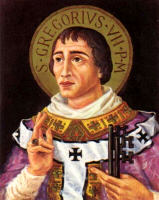
St. Gregory VII, a monk, was
not a fan of reduced Offices |
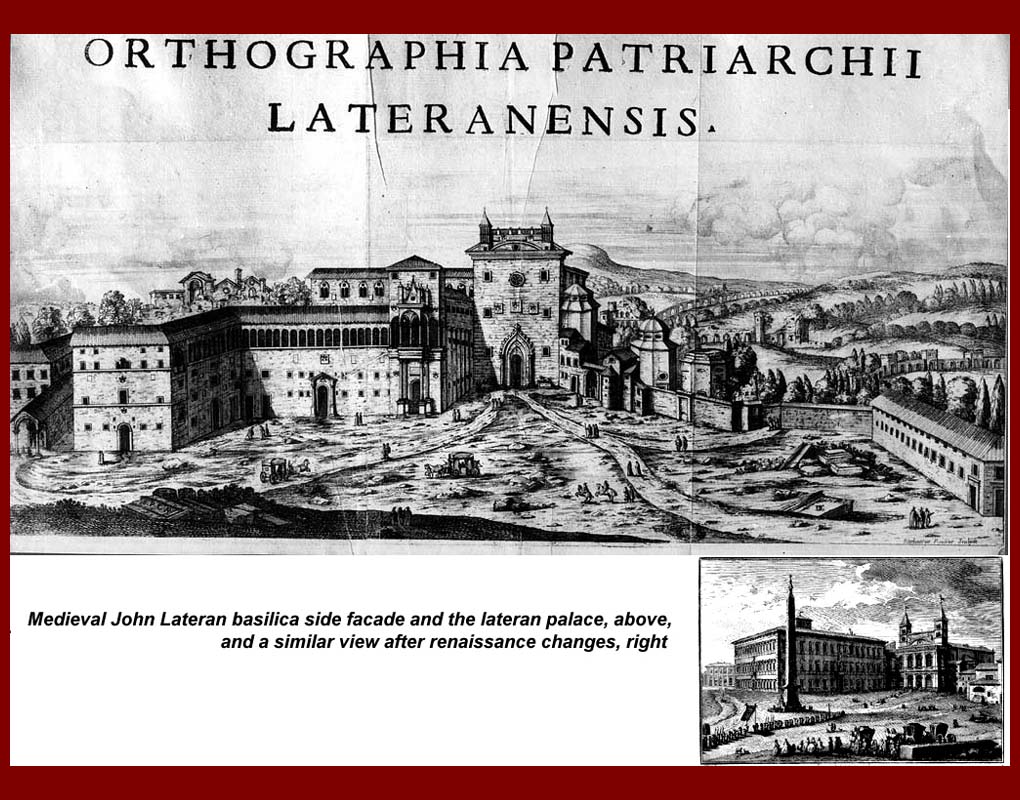
The "modern" Office was a variation of the Roman Office used by the Curia in the Lateran Palace, although not cathedral, from around the time of St. Gregory VII onward. It has many influences from outside Rome, particularly from France. The "modern" breviary, for instance, utilizes hymns before or after the psalms, depending on the hour. Hymns were not a complete innovation, although hymns as we know them did not take liturgical flight in either Rome or in the Eastern Churches. St. Benedict, although generally following the Roman way, prescribes hymns in his
Rule the same way we sing them now. "Ambrosian" hymns, following a specific sort of meter attributed to the patron saint of Milan, became very popular in monasteries and in France. The international nature of the Curia and the re-emphasis on monasticism from St. Gregory VII throughout the high Middle Ages imported elements from priories and foreign cathedrals into the Papal Court. Somehow the Lateran Cathedral managed to resist hymns in their Office until the 12th century! Even the other local churches of Rome had long ago taken on the newer practice.
A tension between the Roman Office and the Curial Office arose in the 12th and 13th centuries, during which the Curia, outside of public Papal celebrations, used their Gallicanized, modern Office exclusively. Innocent III lamented that the Curia only used the true Roman Mass and Office on the feast of St. Peter's Chair in Rome. The Mass, unrelated to this article, may have differed too. Example: at Papal Mass a cardinal deacon and the local sacristan would arrange the burse, chalice, and bread on the altar during the Creed. The Tridentine practice—wherein the deacon of the Mass prepares the burse during the Creed and the subdeacon prepares the matter for the Eucharist during the Offertory—was a Curial adaptation for smaller spaces and less elaborate liturgies. In his own time Gregory VII blamed shortening and simplification on laxity among the clergy. One wonders what he would think of the
Liturgia Horarum, which one can recite, for the entire day, in 30 minutes or less! John Beleth wrote in the 12th century "How many of us are found joyfully to rise with the Sun to say the Divine services?.... How many are they who conscientiously recite in due course the Office of the day? Few indeed, and very few, if the real truth be told."
Another point of note is that the Office, among the Curia, was now more frequently read than sung. St. Leo IX is recorded, in the 11th century, to have piously recited the Office in private daily, a proof of his holiness and sanctity. Given the need for books outlined a few paragraphs ago, we must ask: did a "breviary," an abbreviated version of the Office text without musical notation, exist even then? If not it certainly existed two centuries later. The word "breviary," from the Latin
breve, means "brief" or "shortened" and is directly linked with the Franciscans, who wished to carry the modern Curial Office around in a single volume. Thus the breviary for private recitation was born. The Rad Trad, who has no firm scholarly ground for this assumption, guesses that parish priests outside of cathedral cities, probably just recited psalms with a
Pater noster at the end rather than an entire Office, with hymns and antiphons, every day.
 |
Nicholas III, Franciscan and
liturgical dissident |
At the same time the Papal Court slowly drifted away from the Roman Office as devotion to the Virgin and prayers for the Church Suffering in Purgatory increased. Clergy of the major cathedrals and collegiate churches of Europe would sing the Little Office of the Blessed Virgin on days with three lessons at Mattins and perhaps also the Office of the Dead. The Office of the Dead would, at least, be recited on Fridays of Lent. It was not inconceivable that on a Lenten feria, between the Office of the day, the Office of the Virgin, the Office of the Dead, the seven penitential psalms, the Mass of the feria, and, if it occurred, the Mass of a feast, a canon or monk might spend near ten hours singing. This was truly onerous (compare that with the 1975 Pauline Office!). Inevitably canons and monks viewed this schedule of prayer as a burdensome daily grind rather than as God's praises. Liturgy became a grueling obligation, which is perhaps why when Pope Nicholas III completely suppressed the ancient Roman Office he met no major opposition in doing so.
In 1223 the Franciscans obtained the Roman breviary books and may or may not have "corrected" some aspects, such as which psalter was used. The order was permitted to celebrate local feasts where ever they lived, but had to fit each feast into the relevant Common and never rank it above semi-double. As a result the kalendar took on a lot of extra European saints with little international or distinctly Roman importance. The Rad Trad cannot verify, but guesses some of these feasts were "scrubbed" by St. Pius V in the aftermath of the Council of Trent.
And there it is. The reduced Office for Curial use which made Innocent III lament, himself a former canon of St. Peter's, became the Office of the Franciscans, which in turn became the Office of Rome, which in turn became the Office of Europe. Although the communal nature and structure of the ancient Office died with the clerically focused Curial Office, vestiges of the older Office remain, for instance, in the old Triduum Offices and from Pascha through Low Sunday. The psalm schedule remained and the psalm translation for antiphons and propers of Mass stayed, too. The effect of the impositions of Nicholas III and Trent was an abbreviation, but not a complete loss or change. If there is a real tragedy in all this, it is that the Office used at St. Peter's was the golden standard of the Latin Church and remained for so long, only to be eventually seen as an unneeded weight on lethargic clergy. The popular element of the Office, which incorporated local feasts, interaction with the bishop (in this case the Pope), and participation of parish clergy, was lost for a convenient minimalism.
Of course, as the Rad Trad has suggested earlier, there is no "going back," but we can learn the lessons of liturgical history, lest we traverse the roads of worship with only the most plain and un-detailed maps of the Divine cult.