Showing posts with label St Pius V. Show all posts

Thursday, October 25, 2018

The Legality of the Old Rite


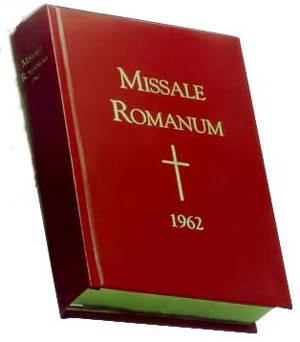
In the following article I shall endeavor to make a case for the public re-introduction of the pre-1962 Roman liturgy, both Mass and Office, from the perspective of Ecclesiastical law. First, I will specify what I mean by the pre-1962 liturgy. Then I will explore the concepts of abrogation, reprobation, custom, and the competing concepts of law present in the Tridentine decrees and the 1983 CIC.

Part I: Defining the Old Rite

By the "old rite" in the context of this blog I generally mean the Roman liturgy as it existed at the dawn of the 20th century, prior to the textual reductions of Pius X and John XXIII to the Office, the ceremonial changes of Pius XII to Holy Week, the vitiations of the kalendar, and the festive ranking system. 

A few posts ago, when discussing Msgr. Schneider's comments on the un-reformed Breviary, a commenting reader asked, presumably in derision, why not go beyond Trent? Why not re-introduce medieval sequences and see how far back into history we can transport ourselves. For the purposes of this article we will confine ourselves to the liturgical books promulgated at Trent and in use in the Latin Church, excepting for local tradition, until John XXIII. Consequently, this includes the typical editions published by Pius X, Pius XII, and early in the life of Papa Roncalli. 

The reason for this is that arguments about Canon Law must be reasonable. Canon Law is not very like modern secular law of the Common Law tradition, whereby established precedents and judicial decisions from prior times guide our contemporary interpretation of law. Additionally, the Codex is not a sacred book in the way law is sacred and uplifting to quotidian society. It is a rule book for governing holy things rather than the holy thing itself; in this it is subject to criticism and historical contrast, but it cannot be interpreted to mean anything other than what it plainly says, the very strange case of the FSSPX not withstanding.

The "Tridentine" liturgy neatly comports to this argument because its use is reasonable in that it is practical, something that could be done without resorting to medieval commentaries, reproducing long lost manuscripts, or resurrecting long dead cultures that used these traditions. The Tridentine liturgy, so named, was ratified by both an ecumenical council and an indefinitely (not the same as eternally) binding papal decree; it was built upon ancient custom and crystallized according to the highest standards of Church law: general episcopal ascent and the judgment of the pope in unison.

"Reasonable", in canonical terms, generally means compelling or necessary, but in the context of someone asking for something it could also mean practical. In this, the Tridentine liturgy, up to '62, is also "reasonable" in that it could be revived without extravagant effort. Before Summorum Pontificum there were enough Missals from which the 1962 Mass could be derived, but most Missals seem to be more recent prints. The older liturgy is accessibly easily enough through the same existing books, older books which can be found with little effort for purchase, and even smaller scale re-printing which one hopes might expand to a larger base.

Legally, a distinction must be adumbrated concerning the Tridentine Office and the Divino Afflatu scheme. In the penultimate paragraph of the aforementioned document Pius X explicitly suppresses the immemorial psalter and declares those who violate his new schema will incur the wrath of Ss. Peter and Paul. This issue will be addressed when we discuss abrogation and its place in law below. Otherwise, there are no such statements in subsequent 20th century liturgical reforms that openly repeal the existing forms, they merely introduce new ones with the assumption clergy will adapt them.

Part II: The Place of Custom

When a liturgical tradition has textual and practical continuity for over a millennium the most immediately obvious canonical precedent is that of custom. Custom in the common parlance means common or habitual practice, but also unwritten law. The Angelic Doctor's own words about "custom" in the Summa, II.97, form the basis for the canonical understanding of custom and, in many respects, are a more complete understanding of Ecclesiastical custom than what is in the current Codex.


Saint Thomas discusses custom in a larger question about whether human laws should be changed and how. In article 2 the Common Doctor observes that "the binding power of the law is diminished, in so far as custom is abolished." More broadly, he means that custom is one with the law and that to change custom is to change law, written or unwritten. Just as Divine Law proceeds from the "reasonable will of God," so Human Law proceeds from the "will of man, regulated by reason." Thomas presumably pauses from calling Man's will "reasonable" because it is not always reasonable, but can be tempered by reason; along a similar vein a great deal of what men do is habitual, not intentional, making those habits inapplicable to law and custom.

As a basis for the rest of his answer, Aquinas adduces St. Augustine's views on Christian custom having the force of Divine Law:
"The customs of God's people and the institutions of our ancestors are to be considered as laws. And those who throw contempt on the customs of the Church ought to be punished as those who disobey the law of God." 
Law is normative, but for Thomas man-made law is also fungible, even Ecclesiastical law. The repetition of external action in union with interior will forms a reasonable custom from which law derives and which has the power to alter law.
"Wherefore by actions also, especially if they be repeated, so as to make a custom, law can be changed and expounded; and also something can be established which obtains force of law, in so far as by repeated external actions, the inward movement of the will, and concepts of reason are most effectually declared; for when a thing is done again and again, it seems to proceed from a deliberate judgment of reason. Accordingly, custom has the force of a law, abolishes law, and is the interpreter of law."
If liturgical historians ever wanted a tight definition of "organic development" they would find it in Thomas's above words. Like administrative law, liturgical norms gain structure, substance, and interpretation through custom. 

Part III: Codex Iuris Canonici MCMLXXXIII

Modern Canon Law, according to the 1983 Codex, makes provision for existing customs and the intentional creation of new customs. Canons 23-28 deal with the erection of customs; intentional customs must:

  • not violate Divine Law
  • be introduced to a "community of faithful" capable of receiving it under its legislative head
  • not violate current Canon Law (unless it has been used for thirty years or holds the force of immemorial custom)
The old Mass and Office certainly do not violate Divine Law, unless all of those Counter-Reformation Saints were as legitimately canonized as Papa Montini.

It is the second of these points that is most critical to understand, that a custom must prevail upon a "community of faithful" capable of receiving it under its legislative head, whoever that happens to be. A custom cannot be a private practice. If a parish priest, for example, were to come upon a Pius IX era Breviary and wish to say it, he really would not carry the force of custom if he were only to use this Office privately. He would, however, have legitimate access to it if he celebrates Mass, whenever he celebrates the pre-Conciliar rites, according to the same rubrics, kalendar, and commemorations; the same would apply for any public celebration of the Office. John Beal's commentary on the Code goes on to remark that a custom must be stable and an intentional norm for a community. There can be no variation, optionality, or mixing-and-matching; otherwise a custom is not realized. This is critical, as custom, both canonically and Scholastically, have the force of Law because they govern popular behavior and belief as much as Law if not more. If it is not "popular" then it cannot be a custom, just a personal habit. 

Who is the legislator or canonical authority for such a decision? Presumably the head of a "community of faithful" as envisioned by the Law, be it an Abbot in a monastery, a Mother Superior in a convent, the parish pastor, or a bishop, should one wish to expand orthopraxis.

With respect to the old liturgy there is the issue of the abrogation of the Roman Psalter by Pius X, which could seemingly end conversation about a liturgical revival, at least of the full blown Latin rite. This is not necessarily the case. In his New Commentary on the Code of Canon Law, Beal observes that the canons regarding custom suppress "reprobated" custom, which is not the same as abrogated custom—custom administratively suppressed, but not something inherently wrong. He goes on to observe that abrogated customs could be legitimized again, whereas a reprobated custom is one that violates Divine Law, morals, or the liberty of the Church. 

The Tridentine Office does exist contrary to modern Law. It also enjoys immemorial custom in every sense of the word. One can pinpoint its official publications and typical editions after the Council of Trent, but its contents reach back centuries and its essentials far beyond that. Indeed, most of it is so very old that no one could really say when its specific contents started. Along the same lines, it met canonical abrogation, but simultaneously enjoys the highest state of approval possible, that of a pope in union with an ecumenical council and the full force of custom. Its revival would be contrary to the current force of liturgical norms, but would, simultaneously, be quite legal in virtue of its "reasonable" nature, the ability of a community of faithful to receive it under the correct authority, and its immemorial precedent.

In short, Pius X, and potentially Pius XII, suppressed the old rite, yet the 1983 Codex provides for immemorial custom to be reasonable enough to contravene existing law and for new custom to be imposed on those who would receive it.

Part IV: Greater Concepts of Law

Canon Law's recognition of custom reminds us of an opening point of this short article, which is that while the Codex cannot be read as saying anything other than what it does (ex. Archbishop Lefebvre rejecting the 1983 CIC altogether), it is not the only source or end of law in the Church. In fact, the general idea of Canon Law today has a very different tone from the medieval decretals from which is derives. Canon Law, both in the 1917 and 1983 forms, comes across as prescriptive, whereas the older outlook was that law is proscriptive and protective. Custom and stability give form to Law itself, which must be stable. Any system of law that changes at a whim debases the authority of the law giver.

Before Canon Law, at still embedded in the general outlook of Catholics and of the Councils we are bound to believe, custom and canons reign supreme, both of which are protective and proscriptive by nature. In our case, Pius V confirmed the Roman rite in the interest of perpetuating its use, not dictating what it is. In light of this plain fact, we can apply Saint Thomas's statement on the legal force of custom—and the Summa was placed on the altar, beside the Gospels, at Trent—guides our outlook on all Church law.

This more ancient and more universal outlook on law and custom resides in the very document which began the question of pre-Conciliar forms, Summorum Pontificum. Upon its issuance in 2007 many understandably raised their motu proprio copies in the air and screamed the old fashioned Traditionalist bromide "Never abrograted." How Michael Davies would have loved to see that day!

The passage of time has discovered another far more illuminating and enduring phrase within Summorum, that "What earlier generations held as sacred, remains sacred and great for us too, and it cannot be all of a sudden entirely forbidden or even considered harmful." 

Concluding Thoughts

The historic concept of Canon Law, omnipresent in councils and theology, is that law derives from custom and should custom be stable, it gives guidance to the understanding and interpretation of law. In no greater point is this more apparent than in the older Roman liturgy as it existed after Trent, which passed on what had been understood as the Roman rite and which tangibly, firmly continued to be the Roman rite for centuries. Modern Canon Law accommodates for both the introduction of custom and the use of immemorial custom, even if contrary to abrogation. Under this aegis, the leader of a Catholic community could reasonably revive use of the old rite if he did in fact intend to do so as a custom, that is, as the normal way of practicing the old Mass and Office in a given place.

Fathers, let go of apprehensions and buy a Ordo for the old Ordo. Get out of the folded chasubles or have them made. Embrace the old liturgy as a custom, both of the past and the future.

Thursday, August 17, 2017

Assumptiontide II: Te Matrem Dei Laudamus

What was the eliminated lesson from the pre-Tridentine Mattins for the Assumption? A good question deserving of an answer I could not find when parsing my 1554 edition of the Breviarium Romanum, a Parisian printing of the most complicated structure. The Tridentine reforms and modern printing brought some order to the ordinary, sanctoral, commons, and temporal of the Office. By mere chance I happened upon this troped version of the Te Deum. Doubtless, readers will be aware that the medieval dioceses troped the Kyrie according to the season, a practice which survived even in early printings of the Missal of St. Pius V. What readers may not know is that the Gloria and Te Deum were frequently troped, too, according to the feast, especially feasts of the Virgin or concerning the Incarnation. Here is a version of the Ambrosion hymn for use on Marian Saturdays.


Saturday, July 8, 2017

Readings: Part of the Roman Rite?


Discussion at New Liturgical Movement has come around to positing that the Roman liturgy proper is composed of "elements more and less central" to its identity rather than a minimal statement of validity. This touches on what has been said on this blog for years, that the Roman liturgy is not to be found in a given set of books ("pre-'55", 1962, "pre-Pius X" etc), but rather a series of characteristics either ancient in origin or synthesized by gradual acceptance over the course of several generations. Some elements, like the Eucharistic Canon of Mass and the Kalendar, are irreplaceable as essentials of the rite. Others, like the offertory prayers and choir ceremonies, form unique aspects of the Latin liturgy that distinguish local "dialects" from the mother tongue. The Sacramentary, Psalter, and Sunday lectionary are essential aspects of the Roman rite, while ritual books and private prayers have always permitted some local variation. However, one aspect of the Roman liturgy that we have not argued as an essential on this blog is the Mattins cycle of readings.....

....Why?

Simply because they changed relatively often before Trent. St. Pius V's commission to pare down medieval exuberances also looked at the inherited Curial breviary's reading schedule for the Office and found it wanting in the age of sola Scriptura. As of 1529 most of the readings for feasts, aside from the Gospel lesson in third nocturne, were edited Patristic sermons of variable, and occasionally dubious, origin.

It was not always this way. Six or seven centuries earlier readings tended towards Scriptural passages, often at lengths that discouraged concentration by the canons and monastics praying the Office. The Cluniac Divine Office often covered an entire Pauline epistle in two days of Mattins; this proved so onerous during the evening vigil that the abbot regularly appointed a monk to roam the Choir with a wooden stick and call inattentive monks to attention when they dozed off.

Centuries before then the readings may have been an odd mix of Scripture and contemporary sermons. Pierre Batiffol recounts St. Augustine advising a pastor as to which of his sermons he thought worthwhile to read during the Office.

The Tridentine commission assigned Scripture to the first nocturne of Mattins for feasts, often taken from the same book and chapter as the pericope at Mass, and a gradual reading of St. Paul on ferial days. The unique Masses of Lent already possessed proper Gospels and hence required no revision in the study group's mind. Local uses seem to have revised their vigil readings in line with the Scriptural revival in the Roman Office, although some, like Sarum, died out as they were, leaving Origen's sermon on the Incarnation for us on Christmas Eve.

Tuesday, January 17, 2017

A Reading from the Book of Numbers (against the Variable Lectionary) UPDATED

I read them the Numbers....
source: Cornell Catholic Community's Facebook page
"Oh, Rad Trad! How are you today, Rad Trad?"

A doey, dopey eyed student asked me as I walked into the chapel for a weekday Mass during my student days. This shorts-wearing man was the perfect JP2 Catholic: young, pro-life, liturgically liberal, Ultramontane in all matters, and he read the new Catechism every night before going to sleep. A kind, simple soul of exceptional devotion whose capacity for creative thought had been circumscribed by too many sports related concussions.

"Would you like to prepare a reading today, Rad Trad?"
"If it will make you feel better, alright," I acquiesced.

I reviewed the material in the lectionary for any Hebraic words or turns of phrase that might rattle my dyslexic eyes and found none. After the Collect Opening Prayer I assumed my place at the ambo and began with the immemorial words, "A reading from the book of Numbers."

A rare thought, gentle and fleeting, like a dandelion petal, that comes to a man only a few times in his life if he is careful enough to nurture it, came to me: "What the hell am I doing?"

The year was 2011, the apogee of Benedict XVI's pontificate, which in retrospect shared much with Pius XII's in looking much better on the outside than on the inside. We were reviving the "never abrogated" 1962 Missal and calling it the "extraordinary form," sticking the Big Six on the altar of Pauline Masses, and telling ourselves that the average parish Mass is not how Paul VI really wanted it. Liturgical conferences with Scott Alcuin Reid abounded and "mutual enrichment" was the defining phrase of obedient clergy. The new Mass could learn much from the old form's prolix reverence, mystery, orientation, and sense of the sacred. But, so the other side of the enrichment went, the old Mass could be inferior to the new in any number of ways, not least of which was the expanded lectionary. As I read figures for building dimensions and storage capacity to the JP2 generation and some paid staff, I concluded the benefits of the expanded lectionary were doubtful.

Peter Kwasniewski rightly points out that the expanded lectionary has allowed grave passages of Holy Writ to be omitted or relegated to obscure times of the year so that they do not appear whenever the church is full; most infamously, St. Paul's admonition against unworthy participation in the Lord's Supper never made it into the lectionary of Paul VI. Dr. K likens the new lectionary to a Cliff Notes version of Shakespeare that includes a large quantity of material, but which censors any passages unsavory to modern ears and modern morals. Quantity over quality.

Another, less often considered problem of the new lectionary is that it drowns any sense of rhythm and thematic continuity with its "Scripture for Scripture's sake" methodology. Keeping with the motif of the Bard, Shakespeare's sonnets are best understood when read aloud so that the pattern of speech and repeated images may mature line to line. The old lectionary used a few sonnets in whole; the new lectionary reads them all in sequence, but never more than five or six of the fourteen lines at a time.

Criticism of the older lectionary and support for the pedantic three year cycle of Paul VI rest on the ahistorical assumption that the Eucharistic sacrifice is the appropriate place for ad libitum readings of Scripture. The original setting for Scriptural lessons, East and West, was the Mattins of the all-night vigil, from which only the Roman rite retained consistent readings; the Byzantine rite does maintain extensive pericopes during Vespers of Great Lent and major feasts. As with the Mass, Romans initially observed the vigil only for Sundays and great feasts, which is reflected in the coherence of the passages for the most ancient feasts (Pascha, Pentecost, Theophany, Christmas, Peter & Paul, Andrew, John the Baptist, and the like). Rome eventually followed the Constantinopolitan custom of observing the vigil every night and began to read Scriptures sequentially through different books each month. Mass, with its instructive lessons geared toward the solemnization of a particular mystery celebrated on a given day, remained unique to feasts, Sundays, and days of penance; there was no daily Mass in St. Peter's Basilica, but there was a daily Office. Local churches had particular Masses for saints more often than the Roman Church, which contented itself with Common Mass formularies for martyrs, bishops, and virgins; by the time of St. Pius V's Missal, half the days of the year were still of either Simplex of Ferial rank, so the repetition of the numerous Commons was hardly as dull and numbing as it was by the time of Papa Sarto's reforms and the rite of Iste Confessor. The considerable number of Ferial and Simplex days also permitted votive Masses of Saints and of Requiem when appropriate, providing a variety of Mass options with unified Scriptural lessons concerning the saint or mystery observed. All of this would gradually change, and perspective with it, in the years after Trent.

The Tridentine Council required the Breviary of every ordained cleric in the Latin Church. Pius V's breviary lessons are similar to those in medieval books, but subsequent popes shortened many readings to lessen priests' burden; contrary to the curt Roman Office, Cluny covered such extensive passages of Holy Writ that a monk with a bat would roam the choir during Mattins to tap anyone who had fallen asleep during the daily reading of many chapters. Mass replaced the Office as the daily observance of parishes and cathedrals, especially Mass in the spoken form, wherein words are less audible to the faithful, faithful who were often speakers of Romance tongues descended from Latin. Similarly, the number of saints multiplied and their feasts were almost always assigned a Duplex rank with a Common Mass, compelling priests to recite the same Masses week after week. By the time of Vatican I one could hardly go a week without a Mass or two that began Os iusti. Vatican I considered a two year lectionary, yet nothing came of it. The 19th and early 20th century Liturgical Movement and Ressourcement revived chatter about the limited use of Scripture in the Roman liturgy, especially when contrasted with the supposedly more Biblical protestant churches. A more tempered perspective might have led these reform-minded gentlemen to realize the Roman liturgy utilized Scripture very effectively in its structures, just not in its contemporary incarnation.

There are a few possible solutions for the limited use of Scripture in the old liturgy, at least in its various forms since the 20th century began. First and foremost would be to reduce the rank of feasts so as to allow the Ferial Mass to be repeated or a votive Mass to be said; the occurring Scripture, at least in the genuine old rite, could also be said in the Office under this scheme. Second, if Ferial Masses can be repeated provide alternative, cogent readings on the same mystery or event from other parts of Scripture, as was the Norman praxis in the middle ages; were the Roman rite to revive the octaves Pacelli removed, different readings pertaining to the feast could also be read during the eight days. Third and finally, Mattins needs to return to cathedrals, collegiate churches, and parishes, even in a reduced form for non-obligatory settings that would permit just one nocturne with the assigned readings; the rhythm of the liturgy is not in the Mass, it is in the Office, which Byzantine churches have managed to keep while Roman counterparts have to bribe the faithful with Communion to get anyone interested in a service.

One must also consider that a practicing Roman Catholic need only attend Mass on Sundays and Holy Days. Not even the most devout are able to attend Mass on a daily basis. The average Roman Christian who does what is required of him will likely hear different lessons at each Mass. Just before Pius X's changes about half of "green Sundays" would have been exceeded by feasts, often from Commons, but not the same Commons. From 1911-1955 feasts of Our Lady, St. Lawrence, the parish patron, and the Apostles could still be celebrated on Sundays, but in practice this only happened a few times a year. Since 1962 only half a dozen feasts can replace the Sunday Mass and none of them probably use Commons. The issue of a limited lectionary was belonged to a narrow segment of the Mass going population from the beginning.

If a Catholic wants to hear a variety of Scripture in a Church, would he not have been better off attending the Office all along?

Update: I seem to have neglected one other possibility for expanded, reasonable use of Scripture at Mass. What of the unique Masses for dioceses and congregations for Counter-Reformation saints that did not make it into the Roman Missal after the saints' canonization? And what of the unique Masses for pope saints suppressed by Papa Pacelli in 1942? Both could be revived without disturbing ancient texts (in the former case) and would even revive some (in the latter case).

Sunday, December 27, 2015

'62ville: Losing the Apostles


One of the few things this blog unambiguously advocates is a widespread reform of the Roman liturgy that involves recovering essential elements of the Latin tradition conspicuously absent in the "extraordinary form" Office and Mass of 1962. These elements include the psalter (lost to Pius X), Holy Week (lost to Pius XII), decent vestments (lost to the Italians), and decent taste (lost to kitsch).

Serious discussion of the Roman liturgical reforms in traditionalist circles, at least until respectable scholars like Laurence Hemming questioned the 1911 breviary reforms, usually contrasted "pre-1955" with 1962 and highlighted glaring differences such as what Pius XII did to Holy Week as a test run for the reformed liturgy. Something less noticeable is what differs on a more regular basis.

Today, until 1955, would have been the feast of St. John the Evangelist, Our Lord's favorite Apostle. One correspondent, who has successfully implemented proper Last Gospels, public horae minores, and some pre-reform Holy Week days at his parish, lamented that his pastor would be observing Sunday within the octave of the Nativity rather than St. John. Offhandedly, I asked how many Apostles had the 1962 liturgy entirely disregarded in the last year; unexpectedly, he told me five. In another conversation a while back I was speaking with an ordo compiler who offhandedly remarked "Nothing for St Andrew this year. He was only the first Apostle."

I am unsure how strictly the Roman liturgy ranked the Apostles before St Pius V's revisions in 1568-1570. Most local European rites give the Apostles, even Peter & Paul, a semi-double rank. Pius V upgraded many feasts to double rank, which allowed them to outrank Sunday. This does not, however, put the pre-Pius V system on par with 1962. Although a semi-double did not outrank Sunday, it was not discarded. Semi-double feasts impeded by Sunday were transferred to the next ferial day. Under St Pius X's system Apostles' Double of the Second Class feasts continued to outrank Sundays, even though lesser feasts could not (they did, however, warrant commemorations at Mass and in the Office). Even under Pius XII's 1955 revisions there were provisions for commemorating the now lessened feasts of the Apostles. The simplification of commemorations in 1962 breaks with all tradition in completely and utterly doing nothing for Apostles not named Peter & Paul when their feasts fall on Sunday. 

Wholesale liturgical restoration is not feasible at this point, even within traditionalist communities, which are quite happy just to get their Mass once a week and have a place at the local parish. We cannot begrudge Catholics gratitude for this. We can, however, push for some provision to be made for such boisterous flaws in a liturgy that purports to be the "Mass of all times." Would it be too much for Fr. Tradman to do a commemoration and proper ultimum evangelium for St. John tomorrow? He only wrote a Gospel.

Friday, April 3, 2015

Good Friday (repost)

I will endeavor to give a very brief explanation of the old, pre-Pius XII, Good Friday "Mass of the Pre-Sanctified." The name is such because the structure, vestments, music, and prayers of this services, particularly towards the end, follow the structure of a Mass, although using a Host consecrated at yesterday's Mandy Thursday Mass.


The priest and his two deacons, who wear folded chasubles rather than dalmatics, prostrate themselves before the altar for enough time to pray psalm 50, the Miserere, in silence, while servers spread a cloth on the altar. Like at Mass, the crucifix and candles remain on the altar, though unlit.


A lector sings a prophecy of the prophet Osee (or Hosea, in the Hebrew spelling), which foretells the suffering, burial, and third day rising of Christ. Then the subdeacon sings chapter 12 of the book of Exodus, which recounts the manner in which the finest lambs were killed during the first Passover in Egypt. This sacrifice liberated the Israelites from the bondage of the Pharoah. The sacrifice of the perfect victim, Christ, liberated the world from the bondage of death. God does not want a sacrifice because He wants things to be destroyed. A true sacrifice is the gift of what is precious to one's self unto another. This was the intent of the Israelites in Egypt, and more so on the Cross. A tract, psalm 139, is sung: Eripe me Domine ab homine malo—"Deliver me, Oh Lord, from the wicked man!"


Three deacons then sing the Passion of our Lord Jesus Christ according to St. John, beginning with His arrest in the Garden and ending just after His death on the Cross. The deacon of the "Mass" removes his folded chasuble, as at Mass, and sings the burial of Christ as the Gospel, suggesting that this, not the general narrative, is the most important text of the day.


Priest and subdeacon listen to the Passion.


Then deacon, now wearing the "broad stole," returns to the other ministers. Returning to the epistle corner, the priest sings the Solemn Collects, some of the oldest continuously used prayers in the Church. Moreover, these prayers give us some indication as to what the structure of the Mass was like in the mid-first millennium and for what those Christians prayed. There is a preface to announce the prayer intention, followed by Oremus—"let us pray," Flectamus genua—"Let us kneel," and Levate—"Let us stand" before the actual prayer itself.


The prayer intentions were:
  • For the welfare of the Church universal
  • For the Pope
  • For the clergy, people in religious life, virgins, and widows
  • For the enlightenment of the catechumens and the remission of their sins
  • For the cleansing of the world of errors
  • For the rescue of heretics and schismatics
  • For the conversion of the Jews
  • For the end of idolatry and conversion of the pagans
No genuflection was made during the prayer for the Jews. A genuflection was added by Pope John XXIII in the revised rite of Holy Week in 1959, although John XXIII seems to have continued to celebrate the old Good Friday in the Sistine Chapel!

The prayer that caused so much consternation is as follows:
Orémus et pro pérfidis Iudaeis: ut Deus et Dóminus noster áuferat velámen de córdibus eórum; ut et ipsi agnóscant Iesum Christum, Dóminum nostrum.
Omnípotens sempitérne Deus, qui étiam iudáicam perfídiam a tua misericórdia non repéllis: exáudi preces nostras, quas pro illíus pópuli obcæcatióne deférimus; ut, ágnita veritátis tuæ luce, quæ Christus est, a suis ténebris eruántur. Per eundem Dominum nostrum Iesum Christum filium tuum, qui tecum vivit et regnat in unitate Spiritus Sancti, Deus, per omnia saecula saeculorum. Amen.

Unlike the other solemn intercessions on Good Friday the clergy and people make no genuflection between the announcement of the intention and the actual collect.
Initially I did not think this prayer bigoted, but I did consider it unnecessarily inflammatory given the use of the term "pro perfidis Iudaeis." That all changed when then-Pope Benedict issued a shiny new prayer for the Jews to be used during 1962 rite Good Friday services. A friend of mine reacted positively to the new prayer, saying it brought us away from "tribal hate" and towards a more brotherly outlook on our antecedent religion. At this point I began to re-consider my position. Benedict's prayer, although different from the traditional one, at least asks for conversion, in stark contrast to the vague platitude in the Pauline Missal's Holy Week.

The first clue in my re-evaluation was the true contextual meaning of that term "perfidis," which does not mean "perfidious" in the modern understanding (wretched, wicked, evil), but rather "faithless." This ought not be anti-Semitic. It is merely a deduction. Anyone who does not believe in Christ lacks proper faith.

The next, and most profound, point makes the loss of this prayer a liturgical, historical, and theological travesty. The intention asks that God might "remove the veil from their hearts," which the collect proper continues to petition that the Jews might "acknowledge the light of Your Truth, Which is Christ" and that they may be "rescued from their darkness." To understand the deeper meaning and truth of this prayer we must recall what happened at the end of the Crucifixion.

"Jesus, when He had taken the vinegar, said: 'It is consummated.' And bowing His head he gave up the ghost" (John 19:30). In tract 119 St. Augustine writes "What, but all that prophecy had foretold so long before? And then, because nothing now remained that still required to be done before He died, as if He, who had power to lay down His life and to take it up again, had at length completed all for whose completion He was waiting." Our Lord's death on the Cross completes everything the Father promised in the Old Covenant and which He appointed His Son to do for our sake. The prophecies and promises are, at this point, fulfilled. Fulfillment, in the Church, does not mean something finished. Rather it means something brought to fruition.

Consequently, the covenant God made with the Jews did not vanish entirely, but became something else, something greater and, as the angel told the shepherds when He was born, a great thing "for all peoples" (Luke 2). The God Who dwelt only among the Jews and Who only revealed His intentions to them and Who only acted among them now dwells and reveals Himself and acts among all people and for the good of all. "Salvation is of the Jews" (John 4:22), but not limited to the Jews. The Old Covenant, now something greater, ends as it was. The Temple veil "was rent in two from the top even to the bottom" (Matthew 27:51). The veil, which concealed the awesome qualitative presence of God within the Temple, is entirely torn when a new, and greater, covenant is sealed in the Blood of Christ. Here is a New Covenant for all people. God, no longer hidden behind the Temple veil, is now accessible to all people. St. Paul reflects on this in his epistle to the Hebrews (9:1-8):

"The former indeed had also justifications of divine service, and a worldly sanctuary. For there was a tabernacle made the first, wherein were the candlesticks, and the table, and the setting forth of loaves, which is called the holy. And after the second veil, the tabernacle, which is called the holy of holies: Having a golden censer, and the ark of the testament covered about on every part with gold, in which was a golden pot that had manna, and the rod of Aaron, that had blossomed, and the tables of the testament. And over it were the cherubims of glory overshadowing the propitiatory: of which it is not needful to speak now particularly. Now these things being thus ordered, into the first tabernacle the priests indeed always entered, accomplishing the offices of sacrifices. But into the second, the high priest alone, once a year: not without blood, which he offereth for his own, and the people' s ignorance: The Holy Ghost signifying this, that the way into the holies was not yet made manifest, whilst the former tabernacle was yet standing."

We have come halfway to understanding the significance of the older Good Friday prayer, but only halfway.

What does a veil, curtain, or wall do? It keeps something concealed, but also protects that something from exterior elements, usually light. Our Lord said "I am the light of the world: he that followeth me walketh not in darkness, but shall have the light of life" (John 8:12). The Jewish leaders persuaded the crowds gathered in the Roman praetorium to reject Jesus and ask for the release of a bad man. After dissolving themselves of the Savior promised to them Jerusalem fell and the Temple, the place of God's covenant with them, burned to the ground. What survived was not Judaism in the pre-Christian sense, but a new sort of Judaism meant for scattered local communities and based on the Jewish people's experiences as the minority in an increasingly Christian world (the so-called "modernist" George Tyrrell wrote an interesting letter on this subject, concluding that Catholicism is the real continuation of Judaism). Rabbis replaced priests; synagogues replaced the Temple; and the Talmud became a new holy book to the Jewish people rather than the New Testament books. This reformed, leaner Judaism would help Jewish culture survive its coming difficulties and would also insulate Jewish people from the light of Christ—as it was founded partially in reaction to what Christ did. When the Father tore down the Temple veil to reveal Christ's light to all a new veil ascended to shield that light.

No one should conclude that this is anti-Semitic. Fr. Hunwicke points out that Arabs are Semites, too. This prayer is about Judaism, not Jews as an ethnic group. On some level the concepts "faithless" persons and of hiding the light of Christ with a "veil" applies to all non-believers. And yet the Jewish people, given their unique place in the chain of event that led to Christ's Incarnation, Passion, and Resurrection, surely warrant a unique place in the liturgical prayers, particularly given their once exclusive covenant with God.

I have never felt comfortable with the description of practitioners of post-Temple Judaism as our "older brothers" in the faith, given that the Judaism which preceded Catholicism no longer exists. I suspect the shift in attitude towards Judaism and the eventual revision of this prayer results from [humanly understandable] European guilt that followed the Holocaust. The pope who initially altered this prayer (John XXIII) aided Pius XII's efforts to obstruct deportations of Jews in Turkey. The pope who introduced the 1970 prayer (Paul VI) served the same Pius XII as his secretary during the War. And the pope who issued a new prayer for the 1962 Missal (Benedict XVI) was a young German man during the War and who, certainly, has a greater cultural association with the Holocaust than the other two.

And yet I maintain that the loss of this prayer is something worthy of re-consideration. It contains a wealth of lessons about covenants, the meaning of the Crucifixion, the openness of Christ's grace, and the danger of veiling Christ's light. During the first fourteen or so centuries, or more, of this prayer's use no one decided to attempt mass extermination of the Jewish people. Hitler's anti-Semitism had nothing to do with Catholicism. His was a neo-pagan, racially-based hatred steeped in the eugenicist delusions pervading secular culture in the early 20th century—not that modern "intellectuals" have disowned the spirit of this delusion. Axing this prayer added very little and pushed aside very much.


The ministers, probably for mobility in ancient times, remove their outer-most vestments and the deacon retrieves the veiled crucifix from the altar and gives it to the priest. The priest, beginning at the bottom of the epistle side, steps higher and towards the center of the altar, unveiling part of the crucifix and singing Ecce lignum crucis—"Behold the wood of the cross"—as he rises. The people respond In quo salus mundi pependit. Venite, adoremus!—"On which hung the salvation of the world. Come, let us adore!"

This happens three times, after which the entire crucifix is visible. It is then laid upon a pillow or cloth and adored by the people. First the priest, then the ministers of the service, then any other present clergy, and the servers. They all adore barefoot. Then the congregation adores, making three prostrations before their kiss of the cross.


Although the Mass of the Pre-Sanctified supposedly died in 1956 under Pope Pius XII, John XXIII continued to use it in the Sistine Chapel, as seen in this 1959 celebration.


Ecce lingum crucis, in quo salus mundi pependit.


Venite, adoremus!


Whilst the laity make their adoration, the altar is prepared for the Mass of the Pre-Sanctified and the choir sings the Reproaches, which includes the Trisagion.

The crucifix is then placed upon the altar, where it would normally go, and is reverenced with a genuflection for the rest of the day.


The clergy, and laity if they wish, process to the altar of repose, where the Blessed Sacrament has been over night.


The Sacrament is then incensed by the priest, who assumes the hummeral veil and takes the Sacrament back to the main altar.


This is a full Blessed Sacrament procession, with incense and the processional cross carried before the priest and the Sacrament. The great hymn Vexilla Regis is sung.


The procession returns to the main altar.


The deacon arranges the chalice and its veil, containing the Sacrament, as it would be at Mass.


The Blessed Sacrament is then incensed by the celebrant.


The subdeacon prepares the chalice with wine and water, as he would at Mass and the "Gifts" are incensed in the same way they would have been at a regular Mass. The priest turns to the people and says the Orate, fratres... ("Pray, brethren, that my sacrifice and yours....) as at Mass.

One English friend of mine always insisted that the Mass of the Pre-Sanctified is indeed an actual Mass. He had something of a point. Its prayers are those of a Mass. It is not a simple communion service. Although there is no consecration of the Host, the actions imitate those of a Mass in order to emphasize the relation between the Mass and Calvary, that they are one and the same sacrifice of Christ.


The celebrant then sings the Pater Noster, "Our Father," and elevates the Host for public adoration as he would after consecration at Mass. He then fractures the Host as at Mass and mingles a fragment of the Blessed Sacrament with wine. Liturgical reformers particularly disliked the pious medieval belief that the fragment consecrated the wine into the blood of Christ (which Eastern Catholics and Eastern Orthodox still believe).

The union between the offering of the Body and Blood here and the same sacrifice that took place on the Cross cannot be emphasized enough. There are two reasons why no active consecration takes place here: the first is that the Eucharistic (which comes from the Greek word for "thanksgiving") has a celebratory character to it, which makes it ill suited for today; the other is that today the priest is less an agent of Christ, in persona Christi, than the rest of the year. Today Christ does everything. He offers Himself on His own and by His own accord. So the priest elevates the Sacrament as at Mass both for adoration of the people and to parallel the same work of Christ that takes place at a normal Mass.


The priest then says the communion prayers of Mass and consumes the Host as normal. He consumes the chalice's contents saying nothing, leaving some mystery as to whether consecration occurred or not!

Today the congregation and attending clergy do not and cannot receive Holy Communion. As we have the Real Presence one could say that today we have the Real Loss. The gravity of this Loss is lost on us today. For one day out of the year there is no Blessed Sacrament, there are no holy images, there are no candles, nor is there any vibrant color. All there is after the Pre-Sanctified Mass is the Crucifix. One is reminded of Cordellia Flyte in Brideshead Revisited lamenting the de-consecration of the family chapel during which a visiting priest consumed the Sacrament and took the altar stone and relic with him. Cordellia asked Charles must "every day be Good Friday?" As a matter of principle when I attend the Pauline Good Friday I do not receive Communion. Doing so misses the point today.

The priest purifies his fingers and the subdeacon cleans the chalice as normal at Mass.

Vespers, the same as yesterday except for the addition of mortem autem crucis ("even unto death on a cross") to versicle and a proper Magnificat antiphon, are chanted in a monotone immediately.

The clergy then leave in silence unless they intend to follow the custom of deposing the corpus from a Crucifix and "burying" it in a sepulcher, a medieval practice which is still alive and well in parts of England, Poland, and the Byzantine rite. One such ceremony, at the monastery of the Franciscans who care for the Church of the Holy Sepulcher in Jerusalem, is shown below.


This marvelous rite was replaced with a general communion services. The revised rites, from 1956 until 1969, involved a maddening three changes of vestments. Prayers and readings, in both the 1956 rite and the Pauline rite, take place at the chair, the altar, at a podium, and any where else you can find. Odd.

A blessed Good Friday to you all.

For those interested here is a video of the first third or so of the Mass of the Pre-Sanctified celebrated as a pontifical Mass from the Faldstool.

Tuesday, October 28, 2014

Perpetuis Futuris

John R and the Maestro have offered two articles on the bull Quo primum tempore well worth reading here and here. What they write is a liturgically driven objection to the reason most traditionalists given for opposing the Pauline liturgy, that it violates the Pian bull, and instead they make the case that the older liturgy more perfectly reflects the Catholic tradition and the Catholic concept of tradition. 

Like John R and the Maestro, I rather doubt anyone really thinks Quo primum tempore is an inviolable dogma or irreformable act of legislation that no future pontiff can change. The liturgy has always and everywhere been subject to variation and the pope, as the bishop of Rome, can alter the Roman liturgy. Some other influence must dissuade a pope from fiddling with the Church's worship than a pseudo-dogmatic bull. Does anyone doubt Guiseppe Sarto was pope? He violated the bull Quod a nobis, issued by the same St Pius V two years before Quo primum tempore and which uses the exact same language in restricting alteration and threatening punishment upon agents of change. Every kind of traditionalist from the "continuity" crowd to the sedevacantists accept the 1911 reform and the papacy of Papa Sarto. It would be intellectually inconsistent to reject the Pauline liturgy while accepting the Pian reforms. 

Another issue is that of language. Phrases in Quo primum tempore like "we declare and ordain" are often associated with the language of papal definitions and have been since Vatican I. This is understandable now that such language is restricted to binding pronouncements, but it was not always such. This kind of language can be found in any number of papal and conciliar documents from past times whenever a pope, bishop, or council wanted people to follow a given idea or program. It was not necessarily dogmatic teaching. How can a document publishing a book be dogmatic? Also, phrases such as perpetuis futuris and ad perpetuam are often translated as "forever" and "in perpetuity," which carry a strong weight in English. Could the actual use of these phrases not mean something more like "indefinitely" or "on-going"? Urban VIII, S Pius X, and Pius XII seem to have felt no scruple about making changes to the existing liturgy and often supplemented their changes with additional documents (OK, Pius X tossed Quo primum tempore equivalent Quod a nobis and outright replaced it). The behavior of the popes seems to confirm a weaker understanding of the original text.

Quo primum tempore and Quod a nobis reflect a larger pattern of centralization that I have discussed in my Reform of the Roman Rite series here and in a post reacting to some of Fr Cekada's ideas here. The real reason to support the old rite, of whatever vintage, is that it is tradition. It is a traditio, a passed-on thing from our ancestors in faith. Local rites arose because our fathers in faith received what the Church had given them and they allowed it to flourish within their own culture and with their own enthusiasm for the faith. They took the Roman seed, planted it everywhere, and watered it until a great tree of tradition grew, with the Roman trunk and many unique branches. The horticulturist managing the greenhouse of the Church can erect a sign reading "No one may ever touch this tree ever", but he has no way of ensuring the next person with his job follows suit. 

Sunday, September 28, 2014

The Top-Down Solution

A reader privately wrote to me generally in agreement with End of Illusions, but he also asked why the top-down solution, with a restoration accomplished through a proactive pope, was out of the question. The top-down solution is not so much impossible as much as it is improbable.

When one thinks of great reforming popes, the names Gregory and Pius come to mind. St. Gregory VII was not, contrary to common misconception, a monk. Hildebrand, as he was in those days, was a man of some influence in Rome during the dark years of "pornocracy" and his opposition to the wicked popes of his age earned him exile to France. In France he came under the tutelage and influence of Abbot Bruno of Cluny, where he lived for a year. He so impressed the abbot that when Bruno was, surprisingly elected to the Petrine chair, the now-Leo IX ordained Hildebrand to the diaconate and made him Archdeacon of the Church of Rome. Twenty years later, Hildebrand was elected pope himself, was consecrated bishop, vested with the red mantle, and began a sweeping series of reforms, expurgations, and re-orientations unrivaled until Trent. 

Michele Ghislieri was a Dominican friar, cardinal, and chief Inquisitor. As a prior of friaries during the decadent days of the Reformation, when clergy were living fat off the money of the faithful, he demanded a return to discipline. As bishop of Mondovi, he opposed Pope Pius IV's arrant nepotism and lost the privileges of his office. When the Church hit rock bottom, Paul III—the "petticoat pope" who rose in the Church through his relation to Alexander VI's younger strumpet—called the Council of Trent and began the process of genuine reform. Ghislieri was elected pope in 1566. As pope, he authorized universally usable editions of the Office and Mass. Above all, he began to implement the initiatives of the Tridentine Council, such as creation of seminaries and the permission for priests everywhere to preach. 

Two features were present in Hildebrand and Ghislieri's times that are not present in our own: an orthodox pro-reform faction in the Church and the probability of compliance from a large segment of the clergy.

Hildebrand was one of many in a series of reformers who came from the Cluniac system. Pope Benedict IX, a "demon from hell disguised as a priest," occupied the See of Peter three times. The first time, he rose at about age 18, his family having secured the Supreme Pontificate through politicking. He left the Apostolic See to pursue a woman's love. When she shunned him he, somehow, managed to depose Pope Sylvester III and re-assumed the pontificate. When the finances of the Church of Rome deteriorated, he looked for an escape and a profit. His pious uncle, Gratian, parish priest of St. John at the Latin Gate and a wealthy man on his own right, eagerly purchased the papacy from his despicable and odious nephew to get the little runt out of the City. A local synod headed by Emperor Henry III forced Gratian to resign his simoniac See and a German bishop succeeded him as Clement. Clement was poisoned and Benedict the Bum again resumed the papacy, storming the City with an army and taking the Lateran Cathedral by force! German troops deposed him and the new Pope Damasus excommunicated Benedict, who lived the rest of his life in penance at a monastery. Popes in the previous two centuries had been philanderers, murderers, or both (like Sergius III, who fathered a future pope through his mistress). The Latin Church generally accepted clerical celibacy as the norm, as is evident in the decrees of local synods. Celibacy was often disregarded and in places where is was out of practice or never practiced priests were leaving their progeny Church property for inheritance. Local princes "invested" bishops with authority, as though Church authority comes from the State and not from the Apostles, usurping the coherence of the Latin Church. The clergy were in disarray, the people of Rome were frustrated, the papacy was an embarrassment (probably a contribution factor to the Greek schism), and emperors were running amok with bishops. Yet, a surge in monasticism gave rise to a reformer agenda. Monasticism had prestige descending from Ss. Benedict and Gregory the Great, universally known monk-saints. Monks operated hubs of education and economic activity in whichever town where they were located. Monks, as celibates, were generally free of the problems of philandering clergy, too. The robust growth of Cluny forced the popes of the age to listen to the abbots and to give the Abbey special status, but Cluny's influence traveled beyond that. In the first millennium, most of the major basilicas of Rome had monasteries. St. Peter's had three. Cluny would have been the exemplar of monasticism for them to imitate, if not in model, then in ideas. Hildebrand was not the first Cluniac pope, nor the last. 

Ghislieri's accession came through the efforts of St. Charles Borromeo, leader of the pro-reform faction within the College of Cardinals. After Borgia's fetid scandals, the militarist papacy of Julius II, the indulgence debacle and sacking of Rome under two Medici popes, the rise of the Protestants with Germanic political protection, the sexual embarrassment of Julius III, and the unexpected death of Marcellus II, the Cardinals, even the worldly ones, were at least amenable to a reform. While the Cardinalate in during the Renaissance and Counter-Reformation was very much a place of status for Italian nobility, the Cardinals had the good sense to realize that their power and prestige depended on the practice and devotion of Catholic Europe. The question was no so much if there would be a reform so much as when. They were practical men who eventually listened to reason. St. Charles Borromeo was a tireless and vibrant reformer. His uncle, Pius IV, was so afraid of him that when his nephew visited unexpectedly while the Pope was luxuriating in a garden, he demanded his staff to get out books and maps and to appear busy! Reform was inevitable, albeit long overdue.

Both saintly popes' reforms also took longer to eventuate than the duration of their pontificates. Both papacies were points of great activity in the protracted effort for reform. The Council of Trent took a century to implement fully—although one could say that the Council, which asked for more people in the lower Orders, was not entirely implemented. Gregory's legal recognition of celibacy, his demand for a return of papal prestige, and his hostility towards secular influences on episcopal enthronement, far from bringing the Church triumph, sent the Pope into exile and accelerated his death. He did, however, provide sufficient impetus and momentum for reform for successive popes to follow. Both Ss. Gregory VII and Pius V lived in times needing reform and lived among large pro-reformation clerical factions willing to turn the popes' agendas into prolonged programs for the Church. Despite resistance from other bishops or princes, both popes had a high probability of eventual success. Neither of those factors are currently true.

We know that there are precious few cardinals who would dare speak of the need for a restorative reform, much less assemble others to their cause for fear of back lash. Benedict XVI tried to make his Continuity program permanent with Cardinals Scola and Bagnasco. It failed. 

Would any of these episcopal conferences be willing to preach openly about the Church's teachings on sexual and life issues? Would they remove priests who engaged in liturgical abuse to refused to do away with Communion in the hand or versus populum Masses? Unlike past times, a large clerical minority, at least at this stage, does not exist to give reform a foothold. Traditional Catholicism—Traddieland or followers of tradition—is primarily a lay movement. Lay people demanded the preservation of older liturgical usages, devotions, and prayers because they were the best ways of living Catholic lives. As a very small minority, those wanting, for example, the old liturgy to be restored cannot hostage Mass attendance or financial contributions to ambitious archbishops or cardinals. Even if those who want tradition were a sizable portion of the Church populace, how many bishops and cardinals would comply? What is the difference between a Democrat and a Republican? Not behavior, but outlook. Politicians behave the same regardless of party. Their affiliation stems from their understanding of which worldview will give them the most traction. Modern churchmen in Latin Christendom can see the Church only through the lens of the late 20th century. They truly believe what they offer is the only popular form of Catholicism and that their futures would be endangered should that model be discarded. Were a reform minded Pope to re-integrate ad orientem worship and threaten suspension upon any cleric unwilling to comply, how many bishops and priests would move their altars? Their bread is buttered by watered down American Catholicism or by secular-influenced European "Catholicism"—the sort of deviations and novelties that come out of Germany. They are protected by the self-selecting Vatican bureaucracy, which in turn would stonewall any major papal efforts for reform at this point. A reform would not only not occur during the hypothetical pontificate, it could not even take root. An ambitious reformer would have to fire most the Curia, replace most of the College of Cardinals, sack every major archbishop in the Latin Church, re-arrange most episcopal conferences, and prepare himself for a few major schisms, particularly in Europe and South America just to begin a program. 

"You vant Mass from ze
ozer side of ze
altar? Nicht!"
The "a future pope will fix it all" view was more tenable in the 1970s and 1980s when enough cardinals still haled from the "old days" and enough priests had a living memory of the old Mass. Even those with the fringe view that the Pauline Mass and ordinations are invalid, like sensationalist Malachi Martin, could still assume Paul VI and John Paul II could be succeeded by a "true pope" cut from the old cloth. Those days passed long ago. True reform and true restoration will have nothing to do with the good ol' days of the early to middle 20th century. For there to be a return to authentic Catholicism we must return to organic Catholicism. The setting for that is not, nor has it ever been, the halls of the Apostolic Palace in Vatican City. It is at Mass in one's own parish.

This will be my last post on modern Church politics for some time. The topic bothers me and our time would be better spent writing something inspiring about the writings of the saints, the liturgy, or the glorious history of the Church. Would anything else be as edifying?