Showing posts with label Byzantine rite. Show all posts

Sunday, July 16, 2017

Cut Chasubles, East & West

The history of the chasuble is well-documented on New Liturgical Movement. It is essentially common male clothing that covered the toga and provided protection much like a suit jacket or overcoat might for a well-dress gentleman today. By contrast, the dalmatic—the tunic worn by the deacon—was a uniform of state administrators adapted by the seven deacons of Rome who ran the bureaucracy of the diocese of Rome; Byzantine deacons preceded the Romans in using the dalmatic (sticharion), and their bishops eventually took up the practice in the middle of the second millennium.


Joseph Braun, SJ posited that around the 9th century deacons wore the chasuble during stational processions, but removed the vestment when entering the church. During penitential times they retained the chasuble rather than don their ornate officials' uniforms. The "folded" part of the folded chasuble shares an origin with the practice of lifting the priest's vesture during the incensations and elevations (not that they originated at the same time, they just originated because of the same problem). Chasubles were normally made of layered wool, often embroidered and layered with additional materials to create motifs, scenes, or ornamentation; some even carried heavy jewels and ivory veneers. The ample cuts that prevailed until the Reformation broke out combined with the heavy properties made movement very difficult. Since deacons and subdeacons did quite a bit of carrying things (lectionaries, the gifts, the chalice) they began to roll up the fronts of their vestments.

Good baroque: $$$$
What is fascinating is that the phelonion, essentially the Byzantine chasuble (yes, we can call it that, both originated in the same religion and the same Roman culture), shares its properties with the Western folded chasuble. Rather than rolled, the front is simply cut out for the priest to manipulate or carry books, the gifts, the spear, or to give Communion.
Sadly, the Western way of adapting the priest's vestments to his need to move was an inelegant one: cut off the sides. Silk, which does not breath as well as light wool or cottons, became the preferred material for vestments during the Renaissance and the age of exploration. At first they merely reduced the scope of the vestment, as with the "Borromean" and "Philippian" chasuble styles. Eventually, someone just cut off the arms and snipped the thing at the knees to create the sandwich board style we all know and don't love. It would be wrong to call the vestments most popular before Vatican II, and hence what it almost exclusively used in Traditionalist circles today, "Roman." Roman vestments were a bit more ample, almost like the Borromean and Philippian styles, and had the perpendicular inserts in the back, a continuation of the medieval parish chasuble style. The dominant pre-Vatican II style is really French: still material, bulging maniples, open fronts, no break in the back, and always a Cross on the back. As with most baroquerie, it can work, but only with the best and most expensive of materials. Otherwise, the chasuble becomes a canvass for kitsch.

In a fit of ludicrous regulation befitting an Italian bureaucracy, the Vatican decreed that traditionally cut Latin rite vestments should not be made without the permission of Congregation for Rites. Pius XI eventually dismissed this rule, but it ranks with some of the sillier things anyone has seen worthy of regulation.

Saturday, March 26, 2016

Good Friday & the Annunciation


The day began with traditional Vespers. The antiphons during the psalms alternated between the Annunciation and Holy Friday. After the Joyful Light hymn the readings again merged the two days.


The Gospel merged both the Annunciation lesson and the Passion into one. In accordance with Byzantine practice the melded text was only attributed to the first one read, in this case St. Luke.


Following the Gospel the rite turned into the Liturgy of St. John Chrysostom, beginning with the Litany of Fervent supplication. After Communion Great and Holy Friday services resumed and, as is the Slavic tradition, a funerary procession circled the church thrice before Christ was buried in the tomb, akin to the medieval Latin sepulcher. In the Greek and Arabic customary, the icon of Christ would have been deposed from a crucifix and laid in the epitaphios.


The priest mentions both the Annunciation and the Crucifixion in the blessing at the dismissal. After the Divine Liturgy the faithful "creep" to the tomb and prostrate before adoring the buried Savior.

Saturday, November 21, 2015

Liturgical Reform in the Orthodox Church

Left to right: Robert Taft SJ, Met. Kallistos Ware, and Vassa Larin
source: olconference.com
What is the most expensive war in human history? No, it was not the weapons race of the Cold War, which in some ways paid for itself by producing technological shocks that could be exported to private industry. No, it was not World War II, which, until quite late, relied on mass production on conventional weapons like guns, tanks, planes and battleships. And, no, it was a war of any of the empires of history, which, again, were fought with traditional, low cost weapons and paid for themselves by opening trade routes. The most expensive, and maybe least fruitful, war in history in the American War on Poverty, inaugurated by Lyndon Johnson's "Great Society" program. Trillions of dollars have been spent on the welfare state to aid impoverished groups, usually racial minorities, in the United States. Today, the average black is really no better off than he was in 1965; perhaps he is worse off, when considering the dissolution of the family that followed the Great Society. A direct transfer of wealth from the top earners to the lowest earners would have accomplished more than this malaise, a malaise created by scholars.

John F. Kennedy insisted on hiring the "best and brightest" when he became president, a departure from the career politicians and political aristocracy of prior administrations. My father personally worked for one of Kennedy's economic advisers, who also held key positions at several international banks, affording a unique view of what transpired. Kennedy's "best and brightest" of academia created the Great Society, but the Bostonian lacked the political capital to implement it. His successor, Johnson, lacked scruples, but not political leverage. And so the most pathetic war in history, one created a priori by postmodern scholars, was put into place.

The other day, His Traddiness was listening to a lecture by Sr. Vassa Larin, a Russian Orthodox liturgiologist trained under Robert Taft, SJ. Sr. Vassa came by way of recommendation from an Orthodox friend. Her daily "Coffee with Vassa" podcasts are light and edifying presentations on basic Christian matters. Her lectures, however, leave much to be desired and much to be concerned about.

Her mentor, Robert Taft, was reared in the Society of Jesus during the liturgical revolt of the 1950s and 1960s, which he acknowledges was "an overwhelming success." Today, Sr. Vassa takes great strides to establish the necessity of scholars—liturgical specialists by any other name—in order to understand the Byzantine liturgy with an eye towards reforming it.

Much of the Byzantine liturgy, Vassa maintains, is "incomprehensible" without a scholarly background. Indeed, some parts of the liturgy have no real meaning, she expounds. One example the nun gives is the moment when the deacon waves his orarion (deacon's stole) towards the people and finishes the priest's prayer with "And unto the ages of ages" before the Trisagion. Commonly, people bow in reverence. Vassa thinks this silly; this gesture is meaningless and originated as a signal to the choir in the Hagia Sophia to begin the Thrice Holy Hymn. She also has an issue with the accusative case replacing the nominative declension in "Mercy of peace, a sacrifice of praise" before the anaphora.

The liturgy is arrantly symbolic and symbols cannot be understood through veils, barriers, arbitrary customs, sacred languages and strange translations, or silent prayers. Everything, including the anaphora, should be done as it was in the primitive Church: aloud and in the vernacular. Vassa dilates at length about her concern for the disinterest of younger Orthodox faithful, who lose their intention to attend the Liturgy on Sundays when reaching their teenage years. The Liturgy is not catechetical enough, too immersed in customs that detract from focus on Christ, such as women wearing veils. "This is the state we find ourselves in," she says.

Sr. Vassa could be just one liturgiologist with views tending toward unstable reforms if not for Taft. Vassa, Taft says in his introduction, is one of the few students he met in his 46 years teaching who could be a truly great scholar. Both of them are positively exuberant that discussion of liturgical reform, impossible a century ago because uneducated people craved stability, is now possible in the Orthodox Churches. Taft himself related an invitation to a conference on reform hosted by the Greek Church. Vassa herself has lately been taking her lecture on liturgical history and the problematic nature of the Divine Liturgy on tour. Why?

Vassa recalls that a poll of Orthodox Christians in the United States revealed most believers want more money in their parishes' coffers; desire for liturgical reform only garnered 10%, to the nun's confusion. Orthodox Christians are leaving Orthodoxy just as fast as white American Catholics lapse when graduating high school. Can anyone really claim the Divine Liturgy's supposed textual inconsistencies are to blame? I have never heard of an Orthodox Christian leaving his church because he sees the priest prostrate during the anaphora without hearing the epiclesis. The Orthodox Churches are national religions removed from their home countries. Young men and women are tempted to look at their churches as ethnic associations their parents frequented and which they have outgrown. They cease to be Orthodox because they want to be modern, not because "Mercy, peace...." has mutated into "Mercy of peace...."

As attendance drops, both in the old world and in the Orthodox "diaspora", the leaders of that communion may be drawn towards the apparent fix of liturgical reform, which intellectual and spiritual successors of Taft will be eager to eventuate. Orthodox Christians should be very cautious of this, given that the first suggestion of a reform is never the last.

The early Liturgical Movement in France did not seek to replace the existing Roman rite, but to practice the existing rite to its full potential. France saw a resurgence in high Mass, public celebrations of the Divine Office, and the innovation of readings in the vernacular. The 20th century liturgical reforms found no stronger opposition than in France, which produced the Fraternity of St. Pius X, Opus Sacerdotale, and one-off dissidents like Quintin Montgomery-Wright. The early Liturgical Movement's legacy is more honestly found in St. Nicolas du Chardonnet than in the average parish, which is the point. True reforms do not restore the liturgy to an imaginary state of pristine order or refashion it according to contemporary needs. It cleans the liturgical lens so that people may peer more easily at God through it.

Does the Byzantine liturgy need an overhaul? Perhaps a scrub, but not a general reform. The Greek rite does not know rubrics in the Latin sense, which might be a good thing, but some unified guidelines would be helpful. A suggestion for a unified Slavic or Greek ritual would not harm the Eastern Orthodox, but this small reform group does not stop there. There is the ringing insistence that the liturgy has textual problems that only they, as scholars, recognize, which is disconcerting.

Do not believe for a minute that Vassa Larin, or those who think like her, is a "modernist" who knows better and who is hell bent on destroying the Byzantine tradition. If a reform movement accumulates, it will be because specialists with little to no parochial experience have convinced the hierarchy that amending perceived defects is the last option to restore church attendance and usher in a revival of Eastern Christian practice. Scholars rarely see past their own desks, and those bowing at the deacon's orarion should keep their heads low, lest well intentioned reformers accidently sever them when trimming excesses.

Ethnocentricism, political relations, a skewed view of the Latin Church's history, and poor catechesis are all legitimate criticisms of the Eastern Orthodox Churches. The Divine Liturgy is one thing is clearly not wrong in the Orthodox Church.

Thursday, October 8, 2015

Her First Divine Liturgy: Very Colloquial

In the tenth century, emissaries of St. Vladimir wandered into the Church of Holy Wisdom in Constantinople and were raptured into religious ecstasy at the sight of the Byzantine Divine Liturgy. Those pagans converted to Greek Christianity and even ensured its survival after the fall of Constantinople and its surrounding empire in 1453. The Prince's men recounted, "We knew not whether we were on earth or in heaven." So, readers, you can understand my interest in the reaction of a dear friend, nominally an Armenian Christian, to her first Divine Liturgy.

I took my friend to another Church of Holy Wisdom three Sundays ago for the usual obligation to sanctify the day of the Lord. Having grown up in one of Russia's puppet states, she speaks fluent Russian and understood the Divine Liturgy, even in its Ukrainian elements, perfectly. After the Liturgy, after lunch, and after some socializing, I asked her, "So, what did you think?" Her answer could not have had less to do with those of the Prince's pioneers. She replied, "It's very.... colloquial."

At some level she is right. The Byzantine rite is the most self-referential rite in the Church, the Pauline liturgy excluded. The Greek work leitourgia betrays that the ecclesiastical liturgy has a source origin in public works of service, the creation of monuments, and other things for popular benefit at the cost of the state. Constantinople's liturgy remained a work by the empire's Church for the benefit of the empire's people. The litanies and diaconal exclamations of the Greek liturgy were originally public prayers led by men in administrative roles while the priests performed duties germane to the Sacraments. It would only be natural that the assembled congregation have an element of self-reference. Indeed, these elements survived the monastic and hesychast makeover the Divine Liturgy received in the 11th-15th centuries.

This is not a fault of the Greek liturgy, just a fact. The city of Rome retained a spiritual identity longer after the political cohesion behind the Western empire evanesced. The Latin liturgy, not unlike the various far Eastern and north African rites, became applied on too wide a scale to be owned by any one culture or polity. Such was not the case of the Greek rite. Greek Christians held their state for twelve centuries. 

The Great Doxology in the third Greek tone, a personal favorite.

This supposed self-reference does draw attention to the mystical development of the Greek and Latin liturgies. My friend's only prior exposure to traditional rites of Christian worship are the old Latin Mass on a few occasions and the Armenian liturgy for weddings, funerals and Christmas. She said of the Divine Liturgy, "You just don't feel like your in the presence of God, watching Him as He is, like at the Latin Mass." My initial reaction to the Greek tradition could not have been more agnostic to her own. I walked into a Melkite parish during Orthros while the deacons and choir sang the Evlogitaria and became immediately aware of the Holy One's presence. This does underscore the different ways in which the Divine Liturgy and Roman tradition gained their grandeur. The Greek liturgy always had an extroverted element, to which the akathist hymns, public incensations, litanies, and processions give witness. The Roman tradition had litanies and processions in a far quieter way; the Roman emphasis was originally on the texts, almost always taken explicitly from Holy Writ or the saints' writings. The Greek liturgy gradually gained a more mystical element as the Palestinian monks of Constantinople imported their simple psalter and their hymnody, supplemented two centuries later by the hesychasts' antiphons. Rome moved from a communal (understood in the sense that the people of Rome were a community who often gathered in churches, not to be conflated with modern concepts of religious communitarianism) to a mystical setting with hardly any innovations to the texts. Elements unique to the city of Rome acquiesced to local variations when the Roman rite traveled throughout Europe and found eccentric, elaborate, divine expressions in the cathedrals of the Latin Church. The Greek liturgy retained the ritual and changed the text, the Roman liturgy kept the text and altered the ritual. 
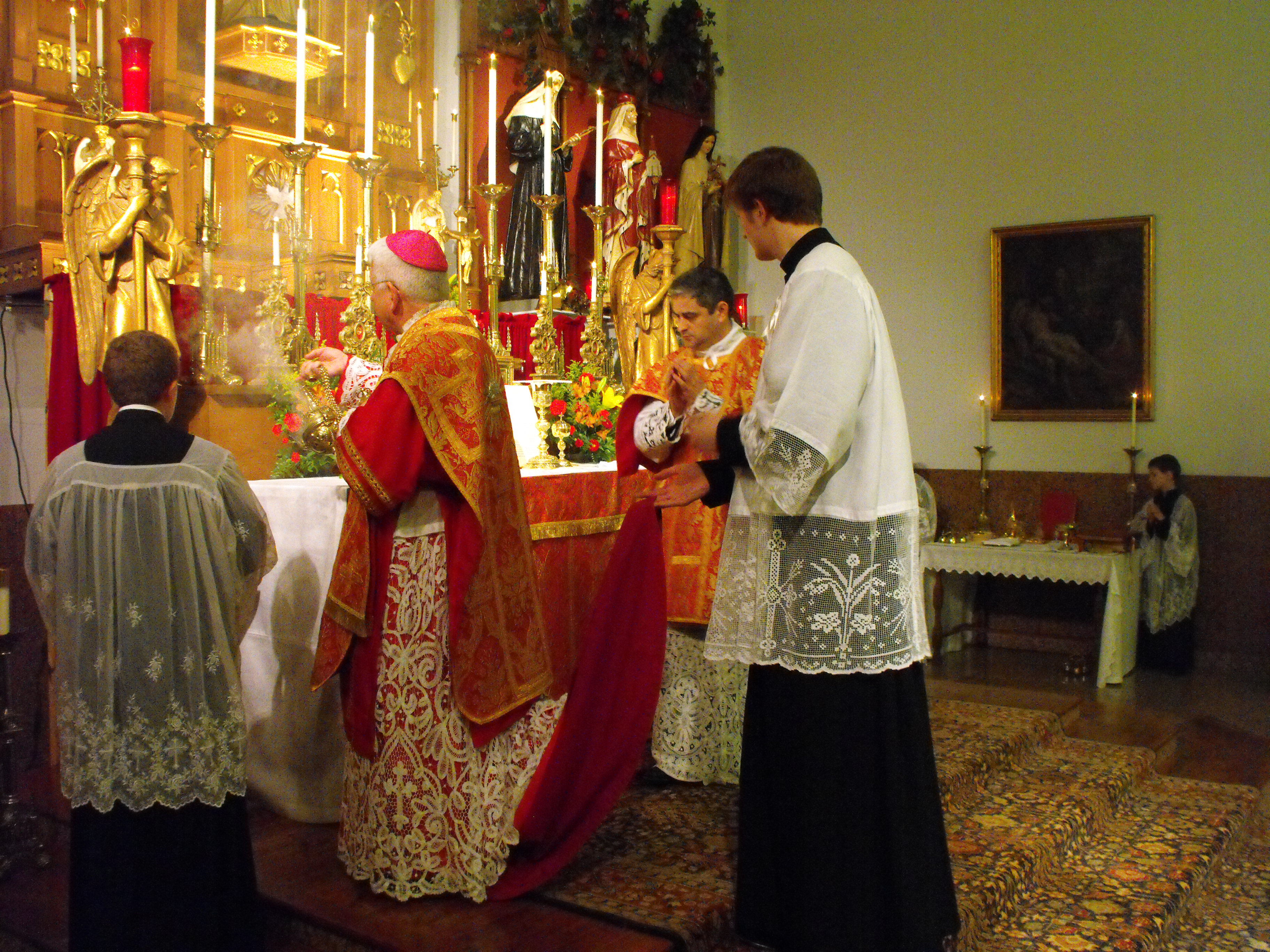
In either case, I will not recycle that familiar "two lung" phrase of a previous Roman ordinary, but will instead leave the reflection that the Greek and Roman liturgies really should be seen as complimentary. The Roman rite presumes the presence of God, the Greek underscores it. The Roman rite basks in the truths of Christ, whereas the Greek rite explicitly states them three times a piece.

Pray for my friend, that she may see the light!

Monday, July 27, 2015

Roman Feasts

Interior of St. Lawrence by Francesco Diofebi
source: schwarzgallery.com
Each rite and usage has its own peculiar and particular feasts which characterize the diocese of that rite's origin, be it Greek, Latin, or Assyrian. The Greeks have their feasts, like "Mid-Pentecost" and the "Protection of the Theotokos." We Latins have a number, too, many of which are coming up next month.

The month begins with St. Peter in Chains, recalling the chains that held St. Peter while he was imprisoned under Herod and Nero, the Jewish and Gentile persecutors of the Church, as well as the cardinatial church that holds two links of those chains. Pope Julius II's tomb, bearing Michelangelo's Moses, resides in this church. The Greeks have a feast commemorating the chains in January, but Rome possesses the actual church with these relics. Rome held a unique place among the churches of Christendom in that it could claim the two foremost Apostles of Christ as its fathers in faith, prompting the city to do its best to multiply their presence throughout the seven hills for stational liturgies.

Next is the feast of the Dedication of Our Lady of the Snows—the "Liberian basilica" of St. Mary Major. The Constantinian basilicas of Rome were dedicated to Our Lord (Lateran cathedral) and Ss. Peter & Paul, but the Virgin had no church dedicated to her. Snow began to fall over one rectangular space in the city, which St. Liberius took as a sign. The saintly pope began construction on the basilica, which is the Roman stational church for the Nativity of Christ and Pascha.

Lastly, Rome enjoys a vigil and an octave for St. Lawrence, the deacon of Rome who teased his torturers and entered eternal life with true Christian joy (I imagine that were he a martyr, St. Philip Neri would have died in a similar manner). His octave and vigil remind us that prior to Pius XII, the local church occupied a place of liturgical prominence: a Double of the First Class with an octave was observed for both the dedication of a parish and its patron saint. St. Lawrence enjoyed a similar place as a foundational saint for the spirit of the Roman church. When the popes wore the maniple on their left arms, it always bore gold and red thread. Gold for the joy of the Byzantine Church, red for the martyrs of the Roman Church.

In the Apostle Peter, the Roman Church recalls the place given to her by the Prince of the Apostles. In the miracle of Our Lady, she recalls that Our Lady laid the cornerstone of her own enduring presence in the Eternal City. In St. Lawrence, she recalls her happy witness to Christ. These feasts do not celebrate Biblical events nor do they teach theological lessons. These feasts are acts of worshipping God for God's own sake, for thanking Him for counting the saints as the closest intimates of the city of Rome, for showing gratitude for His continuing presence in the Roman Church. August, as much as June 29, is an appropriate time to sing O felix Roma.

Wednesday, April 15, 2015

Paschaltide Musings: John 20


The following beginning verses from chapter 20 of St. John's gospel were read during the octave last week at Mass and the Office. I attended the Divine Liturgy for Monday of Bright Week. The pericopes there, the priest explained, already anticipate the mission of the Church and the coming of the Holy Spirit. Indeed, the Byzantine tradition has a unique focus on the Trinity and the Holy Spirit which is not found in the Roman Church. The Roman rite, solidified in its fundamental elements when the fluid Byzantine Church was the battle ground of heresies, glosses over many of the matters concerning the Godhead mentioned in the Greek liturgy. Instead, the Roman liturgy is very Christ-centered, centered on Christ as God and as Man. This Scriptural pericope is quite fitting for the Roman tradition:

"And on the first day of the week, Mary Magdalen cometh early, when it was yet dark, unto the sepulchre; and she saw the stone taken away from the sepulchre. She ran, therefore, and cometh to Simon Peter, and to the other disciple whom Jesus loved, and saith to them: They have taken away the Lord out of the sepulchre, and we know not where they have laid him. Peter therefore went out, and that other disciple, and they came to the sepulchre. And they both ran together, and that other disciple did outrun Peter, and came first to the sepulchre. And when he stooped down, he saw the linen cloths lying; but yet he went not in. Then cometh Simon Peter, following him, and went into the sepulchre, and saw the linen cloths lying, And the napkin that had been about his head, not lying with the linen cloths, but apart, wrapped up into one place. Then that other disciple also went in, who came first to the sepulchre: and he saw, and believed. For as yet they knew not the scripture, that he must rise again from the dead."

At face value, the Evangelist recounts the startling news given to the Apostles that the tomb in which Jesus once laid was now empty and that "they believed." What did they believe? Nothing that we would recognize, at least not yet. Before the descent of the Holy Spirit, the Apostles were faithful and foolish friends, quick to sing the Lord's praises and endear themselves to Him, but not entirely sure why. One thinks of them squabbling over who would have a place of honor in the kingdom of heaven. Even after the Resurrection they seem no better off that before, asking at the Ascension if Christ would finally become the terrestrial and material Messiah for which the Jews longed, one who would free them from Roman oppression and begin a tangible reign of the kingdom of God on earth. When John says "they believed," we are not unfair to ask "What did they believe?"

Living two thousand years later, we enjoy the wisdom of the Fathers, the teachings of the popes, bishops, and their convened councils, as well as the accumulation of centuries of common sense. We know that miracles were outward acts of mercy on the part of Our Lord to point people to His Divinity, to draw people to His teachings and His words. Peter and the rest might have understood the miracles to have shown His favor with God, but not that He was God. Peter's confession of faith was that Jesus was the "Christ, the Son of the living God." None of the brethren understood that He was God made Man or that He must rise from the dead, as the last verse of the Johannine passage reveals. 

It would not be unlikely that Peter and the other apostle, likely John, saw the empty tomb, which had been guarded by soldiers from the Sanhedrin's forces, and presumed an assumption of Christ's body into heaven like that of Elijah when he was alive and possibly Moses after his death. Christ may, to them, have been the greatest and most amazing of all the prophets, those witnesses to God. Yet what could Jesus have accomplished as a prophet, a man, who worked miracles, died a gruesome death at the hands of his own people, and was then bodily removed from the earth? They "believed" without understanding what they believed because they could not possibly know without seeing Him and touching Him that He was God and that, unlike the miracles of prophets of old, He rose from the dead without the prayers of another man. Later, He appeared to the Apostles and to Thomas, and there He revealed His divinity most explicitly.

This is the Catholic paradigm of God. God is Who He is ("I am Who I am" is His name in Hebrew) regardless of what we want God to be. We encounter Him and He tells us about Himself if we listen. We can know about God by reason. We cannot know Him intimately without knowing Him as a person though. "The Lord is God and has revealed Himself to us" from Byzantine Mattins always seemed plain to me until I considered that it was an adaptation to refer to the "Lord" God as a master, a personhood Who comes before creatures of far lesser capacity to understand and tells us what we need to know about Him. This is the Incarnation! This is the purpose of the great condescension! Without this great consideration we demote Christ and the faith to an intellectual proposition, not what "faith" is—a word that shares a Latin root with the same word that means "loyalty." Peter had not understanding, but when he saw the empty tomb his loyalty returned and prepared him to meet his master, risen from the dead.

Friday, February 27, 2015

Blessed Are They Who Hear the Word of God

source: newliturgicalmovement.org

Never has the Word of God been more discussed than in the last two centuries. Vatican II's Dei Verbum is an entire document on interpreting it. Protestantism is an entire religion founded on most of it. Nineteenth century German biblical scholarship assured us it was mostly second century bosh while late twentieth century scholarship has shown it originated frighteningly proximate to Christ and the Apostles. The average American household owns four copies of it. Never before has it been more read, more discussed, and less heard.

Our modern relationship with Scripture is abecedarian. A layman sits at his reading desk or cozies himself in his arm chair in quiet repose, opens his Ignatius Study Bible to whatever section of the Johannine gospel looks interesting, and reads while imagining the events described, as though he is the woman at the well. Could anything be more Ignatian? Could anything be more modern? Could anything be more removed from how our fathers in the faith interfaced with the Word of God?

The dispute over the place of liturgical theology and the value of the pre-20th century Roman rite—the real thing, I call it—is closely related to a long lost dispute over the place of Scripture in the liturgy. The Byzantine rite long replaced most of the Scriptural portions of the liturgy with hymns and symbolic gestures, although readings of substance remain at Vespers for great feasts and the pre-Sanctified weekday rites of Great Lent. The un-reformed Roman rite retained the place of Scripture from ancient times, although some abbreviations took place, such as the reduction of the psalm verses in the introit. Holy Writ narrated the Mass and the Office. The liturgy was how people encountered what we call the Bible. Liturgical worship outside the Eucharistic sacrifice culminated in the reading of the words of Christ by the herald of the Gospel, the deacon, from a lecturn or ambo in the midst of those destined to hear it. In the Roman rite this singing of Christ's words took place in medio choro, in the Greek rite from an enormous stone ambo in the center of the Hagia Sophia.

In neither of these settings was the place of proclamation a rival or equal to the altar of sacrifice that so much heterodox architecture now presents it to be. The Gospel was sung from a prominent place amid the congregation. The Eucharist is offered from the most prominent point, somewhat veiled, and removed from the congregation until Holy Communion. The Word anticipates the Sacrament as it did for the Israelites in the desert of Egypt.

source: lamprotes1 on YouTube

The Gospel was sung either in vernacular or in a mostly intelligible language proximate to the common tongue. Slavonic is near enough to most Slavic languages as is Latin to French and Italian. If not directly understood, the gospel readings would be comprehended to some degree and decorated with some ornament of mystery. A few oddities did and do exist, like Classical Arabic, which is far removed from vernacular Arabic. We Anglophonic men also seem to have been born outside of the Lord's good liturgical graces, condemned to a bastard Germanic language well removed from the tongues of liturgy.

Above all the reading of the Gospel was the greatest encounter with the spoken word of God a human being would have. God the Holy Spirit spoke by the prophets and Christ spoke to the Apostles His commandments. Christ wrote nothing, but He did say, "Blessed are they who hear the word of God and who keep it." The extravagant actions of the Greek rite and the Scriptural narration of the Office and fore-Mass in the Roman rite climaxed with the solemn speaking of God-made-Man. The words of Christ and the actions of Christ are renewed in the presence of the faithful for their edification and holiness. Previous generations, enriched in their poverty of electronic entertainment and television, understood that anticipation and fulfillment meet the imagination's ideas about God. Gestures, actions, and words together synthesize into a taxis which follows the plan of Revelation: the anticipation of the prophets and the fulfillment of Christ.

The marriage of Protestantism and book-printing changed the purpose of the word of God in people's minds. What was something sacred and removed became a pocket-size product for individual interpretation and personal consumption. A Romanian friend once confided that his mother had never heard of a Bible before she came to America: "Oh yes, we have the prophets and the gospels, but not everything bound up in one nifty package." St. Augustine recalls in his Confessions that when the child said "Take and read" he picked up the letters of St. Paul, not the Revised Standard Version. There is nothing wrong reading the Scriptures on one's own outside a liturgical setting for knowledge or spiritual meditation, but who will deny that generally the accessibility of the words of God has resulted in a decline of reverence for those words. God's word has become my Bible. Some well meaning but very lost celebrants of the Pauline spoken Mass try too hard to imbue rediscovered significance in the spoken Gospel by "proclaiming" the "Good news" in theatrical voices punctuated by long, awkward pauses and eye-piercing stares at the congregation. Father, you are trying too hard. The religion founded on [most of] the Bible has reduced the Bible's gravitas. Combined with emotionally and intellectually dulling forms of entertainment like television, the abecedarian approach to Scripture given to us by the Protestants has removed our awe in encountering and keeping the Word of God when we hear it.

In spite of these losses, hope is not gone. Even in the reformed rites of Holy Week ('62 or Pauline) people find the non-Sacramental gestures and readings powerful. People attend these rites for these ceremonies and readings almost exclusively. Were Thursday of Holy Week just a Mass, how many would attend? Most go because of what makes it unique: the reading of the Mandatum periscope and the washing of the feet. The same is true for the singing of the Passion and the adoration of the Cross on Good Friday as well as the blessing of the fire and the prophecies on Holy Saturday. They are going to find Christ in His words and actions, something previous Catholics were able to see more regularly than we can, who Platonically peer into the water which reflects the Sun those before us saw so brilliantly.
 
source: the Pit
 

Sunday, February 8, 2015

When Did They Become Orthodox?


"I believe in one, holy, catholic, and apostolic Church" nearly all Christians who claim any sort of apostolic origin recite on Sundays. Among them are the various kinds of Orthodox Christians of the Eastern Churches. One friend, a Russian Jew born in Orthodoxy who left after falling victim to ethnocentrism, could not quite understand why they said that they believe in the "catholic" Church while not being Catholic. But they do believe they are the Catholic Church, and Orthodox, too.

The birth of "Orthodoxy" and the "Orthodox Church" is one of the minor mysteries in religious linguistics probably worthy of some level of study. The Church of Constantinople—as the Church of Rome, and the Church of Alexandria, and the Church of Aberdeen—believed itself to possess those four marks of the Church and hence to be a part of the Church Christ founded. That Church has gone by a few different names in its two thousand year history, but only a few. St. Ignatius of Antioch wrote in his letter to the Smyrnaeans 
"Where ever the bishop is let the multitude of the people be, as where there is Jesus Christ there is the Catholic Church." 
That phrase, Catholic Church, went on the shelf for the better part of the next few centuries, only coming off when the concept of "Christian" was no longer sufficient to distinguish the true Church from the odd sects engendered by heterodox thinkers or gnostic divines. "Christian," meaning "little Christs"—itself meaning "little anointed ones," a strong indication of Confirmation—by the fourth century had the same general meaning it has today. Anyone who professes Jesus Christ in some meaningful way is a Christian. Those who professed the true faith claimed membership in the "Catholic Church."

"Catholic" lived on in the Creed of Nicaea in the condemnation at the end:
"But those who say 'There was once when he was not,' and 'Before his generation he was not,' and 'He was made out of nothing,' or pretend that the Song of God is of another subsistence or substance, or created or alterable or mutable, the Catholic Church anathematizes."
Christians called the Church Catholic yet they did not always refer to themselves as Catholics. I can recall one occasion when St. Athanasius used the word Catholic substantially to describe individual believers. Most believers contented themselves with the label of Christian except for in the city of Constantinople, which, as the gateway to the east from the west and to west from the east, was the bottleneck of nearly every Christological controversy of the first millennium. Christians there described themselves as "orthodox" or "right worshippers" in contrast to the "heretic," the one who "chooses" to worship God according to his own will. The dialogues of the Greek Fathers crystallized this term in literary style and by the time of St. Theodore the Studite it was an accepted means of self-identification for the Christians of the Byzantine city. As an aside, the Roman Canon does pray for "omnibus orthodoxis.... cultoribus."

"Orthodox" signified an aesthetic, a type of Christian, a Christian who worshipped according to the rites of the Byzantine Church, who bore the scars of the heresies and the scabs of the triumphs that passed through Constantinople, and who adhered uniquely to the theology of the Greek Fathers. John Senior wrote that if philosophy is footnotes on Plato, theology is footnotes on St. Augustine. This phrase holds true only in the West. In the Greek tradition, theology is footnotes on the Cappodocian Fathers. Greek Christians prayed in the Great Entrance "May the Lord Our God remember all you orthodox Christians in His kingdom at all times...." and during the Litany of Fervent Supplication for "our orthodox fathers who here and elsewhere lie asleep in the Lord." While "orthodox" they certainly believed themselves part of the Catholic Church if not the Catholic Church. Then came the fall of Byzantium.


As political as the Roman Church was during the Middle Ages and Baroque era and as institutional as the Roman Church has been since Trent, the Constantinopolitan Church was before 1453 and more. The emperor was God's living representative on earth and the living icon of God the Father before whose image the citizens of Byzantium were to bow in reverence. He could call Councils, kidnap popes, replace the patriarch of his city, and—when he met little resistance—create Church laws that would mold the religious practice of his empire and beyond. Byzantium's triumph in Slavic lands buffered the empire from the west. The disaster of the fourth crusade and the decline of the Byzantine empire polarized Constantinople from "the West" when, hitherto, Constantinople had been more western than any eastern church. In the Palaiologian empire the Greek Church further distanced itself from "the West" during the Hesychast years of St. Gregory Palamas. Theology and liturgy became less communal and more mystical under the influence of Palamas and monastic patriarchs. Symbolism replaced realism in icons which now sat on the curtain around the Holy Place of the Hagia Sophia. Monastic patriarches replaced the organ, choral music, and the old Office with their own chants and psalter. The fall of Constantinople ossified the synthesis of the first millennium Constantinopolitan tradition with the Hesychast monastic movement, the last expression of "orthodox" Christianity.

In the midst of the newfangled Islamic city and without the institutional structures and imperial support the Greek Church previously enjoyed, Christians of Constantinople ceased to identify themselves as the Catholic Church. More troublesome to Greek Christians might have been Rome's unique hold over the title "Catholic Church." All that was left was the way of being Christian that they knew, orthodox. "Holy Orthodoxy" was born. 

One potential pitfall to this argument is that some non-Byzantine Churches of the East that accept the Councils until and excluding Chalcedon are now called "Orthodox." Coptic Christians in my experience are very fervent about the denomination "Orthodox" while Armenians accept the title, but are more content for their church to be known as the "Armenian Apostolic Church." Perhaps the solution to this flaw in my argument lies in the popularity of the term "Orthodox" itself. Could the term have been spread by the Ottoman empire to denote Christians who had nothing to do with the Pope in Rome?

The question is an interesting one and worthy of further study.

Wednesday, December 31, 2014

Silent Anaphora

source: lmschairman.org
I am curious what readers think about the spoken, silent anaphora. I cannot speak for the non-Byzantine oriental rites, but within the Latin and Greek traditions it has become acceptable for the celebrant to pray the anaphora in entirety or part in spoken silence under the sung parts of the congregation. In the Roman rite the Canon was sung by the celebrant in the same tone as the preface, signalling a continuation from the preface (maybe the origin of the Te igitur at the beginning which caused fits for the impious critics of the Canon). At some point in the 9th or 10th century the celebrant began to speak rather than sing the Canon and furthermore commenced it at the start of the Sanctus rather than after. A similar practice arose in Constantinople, perhaps inspired by the Latin habit, in the early second millennium. The celebrant says the pray after the preface dialogue while the people sing the response "It is proper and just" until they are finished, at which point he picks up the pray singing. When I first witnessed this the first words I heard were "six winged, many eyes soaring on their pinyons...." The congregation sings the Holy, Holy, Holy and the celebrant starts the anaphora, again switching from spoken to sung tone when the hymn has ended, usually at "Take, eat, this is my body" etc. The culminating moment of epiclesis cannot be heard over the singing of the "We praise You, we bless You, we give thanks to You, and we pray to You, O Our God." The priest will resume the aloud part at "especially for our most holy, pure...."


Under the influence of restorationist scholarship, many Byzantine Catholic eparchies in the United States have directed priests to sing the entirety of the anaphora, although mercifully the Melkites allow some of the anaphora of St. Basil the Great to be spoken. We all know what happened to the Roman rite in the 1960s. Within the Byzantine context, this writer has never been bothered by either the spoken parts or the practice of singing the anaphora entirely aloud, aside from the length of the anaphora of St Basil (difficult to maintain attention). I know the anaphora of St John Chrysostom and so have never felt excluded on the occasions when I have seen celebrants retain the practice of continuing the prayer in recitation while the congregation sings its responses. In the Roman rite, as with many others, I dislike the practice of an aloud, spoken Canon, although I have heard the Canon sung in the Pauline rite with success. The silent Canon climbs a long peak in a quiet mountain range. The Roman rite, far from the ritual eccentricity of the Byzantine tradition, is highly meditative and textually focused. The silence of the Canon contrasts with the flow of singing and focuses concentration on Christ's work before us. The Greek practice, either of singing in entirety or of switching between the two, creates a pace to the second half of the Divine Liturgy. The Roman rite's silence upholds that tradition's ruminative qualities. In any of these I have never felt excluded because I know the content of the prayers, I know the priest's place, and I know my place as a layman; I am certainly capable of praying with the celebrant in principle, even if not in word. The spoken, aloud practice in the Pauline rite, however, I find quite disengaging. One wonders if celebrants use Eucharistic Prayer II because they know their drowning tongues will only carry attention for so long? 

Always EP2!

The various ways of doing the anaphora in tradition demonstrate the Church's long wisdom as a spiritual psychologist. I wish she would return to her own prescription. What think ye?

Friday, October 31, 2014

The New Mass & "Paschal Mystery"

So what is the deal with traditionalists, the new liturgy, and the "Paschal mystery?" Fr. Zed has recently posted several things that indicate Cardinal Muller and Bishop Bernard Fellay are still talking with some regularity and that hopes for "reconciliation"—whatever that would mean—are not necessarily dashed with Francis' papacy. One commenting reader said on several of these posts that the FSSPX must accept something called "the Paschal mystery" in order to be reconciled. What is the Paschal mystery? 

To the best of my knowledge, Lefebvre's Fraternity does observe the Resurrection on the Sunday after Holy Week. No internet search yields clear results as to what the Paschal mystery is, but it does reveal a few articles from the Fraternity's website and another elsewhere by Fr Peter Scott about the problems of "Paschal mystery" theology in the Pauline Mass. The objection seems to be that the "Paschal mystery" is too focused on God's love and kindness, too little how offended He is by sin and demanding of propitiatory sacrifice to placate Him. The last part of this is a very sore spot for traditionalists whose view of tradition narrowly corresponds 19th and early 20th century Catholicism. Session 22 of Trent was crystal clear that the Mass is a propitiatory sacrifice for the living and the dead. People do seem to forget why. If the Mass is an anamnesis of Calvary, the same sacrifice of the Cross is the sacrifice of the Mass. It was a sacrifice for our sins which is made present again on numerous altars throughout the world daily. Calvary was an act of love. We are not Puritans who are aroused by the likes of Jonathan Edwards' Sinners in the Hand of an Angry God, a God so offended by sin that He dangles over the fires of hell as a spider dangles from his thread. The reduction of God's hatred of sin to a debt repayment alone, ignoring the proactive love of God the Father, gives one the impression that God is infinitely offended, that we have an enormous debt to pay, and that Jesus was the only one who could pay it. Why is the need to make reparation to the Father and to do penance in contradiction to God's love? Why are the two exclusive to each other? While certain prayers of the Mass do emphasize propitiation (the Roman offertory, the Placeat tibi at the end of Mass), a greater number of the orations emphasize love, teaching, and forgiveness. Liturgically, the Church's mind is that the two are inseparable, neither contradictory nor separate things.


The Eastern rites are far more Paschal than the Latin rites. In the Byzantine tradition, the troparion and kantikon on most Sundays is about the Resurrection. During the equivalent of the Preface, the celebrant says "You brought us from nothingness into being, and when we had fallen raised us up again, and left nothing undone until You brought us to heaven and granted us Your future kingdom." The nearest thing to propitiation in the Greek tradition might be "We offer You Your own from what is Your own, from all and for the sake of all." If we are to apply St. Vincent of Lerins' test that for something to be a teaching of the Church it must be believed always, everywhere, and by everyone, the idea of the Eucharist as an exclusively, or even primarily, act of propitiatory satisfaction fails. Canons I and III of Trent, session 22, condemn the idea that the Mass is a human act of praise that does not have sacrificial value to God, which is absolutely heresy. To limit our understanding to a condemnation though is narrow if not dangerous.

Again, not knowing much about the "New Theology" in vogue during the Pius XII and Paul VI years, I cannot comment of the "Paschal mystery," but as a Catholic I can say something about the exclusion of love from the focus of the liturgy. Perhaps this "Paschal mystery" idea was a Trojan horse to water down the sacrificial aspects of the Roman Mass and the inconvenient difficulties of judgment, sin, and hell. If so, commentators should write with more perspective.

Saturday, October 11, 2014

Medieval Rome: Forgotten Glory?

Ancient Rome was the capital of the known and civilized world. Edward Gibbon's Decline and Fall of the Roman Empire recalls the power and honor due to the City at the height of her Imperial powers:
"In the second century of the Christian era, the Empire of Rome comprehended the fairest part of the earth, and the most civilised portion of mankind. The frontiers of that extensive monarchy were guarded by ancient renown and disciplined valour. The gentle but powerful influence of laws and manners had gradually cemented the union of the provinces. Their peaceful inhabitants enjoyed and abused the advantages of wealth and luxury. The image of a free constitution was preserved with decent reverence: the Roman senate appeared to possess the sovereign authority, and devolved on the emperors all the executive powers of government. During a happy period of more than fourscore years, the public administration was conducted by the virtue and abilities of Nerva, Trajan, Hadrian, and the two Antonines. It is the design of this, and of the two succeeding chapters, to describe the prosperous condition of their empire; and afterwards, from the death of Marcus Antoninus, to deduce the most important circumstances of its decline and fall; a revolution which will ever be remembered, and is still felt by the nations of the earth."
Gibbon was quite gifted with adjectives. In the modern day, scholars and tourists alike remember and glorify Renaissance and baroque Rome for its humanism, its revival of painting and sculpture, its place at the center of emerging nationalistic politics, and for its romantic ambiance. This is the Rome of Bernini, Michelangelo, Sixtus V, and Urban VIII. One would think Rome was a city in eternal strife, earmarked at opposite of its history with two periods of adroit artistic and political vibrancy. The understanding of Rome is natural, intuitive, grounded in artistic history and a deep appreciation for the ancient City. It is also completely and utterly wrong.

Rome, aside from these two epochs, also enjoyed a period of religious revival, prosperity, and recovery of self-identity during the high Middle Ages. Renaissance Rome sprung forth from the fountainhead of medieval Rome, not from a vacuum of dark illiteracy and religious ignorance.

Rome entered a truly dark age after the sackings and raids of the fifth century, the abandonment by the Byzantine empire, and the waves of plague which sent most of the still-living populace into the countryside. Rule of the city devolved to the Pope, known until Pius IX as the "Lord Pope," a title used even within the Magna Carta. A form of Senate continued to run the daily, micro-level affairs of the City and the old families held some level of authority, but the Popes' spiritual and administrative power over the churches meant that the Bishop of Rome was the Lord of Rome. Unfortunately, [St] Leo III crowned Charlemagne and the various families of Italy sought the papacy so they could play king-maker and live off papal beneficences. In the 9th century, the Mohammadans sacked Rome and ravaged St. Peter's Basilica. The papacy entered its absolute nadir, when the Bishops of Rome descended from Marozia—mistress of the murderous Pope Sergius III. Indeed, six popes (John XI, John XII, Benedict VII, John XIX, Benedict VIII, and Benedict IX) came from her line, with a few elderly men functioning as placeholders in between, murdered if they lived too long.

Finally, the Gregorian reforms emancipated Rome from central Italian politics and the un-Holy Frankish Clan Holy Roman Empire. What emerged was a Rome revived in continuity with its past, aware of its present, and vivacious in faith.

Ancient peoples were not so introspective and concerned with documenting their own ways as we are today. One is often struck by the absence of ritual descriptions or theological treatises on non-Scholastic during this age. The ancient and medieval Christians expressed what they believed in what they did, not in word alone. They manifested their Roman tradition of faith in their church and secular architecture, as well as in their liturgical and artistic endeavors.

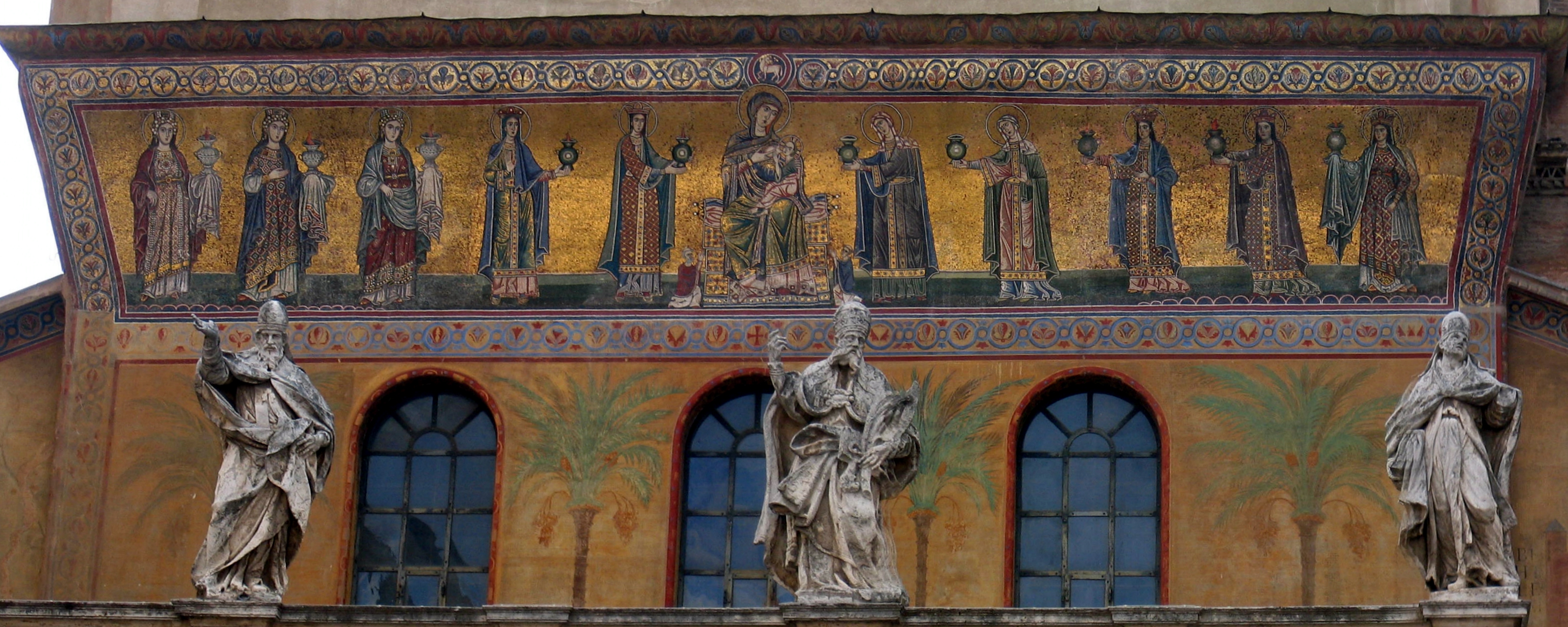
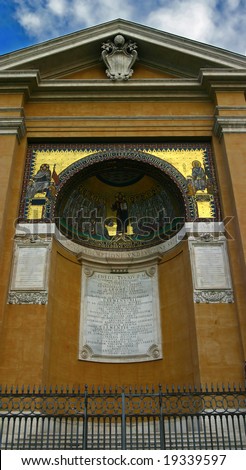
Roman art during the Middle Ages derived from the older Roman mosaic tradition. While the Orthodox Greek tradition had long ago transitioned into painted, "written" icons, less and less realistic in their appearance, the Romans, a people averse to change and innovation in religious matters, kept their mosaic tradition and even imported it into new places. The below mosaic outside of Santa Maria in Trastevere looks quite ancient, but in fact dates to the 12th century.

source: wikipedia
Unlike the Norman French and English, who built their new churches along the soaring vertical lines of gothic pillars and arches, the Roman people conscientiously kept in continuity with their received identity and tradition in all matters, especially architecture.

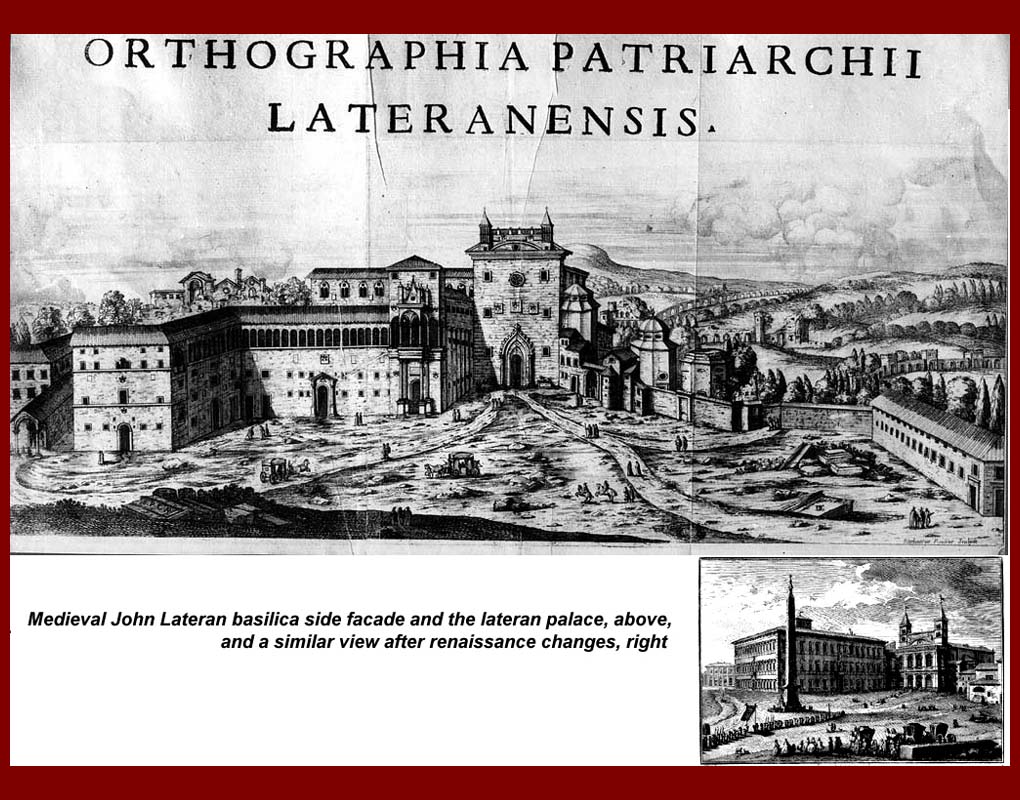
Between 1198 and 1216, one of the great men of the Middle Ages, Lothar Segni, sat atop Peter's chair. Keeping with his own doctrine of the spiritual power's place over the temporal power, he refitted the Lateran palace for the government of the Church and as an example to the world. Sadly, few if any records or reconstructions of the ancient Lateran palace exist for us today. Dante called the Lateran palace a place "above all earthly things." Below are two rare representations of what the palace and adjoining cathedral looked like prior to the tearing down of the palace and the addition of a baroque facade on the Archbasilica.

source: mmdtkw.org

source: augustineofcanterbury.org
These views are from the north, not the front entrance to the cathedral, which is to the east. The Lateran palace, built by the Lateran family and given to the popes by Constantine, encompassed a large courtyard—a feature of Roman palatial architecture imitated with the building of the Apostolic palace adjacent to St. Peter's basilica and the new Lateran palace. Until the 9th century or so, the popes were elected by the people of Rome in the field in front of the cathedral. Often violence would break out and whoever won control of the Lateran complex became pope. This author once recalls reading about a victor having difficulty convincing the mob to spare his opponent's life. Next to the courtyard, at the upper left of the above picture, was the Triclinium of Leo III where Innocent III held the fourth Council of the Lateran. This remarkable hall was torn down, its former foundations replaced by roads. Its apse still stands tall in memorial to its previous function.

source: wikipedia.org

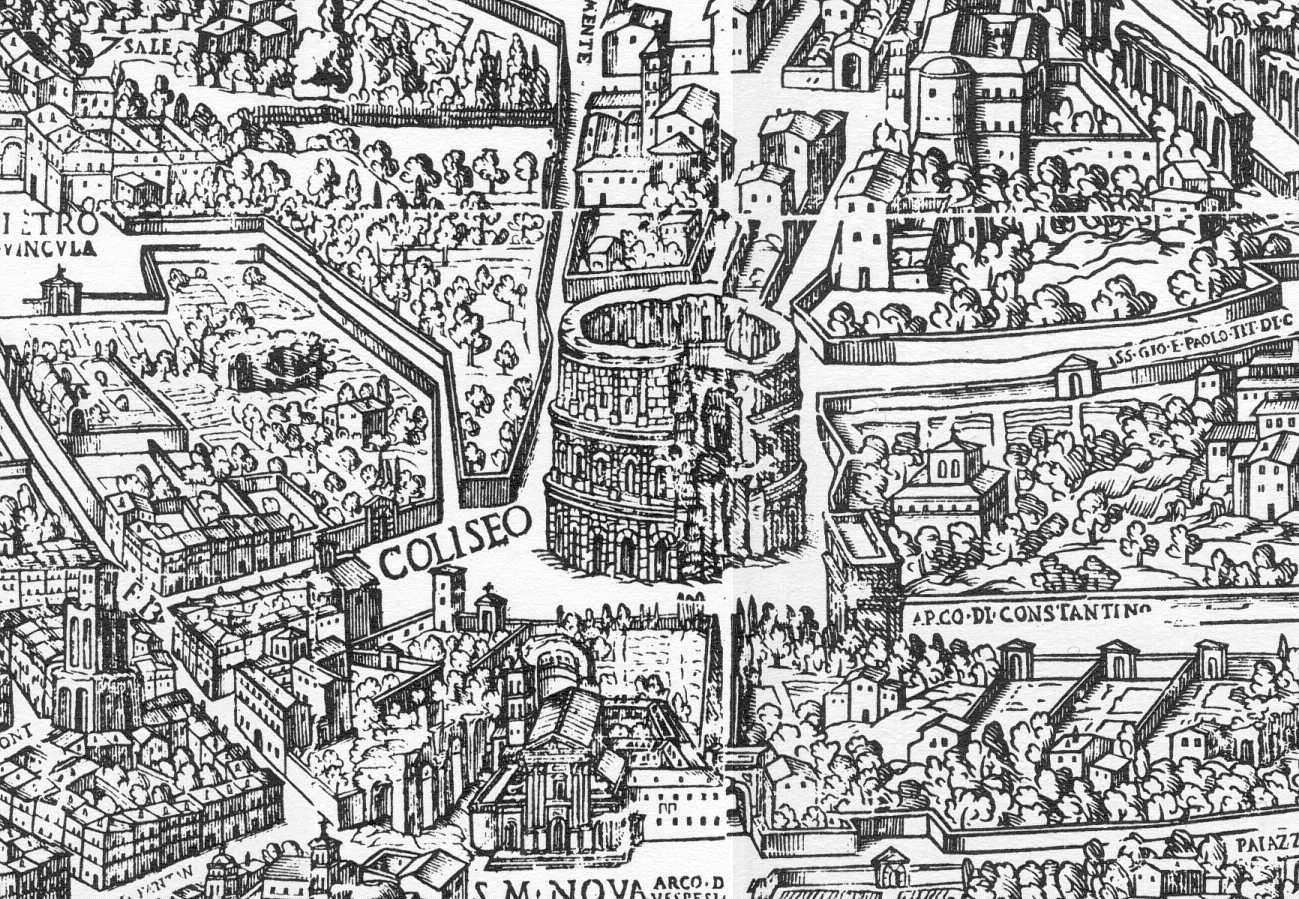
The revival of education in France and trade with the East incited by the Crusades brought Rome back to significance in the intellectual and economic realms, attracting students seeking theological knowledge and merchants looking for middle-points in their routes of trade between the Continent and the Eastern Mediterranean. The Colosseum returned to use after half a millennium of dormancy as an open market and, what we would now call, an industrial park.

The Colosseum during the Middle Ages
source: wikipedia
Above all, the Romans still realized that they were the ancient City that ruled the world and that they were now, without contradiction, the City that ruled the Christian world. As such, Rome revived many of its more catholic Catholic features. The early praxis of reading the lessons of the Mass and Office in both Greek and Latin returned, as did use of the stational churches by the Lord Pope on great feasts. The ancient, un-gallicanized rite of Mass remained in use by the pope one day a year on the feast of St. Peter's Chair in Rome. This ancient use involved numerous deacons and subdeacons, long psalms instead of simple chants, no offertory or silent prayers, a sung Canon, and concelebration. The Lateran and Vatican basilicas also retained the ancient Divine Office, which uses the same orations, antiphons, and psalms as the pre-Pius X Office, but sans introductory rites, no hymns, and a more communal ritual. Moreover, the canons recited the Offices of the Dead, the Blessed Virgin Mary, and of All Saints on ferial days per annum and provided pastoral care to the great many pilgrims. Innocent III himself was a canon of the Petrine basilica before his election and familiar with the observances. These rites remained in use until Franciscan pope Nicholas III squashed everything not done in the Franciscan Order. The Byzantine monastery in Rome also enjoyed a resurgence, with no less that six hundred monks and priests in residence in the 12th and 13th centuries. This also suggests that the Rome-Constantinople schism was not taken as seriously during this period as it would be after 1453. The clergy and people of Rome were the enemies of streamlining. Far from assuming the Church required one way of celebrating Mass, as the capital of Catholicism, they welcomed the catholicity of rites practiced within the City.

Medieval Rome was not the superpower ancient Rome was, nor was it the artistic center baroque Rome would be. But it was once again alive and acting as the center of the Christian world. Perhaps this is why modern historians are unable to see that the period between the Gregorian reform and the Avignon papacy was a glorious one, because they cannot understand how Christianity can be the lifeblood of a people.
Rossellino's proposal for the new St. Peter's basilica
source: studybluecom
Then came the Renaissance. Much would have to be lost and rebuilt because of the neglect of the popes while they lived in Avignon. St. Peter's basilica is particularly flagrant example of the paradigm shift. The roof on the old basilica was wood needed regular replacement, something ignored during those dark French years. As a result, the roof collapsed, fires occasioned the church, as one of the walls warped out by six feet. The basilica, built 1,100 years earlier, was beyond saving. Bernardo Rossellino proposed a new basilica built in the same style and with the same features as the old church, only with longer transepts to accommodate devotions and a longer choir for the new, medieval choir praxis. His proposal was canned by Julius II, who wanted a grand new church to house his tomb. Bramante began the construction of the modern basilica, a significant departure in style and outlook from the previous building. With the new basilica, Pope Julius baptized Rome into the Renaissance and gave precedent for a severe remodeling of many churches of the City along new lines. Rome became a center of baroquerie and its old identity began to fade. Lex supplicandi legem statuat credendi.

The old basilica, along with Cluny and St Paul outside of the Wall, the largest church in the world, is demolished
and covered with the new basilica.
Medieval Rome is gone, but we ought not forget how wonderful a Catholic city it was nor should we neglect its example as a city conscientiously dedicated to God.

Thursday, August 14, 2014

Ascension and Assumption


Fr. Blake has a few interesting observations about the connection between the Ascension of our Lord and the Assumption/Dormition of His mother, the Blessed Virgin Mary. One important thing to add to his thoughts about the icon of the Dormition is the size of Mary in the Byzantine representation. Here we see Mary, having died in Jerusalem, surrounded by the Apostles (as recorded by St. Dionysius the pseudo-Areopagite and St. John of Damascus), being take in soul by Christ while her body temporarily remains on earth, only assumed into heaven after it was sealed in the tomb. In iconographic depictions Mary is almost never shown apart from Christ. Commonly icons depict the Virgin holding young Jesus, wrapped in clothing that shapes the painted (or "written" to use the Greek term) Son of God as a peanut. Regardless of whether the young Christ is written as an infant or as an older child, as is often the case in the apse of Byzantine churches, the Lord is always in front of the Virgin. The Virgin shows us the Lord, Who is due glory in His own right. All honor of Mary descends through him (the opposite of the co-Redemptrix?), 

The Dormition icon reverses this. Mary, although fully grown at the time of her death, is now the size of an infant and shown in the same peanut-like shape as the infant Jesus of the Nativity icon. Christ holds His mother in front of Himself for the faithful to see.

Here the iconographic tradition shows the spiritual realm. Icons spiritually interpret God's action in the physical world. But, as Fr. Blake asserts, there are two planes of reality in this icon: what the Apostles saw, Mary deceased and heralded by angelic song, and the spiritual realm, the taking of her soul into heaven by her Divine Son. In the physical realm Mary was larger than Christ probably for 10 or 12 years and not much smaller for the next 20. In the spiritual realm the Blessed Mother is "more honorably than the cherubim and more glorious beyond compare than the seraphim," but menial compared to God-made-Man, Christ. Mary, great as she was and is among Man, is still small in contrast to the One Who made her. With the Assumption of the Virgin, the Divine plan for the Incarnation is now complete.

The Dormition fittingly marks the end of the liturgical year in the Byzantine rite. The year re-starts on September 8th, the feast of Mary's Nativity.

Sunday, June 8, 2014

Liturgical Theology of Pentecost

source: oca.org
Pentecost is too big, too vast, too intimidating for any singular explanation, but the Roman liturgy's rich vigil for this feast nurtures the faithful with some food for thought. Let us consider the liturgy of the Roman rite for this great feast, second only to the Sunday of the Resurrection in importance.

source: traditionalmass.org
The vigil commences with the celebrant—vested in a violet chasuble—kissing the altar and following the lectors, who read six prophecies from the Old Testament, interspersed with collects sung by the celebrant. The first lesson is the familiar story of Abraham ascending a mountain with his son Isaac, prepared to sacrifice his only child in obedience to God. An angel intervenes and tells a relieved Abraham that God would never really do such a thing. All of this was proclaimed on Holy Saturday, prefiguring Christ's willingness to sacrifice everything to the Father on behalf of the world. Pentecost enters this passage late at the point when God rewards Abraham's fidelity by promising "I will bless thee and multiply thy seed as the stars of heaven, and as the sand that is by the seashore.... and in thy seed all the nations of the earth shall be blessed because thou hast obeyed My voice."

The second prophecy is an extraction from Exodus 14, wherein the Pharaoh's forces chase the Israelites through the desert and into the Red Sea, which St. Moses has just parted by the Lord's command. The Lord then tells Moses to close the Sea and drown the Egyptians, which he does. The tract continues the passage:
"Let us sing to the Lord, for He is gloriously magnified: the horse and the rider He hath thrown into the sea: He is become my helper and protector unto salvation...."
These two prophecies speak of the same thing, Baptism. Water is a symbol of creation and the essential ingredient of all that lives. Yet water is also uncertain, difficult to control. Genesis chapter 1 speaks of water roaming the earth before it had form. God used water to protect the Israelites from the Egyptians. Egypt itself is a type, a parallel, an example of sin and loss and here God saves His people—fulfilled and most perfectly expressed in the Church—through water. Through water He will "multiply thy seed as the stars of heaven," only He will no longer multiply Abraham's progeny through obedience, but Christ's Church through Sacrament. The second collect of the vigil demands this interpretation:
"O God, who by the light of the New Testament hast made clear to us the miracles wrought in earliest times, prefiguring unto us the Red Sea as an image of the sacred font, and Who in the deliverance of Thy people from the bondage of Egypt, hast foreshadowed the sacraments of the Christian dispensation; grant that all nations who have merited by faith the privilege of the children of Israel, may be born again by partaking of Thy holy Spirit."
The third prophecy, take from Deuteronomy 31, compares and contrasts closely with the Ascension of Christ. Moses, nearing death, has taken care to write down his encounters and history with God. He abjures and confronts his fellows Israelites for their infidelity to God, "For I know that, after my death, you will do wickedly, and will quickly turn aside from the way that I have commanded you." The scripture, excluded from this passage, goes on to tell us that his bones were never found. This is extraordinary. Moses joins Elijah, Enoch, and the Blessed Mother among those whose bones have not been found and the others were taken bodily by the Lord, Elijah in a chariot of fire and our Lady after her death in Jerusalem. Moses, a prefigurement of Christ who leads God's people out of bondage, many believe, Jews included, was also taken up by God. Should he have been assumed by God then an strong parallel with the Ascension presents itself. Christ of course was not assumed into heaven, but rather ascended through His own power as God. Moses brought people forth from human bondage and Christ from spiritual bondage. Both died and were raised, so to speak, and rebuked their followers for their lack of faith. Moses's followers would continue to fail God, even if they would eventually reach the promised land and create a kingdom of Israel. Christ, in a marked contrast, promises something perfect that will never be lost, a "Helper" (meaning of the word Paraclete) to preserve the faithful "in all truth." He ascends telling the Apostles to "baptize all nations in the name of the Father and of the Son and of the Holy Ghost.... For I am with you always, even until the end of the world." Moses's deliverance from slavery is made perfect in Christ's words.

The fourth prophecy again anticipates the inception of the Church in the Baptism of its members, "the Lord shall wash away the filth of the daughters of Sion, and shall wash away the blood of Jerusalem out of the midst thereof, by the spirit of judgment, and by the spirit of burning" (Isaiah chapter 4). At this point perhaps the faithful should consider what Baptism is. It is the movement of water over a person's skin with a Trinitarian formula, yes, but it is so much more, too. "Baptism" derives from a similar Greek word meaning "to immerse" or "to plunge." To be "plunged" into Christ and in the name of the Trinity is more than to enter a visible community or lose a sentence of punishments condine to one's sins. To be "plunged" into Christ is to be immersed and filled with the very life of Christ given by the Holy Spirit, Who, St. Gregory reminds the Church of Rome during Mattins of the feast, is the love of God Himself. The Holy Spirit, to be simplistic, is God's love working and doing something, creating or renewing. The Holy Spirit accomplishes this rebirth in Baptism through water, the physical essential in life and the material, again referencing Genesis chapter 1, which formlessly covered the earth before creation. Water is also like the Holy Spirit, or "Holy Wind" to take a very literal translation, in that water is not easily contained, limited, narrowed, or defined. It enters through crevices unseen and can also be lost by poor care through other unanticipated openings. It is this in water that Christ, through the Holy Spirit, renews His creation. It is for this reason so many commentators have adduced the psalm from the Vidi aquam "I saw water flowing from the right side of the Temple, alleluia; and all to whom this water came were saved...." Therefore the Church uses as her last prophecy in the vigil Ezekiel 37:1-14:
"Thus saith the Lord God, Come, spirit, from the four winds, and blow upon these slain, and let them live again. And I prophesied as He had commanded me; and the spirit came unto them; and they lived; and they stood upon their feet, an exceeding great army.... Thus saith the Lord, I will open your graves, and will bring you out of your sepulchres, O My people, and will bring you into the land of Israel.... and you shall have put My spirit in you, and you shall live, and I shall make you rest upon your own land; saith the Lord almighty."
source: traditionalmass.org
A procession then brings the sacred ministers to the baptistry where the font's waters are again blessed and infused with chrism, itself a priestly thing, as on Holy Saturday. The Paschal candle, extinguished on Ascension Thursday after the Gospel, reappears. Let not the importance of its reappearance be lost. As Dr. Laurence Hemming adumbrates in his Worship as Revelation, all the fires in a church are to be lit from the Paschal fire much as the Presence of Christ in the Sacraments comes from Christ's Incarnation and work on earth. The Paschal candle is extinguished at the end of forty days because, as with Christ and the Sacraments, its purpose, to diffuse holy fire, is accomplished. The fire remains without the candle's use just as Christ remains in the Church without a bodily physical presence. The candle returns because it symbolizes the Resurrection, the event which made this new life in the Holy Spirit possible. The celebrant plunges the candle into the font, almost baptizing the font with the candle rather the other way around. The celebrant sparges the faithful with the blessed water, infuses the chrism, and baptizes catechumens into Christ and His Resurrection. More adept parishes will also have the good sense to administer confirmation at this time, giving the neophytes the Holy Spirit and His "sevenfold gifts."

After the baptisms all who have been "baptized into Christ" on earth sing the Litanies of Saints, imploring the intercession of those in heaven who are the perfection of God's promise to Abraham, "multipl[ied] as stars of heaven." The saints, together with those on earth baptized into Christ, form the Church and carry that same Spirit and fire found on Holy Saturday. Pentecost makes the Resurrection permanent on earth, preserved in the Church unto ages of ages.

source: traditionalmass.org
Mass follows immediately during the vigil. The lesson, taken from Acts of the Apostles, recounts Paul's preaching of the Baptism of Christ, or into Christ, to the Ephesians, hitherto only aware of St. John the Baptist's baptism of repentance. The alleluia is the same as on Holy Saturday. And in the Gospel St. John tells of Jesus saying "If you love me, keep my commandments." What is the Holy Spirit other than the strength to do this? This simple, demanding sentence of Christ calls to mind James 2:18, "I will show you my faith by my works." The Holy Spirit creates, re-creates, renews, strengthens, and preserves the Church in Christ, of Christ, and for Christ, as foretold to the prophets long ago. He makes all things anew, fashioning a new, holier creation out of the materials and persons of the existing, fallen creation. And He will remain with us until the very end.

In a rare moment the Byzantine tradition has a far simpler and more understated take than the Roman Church. The Greek theology of this feast can be found in the troparion of Penteost, which I heard today at Divine Liturgy and last evening at Vespers:
"Blessed are You, O Christ our God, You have filled the fishermen with wisdom by sending down the Holy Spirit upon them, and Who through them have caught in Your net the whole world. O Lover of mankind, glory to You!"

And who can turn down a chance to listen to Veni Creator Spiritus?