Showing posts with label icons. Show all posts

Saturday, February 25, 2017

Saint Thomas & Scholasticism, a Legacy of Orthodox Christianity


Underneath the glow of candles lit before icons of the Pantokrator and the Theotokos and the sweet scent of incense a current runs in Greek Christianity that says "We have never changed or thought about anything, ever." One deacon told a very confused congregation "We don't write things down, we just do what the people before us did," a remark which only further befuddled the befuddled. Any contrast with Latin Christianity draws buzz words like "legalism", "Aristotle", "juridical", "original", "mystical", "pastoral", and "the Fathers". What the faithful do not often hear is that Scholasticism and the forces behind it are as much or more integral to Orthodox Christianity than the writings of St. Symeon the New Theologian or Palamas.

A "Scholastic" is a "school man", a variation of the word schola, school in Latin. Schools were not centers of textbook reading, flag saluting, and learning how not to offend men in dresses in prior ages. A schola, East and West, was a center of instruction through dialogue and disputation, a system of purely Greek invention, one founded on Socrates' smart aleck ways and more coherently developed in the Dialogues of his student, Plato. Dialogue proved a useful oral tool in directing conversation to concentrate on crystallizing certain points of inquiry, in finding the finer points of a thing; similarly, dialogue was a useful written tool in answering objections as a point developed and in keeping the reader's interest rather than lugubriously lecturing him like a hipster, post-modern bore. Even when Plato waned in popularity his teaching methods remained in vogue in Orthodox and Latin culture until the end of the Middle Ages.

For as much grief as modern Orthodox writers give Augustine for his reliance on Plato and the Doctor Angelicus for his extensive use of Aristotle, Greek Christian history is plentiful with more notable example of applying the language of popular philosophy to contemporary theology and binding it upon future generations. The definition of a matter of theology in the language of philosophy is not a wholesale baptism of whatever that particular Greek said, merely that certain concepts were found useful to explain a certain elements of Christian truth for all time. In defense of ICEL's caterwauling over the translation of "consubstantial" in the Nicene-Constantinopolitan Creed, the idea of substance very much belongs to Greek philosophy and not to any familiar thought in the last few centuries. Far from excusing our ignorance of "substance"—or prosopon in the case of Trinitarian theology—the Church is obligated to teach us about God using these very fitting terms. 

Similarly, the "legalistic" and exacting approach of Aquinas and the Schoolmen survives today only in courtrooms, yet for centuries was the acceptable means of settling a matter. When Leo III, Leo V, and Michael III stripped the holy images from the churches of Constantinople and rendered the Hagia Sophia as barren and dull as a Dallas church, Saint John of Damascus did not throw up his hands in objection and exclaim "We've always venerated icons! But why is a mystery, so let us do it and not discuss it!" In his third treatise against the iconoclasts, John taxonomizes numerous levels of veneration and their related sub-types:
  1. Veneration due to God, of which there are
    1. Worship
    2. Wonderment
    3. Gratitude
    4. Petition
    5. Repentance
      1. Repentance out of love
      2. Repentance out of fear for loss of love
      3. Repentance out of fear for punishment
  2. Veneration of persons or things through which God has worked
  3. Veneration due to things dedicated to God
  4. Veneration of types of God
  5. Veneration of God in other human beings
  6. Veneration of authority that comes from God
  7. Veneration of benefactors
In a like manner, Saint John examines specific ways in which something can be an image:
  1. A natural image, like God the Son is an image of God the Father
  2. A prophetic image of what is to come
  3. An imitation
  4. A Scriptural type
  5. A type of an event
  6. A memory
After a resurgence of iconoclasm in his own time, Saint Theodore the Studite got in touch with his inner-Plato and wrote a lengthy dialogue pitting the "Orthodox" against the hopeless "Heretic". Contemporaries would have read the names as the "True Worshiper" and "The One Who Chooses". Like the ancient Greeks Theodore uses his protagonist to propose his doctrine and the counterpart to present objections as each brick of teaching builds a wall of belief. 

During the same era the Roman Church produced relatively few notable theologians and no worthwhile movements of thought. Perhaps more genuinely in line with what modern would-be Hesychasts present Greek Christianity to be, the Romans did little else than what was given to them because much of their intellectual inheritance had been lost in the years following the collapse of the Western Roman Empire. The odd notable writer like Saint Gregory the Great or Saint Bede the Venerable relied heavily on Scripture for his terms and monasticism for his outlook.
"Do you like the Pope?"
"No."
"Great! You're in charge."
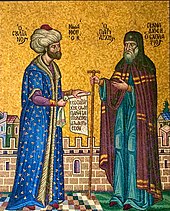
Amid disputes from the Greeks against the Spanish introduction of the Filioque and the "Azymites", as well as from Latins against the deteriorating relationship with the papacy, a renewed interest in theology emerged during Palaiologan Byzantium that did not preclude the Schoolmen. If anything the introduction of Saint Thomas Aquinas' writings shocked the Greek intellectual world. The Summa was probably first translated from Latin to Greek by Maximus Planudes in the early 14th century and quickly gained a following. Opinions of Aquinas and the established Latin theological traditions of Scholasticism and Scotism enjoyed a popularity irrespective of one's opinion of the Filioque, unleavened bread, and the pope. "As a star of the West, [Saint Thomas] illumined the Church of Christ" in the words of hymnographer Janus Plousiadenos (thanks, Marko!). Basilios Bessarion may not have been an outright Thomist, but Scholasticism certainly influenced his speculative theology. Among opponents of Rome, Mark of Ephesus (accomplished in many things and remembered only for giving Rome the middle finger on the eve of Byzantium's fall) criticized Aquinas' rejection of the Immaculate Conception from Scotistic grounds. 

Gennadius Scholarius recanted of his Scholasticism after leaving the Council of Florence without voting on any propositions to lead the separatist party back home. Yet, before Florence he sang Aquinas' praises:
"Would O excellent Thomas that you had not been born in the West. Then you would not have needed to defend the deviations of the Church there.... You would have been as perfect in theology as you are in ethics."
According to Hugh Barbour O. Praem, Palamite emperor John VI took an interest in Thomas and patronized Demetrios Kydones' translation of the Summa contra gentiles. Two other opponents of the Florentine Union quoted Aquinas' arguments for the Incarnation and consecrated virginity word for word and without attribution; these two opponents, Makarios Makres and Joseph Bryennios, were cited as examples of fidelity to Orthodox tradition in a letter of Athonites monks against the ecumenism of the Greek patriarch.

Why were Palaiologan Orthodox so fond of Saint Thomas when their descendants today are not? It seems likely that, aside from where Thomas "needed to defend the deviations" of Rome, the Greeks perceived him as one of the highest expressions of their own approach to theology, to argument, and to reasoning. There was no antithetical relationship between reason and mysticism, between logic and tradition; there was only truth and falsehood, and Aquinas enunciated the former more eloquently and with greater edification than any other writer centuries forward or backward, East or West; his imitators were less successful.

A separate Scholastic tradition would develop in Russia, firmly separated from Rome and independent of Constantinople after the events of 1453. Russia lacked an indigenous theological tradition, relying instead on sparsely available translations of Greek writers. There was a need for stability in both church and state which the Scholastic method supplied. Today some writers consider these centuries as the "Western Captivity of Orthodoxy."

Now that we have seen Greek Christianity's well rooted similarities to Latin Scholasticism and their amenable history with Saint Thomas, the question remains why Aquinas has fallen out of favor and into disrepute with Orthodox theologians. The answer is simple: because Orthodox Christianity, not unlike modern Roman Catholic theology, is under the intellectual domain of a small clique of thinkers who do not represent their tradition in its entirety. I will close with a quote from Patrick Reardon, a priest of the Antiochian Orthodox Church:
“What almost always passes for ‘Orthodox theology’ among English-speaking Orthodox these days is actually just a branch of the larger Orthodox picture. Indeed, it tends sometimes to be rather sectarian.
"The Orthodox Church is an ancient castle, as it were, of which only two or three rooms have been much in use since about 1920. These two or three rooms were furnished by the Russian émigrés in Paris between the two World Wars. This furniture is heavily neo-Palamite and anti-Scholastic. It relies heavily on the Cappadocians, Maximus, and Gregory Palamas (who are good folks, or course). Anything that does not fit comfortably into that model is dismissed as “Western” and even non-Orthodox.
"Consequently, one will look in vain in that theology for any significant contribution from the Alexandrians, chiefly Cyril, and that major Antiochian, Chrysostom. When these are quoted, it is usually some incidental point on which they can afford to be quoted.
"Now I submit that any ‘Orthodox’ theology that has so little use for the two major figures from Antioch and Alexandria is giving something less than the whole picture.
"Likewise, this popular neo-Palamite brand of Orthodoxy, though it quotes Damascene when it is convenient, never really engages Damascene’’s manifestly ‘Scholastic’ approach to theology.
"Much less does it have any use for the other early Scholastic theologians, such as Theodore the Studite and Euthymus Zygabenus. There is no recognition that Scholasticism was born in the East, not the West, and that only the rise of the Turk kept it from flourishing in the East.
"There is also no explicit recognition that the defining pattern of Orthodox Christology was formulated in the West before Chalcedon. Pope Leo’s distinctions are already very clear in Augustine decades before Chalcedon. Yet, Orthodox treatises on the history of Christology regularly ignore Augustine. 
"Augustine tends to be classified as a ‘Scholastic,’ which he most certainly was not.
But Western and Scholastic are bad words with these folks.
"In fact, however, Augustine and the Scholastics represent only other rooms in the larger castle.
"For this reason I urge you, as you can, to read in the Orthodox sources that tend to get skipped in what currently passes for ‘Orthodoxy.’ For my part, I believe the Russian émigré theology from Paris, which seems profoundly reactionary and anti-Western, is an inadequate instrument for the evangelization of this country and the world. I say this while gladly recognizing my own debt to Russian émigré theology.”

Thursday, August 14, 2014

Ascension and Assumption


Fr. Blake has a few interesting observations about the connection between the Ascension of our Lord and the Assumption/Dormition of His mother, the Blessed Virgin Mary. One important thing to add to his thoughts about the icon of the Dormition is the size of Mary in the Byzantine representation. Here we see Mary, having died in Jerusalem, surrounded by the Apostles (as recorded by St. Dionysius the pseudo-Areopagite and St. John of Damascus), being take in soul by Christ while her body temporarily remains on earth, only assumed into heaven after it was sealed in the tomb. In iconographic depictions Mary is almost never shown apart from Christ. Commonly icons depict the Virgin holding young Jesus, wrapped in clothing that shapes the painted (or "written" to use the Greek term) Son of God as a peanut. Regardless of whether the young Christ is written as an infant or as an older child, as is often the case in the apse of Byzantine churches, the Lord is always in front of the Virgin. The Virgin shows us the Lord, Who is due glory in His own right. All honor of Mary descends through him (the opposite of the co-Redemptrix?), 

The Dormition icon reverses this. Mary, although fully grown at the time of her death, is now the size of an infant and shown in the same peanut-like shape as the infant Jesus of the Nativity icon. Christ holds His mother in front of Himself for the faithful to see.

Here the iconographic tradition shows the spiritual realm. Icons spiritually interpret God's action in the physical world. But, as Fr. Blake asserts, there are two planes of reality in this icon: what the Apostles saw, Mary deceased and heralded by angelic song, and the spiritual realm, the taking of her soul into heaven by her Divine Son. In the physical realm Mary was larger than Christ probably for 10 or 12 years and not much smaller for the next 20. In the spiritual realm the Blessed Mother is "more honorably than the cherubim and more glorious beyond compare than the seraphim," but menial compared to God-made-Man, Christ. Mary, great as she was and is among Man, is still small in contrast to the One Who made her. With the Assumption of the Virgin, the Divine plan for the Incarnation is now complete.

The Dormition fittingly marks the end of the liturgical year in the Byzantine rite. The year re-starts on September 8th, the feast of Mary's Nativity.

Tuesday, August 5, 2014

Transfiguration: Paving the Way of the Cross

source: toledofavs.com
The modern trend with regards to the Transfiguration of our Redeemer is to emphasize His glory and divinity, which he revealed to Elias, Moses, Peter, James, and John. The Hesychast theology following the tradition of Palamas even extends this to include the manifestation of the uncreated, uncaused Divine energy of God. The ancient view is both simpler and more intuitive than either of these when we read the Gospel as a whole. From the Fathers in today's Mattins:
"The Lord takes chosen witnesses, and in their presence, reveals His glory. That form of body which He had in common with other men, He so transfigured with light, that His Face did shine as the sun, and His raiment became exceeding white as snow. Of this metamorphosis the chief work was to remove from the hearts of the disciples the stumbling at the Cross. Before their eyes was unveiled the splendour of His hidden majesty, that the lowliness of His freely-chosen suffering might not confound their faith. But none the less was there here laid by the Providence of God a solid foundation for the hope of the Holy Church, whereby the whole body of Christ should know with what a change it is yet to be honoured. The members of that body whose Head hath already been transfigured in light may promise themselves a share in His glory." Sermon of St. Leo the Great on the Transfiguration, taken from the second nocturne
"Since the Lord had spoken much concerning dangers, much concerning His Own sufferings, much concerning death, and the killing of His disciples, and had laid upon them many hard and grievous things, and since all these were in this present life, and already hanging over them, whereas the good things were matter for hope and waiting as, for example, that whosoever should lose his life for His sake should find it, for that the Son of Man should come in the glory of His Father, and reward every man according to his works. Therefore, to assure them by their own eyes, and show them what the glory is wherein He will come, He manifested and unveiled it to them, as far as in this life they were able to grasp it, lest they and especially Peter should grieve over their own deaths, or the death of their Lord." 57th Sermon on Matthew by St. John Chrysostom, taken from the third nocturne
As an addendum, I would like to point out one of my favorite features of the icon of the Transfiguration. something that has always amused me. The three Apostles are blinded by the light and unable to see. John and James are looking away, overpowered by the radiance of the Lord's illuminated majesty. Peter, however, has to say something. Indeed, Peter always has to say something. Throughout the four Gospels he relentlessly speaks up at inopportune times and gets himself in trouble. After receiving the keys to the Kingdom of Heaven he passes on his chance to be quiet and earns the Lord's sharp condemnation "Get behind Me, Satan." There may be some theological significance to Peter's orientation toward the Lord in the icon—he did suggest the erection of three tabernacles—yet I cannot help but think there was an element of humor on the iconographers' part in having Peter attempt to get the Lord's attention while more important things transpire.

Saturday, July 26, 2014

Icons and Reality

Most talks I have heard about icons, such as this one, emphasize that icons are not realistic nor are they meant to be. Instead they depict an image similar to what the reality was, but spiritualize the details and avoid lines and shadows that reflect normal life. This was not always the case.


Observe the two depictions of the common Christ the Pantocrator icon, often found in first millennium Latin churches and still found in Eastern churches. The icon on the left resides in the monastery of St. Catherine on Mount Sinai in Egypt and was "written," likely using vegetable painted paint, in the 6th century. The icon on the right can be found in any Byzantine Catholic or Orthodox church around the world. The older icon takes great pains, nine centuries prior to the Renaissance, to show skin contractions created by making facial expressions, line in the neck and hands from bending skin, shadows in clothing, human skin pigments, books resembling the binding of holy books of the day, and a Semitic face. The newer and more conventional icon on the right has few if any of these features. The absence of these characteristics does not make the icon on the right deficient, but it does underscore an evolution in iconography.

Cathedral of Ss. Peter & Paul, Cefalu, Sicily.
To this day Russian icons look very real. The nineteenth century fascination with baroque and Renaissance art in Russia ushered in a return to realistic iconography visible still in the cathedral of Our Savior in Moscow.

In the West what we now call icons were originally mosaics or fresco styled paintings. One of my personal favorites is the Pantocrator Christ in the apse of Ss. Peter & Paul Cathedral in Cefalu, Sicily (also used as a stand in for the old St. Peter's Basilica in that atrocious Brother Sun Sister Moon film). Christ, the Blessed Mother, and the Saints are shown as realistically as first millennium artists could attempt to make them. Western artists, free from the politics and the spiritual change wrought by the iconoclast controversy in Constantinople, were free to explore new media of expression when sculpture and painting on wood came in the middle ages and marble returned in the Renaissance. 

Eastern images instead took a turn toward the exclusively spiritual. Every detail of Byzantine icons carries a deeper meaning, particularly the icons highlighted during the Great Fast (Palm Sunday, the Ladder of Ascent, and the Icon of Extreme Humility come to mind). I have long held that February 19, 842 was the birth of the Orthodox Church as we know it. During a time when the Roman and Constantinopolitan churches held similar artistic and philosophical traditions, and were recently under one political system, the Byzantine tradition imbued itself with a distinctive and defining attachment to icons unknown in either the West or the non-Byzantine East—where the orthodoxy of images had not been questioned. The Greek proclivity to give icons an exclusively spiritual character would be complete during the Hesychast revival under St. Gregory Palamas and remain a permanent feature of the Orthodox Church after the fall of Constantinople to the Mohammadans, destroying the vibrant cultural and theological center of Eastern Christianity and assuring that the form of Byzantine praxis that existed in 1453 would be what survived to the present day.

Again, none of these changed are necessarily bad. Neither the right side icon at the top of the page nor the Jesus of Michelangelo's Pieta are the Jesus of the first millennium icons, and so what? They each have their own value, but we must not ignore the fact that the original impetus behind creating images means second millennium Latin artwork and Greek iconography should be seen as compliments emanating from a common origin and not as contrasts between the more ancient and original Greeks and the spiritually corrupt Latins.

Let us conclude with an excerpt of a sermon given by [St?] Photios, the ninth century archbishop of Constantinople, on the occasion of the dedication of a Panagia icon int he Hagia Sophia:
"Christ came to us in the flesh, and was borne in the arms of His Mother. This is seen and confirmed and proclaimed in pictures, the teaching made manifest by means of personal eyewitness, and impelling the spectators to unhesitating assent. Does a man hate the teaching by means of pictures? Then how could he not have previously rejected and hated the message of the Gospels? Just as speech is transmitted by hearing, so a form through sight is imprinted upon the tablets of the soul, giving to those who apprehension is not soiled by wicked doctrines a representation of knowledge concordant with piety. Martyrs have suffered for their love of God, showing with their blood the ardor of their desire, and their memory is contained in books. These deeds they are also seen performing in pictures, as painting presents the martyrdom of those blessed men more vividly to our knowledge. Others have been burnt alive, a sacrifice sanctified by their prayer, fasting and other labors. These things are conveyed both by stories and by pictures, but it is the spectators rather than the hearers who are drawn to emulation. The Virgin is holding the Creator in her arms as an infant. Who is there who would not marvel, more from the sight of it than from the report, at the magnitude of the mystery, and would not rise up to laud the ineffable condescension that surpasses all words? For even if the one introduces the other, yet the comprehension that comes about through sight is shown in very fact to be far superior to the learning that penetrates through the ears. Has a man lent his ear to a story? Has his intelligence visualized and drawn to itself what he has heard? Then, after judging it with sober attention, he deposits it in his memory. No less – indeed much greater – is the power of sight. For surely, having somehow through the outpouring and effluence of the optical rays touched and seen encompassed the object, it too sends the essence of the thing seen on to the mind, letting it be conveyed from there to the memory for the concentration of unfailing knowledge. Has the mind seen? Has it grasped? Has it visualized? Then it has effortlessly transmitted the forms of memory. Is there one who rejects the holy writings on these matters and, in spite of the fact that allies are dispelled by them, considers them to be not above dispute? Then this man has long since transgressed by scorning the veneration of holy images. Does he, on the contrary, reverence the latter, and honor them with proper respect? Then he will be disposed likewise towards the writings. If he treats either one with reverence or with contempt, he necessarily bestows the same on the other, unless, in addition to being impious, he has also abandoned reason, and is not only irreverent, but also preaches things which are in conflict with his own position. Those, therefore, who have slipped into assailing the holy images are proved not to have kept the correctness of doctrine either, but with the one they abjure the other. They do not dare confess what they believe, chary, not of being impious, but of appearing so; and they avoid the name whereof they willingly pursue the actions. Abominable in their misdeeds, they are more abominable in their impiety. Their whole offshoot has perished, branches, roots and all, even as the wondrous David in his canticle sings of the memorial of the impious being destroyed with noise, and it is He Whom they have set at naught through His picture Who has passed righteous judgment on them. But before our eyes stands motionless the Virgin carrying the Creator in her arms as an infant, depicted in painting as she is in writings and visions, an interceder for our salvation and a teacher of reverence to God, a grace of the eyes and a grace of the mind, carried by which the divine love in us is uplifted to the intelligible beauty of truth."

The icon dedicated by Photios.

Monday, November 25, 2013

Monastery of Mt Sinai

source: eikonografos.com
Today, in both the Byzantine and older Roman rites, is the feast of St Catherine of Mt. Sinai  the virgin martyr and daughter of an Alexandrian king whose rare education endeared her to Christ to the point of death. According to tradition her remains were miraculously taken to Mt. Sinai where they were discovered by an already established monastic community, which cares for her veneration to this day.
 
The monastery—built around the Burning Bush—is now, of course, Eastern Orthodox, but that does not make it less interesting to us as Catholics and as people appreciative of liturgical historical. Mt. Sinai houses possibly the oldest extant icons in the Christian world, icons which were written when Byzantium was thriving and St. Gregory the Great just an infant. Below is a very short documentary on the monastery which focuses on the place's unique place in icon history.
 
The beginning, for the uninitiated, is the Hajmeh, the first part of the night-long celebration of Pascha which transitions into Mattins and Lauds and ends with the Divine Liturgy. The faithful take "light  that never fades" from the Paschal candle blessed at the Vesperal "vigil" Liturgy earlier that [Saturday] morning. I found my first experience with this rite simultaneously awe inspiring and frightening, much how the two women felt when they encountered the Empty Tomb that day in the year 33, when the Sun was only just rising.


Monday, October 14, 2013

Lesser Known Fathers VII: St. Theodore the Studite on Icons

source: orthodoxwiki.org
For those of us on the Gregorian calendar this past Sunday was the Sunday of the Fathers of the Seventh Ecumenical Council in the Byzantine rite. This Council once and for all condemned iconoclasm and affirmed the right and necessary place of holy images in the Divine worship. Unfortunately the circumstances surrounding the iconoclasm controversy would eventually lead to the Photian schism, the effects of which continue to our present time.

We have already covered the writing of St. John of Damascus on the Holy Icons, but the significance of the Seventh Ecumenical Council and the celebration of its Fathers this week inspired the Rad Trad to examine briefly the writings of St. Theodore the Studite on the matter, perhaps the last major writer concerning the icon controversy. Theodore was born in 759 and raised for a bureaucratic career, but diverged from the set path and joined his uncle Plato's monastery. Circumstances brought Theodore to Studios monastery in Constantinople. Emperor Constantine VI exiled Theodore for opposing his divorce and re-marriage, holding that an emperor had not the competence to override the decisions of the Church concerning marriage. The next emperor, Michael II, permitted Theodore a partial return from exile, but would not permit the Saint to enter the Byzantine capital. Theodore died on November 11, 826, the day before his current feast.

For practical purposes, this post will be shorter than previous installments of the Lesser Known Fathers series, given that much of what St. Theodore says has already been said by St. John of Damascus.

Studios monastery
source: wikipedia.org
First, Theodore refutes the common objection that the creation and veneration of icons violates the second commandment, which prohibits the worship of images and idols. Not all images are made equal. The commandment against the fashioning and veneration of idols and images does not equate with images as the Christian is acquainted with them. Theodore establishes that the veneration of an image or icon for the Christian is actually veneration of the prototype of the image through veneration of a replica. The attention and worship is directed toward the prototype, be it God, a mystery, an angel, or a saint. The Christian does not glorify and give honor to a plank of wood or smudges of paint. His devotion seeks the original through the copy.

This contrasts with the second commandment because, when considered in context, the second commandment has little application in the realm of icons. The Jews were forbidden images, more or less, because no one had "seen God at any time" prior to the coming of the Second Person of the Trinity (John 1:18). Without any comprehension of God in a form discernible to human beings the veneration of images would eventually slip into idolatry, the worship of images as though those images were gods in themselves. Even during Old Testament times God exempted the Jews from this commandment under His Divine providence. For example, God explicitly commanded the Israelites to fashion two cherubim, forming the "Glory Seat" on the Ark of the Covenant (Exodus 25:18). Similarly, He demanded the same Israelites create a bronze serpent which healed snake bitten persons (Numbers 21:8). Given the proper intention and disposition, God is glorified in the veneration of holy icons and images.

This gives way to the second, and far more interesting, aspect of the iconoclast controversy: how an image relates to its original, its prototype. St. John of Damascus briefly touches upon this topic in his third discourse, but does not delve. St. Theodore does.

An image can be venerated as a proximate to the original because the original is intelligible to those who offer it their honor. The iconoclasts, among whom Orthodox translator Catherine Roth nearly counts St. Gregory of Rome, insisted that icons were ill-suited for Divine worship because God cannot be circumscribed to human understanding and human reason. Man cannot know God.

St. Theodore constructs a dialogue between an iconophile and an iconoclast—who he plainly calls the "orthodox" and the "heretic" respectively—in his second treatise in order to set up an explanation for how mankind can know God. He quotes St. Gregory of Nazianzus in saying Christ is God "Circumscribed in the body, uncircumscribed in the spirit (Treatise 2.1, Gregory ep. 101). Similarly those who respected the image of the Byzantine emperor did so because they knew the emperor to be a flesh-and-blood person who could be seen with human eyes (Treatise 2.28).

Is there not a circumscription to the risen Christ? Eastern, and Western, theology holds that Christ's resurrected body was a renewed, transformed one, so glorious and different that it was unrecognized by the Lord's own disciples (St. Mary Magdalen at the tomb) or even by His Apostles (on the road to Emaus). This body could appear and disappear at whim. Surely the resurrected Lord's image should not be venerated (Treatise 2.41-47), but rather treated with the same alien respect as the Jews treated God, in their vague understanding, in the Old Testament. No! This same Christ walked and talked and ate as His Apostles and as He Himself did prior to His Passion. Even the risen Christ is very knowable through the human senses.

Given that the common objectors to images, be it iconography or Roman statues, are protestants in our day, one argument of the iconoclasts is amusing: "'We grant,' the heretics say, 'that Christ may be represented, but only according to the holy words which we have received from God Himself; for He said, 'Do this in remembrance of me,' obviously implying that He cannot be represented otherwise than by being remembered. Only this image is true and this act of depiction sacred'" (Treatise 1.10). Effectively, iconoclasts believed the Eucharist to be the only viable depiction of Christ because the gifts on the altar are Christ. Of course, Theodore rebuts, the Eucharist is the most fitting remembrance of Christ, but an image need not be of the same essence as the original, as the Eucharist is of Jesus (1.10-11).

One last point of interest is the Cross. Some apparently worried that veneration of the mysteries of Christ and of the saints would detract from veneration of the Cross (1.15), which is done at the end of Divine Liturgy. Of course there is a limited amount of wood from the True Cross to venerate, so the faithful adore fabricated crosses. If this is acceptable, why would icons not be? Christ hallowed the cross by making it worthy of His passion. Is not the same true of His other mysteries?

We are beginning to see that written theology has progressed beyond the first millennium and the Fathers. Yet these men and their writings remain singularly important, not just for tracing what the "early Church" (as though it is not the same as today's Church) believed, but how the Church believed. The average quasi-secular person today, when he walks into a parish to observe a Mass, is not going to ask about Aquinas' concept of form-matter-intent for the Sacraments. He is going to ask more basic questions: does God exist? Why worship Him? How does He matter to you? Why do you Catholics do what you do? The writings of the Fathers are more instinctive and accessible for the layman.

Some time in the next week I hope to put up a post on five random Sunday Masses from the Parisian Missal and a review of Evelyn Waugh's Brideshead Revisited.

Sunday, June 30, 2013

Lesser Known Fathers I: St. John of Damascus

First, a very short biography of today's Saint for contextual purposes—you can find the rest with Mr. Google. John was born in the mid-seventh century to a family whose tribal origin is uncertain to us, but which suggests a long history of regional magistrates and administrators. John himself took up service and acted as an administrator for the Umayyad caliph until he left public life for a religious vocation as a monk. The saint was supposedly a polymath, highly capable in geometry and astronomy in addition to theology and philosophy. He most enduring work has been his tracts in defense of iconography and the veneration of icons in prayer, written against the iconoclast heresy of Emperor Leo III. St. John, although not within the domain of the rapidly decaying Empire, constructs some of his language and criticism of his second and third treatises against iconoclasm as though he was a citizen of Byzantium, possibly to give him better ground to abjure the Emperor. The three tracts on icons use the same material, references, and often the same exact phrases and arguments, as they are all really just variants of each other. Therefor we shall discuss them interchangeably. We will then look at his first sermon on the Dormition/Assumption of the Mother of God. Let us begin.
 
Note: references such as (I:9) mean Treatise I, chapter 9.
 
St. John's take on icons should arouse our attention, as his arguments are faithfully intuitive and easy to convey to iconoclastic Roman clergy and protestants who cannot fathom the purpose of displaying and venerating holy images. At the very heart of his defense of icons is the fact that icons are images, and images, he tells us, are very sacred and holy things. Images need not be defined merely as pictures, but as likenesses to archetypes. God the Son is a direct image, says the Saint, of God the Father, composed of the same essence, but different in Person (I:9). The Father is the cause and the Son is caused. John elucidates other "images" throughout Scripture of lesser magnitude than the Son as image of the Father, such as the Ark of the Covenant as an image of the Virgin Mary or, he takes from St. Gregory the Theologian, memory as an image of the historic event. We should see by now that to St. John images and types are one and the same thing. Types are not limited to the Old Covenant, nor are images strictly physical planks created with paint brushes. They are real reflections of God, albeit of a lesser degree.
 
People, then and now, commonly object to the veneration of icons on the grounds of the First Commandment, which prohibits the human fashioning of idols which are worshipped as gods. These people need to read St. Paul, who wrote that the Letter kills, but the Spirit quickens. The Jews of old, John teaches, were prohibited from delving into veneration of physical objects too deeply owing to their tendency toward idolatry and to the incompleteness of Revelation (III:4). The Jews did venerate some physical things, such as Aaron's rod, even things that were images, specifically the cherubim and seat on the lid of the Ark of the Covenant. They were forbidden from making any images of something unrelated to their God and were also forbidden from making images of their God because they did not know what He might look like (II:5). The cause of this restriction ended with the Incarnation, when God put on human flesh, sanctified it, and dwelt among us in it. God became intelligible to the human eye and human experience. As St. Paul wrote in his first epistle to the Church in Corinth, "now we see puzzling reflections in a mirror."
 
In venerating images, we engage in a specific type of veneration, as veneration is not a single action but rather is composed of different grades. All worship is due to God and God alone, as His nature is ineffable and above all things. Yet we can worship in many ways. We can worship God in His nature directly. We can worship Him in veneration of His actions, such as the Incarnation and Resurrection. We can venerate Him in His works. We can venerate Him in ways which we can comprehend Him in His corporeal body. Veneration of icons falls into this last level. We worship God Who became Man, and we do so by showing reverence to depictions of this intelligible and visible work of God.
 
John quotes the Greek Fathers, particularly St. Gregory the Theologian, constantly driving home the point that he would not need to explain the obvious concerning sacred images had the opponents of iconography only followed the Church's traditional teaching concerning them: "if anyone proclaims anything to you other than what the Catholic Church has received from the Apostles and Holy Fathers and synods and preserved up to now, do not listen to him nor accept the counsel of the serpent, as Eve accepted it and reaped death" (II:6).
 
The Saint finds other reasons to uphold the veneration of icons and sacred images in the Church's contemporary practice, such as praying to the saints. Neglecting the veneration of the saints, the army of Christ the King, is the same as divesting God of His army (I:21). The same applies to the icons. Does their neglect not neglect Jesus' Revelation to us in our nature? The pagans, who denied Christ's Redemption of the human race, saw their images and statues destroyed and replaced with images of God (images according to John's vocabulary) in the form of icons of Christ, of His Life on earth, of His Mother, and of the Saints (III:9).
 
Treatises II and III have no real ending, just a brutal series of quotations from various Greek Fathers concerning icons. Treatise I concludes in exhorting the reader to cling to the traditions of the Church (I:68). The removal of a tradition is like the removal of a foundational stone from a building: eventually it all tumbles down.
 
Lastly, we should consider his first sermon on the Dormition/Assumption of the Mother of God, the Virgin Mary. "How can the source of life pass through death to life? O how can she obey the law of nature, who, in conceiving, surpasses the boundaries of nature? How is her spotless body made subject unto death? In order to be clothed in immortality she must first put off mortality, since the Lord of nature did not reject the penalty of death."
 
Heaven and earth cannot contain God's infinite majesty, but Mary's womb did. Therefor God took her bodily into heaven after her death, so that such a virginal body which bore God the Son would not be subject to decay. She was blessed and unspotted, not after death but from her own conception. And she was considered blessed while she lived, as in the Magnificat she states that "from henceforth all generations shall call me blessed," meaning from Our Lord's conception within her, not years after her death. God planned Mary, says St. John, from the very beginning. In illustrating this point John turns to the many passages from the Wisdom books used in the Mariam feasts and Saturday votive Masses in the Roman rite—a nice nod to modern Roman readers.
 
By the Incarnation of God the Son the gap between Man and God was filled by God putting on human nature, specifically our Lady's human nature. She is, says St. John, the bridge between God's and Man's natures! John takes the story of Jacob's Ladder as an Old Testament type, or image, of our Lady's role in Salvation.
 
The Saint from Damascus finds another type of Mary in the Old Covenant by virtue of her origin. Our Lady's parents Joachim and Anne, whose "name means 'grace,'" were a barren couple who bore the spring from which Salvation and grace would flow, much like how flowers sprung forth from the rod of Aaron. The end of Ss. Joachim and Anne's sterility also meant the end of the world's spiritual sterility.
 
Our Lady of Silence (Assumption)
Mary's body, so pure and holy by virtue of what Our Lord Jesus Christ did through it, could only be taken to heaven, as it belongs to the things of heaven. In another sermon, John concludes by describing the manner in which our Lady's death was followed by her Assumption (since Pius XII omitted it in his pronouncement):
"An ancient tradition has been handed down to us, that, at the time of the glorious falling-asleep of the blessed Virgin, all the Apostles, who were wandering throughout the world preaching salvation to the Gentiles, were caught up aloft in the twinkling of an eye, and met together in Jerusalem. And when they were all there, a vision of Angels appeared to them, and the chant of the heavenly powers was heard; and so with divine glory she gave up her soul into the hands of God. But her body, which bore God in an effable manner, being lifted up amid the hymns of Angels and Apostles was laid in a tomb in Gethsemane. There for three whole days the angelic song was heard.
"But after three days, the chant of the Angels ceased, and the Apostles who were present (for Thomas, the only one who had been absent, came after the third day, and wished to adore the body which had borne God) opened the tomb; but they could by no means find her sacred body in any part of it. But when they only found those garments in which she had been buried, and were filled with indescribable fragrance which emanated from them, they closed the tomb. Amazed at this wonderful mystery they could only think that he, who had been pleased to take flesh from the Virgin Mary, to be made man, and to be born though he was God the Word, and the Lord of glory, he who had preserved her virginity without stain after childbirth, should also have been pleased to honor her pure body after her death, keeping it incorrupt, and translating it into Heaven before the general resurrection."
 I hope you enjoyed this little vignette on a Father who needs more attention these days. The Rad Trad, who is not really that "rad," has yet to decide who to cover next week, given the possibilities, but will make a decision in due time. In the meantime, drop the theology manuals and read the Fathers!