Friday, February 7, 2014

Sad End at Le Chamblac

I have mentioned in a few places the story of Fr. Quintin Montgomery-Wright, the convert priest who celebrated the old rite with Norman influences until his death in 1996. He attempted to arrange the FSSPX to take his church after his death, but disputes with the diocese of Evreux (which gave Abbe Michel so much grief) resulted in the closure of the church. From an old Google Group you can read the appeal of one of the parishioners of Le Chamblac here. He sounds quite irate:
Coincidentally, on May 10th, many parishoners from the three parishes received a letter from Mgr. David. He assured them that they were all Catholics; that their needs would be ministered to; and that "together we shall build the church". That the Old Mass was not available was clear; that the traditional Sacraments were not available was clear; that there would be no resident priest was clear. In other words, Mgr. David was once again failing to practise his beloved "dialogue" and was forcing himself and his views on "the People of God"!!
Unfortunately for Mgr. David, the faithful of Le Chamblac are not the feeble-minded peasants that he hoped they were. They are not impressed by a bishop who mutters about friendship and dialogue, but only deals out actions aimed at extinguishing the Catholic life of Le Chamblac. On May 16th, despite a police presence, the faithful managed by legal means to open the church and celebrate Holy Mass. The church was packed tight. People from the community who had not been to church for years had come to show their support in the clearest possible way. They may not practise, but they know how important Le Chamblac's church is to their community and way of life.

The stage is now set for confrontation week after week because of the shortsightedness and stupidity of Mgr. David. Instead of bringing peace, he has declared war on fellow Catholics, on the most successful parishes in the diocese. Only an idiot can seriously believe that the faithful are going to obey the order to go away and die. 

One wonders if this fellow would have gotten further with some manners....

The parish has been re-opened and "improved" under the aegis of the diocese. The parish went from this....

source: Getty Images (free preview)
and this....
source: Getty Images (free preview)
to this.


At least they re-cycled the tabernacle and put a few Latin words on the altar....


EDIT: Thanks to Mr Alan Robinson we now know that the above altar was at some point installed by Fr Montgomery-Wright and not by the current authorities. The Rad Trad had read elsewhere, perhaps on Fr Chadwick's blog, that Fr M-W moved an existing altar.

Thursday, February 6, 2014

Have We Been Wrong?

Have we been wrong about the liturgy and Vatican II's Sacrosanctum Concilium? I have tried on this blog to dispel the myth that the liturgical overhaul of the 20th century descended from the Council or even from the same people who acted as the main players at the Council. The trend towards change began earlier during the days of Jansen and during the 19th century Liturgical Movement. For various reasons those forces merged with Modernism in the early 20th century after Pascendi Dominici Gregis drove that movement underground in the academies and forced it to study seemingly benign subjects like liturgy (ironic that the Pope who issued Pascendi blew the first salvo against the old rite).

My thesis until recently has been that Sacrosanctum Concilium, the document on liturgy written by Msgr. Annibale Bugnini either during the waning years of Pius XII—who began the study groups for an Ecumenical Council—or early days of John XXIII—who called Pope Pius' Council, was meant as a pretext for greater changes. The vague instructions on the place of Latin, of chant, and the variety of readings could justify the 1962, 1965, and 1969 Ordines Missae. The document was a stepping stone, not an end. Indeed, I would side with the "neo-cons" in saying that the document was never implemented. Where their position fails is in claiming that the document was mis-interpreted, as though the man who wrote it did not know his own intentions.

What has caused me to revise my views slightly is a book called From Breviary to Liturgy of the Hours by Stanislaus Campbell, a thorough account of the re-structuring of the already altered Divine Office which took place between 1964 and 1971. The book traces the process using the records and meeting notes from the various study groups within Consilium, the commission Pope Paul established to circumvent the impossibly baroque SCR. The suggestions and discussions are frighteningly irreverent to the past, to patrimony, and the common worshipper—despite the prevalence of the word "pastoral." Study group 9's records reveal the memorandum: "Today, Lauds and Vespers are not popular, and they require a radical restoration." I now think that Sacrosanctum Concilium and the Council were actually a slight moderating influence on the Consilium and the new liturgy. How?

Some of the most radical moves, such as the de facto abolition of the minor hours, came from the top. The death of Prime/Terce/Sext/None and the creation of an optional series of hours descended from the mind of Papa Montini himself. Pope Paul even thought the novel cycle for Lauds and four week cycle for the rest of the hours too cumbersome for pastoral reasons. He favored an alternation between psalms and readings. Another example would be the endless options in the Pauline liturgy. There could have been even more profound differences in the options. At one point Consilium wanted a three psalm scheme for the major hours when celebrated with laity present and a five psalm scheme for private recitation. The three psalm scheme seems absurd to those who favor the older liturgy, but would it not be even more absurd to have two Divine Offices: one for the parish and one for the priest at his desk? The Consilium even describes Sacrosanctum Concilium 89 as "dangerous" because it could elicit repetition among the psalms during the little hours, as was done from the start of the little hours until 1911.

As troubled as the reform was, it seems the Council and particularly Sacrosanctum Concilium prevented the finished product from being an even greater departure from the traditional liturgy than it already was.

P/S - the book is available for purchase on Google Books for $15, a reasonable price in contrast to the $1,085 for a copy on Abe Books.

Wednesday, February 5, 2014

Reading and Re-Reading


Regardless of what I read, I notice two books—aside from Scripture and the Divine Office—that I re-read every year: Brideshead Revisited by Evelyn Waugh and Confessions by St. Augustine of Hippo. 

What does this say about me? I do not know. A friend of mine began reading Confessions for a class and attempted to dissect the book into a Trinitarian structure through which he could deduce a neo-Platonic Christian message. I told him he had missed the point. Under the polemics against the Manichean heresy, and it is a polemic in some places, Confessions is the story of a soul, of a man whose life can be summed up in those words from psalm 50: "I am well aware of my iniquity and my sin is before me always." Augustine turned away from sin after a long captivity within its snares and entered the Church through Baptism. And yet his conversion did not stop there. His focus shifts from sin to Truth, to Christ in the last books of Confessions. We all must turn away from evil, but we still not see anything if we keep our eyes closed before Christ.

The other book, which I reviewed here, is Evelyn Waugh's Brideshead Revisited. Rubricarius tells me there is an extraordinary form of Brideshead, which was never abrogated and was good reading then and good reading now. I shall have to track it down one day. The abridged and standard version is still fantastic reading. Waugh's descriptions excite an aesthetic sensation similar to mixing a recording of Victoria's Tenebrae responsories with good wine. Above all I love the characters of Brideshead because I know some of them and I am some of them. The way in which God works among the characters aptly reflects how He works in most of our lives, letting us go in sin to the ends of the world only to be brought back to Him by a "twitch upon a thread." I also recommend the 1981 serialization of Brideshead staring Anthony Andrews and Jeremy Irons, which is usually available for instant viewing on Netflix. An hour of free time could be worse spent.

What do you re-read?

Let There Be the Te Deum

From today's Papal audience:

It's also "important that children are well prepared for first Communion because ... after baptism and confirmation it is the first step toward belonging strongly, really strongly, to Jesus Christ," he said Wednesday at his weekly general audience. source 
Tradition, you are affirmed!

Tuesday, February 4, 2014

You Must Be Joking

"I will crush the Index!"

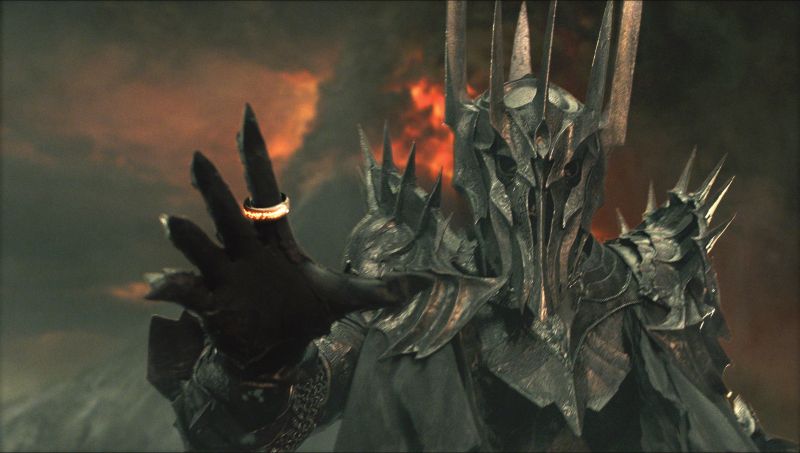
JRR Tolkien, the Roman Catholic layman whose day job as a linguistics lecturer at Oxford was overshadowed by his brilliant books The Hobbit and The Lord of the Rings, was not sufficiently Catholic in his writings according to a few absurd traditionalists (here and here). Tolkien—who shouted Et cum spiritu tuo after the local bishops conferences translated the Roman Mass into vernacular—is apparently analogous to those teachers of false doctrine against whom St. Paul warns us in his first epistle to St. Timothy. Does anyone think Tolkien proffered a real pagan alternative to Christianity? Does anyone think the Fantasy genre (and Tolkien ought not be confined to it) is real? If Paul read and quoted pagan writers in the Scripture he wrote why can we not read the fiction of an entirely orthodox Catholic?

The Rad Trad suspects the dangers of emotionalism and brashness forewarned in these lectures are actually the Catholic spirit and religious instinct, not the preferred manual-based formal theology. Honestly, if a 5th century believer read Return of the King and Ludwig Ott's manual on dogma which would he find more Catholic in its totality, not just in what it says its outlook and how it speaks?

As an aside I met Tolkien's daughter Priscilla once in Oxford. She was leaving the Sheldonian with a friend of mine one night during Trinity term after a performance of Beethoven's Missa Solemnis. I greeted my friend, with no idea who the lady to his left was. He said, "Oh! [Rad Trad], this is Priscilla Tolkien!" We chatted for only a quick moment and my friend and I went on our way. My friend nearly died during the encounter. Why, you might ask? She is on the petite side and he could only think of hobbits....

Monday, February 3, 2014

Big Money Religion, Ex-Catholics, and the Eucharist

In New England there are three major religious groups: Catholics, non-practicing Catholics (either cultural Catholics, lapsed, apostates, or just plain inactive), and the irreligious. Texas, I have found, is something entirely different.

Jerry Falwell gets dunked
Religion here is an industry, and a big one at that. During drives through Frisco and Irving I passed half a dozen or so megachurches in each town. A megachurch, for my international readers, is a uniquely American bit of Protestantism wherein a team of pastors raises a congregation numbering in the high four or low five digits and builds an entertainment facility to use as a house of worship. It is, as one Evangelical put it, like going to the movies. I attended a Evangelical service once as a social courtesy and did not participate in the actual service. Initially I thought the service would offend me, but time and patience revealed pity and not antipathy to be the proper disposition towards these folks: no Sacraments, no Holy Spirit, no Fathers, no liturgy. These people are not little Luthers. They are Luther's victims. But like Luther they have capitalized on their Protestantism and translated their authority into political capital.

Apparently one Democrat candidate for governor in Texas intends to run entirely on a pro-abortion platform. Her money, obviously, comes from outside the state. Regardless Texas will prove a challenge for her. The money behind these megachurches warrants awe and the pastors do not shy from encouraging their congregants from "voting according to [their] Sunday beliefs." No wonder Jerry Falwell's "Moral Majority" was able to raise Ronald Reagan to the Presidency.

But is this religion? Is this Christianity?

The Roman martyred our Fathers among the Saints for not being Roman enough, for being the "other." Had the Christians been enemies of the Empire or its friend they would have received predictable treatment. The Roman subjugated many enemies, such as the Jews, and then re-appropriated their political systems to their own ends. Given the Church's entirely other worldly view this was not possible and many God glorified many of the Church with martyrdom, not with political coalitions.

A more Catholic outlook on how the Bible
is the "Word of God"
The multimedia empires of megachurch Protestantism really have no place among Christianity as I recognize it. The Catholic, and Orthodox, Church always try to maintain positive relationships with monarchies and local governments in order to assure her own rights and freedom to operate. The state and local authorities usually complied because 99% of people were Catholic. When that was not the case a pluralism was accepted, but the Church still kept her outlook practical and her goals militant, not commercial. Even the Anglican Church, which I have criticized on this blog, can be said to follow the traditional pattern more than megachurchdom. 

Many Catholics, or ex-Catholics, seem to have purchased one edition or another of this American product called the megachurch. Today at a business event I found two instances of ex-Catholics. One was an Evangelical who married a Catholic woman in a Catholic parish—despite his disdain for the gay priest—because the faith was important to her. She now attends his church.... Another fellow was raised Catholic, but left the Church, married, and continues in ignorance. The first fellow attends a more "moderate" brand of megachurch wherein they admit the Bible ain't really the "Word of God" while the other fellow seems to possess a more fundamentalist focus. Despite all this, the second man's wife insists that they attend midnight Mass every Christmas. Why? "She likes Communion and thinks it's important."

Those two exchanges revealed something important to the Rad Trad. The Catholic Church is still recognizable to these people, but, as she was in her early Roman days, she is still the other. Megachurches rarely if ever do "communion" so where would she get the idea that it matters? Why go to a church that does "communion" on a night that is, to Americans, the most important of the year? In the former case the man might have done well to realize that the Church does not believe the Bible is the Word of God in the same way Protestants do. Protestants tend to view the Bible as Muslims view the Koran: God dictated and someone wrote the literal meaning. The Church has a more mature view of the Bible as a whole (she assembled it after all) and in parts (formed by the Fathers, use of those languages, a chain of interpretation, and the Holy Spirit).

Much like the early Romans many American Protestants of various denominations swing between places of worship, be it Bacchus or Baptist, seeking what they know to be missing and they continue to miss it because they are looking in the wrong places. As the Romans discovered, and as these souls hopefully will discover, no Roman or American product solves spiritual woes. They real solution is the "other," the Catholic Church. They are not unlike the women at the tomb on the morning of the Resurrection. They sought one thing and found, or did not find, something entirely different (they probably did not understand even the physical event for days): 
The radiant angel standing within the tomb, cried out to the Myrrh-bearers: Why O women Disciples, do you mingle myrrh with your tears of pity? Look upon the tomb and rejoice, for the Savior has risen from the dead.
Blessed are You , O Lord, teach me your statutes.
Very early in the morning, the myrrh-bearers ran lamenting to your tomb. But the angel stood by them and said: Do not weep, the time of lamenting has passed. Announce the Resurrection to the Apostles.
Blessed are You, O Lord, teach me your statutes.
The myrrh-bearing women came with myrrh to your tomb, O Savior, and heard the angel say to them: Why do you think that the Living One is among the dead, for as God He has risen from the dead.
Let us pray to St. Monica for these souls and souls like them, that they may one day return to Christ's fold.

God bless you all!

Saturday, February 1, 2014

The Poor

I have always found the poor difficult. Today I visited Fort Worth, TX and had to refuse two homeless people who approached me. Admittedly I refused the first one because I thought he looked a bit off kilter. After confessing at the cathedral I refused yet another from behind the wheel of my accidentally pretentious car. What do we do with the poor?

Logically I know that the poor of modern America are a different matter from the poor of 1st century Jerusalem. Those poor lived in an intractable socio-economic system worsened by compounding taxes and Roman domination. The poor of Boston and Brooklyn are less often families burdened by debt collectors and more people with mental problems or addictions. Surely this does not discount our duties as Catholics and servants of Christ to do something for these children of God, but giving them alms solves nothing. What will an alcoholic do with $5? Buy a shot-sized bottle of Smirnoff?

A few years ago I took on the policy of not giving the poor money. Judgmental as I sound, I do not trust the average beggar with $1 or $5. I will buy them food, whether they ask for it or not. Never groceries that can be traded, just one warm and hearty meal. Is this enough? Is this helping one's brother? Something I think it comes up short: me determining what someone else needs or is fit to have. Do I have another choice?

As I drove away from that third poor man I felt a sharp cut in my heart, wounding my soul a bit as I rationalized my three refusals. Yes, they logically make sense. Yes, many of us intend to do the right thing. Does this part of Our Lord's charge simply not fit into the modern American economic situation? The Pope clearly wants us to do something to engage the poor, but how? As one blogger said—and the press buried him for it—"The poor are messy." I knew a priest who would give beggars food or a small quantity of cash, but only if they said a prayer for him to his face.