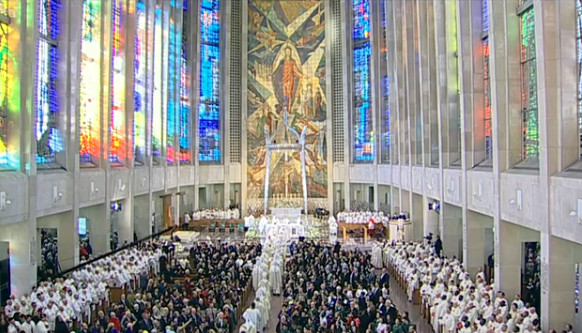
In the heart of Hartford, Connecticut is a large, red house with brown lattice woodwork and colorful windows. Inside, the years have imbued a dignity that comes with age upon this large bungalow full of Italian mementos, statuettes of cats, and books. The house belonged to Samuel Clemens, Mark Twain. Down the road is a big, ugly cement airplane hanger called St. Joseph's Cathedral.
The Archdiocese of Hartford is rarely bestowed prime quality bishops. It has been a consolation see for several prelates who were deprived of the cardinal-archbishopric of New York City after laboring in the vineyard of ecclesiastical obedience for so many years. My former home is on its third consecutive "caretaker" archbishop, someone whose job it is to curtail years of financial mismanagement and population implosion. There are very orthodox bishops and very heretical ones, very holy ones and very worldly ones; but there seem to be none who are zealous or visionary, and that has taken its toll in the archdiocese of contented caretakers.
The week of Christmas the Archdiocese announced a plan to
close or cluster 100 of its 212 parishes throughout the three Connecticut counties it encompasses. As the article states, Mass attendance has dropped 70% among self-identified Catholics from 1965 and the number of Catholics has dropped a quarter, although the state population, while stagnant, is 40% higher than it was when Vatican II ended. The number of priests is down 65% in that same period and 22% will be 75 within five years. While the state of Connecticut remains uninspiring, the archdiocese of Hartford is resolutely mediocre.
 |
| St. Aedan's |
My father was baptized in 1941, just after his birth, at St. Aedan's in New Haven. In 1950 he was confirmed by Msgr. Henry J. O'Brien, the last archbishop of Hartford born in Connecticut. That same year St. Aedan's opened a school, the apogee of every pre-Vatican II American parish. In 2012 my father and I heard a Saturday night Mass there: the priest neglected the chasuble, omitted a reading, read the pseudo-Hippolytan anaphora, and gave a sermon about sharing to a congregation of 40 white headed persons.
While Archbishop O'Brien should not be singularly credited with the growth of the archdiocese after World War II—an era in which the Polish, Italian, and Irish communities were becoming more perfectly Americanized and protestants were converting in noticeable numbers—he does deserve his due as a native who knew his own flock and managed to meet their needs without saddling parishes and schools in debt. His replacements, Whealon, Cronin, Mansell, and now Blair, cannot seem to be interested in anything other than a well managed declined.
Are these churchmen conservative by instinct because they are caught in their childhood vision of the Church? A four hymn sandwich Mass, a communitarian schedule run by people in black suits, schools, and a sodality or two? Or could it be the familiar career progression, almost a treadmill? Daniel Cronin served in the Vatican Secretariat of State and made monsignor within ten years of ordination; despite gaining the episcopacy six years later he never went much further. Henry Mansell was a priest of the archdiocese of New York, a monsignor, and vice-Chancellor of New York. Msgr. Blair held administrative positions in Detroit, a professorship at a seminary, and served as a secretary to a cardinal who ran a Roman dicastery. All went to a Roman seminary. All met a minimal need to display orthodoxy without upsetting the established order too severely. Cronin mildly rebuked Ted Kennedy for his weak opposition to abortion and Blair did the same to the "nuns of the bus" and the Susan G. Komen Foundation. What of pastoral experience?
In the past priests perceived to be worthy of violet cloth were given a few stitches early on as a test run and as a reward for good behavior, at least in America. "Monsignor" ("My lord") originated as an Italian address for higher clergy and clergy of noble heritage. The honor continued to be used in such a manner in Europe. In America it became a way of playing favorites. Today priests make a salary of around $40,000 a year; fifty years ago they kept the Christmas collection as their salary. Monsignori with "plumb parishes" and congregants in the thousands generously willing to pay their Nativity tithe did much better than those priests in backwater towns and a hundred poor Micks who knew what the bishop thought about them.
Ecclesiastical vocations tend to attract the intelligent believer, the unintelligent believer, and the unintelligent disbeliever in our time with a strong preference for the second and third of these. Our current age of renewal and consolidating ("synergies", as we call them in corporate finance) can be read in the spirit of orthodoxy or novelty, but it cannot be read in the spirit of non-contradiction with the past, a fact most stubborn to career churchmen. After years of lay "ministries" churchmen are getting what they wished for only to find laymen are incapable of confecting the Eucharist or giving Absolution.
There are alternatives to the slow bleed more forward minded bishops could embrace. There is the Lincoln solution of radical modern orthodoxy which allows priests to do as they will in the most conservative way, replete with pro-life ministries and Latin Masses. There is also the Oratorian solution advocated
here,
here, and
here, which this author believes the most feasible way of both reinvigorating parish life and meeting Catholics where they are, uninitiated with Latin, in questionable marriages, and poorly taught. And then there is the solution of monasticism, of bringing the liturgical heart of the Church back into rural and cathedral life. New traditional monasteries open constantly in France and fill up immediately; while hardly a solution to parish problems, monasticism does revive the pulse of the Church and provide a spiritual heart beat.
Career clergymen are rarely visionaries or even pastorally adept. In their eagerness to check off their boxes on their way to the elusive red hat they neglected their duties, assuming the churches are as enduring as the marble they were once built with. Without care, marble cracks and fades.
One wonders if rather than caretakers, these gentlemen would have been better off picking careers as undertakers?