Showing posts with label marriage. Show all posts

Monday, September 30, 2019

St. Jerome: Moralistic Quibbler [repost]

[This is an old post from 2015 for the feast of St. Jerome. The opposition of the holy Church Fathers to current ecclesiastical trends remains, of course, very relevant.]

(Francisco de Zurbarán)
My dear Amandus,

I find joined to your letter of inquiries a short paper containing the following words: “ask him, (that is me,) whether a woman who has left her husband on the ground that he is an adulterer and sodomite and has found herself compelled to take another may in the lifetime of him whom she first left be in communion with the church without doing penance for her fault.”

As I read the case put I recall the verse “they make excuses for their sins.” We are all human and all indulgent to our own faults; and what our own will leads us to do we attribute to a necessity of nature. It is as though a young man were to say, “I am over-borne by my body, the glow of nature kindles my passions, the structure of my frame and its reproductive organs call for sexual intercourse.” Or again a murderer might say, “I was in want, I stood in need of food, I had nothing to cover me. If I shed the blood of another, it was to save myself from dying of cold and hunger.”

Tell the sister, therefore, who thus enquires of me concerning her condition, not my sentence but that of the apostle. “Do you not know, brethren (for I speak to them that know the law,) how that the law has dominion over a man as long as he lives? For the woman which has an husband is bound by the law to her husband, so long as he lives; but if the husband be dead, she is loosed from the law of her husband. So then, if, while her husband lives, she be married to another man, she shall be called an adulteress.” And in another place: “the wife is bound by the law as long as her husband lives; but if her husband be dead, she is at liberty to be married to whom she will; only in the Lord.” The apostle has thus cut away every plea and has clearly declared that, if a woman marries again while her husband is living, she is an adulteress.

You must not speak to me of the violence of a ravisher, a mother’s pleading, a father’s bidding, the influence of relatives, the insolence and the intrigues of servants, household losses. A husband may be an adulterer or a sodomite, he may be stained with every crime and may have been left by his wife because of his sins; yet he is still her husband and, so long as he lives, she may not marry another.

The apostle does not promulgate this decree on his own authority but on that of Christ who speaks in him. For he has followed the words of Christ in the gospel: “whosoever shall put away his wife, saving for the cause of fornication, causes her to commit adultery: and whosoever shall marry her that is divorced, commits adultery.” Mark what he says: “whosoever shall marry her that is divorced commits adultery.” Whether she has put away her husband or her husband her, the man who marries her is still an adulterer. Wherefore the apostles seeing how heavy the yoke of marriage was thus made said to Him: “if the case of the man be so with his wife, it is not good to marry,” and the Lord replied, “he that is able to receive it, let him receive it.” And immediately by the instance of the three eunuchs he shows the blessedness of virginity which is bound by no carnal tie.

I have not been able quite to determine what it is that she means by the words “has found herself compelled” to marry again. What is this compulsion of which she speaks? Was she overborne by a crowd and ravished against her will? If so, why has she not, thus victimized, subsequently put away her ravisher?

Let her read the books of Moses and she will find that if violence is offered to a betrothed virgin in a city and she does not cry out, she is punished as an adulteress: but if she is forced in the field, she is innocent of sin and her ravisher alone is amenable to the laws. Therefore if your sister, who, as she says, has been forced into a second union, wishes to receive the body of Christ and not to be accounted an adulteress, let her do penance; so far at least as from the time she begins to repent to have no farther intercourse with that second husband who ought to be called not a husband but an adulterer.

If this seems hard to her and if she cannot leave one whom she has once loved and will not prefer the Lord to sensual pleasure, let her hear the declaration of the apostle: “ye cannot drink the cup of the Lord and the cup of devils: ye cannot be partakers of the Lord’s table and of the table of devils,” and in another place: “what communion has light with darkness? And what concord has Christ with Belial?”...

Wherefore, I beseech you, do your best to comfort her and to urge her to seek salvation. Diseased flesh calls for the knife and the searing-iron. The wound is to blame and not the healing art, if with a cruelty that is really kindness a physician to spare does not spare, and to be merciful is cruel.

Your affectionate sourpuss,
Jerome

(From Letter 55 of St. Hieronymus, Presbyteris Confessoris et Ecclesiae Doctoris)


(Leonello Spada)

Sunday, April 15, 2018

The Dubious End of the Dubia


The word on the street is that the dubia of Cdls. Brandmüller, Burke, et al. has finally reached its termination with a traditional definition of the immorality of receiving Communion whilst in the midst of adultery by a small, toothless conference in Rome. This “whimper” ending of the dubia process is disappointing but unsurprising. An old mentor of mine once encouraged me to pray for Joseph Ratzinger upon his election to the papacy because he was “more of an academic than a man of action,” and that goes double for Raymond Leo Burke, a man more comfortable in a law library than the public square.

This is not to suggest that the cardinal lacks a spine, merely that he is better at standing still in the midst of a hurricane than he is at wielding a weapon against the enemy. The fruitless exercise of the dubia by the ever-dwindling association of cardinals ended in frustration and confusion, and perhaps it has left the situation worse than when it began.

Meanwhile, the Francismachine continues to bulldoze apace. Cdl. Raymond “Lion” Burke lacks the resolve of his middle-namesake, favoring public respect and a show of obedience to the direct opposition of this Satanic undermining of marital life.
How can any one enter into the house of the strong, and rifle his goods, unless he first bind the strong? and then he will rifle his house. He that is not with me, is against me; and he that gathereth not with me, scattereth.
The Vatican’s offenses against matrimony are accumulative and disastrous for the salvation of men. We traditionalists have been looking to the dubia cardinals as modern-day Bishop Turpins—the celebrated warrior-bishop of La Chanson de Roland—but they are in the final analysis mere clerics in the reductive sense of the word: clerks worried more about an imbalance in the books than about the evil at the root of the problem.

One day we may get the reforming clergy we need, but Brandmüller and Burke have quietly retreated from the field while their soldiers still fight. They may continue to grant interviews until the day they die, but talk is only talk.
From the other part is the Archbishop Turpin,
He pricks his horse and mounts upon a hill;
Calling the Franks, sermon to them begins:
“My lords barons, Charles left us here for this;
He is our King, well may we die for him:
To Christendom good service offering.
Battle you’ll have, you all are bound to it,
For with your eyes you see the Sarrazins.
Pray for God’s grace, confessing Him your sins!
For your souls’ health, I’ll absolution give
So, though you die, blest martyrs shall you live,
Thrones you shall win in the great Paradis.”
The Franks dismount, upon the ground are lit.
That Archbishop God’s Benediction gives,
For their penance, good blows to strike he bids. (lxxxix)

Sunday, September 24, 2017

Brotherly Correction

The recent publication of the Correctio filialis de haeresibus propagatis of 40 scholars and clergy to P. Francis, originally presented to the pontiff early last month, is causing some minor waves in Catholic society. While this correction produces indisputable evidence of material error issuing forth from the current pontificate, the response from the pope and his entourage is likely to be similar to that given to the steady stream of corrections, appeals, and dubia thus far: dismissive mockery followed by silence.

Still, responses of this sort—explicit, thorough, and precise—are necessary and helpful in other ways. They are helpful for the multitude of lay Catholics who remain confused and hurt by the pope's apparent madness, and feel timid or impious at the thought of making their concerns heard. They are helpful also for those who have steadfastly ignored all but the most benign words coming from Rome, since the most essential Franciscan errors are now very helpfully collected, summarized, and explained. Willfully ignorant Catholics are prodded to pull their heads out of the dirt and pay attention to reality. The signatories do not allow the Holy Father to get away with his careless words spoken in interviews, nor with his silence in response to the "implementations" of episcopal conferences.

That this correctio is being published during the quincentenary of Fr. Luther's revolution is not lost on its authors. There is a rather extensive section on "The Influence of Martin Luther" in the document (p. 12f), and it is worth nearly as much consideration as the marriage-related material.

Pray for the signatories. Pray for the pope. Only truth and repentance will heal these wounds. "For everyone who exalts himself shall be humbled, and he who humbles himself shall be exalted."


Saturday, August 19, 2017

Matrimony in the Post-Collapse

The news that Cdl. Burke and his now-two compatriots are slowly moving forward with the process of the dubia has us traddies in a tizzy about how slow the whole thing is, as if the Vatican has ever moved in a good direction at anything higher than a glacial pace. I do not know if the cardinals will get this declaration of orthodoxy signed or clearly rejected before the Fatimaversary is through, but doing so would help calm a lot of people down.

Meanwhile, my own experience with the married seems to be ever-increasing in variety and alarm. I know those once-divorced, once-separated, and constantly online-dating; those hastily wed after a pregnancy; those in active concubinage; those with children and an annulled marriage; and those young, in love, and getting engaged against the judgment of their parents (God bless them). Marriage is an increasingly messy proposition, but it is still the natural end of healthy adulthood. One not vowed to celibacy nor afflicted with some serious disability finds his proper and natural end in marriage and child-making, and woe to those who put stumbling blocks along the way of those who seek it.

That goes double for vocation-obsessed busybodies who demand years of prayer and preparation for the common state of life in which God created our race. "It is not good for man to be alone" is not a complex maxim, and derailing a young man or woman seeking marriage with vocational retreats and the accompanying scrupulosity is to create an occasion of sin.

It is also true for those who spread cynicism about marriage as such, frightening young men with horror stories of ex-wives taking everything in the divorce and encouraging a culture of mistrust. Serial fornicators are made of such stuff as this.

And I think it is true also of the matrimonial spiritualists, those who elevate marriage to a state of life equal to the religious and contemplative. There is a theology of matrimony, it is true, but mostly marriage is practical, down to earth, and humble. Catholic apologists do not need to spice it up with charismatic pretensions. Even the old manualist definition of the home as the "Domestic Church" veers off the rails when it recommends a pseudo-monasticism instead of the perpetuation of folk traditions.

But from the beginning it was not so.

We live in an unthinkable age when people suffer simply for marriage. Chinese wives have their bodies invaded to slaughter the children within. Wedding planners and chefs are financially ruined for not supporting perversion. Governments encourage a great burden of collegiate debt on young people who simply wish to work and support a family. Subhuman fools deride mothers of more than 2.5 children publicly in the supermarket.

"Adulterers, know you not that the friendship of this world is the enemy of God?"

Now, blind clerics lead blind adulterers to the cliff. Would that Henry VIII had lived in our times, he would still be a proud papist! When Elias returns in the final days, do we think he will be condemning the Antichrist for his Satanic pacts, or will he perhaps rather be condemning him for his three divorces? Like the Forerunner who came in his spirit, Elias might very well be martyred for defending the primordial state of marriage.

"It is not good for man to be alone.... It is not lawful for you to have your brother's wife." Those are two hills worth dying on.
 

Friday, July 28, 2017

Friends Don't Let Friends NFP

The week of July 23-29, 2017—as my dear, humorous wife informed me out of the blue, earlier today—is National NFP Awareness Week. For the five or so Catholics in America who are blessed never to have heard of NFP, it stands for "Neither Fun nor Posterity."

The USCCB has produced an extensive media kit and educational program on its website, complete with suggested homily talking points, bulletin inserts, and prayers of the faithful. This year's promotional poster, attached immediately below, is indicative of the narcissistic, child-fearing culture in which the Gospel of NFP intends to find purchase: a 20-something couple drinking terrible alcohol whilst announcing their engagement to friends and family with a so-called selfie by way of text and/or social media. The fearful look in his eyes complements her look of vacant inebriation.

But let's hope "the time" doesn't happen on the honeymoon!
The recommended bulletin inserts range from the banal to the obscene. Some of these risqué selections will have parents burning the bulletins and scattering the ashes before the little children (who may or may not exist) can get their wee hands on this lewd material:
NFP is an umbrella term for certain methods used to achieve and avoid pregnancies. These methods are based on observation of the naturally occurring signs and symptoms of the fertile and infertile phases of a woman’s menstrual cycle. Couples using NFP to avoid pregnancy abstain from intercourse and genital contact during the fertile phase of the woman’s cycle.
The couple... are acting as “ministers” of God’s plan and they “benefit from” their sexuality according to the original dynamism of “total” self-giving, without manipulation or alteration. [All quotation marks sic, by the way.]
Couples who adopt NFP to space the births of children find that it brings about many positive changes in their relationship and even becomes a way of life. It begins with acceptance, and even wonder, at the way the human body is made.
But enough sex ed. For all the "wonder" and "total" self-giving that NFP is supposed to engender, "God's Plan for Married Love" in fact baffles and frustrates newlyweds who are unhappy with the insertion of periodic celibacy into their marital bliss. The FAQs about the whens and whys of NFP practically forbid any tangible interaction with the grave reasons (translated less gravely here as "serious") that permit its practice. Instead, the assumption is that regular continence should be the norm and the old method of "just havin' them babbies" is for third-world weirdos who don't know any better:
In this view of "responsible parenthood" married couples carefully think about the just reasons they may have to postpone pregnancy. When making decisions about the number and spacing of children in their family, they weigh their responsibilities to God, each other, the children they already have, and the world in which they live.
Or, well, they don't.

Not so long ago, experienced adults would have recommended to young men and women who were itching for a scratch that they had better be prepared for parenthood before walking down the aisle. Indulging in God's gift of intercourse between the sexes came with the great joy of fatherhood and motherhood, which was its natural end. Those who presume to indulge had better be ready for the results, emotionally, morally, and financially. The perversion of this end used to be so despised that it was even illegal in the secular state. Now it is claimed as a right.

"Be Her Joseph!" one JP2-generation Catholic writes, but one can hardly imagine the chaste St. Joseph penning something like this about the Blessed Virgin: "Much to my surprise, I also learned how grateful my wife was that I was willing to learn how her body worked!" But one might suppose that the celibate marriage of Joseph and Mary is a somewhat fitting model for the quarter-celibate lifestyle promoted by NFP missionaries and mommy bloggers who cannot abstain from venting their periodic frustration on the rest of us innocent bystanders.

Evelyn Waugh mocked the rise of the birth control movement in his 1932 novel Black Mischief, when the Minister of Modernization in a small African nation attempted to spread propaganda to the uneducated masses by means of a colorful poster design:
It portrayed two contrasted scenes. On one side a native hut of hideous squalor, overrun with children of every age, suffering from every physical incapacity — crippled, deformed, blind, spotted and insane; the father prematurely aged with paternity squatted by an empty cook-pot; through the door could be seen his wife, withered and bowed with child bearing, desperately hoeing at their inadequate crop. On the other side a bright parlour furnished with chairs and table; the mother, young and beautiful, sat at her ease eating a huge slice of raw meat; her husband smoked a long Arab hubble-bubble (still a caste mark of leisure throughout the land), while a single, healthy child sat between them reading a newspaper. Inset between the two pictures was a detailed drawing of some up-to-date contraceptive apparatus and the words in Sakuyu: WHICH HOME DO YOU CHOOSE?
Interest in the pictures was unbounded; all over the island woolly heads were nodding, black hands pointing, tongues clicking against filed teeth in unsyntactical dialects. Nowhere was there any doubt about the meaning of the beautiful new pictures.
See: on right hand: there is rich man: smoke pipe like big chief: but his wife she no good: sit eating meat: and rich man no good: he only one son.
See: on left hand: poor man: not much to eat: but his wife she very good, work hard in field: man he good too: eleven children: one very mad, very holy. And in the middle: Emperor’s juju. Make you like that good man with eleven children.
And as a result, despite admonitions from squire and vicar, the peasantry began pouring into town for the gala, eagerly awaiting initiation to the fine new magic of virility and fecundity.
Our desires are today so divorced from nature that those few who welcome all of God's gifts are expected to explain themselves to the "normal" married couple with 1.5 children and a dog. Anyone can slap "God's Plan" on a poster. Few consider the consequences.

"Dear St. Joseph, please make my husband like you: young, hunky, and never too grabby."

Thursday, May 11, 2017

St. Gengulphus: Martyr for Marriage

(source)
The cultus of St. Gengulphus (†AD 760) does not appear to have ever been especially large. He was one of the rare "secular" saints of the first millennium, being neither a cleric nor a religious, but rather a martyr of sorts. He lived in Burgundy, and many churches in France still bear his name (or some variant thereof), as do some German churches.

His hagiography is miraculous from its first recounting, and serves as an interesting counterpoint to later women saints who suffered greatly under their wicked husbands. Gengulphus suffered the indignity of a straying wife, who began an adulterous affair with a clerk of some unknown rank while her husband was away from home. When the nobleman was finally convinced of his wife's unfaithfulness, he advised her to repent and himself retired to a distant estate, rather than punish her. The two adulterers feared for their safety and plotted to kill the saintly husband, and one night the clerk slipped into his bedroom and dealt him a mortal blow. After returning to his mistress, the clerk quickly died in the manner of Arius and the wife was ironically cursed after replying to news of miracles performed at her husband's grave with, "If Gengulph can work miracles, then so can my arse." One day a week for the rest of her life, an ignoble sound erupted constantly from the part of the body she thus indicated.

The story of St. Gengulphus was not popular enough to warrant inclusion in the Golden Legend, and his mention in the martyrology of the Roman Breviary for May 11 is terse: Varennis, in Gallia, sancti Gangulphi Martyris. Nevertheless, many of his relics can still be found in the areas surrounding his original cult, as can the aforementioned churches named in his honor.

Some later legends claim that Gengulphus had retired from married life to become a hermit, but there is no such indication in the earliest hagiographies. He never divorced his wife nor sought to annul his marriage. In many ways he is the kind of saint needed in our troubles times. The culture of divorce and "easy outs" from bad marriages has permeated the Church herself. Gengulphus suffered greatly from a bad spouse, but did not use this injustice as an excuse to commit sin.

Thursday, March 9, 2017

Maybe When You're Older: or, The Canticle of Canticles

(source: Wikimedia)
The ancient Hebrews, it is said, did not allow even pious men to read Solomon's Canticle of Canticles until the age of thirty. The Catholic tradition has almost universally interpreted the literal intention of the Canticle as an allegory of Christ and the Church, a reading even the early Protestant heretics were loathe to reject. The modern lust for novelty insists on a hermeneutic of crassness, and interprets this book as a "better sex" manual for married couples—or perhaps for those who prefer other arrangements.

Like the speculated dialogue form of Ecclesiastes, the Canticle possesses multiple speakers, and the Vulgate suggests a division along the lines of Sponsa, Sponsus, Chorus Adolescentularum, and Chorus Fratrum. Knox decides not to include any speaker labels due to his agnosticism about finding a clear identification, so it was oftentimes amusing when deciding whether my wife or I would be reading a certain paragraph aloud.

There is no clear narrative to follow, and the book seems rather to include a selection of incidents presented non-chronologically, especially since the marriage of Solomon and the Sulamite woman takes place before their nighttime yearnings for one another. This disjointed narrative lends credence to the spiritual-allegorical reading, as do the many odd dreamlike incidents (such as the beating of the Sulamite by the night watchmen after the through-the-lattice encounter in ch. 5). Solomon's own professed unhappiness with all his dealings with women elsewhere also makes the allegorical reading more certain.

I will not offer any particular reading of the text, due to its obscurity and the already rich tradition of holy commentators. If the Canticle offers any solace to those in the state of marriage rather than those pursuing a life of spiritual contemplation, it is perhaps that the joys of the marital state are considered to be a worthy image of the intimate love God has for his own Bride; that it is indeed not a contradiction to call it Holy Matrimony, and that the "marriage bed undefiled" (Heb. 13) is still a blessing from on high.
As there are two evils which, solely or especially, wage war against the soul, we are given the two Books [Proverbs and Ecclesiastes] to oppose them. Of these the former, using the hoe of discipline, grubs out whatever is corrupt in our morals, and whatever is superfluous in the indulgence of the flesh; whilst the latter, by the light of reason, prudently discovers the smoke of vanity in all worldly glory, and distinguishes it faithfully from the solidity of truth, putting the fear of God and the observance of His commandments before all human interests and earthly desires.... 
Now, then, ridding ourselves of these two evils by the study of these two books, we may confidently take in hand this third discourse on holy contemplation, which, being the fruit of the preceding, should only be entrusted to sober minds and chastened ears. For it would be criminal presumption on the part of imperfect souls to occupy themselves with such a sacred subject before the flesh has been tamed by discipline and subdued to the spirit, and the vanity and cares of the world despised and abjured. 
—St. Bernard's first sermon on the Canticle of Canticles

Tuesday, January 10, 2017

Contentions via the Holy Family

Joseph and his brethren, the iconic unhappy family.
A recent sermon at Tradistan was cause for some unfortunate Joseph-related debate. Speaking on the occasion of the feast of the Holy Family (instituted in 1893), the priest talked about Catholic family life from the perspective of the Household of Nazareth. The sermon was decent enough, and the lessons drawn for Catholic family life were not unreasonable, but the priest’s opinion of St. Joseph’s virginity and confirmation in grace after his marriage to the Virgin sparked some previously calm disagreement between friends into dissension.

My own opinions on St. Joseph are well known among my close friends, not only by His Traddiness and my bride. Recently it has become a point of contention in a larger group of friends, drawing a line between those with a devotion to Young St. Joseph and those who prefer Old St. Joseph. The Tradistani sermon further sparked a flurry of text messages, arguments in the parish hall, and emails to the priest, most of which I successfully avoided until later in the day. By the time I was able to catch up on this activity, the various parties had more or less sullenly retreated to their own corners, still certain of their own opinions and no longer willing to engage in debate.

Thankfully, my wife is on my side on this matter, as she is with so many things. I have no doubt we will be putting up an image of Young St. Joseph somewhere in the home, if only because it was a gift from a friend or family member. Such are the small compromises that one makes for the sake of a happy family and social life. She has suggested I compile and edit all of my original Josephology series into a book format and think about publishing it, although I cannot think of any Catholic publisher—traddy or neo-conservative—who would be interested in printing such a volume. Even the now-defunct Thomas A. Nelson publishing house would never print something so traditional. Nonetheless, while agreement on things like St. Joseph’s age and marital history might be objectively minor, such an harmony of thought can be a major step towards long-term familial happiness.

Among friends, disagreements on minor matters can be a cause for good-humored ribbing, intensely engaging debate, or miserable complaints. It’s a pity when the latter ends up being the case. Damage control is always tedious work, especially when most of the damage is self-inflicted. Those who are unwilling to put in the work to research a topic are too often the loudest at expressing their opinion, and do not know how to react to an intellectual argument except for a quick retreat paired with an unimpressive Parthian shot.

When the priest in question finally responded to my friend’s email, he admitted that he was unsure if Joseph had been married before the Annunciation, but doubted it. The casual misuse of words, like “virginity” when “chastity” is meant, can cause great problems, it would seem. Ideas have consequences, and so do intellectual mistakes. St. Jerome’s fabulation of a vowed-to-virginity St. Joseph certainly has had consequences some 1600 years later, including the occasional haze of stubbornness and hurt feelings. I remember a similar argument with a good friend that ended in him spitefully shutting it down when he thought it absurd that the perpetual virginity of Mary had anything whatsoever to do with physical integrity, in spite of the theology of the Church Fathers. The cause of his reaction was a simple-minded emotionalism about certain aspects of womanhood (especially not wishing women to feel bad about certain… incidents) and an assumption that the Patristic position was due to their sexual naïveté. That friendship survived, but in a noticeably altered form after I refused to back down.

Emotion sometimes gets the better of the intellectual life, and devotionalism often has an emotional spillage that goes to great lengths to protect the object of devotion. Such was Jerome’s zeal to protect the belief in Mary’s perpetual virginity that he created for her a celibate warrior-bodyguard from whom she need never fear any lusty rudeness. But truth can not allow its terms to be dictated by emotion, no matter how well-placed they may be. The heart must learn what is lovable from the head, or else the soul ends up like the old image of Phyllis riding on Aristotle’s back: reason subjected to desire, in a kind of inversion of the story of Joseph and Potiphar’s wife.

Be like Joseph, instead.

Monday, October 10, 2016

Preparation for Marriage


The bridal imagery of the Church is frequent in Scripture and Tradition, in the spiritual writings of the European monks and in the jeremiads of the Hebrew desert prophets. Other familial and societal images are used to describe the relationship between God and his people—father-son, master-slave, brother-brother, king-subject—but the marital bond has been fruitful for spiritual expositions, even if that imagery is not especially useful for everyone.

Being in the midst of marriage preparation, myself, I find it unfortunate that the priests involved in my fiancée’s and my spiritual formation in this regard find little use for the mystical symbolism that could provide a larger context for the sacrament of marriage. There is also little use for the advice of the Old Testament wisdom literature about the troubles of married life, and for the examples of saints and holy people who were not members of the Holy Family.

Fulton Sheen’s Three to Get Married is one of the recommended readings for the preparation course. Turgidly abstract and outdatedly anti-Freudian, Sheen’s complaints about the modern misuses of marriage could easily have been made in a short tract. The late bishop also makes an argument for the mystical aspect of the sacrament, but never in a way that allows the average reader to truly get a sense of what he means. He writes of spirituality, of the need for God, in the abstract, and when he talks about the heights and depths of Christian love he never really brings the reader along for the ride.
Humans in the sacraments supply the act, the bread, the water, and the words; God supplies the grace, the mystery. In the sacred act of creating life, man and woman supply the unity of the flesh; God supplies the soul and the mystery. Such is the mystery of sex.
Doesn’t that just make you want to immediately sign up for Catholic Match? Thomas à Kempis wrote more passionately about the trials and loneliness of the monastic life! Must marriage be reduced to dusty neo-Aristotelian lecture notes? How much more lively are these brief passages of bridal imagery from the Holy Writ:
He hath set his tabernacle in the sun: and he, as a bridegroom coming out of his bride chamber, hath rejoiced as a giant to run the way. (Ps. 18)
With the robe of justice he hath covered me, as a bridegroom decked with a crown, and as a bride adorned with her jewels. (Is. 61)
Will a virgin forget her ornament, or a bride her stomacher? but my people hath forgotten me days without number. (Jer. 2)
With three things my spirit is pleased, which are approved before God and men: the concord of brethren, and the love of neighbours, and man and wife that agree well together. (Sir. 25)
Can the children of the bridegroom mourn, as long as the bridegroom is with them? But the days will come, when the bridegroom shall be taken away from them, and then they shall fast. (Mt. 9)
Come, and I will shew thee the bride, the wife of the Lamb. (Apoc. 21)
And so forth. When you have read all of the above for many years, it is quite the disappointment to realize that the parish and diocesan preparation consists of little more than filling out personality tests and reading marriage-related encyclicals aloud. It is all very good to insist that the future groom and bride understand their moral and societal duties, but there is something perverse in ignoring the joyfulness of the occasion in favor of “moral manual”-level exposition.

Strangely enough, it is the post-conciliar theologians who have attempted to revive some sense of wonder and joy in the spirituality of marriage. Everything from John Paul’s “theology of the body” to EWTN radio marriage counseling makes an attempt to reinvigorate marriage with liveliness, joy, and even fun. Perhaps it is the abuses of this movement, like the recent Familiaris consortio, that cause Tradistani priests to react in the opposite direction. There is a fear that indulgence will lead to sin and various abuses; and of course it can and sometimes does. The Church Fathers and patristic-era monastics insisted on the superiority of the celibate life over the married because even sacramental marriage is rarely free from sinful excesses.

All human loves are meant to be reflections of divine love. As fallen, concupiscible beings, our loves inevitably fall short. A father’s love for his children ought to reflect God’s love for Christ and for his adopted sons, but doesn’t it often become petty? A mother’s love ought to reflect the Virgin’s solicitude for her disciples, but it easily becomes overbearingly codependent. Friendships ought to be like the help of Jesus, our perfect friend, but too often they disintegrate into squabbles and rifts. The love of a husband and wife should be like that of Christ and the Church Triumphant, but it is as susceptible to fragmentation as the other loves.

One cannot love fully what one does not understand, but understanding is not itself love. The intellect points the will towards the direction in which it should love. We know that a father should love his son, a husband his wife, a subject his king, a poet the flowers, a hunter the foxes, a pastor his flock, &c. This knowledge does not inevitably lead to love. The will, rather, moves the lover towards the beloved. And we learn to love, not by argument, but by example. The laity will love the Eucharistic Christ just as much as the priest. The son will love and respect his mother as much as his father does. The carpenter will love the warping and shaping of the wood as much as his mentor. Only the occasional and gracious inspiration of the angels will move us to higher loves than those we see in practice.

Who has wept to see his fatherland after being absent for many years? Who stares up at the stars in wonder, his mind expanding recklessly to contain the infinite depths of heaven? Who thrills at the destruction of the suitors at Odysseus’s hands as he finally reclaims his ancestral home? Who yearns for the return of the Bridegroom, his feet once again standing on the Mount of Olives? Who sees in his beloved the vineyards of Egypt, the pillar of aromatic smoke, the dove in the cleft of the rock?
And I heard as it were the voice of a great multitude, and as the voice of many waters, and as the voice of great thunders, saying, “Let us be glad and rejoice, and give glory to him; for the marriage of the Lamb is come, and his wife hath prepared herself. And it is granted to her that she should clothe herself with fine linen, glittering and white, for the fine linen are the justifications of saints.” And he said to me, “Write: ‘Blessed are they that are called to the marriage supper of the Lamb.’” (Apoc. 19)

Friday, July 1, 2016

The Mysteries of Marriage

Rule #1: Maintain a stoic front at all times.

Fr. Smiles

“Every sacrament has matter and form, both,” Fr. Smiles preaches.

The occasion is a friend’s wedding, and many of the groom’s Protestant relations are present. Presumably they had no idea they were about to be catechized in Catholic sacramental theology.

“The matter is the stuff that is used in the sacrament, the form is the words used to indicate what that sacrament is doing. The words inform the matter.”

Close enough. A good introduction for the ignorant.

“So what are the matter and form of marriage? That’s a little more difficult. The Church teaches that the matter of matrimony is the husband, offering his role as the head of the family to the wife. The form is when she accepts that.”

I steal a glance at my fiancée. She appears as shocked and confused as me.

“And then it goes the other way. She offers her service and obedience, and he receives it. The matter and the form. The offering is the matter, the reception the form. He’s offering something. It’s just stuff that doesn’t have form yet, until she accepts it.”

Are there two forms (man and woman both offering themselves) and two matters (both receiving the other)? At this point I imagine legions of Thomists spinning in their graves so fast it solves the world’s energy crisis.

Later, after the wedding and reception, we discuss Fr. Smiles’ peculiar sacramental theology. We wonder if he was perhaps trying to be appealing to the Protestant guests, since many Protestant churches include the wife’s obedience to her husband in the marriage vows. I start browsing through the Summa on my phone and find the following excerpt:
Now the sufficient cause of matrimony is consent expressed in words of the present. Therefore whether this be done in public or in private, the result is a marriage. Further, wherever there is the due matter and the due form of a sacrament there is the sacrament. Now in a secret marriage there is the due matter, since there are persons who are able lawfully to contract—and the due form, since there are the words of the present expressive of consent. (sup.45.5)
God bless St. Thomas and his pedantic quest for brevity and clarity.

Joseph to the Rescue

“While you’re preparing for marriage,” Mr. Helpful instructed me, “you should really take St. Joseph to be your model.”

“Old, cranky, and surprised to find himself betrothed to a younger woman?” I said.

“Well, he was the perfect husband, you see,” Mr. Helpful continued, ignoring my restorationist sarcasm, “and the perfect model of masculinity. He can teach you how to be a great husband and father.”

“I don’t know. People who take St. Joseph very seriously as their model sometimes end up not consummating their marriages.”

“Oh, sometimes you can find a good compromise. Look at Saints Louis and Zélie Martin, who abstained from the marriage bed for their first year of marriage, offering it up to God as a sacrifice, so that God would bless them with many holy children! And look, they gave us the Little Flower, herself!”

“Is that what happened? I read that Zélie was furious with her husband for springing the ‘Josephite marriage’ thing on her at the last minute, and then had to pester him into listening to a priest who knew better. It sounds to me like taking St. Joseph as a model for marriage is a terrible idea!”

“Well, you should pray about it more.” Mr. Helpful began fishing through his pockets, pulling out a small white rope with knots. “Here’s a St. Joseph cord. You should ask Fr. Smiles to enroll you when you see him next. You’ll need to daily recite the prayer in this booklet”—swiftly produced—“and the Glory Be. It has indulgences attached and grants the benefits of purity and chastity.”

“I’m getting married soon. Chastity may not be what I’m in the market for.”

“Also be sure to meditate on the seven sorrows and joys of St. Joseph every day. Tie the cord around your waist like a girdle. It will protect you against temptations.”

“Thanks, I’ll place it next to my scapular.”

Anathema Sit

Some choose to respond to the ravings of clerical loons with mockery or silence. For myself, I enjoy opening up the sessions of old ecumenical councils while sipping a good scotch in one hand.

Wondering about the “fidelity” or “real marriage” of cohabitating adulterers?
If any one saith, that it is lawful for Christians to have several wives at the same time, and that this is not prohibited by any divine law; let him be anathema. 
If any one saith, that the Church has erred, in that she hath taught, and doth teach, in accordance with the evangelical and apostolical doctrine... that both, or even the innocent one who gave not occasion to the adultery, cannot contract another marriage, during the life-time of the other; and, that he is guilty of adultery, who, having put away the adulteress, shall take another wife, as also she, who, having put away the adulterer, shall take another husband; let him be anathema.
Take that, sycophants!

Also, a little bonus canon I noticed whilst browsing this Tridentine session:
If any one saith, that the marriage state is to be placed above the state of virginity, or of celibacy, and that it is not better and more blessed to remain in virginity, or in celibacy, than to be united in matrimony; let him be anathema.
Feel free to quote that to the next “Theology of the Body” missionary who insists that marriage is a spiritual good as great as the life of the evangelical counsels. Anathema sit!

Bear-Facedness

Between the Scylla of bureaucratic diocesan requirements and the Charybdis of Pope Francis’ devil-may-care demolition of marriage, we only lost a few sailors along the way.

The paperwork is endless: forms for the engaged couple’s parents’ to fill out, forms for getting the music approved, forms for ensuring compatibility, forms for obtaining sacramental records from all previous parishes, forms for requesting altar servers, forms for keeping track of every associated fee. Somewhere in the middle of all this is actual preparation.

On our own initiative, the little lady and I have begun reading Fulton Sheen’s Three to Get Married. The late bishop spends a lot of time arguing with the pop-Freudianism of his day. Doubtless this was useful at the time and might occasionally be so today, but one gets impatient to reach the meat of his marriage advice. I am assured it will eventually be worthwhile.

More interesting is the marriage advice found in the pre-Christian Jewish wisdom literature. The book of Ecclesiasticus contains such wonderful selections as:
Happy is the husband of a good wife, for the number of his years is double. A virtuous woman rejoiceth her husband, and shall fulfill the years of his life in peace. A good wife is a good portion, she shall be given in the portion of them that fear God, to a man for his good deeds. (ch. 26)
And:
There is no anger above the anger of a woman. It will be more agreeable to abide with a lion and a dragon, than to dwell with a wicked woman. The wickedness of a woman changeth her face, and she darkeneth her countenance as a bear, and sheweth it like sackcloth. In the midst of her neighbours, her husband groaned, and hearing he sighed a little. (ch. 25)
You said it, Jesus.

Saturday, October 24, 2015

St. Raphael, Protector of Holy Marriage

(Jan Steen)
Today’s feast is that of St. Raphael, “one of the seven who stand before the Lord” (Tob. 12). His name means “God has healed”; in the book of Tobit he heals the elder Tobias of his blindness, and also heals the marriage of the younger Tobias and Sara of its demonic infestation. The purification of their marriage prompts Tobias to pray at length with his new bride:
Then Tobias exhorted the virgin, and said to her: “Sara, arise, and let us pray to God to day, and to morrow, and the next day: because for these three nights we are joined to God: and when the third night is over, we will be in our own wedlock. For we are the children of saints, and we must not be joined together like heathens that know not God.” 
So they both arose, and prayed earnestly both together that health might be given them. And Tobias said: “Lord God of our father, may the heavens and the earth, and the sea, and the fountains, and the rivers, and all thy creatures that are in them, bless thee. Thou madest Adam of the slime of the earth, and gavest him Eve for a helper. And now, Lord, thou knowest, that not for fleshly lust do I take my sister to wife, but only for the love of posterity, in which thy name may be blessed for ever and ever.” 
Sara also said: “Have mercy on us, O Lord, have mercy on us, and let us grow old both together in health.” (Tob. 8)
These three nights of abstaining from lawful pleasures stems from the earlier advice of the angel:
“Hear me, and I will shew thee who they are, over whom the devil can prevail. For they who in such manner receive matrimony, as to shut out God from themselves, and from their mind, and to give themselves to their lust, as the horse and mule, which have not understanding, over them the devil hath power.

“But thou when thou shalt take her, go into the chamber, and for three days keep thyself continent from her, and give thyself to nothing else but to prayers with her. And on that night lay the liver of the fish on the fire, and the devil shall be driven away.

“But the second night thou shalt be admitted into the society of the holy Patriarchs.

“And the third night thou shalt obtain a blessing that sound children may be born of you.

“And when the third night is past, thou shalt take the virgin with the fear of the Lord, moved rather for love of children than for lust, that in the seed of Abraham thou mayst obtain a blessing in children.” (Tob. 6)
St. Raphael reminds Tobias that end of marriage is posterity, not the indulgence of lust. Those who approach the Sacrament with a desire for luxury are allowing the devil into their midst.

The parents of St. Thérèse of the Child Jesus dedicated the first year of their marriage to God by abstinence, in the hopes of bearing holy children. It was a common custom in the recent past for newly-married Catholic couples to abstain on their first night (called “St. Joseph’s Night”), in remembrance of the advice given to Holy Tobias. This practice is even alluded to in the first novel of Evelyn Waugh’s Sword of Honour trilogy, with the description of Gervase and Hermione Crouchback’s honeymoon.

But the book of Tobit is not all about diminishing the pleasures of life. The return of Tobias to his father’s house with a new wife in tow is seasoned with this charming description:
Then the dog, which had been with them in the way, ran before, and coming as if he had brought the news, shewed his joy by his fawning and wagging his tail. (Tob. 11)
Woof!

(Peter Rittig)

Wednesday, September 30, 2015

St. Jerome: Moralistic Quibbler

(Francisco de Zurbarán)
My dear Amandus,

I find joined to your letter of inquiries a short paper containing the following words: “ask him, (that is me,) whether a woman who has left her husband on the ground that he is an adulterer and sodomite and has found herself compelled to take another may in the lifetime of him whom she first left be in communion with the church without doing penance for her fault.”

As I read the case put I recall the verse “they make excuses for their sins.” We are all human and all indulgent to our own faults; and what our own will leads us to do we attribute to a necessity of nature. It is as though a young man were to say, “I am over-borne by my body, the glow of nature kindles my passions, the structure of my frame and its reproductive organs call for sexual intercourse.” Or again a murderer might say, “I was in want, I stood in need of food, I had nothing to cover me. If I shed the blood of another, it was to save myself from dying of cold and hunger.”

Tell the sister, therefore, who thus enquires of me concerning her condition, not my sentence but that of the apostle. “Do you not know, brethren (for I speak to them that know the law,) how that the law has dominion over a man as long as he lives? For the woman which has an husband is bound by the law to her husband, so long as he lives; but if the husband be dead, she is loosed from the law of her husband. So then, if, while her husband lives, she be married to another man, she shall be called an adulteress.” And in another place: “the wife is bound by the law as long as her husband lives; but if her husband be dead, she is at liberty to be married to whom she will; only in the Lord.” The apostle has thus cut away every plea and has clearly declared that, if a woman marries again while her husband is living, she is an adulteress.

You must not speak to me of the violence of a ravisher, a mother’s pleading, a father’s bidding, the influence of relatives, the insolence and the intrigues of servants, household losses. A husband may be an adulterer or a sodomite, he may be stained with every crime and may have been left by his wife because of his sins; yet he is still her husband and, so long as he lives, she may not marry another.

The apostle does not promulgate this decree on his own authority but on that of Christ who speaks in him. For he has followed the words of Christ in the gospel: “whosoever shall put away his wife, saving for the cause of fornication, causes her to commit adultery: and whosoever shall marry her that is divorced, commits adultery.” Mark what he says: “whosoever shall marry her that is divorced commits adultery.” Whether she has put away her husband or her husband her, the man who marries her is still an adulterer. Wherefore the apostles seeing how heavy the yoke of marriage was thus made said to Him: “if the case of the man be so with his wife, it is not good to marry,” and the Lord replied, “he that is able to receive it, let him receive it.” And immediately by the instance of the three eunuchs he shows the blessedness of virginity which is bound by no carnal tie.

I have not been able quite to determine what it is that she means by the words “has found herself compelled” to marry again. What is this compulsion of which she speaks? Was she overborne by a crowd and ravished against her will? If so, why has she not, thus victimized, subsequently put away her ravisher?

Let her read the books of Moses and she will find that if violence is offered to a betrothed virgin in a city and she does not cry out, she is punished as an adulteress: but if she is forced in the field, she is innocent of sin and her ravisher alone is amenable to the laws. Therefore if your sister, who, as she says, has been forced into a second union, wishes to receive the body of Christ and not to be accounted an adulteress, let her do penance; so far at least as from the time she begins to repent to have no farther intercourse with that second husband who ought to be called not a husband but an adulterer.

If this seems hard to her and if she cannot leave one whom she has once loved and will not prefer the Lord to sensual pleasure, let her hear the declaration of the apostle: “ye cannot drink the cup of the Lord and the cup of devils: ye cannot be partakers of the Lord’s table and of the table of devils,” and in another place: “what communion has light with darkness? And what concord has Christ with Belial?”...

Wherefore, I beseech you, do your best to comfort her and to urge her to seek salvation. Diseased flesh calls for the knife and the searing-iron. The wound is to blame and not the healing art, if with a cruelty that is really kindness a physician to spare does not spare, and to be merciful is cruel.

Your affectionate sourpuss,
Jerome

(From Letter 55 of St. Hieronymus, Presbyteris Confessoris et Ecclesiae Doctoris)

(Leonello Spada)

Monday, January 14, 2013

Pro-Marriage Demonstrators in France Number 1 Million, Press Take Little Notice


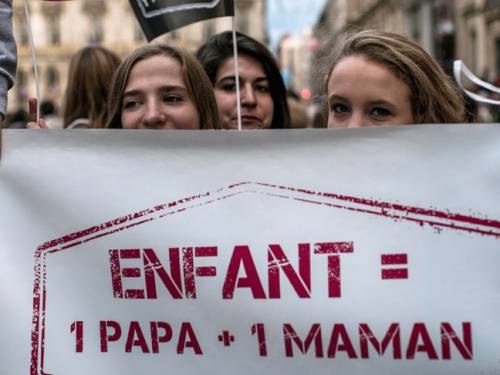
According to numerous press sources a demonstration in France in favor of marriage and against Francois Hollande's proposal for marriage "equality," as though a marriage is not an equal undertaking, numbered in the several hundreds of thousands and, according to some sources, over a million! Needless to say, America's mad media have taken no notice.

There are a lot of them! Source: CNN
One poll I read yesterday indicated over 50% of French person favored gay "marriage," but an identical percentage opposed adoption of children by homosexual couples. Many of the signs at the protest were a variation of something like "1 man + 1 woman = child." Here we see a integral element to the marriage debate sorely missing in the United States and United Kingdom: children! Perhaps the first daughter of the Church has retained common sense in some pockets after all!

In the English speaking world we have often framed the marriage debate over whether or not it is traditional to have one man and one woman unions, whether nature intended it to be that way or whether people who hold such tenets are just fuddy-duddy antiquarians who cannot adapt. Children change the matter.

It cannot be contested that one man and one woman are the procreators, the people who make children, and by virtue of that, the family, happen. No matter what strange devices are derived by vulgar imaginations, one fellows will never, ever conceive a child within the realm of the natural. Why? God made it that way, of course, but this reasonable explanation will not do for many these days. Consider this: the child takes his or her cues for future gender-behavior from his or her parents. A boy will learn who to behave, or not behave, from his father and learn what traits to seek in a woman from his mother. The mother also nurtures the boy while the father teaches him how to do things unique to being a man. Gay couples simply cannot do this, o at least not well, and certainly not without confusing children.

Come on people, think about it!