Thursday, March 28, 2013

Great and Holy Thursday: Usque ad Mortem Obediens Factum


Usque ad mortem obediens factum—"obedient unto death," words constantly repeated in the Divine Office today and tomorrow.

There are two ideas that catch our attention today: (1) a sadness over the impending loss of a loved one, the One and (2) the choice of accepting what Christ offers us.

First, the sense of loss is one made in the Roman rite through subtlety, something not well known in the Eastern rites, where dramatic and symbolic gestures dominate the liturgy. At Tenebrae, Mattins and Lauds sung in a progressively darker setting the night before the particular day, we sang the ferial psalms with three sets of lessons. The first set of lessons, taken from the Lamentation of the Prophet Jeremias, begins with the words Quomodo sedet sola civitas, "How sits the lonely city." The Lamentation is full of morose imagery: widows, weeping, tears, gates broken, and "remembering the days of her affliction" (lesson 2). The Prophet is staring at the great city of Jerusalem, where God's chosen people lived, in utter desolation some time after being sacked in the sixth century before Christ, a tragedy which saw the Temple of Solomon destroyed.

At the time of the Last Supper the Crucifixion had not yet taken taken place, but two millennia later It has, and we can look back to it it with the same same fascinated macabre through which Jeremias looked at the "lonely city." More importantly, Jerusalem was not a city with a temple. It was a temple with a city attached to it. Everything about Jerusalem revolved around the temple and the promises God made to the Jews through it. Similarly, Christ likens Himself to a temple, which he challenges the Jewish priests to destroy and which He will rebuild within three days (John ch. 2).

At Mass the finest vestments are worn and the altar is prepared as it would be for the greatest of feasts. The Gloria is sung de tempore for the first time since in two months, with organ and bells blaring. It is  a time for celebration and for joy. Yet, the organ stops and is not heard again. The word "alleluia" is still absent and the Gloria Patri.... ("Glory be to the Father....") prayer is missing from the Mass. What a quiet contrast. If I may be crude, I think of the initial joy followed by liturgical starkness as representative a great party for a friend who you love, but may never see again. You want to sing, dance, eat, and cry with this person, yet your heart and mind still cannot be satisfied because you know your friend will be gone in a few hours and you have no control over his fate. That friend is our Lord today.

The second theme of the day is accepting what Christ gave us. Many in our Roman tradition emphasize the ordination of the Apostles, though the "form" throws the Thomists a real curve, or the institution of the Eucharist. Yet, reading St. John's Gospel from chapter 12 until the Passion begins, one cannot help but notice everything is one continuous discourse. After washing the feet of the Apostles Christ tells them that His commission and His commandment for them is love of one another. He continues to clarify that He is of His Father, and that only through Him and His love will anyone see His Father. The Apostles are humanly confused at the moment, but our Lord promises them the "Paraclete," the Comforter, who will illuminate them and preserve them in Truth at the appropriate time. Yet by the time Jesus says these things Judas has gone, being told "What you must do, do quickly." The Apostles cannot fully understand what is transpiring before them. My own poorly-formed opinion is that their sins and lack of grace impedes them from seeing Christ as He truly is. Yet, Jesus allows them to hear His entire message that night and prays to His Father in heaven for unity among them.

Judas does not hear the message. Is he included in our Lord's prayer? It is unclear.

Caravaggio's Betrayal of Christ
Judas is a case study is turning away from God and losing one's soul to the abyss. We find intimations in the Gospel that Judas had an eye for money, accosting the sinful woman for pouring valuable perfume on Christ's feet (John ch. 12). Perhaps he thought he could start a revolution. Perhaps he was disappointed in the sort of Messiah Jesus was. Perhaps he was simply greedy. Either way, Judas did not lose his soul in any one instant. It was a gradual decay of his faith in Christ. Yet our Lord allows this betrayer to eat at His table and partake in Holy Communion. How welcome are we to approach then! How kind God is! Yet, we must be careful with this kindness and approach it worthily, as Judas also illustrates the compounding effect of sin wrought by an unworthy communion.

For his sins, although He knew Christ in a more human way than anyone who has lived since 33 AD, Judas was excluded from Christ's discourse on union with His Father, on love, and on the comfort God grants. Judas removed himself from all these things.

We cannot gerrymander with God. We must accept what Christ offers us, everything, even if His message, His commands, His actions, and His precepts for living discomfort us, as they should. Judas tried to pick and chose what of Christ he wanted, mainly a miracle-worker who would eventuate some desired effect. But this is wrong, both for Judas and for us.

Christ's love is so complete and so perfect that we lose our souls by not embracing it when it is offered to us. Take it, all of it. Much like the Eucharist....


Wednesday, March 27, 2013

Mandy Thursday: The Most Dreaded Hymns

Today, Spy Wednesday, and tomorrow, Many Thursday give us the Church a lot to consider: Judas's betrayal of our Lord and his subsequent punishment, the Last Supper, the Institution of the Priesthood and Eucharist, the Washing of the Feet, the Agony in the Garden, Christ's interrogation by the Sanhedrin, and Peter's denial. Heaven and Hell seem to fight in darkness over these next two nights. Therefor I think some lighter fare is appropriate today!

I have decided to post, for your benefit, some of the worst hymnody in Christendom, music played at my university chaplaincy on Mandy Thursday last year. The previous year I had been treated to Nos Autem, Pange Lingua, Ubi Caritas, and other memorable antiphons and motets in Oxford. Last year there was no such benefit. Only the most insipid, banal, and trite music, below the quality of a toothpaste commercial jingle, would suffice for Mandy Thursday, especially for the mandatum.

First, the notorious Gather Us In


Then came a modern rendition of the Gloria, though a piano and some sort of flute replaced the trumpets and the singing lacked the studio recording's subtlety (you read that right, modern Church music has a "studio version" and a live version!)


Then came the mandatum, when we were compelled to listen to such communitarian drivel as the Servant Song and the Taize version of Ubi Caritas, which, aside from a few words, has nothing to do with the Gregorian chant from the old rite


The offertory saw such hits as I Am the Bread of Life and One Bread, One Body


Communion was followed by the always moving Pan de Vida, which at least did not have the percussion section as this rockin' "live" rendition does


Mercifully, Pange Lingua was sung during the Blessed Sacrament procession. Phew!

Saturday, March 23, 2013

Palm Sunday: An Exercise in Ignorance


Today is one of the great days in the Church's year, Palm Sunday. Today we re-live and commemorate both the Lord's entrance into Jerusalem and His Passion and death. It is also a day which highlights our personal ignorance of God, in spite of what seems obvious in retrospect. Two millennia later, we safely judge these concatenation of events. At the time their meaning was not so obvious, and would not be until Pentecost. Are we ignorant of the truth of God's actions?

Jean Baptiste Jouvenet's Raising of Lazarus
Just a few days before, on his way to Jerusalem, our Lord Jesus stopped in Bethany at the news Lazarus, one of his beloved followers, had fallen ill. By the time Christ arrived in Bethany, Lazarus had been dead and buried for four days. Yet Christ took pity upon him and his sisters, Mary and Martha. Jesus here reveals Himself to be more than a prophet, more than a healer, more than a local mystic or anti-establishment rabbi. he has dominion over death.

Christ asks Martha, "I am the resurrection and the life: he that believeth in me, although he be dead, shall live:
 And every one that liveth, and believeth in me, shall not die for ever. Believest thou this?" (John 11:25-26). She responds that she does believe. Christ turns to the tomb where Lazarus has resided in decay and rot for days and yells "Lazarus, come out!" And the man who was not near death, but dead, was now alive.
Not quite understanding the gravity of what transpired, but still chocked and interested (John ch. 12), the people came to see and greet our Lord when he finally arrived in Jerusalem. As Benedict XVI pointed out in his second Jesus of Nazareth book, Jesus sent two Apostles ahead to acquire a donkey and a horse, meaning He already had a following in Jerusalem. Other places in the Gospel indicate that outside the Apostles, Christ had a significant entourage, several hundred people or more. These were those who greeted  Him with palms and enthusiasm. The rest of the crowd sought a thrill or novelty. Actually, did not the Apostles and other disciples? They knew more than the people of Jerusalem, but they comprehended practically nothing. In my moments of cynicism I cannot help but interpret certain words of Jesus's like "How much longer must I endure this generation?" as "These people are ridiculous." The Church has understood this frustration over the years. St. Leo the Great remarks in a sermon "Let man's weakness, then, fall down before the glory of God, and acknowledge herself ever too feeble to unfold all the works of His mercy."
Reading from Exodus at the dry Mass at the Institute of Christ the King
seminary in Gricigliano, 2003
What was the purpose of the palms? I've always wondered. At some level there is a practical and honorific element to the placing of palms in the path of the Lord, almost saying that the ground on which Christ's donkey walks is unworthy to support the Lord. Yet we ought to recall some typology from Exodus. During the Mass today there is actually a "dry Mass" (Missa sicca) to bless the palms, a ceremony with an introit, reading, gradual, Gospel, preface, Sanctus, and blessing prayers, much like a Mass. the reading from the "dry Mass" is from the book of Exodus, at the moment when Moses and the Israelites arrive at an oasis of twelve fountains and seventy palm trees. The Israelites had left their bondage but would not have made their way out of Egypt without rest, a place of shade, and some water. In short, the palms provided that. As those palms and water provided the Israelites the means of leaving the bondage of slavery, so Christ provides His people with the means of leaving the bondage of death. The third of the five collect prayers to bless the palms contains not a few didactic lines:
The branches of palms, therefore, represent His triumphs over the prince of death; and the branches of olive proclaim, in a manner, the coming of a spiritual unction. For that pious multitude understood that these things were then prefigured; that our Redeemer, compassionating human miseries, was about to fight with the prince of death for the life of the whole world, and, by dying, to triumph. For which cause they dutifully ministered such things as signified in Him the triumphs of victory and the richness of mercy.
The procession from the aforementioned celebration of Palm
Sunday by the Institute of Christ the King in 2003
In the first millennium there would be two Masses in Rome. The first would be celebrated in the presence of the Pope at St. Mary Major, where palms would be blessed and distributed. The focus of this Mass would be Palm Sunday. There would then be a procession to St. John Lateran, the cathedral of Rome, where the Pope would celebrate a Mass about the Passion of the Lord. The current arrangement of a "dry Mass" followed by a procession and a Mass of the Passion is a remnant of that, unlike one uses the newer rite, which is very reduced.
A procession of clergy and laity, holding their palms and preceded by a veiled cross—as the mystery of the Cross is hidden!—leaves the church and takes a path eventually leading back to the front door, which is sealed, a representation of the resistance of the people of Jerusalem to our Lord. A small choir still within the Church sing the hymn Gloria, Laus, et Honor Tibi Sit in alternation with those outside. The entrance of Christ, the unease of the Jewish people, the laud of Christ's followers, and the Lord's lament for Jerusalem are not simply re-enacted, but re-visited! At the end the subdeacon knocks on the door of the Church with the cross, opening it. From here the Mass of the Passion begins.
Glory, praise and honor to Thee, O King Christ, the Redeemer: to whom children poured their glad and sweet hosanna's song.
Hail, King of Israel! David's Son of royal fame! Who comest in the Name of the Lord, O Blessed King.
Glory, praise and honor to Thee, O King Christ, the Redeemer: to whom children poured their glad and sweet hosanna's song.
The Angel host laud Thee on high, On earth mankind, with all created things.
Glory, praise and honor to Thee, O King Christ, the Redeemer: to whom children poured their glad and sweet hosanna's song.
With palms the Jews went forth to meet Thee. We greet Thee now with prayers and hymns.
Glory, praise and honor to Thee, O King Christ, the Redeemer: to whom children poured their glad and sweet hosanna's song.
On Thy way to die, they crowned Thee with praise; We raise our song to Thee, now King on high.
Glory, praise and honor to Thee, O King Christ, the Redeemer: to whom children poured their glad and sweet hosanna's song.
Their poor homage pleased Thee, O gracious King! O clement King, accept too ours, the best that we can bring.
Glory, praise and honor to Thee, O King Christ, the Redeemer: to whom children poured their glad and sweet hosanna's song.

A short clip of the door knocking ceremony


Subdeacon opens the door with the processional cross
at the FSSP church in Rome, 2012
 The Mass is one of the most beautiful of the year, and especially notable for its music, including the singing of psalm 21 as the tract, the full Passion according to St. Matthew, and the Gospel in the "haunting" tone.

The prayers at the foot of the altar are the reduced form used in Passiontide, the last two weeks of Lent. This form omits the Iudica me psalm and the Gloria Patri.... doxology, which is also omitted in other parts of the Mass as at a requiem Mass. As Fr. Andrew Southwell, OSB once said, Mother Church "is in mourning."

The Epistle is from St. Paul's letter to the Philippians, in which the Apostle writes that at the "name of Jesus every knee should bow, of those that are in heaven, on earth, and under the earth." Christ's sacrifice on the Cross for man gives Him primacy over all things in God's creation.

The gradual today, as in very ancient days, is a full psalm and not just an excerpt. It is psalm 21, which Christ quoted from the Cross: "My God, my God, why hast thou forsaken me?" The Father did not desert the Son, but today the psalm functions as an allusion, as the psalm describes the pains of a man suffering for the sins of the world.

Deacons reading the Passion according to St. Matthew
Then three deacons enter the sanctuary and begin to sing St. Matthew's account of the Passion of our Lord, beginning with the events leading up to the Last Supper and ending just after Christ's death on the Cross, for which there is silence and all present kneel.

The three deacons then leave and the deacon of the Mass asks for the blessing, incenses the Gospel book, and sings in a special chant-tone the burial of Christ. The separation from the Passion reading may not be intuitive, but it is instructive: this is the Gospel reading of the Mass, not the Passion—which is an interpolation into Mass. Christ's death and burial are the point of this Mass, which should clear up confusion for us, as opposed to those who watched these events two thousand years ago with little or no break, and who were left in bewilderment as to what to make of the drear they had just witnessed.

In the video to the right, Fr. Tim Finigan sings the Gospel of Holy Tuesday in the same tone used for the Gospel of today. It is sublime.

The Mass continues as normal, with no extra "frills."


At Vespers the hymn Vexilla Regis is sung, which beings with the words:
Abroad the regal banners fly,
Now shines the cross’s mystery;
Upon it Life did death endure, 
And yet by death did life procure.
The hymn makes a conclusive elucidation of the mystery of Palm Sunday, that the Cross is slowly unveiled before our eyes. We do not merely read about it in the Scripture or hear some analysis in the sermon, but we enter these mystical events which are so monumental that they do not know the limits of time. Perhaps one of the great tragedies in the Roman rite in the last century or so is that with the endless stream of reforms begun by St. Pius X, furthered by Pius XII, and concluded by Paul VI, we have lost the notion that the liturgy reveals mystery to us, that it is a method of worshiping God, but also a tool God gives us to understand Him.  The raising of Lazarus, the veiling of the Cross, the Old Testament significance of the palms, the restless and lamenting entrance into Jerusalem, and the Cross itself make "sense" to us here. Through the lessons, the Mass, the hymns, and procession today God lifts the veil of ignorance the people of Jerusalem had when they went to see the One who raised a man from the dead and, in their own understanding, turned Him over for death, not realizing His dominion over it.

A blessed Palm Sunday.

Thursday, March 21, 2013

Friday in Passion Week


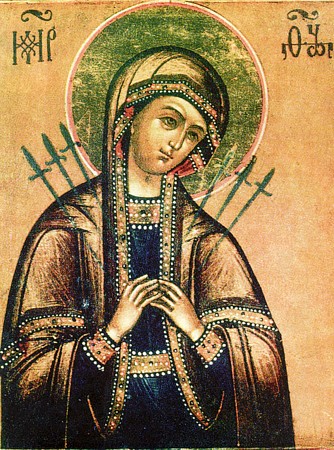
Tomorrow is Friday in Passion week, a rare day in which the Church permits a festive Mass to be celebrated during Lent, the Mass "Seven Dolours of the Blessed Virgin Mary." Because next week is dedicated to Our Lord's Passion and the week after to his glorious Resurrection, the Church provides a time for us to consider the sufferings endured by His Mother in union with Him, as where is the Mother there is the Divine Son. Our Lady's Seven "Dolours," or "Wounds," are:
  1. The Prophecy of St. Simeon when Our Lord was presented at the Temple (Luke ch. 2)
  2. The flight of the Holy Family into Egypt (Matthew ch. 2)
  3. The disappearance of Jesus for three days in the Temple (Luke ch. 2)
  4. The Blessed Virgin meets Her Son on the way of the Cross
  5. The Death of Jesus on the Cross (John ch. 19)
  6. The deposition of Jesus from the Cross and His placement in Mary's arms (Matthew ch. 27)
  7. The burial of Our Lord in the Tomb of St. Joseph of Arimathea (John ch. 19)
A Russian Orthodox icon of Our Lady of Sorrows

The Gospel of the Mass, St. John's account of the Crucifixion, when Jesus says to John "Man, behold thy mother" and to Mary "Woman, behold thy son," reminds us that <an, represented by the young Evangelist, was given to Mary as her child. As the new Eve, Her too redeemed by Christ, has a unique role in humanity before God. She is what Eve should have been and more. While She was born sinless, like Eve, She not only did not sin, but Her union with the sufferings of Christ give Her a paramount place in God's creation. Indeed, She is above anything else God has created, even the Angels. Therefor, having maintained her virginity, purity, sinlessness, and being united to Our Savior in His Passion, the Virgin is a powerful intercessor with Her Son and with the Father for us.

The offertory chant of the Mass, taken from chapter 18 of the prophecy of Jeremiah, sums up her purpose for us succinctly:
Be mindful, O Virgin Mother of god, when you stand in the sight of the Lord, to speak good things for us, and to turn away His anger from us.

Lastly, Mary's sufferings are commemorated a week before Good Friday, fittingly. This Mass is an opportunity to take our minds off our fasting and penance, the purpose of which is to aid us in listening to God, and turn our attention to Our Lord's impending Passion. The time of preparation is ending. The time of the Cross is about to begin.

I will leave you with the sequence from the Mass and a translation I like.


At the Cross her station keeping,Stood the mournful Mother weeping,Close to Jesus to the last.
Through her heart, His sorrow sharing,
All His bitter anguish bearingNow at length the sword had passed.
Oh, how sad and sore distressed
Was that Mother highly blessedOf the sole begotten One!
Christ above in torment hangs,
She beneath beholds the pangsOf her dying, glorious Son. 
Is there one who would not weep‘Whelmed in miseries so deepChrist’s dear Mother’s pain untold.
Can the human heart refrainFrom partaking in her pain,In that Mother’s pain untold?
Bruised, derided, cursed, defiled,She beheld her tender Child,All with bloody scourges rent. 
For the sins of His own nationSaw Him hang in desolationTill His spirit forth He sent.
O sweet Mother! fount of love,Touch my spirit from above,Make my heart with yours accord.
Make me feel as you have felt;Make my soul to glow and meltWith the love of Christ, my Lord.
Holy Mother, pierce me through,In my heart each wound renewOf my Savior crucified.
Let me share with you His pain,Who for all our sins was slain,Who for me in torments died.
Mix’d with yours let my tears be,Mourning Him Who mourned for me,All the days that I may live.
By the Cross with you to stay,There with you to weep and pray,Is all I ask of you to give.
Virgin of all virgins blest!Listen to my fond request:Let me share that grief of yours.
Let me, to my latest breath,In my body bear the deathOf that dying Son of yours.
Wounded with His every wound,Steep my soul till it has swoonedIn His very Blood away.
Be to me, O Virgin, nigh,Lest in flames I burn and die,In this awful judgment day.
Christ, when You shall call me hence,Be Your Mother my defense,Be Your Cross my victory.
While my body here decays,May my soul Your goodness praise,Safe in heaven eternally.Amen.

Tuesday, March 19, 2013

Papal Coronation Part III: The Coronation Itself

Coronation of St Celestine V
The coronation of the Pope can take place in any number of locations. Some say it was always at St. Peter's, while others indicate that Popes were crowned at St. John Lateran. Leo XIII and Benedict XV were crowned in private ceremonies in the Sistine Chapel. Pius VII was crowned in exile using a tiara of paper mache at San Giorgio's in Venice. In recent memory the Papal Coronation, and the new rite inauguration, has taken place in St. Peter's Square. Pius XII and John XXIII were crowned on the balcony overlooking the square, while Paul VI, who held the Mass on the steps of the Square, was crowned at the throne erected in front of the doors to the Basilica.

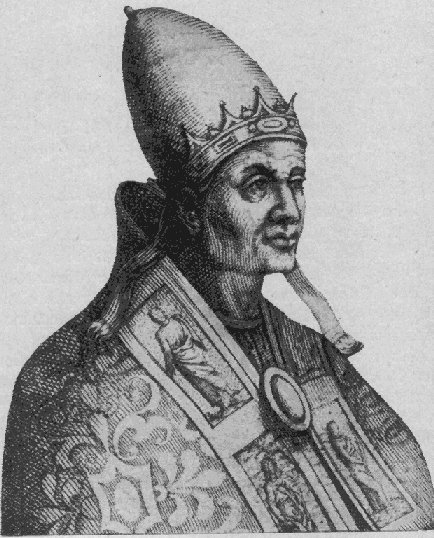
Benedict VIII wearing an early tiara
made of cloth with one crown
It is worth saying a few words about the tiara itself. The origins of the Papal tiara are unclear, though the bright thinkers over at Wikipedia seem to believe it rooted in Anatolian headware. Pope Constantine mentions a Byzantine hat called a camelaucem in the eighth century. Either way, it was likely some sort of secular apparel, that is, it was not used during Mass or the Divine Office or other manner of liturgical function. It could have been used in processions, simply as a headpiece distinct to the Papal office, but still with a practical function. By the ninth century a crown appears at the bottom of it, as is seen in coins depicting Sergius III and Benedict VII. Around this time bishops start wearing imitations of the tiara made of softer material with hard lining that can be collapsed and re-opened, the bishop's mitre! This would also suggest that the tiara had come to enjoy some sort of liturgical significance, if bishops were modelling their own liturgical dress after something the Pope wore. Again, perhaps in processions or before and after Mass. New crowns were added in the following centuries and the style became shorter during the baroque period. Despite use of the tiara, which had taken on both political and religious meaning during the "Age of Faith," the Pope adopted use of the bishop's mitre for Mass and the Divine Office.

Back to our coronation! The Pope and his ministers make their way to the place of coronation and the Pontiff seats himself in a throne erected for the occasion. The Dean of the College of Cardinals sings a few short versicle prayers followed by a Pater Noster in silence followed by a short collect. The Pope's mitre is removed, the tiara is given to proto-deacon (senior most), who places it on the head of the Pontiff with the words:
Accipe tiaram tribus coronis ornatam, et scias te esse patrem principum et regum, rectorem orbis in terra vicarium Salvatoris nostri Jesu Christi, cui est honor et gloria in saecula saeculorum.
Receive the tiara adorned with three crowns, and know that you are father of princes and kings, ruler of the world, vicar on earth of our Savior Jesus Christ, Whose is the honor and the glory for ever and ever.
After some silence, or in practice, applause, the Urbi et Orbi blessing would be announced to those gathered. The Pope with the tiara, would then give the fourt-part urbi et Orbi blessing, with the people kneeling for the final part. At this point the Papal Coronation has ended and the new Pontificate begins in earnest!

1939 coronation of Pius XII


Sunday, March 17, 2013

Lenten Wisdom from St. John Climacus

source: orthodoxwiki
Last Sunday was, in the Byzantine rite, the fourth Sunday of Lent and the commemoration of the great seventh century ascetic St. John Climacus, or St. John of the Ladder. I commented last week on the icon written to illuminate the meaning of his book The Ladder of Divine Ascent, but said little about the book itself. To save both you, fair reader, and I some time I will simply share some of the more memorable lines, aphorisms, and nuggets of holy wisdom from the great Sinai saint.

" The Christian is one who imitates Christ in thought, word, and deed, as far as is possible for human beings, believing rightly and blamelessly in the Holy Trinity." (Step 1, Section 4)

"Some people living carelessly in the world have asked me: 'We have wives and are beset with social cares, and how can we lead the solitary life?' I replied to them: 'Do all the good you can; do not speak evil of anyone; do not steal from anyone; do not lie to anyone; do not be arrogant towards anyone; do not hate anyone; do not be absent from the divine services; be compassionate to the needy; do not offend anyone; do not wreck another man's domestic happiness, and be content with what your own wives can give you. If you behave in this way, you will not be far from the Kingdom of Heaven.' " (Step 1, Section 21)

"To admire the labors of the saints is good; to emulate them wins salvation; but to wish suddenly to imitate their life in every point is unreasonable and impossible." (Step 4, Section 42)

"A servant of the Lord is he who in body stands before men, but in mind knocks at Heaven with prayer." (Step 4, Section 102)

"To judge others is a shameless arrogation of the Divine prerogative  to condemn is the ruin of one's soul." (Step 10, Section 14)

"The sun shines on all alike, and vainglory beams on all activities. For instance, I am vainglorious when I fast; and when I relax the fast in order to be unnoticed, I am again vainglorious over my prudence. When well-dressed I am quite overcome by vainglory, and when I put on poor cloth I am vainglorious again. When I talk I am defeated, and when I am silent I am again defeated by it. However I throw this prickly-pear, a spike stands upright." (Step 22, Section 5)

"An angel fell from heaven without any other passion except pride, and so we may ask whether it is possible to ascend to Heaven by humility alone, without any other of the virtues." (Step 23, Section 12)

"In all your undertakings and in every way of life, whether you are living in obedience, or are not submitting your work to anyone, whether in outward or in spiritual matters, let it be your rule and practice to ask yourself: Am I really doing this in accordance with God's will?" (Step 26, Section 91)

"Do not be surprised that you fall every day; do not give up, but stand your ground courageously. And assuredly, the angel who guards you will honor your patience."

"The forgetting of wrongs is a sign of true repentance. But those who dwell on them and think that they are repenting are like a man who dreams he is running while he is actually asleep...."

Saturday, March 16, 2013

Papal Coronation Part II: The Mass

Mass sung by Pius XII

On the altar are two Papal tiaras to the Epistle (right) side and two episcopal mitres to the Gospel side (left). Seven candles adorn the altar, with the crucifix in the center, and another row of candles in front of the altar over the tomb of St. Peter. Relics of Saints are often placed on the altar, as are two small statuettes of Ss. Peter and Paul. The Pope and the ministers of Mass arrive at the main altar of St. Peter's Basilica, with the sedia gestatoria left right behind the Pope, as it will be needed momentarily.

The cardinals who are not ministers of the Mass or acting as chaplains to the Pope at his throne go to their choir stalls in the apse of the Basilica. Their choir dress for Papal Mass is something of a remnant of ancient concelebration mixed with the dress of Canons: They wear a red cassock with a train, a rochet, their pectoral cross, the mitre, and, depending on rank, a dalmatic, chasuble, or cope—for cardinal deacons, cardinal priests, and cardinal bishops respectively.


Cardinal Deacon


Cardinal Priest
Cardinal Bishop
The Pope and his ministers pray the normal prayers at the foot of the altar, with the Iudica me psalm and the two Confiteor prayers, putting on the maniple after the Indulgentiam. At this point the Pope turns from the altar and sits again in the sedia gestatoria. The pallium, a woolen scarf-like vestment adorned with crosses and worn by all major bishops, is retrieved from the altar and the three cardinal bishops of Albano, Porto, and Ostia pray over the Pope:
God, who are present without distinction whenever the devout mind invokes you, be present, we ask you, we and this your servant, __, who to the summit of the apostolic community has been chosen as the judge of your people, infuse with the highest blessings that he experience your gift who has reached this point.
We supplicate you, Almighty God, effect your customary devotion and pour out on this your servant, __, the grace of the Holy Spirit that he who is constituted at the head of our church as the servant of the mystery, you would strengthen with the fullness of virtue.
God, who willed your Apostle Peter to hold first place in the inner fellowship of the apostles, that universal Christianity overcome evil, look propitiously we ask on this your servant, __, who from a humble position has suddenly been enthroned with the apostles on this same principal sublimity, that just as he has been raised to this exalted dignity, so may he likewise merit to accumulate virtue; in bearing the burden of the universal church, help him, make him worthy and for thee who are blessed may merits replace vices.
Then the senior-most cardinal deacon would place the pallium on the Pope's shoulders saying: "Accept the pallium, representing the plenitude of the Pontifical office, to the honour of Almighty God, and the most glorious Virgin Mary, his Mother, and the Blessed Apostles Peter and Paul, and the Holy Roman Church." (Coronation Rites, Reginald Wooley [Cambridge, univerity Press; 1915] 160).

Paul VI reads the Introit and Kyrie at a Papal Mass in 1964.
Here begins a normal Pontifical High Mass. The Pope incenses the altar during the introit (Si diligis me, "If thou lovest me, Simon Peter, feed my sheep"), then he is incensed, makes his way to the throne at the back of the apse with his ministers, and reads the opening texts during the Kyrie. He intones the Gloria in excelsis Deo, which the choir sings. At the end he greets the congregation with Pax vobis ("Peace to you) and prays the collect found in any Missal "pro Papa," though adjusted for the difference in who says the prayer ("me famulum tuum... da mihi...."). He says another prayer for himself privately.

Here another difference from an ordinary Pontifical or Papal Mass arises. Cantors from the choir, wearing choir dress and copes, go into the confessio, the entrance to St. Peter's tomb, and intone a litany asking the Saints to pray for the Pope; all remain standing. Rather than the customary response "Ora pro nobis" or "Ora pro eo" the response to the invocations to the Saints is "Tu illum adiuva" ("Grant him aid").

The litany beings at 1:28

A neat note: the Greek and Latin subdeacons and deacons do not sit to the side or with the Pope but, per the primitive practice at Papal liturgies, on the steps of the altar.

Pius XII listens to the Gospel at Mass
from: newliturgicalmovement.org
The Epistle, taken from the first letter of St. Peter, is sung by the cardinal Latin subdeacon and then by the Greek subdeacon according to the language and full ceremonies of the rites to which they belong. They then kiss the Pope's feet and receive his blessing while the choir sings the Gradual. During the Gradual the Pope reads the Gospel quietly as the Greek and Latin deacons make their own preparations to read the text aloud. During the Gospel procession seven candles, instead of the two at any non-Papal Mass, are carried. The Latin cardinal deacon sings the Gospel, taken from the 16th chapter of St. Matthew, after the Dominus vobiscum. He is followed immediately by the Greek deacon who sings the text in Greek, again with the introduction and full ceremonies accorded to the Byzantine rites. This is a wonderful example of the full extent of the Papal ministry, which is not limited to the Latin Church, although it also respects the traditions, history, and privileges of the Eastern Churches. As per the Byzantine custom, only two candles are present during the Greek reading of the Gospel, so five candle-bearers leave.


Greek reading of the Gospel

The Latin and Greek subdeacons bring the Pope Latin and Greek Gospel books to kiss, and then the Pope is incensed. He immediately intones the Credo.

Archdale King describes the remarkable measures taken against poison from here until the Pope's communion:
"Precautions are taken against poison, and a pregustatio ceremony for the tasting of the bread and wine takes place at the offertory. After Et homo factus est has been sung in the Creed, the cardinal bishop and apostolic subdeacon wash their hands at a credence, and then unfold a linen cloth, edged and divided with gold lace, over the mensa of the altar. The cloth originally served as a corporal and covered the oblata. The subdeacon in a humeral veil brings up the burse and corporal, two purificators and a silver box of hosts. The burse and hosts are received by the deacon, who spreads the corporal. In the meanwhile, the sacristan in a humeral veil carries the chalice, paten, purificators and gold spoon to the papal credence on the gospel side of the altar, accompanied by an acolyte with two empty cruets and a small vase. The sacristan assisted by the cup-bearer or pantler, then purifies the sacred vessels, spoon and cruets with wine, and the water cruet with water. A small quantity of wine and water are poured into a vessel, and consumed by the cup-bearer: the remainder put into the cruets and given to the acolyte. The sacristan in a humeral veil places the vessels on the altar. Then the cardinal deacon takes the three hosts, and lays them on the paten: with one of them he rubs the paten, and with another touches the inside and outside of the chalice. These two hosts are consumed by the sacristan with his face turned towards the Pope; while the third serves for the Mass. The testing of the oblations is concluded by the cardinal deacon pouring a little of the wine and water into a vessel, which the cup-bearer immediately drinks. The deacon pours enough wine into the chalice for three people, and the subdeacon adds the water with a gold spoon. If the occasion of the Mass should be a canonisation, candles, bread, wine, water, young turtle-doves and two other small birds are offered to the Pontiff after the Creed.

Eight prelates carry torches for the elevation, but there is no bell either then or at any other time in a papal Mass. The use of a small bell has never been introduced, even for a Mass said in the presence of the Pope.

 Aside from these measures, the Mass is quite standard until the consecration, except no bells are rung, as they were never introduced to Papal Mass. The honor guards kneel—and salute—during the consecration, as do the ministers of Mass, but the Greek deacon and subdeacon only make a profound bow—as is the norm in their rite. During the elevation of the Blessed Sacrament and the Chalice the Pope turns in half circles, so as to show Jesus Christ to each point of the compass. During the elevations the baroque jazz section that gave us so much grief earlier redeems itself by playing a lovely piece called the Silveri Symphony.

Canon from John XXIII's coronation. Start at 2:35

Paul VI communicates from the chalice via the fistula in 1964.
After fracturing the host following the Pater Noster the Pope says the communion prayers and retires to his throne. At this point a deacon would again consume part of the Host, this time consecrated, to test for poison. The Latin subdeacon receives the Blessed Sacrament on a Byzantine styled plate with a covering called an asterisk and brings the Sacrament to the Pope at the throne for communion. The Latin deacon brings the Chalice with the Blood of the Lord and a gold straw called a fistula used to communicate from the chalice but not risk spilling anything, as there are no altar cloths to sop up any potential accidents.

The Pope then gives communion to the Latin deacon, standing, and subdeacon, kneeling. Both kiss his ring before receiving communion. No one else receives communion at Papal Mass, coronation day or otherwise. The Pope then gives the Kiss of Peace, the pax, to the deacon and subdeacon and ablutes his fingers in a small chalice. He then resumes his pontifical gloves and returns to the altar, blessing the cardinals and canons in choir as the passes them.

At the altar the Pope reads the communion verse, "Tu es Petrus et super hanc petram aedificabo ecclesiam meam" ("Thou art Peter and upon this rock I shall build my church), then greets the people and sings the post-communion prayer aloud. The dismissal, "Ite, missa est," is sung by the deacon behind him. As the altar of St. Peter's is both ad orientem and versus populum neither the Pope nor deacon turns when they make their greetings. The Pope then gives the standard three-part pontifical blessing of any bishop, but without the mitre on his head, and says the prologue from St. John's Gospel, the "Last Gospel," on the Gospel side of the altar. During the blessing the "Auditor of the Roman Rota," a legal counselor who works in the Holy See, holds the Papal processional cross next to the Pope. The Pontiff then gets re-mitred, returns to the sedia gestatoria, and is taken in procession to the place of the coronation, accompanied by more of those damn horns (you thought you escaped them when Mass started, did you not?). Were this not a coronation Mass, the Pope would take off the pallium and maniple following the Mass and leave them at the altar, as shown below.

Pius XII after a Papal Mass in the 1940s. By 1950 his health was in rapid decline and he began using low Masses or had cardinals celebrate public Masses in his presence
Next, the coronation....