Showing posts with label Pope Benedict XVI. Show all posts

Saturday, May 13, 2017

The Future of the Roman Liturgy & the Ordinariate Option


In his 2015 article The Silent Action of the Heart Cardinal Sarah wrote in L'Osservatore Romano that he would welcome a return to normative oriented worship in the fourth edition of the Pauline Roman Missal. “Liturgists” decried the cardinal’s assertion of orthopractic worship and let a more intriguing textual suggest slip by, that is, the desirous return of the Roman offertory prayers. Unlike the Canon Missae, offertory prayers originated in the Middle Ages and never enjoyed a universal text, so why reify such a narrow restoration? The old Roman offertory is now the most commonly used Sunday and festive option in the most recently approval Roman Mass books, the Missals for the various Ordinariate communities whose worship descends from Anglican rites. Has the Ordinariate Missal become a test run for the future of the Latin liturgy? No, but the future itself is less certain than it was just a few years ago.

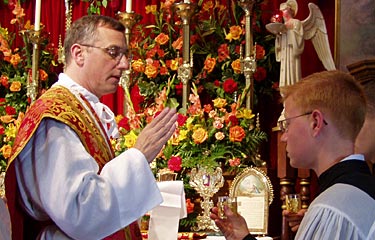
The Ordinariate Liturgy

“Almighty God, unto Whom all hearts be open” are the first distinctively Anglican words at the Ordinariate Mass to an average Roman Catholic who attends either a Paul VI or pre-Conciliar Mass. In fact this prayer is not Anglican at all. It originated in pre-Reformation England and appears in several editions of the Sarum Missal’s prescribed clerical vesting prayers.

The Ordinariate Missal is not the Sarum Mass or the Tridentine Mass celebrated in English. It is an adaptation of Paul VI’s Mass to a manner of liturgical worship that originated in post-Reformation England and done in accordance to the Book of Common Prayer. Several features of the Prayer Book rites of Eucharist are inserted into the Mass at their appropriate times (the litany, the Comfortable Words, the Prayer of Humble Access) and numerous Anglican formularies appear along Roman greetings (“Christ our Passover is sacrificed”). The Missal renders the texts in an early modern-style English rather than the literal translation now in force for the Roman Missal and the heretical translation previously in force.

Paul VI’s Mass is more than a palimpsest for Prayer Book texts in the Ordinariate rite. The eventual outcome of the Ordinariate liturgy reflects Anglican tradition as much as it reflects the sort of Anglicans who took advantage of Benedict XVI’s generous offerings in Anglicanorum Coetibus. While many who have come over to the Church do so from a “high” American Anglican patrimony of sung Prayer Book Eucharist and Evensong services, a similar number of English extraction converts come from an “Anglo-Catholic” background, wherein some variation of the Tridentine Mass or English Missal was done in fiddleback vestments and Benediction followed Vespers. These celebrants and faithful come to the Ordinariate familiar with the prayers before the altar, the priest offering “a flawless victim” for the benefit “of all Christians living and dead,” the triple Domine non sum dignus, and the Johannine prologue. These prayers are medieval Roman prayers which are as proper to the spirituality of many in the Ordinariate as “Almighty and everliving God….” While they do not belong to the patrimony of William Laud they do belong to the patrimony of the Ordinariate.

Anyone who can attend an Ordinariate Mass, even if infrequently, should do so. The Mass captures the illative part of Catholic worship between reverent words spoken to God and the sweetness needed to move a Christian to devotion without delving into profundity. The parishes tend to exceed the average diocesan church in music; the propers are almost always sung as are motets and hymns. The now-cathedral in Houston even has a Rood Screen, an element of pre-Reformation liturgy if ever there was one. The Divine Worship Missal transposes much of what was good in post-Reformation Anglicanism into the contemporary Roman Mass for most excellent use by Ordinariate parishes.

A True Reform of the Pauline Mass?

Benedict XVI’s 2005 Christmas address to the Roman Curia brought the impossibly post-modern academic phrase “hermeneutic of continuity” into the vocabulary of liturgists and students of ecclesiology. A small collective of critics of the modern Church arose from Benedict’s pontificate. These men tended to have been ordained from the time of Paul VI and John Paul II, too young to remember the days before the Council and too old to be caught up in the post-Summorum traditionalist movement; the outlook on what went wrong always included the liturgy, although agreement on what was never universally agreed upon. The one consensus of their liturgical critiques was that the Mass of Paul VI had been misapplied, that those who brought “Pope Paul’s New Mass” into parishes did so with the “hermeneutic of rupture” rather than continuity. In Work of Human Hands: A Theological Critique of the Mass of Paul VI Anthony Cekada personifies this generation of priests as “Fr. Retreaux,” who believes the reformed liturgy requires an ars celebrandi as buttoned up as an Italian cassock.

During Benedict’s papacy a style of Mass emerged in a handful of parishes in every diocese called “Reform of the Reform.” Just as the hermeneuticists of continuity could not agree with what was defective in modern liturgy, they could not agree on a consistent fix. Several different reformed styles of celebrating the reformed Mass proliferated. They included Latin chants for the ordo Missae, use of the Roman Canon, fiddleback vestments, canonical digits, singing of the propers, male altar boys, birettas, six candles around a central crucifix atop the altar, and, when possible, Mass versus Deum.

These applications of the pre-Conciliar praxis to the new Mass reflect an outlook already held by English Oratorians since the 1970s, although the Oratorians’ independence allowed them to anticipate the Reform of the Reform more thoroughly than most diocesan ordinaries will permit their pastors.

Even before the election of Jorge Mario Bergoglio, interest in the Reform of the Reform waned. No one declared it dead or read its obituary at a CMAA conference, but there was a subtle realization that “Blessed are You, Lord God of the Universe” is a Seder Meal prayer, whether in Latin or Latvian. Moreover, the assertion that Paul VI meant for the reformed Missal to be celebrated like an Institute of Christ the King Mass has no basis in the historical record. The three trial run demonstrations put on for the 1967 synod of archbishops in the Sistine chapel were a low Mass, a low Mass with hymns, and some sort of “high Mass”, all on a free standing table. Paul VI celebrated a hybrid Mass in Italian and Latin versus populum the first day the law permitted in 1964 following the changes of Inter oecumenici.

The faithful welcomed or sought improved celebrations of the Mass of Paul VI, but by 2013 few were still extolling its inherently ceremonial character. If the election of Francis did not end the Reform of the Reform, time would have. The Oratorian celebration of the Pauline Mass can be an aesthetic apotheosis that few bishops would permit; it was easier to celebrate a 3PM indult Mass for the hundred people who want it than to celebrate an improved new Mass as the primary service of the day in full view of a thousand donating parishioners. With the election of Francis to the Petrine See and the conversion of several Reformers of the Reform (notably Thomas Kocik) to the old Mass the movement to celebrate the new liturgy as if it was the old lost momentum.

No broad movement has been born out of the publication of the finalized Ordinariate Missal, but significant anecdotal discussion has come out of it and what it might imply for the Roman rite said in 99% of parishes throughout the world. A celebratory change in the new Mass could only accomplish so much without becoming awkward and uncharacteristic of its intent. The Ordinariate Missal offered something Benedict’s outlook did not, the possibility of fundamental changes to the text in the post-Conciliar Missal. Few if any are interested in the uniquely English flavor of the translation, ceremonial movements, or the character of those for whom it was ratified, merely how it might prove a useful precedent for improving what people have to sit through one hour a week.

What did attract the attention of post-Benedictine Catholics were the Anglo-Catholic features of the Missal, namely the prayers before the altar with the double Confiteor, the Tridentine offertory, the restriction of Eucharistic prayers with an explicit preference for the Roman Canon, and the Johannine prologue at the end of the Mass. All traditional elements of Roman worship present in a ritus for former Anglicans and all absent in the Missal of Paul VI.

So the question arises, could the Mass of Papa Montini effectively remain as is in its lectionary and sacramentary, but find the eventual additions of certain elements from the old Mass, saved only by the miracle of the Ordinariate? Or, put another way, could the Ordinariate Mass, sans its many Anglican texts imported from the Prayer Book, be a template for how the new Mass might look in twenty or fifty years? Is the Ordinariate a typos of the general Roman Church’s future?

No, it is not, but the future is increasingly difficult to ascertain.

The Road Ahead

There are a few hundred traditionalist Mass centers, regular or irregular, in the United States. There is a similar figure in France, which comprises a significantly higher percentage of practicing Catholics in that country. Currently there are a humble 43 Ordinariate parishes in North America with similarly modest figures in England and Australia. Along the same vein various Oratories of Saint Philip Neri have appeared regularly in the Anglophonic world, always styled after their English counterparts rather than their Continental ancestors.

These groups collectively make up a fraction of a percent of the Roman Church throughout the world, yet discussion about the future of the Roman Church tangibly looks at little else if only because there are few other places to look. Countries which once propagated Catholic culture are now utterly bereft of it. The land of Ferdinand and Isabela championed gay marriage long before most European nations would touch the issue; 17% of Spaniards attend Mass. The Fraternity of St. Pius X has served a few Mass centers in Portugal for nearly five decades and has never had a vocation from that country; 19% of self-identified Catholics hear Mass on Sundays. The most stunning collapse of Christianity has transpired in Ireland, where, in the wake of institutional protection of pederast priests and an economic boom in the years after the birth of the Common Market, Mass attendance has dropped from 90% to below 30%; Maynooth seminary operates at 10% its intended capacity. Hardly any of those who still attend Mass go parishes staffed by Ordinariate priests, traditionalists, hermeneuticists of continuity, or reformers of the reform. Yet this topic must necessarily revolve around those very people.

The shortage of vocations to the priesthood in more troubling that the decay of Mass attendance, if only because it offers fewer opportunities for those weak in faith or who attend Mass for habitual reasons to remain somewhere near the bosom of the Church. Jansenism is for the devout, the Church is for all. While Rorate-Caeli could hardly suppress its Alleluias that every parish in Limerick, save for the Institute of Christ the King, will be without Mass every other Sunday, others understand that this marks the beginning of the end for a highly structural, NGO institutional Church that emerged after the 19th political revolutions and normalization of Catholicism in non-Catholic countries. There are enough faithful to justify a few Sunday Masses, but fewer and fewer priests to celebrate them.

Progressive relics from the ages of Paul VI and John Paul II, who for years yearned that the laity might have greater participation in the “ministries” of the Church, may finally get their hearts’ desire, the priestless parish. Meanwhile, the real battle should be over what emerges among those who do celebrate Mass, barring a drastic change in paradigm such as the normative ordination of married men in the West.

Among priest-filled parishes will emerge destination churches, the kinds of parishes people seek in preference to the nearest convenience. Traditional forms of Catholicism are not merely the fastest growing in vocational numbers, they are the only places where there is growth. These various expressions of traditionalist or conservative parish life invariably favor some brand of liturgical orthopraxy, numerous priests living together under one roof, and offer more programs than the average parish. These parishes appeal to a broad range of faithful, from aesthetes to families with children, the simple and the over-educated. Parishes like this currently struggle in bringing the middle of the Church through their doors, the weekly Mass and little-catechized people in suspect marriages. However, as clergy fade without replacement and the less anchored lamentably lapse, the “remnant” may not have much choice but to embrace these destination churches.

In France there are already less than a hundred priestly ordinations a year, between seventy and eighty when excluding the archdiocese of Paris. Various purveyors of “destination parishes”—FSSPX, FSSP, ICRSS, IBP, Communauté de Saint-Martin, the diocese of Fréjus-Toulon, and traditionalist monasteries—gradually occupy a larger and larger percentage of the declining total. A similar effect might eventually take root in less “integrist” lands where one off communities like Oratories or canonries become thriving focal points of dioceses, even if they do not make up a significant portion of priests. Destination parishes will never make up the majority of the Roman diocesan churches, but then again neither did the Dominicans, Franciscans, Oratorians, or Augustinian Canons. Movements are never effected by majorities, but vocal minorities whose vigor convinces a surplus to throw in with their cause or become amenable to their view.

The surplus in this case is whatever remains of the diocesan priesthood, men who survive seminary formation and who are spread thin like butter over too much bread in a cluster of parishes in France or alone in a rectory built for five in Ireland. Diocesan formation is as mediocre as it has been since the 1970s, save for a few reputable programs. The “JP2 generation”, however, does not share the political views of its antecedents and often not its liturgical views either. Anecdotally, diocesan seminarians are either friendly to traditional liturgy or indifferent on the matter with the former more resolute in its interest than the latter in its disinterest. This hardly constitutes a movement, but it does constitute a group of people who can be moved, especially if they already have something in common with more vibrant destination churches than they do with those where the weak continue to lapse.

The Growing Rift

The failure of the Reform of the Reform or improved celebrations of the Mass of Paul VI to take root originate in two distinct places, the nature of the new liturgy’s introduction and its regulation.

Conventionally, attempts at Tridentinizing, medievalizing, or simply making more reverent the common celebration of the Montinian Mass came from desire to continue a pre-existing liturgical maximalism in an age where the ceremonies and texts did not agree with symphonic Masses or Palestrina’s motets. This was certainly the case with Msgr. Schuler or the Brompton Oratory. The purpose to prolong a certain liturgical style characteristic to a parish did not apply to the majority of churches after 1970. More relevant today is without formation in the old liturgy few clerics feel compelled to sublimate its genius in the context of the new liturgy.

The other impediment to the various essays at “enriching” the new liturgy is that organic development is both unknown and illegal in the modern liturgy. The new Missal is without essential change since its introduction, not unlike the Roman liturgy from the time of Trent until the nineteen regrettable years of Pius XII. Celebrants follow an intuitive combination of what is in the book and what they have watched since childhood. The ritual imitation of the old rite once called Reform of the Reform comes across as stilted, misapplied, and out of place. It is even more difficult to imagine a textual enrichment of the new Mass from the old, or from other sources, in the current milieu. The books of the reformed liturgy are regulated and published by the Congregation for Divine Worship without the input or approval of local priests, who habitually follow its familiar gestures.

While the number of priests continues to contract and the number of more traditional (broadly understood) Masses proliferate, the very barriers to the long desired “mutual enrichment” remain, the barriers of inorganic formation and of the centralization around the new rite. Diocesan clergy who wish for more to their new rite Mass than the odd Latin Agnus Dei at Christmas may find it easier to throw in their lot with the “stable groups” who want an old Mass or with destination parish clergy who have adopted a different outlook altogether.

One might optimistically tend to think this would eventually effect a more traditional version of the new liturgy. It will not. Unlike diocesan clergy, bishops are selected abroad from among men whose dedication to the current causes of national conferences and Rome outweigh their sympathy for the interests of parish liturgy. As long as this remains true the new Missal will remain as is, without any mutual enrichment, Tridentinisms, or new developments of its own accord.

What might this mean in a world of fewer priests and less ecclesiastical structure to watch over those who remain in parishes rather than in the growing fraternal communities? Diocesan clergy who were interested in the old liturgy, in part or whole (a sizeable minority from purely anecdotal experience), but who were not interested in leaving their hometowns for ‘50s-ism or Nerian spirituality, may find themselves free to expand their offering of the old Missal rather than toy with what they know they may not change. As peculiar as it sounded ten years ago, traditionalist communities have expanded modestly, but diocesan Latin Masses have grown by a multiple. Many remain at odd times for small groups, but the growing normality of the [putative] 1962 Missal could well justify a liturgically-minded pastor’s expansion of his Mass schedule to include a Latin Mass at 11AM rather than at 2PM, especially if he is the only priest in a parish.

The danger in this emerging trend of traditionally minded seminarians, priests, and priests of what we have termed destination parishes is that the Roman Church’s internal divisions would become externally manifested by liturgical praxis. If the French trend continues and diocesan interest in the Latin Mass increases, a third of French clergy may be Tridentine Mass-saying integrists who support the National Front while the other two thirds wear golf shirts around town between celebrating one monthly Mass at each parish in their clusters. Bishops, again, almost always strangers to their own flock, will have less and less in common with a growing segment of their own clergy. What are they to do with such priests? Ghettoize them? Leave them be? Promote them to larger parishes on merit?

Reform or Return?

1982 might have been the optimal year to re-instate the pre-Conciliar Latin liturgy as the normative Mass in the Roman Church. John Paul II re-established a nominal orthodoxy regarding sex, the roles of the sexes, and basic doctrines that were ignored during the stagnant post-Conciliar days of Papa Montini. Regardless of his phenomenology the Polish Pope created an externally sound perception to the Church that hid the liturgical abuse so arrant to those inside. Liturgical experiment continued in some circles, but a general mediocrity, born in suburban American parishes, became the international standard. So why would 1982 have been the best year to return to the old Roman ways?

In that same year The Tablet published results of a poll of English Catholics concerning the liturgical reform. Over 40% desired a return to the old Mass; the next largest block were indifferent; only a quarter preferred the new Mass to the old. The new liturgy’s novelty factor had run its course during an age when the former ways were still within living memory of most priests and laity. A return would have been difficult, but far easier than either a return to the old rite or a revitalization of the new rite has proven today.

There also existed the issue of Archbishop Marcel Lefebvre, who, for what good he did, missed a grand opportunity at this juncture. He founded the Seminary of Saint Pius X in 1970 with permission of the diocesan bishop for the formation and ordination of priests. Doctrine concerned the French archbishop as did clerical education. Liturgy ranked lower on his list of priorities. Originally, the Seminary of Saint Pius X, and the associated priestly fraternity that governed it, was intended for the training of clergy who could return to their home dioceses for regular parish work; Cardinal Siri sent men to Econe in the early years and incardinated a few into his diocese, presumably celebrating the “illegal” Latin Mass until Paul VI noticed. If he had qualms about the new rite, then those qualms arose from what the new rite represented more than the integrity of the rites themselves; how could he celebrate the 1962 rite otherwise? After his 1976 suspension by Paul VI the “rebel archbishop” found himself the subject of religion segments in the newspapers and the topic of shorts in international news. During the same period a significant number of clergy in the United States and Europe, some retired and some forced into “independent” ministry, could have reverted to the old rite with the inspiration that a charismatic, orthodox figure could imbue. As a former missionary who baptized thousands of Africans, Msgr. Lefebvre should have been that very figure. The requisite inspiration never came, and the old Mass remained a symbol of opposition to Dignitatis humanae and French democracy. At the peak of his potential influence Lefebvre quietly began to work with the Vatican for a successor bishop and in the process forced the entire non-Francophonic populace of his Fraternity into adopting the 1962 liturgy over the pre-Pius XII book in force; it seems “pre-Vatican II” and “Latin” were more operative in the Fraternity’s liturgical outlook than “tradition.” Lefebvre never lawfully received his successor bishop; the June 30, 1988 consecrations and the following Vatican pseudo-liberation of the 1962 Mass in Ecclesia Dei adflicta all but ensured the old liturgy would stay in the realm of ghettos for those who could not move on.

Spiritual Health

While a wholesale return to the old liturgy remains an elusive dream, the prominent return of older rites in a larger portion of the Church remains more probable than a reform of the Pauline Mass along the lines of the Ordinariate Missal or a better practice of the current Novus Ordo liturgy. On its own, diverse rites cause little trouble; Lebanese Catholics attend rites based on whether they live in a Maronite village or Melkite village. However, liturgical diversity within narrow geographies, when the liturgical boundary is not also a national or cultural boundary, has a checkered history on a larger scale. Melkite Christians lost their original Antiochian liturgy and were compelled to adopt the Byzantine rite. Roman missionaries in Ethiopia attempted to foist the Roman rite on the locals and separate the priests from their wives. In a divided Church liturgy has historically been used as a symbolic weapon against those with a different idea of how to be a Catholic. Given the turbulence of the contemporary Roman Church the Pauline Mass, old Mass, and reformed new Mass—if the latter two gain sufficient “market share”—may provide visible markers of division between contrasting opinions of what constitutes a Catholic.

In a normatively Catholic world justice would demand those who believe themselves in the right to combat those in the wrong at the parish level as Athanasius did against the Arians and Augustine against the Donatists; even the Great Western Schism, which controverted the legitimacy of the rival popes more than any doctrine, was reduced to the local church with rival bishoprics. We do not live in a normatively Catholic society anymore, any further diversity risks creating an Anglican menagerie if the liturgy merely becomes a banner for other causes.

The broad mission of liturgical restoration must make inroads with seminarians and celebrants for diocesan churches in order to be anything other than a sect within a sect. Anything less than meeting Catholics where they are—poorly catechized, in dubious marriages, and agnostic to Latin—will only succeed in creating more minute groups dedicated to long dresses, home schooling, lace albs, and the National Front. The new liturgy has too little history and too much centralization to reform itself organically while the old is too different from the new to be introduced in a broad stroke; with these challenges, champions of reform—or, more accurately, restoration—would be wise to let reverent liturgy inform the culture of a parish rather than force an arbitrary culture on those who seek reverent liturgy.

Benedict Revisited: Felix Culpa?

Four weeks ago more Roman Catholics celebrated the traditional rites of Holy Week than at any other point since 1955. Deacons sanctified the Paschal candle by inserting blessed incense into the torch that burns with the uncreated light. During the blessing the Levite remembered God’s permitting the Fall of Adam: “O felix culpa quae talem et tantem meruit habere redemptorem.” God, wrote Saint Augustine when he coined the term felix culpa, does not create evil, but he does allow it if a greater good might prevail.

Never before have the futures of both the liturgy and the institutional structures of the Church been less certain. Past attempts to focus the reformed liturgy through the lens of tradition belong to extenuating circumstances in an era gone by, while current attempts, exemplified by the Ordinariate liturgy, are bound to be thwarted by the bureaucratic root of the contemporary Mass. Groups desiring more orthopractic liturgical forms have experienced modest growth, but the most startling numbers lay in the growth of vocations in these “destination” communities, which figure to make up a sizable minority of the shrinking institutional Church within a few generations. Those favoring older rites have a clearer path to influence than Reformers of the Reform, although they lack any clear route to the restoration they so desire unless they are willing to engage younger diocesan celebrants who are amenable to tradition and not weighed down by the baggage of post-Vatican II Traditionalism.

In a Church where some purport to speak for the Magisterium, some for God, some for Kasper, and all for Bergoglio, any liturgical revival threatens to become a battlefield for other conflicts that will make visible those divisions which have already insinuated the subterranean structures of Western Catholicism. Yet does not natural justice demand the right thing be done irrespective of circumstance? It does, and targeting strife within the Church is far apart from trying to survive it. Laity, unfortunately, suffer more than clergy amid disputes between Churchmen and their causes, as happened during the Great Western Schism, the Reformation, and the 20th century liturgical revolt.


Benedict XVI’s liberalization of the 1962 liturgy may well have been a felix culpa in clarifying competing factions and the struggle for the Church’s temporal future. More importantly Benedict’s motu proprio led to a dual effort to revive the ’62 rite and improve the new rite using its existing text. The abandonment of the Reform of the Reform and visible trend to pre-Pacellian rites among diocesan Traditionalists can only mean people have looked at the existing Roman liturgy in both “forms” and found it wanting. While the future is less certain than ever the current revival of the old rite and trend towards the un-revised Roman liturgy represent the first genuinely organic, non-committee driven liturgical movement in the Roman Catholic Church since the original Liturgical Movement a century and a half ago. A grassroots transition through an Ordinariate-style Missal would benefit the faithful, but there exists no viable channel for such a transition.

Thursday, February 16, 2017

The Legacy of Benediktuskirche


The recently published book-length interview with the Pope Emeritus, Last Testament: In His Own Words, goes far beyond the opening discussion about his resignation and retirement, also recapitulating the childhood, youth, and unexpectedly dramatic ecclesiastical career of Joseph Ratzinger. Some items from his memoirs and earlier interviews are revisited and clarified, and some controversies—like his falling out with the heretic Hans Küng—are discussed at length. Most interesting is the P. Emeritus’s continued identification as a theological progressive, and his belief that being such was always the right choice.

I do not intend to review the book as a whole, but I will share a few interesting selections from Ratzinger’s final interview. We need to be reminded, I think, of how little of a friend he was and is to the various traditionalist movements in the Church.

After the war, Ratzinger began his studies in Freising with his brother Georg, at a school that had been founded with a monastery by St. Corbinian in AD 716. He speaks of a retreat led there by a certain Professor Angermair:
He was a fresh, new thinker who particularly wanted to take us out of the cramped piety of the nineteenth century, and into the open. You sensed the new mood, and it was a breakthrough for me, so to speak. Accordingly, your curiosity then grows while you’re in university, even if everything wasn’t quite so convincing there. (Ch. 6)
This sense of moving out of a cramped spirituality and theology was a prominent aspect of the 20th-century Modernists and quasi-Modernists, although in many respects their accusations were true. There was a kind of tunnel vision when it came to theology and spiritual formation, especially as it was disseminated to the laity, and this sense of unjust confinement led contemporary thinkers to be careless when breaking off their shackles.

The topic comes up again when Seewald asks Ratzinger why he has seldom addressed the topic of Hitler and the Third Reich:
Well, the eyes are always looking to the future. And it was not specifically my topic. We had the experience within us, but to reflect further on it historically or philosophically was something I never saw as my task. For me the important thing was to conceive the vision for tomorrow. Where are we today? How will things proceed with the Church? How will things proceed in society? (Ch. 6)
From there the questions proceed deeper into his theological vision, and it is worthwhile to quote him at some length:
Well, I didn’t want to operate only in a stagnant and closed philosophy, but in a philosophy understood as a question—what is man, really?—and particularly to enter into the new, contemporary philosophy. In this sense I was modern and critical…. [I] didn’t simply want to learn and take on a closed system, I also wanted to understand the theological thinkers of the Middle Ages and modernity anew, and to proceed from this. This is where personalism, which was in the air at that time, particularly struck me, and seemed to be the right starting point of both philosophical and theological thought….
We were forward-thinking. We wanted to renew theology from the ground up, and thereby form the Church in newness and vitality. In this respect we were lucky that we lived in a time in which both the youth and liturgical movements had opened up new horizons, new paths. Here we wanted to press forward with the Church, so that, in precisely this way, she would be young again. At that time we all had a certain contempt for the nineteenth century; it was fashionable then. So neo-Gothic and those rather kitschy figures of saints, the narrow, somewhat kitsch piety and over-sentimentality—we wanted to overcome all that. We wanted a new era of piety, which formed itself from the liturgy, its sobriety and its greatness, which drew on the original sources—and was new and contemporary precisely because of this….
As mentioned already, I wanted out of classical Thomism, and Augustine was a helper and guide with this. In this connection it was worthwhile entering into a living conversation with contemporary philosophy. But I’ve certainly never been an existentialist….
I thought: we are young people, we have a point of entry. From this certainty that we are able to build the world anew, I was fearless before great things…. The personal struggle which Augustine expresses really spoke to me. Thomas’s writings were textbooks, by and large, and impersonal somehow….
It [the “Munich School”] was defined by the fact that it was completely biblically oriented, working from Holy Scripture, the Fathers and the liturgy, and it was very ecumenical. The Thomistic-philosophical dimension was missing; maybe that was its real benefit. (Ch. 6)
Neither I nor His Traddiness are great defenders of the Thomistic school, but the hubris of thinking that one can discard what had been a long-proven instructional tool for basic theology and exchange it for something which the beginners themselves were building from the ground up, is obvious. The theological legacy of Thomas of Aquino is no more disposable than the Fathers and Scriptures that the amatores aggiornamento supposedly respected. It is probably true that Thomism was in need of serious reform and correction, but the Summa has always been effective in its original intended use, as a beginner’s guide to theology. That is not something to be lightly dismantled.

(As a sidenote, it is interesting that at the end of this chapter, Ratzinger discusses the novels of Hermann Hesse, especially The Glass Bead Game, which ends with a spiritual-intellectual leader deciding to lay down his responsibilities and retire into a more humble life. I noted the similarities between the action of the novel and the P. Emeritus’s actions in a post last year.)

His thoughts continue as he hikes over the mountains and valleys of memory through his higher education:
In Munich we had of course grown up with a modern philosophy. Certain professors had taken us to pastures new and opened them up for us. I had taken this mood on internally, and tried to perpetuate it according to the possibilities at my disposal….
Only later was there separation between those who rejected the Magisterium and went their own way, and those who said that theology can only be done within the Church. [Meaning the supposedly divergent paths of the progressive school. -J] Then, everyone was still aware that theology obviously has its own freedom and task, that it cannot be completely servile to the Magisterium, but we also knew that theology without the Church would be theology in name only, and would no longer have any meaning. I was considered someone who is young, who opens new doors, treads new paths, so then persons who were just plain critical came to me. (Ch. 7)
He reflects later on many aspects of his experience during the recent Council:
During the period of the Council in Rome, did you sometimes stop for a couple of drinks with someone along the way?
Not as a pair, no, but as part of a small group. Especially in the theological commission. Then we often drank plentifully in Trastevere.
Plentifully?
[The Pope laughs loudly.]…
Which theologians do you actually appreciate the most?
I would still say Lubac and Balthasar….
Which camp did you belong to at that time: the progressives?
Yes, indeed, I would say so. At that time progressive did not mean that you were breaking out of the faith, but that you wanted to understand it better, and more accurately, how it lives from its origins. I was of the opinion then that that was what we all wanted….
You were charged with that [freemasonry]?
[Laughs] Yes, yes, although I really shouldn’t be held in suspicion of being a freemason…. 
Was it a mistake to convoke the Council at all?
No, it was right for sure. One can ask whether it was necessary or not, OK. And from the outset there were people who were against it. But in itself it was a moment in the Church when you were simply waiting on something new, on a renewal, a renewal of the whole…. In that respect the time was simply nigh. (Ch. 8)
Presumptions of inaugurating a new dispensation in the Church was common among mid-20th century theologians, especially the Germans. The “new wine” apparently flowed freely across the Tiber during the Council, the same place where Fr. Bouyer famously penned the corrected text of Eucharistic Prayer II on a napkin.

It was also in Trastevere, on an outdoor table at a small restaurant in 2004, where I talked at great length with another recent American convert well into the night about the many troubles in the Church. I had barely been Catholic a full year, and already I was growing sickened by the theological and moral disintegration that most of my fellow Catholics were happy to willfully ignore or excuse. It is sad to see that Joseph Ratzinger is still so full of his youthful naïveté that he defends every principle he followed, even while weakly condemning their usual consequences.

The penultimate chapter of the interview, “Shortcomings and Problems,” is a far cry from the example of Ratzinger’s hero St. Augustine, who wrote a series of Retractationes. In here, the P. Emeritus makes a long series of excuses, and casts blame for some events (especially the “Williamson affair”) on others. He claims also that the “gay lobby” problem had been entirely taken care of before his resignation.

In the concluding chapter, he ominously describes the historical import of his papacy:
Do you see yourself as the last Pope of an old era or the first Pope of a new era?
Between the times, I would say. 
As a bridge, a kind of connecting link between the two worlds? 
I don’t belong to the old world any more, but the new world isn’t really here yet.
The new world is still being constructed around us, with the neverending “year” of “mercy” and “humility.” We can only pray that its reforms will be stopped before they are irreversible.

Sts. Benedict and Joseph, pray for us!

Thursday, December 22, 2016

Benedict at Rest


Earlier this year I offered my opinion that P. Benedict XVI’s resignation was valid in spite of his blatherings-on about “active” and “contemplative” aspects of the “Petrine ministry.” But there is also the occasional argument, mostly from the outer reaches of Tradistan, that his resignation was invalid because of some external pressure that would have removed the exercise of his free agency. P. Francis, then, would be interpreted as an anti-pope reigning while the true pope still lived.

Any doubts about the freedom of Benedict’s will should be washed away by the recent publication of Last Testament: In His Own Words, a book-length interview conducted by his long time interviewer Peter Seewald. The interview begins with questions about the Pope Emeritus’s current retirement and recent resignation, and his subject is crystal clear on the internal peace surrounding his decision.

For instance, in the chapter “Quiet Days at Mater Ecclesiae,” the once-Cardinal Ratzinger declares he does not miss the papacy:
Not at all, no! On the contrary, I am grateful to God for lifting this responsibility which I could no longer bear from my shoulders. I am grateful that I am now free humbly to walk with Him, to live among, and be visited by, friends.
He admits that the fear of a lingering death—something experienced in concrete reality with his predecessor—was a minor factor in his decision:
For one thing there is the fear that one is imposing on people through a long period of disability. I would find that very distressing. My father always had a fear of death too; it has endured with me, but lessened.
The next chapter “The Resignation” takes on the subject squarely. He asserts that his decision was made after a long period of internal consideration and with minimal advice from anyone else.
An awareness of its [the decision to resign] responsibility and seriousness called for the most thorough examination, time and again having to examine yourself before God and before yourself; that took place, yes, but not in the sense that it tore me to pieces.
He notes that he wrote his resignation announcement in Latin because his Italian is not perfect, and he wanted to ensure that it would contain no ambiguity or mistakes.

Mr. Seewald asks him point-blank:
Are you at peace with God? 
Indeed, I really am.
And he goes on to ask if that peace extended to the turmoil of the Vatileaks and financial scandals rocking the Vatican before the resignation, and the Pope Emeritus’s response is telling:
I said… that one is not permitted to step back when things are going wrong, but only when things are at peace. I could resign because calm had returned to this situation. It was not a case of retreating under pressure or feeling that things couldn’t be coped with. [emphasis added]
He responds to a more blunt question about blackmail:
That’s all complete nonsense…. But no one has tried to blackmail me. If that had been attempted I would not have gone, since you are not permitted to leave because you’re under pressure…. On the contrary, the moment had—thanks to be God [sic]—a sense of having overcome the difficulties and a mood of peace.
When asked about regret, he denies having any: “No! No, no. Every day I see that it was right.”

And again he denies any illegitimate pressure on him to resign:
I therefore emphasized in my speech that I was acting freely. One is not allowed to go away if one is running away. One cannot submit to coercion. One can only turn away when no one has demanded it. And no one demanded it of me during my time as Pope. No one. It came as a complete surprise to everybody.
That is all more than enough to prove my point. If Benedict is indeed being held under some kind of house arrest by Francis and forced to say all these things, one would expect his answers to be terse or stock, or even to refuse to acknowledge them. His later words about Francis in the book are respectful, but one gets the impression that he is rolling his eyes a bit as he gives them; hardly the tone one would expect from a prisoner. One under compulsion could not show the range of emotion he does in this interview, unless we are going to consider Mr. Seewald to be a talented novelist in addition to a journalist.

The current Roman Pontiff may be unwilling to let his yes be yes and his no be no, but the P. Emeritus has no such difficulty. His tone in the book is one of a man at rest, who is enjoying his final days in peace, who can laugh and tear up when remembering his finals days as pope, and who tires of being pulled into what he now considers other people’s business.

Back when Ratzinger was first announced as the newly elected pope, an academic mentor of mine opined that he will need many prayers, because this man is also an academic and not well suited for the kind of public life that John Paul has made of the papacy. I think he was right, and that the resignation was merely a result of a man better suited for reading, writing, and contemplation having finally exhausted himself. John Paul made the papacy an extravert’s playground, leaving any future introvert popes in the lurch.

When asked about the feeling of God’s nearness, Benedict’s answer goes in an interesting direction:
Of course new insights are opened up again and again. I find this touching and comforting. But one also notices that the depths of the Word are never fully plumbed. And some words of wrath, of rejection, of the threat of judgement, certainly become more mysterious and grave and awesome than before.
Let us pray for our retired pope in his final days, especially that he would be prepared to meet the Judge, and that he will find mercy when his time comes, and rest in peace.

Thursday, September 3, 2015

FSSPX Confessions


The official line some harsh critics of Msgr. Lefebvre's fraternity have held in recent years asserts that, by lack of jurisdiction, priests of the Fraternity of St. Pius X cannot absolve sins under normal circumstances. They also assert that the 1983 Codex's provisions for crises, cases of emergency, and common error do not apply—some in fidelity to John Paul II and some out of legal positivism.

The Fraternity has always held, to the contrary, that their absolutions hold valid because of common error, because the Law supplies the faculties where jurisdiction is lacking, and because the faithful supply jurisdiction (canon 1335 allows the faithful to request Sacraments of any priest not under latae sententiae excommunication for any reason whatsoever). 

In short, it's all a mess, and Francis's latest letter does not clarify the matter. He grants that "those who during the Holy Year of Mercy approach these priests of the Fraternity of St Pius X to celebrate the Sacrament of Reconciliation shall validly and licitly receive the absolution of their sins." What he does not do is grant explicit faculties to the Fraternity, which would be necessary to fit this narrative, which posits that the FSSPX is being "given the faculty to hear confessions." The Pope is actually investing, in some rather ambiguous way, the power for the laity to give the Fraternity jurisdiction, which has been their claim all along. If the Pope does want to reconcile the followers of the man they call "the Archbishop," then it would only make sense that he ingratiate their claims a bit, ironically more diplomatic than Benedict XVI's approach—which many commentators at the time insisted was the Fraternity's last chance.

I have no vested interest in the outcome of this. I have attended one Fraternity Mass in my life and never confessed to one of their priests, but this does matter for the greater Church, for Vatican II's legacy, for the legitimacy of resistance to the new ways, and for the future of the papacy. 

Validity of FSSPX absolutions. Discuss....

Monday, July 7, 2014

Summorum Pontificum & the Rite of Econe


Today much of the Tradosphere celebrates the issuance of then-Pope Benedict XVI's Summorum Pontificum, which largely deregulated use of the 1962 Roman rite. What is really used is not 1962, I do not think anyone uses 1962 by the book, but what I call the "Rite of Econe," the result of tinkering during the formative years of the FSSPX.

Early on, outside of France, most everyone in the traditionalist movement used pre-Pius XII. Even in France St. Nicolas du Chardonnet used pre-Pacelli until 1984 when the priest in charge of that church died. For some reason 1962 caught on in France. Why? Perhaps during the 1960s priests became gradually more agitated and stopped accepting changes at a certain point. Rather than turning back the clock they refused to go forward. This was the case of Fr. Quintin Montgomery-Wright, who then Sarum-ized the Roman liturgy and recovered the Norman liturgical heritage of northern France. It may also have appealed because of its very sparse and simple Divine Office.*

A man who was a postulant with the FSSPX in Econe "back in the day" once told me that they did 1965—essentially 1962 with the popular parts in vernacular and options for lay people to do readings—with some modifications, among them the Ordinary of Mass in Latin and the Confiteor prior to Communion. At some point they switched to 1962 outright at Econe, meaning all Latin, no lay readers, and recovering the hour of prime. They continued to make alterations—such as the epistle in French, bows to the Cross, and no genuflection for the Jews on Good Friday—until arriving at their current praxis. Do any readers, particularly older ones, know additional details about this development? After all the rite of Econe is the Extraordinary Form.

* = for example yesterday would have been Sunday and the Octave day of Ss. Peter & Paul, warranting nine readings at Mattins (including three from the superseded octave day being read as one long ninth lesson), commemorations at Lauds, Mass, and Vespers. This Wednesday would see Vespers of St. Elizabeth of Portugal followed by Vespers of the Dead, as the Officium Defunctorum is prayed on the first free day of the month in addition to the Office of the season/sanctoral cycle. Lent and Advent are especially involved in the old Office, with the Officium Defunctorum and Requiem Masses in additional to the Lent and Advent liturgy on Mondays. In 1962 Sundays usually have three lessons as opposed to the traditional nine. The difference could be up to 30 minutes of time in private recitation during violet seasons.

Saturday, January 18, 2014

Evangelii Gaudium 247 & the Good Friday Prayer for the Jews


Pope Francis' latest work/document/encyclical/bull/exhortation/stream-of-consciousness, Evangelii Gaudium, has in some circles re-ignited the 1960s and 1970s debate concerning the [in]validity of the Old Covenant. As the Byzantine Paschal Gopsel pericope says "The Law was given by Moses; grace and truth came through Jesus Christ" (John 1:17). The words of St. John are enough for me on this matter. A better, and more detailed, summary of the Church's general outlook on modern Judaism and the idea of Covenant can be found in Fr. John Hunwicke's series on the Vatican II document Nostra Aetate, which, Hunwicke reminds us, has not earned the wrath of the SSPX, a group more than willing to pounce upon any perceived deviations within the documents of the most recent Church council.

On an entirely unrelated note, the first time I heard of Evangelii Gaudium was in the confession box at a local parish. I had to confess a sin concerning the lending of money at interest. The priest, a professed union member, spent five very long minutes telling me about "the Holy Father's latest letter. In it, and it's hundreds of paragraphs long, he really lays out how everything in our society and in our economy is just so unfair." I got three Hail Mary's.

I mention the papal document in order to opine on a liturgical and theological topic that come to my mind once and year and which I have never considered "on paper" before now. One reason is absence of opportunity. Another is that my judgment on this matter has evolved over the last four years or so. The matter is the Good Friday prayer for the Jews that existed mostly prior to Papa Ratzinger's change in 2008 and Papa Roncalli's change in 1960. The prayer that caused so much consternation is as follows:
Orémus et pro pérfidis Iudaeis: ut Deus et Dóminus noster áuferat velámen de córdibus eórum; ut et ipsi agnóscant Iesum Christum, Dóminum nostrum.
Omnípotens sempitérne Deus, qui étiam iudáicam perfídiam a tua misericórdia non repéllis: exáudi preces nostras, quas pro illíus pópuli obcæcatióne deférimus; ut, ágnita veritátis tuæ luce, quæ Christus est, a suis ténebris eruántur. Per eundem Dominum nostrum Iesum Christum filium tuum, qui tecum vivit et regnat in unitate Spiritus Sancti, Deus, per omnia saecula saeculorum. Amen.

Unlike the other solemn intercessions on Good Friday the clergy and people make no genuflection between the announcement of the intention and the actual collect.

Initially I did not think this prayer bigoted, but I did consider it unnecessarily inflammatory given the use of the term "pro perfidis Iudaeis." That all changed when then-Pope Benedict issued a shiny new prayer for the Jews to be used during 1962 rite Good Friday services. A friend of mine reacted positively to the new prayer, saying it brought us away from "tribal hate" and towards a more brotherly outlook on our antecedent religion. At this point I began to re-consider my position. Benedict's prayer, although different from the traditional one, at least asks for conversion, in stark contrast to the vague platitude in the Pauline Missal's Holy Week.

The first clue in my re-evaluation was the true contextual meaning of that term "perfidis," which does not mean "perfidious" in the modern understanding (wretched, wicked, evil), but rather "faithless." This ought not be anti-Semitic. It is merely a deduction. Anyone who does not believe in Christ lacks proper faith.

The next, and most profound, point makes the loss of this prayer a liturgical, historical, and theological travesty. The intention asks that God might "remove the veil from their hearts," which the collect proper continues to petition that the Jews might "acknowledge the light of Your Truth, Which is Christ" and that they may be "rescued from their darkness." To understand the deeper meaning and truth of this prayer we must recall what happened at the end of the Crucifixion.

"Jesus, when He had taken the vinegar, said: 'It is consummated.' And bowing His head he gave up the ghost" (John 19:30). In tract 119 St. Augustine writes "What, but all that prophecy had foretold so long before? And then, because nothing now remained that still required to be done before He died, as if He, who had power to lay down His life and to take it up again, had at length completed all for whose completion He was waiting." Our Lord's death on the Cross completes everything the Father promised in the Old Covenant and which He appointed His Son to do for our sake. The prophecies and promises are, at this point, fulfilled. Fulfillment, in the Church, does not mean something finished. Rather it means something brought to fruition.

Consequently, the covenant God made with the Jews did not vanish entirely, but became something else, something greater and, as the angel told the shepherds when He was born, a great thing "for all peoples" (Luke 2). The God Who dwelt only among the Jews and Who only revealed His intentions to them and Who only acted among them now dwells and reveals Himself and acts among all people and for the good of all. "Salvation is of the Jews" (John 4:22), but not limited to the Jews. The Old Covenant, now something greater, ends as it was. The Temple veil "was rent in two from the top even to the bottom" (Matthew 27:51). The veil, which concealed the awesome qualitative presence of God within the Temple, is entirely torn when a new, and greater, covenant is sealed in the Blood of Christ. Here is a New Covenant for all people. God, no longer hidden behind the Temple veil, is now accessible to all people. St. Paul reflects on this in his epistle to the Hebrews (9:1-8):


"The former indeed had also justifications of divine service, and a worldly sanctuary. For there was a tabernacle made the first, wherein were the candlesticks, and the table, and the setting forth of loaves, which is called the holy. And after the second veil, the tabernacle, which is called the holy of holies: Having a golden censer, and the ark of the testament covered about on every part with gold, in which was a golden pot that had manna, and the rod of Aaron, that had blossomed, and the tables of the testament. And over it were the cherubims of glory overshadowing the propitiatory: of which it is not needful to speak now particularly. Now these things being thus ordered, into the first tabernacle the priests indeed always entered, accomplishing the offices of sacrifices. But into the second, the high priest alone, once a year: not without blood, which he offereth for his own, and the people' s ignorance: The Holy Ghost signifying this, that the way into the holies was not yet made manifest, whilst the former tabernacle was yet standing."

We have come halfway to understanding the significance of the older Good Friday prayer, but only halfway.

What does a veil, curtain, or wall do? It keeps something concealed, but also protects that something from exterior elements, usually light. Our Lord said "I am the light of the world: he that followeth me walketh not in darkness, but shall have the light of life" (John 8:12). The Jewish leaders persuaded the crowds gathered in the Roman praetorium to reject Jesus and ask for the release of a bad man. After dissolving themselves of the Savior promised to them Jerusalem fell and the Temple, the place of God's covenant with them, burned to the ground. What survived was not Judaism in the pre-Christian sense, but a new sort of Judaism meant for scattered local communities and based on the Jewish people's experiences as the minority in an increasingly Christian world (the so-called "modernist" George Tyrrell wrote an interesting letter on this subject, concluding that Catholicism is the real continuation of Judaism). Rabbis replaced priests; synagogues replaced the Temple; and the Talmud became a new holy book to the Jewish people rather than the New Testament books. This reformed, leaner Judaism would help Jewish culture survive its coming difficulties and would also insulate Jewish people from the light of Christ—as it was founded partially in reaction to what Christ did. When the Father tore down the Temple veil to reveal Christ's light to all a new veil ascended to shield that light.

No one should conclude that this is anti-Semitic. Fr. Hunwicke points out that Arabs are Semites, too. This prayer is about Judaism, not Jews as an ethnic group. On some level the concepts "faithless" persons and of hiding the light of Christ with a "veil" applies to all non-believers. And yet the Jewish people, given their unique place in the chain of event that led to Christ's Incarnation, Passion, and Resurrection, surely warrant a unique place in the liturgical prayers, particularly given their once exclusive covenant with God.

I have never felt comfortable with the description of practitioners of post-Temple Judaism as our "older brothers" in the faith, given that the Judaism which preceded Catholicism no longer exists. I suspect the shift in attitude towards Judaism and the eventual revision of this prayer results from [humanly understandable] European guilt that followed the Holocaust. The pope who initially altered this prayer (John XXIII) aided Pius XII's efforts to obstruct deportations of Jews in Turkey. The pope who introduced the 1970 prayer (Paul VI) served the same Pius XII as his secretary during the War. And the pope who issued a new prayer for the 1962 Missal (Benedict XVI) was a young German man during the War and who, certainly, has a greater cultural association with the Holocaust than the other two.

And yet I maintain that the loss of this prayer is something worthy of re-consideration. It contains a wealth of lessons about covenants, the meaning of the Crucifixion, the openness of Christ's grace, and the danger of veiling Christ's light. During the first fourteen or so centuries, or more, of this prayer's use no one decided to attempt mass extermination of the Jewish people. Hitler's anti-Semitism had nothing to do with Catholicism. His was a neo-pagan, racially-based hatred steeped in the eugenicist delusions pervading secular culture in the early 20th century—not that modern "intellectuals" have disowned the spirit of this delusion. Axing this prayer added very little and pushed aside very much.

Monday, December 9, 2013

This Pope

The incumbent of the Roman bishopric has caused tremendous confusion since his elevation in March, elating liberals into thinking that Church teaching would change, only to burn him in effigy. Ultramontanists like Fr. Longenecker have expressed their disappointment in the Pope's attacks on doctrinaire Catholics while Fr. Zzzzzzz is convincing his readers than Francis is just as traddy as Benedict XVI (who was just so trad himself). And then there is the SSPX/Rorate Caeli group whose thoughts can be summed up in the words of Bernard Fellay: "We have a modernist pope."
 
Clearly this Pope, whether he means to do so or not, is perturbing many Catholics. While many readers may suffer scruples and difficulties owing to Roman politics and even the Pope's own words, let not your hearts be troubled! "Lutheran Satire," a conservative protestant pundit group, has come up with an amusing bit of insight into the current pontificate.
 

Tuesday, September 10, 2013

Anti-Semitism in Traddieland?

The Rad Trad somehow stumbled upon this passive-aggressive hit piece on concerns some Catholics, often nervous residents of Traddieland, expressed upon the election of Cardinal Bergoglio as the new Roman Pontiff. One such area of concern was that as Archbishop of Buenos Aires, Jorge Bergoglio resisted a forthright implementation of Benedict XVI's motu proprio on the 1962 rite. In our age of Ultramontanism, the idea that the Pope was not entirely lock-in-step with the Pope was unthinkable! There were several 1962 Masses in neighboring dioceses, but there was only one in the archdiocese of Buenos Aires. The Mass was a once-a-month affair and a hybrid with the Mass of Paul VI: the 1970 kalendar, the 1970 lectionary, vernacular, and lay readers were employed for the Fore-Mass (or should it be called "Liturgy of the Word"?). The laity became frustrated, according to eyewitness accounts, and attendance dwindled to the point that the Mass was cancelled. So what is the point of the title of this post?
 
Many bloggers exhibited an understandably uncomfortable reaction to this news. The idea that one Pope did not follow the other's program perfectly was problem of which even the greatest Scholastics could not understand in the modern day. Celebrity bloggers suggested that the 1962 Masses in neighboring dioceses should be counted among those in Cardinal Bergoglio's archdiocese, a factually strained attempt at re-constituting continuity between the incoming Pope and his predecessor's liturgical program. For some this was not enough. Enter the above article.
 
Pope John XII: not a pleasant fellow
Many comments about the [no longer] new Pope have been quite distasteful. That said no Catholic is obliged to like the Pope, only to acknowledge his authority. Were John XII still Pope the Rad Trad would become a hermit in order to avoid that scoundrel's scandalous activity. Some bloggers, such as the writer of the first article linked above, did not wish to consider this vital distinction and took the acerbic comments flowing from Traddieland River very personally. Unable to dispute the facts surrounding the 1962 rite within the Archdiocese of Buenos Aires with a higher level of respect than that which was perceived among traddies, the writer basically called the source of the information in the Rorate Caeli piece a Holocaust denier. The evidence? A piece written by Marcelo González in Panorama Católico Internacional. From a cursory glance Panorama seems like a run-of-the-mill traddie blog, only in Spanish. The article referenced by the reactionary blogger, Ms. Eden, is of course in Spanish. Ms. Eden, it seems, does not speak Spanish:
Five months ago, Marcelo Gonzalez announced he had reached the “fixed position” that the “so-called ‘holocaust’” is a media exaggeration. If Google’s translation is correct, he wrote that he prefers to call it “the so-called ‘holocaust’” or, alternatively, the “hollowcaust.”  You can read for yourself his blog entry “Holocaust and Hollowcaust” via Google Translate (or read it here in the original Spanish). It’s disgusting, and as a fellow member of the Mystical Body, I am ashamed.
Fortunately for us, and unfortunately for Ms. Eden, the Rad Trad does speak Spanish, and her borrowing from Google Translate does not help her case, even with the shoddy translation. The actual word used "Holocuento" literally means "Holo-story." The premise of the article is that many people, Catholics included, died as a result of Nazism, but people tend to focus primarily on the plight of European Jews. The suffering of the Jewish people was then utilized politically, the author contends, as a pretext for the foundation of the Jewish state of Israel. I do not think any historian would factually deny these claims, even the latter of them. The Holocaust was certainly the reason the United Nations chartered the state of Israel. If not for the great violence they suffered, why would Jewish people want to leave Europe? González continues in lamenting that political correction, particularly in Catholic-Jewish relations, has become something of a doctrine in the modern day, given once-Pope Benedict XVI's statement that one cannot be Catholic and deny the Holocaust (which a historically insane position anyway). This last point is the crux of the article. No where in it does the author deny the Holocaust or even question death tolls as former FSSPX bishop Richard Williamson infamously did in 2009. The author makes one statement that, when a biased person utilizing an electronic translation encounters it, lends itself to corruption:
"Sabemos que hay intereses políticos, económicos y propagandísticos en esto de fijar cifras millonarias de víctimas y sobre todo en ignorar a las otras víctimas que no fueron judíos."
Ms. Eden
It means "We know there are political, economic, and propaganda interests in fixing the numbers of millions of victims and, above all, in the ignoring of the other victims who were not Jewish." Half the people who died in World War II were not Jewish. Many people, often Catholic political prisoners, found themselves dying in concentration camps prior to the commencement of the Holocaust, which was a systematic extermination process directed against a demographic, not a political party. The shortcoming of this article is that it used the term "Holocaust" to denote anyone who died during World War II in Europe when most are accustomed to hearing it used specifically to denote the 1942-1945 actions against the Jewish populace.
 
Why does all this matter? Catholics attached to the older liturgy have, sometimes by their own faults and sometimes by the faults of others, found themselves isolated from the mainstream. This can lead to internal paranoia and external caricatures. The article suggesting Mr. González is a Holocaust denier fits into the second of these. Ms. Eden approaches the finale in her assault on this maligned Latino with a furious parade of suggestions that traddies ought to speak up now, or forever be put on the Southern Poverty Law Center's hate group list:
UPDATE #3: Rorate Caeli commenters have shown their true colors with viciously antisemitic comments to this post. I have allowed some to appear in the comments section here for the record, but the more vicious ones I have forwarded to other concerned bloggers, as I am occupied with schoolwork and do not wish to continue to engage the soft white underbelly of the rad-trad world. You may look for them on Mary Victrix, the blog of Father Angelo Mary Geiger, F.I., who has already written about this post.
UPDATE #4, 4/9/13: Closing comments so that I can get some schoolwork done today and not have to sift through hateful words against my Jewish ancestors and relatives and against those who think the Church has, in fact, continued past 1965. Many more viciously antisemitic comments have come in. I am sending the rest to Mark Shea, who has told me he will have something to say on the matter—oh, I see he just put up a post.
Thanks to the relatively few lovers of the Extraordinary Form who have written with their support. [As of 4/10/13, many more have written. Thank you!] To those who love the traditional Mass and have not commented: If you don’t want the Extraordinary Form community to be dismissed as a bunch of hate-filled, antisemitic cranks, you need to raise your voice in the public square, and not be afraid of what the veils-and-brocade police say about you.
After Mr. González issued a clarification in Spanish and English, explaining what anyone who bothered to read the Spanish version with care or find someone with proficiency in the tongue, would have already known: the article is not about the Holocaust. It is about political correctness and the Catholic Church. Ms. Eden still insists the man is a Holocaust denier:
Gonzalez says in his non-apology apology, “For this reason, I clarify, or rather I reiterate that I am convinced that the Holocaust (that is, the death of millions of Jews in concentration camps or on their way to them during the Second World War) is a fact of uncontested historicity. Other aspects – of which I cannot speak, because I am no historian – remain in the academic sphere.”
Note what he is not saying–that there was a systematic, state-sponsored plan of extermination. In his article, he in fact denies such a plan, offers other reasons why Jews died, and claims that one who accepts that there was a Holocaust “may incur in an historical error of judgment.”
So he is a Holocaust denier–because the Holocaust was nothing if not “a program of systematic state-sponsored murder” of Jews, to use Wikipedia’s current and very apt wording. It is true that the Nazis also targeted millions of others for extermination because of their race, Catholic or Orthodox religion, disability, homosexual behavior, or political affiliation, and it may be legitimately argued that the killing of these populations should be included in the term “Holocaust.” But to cast doubt in any way upon the Nazis’ systematically murdering Jews is outrageous.
Does any of this have to do with the implementation of Summorum Pontificum in Brazil? No, but the Rad Trad does not want to see a man lose his reputation because of a petty political dispute within the Church either. 

Sometimes I think about getting rid of the internet and becoming a monk....


Friday, August 9, 2013

On the Validity and Legality of the Mass of Paul VI

JohnR, a friend of this blog, recently alluded to something in a comment on the previous post concerning Fr. Anthony Cekada's thesis in The Work of the Human Hands: A Theological Critique of the Mass of Paul VI that the new Mass is invalid. His opinion is ubiquitous in sedevacantist-ville while the opinion that the new Mass is likely valid but certainly illegal was, at least once, popular in SSPX-land. The premises for both these opinions are utterly banal and without theological, historical, or legal merit, yet they exist and the Rad Trad, being in a devious mood, would like to look into them a bit more.

Validity

Fr. Anthony Cekada celebrating Mass very Romanly
Toward the end of Work of Human Hands Fr. Cekada argues on Thomistic grounds that the Order of Mass promulgated in 1969 is absolutely invalid in Latin or vernacular. Some hardline SSPXers used to argue that the common mistranslation of pro multis invalidated the consecration of the chalice; taken to its logical conclusion, there would be no Mass in that case and the consecration of the bread, since the Church does not consecrate outside of Mass, would also be invalid. But back to the more general validity issue. The reason Fr. Cekada gives is that the institution narrative in the new rite is treated as just that: a narrative, as opposed to a consecration formula. The words in the new rite, he says, do not contain the intention to consecrate and hence no consecration is possible, even if a validly ordained priest who intends to consecrate speaks the narrative words with the proper intention. Your eyes are not under the spell of glaucoma. You read it correctly. A validly ordained priest with the right intention speaking the words of consecration, which are the same in the new and old rites, cannot consecrate validly. So, is Fr. Cekada right?
 
His invalidity stance rests on intention within the "form" of the consecration. The old rite gradually builds up the priest's intention, from the sacrificial offertory prayers, through the thanksgiving prayers early in the Canon, transitioning into prayers for the living and dead, and concluding the Canon with an act of offering the Victim to God (Per ipsum....). The new rite certainly lacks this continuous flow, but I think Fr. Cekada would concede that it is not absolutely necessary. His position is specifically concerned with the consecration itself. At this point a little bit of history goes a long way.
 
When does the consecration happen? At Hoc est enim corpus meum and Hic est enim calix sanguinis mei? That has certainly been the prevailing teaching since the Scholastic era in the high Middle Ages, but it is not as clear cut as one may think. Around the 11th or 12th century priests, at the behest of the faithful often yelling from the nave, elevated the host and chalice during the Canon for their benefit and view. Some say this form of piety was a soft substitution for actual reception of the Blessed Sacrament, owing to the infrequency of reception that arose in the Dark Ages and which continued for centuries afterward. It is also at this point when scholars and theologians begin to question the specific moment of the "change." We are so accustomed to seeing those specific words of the priest as the formulation for the change that we read the rest of the Canon of Mass around it. But consider this: five centuries earlier the same Canon was sung, without pause, aloud in the tone of a preface in its entirety. A preface tone indicates that the prayer is concerned with blessing or consecrating something. The various signs of the cross and gestures made throughout the Canon differed diocese to diocese, sometimes greatly. Sarum, for example, has very few reverences (later genuflections) and a very different series of actions at the Per ipsum. For whatever reason at the end of the first millennium priests began to recite the Canon rather than sing it aloud and the gestures flourished as private signs of devotion in a private prayer. A consequence of these gestures was the partitioning of the Canon, in the priest's experience, into varying parts. The institution of the elevation of the elements had the same consequence, making the institution narratives a unique segment of the Canon.
 
Yet, without these gestures and motions we could read the Canon's text straight through and see that that institution narrative may well have been seen in earlier times as just that, a narrative. It is the justification, within the text of the prayer, for why the Church celebrates the Mass. It is hardly a story time, but rather is a public supplication to God on the grounds that we are obeying His Only Begotten Son's precepts. In those days one would of course agree that the change had taken place by the end of the Canon, although today we pinpoint it at the institution narrative. Months ago the Rad Trad published an appendix from an English translation of the Ordo Romanus Primus which contains a replication of what a Paschal Mass celebrated by the Pope may have looked like around the year 800 here. As readers will see the celebrant continues through the Canon unabated, without any special notice.
 
How does this influence our view of Fr. Cekada's thesis? The Rad Trad readily acknowledges that the change, the transubstantiation, happens at the narrative. Why? Two reasons: (1) the priest is given the power to consecrate and he intends to consecrate at this moment and (2) because the Church has agreed for a millennium to treat this particular point as the moment of transubstantiation. What the Rad Trad cannot do, and what the sedevacantist theory does do, is ignore the first ten or eleven centuries when the moment of change is at best vague or a little iffy. The Church, in her kindness and respect for tradition, cannot and does not uproot and ignore the prayers, beliefs, or intentions of previous generations of the faithful. It is for this reason that the Addai and Mari rite is valid. Liturgical historicity takes precedent over, admittedly Church sanctioned, Scholastic theology concerning forms. By ignoring this principle and by ignoring the history of the Canon itself one looks away from a legitimate reading of the narrative as a narrative. Hence the idea that somehow treating this part of the Canon as what it originally was invalidates it on defect of form is myopic.  Also, need the function of the institution words as a narrative and as consecration formula clash?
 
I have never met a priest or lay person who has read the narrative and thought any other intention other than consecration is latent in the words contained therein. One would think someone other than Fr. Cekada had caught on to the structural defects supposedly present in the altered Canon or new Eucharistic prayers.
 
Yes, it is very valid.

Licit?

St. Pius V, Pope of Quo Primum
Part of the fallout within the Society of St. Pius X over Bishop Fellay's failed attempt to give his institution canonical standing was Rome's demand that the Society sign on to the "legitimacy" of the new rite. This sounds odd, but it really just means the legality. In short, was the "new Mass" promulgated in a valid, legal action by the proper authority? Some apparently say no. Others, like one Paul Kramer in his article Legal Status of the Tridentine Mass, argue that since Quo Primum is a dogma of the faith Paul VI avoided going into schism by merely publishing, rather than promulgating, the new Mass.
 
First, we will discuss Quo Primum. Both of these positions are really variations of each other and they rest on the principle that St. Pius V's bull Quo Primum made the 1570 Missal, or at least the Ordo Missae within it, a dogma of the faith that cannot be violated and which guaranteed that it could never be taken away. This is wrong at two levels:
  1. Quo Primum is primarily a legal document promulgating use of a certain liturgical book within the Latin Church. As a legal and administrative act it cannot bind a successor of equal status should he take the proper steps to depart from it.
  2. Neither Pius V, nor any following pope, thought it was such. Two years earlier the same Pius V published Quod a nobis promulgating a Roman Breviary for general use which contains the same rules of use and prohibitions against alterations and threats of Divine retribution as Quo Primum. Urban VIII did not go into schism or heresy by changing the hymns and no one has suggested the 1911 breviary changes were illegal or invalid (although they were unwise).
Confusion over this point may have been compounded when Benedict XVI wrote that the 1962 Missal was never abrogated, which begs the question: how is any following liturgy legal? Were priests who held out in the 1970s and onward justified in their use of 1962? The Rad Trad, no canonist, does know of one distinction in Canon Law that could serve us well here and which may not, legally at least, justify those who adhered to 1962 after the promulgation of the 1969 Ordo. In Canon Law there is a taxonomy of "derogation" and "abrogation." The former is the partial removal or replacement of the existing law while the latter is its outright suppression. To abrogate the 1962 Missal, Paul VI would have had to issue some sort of legal document explicitly prohibiting use of that Missal. This was clearly never done. The "extraordinary" rite was never abrogated. All well and good? New Mass illegal? Not so fast.
 
The Pauline liturgy was not introduced to the Latin Church by the abrogation of the "traditional" liturgy. For example, John XXIII compressed festal categories into Class I, Class II, and Class III, not abrogating the old calendar entirely, but derogating the ranking system within it in his Rubricarum Instructum. The same holds true for his changes to the breviary lessons, not abrogating the [not so] old Mattins, but derogating the particular way of picking lessons in place in 1955 (both changes were ultimately made by Pius XII, although John XXIII pulled the trigger on the 1960 set). Similarly the 1962 Missal was not abrogated with the publication of the 1965 Missal, but anything in it that differed from 1965 was derogated (use of Latin in readings, the Introibo prayers, the "doubling" of certain texts, ordinary of the first half of Mass in Latin, the communion formula, the Last Gospel, and some other details). 1962 was not strictly "abrogated" but it was by no means usable. The 1967 document Tres abhinc annos introduced further changes by derogating what was different in the 1965 Missal: optional use of a weekday lectionary, optional use of different orations, the Canon was not abrogated but the rubrics governing the priest's actions during it were derogated and replaced, the entire Canon is said aloud, and other alterations; interestingly, IV.17 in that document is the first official instance, to the Rad Trad's knowledge, of a rubric that assumes Mass facing the people could be ordinary and normal outside of a few Roman parishes. On the feast of the Assumption in 1968 the new Eucharistic prayers (2-4) were introduced, again not replacing the entire existing liturgy, but replacing and derogating certain rules and rubrics, this time governing the Canon, therein. A new Pontificale came about that same year.
 
Here comes the 1969 change. Paul VI did not introduce a new Missal or a new Mass in 1969. He introduced what was mostly a new text for the ordinary of the Mass. The Canon and Eucharistic prayers, lectionary, rubrics, calendar, and Divine Office remained unchanged from the previous year. Even some parts of the ordinary itself were unchanged, given the significant alterations in 1964-8. Perhaps the most dramatic different between 1968 and 1969 is the contrasting offertory prayers, but most everything else matches. The Missal introduced by Paul VI in 1970 again did not "abrogate" 1962 or even whatever was used in 1969, but de facto derogated whatever differed from it: the old sacramentary and [again, no so] old lectionary was replaced. Otherwise, 1970 and 1969 match up very closely.
 
The idea that the new liturgy is somehow canonically illegal or that the 1962 liturgy was abrogated relies on the view that the Pauline rites were introduced and imposed instantaneously rather than gradually and under transitional, derogation-based legal auspices.
 
Thank you for reading a such dry and disinteresting post,
The Rad Trad