A nasty cold retired me from my day job and any productive blogging this past week, but it did give me ample time to resume my reading of Tolkien's
The Lord of the Rings, which I last read in 2003 while Peter Jackson's "adaptations" were in theaters. This rereading has yielded many interesting reflections lost on the thirteen year old version of myself, particularly the religious components. It would be a danger to read
Lord of the Rings as a direct Christian allegory, for it is not, but it does have broad Catholic themes, a strict outlook of good and evil, and the construction of the world, through revisions, seems to mirror the composition of our world (angelic elves, demonic orcs, Sauron as Satan, men running from their fate while capable of good and evil). One minor detail which stunned me came in chapter IV of
Return of the Ring, "The Field of Cormallen." You see, Tolkien writes this little passage:
'The fourteenth of the New year,' said Gandalf; 'of if you like, the eighth day of April in the Shire reckoning. But in Gondor the New Year will always now begin upon the twenty fifth of March when Sauron fell, and when you were brought out of the fire to the King....'
The wizard, Gandalf, refers to the date of the destruction of the One Ring, the tool by which the invisible antagonist tempts men to turn against their innate knowledge of right and wrong and to do his bidding until their own countenances are vanished. The Ring, whether conceived as such or not, is a clear analogue for the "stain of Original Sin" (cf. Vatican I) that infects men who do not live in the life of grace. Tolkien picked for its destruction Lady Day, when after centuries of prophets and kings dragging their feet to do some, but never all of God's will, a poor Jewish maiden in Nazareth gave the angel Gabriel an unequivocal "Yes" and conceived the God-Man of the Holy Spirit. Unlike C.S. Lewis, Tolkien seems too restrained to make a perfect Christological equivalent in his classic work, yet the obedience of Mary and the sin-vanquishing presence of Christ are made present by Aragorn's acceptance of his own destiny, in contrast with his vacant ancestors, and Frodo's destruction of the Ring, albeit with the help of the creature Gollum (Frodo cannot be perfect like Christ, so evil must play a part in its own destruction).
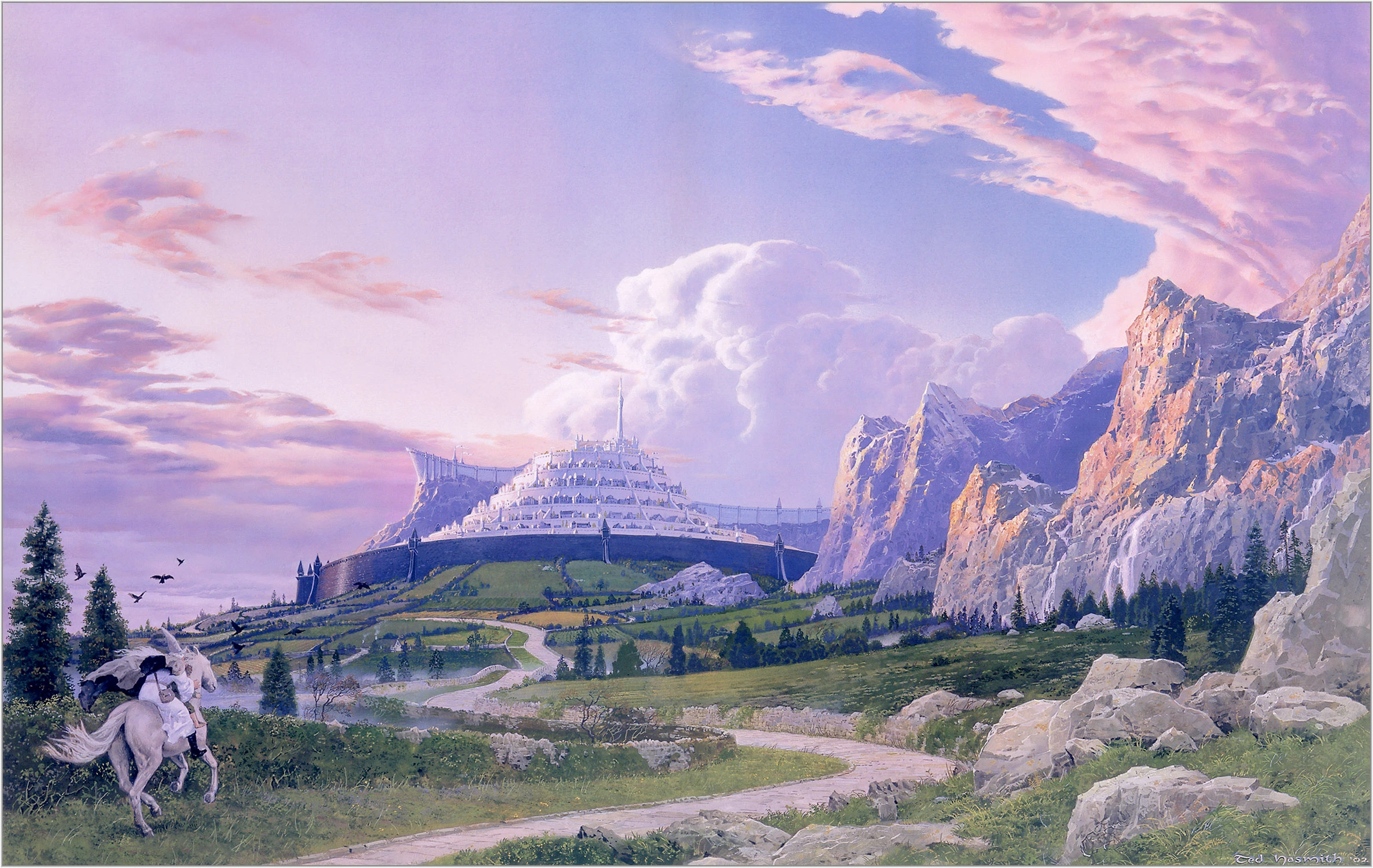
There is also the curious dating of the same to April 8th in "Shire reckoning." With no proof from the author's own records and no specialized knowledge of Tolkien aside from having read a few books, I gander that he is testing competing views of man's happiness. The Shire, isolated from the troubles of Middle Earth and also its progress, is a place of natural contentment where people carry on their lives in a traditional manner (
tradere, passing on what was received) and are fortified by their living within the confines of their realm. According to a footnote the Shire calendar has one thirty days, not thirty-one; for April 8th to coincide with March 25th the two would have to be thirteen days apart, the variance of the Julian and Gregorian calendars. Apart from the blissfully ignorant Shire, Gondor is in the heart of Middle Earth, the capital of men and right next to the citadel of evil. Aggression has less to do with its decay than its absent kings and lost purpose, all of which are put right by Aragorn's ascent to the throne after Frodo's deed. Gondor becomes what it was always meant to be, like mankind in the Saints after the Incarnation. By the end of the story Gondor is fulfilled, but the bucolic Shire has not been saved from the ravages of reality by its remoteness.
As happy and preferable as hiding from the machines of our day may be, it will not save either our world, our Church, or our souls. We must controvert our day if we are to enter our own heavenly city and join the ranks of men who were changed after the Annunciation and were restored from ancestral guilt to ancestral innocence.
.jpg)


.jpg)


