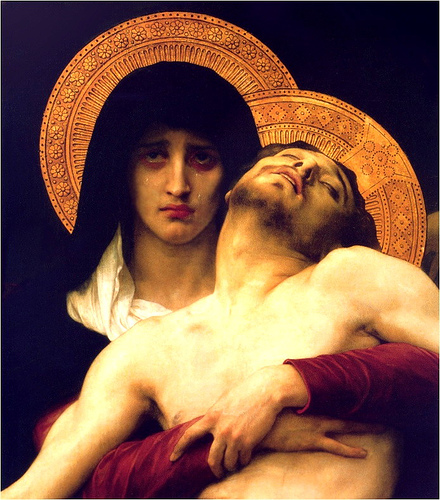
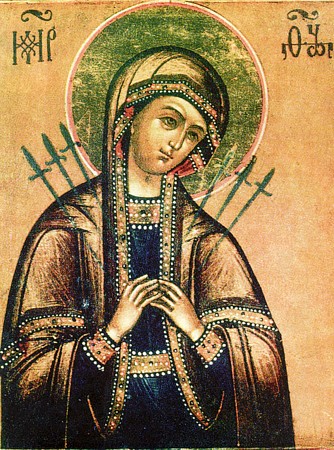
First, a very short biography of today's Saint for contextual purposes—you can find the rest with Mr. Google. John was born in the mid-seventh century to a family whose tribal origin is uncertain to us, but which suggests a long history of regional magistrates and administrators. John himself took up service and acted as an administrator for the Umayyad caliph until he left public life for a religious vocation as a monk. The saint was supposedly a polymath, highly capable in geometry and astronomy in addition to theology and philosophy. He most enduring work has been his tracts in defense of iconography and the veneration of icons in prayer, written against the iconoclast heresy of Emperor Leo III. St. John, although not within the domain of the rapidly decaying Empire, constructs some of his language and criticism of his second and third treatises against iconoclasm as though he was a citizen of Byzantium, possibly to give him better ground to abjure the Emperor. The three tracts on icons use the same material, references, and often the same exact phrases and arguments, as they are all really just variants of each other. Therefor we shall discuss them interchangeably. We will then look at his first sermon on the Dormition/Assumption of the Mother of God. Let us begin.
Note: references such as (I:9) mean Treatise I, chapter 9.
St. John's take on icons should arouse our attention, as his arguments are faithfully intuitive and easy to convey to iconoclastic Roman clergy and protestants who cannot fathom the purpose of displaying and venerating holy images. At the very heart of his defense of icons is the fact that icons are images, and images, he tells us, are very sacred and holy things. Images need not be defined merely as pictures, but as likenesses to archetypes. God the Son is a direct image, says the Saint, of God the Father, composed of the same essence, but different in Person (I:9). The Father is the cause and the Son is caused. John elucidates other "images" throughout Scripture of lesser magnitude than the Son as image of the Father, such as the Ark of the Covenant as an image of the Virgin Mary or, he takes from St. Gregory the Theologian, memory as an image of the historic event. We should see by now that to St. John images and types are one and the same thing. Types are not limited to the Old Covenant, nor are images strictly physical planks created with paint brushes. They are real reflections of God, albeit of a lesser degree.
People, then and now, commonly object to the veneration of icons on the grounds of the First Commandment, which prohibits the human fashioning of idols which are worshipped as gods. These people need to read St. Paul, who wrote that the Letter kills, but the Spirit quickens. The Jews of old, John teaches, were prohibited from delving into veneration of physical objects too deeply owing to their tendency toward idolatry and to the incompleteness of Revelation (III:4). The Jews did venerate some physical things, such as Aaron's rod, even things that were images, specifically the cherubim and seat on the lid of the Ark of the Covenant. They were forbidden from making any images of something unrelated to their God and were also forbidden from making images of their God because they did not know what He might look like (II:5). The cause of this restriction ended with the Incarnation, when God put on human flesh, sanctified it, and dwelt among us in it. God became intelligible to the human eye and human experience. As St. Paul wrote in his first epistle to the Church in Corinth, "now we see puzzling reflections in a mirror."
In venerating images, we engage in a specific type of veneration, as veneration is not a single action but rather is composed of different grades. All worship is due to God and God alone, as His nature is ineffable and above all things. Yet we can worship in many ways. We can worship God in His nature directly. We can worship Him in veneration of His actions, such as the Incarnation and Resurrection. We can venerate Him in His works. We can venerate Him in ways which we can comprehend Him in His corporeal body. Veneration of icons falls into this last level. We worship God Who became Man, and we do so by showing reverence to depictions of this intelligible and visible work of God.
John quotes the Greek Fathers, particularly St. Gregory the Theologian, constantly driving home the point that he would not need to explain the obvious concerning sacred images had the opponents of iconography only followed the Church's traditional teaching concerning them: "if anyone proclaims anything to you other than what the Catholic Church has received from the Apostles and Holy Fathers and synods and preserved up to now, do not listen to him nor accept the counsel of the serpent, as Eve accepted it and reaped death" (II:6).
The Saint finds other reasons to uphold the veneration of icons and sacred images in the Church's contemporary practice, such as praying to the saints. Neglecting the veneration of the saints, the army of Christ the King, is the same as divesting God of His army (I:21). The same applies to the icons. Does their neglect not neglect Jesus' Revelation to us in our nature? The pagans, who denied Christ's Redemption of the human race, saw their images and statues destroyed and replaced with images of God (images according to John's vocabulary) in the form of icons of Christ, of His Life on earth, of His Mother, and of the Saints (III:9).
Treatises II and III have no real ending, just a brutal series of quotations from various Greek Fathers concerning icons. Treatise I concludes in exhorting the reader to cling to the traditions of the Church (I:68). The removal of a tradition is like the removal of a foundational stone from a building: eventually it all tumbles down.
Lastly, we should consider his first sermon on the Dormition/Assumption of the Mother of God, the Virgin Mary. "How can the source of life pass through death to life? O how can she obey the law of nature, who, in conceiving, surpasses the boundaries of nature? How is her spotless body made subject unto death? In order to be clothed in immortality she must first put off mortality, since the Lord of nature did not reject the penalty of death."
Heaven and earth cannot contain God's infinite majesty, but Mary's womb did. Therefor God took her bodily into heaven after her death, so that such a virginal body which bore God the Son would not be subject to decay. She was blessed and unspotted, not after death but from her own conception. And she was considered blessed while she lived, as in the Magnificat she states that "from henceforth all generations shall call me blessed," meaning from Our Lord's conception within her, not years after her death. God planned Mary, says St. John, from the very beginning. In illustrating this point John turns to the many passages from the Wisdom books used in the Mariam feasts and Saturday votive Masses in the Roman rite—a nice nod to modern Roman readers.
By the Incarnation of God the Son the gap between Man and God was filled by God putting on human nature, specifically our Lady's human nature. She is, says St. John, the bridge between God's and Man's natures! John takes the story of Jacob's Ladder as an Old Testament type, or image, of our Lady's role in Salvation.
The Saint from Damascus finds another type of Mary in the Old Covenant by virtue of her origin. Our Lady's parents Joachim and Anne, whose "name means 'grace,'" were a barren couple who bore the spring from which Salvation and grace would flow, much like how flowers sprung forth from the rod of Aaron. The end of Ss. Joachim and Anne's sterility also meant the end of the world's spiritual sterility.
 |
| Our Lady of Silence (Assumption) |
Mary's body, so pure and holy by virtue of what Our Lord Jesus Christ did through it, could only be taken to heaven, as it belongs to the things of heaven. In another sermon, John concludes by describing the manner in which our Lady's death was followed by her Assumption (since Pius XII omitted it in his pronouncement):
"An ancient tradition has been handed down to us, that, at the time of the glorious falling-asleep of the blessed Virgin, all the Apostles, who were wandering throughout the world preaching salvation to the Gentiles, were caught up aloft in the twinkling of an eye, and met together in Jerusalem. And when they were all there, a vision of Angels appeared to them, and the chant of the heavenly powers was heard; and so with divine glory she gave up her soul into the hands of God. But her body, which bore God in an effable manner, being lifted up amid the hymns of Angels and Apostles was laid in a tomb in Gethsemane. There for three whole days the angelic song was heard.
"But after three days, the chant of the Angels ceased, and the Apostles who were present (for Thomas, the only one who had been absent, came after the third day, and wished to adore the body which had borne God) opened the tomb; but they could by no means find her sacred body in any part of it. But when they only found those garments in which she had been buried, and were filled with indescribable fragrance which emanated from them, they closed the tomb. Amazed at this wonderful mystery they could only think that he, who had been pleased to take flesh from the Virgin Mary, to be made man, and to be born though he was God the Word, and the Lord of glory, he who had preserved her virginity without stain after childbirth, should also have been pleased to honor her pure body after her death, keeping it incorrupt, and translating it into Heaven before the general resurrection."
I hope you enjoyed this little vignette on a Father who needs more attention these days. The Rad Trad, who is not really that "rad," has yet to decide who to cover next week, given the possibilities, but will make a decision in due time. In the meantime, drop the theology manuals and read the Fathers!