First order of business is to tell you all to pray for JohnR, whose wife is scheduled to deliver his fifth child today! What a blessing that should be for John and what a witness to Catholic fatherhood for the rest of us!
Second, I wish all my fellow Americans a happy Fourth of July and hope that they enjoy their time with their families.
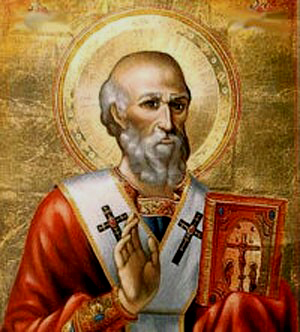
Third, and most related to the post title, St. Athanasius' De Incarnatione. "God became man so that man might become God" the saintly patriarch of Alexandria writes in section 54 of his treatment of the Incarnation of Our Lord Jesus Christ. This is the central point of the Incarnation of Christ, lifting man from his fallen state and elevating him to intimate confidence and knowledge (understood personally, not intellectually) in the Divine. Why would God do such a thing? Would not such a condescension mean a lessening of the Holy Trinity? Would the Son of God not suffer merely by taking on the human nature?
 |
| from: lent.goarch.org |
Not at all. Athanasius shares St. Augustine of Hippo's view of evil: that evil is the absence, deterioration, or destruction of something good. Through the Fall of Adam and Eve evil came into the human experience. Man, created in the image of God, received from God, Who is life, his life. What is death other than the absence of life? The introduction of evil to the human person is the loss of the Divine life, hence death. By taking on human flesh and dying as a man, God the Son restored and further sanctified the human person: "by offering His own body He abolished the death [man] had incurred, and corrected [man] by His own teaching" (section 10). Again, we ask why God would do this? We can go on and on—as many have—about justification and penal substitution, but why would God even care?
Because man, the Saint reiterates, was made in God's own image. Death means the image of God evanesces from existence, a consequence antipodal to God's very nature. This corruption of man could only be solved through God becoming man and living the same life and dying the same death as man (section 9). The Saint calls the status of man at the time of the Incarnation "dehumanizing:" man had fallen so far from his original state and become so alien to the Divine nature that he had concocted idols, false gods, and magical incantations for himself as substitutes and superstitions (section 13). God could not allow His image to follow on this slow and painful suicide.
Still, could God not restore man to his original state remotely? We often ask this question concerning Our Lord's miracles. Why did He scrub the blind man's eyes with dirt rather than just give the word so that he might be healed? Man could have been fixed from a distance, but he would not have actually learned anything or made a choice for God in such a restoration. "In order to effect this re-creation, however, He had first to do away with death and corruption. Therefore He assumed a human body, in order that in it death might once and for all be destroyed, and that men might be renewed according to the Image. The Image of the Father only was sufficient for this need" (section 13).
The Son of God did not sacrifice Himself immediately for our salvation after His Incarnation. First He had to give His presence in our nature a point and presence that could be passed on through action, and that action is love: "That ye, being rooted and grounded in love, may be strong to apprehend with all the saints what is the length and breadth and height and depth, and to know the love of God that surpasses knowledge, so that ye may be filled unto all the fullness of God" (Ephesians 3:17). Love is inter-personal, including God's love. Indeed, God is a Trinity because God is love! So God remained among men for many years doing good and showing to man what love is and how to love one another (section 16). His works revealed Him to be God.
Just as His love was inter-personal, so was His death. He died on a Cross for all the people of Jerusalem and other passersby to see (section 21). The same goes for His glorious Resurrection from death and His changing of water into wine and His casting out of demons. All these things He did in public not only so that they might be of benefit, but so that people might know them and by knowing them know Him (section 23).
Finally, in the Resurrection death, the decay and disappearance of God's image, is no more (section 26). Indeed the Apostles in their own ministries "trample upon death as something dead" (section 27). Death is crushed and is no longer of consequence to us; the death of a martyr or believer is utterly powerless to those who hold to the sign of the Cross (section 29). Those who do not believe have no facts, but instead are convicted by Christ in the death and transitory nature of their substitute gods and idols (section 31)—how true this still is today.
Athanasius gives a chapter to refuting the objections of the Jews to Jesus by examining the story of salvation in the Old Testament and specific prophecies from Osee, Isaiah, and others concerning suffering, the Annointed One, death, and rising again.
More interesting, and pertinent to today's laxity of belief, is the Saint's refutation of the gentiles and pagans. The pagans, and the Greeks in particular, object to the Incarnation's restriction of God to a particular place and His binding in terrestrial nature. St. Athanasius begins answering this common objection by first mocking the mythical and ineffective stories of the pagan gods, how stupid they are and how they succeed not in bettering human beings (section 41). The gentiles object, why did God not make Himself known to us by nobler methods, in the mountains and waters rather than in mere flesh? (section 43) Because "For, being men, they would naturally learn to know His Father more quickly and directly by means of a body that corresponded to their own and by the Divine works done through it (
ibid). "The whole of the universe was filled with the knowledge of the Lord," writes Isaiah (11:9). The Lord's influence and presence can be found everywhere which, contrary to the objections of the pagans, is precisely why He
could take human flesh. Far from a redundant act, the Lord's presence, already ubiquitous, is felt more fully by material beings now that the Lord has taken physical form (section 45).

St. Athanasius' last full chapter is a series of common sense refutations of pagan religion in action. Have the pagan gods ever really done anyone any good? Have they increased the virtue of chastity and virginity? Have they effected peace among bellicose peoples like the Chaldeans and Ethiopians, or decreased the superstition latent in those cultures (section 50)? A resounding "no." The ability of Christ to do all of this sufficiently proves His Godhead to Athanasius (section 53). The "darkness of idols prevails no more" (section 55).
Despite his times, St. Athanasius' tone throughout the work is very positive and optimistic about the power of the truth of the Trinity and it inevitable triumph in the hearts of men. Paganism would recede as man became more aware of the omnipotent God Who has dwelt with him.
This short book is an excellent case study in the relevance of the Fathers to us today. The Fathers wrote in literary terms less bound in theological terminology than the Scholastics or other later thinkers. As a result their writings manage to explain concepts to us without being doctrinaire. In spite of the Latin Fathers', particularly St. Augustine, leaning on the Roman legal tradition and the Greek Fathers' dependence on [neo-]Platonism, their examination of Christian teaching is very humane and intuitive, often based on human experience with some common sense and rationality rather than harsh reason.
Why does this matter today? Because we are not living in the thirteenth century, when our neck of the world was Catholic and people had the luxury to ask if the Virgin Mary was conceived under time-exempt privilege
per Scotus or protected from sin
per the Greeks. They are asking more basic questions like "Does God exist" or "Who was Jesus really" or "Does God actually care about us?"—all questions which, for the mass of people, will need simpler answers.
I highly recommend
De Incarnatione for some quick and light reading. You can skip the three chapters dedicated to Jews and pagans if you wish, they do not add anything to St. Athanasius' general argument.
God bless,
The Rad Trad