Showing posts with label Extra ecclesiam nulla salus. Show all posts

Tuesday, September 20, 2016

Rich Mullins, Catholic?

(source)
Yesterday was the nineteenth anniversary of the death of Christian singer-songwriter Rich Mullins, a favorite in the so-called contemporary Christian music movement during the 1980s and ’90s. While the Christian music genre was and is a largely Protestant movement, Mullins has long enjoyed some popularity among American Catholics because of the occasional influence of Catholic liturgy and spirituality on his songs, and because of his aborted attempt at conversion. I listened to him occasionally in my pre-Catholic days, especially in high school.

Raised in a family of Indiana Quakers, Mullins was baptized in the third grade and imbibed an atmosphere of social justice theology and pacifism from early childhood. He began performing music, both for a choir and in a band, at Cincinnati Bible College in the late ’70s. His career as a musician took off in 1981 when his song “Sing Your Praise to the Lord” was recorded by Amy Grant, who at the time was one of the most popular Christian recording artists. He soon began recording his own albums, and enjoyed both popularity and the respect of his fellow music ministers.

Very much a melancholic and prone to extreme moods, and (reportedly) occasional drunkenness, Mullins’ lyrics were often shockingly personal with only a thin veneer of metaphor as a barrier between him and his fans. Most of his songs are prayers, and his body of work composes a kind of Protestant Psalter. Musically, his style fluctuates between cheap praise-and-worship pseudo-rock, and intimate dulcimer-infused minimalism. His hit single “Awesome God” is not especially indicative of his larger work.

In the 1990s Mullins came under the influence of Brennan Manning, a laicized Franciscan priest who had been writing devotional books like The Ragamuffin Gospel, which notoriously out-Luthers Luther in its monistic exaltation of grace over works. In spite of this, Mullins developed an increasing fascination with Catholicism, and his 1993 album A Liturgy, a Legacy, and a Ragamuffin Band is structured in part on the new Roman Mass. In September 1997, he died in a brutal car accident on his way to a benefit concert at Wichita State University. A few days later, Fr. Matt McGuinness, head of the university’s Newman Center, shocked the musician’s mostly Protestant fans by stating publicly that he had been intending to be received into the Catholic Church.

As it turns out, Mullins had flirted with the idea of conversion for years, and had made it all the way through RCIA two years earlier before backing out of the decision. By 1997, he was often attending daily Mass and had written a musical based on the life of St. Francis of Assisi. He had finally arranged with Fr. McGuinness to make his profession of faith on September 20 at WSU Newman Center. McGuinness had also arranged for Mullins to make his first Confession with Fr. Paul Coakley (now the archbishop of Oklahoma City) at the Church of the Resurrection, a few miles north of WSU.

Today could have been the anniversary of his reception into the Church Catholic. Yesterday was the anniversary of the day he died on I-39 outside of Lostant, Illinois, a ten-hour drive from the Church of the Resurrection. McGuinness was not shy in claiming Rich Mullins as a “convert by desire” in a statement given shortly after the musician’s death, but one truly has to wonder. I am no disciple of Leonard Feeney, but it is hard to ignore a sudden and unexpected death happening so soon before a formal conversion, and presumably while sacramentally unshriven (Mullins assured his priest friend that he indeed had many sins to confess). McGuinness even mentioned in his statement that Mullins had told another friend that he was intending to move his reception back two weeks to October 4, for the feast of St. Francis. Would he have simply kept moving the date back again and again, from a failure of nerve? It’s impossible to say, but the evidence is not optimistic.

To die without Confession, without Confirmation, without the Eucharist—Quantus tremor est futurus, / Quando Judex est venturus, / Cuncta stricte discussurus!—it is a terrifying prospect. I do not wish to be morbid nor to minimize the potential of God’s mercy, but Mr. Mullins did not die a Catholic, however much he loved the Catholic milieu. The year he died, he mused in an interview, “The issue is not about which church you go to, it is about following Jesus where He leads you.”

It seems that Jesus finally led him to a lonely stretch of I-39 on a Friday night in September. Who knows where he went from there?


Thursday, May 26, 2016

Extra Ecclesiam


One of the Catholic doctrines most alien to a convert, but also the most urgent spur for conversion, is the long-disused extra Ecclesiam nulla salus. It is a cause for wonder, a mystery almost as deep as that of predestination. Fear of dying outside the Church, a society seemingly necessary for salvation, is one of the greatest motivators for leaving one’s non-Catholic life behind. The Church is the pearl of great price, the barque of Peter, the city of God, all worth more than any measly treasures that can be found outside its confines. Without the terrible suspicion that extra Ecclesiam nulla salus is true, many would never convert at all.

So what a shock it is to the convert who has sold all he has in order to obtain this pearl, to realize that few within Peter’s barque actually care about this doctrine. Even those who believe it are strangely apathetic in defending or promulgating it. The fewer who both believe and insist upon this doctrine are considered mad if not schismatic—Fr. Feeney’s disciples, sedevacantists, and a few others—which is greatly ironic if not humorous.

I am not here making any historical arguments for or against this doctrine, nor any argument concerning a particular method of interpretation. Rather, I am noting the existential crisis this necessarily causes in the soul of the convert. He has been told that he must do A (convert) in order to achieve positive consequence B (Heaven) and avoid the negative consequence C (Hell). While C is still possible after doing A, it is not avoidable without A. However, once A is complete, he is suddenly told that he might have achieved B without A, but now that A is done he can no longer achieve B if he repudiates A.

There’s a lie in here, somewhere, and the convert knows it. He knows he’s been lied to, but unsure at what point the lie occurs. Is it a lie that nobody outside the Church is saved? Is it a lie that the Catholic Church is the “Church” referred to in this doctrine? Is the lie that he could have remained blissfully ignorant of all things Catholic and floated into Heaven on his mere good intentions?

The answer, if one is given at all, is usually that “outside,” “Church,” and “no” are fuzzy concepts that admit to multiple interpretations. After listening to this half-baked sophistry for an hour or two, the convert inevitably asks the question: Did I need to convert to be saved? Heaven help him if he asks a Balthasarian. At least the Feeneyite will try to keep him Catholic.

The exclusivity of the Catholic doctrine is nearly unknown among Protestant denominations. Most of them will acknowledge the basic acceptability of other broadly Christian creedal communities, in spite of doctrinal and practical disagreements. Islam is one of the few world religions to also profess exclusivism, which is probably one of the reasons why they have opposed Catholicism so vociferously for centuries.

I am not suggesting that the proper interpretation of extra Ecclesiam is a simple or easy one, but it has to mean something, and the apologists drop the ball explaining the doctrine even while practically acting as though the interpretation ought to be strict. After all, they insist that everyone who is capable of understanding the teachings of the Church must investigate them and then strive to become her members. Their salvation, supposedly, depends on it. Which is why the apologists scurry into the cracks once they are queried about John Paul’s praise of other religions, Mother Theresa’s indifferentism towards the pagans under her care, and Cdl. Ratzinger’s assurance to a Lutheran that she could safely remain non-Catholic.

The terrifying attrition rate of Catholic converts should give us pause. Many converts feel that they have been lied to on their way in, and that the extra Ecclesiam doctrine is used as a bully stick to keep them from leaving. Nobody likes to feel trapped, and those who apostatize often do so out of a sense of desperation rather than boredom or malice.

As I’ve said before, a healthy dose of realism is necessary for those shepherding new converts into the One Fold. They need to be realistic about the failings of the Church today, and brutally honest towards those they are godfathering or sponsoring. The Church on Earth is the Church Militant, but militant not only towards the non-Catholic world and the Devil; the Catholic must also be on his guard against the many threats within the Church. It has always been this way, and if 1950s-triumphalism is responsible for any great evil it was the dulling of the wit towards internal threats.

(José Benlliure y Gil)

Sunday, May 25, 2014

Prevalence of the Feeney Thesis?

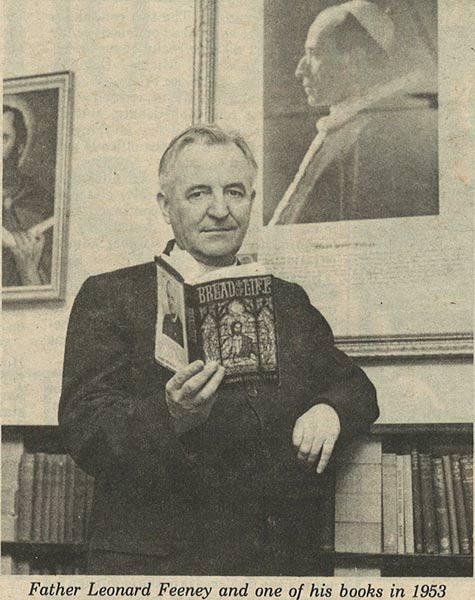
Having lived in New Hampshire I am familiar with the "Feeneyites," followers of the deceased Jesuit Leonard Feeney, a professor of Literature at Boston College who held a very strict interpretation of Extra ecclesiam nulla salus. On the Feeney scheme one must undergo sacramental water Baptism and profess juridical union with the Pope in Rome to be Catholic and hence saved, no exceptions permitted (Cardinal Cushing, a capable politician friendly with the Americanist Kennedy family, found this very embarrassing and put a lid on Feeney). I find the idea to be at best historical spurious, but I am not going to talk about Fr. Feeney's opinion itself. I am more interested in its prevalence.

New Hampshire was my first exposure to this perspective. The "Feeneyites" run the St. Benedict Center in New Hampshire which offers the '62 liturgy, promotes Immaculate Heart devotions, and prints biographical information on Fr. Feeney. They have competition from a rival group in Massachusetts. The Byzantine Catholics found the position mind boggling. Thinking this was an insulated issue, given that Feeney lived in Massachusetts, about 40 minutes from New Hampshire, I moved to Texas and forgot all about it. Now I am told that there are some upholders of this position at the FSSP church in the Dallas area, Mater Dei. Ironically the FSSPX clergy are more willing to "crack down" on "Feeneyism," possibly because it was condemned during the "good old days." This does not seem to be a "traditionalist" issue per se. The group in New Hampshire attended the Pauline Mass at a local parish under they formally reconciled with the bishop of Manchester and were granted permission to erect their own facility.

New Hampshire, Massachusetts, Texas. Are there followers of this idea where you lived my dear English readers? How about ye Portuguese? And readers in Spain? Americans are of course also invited to respond! Do please say something about the circumstances (social background, the rite of Mass used, and anything else that might be useful in aiding our understanding).