Showing posts with label Greek Orthodox. Show all posts

Sunday, February 8, 2015

When Did They Become Orthodox?


"I believe in one, holy, catholic, and apostolic Church" nearly all Christians who claim any sort of apostolic origin recite on Sundays. Among them are the various kinds of Orthodox Christians of the Eastern Churches. One friend, a Russian Jew born in Orthodoxy who left after falling victim to ethnocentrism, could not quite understand why they said that they believe in the "catholic" Church while not being Catholic. But they do believe they are the Catholic Church, and Orthodox, too.

The birth of "Orthodoxy" and the "Orthodox Church" is one of the minor mysteries in religious linguistics probably worthy of some level of study. The Church of Constantinople—as the Church of Rome, and the Church of Alexandria, and the Church of Aberdeen—believed itself to possess those four marks of the Church and hence to be a part of the Church Christ founded. That Church has gone by a few different names in its two thousand year history, but only a few. St. Ignatius of Antioch wrote in his letter to the Smyrnaeans 
"Where ever the bishop is let the multitude of the people be, as where there is Jesus Christ there is the Catholic Church." 
That phrase, Catholic Church, went on the shelf for the better part of the next few centuries, only coming off when the concept of "Christian" was no longer sufficient to distinguish the true Church from the odd sects engendered by heterodox thinkers or gnostic divines. "Christian," meaning "little Christs"—itself meaning "little anointed ones," a strong indication of Confirmation—by the fourth century had the same general meaning it has today. Anyone who professes Jesus Christ in some meaningful way is a Christian. Those who professed the true faith claimed membership in the "Catholic Church."

"Catholic" lived on in the Creed of Nicaea in the condemnation at the end:
"But those who say 'There was once when he was not,' and 'Before his generation he was not,' and 'He was made out of nothing,' or pretend that the Song of God is of another subsistence or substance, or created or alterable or mutable, the Catholic Church anathematizes."
Christians called the Church Catholic yet they did not always refer to themselves as Catholics. I can recall one occasion when St. Athanasius used the word Catholic substantially to describe individual believers. Most believers contented themselves with the label of Christian except for in the city of Constantinople, which, as the gateway to the east from the west and to west from the east, was the bottleneck of nearly every Christological controversy of the first millennium. Christians there described themselves as "orthodox" or "right worshippers" in contrast to the "heretic," the one who "chooses" to worship God according to his own will. The dialogues of the Greek Fathers crystallized this term in literary style and by the time of St. Theodore the Studite it was an accepted means of self-identification for the Christians of the Byzantine city. As an aside, the Roman Canon does pray for "omnibus orthodoxis.... cultoribus."

"Orthodox" signified an aesthetic, a type of Christian, a Christian who worshipped according to the rites of the Byzantine Church, who bore the scars of the heresies and the scabs of the triumphs that passed through Constantinople, and who adhered uniquely to the theology of the Greek Fathers. John Senior wrote that if philosophy is footnotes on Plato, theology is footnotes on St. Augustine. This phrase holds true only in the West. In the Greek tradition, theology is footnotes on the Cappodocian Fathers. Greek Christians prayed in the Great Entrance "May the Lord Our God remember all you orthodox Christians in His kingdom at all times...." and during the Litany of Fervent Supplication for "our orthodox fathers who here and elsewhere lie asleep in the Lord." While "orthodox" they certainly believed themselves part of the Catholic Church if not the Catholic Church. Then came the fall of Byzantium.


As political as the Roman Church was during the Middle Ages and Baroque era and as institutional as the Roman Church has been since Trent, the Constantinopolitan Church was before 1453 and more. The emperor was God's living representative on earth and the living icon of God the Father before whose image the citizens of Byzantium were to bow in reverence. He could call Councils, kidnap popes, replace the patriarch of his city, and—when he met little resistance—create Church laws that would mold the religious practice of his empire and beyond. Byzantium's triumph in Slavic lands buffered the empire from the west. The disaster of the fourth crusade and the decline of the Byzantine empire polarized Constantinople from "the West" when, hitherto, Constantinople had been more western than any eastern church. In the Palaiologian empire the Greek Church further distanced itself from "the West" during the Hesychast years of St. Gregory Palamas. Theology and liturgy became less communal and more mystical under the influence of Palamas and monastic patriarchs. Symbolism replaced realism in icons which now sat on the curtain around the Holy Place of the Hagia Sophia. Monastic patriarches replaced the organ, choral music, and the old Office with their own chants and psalter. The fall of Constantinople ossified the synthesis of the first millennium Constantinopolitan tradition with the Hesychast monastic movement, the last expression of "orthodox" Christianity.

In the midst of the newfangled Islamic city and without the institutional structures and imperial support the Greek Church previously enjoyed, Christians of Constantinople ceased to identify themselves as the Catholic Church. More troublesome to Greek Christians might have been Rome's unique hold over the title "Catholic Church." All that was left was the way of being Christian that they knew, orthodox. "Holy Orthodoxy" was born. 

One potential pitfall to this argument is that some non-Byzantine Churches of the East that accept the Councils until and excluding Chalcedon are now called "Orthodox." Coptic Christians in my experience are very fervent about the denomination "Orthodox" while Armenians accept the title, but are more content for their church to be known as the "Armenian Apostolic Church." Perhaps the solution to this flaw in my argument lies in the popularity of the term "Orthodox" itself. Could the term have been spread by the Ottoman empire to denote Christians who had nothing to do with the Pope in Rome?

The question is an interesting one and worthy of further study.

Wednesday, June 4, 2014

Book Review: Interpreting the Liturgy, Nicholas Cabasilas, the Divine Liturgy & the Roman Rite


During the final two centuries of the Byzantine Empire Eastern Roman culture underwent a resurgence in art and philosophy which was both introspective and nostalgic. As the Serbs and Ottomans shrank the outer realms of the remnant of the Roman Empire, the spiritual eye turned inward, towards things of religion. During these last years the Greek Church experienced the Hesychast movement and the accompanying Christian renaissance. New writings on religious subject proliferated as did scholarship of past texts. Ironically, this new found vibrancy served to stagnate Byzantine Christianity in the form of the age, much as Counter-Reformation legalism did with Roman Christianity. Men like St. Gregory Palamas, Mark of Ephesus, Nilus Cabasilas, and others created the expression of Greek Christianity that now survives as the Orthodox Church.

During this period the Byzantine liturgy evolved from a long, mystical, public action to a symbolic action adaptable to various settings, perhaps the reason why Byzantine Christianity, although rarely missionary is never the less durable under persecution. This process involved a spiritual imagination. An example of this transformation can be seen in the world of iconography. The icon of Christ above currently resides on Mount Sinai, but originates in 6th century Constantinople. In contrast the icon is fairly indicative of modern non-Russian iconography. Which looks more realistic? Precisely. Contrary to the wide-spread belief that icons are unrealistic, ancient icons were highly realistic and attempted to give hue and color to the flesh of Christ and the saints. The inward seeking renaissance, like most revivals, romanticized the past to some extent and made the icons less realistic and more mystical. The same could be said of the Divine Liturgy. Many practical things became imbued with spiritual meaning. For instance, the bread to be consecrated was hidden under a small cage called an asterisk (used in Papal Mass, too) which protected it from the cloth which covered the elements. Our feature today interpreted the asterisk as a mystical symbol of the star which covered over Bethlehem during the Nativity of the Lord. What is wrong with this interpretation? Nothing at all, and that is something liturgical critics must recognize. Praxis derives from meaning and the synthesis of various elements of rite clarifies that meaning.

Today let us consider Interpretation of the Divine Liturgy by the Greek saint Nicholas Cabasilas. Nicholas was born in the early 14th century in Thessalonica and lived most of his life as a layman. Contrary to what some believe, he was never a bishop. Robert Taft SJ believes that later in life he may have lived as a monk in Constantinople. His brief work, Interpretation, is hardly long enough to be considered a book, but we will review his essay and use it as a conversation piece to discuss the Roman liturgy.

He begins by taking the liturgy as a given, as something received and to be esteemed in virtue of what God does during its course:
"The prayers, chants the scriptural readings and all those things that are performed and said during the liturgy aid this work and purpose. In these it is as if we are seeing the whole life of Christ depicted in painting, from beginning to end. Because sanctification of the gifts, the sacrifice itself, in other words, proclaims His death, resurrection, and ascension. Since these gifts are changed into the Lord's body itself, into that which was crucified resurrected and ascended. Whatever precedes the sacrifice, reveals the events that happened before the Lord's death, that is His coming into the world, His public appearance, His miracles and teaching. The things that follow the sacrifice, symbolize the Holy Spirit's descent on the Apostles, people returning to God and their communion with Him."
Nicholas first considers why bread and wine are used as the elements of the Eucharistic liturgy. He concludes that it is because these two things are essential foods, for "when one offers food, it is like offering life itself" because life depends on material sustenance. Christ "wanted us to offer Him temporal life, and He would offer us back eternal life." Yet the Eucharist is not merely an offering of bread and wine. It is a sacrifice which remembers, in the most mystical and vividly real ways possible, the sacrifice of the Cross:
"How shall we remember the Lord in the Liturgy and what will we narrate about Him? Maybe those things that prove He was the almighty God? That, in other words, He resurrected the dead, granted light to the blind, commanded the winds to cease, fed thousands of people with a few breads? No, Christ did not ask us to remember these things, but rather those things that revealed the weakness, that is the crucifixion, the passion, the death. Because the passion was more necessary than the miracles. The sufferings of our Christ cause salvation and resurrection, whereas His miracles prove only that He is the true Savior."
Contextually, the writer comments on the proskomide, the rite by which the bread and wine were prepared in the sacristy of Hagia Sophia for the Divine Liturgy, or later in a table to the left of the altar in the Holy Place. The priest cuts out a large piece from the loaf called the "Lamb," symbolizing Christ, the innocent "led to the slaughter" (Isaiah 53:7). The prayers over the Lamb do not consecrate, but prayers such as "The Lamb of God is sacrificed, Who takes away the sins of the world" clearly anticipate the sacrifice much as the pre-Pauline offertory prayers did in the Roman rite.

The Divine Liturgy commences with the familiar "Blessed is the Kingdom of the Father and of the Son and of the Holy Spirit, now and ever and unto the ages of ages. Amen." Then follows the Great Litany of Peace. The first petition is "For peace from on high and the salvation of our souls, let us pray to the Lord." Why? Nicholas writes that the purpose is to ask for the Christian idea of peace to prevail among the congregation. Peace "does not only [mean] peace between us, when in other words, we do not have animosity against others, but also peace towards our own selves, when, in other words, our heat does not accuse us of anything."

Then follows the antiphons, taken from the psalms. These are both instructional and prophetic. They sanctify and prepare the believer for the mystery and harkens the believer to Christ's life before His ministry, when He would have prayed to the Father with the psalms of David, and even further back to those who awaited the coming of Christ. The writer underscores the importance of psalms, texts of prophecy, being sung during the synaxis. They could not be sung in full during the second half of the liturgy because Christ, at that moment, has come.

The antiphons give way to the small entrance and the Trisagion. Then the faithful come to the readings. Nicholas reflects that the deacon instructs "Wisdom" and the priest "Let us be attentive" because "he reminds the believers of the wisdom with which they must participate in the Liturgy. These are the good thoughts that those have who are rich in faith and foreign to everything human. It is truly necessary for us to attend the Liturgy with suitable thoughts, if we want, of course, not to spend our time in vain." Could there be a better definition of participatio actuosa?

A sermon traditionally follows the Gospel and then comes the great entrance and the "symbol of faith," the Creed. Nicholas' commentary on this section again indicates the spiritualizing of once practical actions. The exhortation "The doors! The doors! In wisdom, let us be attentive" once expelled the catechumens and shut the doors behind them, restricting the miracle of the consecration to the faithful. Nicholas interprets it as meaning "Open wide all the doors, that is, your mouths and ears."

The Thrice Holy Hymn is then sung followed by the anaphora. The beginning of the anaphora is a thanksgiving for all that was done for mankind's sake. The "Lord's words" from the Last Supper are repeated as a justification and narration as to why the Eucharist is celebrated. This gratitude culminates in the priest's turning towards the Father and saying "We offer You Your own from what is Your own, from all and for the sake of all." It is the offering of Christ, without human change or touch. The Father is given the most precious thing He gave mankind, His Son. This divestment from human intervention is critical to Nicholas, who writes "Neither is this manner of worship our own intervention, but You taught it to us and You urged us to worship You in this manner. For this reason, all that we are offering You is completely Your own." The priest, who Nicholas calls the "liturgist," then invokes the Holy Spirit to change the species. The commentator's reflections are entirely familiar to Roman ears at this point: "The sacrifice took place! The great victim and slaughter which was sacrificed for the sake of the world is found before our eyes, on the Holy Altar Table! Because the bread is no longer a type of the Master's body. It is the all holy Body of the Lord itself."


The Holy Spirit is given to the priest as a strength, a confirming grace to perform the divine mysteries. The priest is the servant of the Holy Spirit, not offering anything of his own. Consequentially, the validity of the Sacrament, Nicholas writes, has nothing to do with the priest's personal condition or worthiness. Indeed, the change of the species into the Sacred elements can happen in spite of the priest's sinfulness. The priest, before preparing for his own Communion, shows the Body to the faith, almost as to say "Here is the Bread of life! You see it, so run to commune of it. Not everyone, however, but whoever is holy. Because holy things are allowed only for holy people." By "holy" he means the baptized.

The priest pours warm water into the chalice, symbolizing the descent of the Holy Spirit into the Church, the Body of Christ. Then comes the Communion of the congregation:
"Christ's Body and Blood are true food and true drink. When one communes of them, they are not altered into the human body, as happens with customary foods, but the human body is altered into them, just as when iron comes into contact with fire, it also becomes fire. It does not make the fire iron."
The people communicate. The priest gives the dismissal and the blessing. The faithful partake of antidoron, a blessed bread left over from when the matter for the Eucharist was cut out prior to the Liturgy.

Here, if anywhere, is an argument against the typical "East vs. West" badinage spouted by elitists on both ends. Roman and the Greek Church were both under one cultural and political system for centuries, so one would expect the liturgy and the liturgical theology to be very similar. Indeed, their Holy Week rites were virtually identical until the deforms of 1955. Common concepts abound: the Eucharist as a sacrifice instructed by God the Father of God the Son, Communion as sanctification by union with Christ, participation as a frame of thought and not just mouthing the words, the priest as the servant of God and not his own person, and Christ as a victim on the altar. Particularly worthy of attention is the concept of the priest as servant of the Holy Spirit. The old Roman consecration rite for bishops revolved around the phrase "Receive the Holy Spirit," which many thought was the formula of ordination until Pius XII decided it was something else. Even the phrase Pius picked and the formula his successor Pope Paul VI promulgated reflect a similar theology of priesthood—ironic given the 20th century reformers' efforts to further distinguish the priesthood from the episcopacy. 
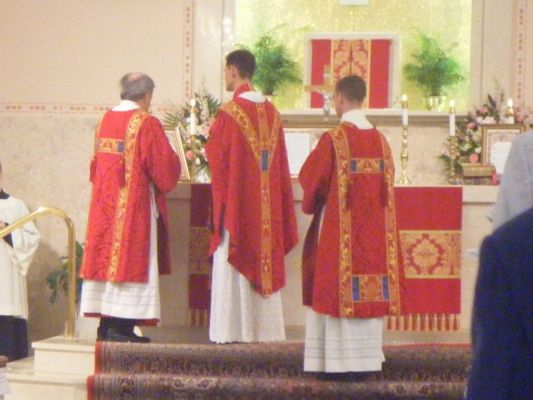
A point of difference between the two is that while the vibrant East spent the waning years of Byzantium spiritualizing the practical in its praxis, the Roman Church, just as liturgically vibrant and alive, both retained ancient practices and added new ones with specifically spiritual aims. There is not, nor was there ever, a "practical" point to the prayers before the altar or the Johannine prologue at the end of the Mass. These elements were enhancements which completed the Ordo Missae, which perfected it as a literal symbol of the work of Christ, beginning with sinners pleading for mercy, the Incarnation amid cries of "Glory be to God in the highest," the preaching ministry of Christ, the Cross and Resurrection, the descent of the Holy Spirit, and the sending of the Apostles into the world. As with the practical elements in the Byzantine rite, many integral parts of the Roman Mass came to their place by happenstance. The Gloria was once an awkward interpolation into the Mass reserved to the Pope. Yet, like the Byzantine liturgical praxis, it became something coherent with an underlying spiritual order which reflects the work of Christ. Why can the Roman Church not do the same with its Ordo Missae and, particularly, with the rites of Holy Week and the Divine Office.

The growth of the Roman liturgy during this period remains something of a sore spot to me precisely because it stopped with Trent. The Office of the Blessed Virgin, the Office of the Dead, the rites of Pontifical Mass, the ceremonies of Holy Week, the hourly and seasonal pattern of the liturgy, and the synthesis between these features with art and music all occurred from late antiquity through the high Middle Ages. Many local rites kept parts of the pre-Gregory VII Roman rite, such as Sarum having more than one psalm verse in the Introit or Lyons retaining use of the Apocalyptic seven candles held by acolytes, while fostering new liturgical expressions based on a reverence for the received Order. This, if anything, is what Geoffrey Hull called "authentic" liturgy in his masterful Banished Heart. The liturgical fallout also underscores Hull's thesis that the Rome-Constantinople schism has been an unmitigated disaster for the Roman liturgy, having lost the "heart" to the "head."

Trent did not smash all of this to bits. Trent simply froze the liturgy in place, or at least chilled it. Some trimming was due, such as feasts of local saints and excessive local use of octaves, but was too much lost in the process? The liturgy became something administered by an office in Rome rather than something held dear by the various intimate communities (dioceses and monasteries) that used it. The liturgy fell out of use and no one opposed the new Divine Office of 1911. Some opposed, rightly, the Pian Holy Week. Then of course came the Pauline Mass the following decade. Could any of this have happened had not the old liturgy froze and then shattered like grass on a cold New England morning? The greatest of these ironies is that the Greek liturgy changed quite a bit when strong authority existed in the Byzantine Church and the liturgy has remained ossified since that authority disappeared, whereas the Roman liturgy thrived locally without centralized authority, but was stilled and killed with it.

For deeper thoughts about how to read the liturgy spiritually, for an understanding of liturgical theology, and for material on the commonalities of Byzantine and Roman liturgy read Nicholas Cabasilas' Interpretation of the Divine Liturgy, available online for free.

Wednesday, May 28, 2014

Bringing Back Sinners: A Personal Reflection on Communion for the Divorced & Re-Married

My perspective here is hardly original or unique to my own experiences, but it is a perspective that no one has discussed in the forensic exercises over Cardinal Kasper's proposal to admit the divorced and re-married to Communion under some pastoral regulations that everyone knows full well will not be enforced strictly. The reason the Church does not admit, and historically has not admitted, those who left their spouse and married again to Communion is because the Church wants sinners to repent and turn back to God. The matter really is not theological, but pastoral. It is that simple. Get sinners to turn back to God.

Daily I witness two intensely close and violently torrential cases of ex-communication, restriction from receiving Communion, that perturb me. Those cases are of my father and one of my best friends.

My father married during the year the Second Vatican Council convened, fathered three children (of whom I have met two, and only seen one in the last seven years once), divorced in 1972, received a letter of ex-communication shortly thereafter, and married my mother in Methodist rites in 1974. He goes to Mass perhaps once a year if the good Lord disposes him to do so. The setting varies: the old Mass, the Pauline Mass, and once the Divine Liturgy (which he insisted was not really Catholic). Religiously my father is a product of the 1950s. He never knew what happened at Mass. He just knew all the respectable people went there for their 25 minute service and followed it up with an omelette. A few times a year he would go to Communion, of course after confessing all his major sins and fasting. No one goes to Communion in sin and without preparation. Having been ex-communicated since 1972 he still knows and believes that much. Once he attempted to go to Confession, but found the priest meddlesome and unhelpful, which turned him off from reconciling with the Church. The shell of his 1950s Catholicism is all he has left. He is my father and I love him dearly, but his life could be called one of disappointments and some bitterness to boot.

A friend of mine was raised in a lesbian household with a distant father and, after having gone through some 1980s Catholic education, drifted away from a faith which I do not believe he ever really understood. He was a rambunctious child straightened out by a decade and a half of service in the infantry of the United States Army. He worked ground zero after 9/11 and toured Afghanistan, burning out his lungs in the process. During his army stint he married in a secular ceremony a wonderful woman who has never been anything but kind to me. Since then he has strayed in the annals of academia and all the dismaying tendencies therein. Whenever I visit him in his house I am received with the greatest affection and hospitality. He always takes me to Confession on Saturday night and Mass on Sunday. And on Saturday nights he stares at the Confessional, joins the line, and then walks away at the last moment saying he will take too long. At Mass he refrains from Communion, instead remaining on his knees in meditation.

According to the laws of the Church and the Church's traditional understanding of marriage there is no way either my father or my friend are married. They are both lapsed Catholics who married without the witness or blessing of the Church and remain in such arrangements. They cannot take Communion and in no way do I wish for this situation to change.

The de facto ex-communication of these two loved ones is the only thing keeping them close to the Catholic faith, to taking it seriously. My father's mind clings to two facts about Catholicism, that one must be clean of sin to partake of Communion and that he cannot partake of Communion. My friend's matter is the same way, although my friend's conscience does tear at his heart. It is my hope that these two dear people will one day return to the Church, even if it be the hour of death, when all worldly attachments and interests that mire us in sin fade to dust and we must see God, not as we imagine Him to be in our tinted looking glass, but as He actually is. I hope that before death they both wish to ask God's forgiveness and petition the Church to receive the Body of Christ worthily.

The Church always places repentance before the celebration of the holy things of God. Both the new and old Roman Masses begin with a general confession of unworthiness. In the older rite the people, or the deacon, repeat this confession prior to the reception of Communion. At Compline, the hour prayed before going to bed, our must vulnerable state, we again pray for the forgiveness of sins by saying the Confiteor and asking for the Lord's protection. In the Byzantine rite the priest prays "Lord, forgive me the sinner and have mercy on me" before the celebration of Orthros (Mattins and Lauds) and Vespers; he will say "God have mercy on me a sinner" after the anaphora and before his own Communion. And lastly there is the long "Lord, I truly believe and confess...." before the Communion of the congregation. One must turn from sin to God prior to participating in the sacred rites of the Church. Is not the same true in eternity? Must not one repent before entering into the Kingdom of God?

What of the Orthodox approach? What of it? I think it is wrong, but I cannot see how it would be helpful in this day and age. When the Church of Constantinople decided that marriage can die and one can re-marry twice given the proper state of mind and a heavily penitential effort prior to the new union, the spirit of penance was alive and well. People fasted from all meat and dairy products during Lent, the pre-Christmas fast, and the Dormition fast. Even though I think the practice wrong, I cannot deny that it could be done in the right spirit. All of that is gone now. The Church now requires fasting two days of the year: Ash Wednesday and Good Friday. Further more, the modern age would confirm that the Church was changing her outmoded teachings, not forcing people who failed their vocations to do penance. The adaptation of the Chalcedonian-Orthodox discipline would be a disaster in practice in this day and age. To admit the divorced and re-married to Communion will not make those in question grateful to the Church for her mercy and understanding. Rather they will hear all the talk of the "Body of Christ" and the confessions throughout the liturgy and think to themselves "So it was not really such a big deal after all."

So again I say the only thing keeping my father and my friend close to the Church is the very fact that they cannot go to Communion. They know that the Church guards something sacred which they still, on some level, believe and would like to receive yet cannot. When time purges these men of all that ties them to the world they will have the option of repenting and reconciling to God before death or the other, less attractive option. It is precisely because they cannot repent now that they still believe in God, Christ, the Church, and the Eucharist. To remove their barrier from Communion will not bring either my father or friend to Mass with any regularity. It will merely tell that the Church does not consider what she does at Mass very important. It will tell them that the Church was bluffing all the time.

If the Church does not admit these men to Communion then they may still believe something important resides in the Catholic Church and wish to return to it. I can very much envision this one fact returning my father to the Church at some point before he dies and my friend sooner than that. My friend especially wants to repent and to go to Communion. Why remove the impetus? I want nothing more than for these two men to enter heaven, but not without repentance first.

The Church's power to loosen and to bind the sins of men has brought back into the fold men like Oscar Wilde, Voltaire, and John Wayne. Why not my father and my friend, too?

Thursday, December 5, 2013

Greek Ecumenism

An article about the ecumenical view on Mt. Athos:

The Greek government sent riot police to Mount Athos in Northern Greece this morning, to forcibly remove a group of monks from Esphigmenou monastery, one of the twenty monasteries that form part of this famous Eastern orthodox complex. Esphigmenou monastery is renowned for the war it has waged against the Ecumenical Patriarchate of Constantinople which it accuses of betraying the Orthodox Church by opening ecumenical dialogue with the Vatican. A war which has been going on since the 70s. According to an Associated Press report, the traditionalist monks threw stones and Molotov cocktails at police and judicial officials as they attempted to storm the building .Patriarch Bartholomew declared the monks of Esphigmenou an illegal brotherhood in 2002 and ordered their eviction. But the monks ignored this, claiming the Patriarch of Constantinople does not have the power to evict them.  
The conflict has been going on for decades: it all began when Paul VI visited Patriarch Athenagoras in 1967. The Esphigmenous community protested against the two religious leaders praying together by famously raising black flags displaying the message “Orthodoxy or death”. Patriarch Bartholomew decided to resolve the question by contacting the Greek Foreign Minister who - according to the complex jurisdiction regulations which apply to the Hagiorite institutions - is in charge of the security of the twenty monasteries which make up the monastic community of Mount Athos. Over the years, the Greek authorities have tried almost everything to get the Esphigmenou community to back down. They even tried cutting off food supplies to the monks, but in vain.  
The situation was complicated further after a Greek court granted an injunction allowing the new brotherhood Bartholomew wants installed, to replace the old monastic community. There are 500 thousand Euros at stake, which the European Union could dish out for restoration work to be carried out on the 11th century monastery. But given the current crisis Greece finds itself in, the funding has been yet another cause for tension between the rebel monks and Constantinople.  
Local sources say about twenty monks have barricaded themselves inside their monastery. Some supporters apparently joined them this afternoon. On the Esphigmenou monastery website, the monks are calling on faithful to support them and accuse the government of “giving the green light to the police to raid the monastery,” ignoring the fact that “this could cause bloodshed among the monks at Mount Athos.” .