Showing posts with label Holy Cross. Show all posts

Sunday, September 14, 2014

Holy Cross & the Physician of Souls


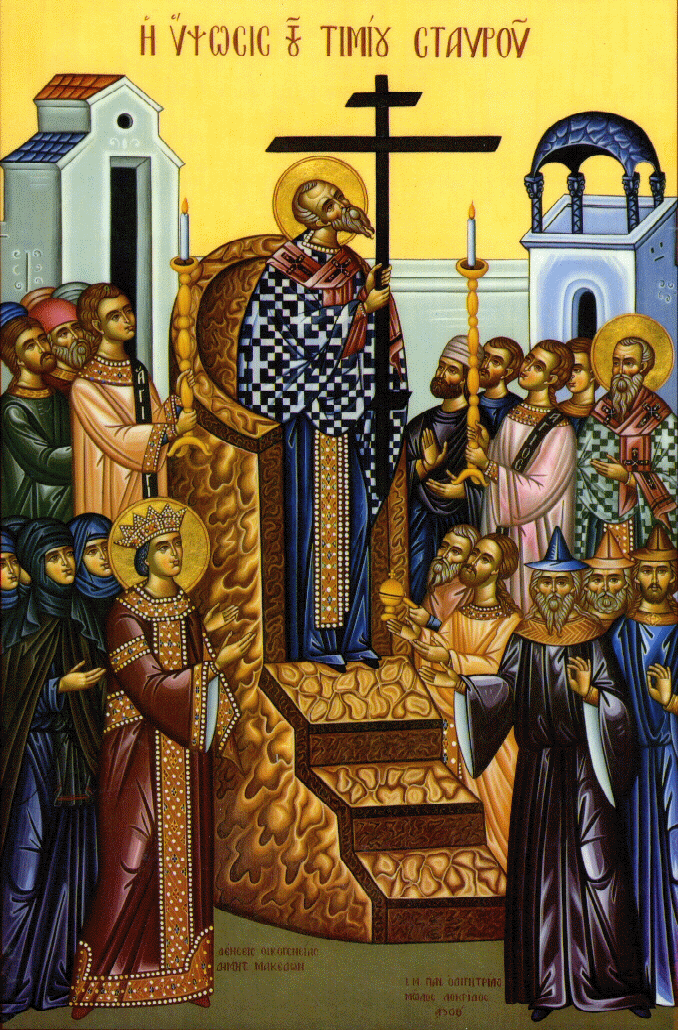
The multiple layers of history around the feast of the Exaltation of the Holy Cross makes it one of the most enduring days in the Christian kalendar. It is an important day in both the Roman and Byzantine rites, enjoying the equivalent of a lesser octave in the Greek liturgy, complete with a "pre-feast" and a "leave taking" on the 21st of the month. As the story goes, Constantine's pious mother, St. Helena, found the Cross in Jerusalem and the locals celebrated by lighting a bonfire. The people in the next town saw the fire and lit their own, with contiguous towns imitating the pyrotechnics until flames reached the Eternal City. Constantine encased the Lord's Cross in silver, gold, and precious gems and build the Church of the Holy Sepulchre (or Resurrection), which was dedicated on September 13th. At a later time Persians captured the True Cross, which was only returned because of the guile of Heraclius. Heraclius returned the Cross to Jerusalem on September 14th, the feast we observe today. In the Roman rite the "Invention", or finding, of the Holy Cross is observed as a Double of II Class on May 3rd. So much for the history.
When Constantine encased the Cross in precious metals and gems, the Romans still used crucifixion as a means of capital punishment for the most despicable of persons. Romans held crucifixion to be such a horrible means of death that the laws of the Empire exempted condemned citizens from its cruelty, as was the case of Saint Paul. To exalt a cross would be like to exalt hanging, drawing, and quartering in Tudor England. Perhaps the emperor did not encrust the tool of the Lord's Passion only to glorify it, but also to sanitize it, to make it less a scandal to the people of the Empire. The Cross is a triumph, a triumph over death accomplished by a very gruesome death. 

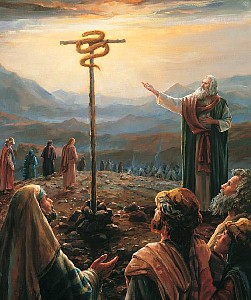
On the Cross our Lord saved us from death and explained suffering to us. When He began His earthly ministry He told a Pharisee, "They that are well have no need of a physician, but they that are sick do. I came not to call the just, but sinners" (Mark 2:17). To modern minds chapter 21 of the Book of Numbers has the overtly medicinal imagery. Medicine has adapted the caduceus, the image of a staff entwined with two serpents used by the Greeks in antiquity. It is not directly related to the staff mentioned in Scripture, but the use of the caduceus in a Christian-influenced society cannot be discarded. The Israelites spoke against God, Who in turned unleashed punishing serpents upon them. In a seemingly pointless change of course, God told Moses to fashion a "brazen serpent" and raise it on a rod. All who looked upon the rod, regardless of the infirmities brought by the snakes which punished them for their disbelief, lived. The Cross brought meaning and fulfillment to this symbol, which is empty of any value without the Cross. On the Cross, Christ did for men's souls what a doctor does for men's bodies. How many are potentially lost because they refuse the difficulties of spiritual treatment?

The Cross is the Body of Christ's vaccination against death. Vaccines traditionally inoculate recipients from diseases and other harmful influences by introducing a small amount of that danger into the body and allowing the immune system to become familiar with it, fight it, and defeat it. The disease can no longer harm the vaccinated person. The same is true of mankind, death, and the Body of Christ. Our Lord did not vaccinate Himself from death, from which He rose on His own, but those who would eventually be joined to His Body through Baptism and Communion. The third responsory at Mattins today says, "Wherein the Author of salvation triumphed over death by His own death," echoing the Paschal troparion in the Greek liturgy, "Christ is risen from the dead and by His death He has trampled upon death...." 

Our vaccination is quite a scandal in the Greek sense of the word, scandolos, a barrier or stumbling block. Death frightens man. It is uncertainty, loss, despair, and the result of our sins, yet through it eternal happiness comes. The same is true of suffering. A little suffering borne in the Sacraments and the protection of the Saints, although it can last a lifetime, protects us from an eternity of unhappiness.

Perhaps with the loss of Christian culture and society we can strip away the silver, gold, and diamonds that have encrusted the Cross over time and look upon it for what it actually is: our vaccination from suffering, death, and Hell, our treatment from the "Physician of our souls and bodies" that will lead us to life everlasting.

Thursday, May 1, 2014

Ss. Philip & James


A happy feast of Ss. Philip and James to all readers! May these holy Apostles of the Lord intercede for you in your lives and lead you all to the awesome face of Christ which these men had the privilege to behold on earth.

Today is a liturgical curiosity in that in the Roman rite today is the feast of two Apostles, in the Pian rite it is the feast of Joe the Communist, and in the Pauline rite it is a ferial day (although masochistic priests may commemorate Joe the Communist). Indeed, once while reading an introduction to St. Athanasius' On the Incarnation I burst into an embarrassed hysteria when the writer lamented that the saint from Alexandria is liturgically obscured, losing his first Vespers to Ss. Philip & James and his second Vespers to the feast of the Invention of the Holy Cross! For more on just what the hell happened we turn to the esteemed Rubricarius:
In the 'liturgical books of 1962' the ancient feast of SS Philip and James has been shoved aside until May 11th, the first 'free' liturgical day, and May 1st became the execrable 'Joe the Worker' day. Pius XII's Commission for General Liturgical Reform had discussed making May 1st a Marian feast but settled on S. Giuseppe Artigiano (c.f. minutes of meeting 45; 19 Oct 1954 and 59; 17 Jan 1956 in Giampietro). Clearly feasts of antiquity were not considered particularly sacred - but neither was much else - so from 1956 the beautiful feast of the Solemnity of St. Joseph and its Octave were abolished and today's venerable and ancient feast of the Holy Apostles cast aside to May 11th. On May 1st was placed perhaps the nadir of two thousand years of Christian liturgy (although Pius XII's reign resulted in much competition for that dishonour) with a modern liturgical composition that instead of honouring St. Joseph as Patron of the Universal Church made him some type of shop steward ostensibly out of pastoral need. The Office is truly appalling with lessons about multitudes of working men gathering in St. Peter's Square: '...cum occasionem nactus opificum conventus Kalendis maiis...Romae celebrati, ingentum multitudinem in foro ad sancti Petri Basilicam...' It really is atrocious. In an excellent article on the highly inorganic Pian changes Fr. Francesco Ricossa quotes a Jean Crete:
"The Sacred Congregation of Rites was not favorable toward this decree [Cum nostra], the work of a special commission. When, five weeks later, Pius XII announced the feast of St. Joseph the Worker (which caused the ancient feast of Ss. Philip and James to be transferred, and which replaced the Solemnity of St Joseph, Patron of the Church), there was open opposition to it.
“For more than a year the Sacred Congregation of Rites refused to compose the office and Mass for the new feast. Many interventions of the pope were necessary before the Congregation of Rites agreed, against their will, to publish the office in 1956 — an office so badly composed that one might suspect it had been deliberately sabotaged. And it was only in 1960 that the melodies of the Mass and office were composed melodies based on models of the worst taste.
"We relate this little-known episode to give an idea of the violence of the reaction to the first [It was hardly the first - R.] liturgical reforms of Pius XII".
 He also relates an amusing story about Msgr. Alfred Gilbey, who had little use for novelty and poor taste:

One of my happiest memories of the late Mgr. Alfred Gilbey is of his early morning Mass on May 1st. Mgr. Gilbey would come into St. Wilfrid's Chapel at the Brompton Oratory, radiant in red vestments, and approach the small, loyal, congregation and say "Today is the feast of the Holy Apostles Saints Philip and James. For some curious reason some of you may find Jerz the Werz [I think to pronounce a title such as Joseph the Worker would have been offensive to the good Monsignor's refined lips] on this day but that has been abolished and Saints Philip and James restored to their rightful date." Alas, not quite true although in the 1970-2002 calendar Joe the Worker has been reduced to an 'optional memoria' and SS Philip and James place on May 3rd. Certainly there is a lot of restoration to do...
Pray for us Holy Apostles! Pray for us Holy Patron of the Universal Church! Pray that we may be rid of the stain and stench of the 1962 books.

No Jerz the Werz....

Friday, May 3, 2013

Invention of the Holy Cross

source: disharoon.net

Today is the Feast of the "Invention," or "finding," of the Holy Cross by St. Helena, mother of Emperor Constantine. The second nocturn of Mattins today recounts how the saint used a sick person to discern which of several candidates was indeed the True Cross of our Lord, the person being healed instantly upon touch the real one. Despite the liturgical reforms of the 1950s and 1960s, the Latin rite Catholics in the Church of the Holy Sepulchre in Jerusalem still observe this feast, which mostly disappeared in 1960. Below is a video of last year's celebration, in which a relic of the True was carried in procession.