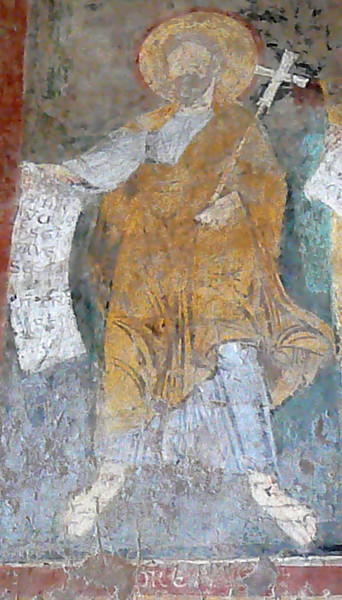
Showing posts with label St. Andrew. Show all posts
Sunday, November 29, 2015
Salve crux, quae in corpore Christi dedicata es
The Apostle Andrew was born at Bethsaida, a town of Galilee, and was the brother of Peter. He was a disciple of John the Baptist, and heard him say of Christ, Behold the Lamb of God, whereupon he immediately followed Jesus, bringing his brother also with him. Some while after, they were both fishing in the Sea of Galilee, and the Lord Christ, going by, called them both, before any other of the Apostles, in the words, Follow Me, and I will make you fishers of men. They made no delay, but left their nets, and followed Him. After the death and Resurrection of Christ, Andrew was allotted Scythia as the province of his preaching, and, after labouring there, he went through Epirus and Thrace, where he turned vast multitudes to Christ by his teaching and miracles. Finally he went to Patras in Achaia, and there also he brought many to the knowledge of Gospel truth. Aegeas the Pro-consul resisted the preaching of the Gospel, and the Apostle freely rebuked him, bidding him know that while he held himself a judge of his fellow men, he was himself hindered by devils from knowing Christ our God, the Judge of all.
Then Egeas, being angry, answered him, Boast no more of this thy Christ. He spake words even such as thine, but they availed Him not, and He was crucified by the Jews. Whereto Andrew boldly answered that Christ had given Himself up to die for man's salvation; but the Pro-consul blasphemously interrupted him, and bade him look to himself, and sacrifice to the gods. Then said Andrew, We have an altar, whereon day by day I offer up to God, the Almighty, the One, and the True, not the flesh of bulls nor the blood of goats, but a Lamb without spot and when all they that believe have eaten of the Flesh Thereof, the Lamb That was slain abideth whole and liveth. Then Aegeas being filled with wrath, bound the Apostle in prison. Now, the people would have delivered him, but he himself calmed the multitude, and earnestly besought them not to take away from him the crown of martyrdom, for which he longed and which was now drawing near.
Come a short while after, he was brought before the judgment-seat, where he extolled the mystery of the cross, and rebuked Aegeas for his ungodliness. Then Aegeas could bear with him no longer, but commanded him to be crucified, in imitation of Christ. Andrew, then, was led to the place of martyrdom, and, as soon as he came in sight of the cross, he cried out, O precious cross, which the Members of my Lord have made so goodly, how long have I desired thee! how warmly have I loved thee! how constantly have I sought thee! And, now that thou art come to me, how is my soul drawn to thee! Welcome me from among men, and join me again to my Master, that as by thee He redeemed me, so by thee also He may take me unto Himself. So he was fastened to the cross, whereon he hung living for two days, during which time he ceased not to preach the faith of Christ, and, finally, passed into the Presence of Him the likeness of Whose death he had loved so well. All the above particulars of his last sufferings were written by the Priests and Deacons of Achaia, who bear witness to them of their own knowledge. Under the Emperor Constantine the bones of the Apostle were first taken to Constantinople, whence they were afterwards brought to Amalfi. In the Pontificate of Pope Pius II his head was carried to Rome, where it is kept in the Basilica of St Peter.
Saturday, November 30, 2013
Rad Trad's Advent Challenge
"It's the most wonderful time of the year!"
No, not that secular commercial holiday called Christmas (not to be confused with the Holy Day called Christmas) which is preceded by a month or so of mindless ditties about snow and "40% off overpriced stuff" sales. The most wonderful time of the year for the Rad Trad is Advent, the time during which we contemplate the unspeakable mystery of the Incarnation and the period before it, an epoch of hope for a salvation not then visible.
Advent is a time for thinking about sin, more so than Lent in my book. During Christ's 40 days in the desert and the days leading up to the Triduum He at least dwelt on earth and walked among men like us. The people of prior times had no such consolation. They had hope, or at least those aware of their own sins had hope. Without sin why yearn for redemption? Without falling why rise? Without darkness why seek light? When I sin I can drive a few miles to a parish that has daily Confession and take a "spiritual shower." What about the peoples of that time before Christ, whose difficulties are recalled during Advent? Advent seems to be the proper time for reflection on sin, on one's burning need for God's mercy in every moment of life, and on the great gift given to us at the end of it, the Incarnation. As St. Athanasius wrote, "God became man so that man might become God."
My challenge to readers is, if you do not already, to pray one major hour of the older Divine Office every day of Advent and through the Octave of Christmas. Oh no, that's a whole month! Exactly. You will appreciate Christmas all the more when it comes at the end of a month's rumination on sin and forgiveness with the Church. It will mean all the more when its mysteries permeate your life for an entire week. As always, I suggest Vespers or Lauds. It is customary during Advent and Lent to pray the Office of the Dead on Mondays in addition to the Office of the day. If you do not have the time for both (although Vespers/Lauds can easily be recited in seven minutes or so) I would pick the Office of the Dead on Mondays and the regular Office on weekdays just for the sake of some balance. However, if you do this do not pray the Office of the Dead on Monday December 23rd; instead pray the Office of the day so that you might have the seasonal "O" antiphon.
On a related note, please notice that the tab for the Officium Defunctorum is now gone as there will be no more opportunities to pray for the dead this month.
A happy feast of St. Andrew to all!
Friday, November 30, 2012
St. Andrew the Apostle
"Who shall ascend into heaven? that is, to bring Christ down"—Epistle of St. Paul to the Romans 10:6
| Statue of St. Andrew with his unique cross in the sanctuary of St. Peter's Basilica, Rome. |
Today is the feast of St. Andrew the Apostle, brother of St. Peter.
The Apostle Andrew was born at Bethsaida, a town of Galilee, and was the brother of Peter. He was a disciple of John the Baptist, and heard him say of Christ, Behold the Lamb of God, whereupon he immediately followed Jesus, bringing his brother also with him. Some while after, they were both fishing in the Sea of Galilee, and the Lord Christ, going by, called them both, before any other of the Apostles, in the words, Follow Me, and I will make you fishers of men. They made no delay, but left their nets, and followed Him. After the death and Resurrection of Christ, Andrew was allotted Scythia as the province of his preaching, and, after labouring there, he went through Epirus and Thrace, where he turned vast multitudes to Christ by his teaching and miracles. Finally he went to Patras in Achaia, and there also he brought many to the knowledge of Gospel truth. Aegeas the Pro-consul resisted the preaching of the Gospel, and the Apostle freely rebuked him, bidding him know that while he held himself a judge of his fellow men, he was himself hindered by devils from knowing Christ our God, the Judge of all.
Then Egeas, being angry, answered him, Boast no more of this thy Christ. He spake words even such as thine, but they availed Him not, and He was crucified by the Jews. Whereto Andrew boldly answered that Christ had given Himself up to die for man's salvation; but the Pro-consul blasphemously interrupted him, and bade him look to himself, and sacrifice to the gods. Then said Andrew, We have an altar, whereon day by day I offer up to God, the Almighty, the One, and the True, not the flesh of bulls nor the blood of goats, but a Lamb without spot and when all they that believe have eaten of the Flesh Thereof, the Lamb That was slain abideth whole and liveth. Then Aegeas being filled with wrath, bound the Apostle in prison. Now, the people would have delivered him, but he himself calmed the multitude, and earnestly besought them not to take away from him the crown of martyrdom, for which he longed and which was now drawing near.
Come short while after, he was brought before the judgment-seat, where he extolled the mystery of the cross, and rebuked Aegeas for his ungodliness. Then Aegeas could bear with him no longer, but commanded him to be crucified, in imitation of Christ. Andrew, then, was led to the place of martyrdom, and, as soon as he came in sight of the cross, he cried out, O precious cross, which the Members of my Lord have made so goodly, how long have I desired thee! how warmly have I loved thee! how constantly have I sought thee! And, now that thou art come to me, how is my soul drawn to thee! Welcome me from among men, and join me again to my Master, that as by thee He redeemed me, so by thee also He may take me unto Himself. So he was fastened to the cross, whereon he hung living for two days, during which time he ceased not to preach the faith of Christ, and, finally, passed into the Presence of Him the likeness of Whose death he had loved so well. All the above particulars of his last sufferings were written by the Priests and Deacons of Achaia, who bear witness to them of their own knowledge. Under the Emperor Constantine the bones of the Apostle were first taken to Constantinople, whence they were afterwards brought to Amalfi. In the Pontificate of Pope Pius II his head was carried to Rome, where it is kept in the Basilica of St Peter.
![]() |
| A fifth century mosaic of St. Andrew in St. Paul Outside the Wall (source: wikipedia) |
Subscribe to:
Posts (Atom)