No, not the Geoff Stephens song. The actual Cathedral in Winchester, England. This post is somewhat inspired by Marko's comment on a previous post which called attention to a pair of Latin Masses in Anglican Churches. I made an offhand comment about a "reverent informality" for the Divine things that often existed in the Middle Ages. I hope that a quick look into one of the finest churches of the Middle Ages could provide some insight as to what I meant.
 Two quick points: (1) the Rad Trad purports no expertise concerning Winchester Cathedral, so he will only be relaying his impressions from a personal visit and his poor knowledge of the liturgy; (2) except for the floor plan, all images are from the Rad Trad's collection, so no copyright issues.
The diocese of Winchester dates to the seventh century and boasts many great English saints, most notably Swithun and Birinus. The enormous cathedral that comes to us today dates from only 1079. The building's foundations, built on a wetland, only go a few feet into the ground. At the turn of the last century the cathedral was actually sinking in some parts, though this problem seems to be resolved. Many famous events took place at Winchester, including the marriage of Queen Mary Tudor to King Philip II of Spain. Author Jane Austen is buried near the entrance. I am tempted to repeat something an English priest once said about the presence of her tomb, yet I think in the interest of taste I shall hold my tongue.
The layout is a classic medieval cruciform shape, although no baptistery exists off the side, as one might expect. I am unsure if perhaps it was destroyed or simply never existed, given the date of the cathedral's construction.
 |
| source: Wikipedia |
The purpose of medieval architecture was to create a convergence between heaven and earth, to blur the lines between where men lived and the altar that the Son of God deigned to visit. The cathedral is gathering place for the believers of a city, and also the place where, until Trent, the bishop would instruct the people in the faith. Lastly, cathedrals were temples of God, places where sacrifice was offered to the Father in fulfillment of the Sacrifice of the Cross.
For all these purpose cathedrals like Winchester took on a general style adjustable for local needs and local character. The cruciform shape recalls the Latin emphasis on the Cross, as opposed to the generally round Byzantine churches which are more reminiscent of the Imperial Court. Many cathedrals, notes Dr. Laurence Hemming, were built on water, reminding us of that psalm that substitutes for the Asperges during Paschaltide: "I saw water flowing from the right side of the temple...."
Out of necessity the buildings were naturally luminous. Enormous portals of light washed Winchester in an albescent effulgence reflective of the un-caused energy and light of God reveals to Peter, James, and John on Mount Tabor.

Yet despite the natural necessity of large windows, the builders felt no constraint in making a theological expression of the Divine nature in the arrangement of these windows. Typically the lower windows of a cathedral are large and of stained glass in the nave, emitting a rich floral array, but clearer towards the top, basking the upper part of the building in white light which better illuminates any depictions of heavenly things on the ceiling.
 A variation, seen in the transepts of Winchester and more prominently in the nave of the abbey church at Cluny, augments the size of the windows either as one approaches the altar (Cluny) or as one raises the eyes upward (Winchester). The effect is an understanding of the celestial powers over the temporal.
The view to the right, which is of the North transept of Winchester Cathedral, details this last point rather splendidly. Places like Winchester did not become temples of God only by virtue of their consecration by bishops, but by the very nature and intentions of their builders to create a reflection of heaven where the faithful could carry on their conversation with the Trinity and the Saints: "But our conversation is in heaven; from whence also we look for the Saviour, our Lord Jesus Christ, Who will reform the body of our lowness, made like to the body of his glory, according to the operation whereby also he is able to subdue all things unto himself" (Philippians 3:20-21). One does not come to a building like this for merely formal worship, but to become immersed in the spiritual, to commune, to pray perpetually, to gather in the rites of the Church, but also for private devotion.
This point held true for the priests as much as the laity. When concelebration died out in the Latin Church in the Middle Ages, private Masses began to take its place. Consequently altars began appearing in places normally reserved to private devotion. In this instance the private Mass was the priest's private devotion. Priestly monks and canons not assigned to the conventual Mass of the day would go to their customary chapel with a server, usually an apprentice (now a seminarian), and would pray a votive Mass particular to the day of the week unrelated to the feast or feria of the day. Mass could be done a little differently at each altar and the rubrics began to mix with pontifical Mass to create some of the unique ceremoniale of a given local rite.

The above chapel, below the Choir and Sanctuary on the North side, should end any notion that medieval religion was dark, dreary, and desolate. This chapel was once ensconced in images of the Divine mysteries, images which time and neglect have sadly faded from contemporary view.
Yet the image of Christ, similar to the Pantocrator icon above the Holy Places of Byzantine churches, watches the place where a priest once prayed daily Mass. Laity might enter this place around 7:00AM, an hour or two before the conventual Mass, and find a few dozen Masses hidden in the various chapels, chanted in either a simple tone or a monotone. Lay persons, in attending, might "hear' the whole of the Mass or only remain for the elevations and leave. Such was medieval piety. The elevations of the Sacred Species were themselves innovations of medieval piety.
The focus of the cathedral is entirely vertical. We expect this tall and narrow view on our neo-gothic American and English churches, but it is hard to appreciate without the massive scale of a place like Winchester.

The Choir of the cathedral is where the monks and canons would spend several hours a day, beginning very early in the morning, singing to and about God. Like the chapels, each monk or canon would have his own choir stall. Although not a social arrangement, the proximity of those in choir to each other, the conversational arrangement of the choir stalls (one across from the other), the social hierarchy (the episcopal throne closest to the altar, followed by the rector and senior-most canons), and the relatively enclosed space engendered a certain degree of familiarity with what was going on in the Choir from day to day.

Because of the communal arrangement the lessons at Mattins, the antiphonal chants of all the Offices, the propers of the Mass, and the readings of Mass, were sung from a lecturn in the middle of the Choir. The Tridentine arrangement of, for instance, singing the Epistle a few feet away from the altar directly behind the priest is the result of imposing a Missal with rubrics suited to office staff praying Mass in a limited chapel space. Entirely different game here. I see no good reason why the traditional choir arrangement could not be resurrected in the setting of the Roman books. It was probably done in the Roman basilicas for most of Rome's Christian history.
Side chapels and Choir arrangements, far from separating the congregation from the enclosed clergy, figured prominently in the Sunday worship. I remember once reading of a saint who suggested those that attended low Mass on Sunday cheated and failed to meet their Sunday obligations. A "real" Sunday obligation was met by waking up before the crack of dawn and attending Mattins and Lauds. During the interstice between Mattins and Lauds and the Mass the laity would visit the various chapels and pray to the saints honored therein. Or perhaps they would pray for the dead, either those of prominence buried within the cathedral or deceased family in humble graves. The Office of Prime, a "chapter" hour, would not likely be chanted within the Cathedral. This meant the congregation had dedicated time to their private devotions and practices. One advantage of this era is that most dioceses had their own saints canonized through local devotion in the first millennium rather than those recognized by Papal bull, which imbued some of these shrines and altars with a distinctly local character.
Before the main Mass on Sundays the canons and monks would sing the hour of Terce and then lead a procession around the cathedral, visiting each altar and singing hymns and prayers to the saints honored there.
The faithful, depending on their interest level, might continue to pray unmolested at their private places within the cathedral and "absorb" the chant and prayer resonating above or they might participate in the procession. Some wealthier and more literate members in attendance, normally nobility, would pray the Little Office of the Blessed Virgin Mary during the time before Mass. The "bidding prayers," which in content more resembled the old rite intercessions on Good Friday than the "For everyone getting along and feely gushy, let us pray to the Lord" material heard in most modern parishes, were prayed in vernacular before the Rood Screen. The clergy would vest either at the main altar after the procession or in the Lady chapel before the procession.
Despite the enclosure of the Rood Screen, in this case a restoration and not original, the ceiling really unites those in the Choir to the rest of the building.

A few peculiarities of Winchester's reredos are the very Romanesque-looking Roman saints, given the influence of branch-theory in the 19th century, and the post-medieval, Renaissance-like vividness of the statuary.
After the conventual Mass on Sunday people would go their separate ways. Some might revisit the chapels to make thanksgiving or to witness private Masses. Others would spend time with their families and finally break the fast. Many would then return in the evening for Vespers and another round of saintly devotions.
Such was liturgical life before the Reformation, when the Latin Church became very minimalistic. If anything the line between private devotion and public prayer became more formalized and strict. The public prayer was reduced to bare essentials (a valid priest using a rite approved by the Congregation of Rites in Rome) and devotions were seen as a legitimate substitute for formal liturgy, rather than part of it or an addition to it. Something I have noticed in the Byzantine rite, which was in my mind when reading Marko's comment on informal reverence, was that no one thinks twice about taking time out during Mattins to light a candle or kissing the icon of the Virgin who carried Christ after receiving communion. Call me crazy, but do pews (and the modern GIRM) not prevent this sort of thing in the Roman rite? Everyone has a space to which they feel constrained for the next hour or so. If one leaves the assigned space and visits a chapel to pray during communion or to get closer to the sanctuary during the Gospel one arouses at best unwanted attention or at worst draws the stern eyes of the liturgical police. Yet this is precisely the reverent informality that existed once, and still does in many places, in the Latin liturgy. The entire experience of being in a cathedral, or a lesser parish, should be a continual interaction with God.
On days with three lessons at Mattins the Choir would pray the Officium Defunctorum and the Little Office of the Blessed Virgin in the Lady Chapel, invariably at the back of the cathedral in the Middle Ages.
While visiting Winchester's Lady Chapel the Rad Trad had a memorable experience indicative of post-modern Western religion, otherwise known as stupidity. Here is an image on the wall:

.... and this is what the picture guide said about it (number 2):

Needless to say, this particular chapel is neither original nor a period reconstruction.
The ceiling successfully conveys the irreducible complexity and awe of the Divine, yet the design is actually very practical—the opposing arches support each other.

Many Requiem Masses were hopefully offered for this man, Cardinal Beaufort, thrice Chancellor of England, bishop of Winchester, and the man responsible for St. Joan of Arc's martyrdom. While laying in bed, minutes from judgment, he offered death all the treasury of England for more time.
A few quick exterior images:

From the approaching path:

On Palm Sunday the procession would visit the various corners, including the cemetery, around the cathedral while a few cantors would exchange chants from the roof with the choir below.

English readers fear not! The Rad Trad did visit the Round Table.

I did not know how to explain this concept of reverent informality, so I endeavored to demonstrate it by describing what the faithful did, and still do, and where they did it. I hope I have done that much.
The Rad Trad

Yet despite the natural necessity of large windows, the builders felt no constraint in making a theological expression of the Divine nature in the arrangement of these windows. Typically the lower windows of a cathedral are large and of stained glass in the nave, emitting a rich floral array, but clearer towards the top, basking the upper part of the building in white light which better illuminates any depictions of heavenly things on the ceiling.
 A variation, seen in the transepts of Winchester and more prominently in the nave of the abbey church at Cluny, augments the size of the windows either as one approaches the altar (Cluny) or as one raises the eyes upward (Winchester). The effect is an understanding of the celestial powers over the temporal.
 The view to the right, which is of the North transept of Winchester Cathedral, details this last point rather splendidly. Places like Winchester did not become temples of God only by virtue of their consecration by bishops, but by the very nature and intentions of their builders to create a reflection of heaven where the faithful could carry on their conversation with the Trinity and the Saints: "But our conversation is in heaven; from whence also we look for the Saviour, our Lord Jesus Christ, Who will reform the body of our lowness, made like to the body of his glory, according to the operation whereby also he is able to subdue all things unto himself" (Philippians 3:20-21). One does not come to a building like this for merely formal worship, but to become immersed in the spiritual, to commune, to pray perpetually, to gather in the rites of the Church, but also for private devotion.
This point held true for the priests as much as the laity. When concelebration died out in the Latin Church in the Middle Ages, private Masses began to take its place. Consequently altars began appearing in places normally reserved to private devotion. In this instance the private Mass was the priest's private devotion. Priestly monks and canons not assigned to the conventual Mass of the day would go to their customary chapel with a server, usually an apprentice (now a seminarian), and would pray a votive Mass particular to the day of the week unrelated to the feast or feria of the day. Mass could be done a little differently at each altar and the rubrics began to mix with pontifical Mass to create some of the unique ceremoniale of a given local rite.

The above chapel, below the Choir and Sanctuary on the North side, should end any notion that medieval religion was dark, dreary, and desolate. This chapel was once ensconced in images of the Divine mysteries, images which time and neglect have sadly faded from contemporary view.
 |
| Tilt your head to the right and see what looks like Christ the Pantocrator |
The focus of the cathedral is entirely vertical. We expect this tall and narrow view on our neo-gothic American and English churches, but it is hard to appreciate without the massive scale of a place like Winchester.

The Choir of the cathedral is where the monks and canons would spend several hours a day, beginning very early in the morning, singing to and about God. Like the chapels, each monk or canon would have his own choir stall. Although not a social arrangement, the proximity of those in choir to each other, the conversational arrangement of the choir stalls (one across from the other), the social hierarchy (the episcopal throne closest to the altar, followed by the rector and senior-most canons), and the relatively enclosed space engendered a certain degree of familiarity with what was going on in the Choir from day to day.

Because of the communal arrangement the lessons at Mattins, the antiphonal chants of all the Offices, the propers of the Mass, and the readings of Mass, were sung from a lecturn in the middle of the Choir. The Tridentine arrangement of, for instance, singing the Epistle a few feet away from the altar directly behind the priest is the result of imposing a Missal with rubrics suited to office staff praying Mass in a limited chapel space. Entirely different game here. I see no good reason why the traditional choir arrangement could not be resurrected in the setting of the Roman books. It was probably done in the Roman basilicas for most of Rome's Christian history.
 |
| Another one of those lovely side chapels |
Side chapels and Choir arrangements, far from separating the congregation from the enclosed clergy, figured prominently in the Sunday worship. I remember once reading of a saint who suggested those that attended low Mass on Sunday cheated and failed to meet their Sunday obligations. A "real" Sunday obligation was met by waking up before the crack of dawn and attending Mattins and Lauds. During the interstice between Mattins and Lauds and the Mass the laity would visit the various chapels and pray to the saints honored therein. Or perhaps they would pray for the dead, either those of prominence buried within the cathedral or deceased family in humble graves. The Office of Prime, a "chapter" hour, would not likely be chanted within the Cathedral. This meant the congregation had dedicated time to their private devotions and practices. One advantage of this era is that most dioceses had their own saints canonized through local devotion in the first millennium rather than those recognized by Papal bull, which imbued some of these shrines and altars with a distinctly local character.
 |
| Where the shrine to St. Swithun once stood. This place, located behind the Choir and Sanctuary was in medieval times where the foremost saint of a diocese would be buried (Becket at Canterbury, St. Osmund at Salisbury etc.) The bronze tent unfortunately obstructs the "hole" leading under the altar where the faithful would crawl to be nearer St. Swithun's tomb. |
 |
| A better view of the "hole" |
The faithful, depending on their interest level, might continue to pray unmolested at their private places within the cathedral and "absorb" the chant and prayer resonating above or they might participate in the procession. Some wealthier and more literate members in attendance, normally nobility, would pray the Little Office of the Blessed Virgin Mary during the time before Mass. The "bidding prayers," which in content more resembled the old rite intercessions on Good Friday than the "For everyone getting along and feely gushy, let us pray to the Lord" material heard in most modern parishes, were prayed in vernacular before the Rood Screen. The clergy would vest either at the main altar after the procession or in the Lady chapel before the procession.
 |
| The reredos and altar are, to the Rad Trad's knowledge, not original, but re-constructions done in the 19th century by a High Church bishop |

A few peculiarities of Winchester's reredos are the very Romanesque-looking Roman saints, given the influence of branch-theory in the 19th century, and the post-medieval, Renaissance-like vividness of the statuary.
 |
| The Rad Trad found this specific depiction very surprising and very powerful |
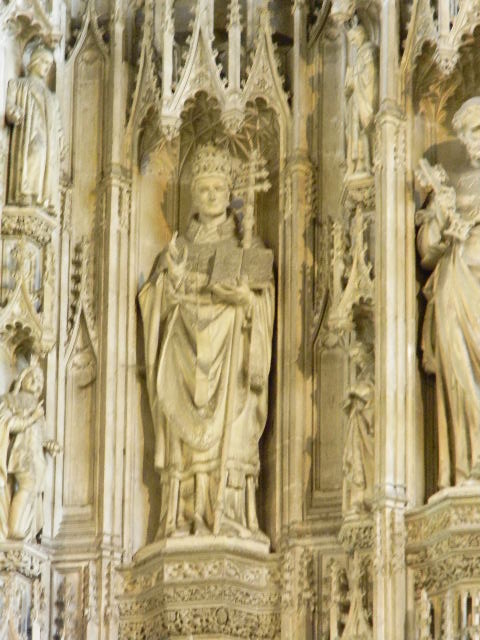 |
| A very Popish-looking Pope! |
Such was liturgical life before the Reformation, when the Latin Church became very minimalistic. If anything the line between private devotion and public prayer became more formalized and strict. The public prayer was reduced to bare essentials (a valid priest using a rite approved by the Congregation of Rites in Rome) and devotions were seen as a legitimate substitute for formal liturgy, rather than part of it or an addition to it. Something I have noticed in the Byzantine rite, which was in my mind when reading Marko's comment on informal reverence, was that no one thinks twice about taking time out during Mattins to light a candle or kissing the icon of the Virgin who carried Christ after receiving communion. Call me crazy, but do pews (and the modern GIRM) not prevent this sort of thing in the Roman rite? Everyone has a space to which they feel constrained for the next hour or so. If one leaves the assigned space and visits a chapel to pray during communion or to get closer to the sanctuary during the Gospel one arouses at best unwanted attention or at worst draws the stern eyes of the liturgical police. Yet this is precisely the reverent informality that existed once, and still does in many places, in the Latin liturgy. The entire experience of being in a cathedral, or a lesser parish, should be a continual interaction with God.
On days with three lessons at Mattins the Choir would pray the Officium Defunctorum and the Little Office of the Blessed Virgin in the Lady Chapel, invariably at the back of the cathedral in the Middle Ages.
 |
| The Lady Chapel of Winchester Cathedral |

.... and this is what the picture guide said about it (number 2):

Needless to say, this particular chapel is neither original nor a period reconstruction.
 |
| Woodsmen worshiped on tree stumps! |

Many Requiem Masses were hopefully offered for this man, Cardinal Beaufort, thrice Chancellor of England, bishop of Winchester, and the man responsible for St. Joan of Arc's martyrdom. While laying in bed, minutes from judgment, he offered death all the treasury of England for more time.
 |
| Sic transit gloria mundi |

From the approaching path:

On Palm Sunday the procession would visit the various corners, including the cemetery, around the cathedral while a few cantors would exchange chants from the roof with the choir below.

English readers fear not! The Rad Trad did visit the Round Table.

I did not know how to explain this concept of reverent informality, so I endeavored to demonstrate it by describing what the faithful did, and still do, and where they did it. I hope I have done that much.
The Rad Trad
