Showing posts with label banished heart. Show all posts

Monday, August 18, 2014

Constantinian Christianity

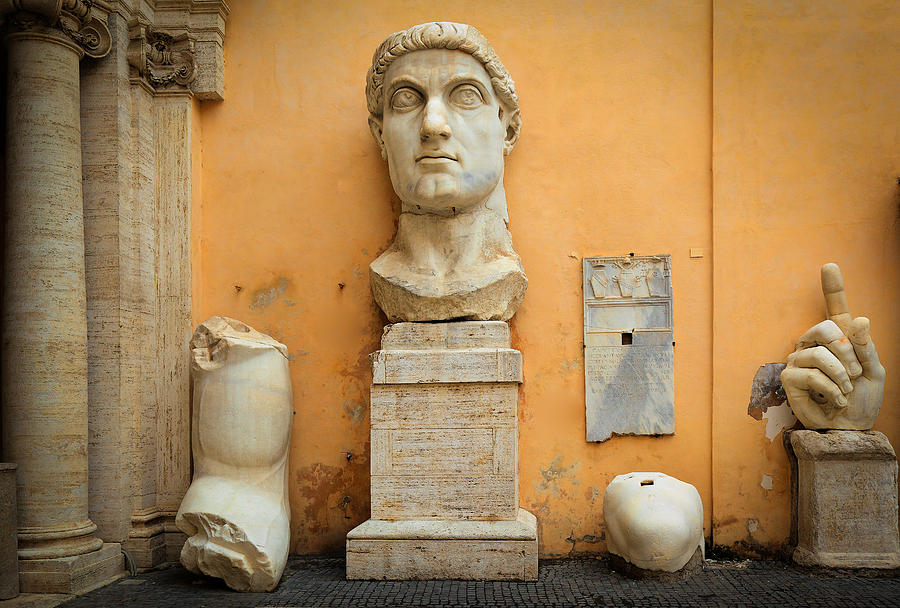
source: fineartamerica.com
Popular now among Catholics, Schmemann-derived Orthodox, and various stripes of protestants is the narrative that Constantine corrupted Christianity by bringing about its legality and the official juridical preference given to it by his successors. Malachi Martin promoted this telling in his Decline and Fall of the Roman Church as did Alexander Schmemann in his Church, World, Mission. A complimentary narrative purports that the schism between Rome and Constantinople occurred in 1054, was solidified in 1204, and was the consequence of papal ambition. There is some truth to the last part of the second story, but it wholly misses the point. The un-caused cause of the schism is Constantine, who created "Byzantine" Christianity.

He is called "St. Constantine, equal to the Apostles" in the Greek liturgy—"equal" in his influence in spreading Christianity and in no other way whatsoever. Emperor Constantine was accorded by Russell Kirk the same appellation Edmund Burke gave Oliver Cromwell: "a great bad man." After the miraculous apparition prior to the Battle of the Milvian Bridge, Constantine found himself the ruler of a war torn empire stirred by the upstart Catholic faith. Constantine presided at the Council of Nicaea, partially to resolve a theological dispute which caused angst within the large Christian community and partially to baptize Christianity into the reformed and Hellenized Roman Empire. 

In the years following Nicaea the bishop of Constantinople, formerly a minor bishopric of little prestige (antipodal to Jerusalem, a prestigious bishopric of no political importance) exercised greater and greater authority within the Eastern Roman Empire. The fourth ecumenical council, held at Chalcedon, effectively pushed out of the Church Coptic Christians who were duped by the heresiarch Eutyches. The same council promoted the bishop of Constantinople to Patriarch, second only to the Apostolic See of Rome. This promotion bypassed the eminence of the Petrine see of Antioch and the newly-alienated see of Alexandria in favor of political expediency. Slowly the Christianity at Constantinople became separated from Roman Christianity. By the time of the iconoclast controversy, we could say that there was such a thing as Byzantine Christianity, supported by the state and defined both by its Platonic language, its liturgy, and its prominence in conciliar decisions.

All this time the popes sat in Rome doing exactly what they should have done, absolutely nothing. Fr. Hunwicke once said it best: the strongest point of the popes during the period of Byzantine domination of theology is that they themselves contributed next to nothing. The popes of the first millennium, in stark contrast to the 20th century popes, were distinctly allergic to any kind of renovation, innovation, or evolution of the faith whatsoever. The papal reaction to the iconoclast dispute exemplifies this. While the Byzantines fought in the streets over proactive veneration of icons against the imperials who want them erased from the churches altogether, Pope Gregory III condemned iconoclasm and at the same time suggested a pastoral resolution, to put icons on the walls and ceilings of churches where veneration would not become an issue. After Greek control of the papacy detumesced and the Western Roman Empire fell apart, the Bishops of Rome and their Greek counterparts found themselves presiding over two increasingly distant parts of the universal Church.

The schism, contrary to popular opinion, did not happen in 1054. It did not happen in 1204 either. 1054 was not a breech between Rome and the rest of Christianity, which had long ago itself been separated from the former-Byzantine Empire. 1054 marked the culmination of a bickering match between Rome and Constantinople that began with the creation of a uniquely Byzantine Church, which was nurtured by the Photian affair and the triumph over the iconoclasts, and which was brought to a head by the re-assertion of Papal power. Over the two previous centuries, the popes had been a remarkably bad bunch (philanderers, simonists, murders, and the occasional heretic). Meanwhile the various patriarchates became accustomed to operating without the popes and their judgments. One could say Papal power was stronger in the 5th century than in the 10th. The all-time nadir of the Papacy came during the reign of Benedict IX, who bought and sold the papacy to marry a woman, held the Petrine chair thrice, and raised an army to dispute his uncle for the Roman see. After such a soap opera, the re-assertion of papal primacy under Leo IX, Gregory VII, and Urban II seemed absurd to the Byzantine patriarchs, who now presided over a tradition separate from that of Rome. A rift that had been taking root for centuries flowered with the dispute between Cardinal Humbert and Archbishop Michael Cerularius. The Emperor rightly ignored the separation when his kingdom was put at risk. The Crusades created a cultural animosity between the Greeks and Latins that spilled over into religion and in the years after the fall of Constantinople Greek Christians, understandably, looked to blame the Latin Church for its sins in meddling with Byzantine affairs. The Pope became the absolute head of all matters in the Latin West and the Greek Patriarch became Vice President of non-Islamic Religions in the Ottoman Empire; many patriarchs, even given their animosity towards the Roman Church, should be admired for their sufferings under the Turks. Individual cases of reunion, like that of the Melkite Church, were often disrupted or brought to naught by Turkish and Constantinopolitan intervention. Moreover, the roles of the Pope as Patriarch of Rome and "head bishop," as Armenian king Vartan II called the Roman bishop, became blurred.

At this point the "Hull thesis" takes over. The Latin Church been self-reflective and encumbered in her own legal system, her own theology, and her own devotions with no external oversight from the other patriarchates as existed centuries earlier. The Roman objectified theology and turned it into a variation of Greek logic. Conversely, the Greeks began to hold in suspicion things that were not Greek: the Roman Canon, the primacy of the Pope, St. Augustine, and the like. One epigraph in Banished Heart referred to the Pope as the "ghost of Caesar." Similarly, historian John Romer called the Orthodox churches the last "relic" of the lost Byzantine Empire. Both statements are exaggerations, but do procure strong elements of truth for modern consideration.

Now the Roman Church is in administrative and bureaucratic shambles; Mass attendance is in the gutter. The Byzantine Orthodox world is de facto run by Russian primacy, and Russia is among the most secular countries in the world; Orthodox churches are often strong centers of faith, but just as often seem to function as cultural hubs (Eastern Catholic churches are just as guilty here). The Greeks triumphantly uphold the religion of a defunct world power while the Romans have dismantled their once ubiquitous, virile praxis. And the Oriental Catholic and Orthodox Churches are forgotten.

Patriarch Gregory III of the Melkite Church
The cultural divide begun by Constantine continues to this day, separating Byzantine Christianity from both Rome and the far East. Coptic Catholics and Orthodox have inter-Communion in Egypt and have for years. The Melkites and their Antiochian Orthodox brethren also have inter-Communion, shared Sacraments, and even shared parishes; they use the Greek liturgy, but have carefully spurned any excessive embrace of non-Arabic culture. The non-Byzantine Eastern Catholics have displayed very little trouble adapting to the teachings of the last millennium without vitiating their own perspectives. Why must the Byzantines be different? Perhaps it is post "Uniate" guilt wrought by de-Latinization, pro-Orthodox ecumenism, and cultural pull. One Slavic Byzantine Catholic said to me "Well, we should all really be Orthodox and would be if not for the Union of Brest." Ignoring the fact that the Union of Brest influenced the Slavic churches and not the north African or far Eastern churches, my mind nearly prompted me to ask "Are you Catholic by birth or by faith?" I held my tongue.

The healthiest Byzantine Catholic parishes I have seen in the United States have embraced Byzantine spirituality as their future and reeled in the ethnocentrism that once dominated those churches. The Melkites and Ruthenians are doing well enough in the United States while the Ukrainian Catholic Church is struggling (but doing well in missionary areas). Was this not what Alexander Schmemann wanted his own Russian Orthodox Church to do decades ago? God became Man neither as a Greek, nor Slav, nor Roman, but as  Palestinian Jew. Constantine did not intend to drive a wedge between the various parts of Christendom, only to use part of it to strengthen his declining Empire. In that he succeeded. He was not the immediate cause of the East-West Schism, but he is the most necessary one.

This short reflection carefully advocates nothing. The purpose of this post is to summarize why the author believes the seeds of division of Byzantine Christianity (Orthodox and Catholic) from the rest of Apostolic Christendom were planted long before most think. Such a long division brings about many questions. Answers will not be found with the Moscow Patriarchate, the Congregation for Oriental Churches, or weekend conferences in Ravenna. They will only be found at the ground level.

Thursday, October 17, 2013

The Rad Trad's One Year Anniversary

Today is the one year anniversary of the Rad Trad's first ever post, a sort of meditation on the East-West schism after attending a marriage between two Catholics—one cradle and one from a Russian Orthodox/Jewish background. This blog began as the brainchild of the Rad Trad's best friend, who suggested he start this little endeavor as an outlet for relaxation and expression.

For the first several months readership was remarkably low, so low I dare not speak of numbers. Around the time Benedict XVI abdicated the Papacy the Rad Trad wrote a very brief series on the Papal Coronation as it existed before Paul VI, which garnered some interest, but not quite lasting. The two real "breakthroughs" in readership came with the Rad Trad's descriptions of Holy Week before Pius XII's novel rites and with his series Reasons for the Reform of the Roman Rite, which traced the broader causes of the 20th century upheaval in the Roman liturgy. Both sets of posts were meant to spread information and begin serious conversation about what happened to the Roman rite in the 20th century, something beyond the conventional Traditionalist claptrap ("Everything was perfect and Plasticine in 1962 until evil Freemason Bugnini came out of the shadows....") and ahistorical modern ignorance ("Well the Church always changes her liturgy, the new liturgy is true renewal, and has brought about nothing but good fruits"). These posts were featured on the St. Hugh of Cluny blog, the St. Lawrence Press blog, and various internet fora. Recently the Rad Trad has noticed an enormous increase in links via Facebook, but Blogger does not allow him to backtrack the links to the pages which advertise his posts.

As of this moment the Rad Trad has received 38,555 hits, currently averaging about 200 per day. After a day or two without a post the average drops to about 150. Days with liturgically oriented posts get 250-350 views. Every month, except June and July (likely because it was summer) readership has increased. Last month, September, was the best to date, with 7,464 hits. The five most viewed posts to date are:
  1. The Practical Effects of Ultramontanism (587)
  2. Book Review: The Banished Heart (451)
  3. Good Friday: Mass of the Pre-Sanctified (391)
  4. The Roman Rite in Transition (325)
  5. Reasons for the Reform of the Roman Rite Part I (290)
The most commented-on posts are FSSP Priest Caught Celebrating Versus Populum!, the review of Dr. Hull's Banished Heart above, and the most recent posting on the Parisian Missal.

More importantly the Rad Trad has been privileged to correspond and learn from many of his readers (you know who you are) about the faith and our Lord. It is a blessing.

from: catholicculture.org
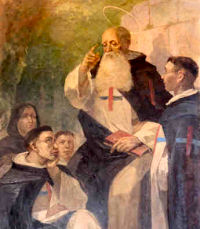
Lastly, the Rad Trad will now unveil the blog's new patron saint (and will give him a permanent presence once he figures out how to side bar material): St. Felix of Valois! The last lesson in the second nocturn of Mattins for St. Felix's feast should give readers a hint as to why the Rad Trad took Fr. Capreolus' suggestion for this saint's patronage:
"There Felix wonderfully devoted himself to the promotion of Regular Observance and of the Institute for the redemption of bondsmen, and thence he busily spread the same by sending forth his disciples into other provinces. Here it was that he received an extraordinary favour from the blessed Maiden-Mother. On the night of the Nativity of the Mother of God, the brethren lay all asleep, and by the Providence of God woke not to say Mattins. But Felix was watching, as his custom was, and came betimes into the Choir. There he found the Blessed Virgin in the midst of the Choir, clad in raiment marked with the Cross of his Order, the Cross of red and blue; and with her a company of the heavenly host in like garments. And Felix was mingled among them. And the Mother of God began to sing, and they all sang with her and praised God; and Felix sang with them; and so they finished the Office. So now that he seemed to have been already called away from glorifying God on earth, to glorify Him in heaven, an Angel told Felix that the hour of his death was at hand. When therefore he had exhorted his children to be tender to the poor and to slaves, he gave up his soul to God (upon the 4th day of November) in the year of Christ 1212, in the time of the same Pope Innocent III., being four-score-and-five years old, and full of good works."
Tonight is first Vespers of the feast of St. Luke the Evangelist. May we all be aware that the saints, God's friends, are also our own and let us be cognizant of their presence among us as St. Felix was.

Thursday, September 5, 2013

Interesting Comments

Chris, Jason, Therese, and Bodhan have made some interesting comments on the Rad Trad's review of The Banished Heart by Dr. Geoffrey Hull, particularly concerning language, evangelism, and modern day Orientalism. Readers may find some of these comments intriguing and worth reading.

Tuesday, August 27, 2013

Book Review: The Banished Heart: Origins of Heteropraxis in the Catholic Church by Dr. Geoffrey Hull (minor update)

Dr Geoffrey Hull
source: Wikipedia.org
Once every now and then one finds an author capable of approaching a daunting subject with remarkable clairvoyance, not muddling himself among polemics or minutiae. Dr. Geoffrey Hull is one such author. His The Banished Heart: Origins of Heteropraxis in the Catholic Church recalls that old saying that the truth is not between two positions, but rather above them. Hull examines the roots of the twentieth century liturgical overhaul by rising above the disputes between liberals and traditionalists that have raged on for five decades and taking a long, far-sighted look back centuries more, to the late first millennium, when the Roman liturgy was maturing, the Roman patriarchate was expanding its missionary presence in Western and Eastern Europe, and the Papacy's prestige and power were expanding well beyond the walls of Rome. How and in what context did the Roman liturgy change from a theocentric, organic act of worship to an anthropocentric fabrication? The Banished Heart is a thorough, insightful answer to this question.

The Basic Argument


The answer to the aforementioned question, developed over 356 pages, is found in an epigraph at the beginning of the second chapter. He quotes the 19th century Russian ascetic Theophan the Recluse: "You should descend to your heart from your head... The life is in the heart, so you should live there. Do not think that this applies only to the perfect. No, it applies to everyone who begins to seek out the Lord." The Roman rite of the Catholic Church began to live more and more in its head rather than in its heart, which is its holy liturgy. Hull traces two closely intertwined trends that emerged as characteristics of the Roman Church:
  1. An emphasis on rationality and logic that descends from the Roman legal tradition and which survived in the Latin Church's theological language
  2. A tendency to imitate the secular forces of the time with regards to internal government and relations with those outside of itself (in this case, non-Latin Christians)
The second of these points became a problem when Charlemagne attempted, with reasonable success, to appropriate the Church into his Frankish kingdom and utilize Christianity as a means of state unification. So strong a unity with the state existed that the Greek routinely called the Latins "Franks" rather than "Romans" or "Italians" or "Germans." Toward the end of the first millennium and at the dawn of the second, the Roman Church began to equate itself exclusively with Christianity, supposing anything at variance with its own theology and liturgy to be suspect. This led to the virtual suppression of the Mozarabic rite in Spain, the attempted suppression of the Ambrosian rite in Milan, and tergiversations of language and rite in Eastern Europe. What was originally the Primacy of Rome became justification for uniformity, an obsession which plagues the Latin rite of the Catholic Church to this day.

The often-maligned rite of Milan
source: newliturgicalmovement.org
This phenomenon continued well after the end of Frankish significance. Innocent III imposed the Latin liturgy on Constantinople after finding himself, unhappily, de facto king-maker of Byzantium. The Church's missionary efforts in this regard are also quite sad, as Hull demonstrates. Chapter 12 is a particularly difficult one to read. In it Hull recounts the visits of various Catholic missionaries to many branches of Apostolic Christendom which found themselves, either through historical circumstance or the sins of their fathers, out of communion with the Holy See. Many of these communities, often entire Churches, wished to re-establish communion with Rome. The "Thomas" Malabar Christians of India, the Chaldeans of the Middle East, and the Orthodox of Ethiopia all entered into inter-communion with the Roman Church and clergy, even giving Rome considerable leeway in local matters. Invariably a derisive attitude overcame the visiting clergy, who attempted to impose the Roman rite on these Christians and to end their own unique traditions, such as married priests. The local Churches rebelled and a small fragment, wishing to retain the Roman communion, would set up a "uniate" church, a church that would be held in contempt by both Rome and the local Orthodox. The disorder and disdain causes by Latinizations in Ethiopia were of such great magnitude that a Roman priest would be stoned to death without trial until the 19th century.

This narrow view was noxious alone, but with a few other influences it would become fatal. In earlier days the Eastern Churches maintained the heart of Christianity while Rome was its head. The loss of the Eastern Churches meant Rome would think itself the only legitimate expression of liturgy, of theology, and of the priesthood (disdain for married priests outside the Latin rite continued into the 20th century). There could be little introspection possible in such an environment.

Which returns the reader to the first point: rationalism. Everything would henceforth conform to Roman rationalism. Although the book is largely about the danger of excessive rationalism, Dr. Hull provides no strong definition, but it might suffice to say that the author means the idea that all matters, human and Divine, must be reduced and explained according to human reason. Human reason eventually became a standard by which other facets of the faith were to be judged and expressed. Prosper of Aquitaine's dictum "Lex orandi legem statuat suplicandi" was the common belief of all Christendom at one point. Liturgy was the theologia prima, the primary study and expression of faith in the mysteries of Our Lord. But as the Church began to enter secular endeavors her theological language became more and more legalistic. Scholasticism is an accurate and clear system, but it is also a system born out of the words and thought process of the pre-Christian Roman Law. When written theology began to supplant liturgy concepts became fungible. Many movements in the Middle Ages, Hull aptly proves in Chapter 4, were anti-rational: the Nominalists, the Franciscans, and the Scotists all diminished reason's capacity to understand the Divine. The Counter-Reformation would see rationalism return with renewed vigor: primary consideration drifted from elegance to validity, from worship to instruction.

Yet the liturgy survived the East-West schism intact. Even under the auspices of Papal primacy, Rome was less and less able to alter the local rites of given dioceses and Rome, although convinced of the theological superiority of her rite, often had to defer to the local usages. All that ended with the Protestant Reformation.

The Reformation


Hull acknowledges the irony that the Reformation began as a reaction to a perceived idolatry, the Renaissance era Roman Church's emphasis on philosophy and human reason. Dr. Hull does not state this observation, but readers should find another irony in that, aside form Luther and Cranmer, most all the major Reformers were lawyers.

Chiesa Gesu in Rome, home of the Society of Jesus.
Notice the great nave and tiny sanctuary with
no choir.
source: Wikipedia.org
The Reformation essentially privatized religion, making faith a matter of private piety and Scriptural study. What is most perplexing is that the Church, in combatting Protestantism's heresies, followed the same spirit and pattern. The adoration of the Blessed Sacrament, devotions deriving from private revelations, Benediction of the Blessed Sacrament, and the reception of the Sacraments more often than not became matters of personal, private spirituality. The greatest force during the Counter-Reformation was the Society of Jesus which, Dr. Hull reminds readers, was the first religious order ever to not sing the Office in common every day. The purpose of the Jesuits was to promote the basic teachings of Catholicism, which they did quite well. What they did not do was promote the Catholic spirit. The Jesuits succeeded in building universities and parishes, in instructing millions and even in creating their own operatic genre. Yet they did not re-kindle the liturgical understanding of the faith that had existed from the earliest days of Christianity until the 16th century.

The religious pluralism that resulted from the Reformation often meant that Catholicism was not as keenly defended by the ruling authorities as in previous times. Indeed, rather than the secular defending the spiritual, the spiritual took on the ethos of the secular. Baroque churches, with reredos that look like stone curtains and altars as close to the rail as can be, in some ways resemble theaters of the same era more than they resemble churches of a few centuries prior (161). Consequently, the liturgy became either a time for private prayer or a great Italian opera. Indeed, Voltaire called the Mass the "opera of the peasants."

The sad conclusion one reaches at the end of Chapter 10, called "Reformed Catholicism," is that the Counter-Reformation failed to reach its goal of re-converting Europe. Secular revolutions sprang up, one after another, promulgating and promoting humanist, socialist, democratic ideals far removed from Christianity. The liturgy fell into disuse. A cult of personality, called Ultramontanism—which survives to this day, developed around the Pope. The Church had made herself the religion of the majority of persons in Europe. It is little wonder that with such a pious, rationalistic outlook the gaze of the theologian's eye would eventually turn inward.

Setting the Stage and the Featured Presentation


The Banished Heart recounts various moments in the development of the Liturgical Movement: the Jansenist movement's demands for more focus on the laity, for simplification, and for rubrics that conformed to their own standards, all supposed features of a more primitive, purer liturgy. The movement culminated in the robber-council of Pistoia, condemned by Pius VI in 1794.

Whereas many traditionalist writers often focus on the Modernist heresy, Hull spends more time connecting the proverbial dots between Jansenism—an outgrowth of rationalistic Protestantism—and the left wing of the Liturgical Movement. After the condemnation of Modernism by St. Pius X in Pascendi many would-be Modernists began to study more benign subjects, such as liturgy. Here the Liturgical Movement underwent a fundamental change. Initially it had intended to restore full use of the Roman liturgy, as opposed to the low Mass and a Rosary variety that existed at the time. Suddenly it took on a "pastoral" aspect interested in the needs of "modern man." Pius XII's reversal of Prosper of Aquitaine's dictum, the immovable baroque mindset of the Curia, the dynamism of the Modernist movement, and the election of John XXIII all but guaranteed serious liturgical change.

Much has been made of the process of constructing the new liturgy, so we shall not recapitulate it here. Dr. Hull adumbrates accounts of the first celebration of the Novus Ordo Missae for the Synod of Bishops in 1967 and three celebrations for the Roman Curia (one low, one high, and one low with music). All three were in vernacular and, possibly, versus populum.

Archbishop John Ireland
Another effect of the Reformation Hull does not neglect was the founding of the United States of America, which is given all of chapter 14 (Pax Americana). The materialistic outlook of American society and the focus on the individual impacted the practice of the faith in the United States, the author suggests. In light of Bishop Carroll of Baltimore and Archbishop John Ireland's outright jingoism, one would be hard pressed to see matters otherwise. Hull's outlook on the United States' culture can be summed up in these two sentences: "In the American philosophy man's highest purpose is to assert his 'inalienable right' to 'Life, Liberty, and the pursuit of Happiness' on earth. Eternal life is an optional extra for those who choose to believe in it" (238). America's tremendous wealth allowed American bishops and theologians to leverage their influence on a Vatican in dire need of funds to rebuild a Church decimated by war. This took the form of Dignitatis Humanae and seats on the various liturgical commissions.

Other Points


The Banished Heart, which is laid out by theme rather than by chronology, touches on several other points that did not fit into the structure of the above summary:
  • Roman centralization's effects on local languages: there are dialects of Spanish and Italian which are not available in the new liturgy, forcing locals to worship in a language that may be considered outside of the community. A more serious example might be the near extinction of the Irish language at the hands of clergy who thought speaking it a sin.
  • Obedience was made into a worthy end in and of itself rather than a means of living an un-complicated life, as it was originally intended. The author has some especially strong words for those who equate the Pope's words and actions with the immediate inspiration of the Holy Spirit. Dr. Hull passes some comments about John Paul II that I dare not repeat here.
  • The Banished Heart presents a realist assessment of the work of Archbishop Marcel Lefebvre, the controversial French prelate who founded the Society of St. Pius X and consecrated four men to the episcopacy without canonical approval. The Banished Heart acknowledges that while Lefebvre kept the pre-Conciliar liturgy alive the right wing political affiliations of the SSPX also contributed to making the 1962 rite a "ghetto" rite until 2007. Still, Dr. Hull asks, why was Lefebvre the only noticable dissident of any degree or of any kind punished after Vatican II? Lefebvre's work, sometimes good and sometimes bad, retained some semblance of continuity with the Church's past, which is exactly why he drew the ire of Paul VI and John Paul II.
  • The author relies heavily on Eastern Orthodox liturgists and theologians, as the East, whatever their problems, have retained the primacy and importance of liturgy as the theologia prima better than the Western Christians have. Many traditionalists will undoubtedly find this point discomforting and some may even accuse Dr. Hull of swallowing Orthodox glorification of the liturgy, as this one fellow does, but this canard lacks merit. Eastern theologians rarely think of anything new. Their most recent theological movement was the Hesychast revival of the 14th century, in itself a reiteration of 5th century theology. Byzantine liturgical theology is not made illegitimate by the faults of the Popes and Patriarchs.
  • The negative reaction to Summorum Pontificum was an internal dispute between two segments of the revolutionary party within the Church, not between "liberals" and "conservatives." Josef Ratzinger, who maintains that he never revised his views, was a proponent of the "new theology" in the 1950s and 1960s. His interest in the 1962 rite and in Archbishop Lefebvre's Society of St. Pius X derives from his pluralistic world view and his wish to have come to lasting peace with the French prelate in 1988. His interest was not in a revival of the old liturgy per se. His opponents lacked his desire to find a solution for the Society of St. Pius X, but not his opinion that the new missal has brought good.

Shortcomings


On the whole this is the best book I have read in years on the current state of the Catholic Church, both liturgical and otherwise. Dr. Hull displays tremendous insight into liturgical theology, the history of the Papacy, the evolution of piety, the Church's relationship with secular culture, and the events of the 20th century, namely the Second Vatican Council. Toward the end of The Banished Heart Dr. Hull briefly relapses into the common mistake of seeing everything prior to the Council as a countdown to the Council. The Council's only document on the liturgy was a transitional one, written to justify more substantial reforms that had yet to come. Banished Heart only briefly touches on this point, instead adopting the familiar line that the reforms betrayed the Council's modest wishes.

Another shortcoming is an omission. The Banished Heart rightly asks why the Eastern Catholic Churches, if they are considered by the modern authorities to be as fully Catholic as the Roman Church, were given a separate document at Vatican II un-related to the document on the Roman liturgy. In short, the Eastern Churches were treated as a curiosity. Another point that could have been made is the dishonest, ecumenical use of Eastern theology in the post-Conciliar age. How often have we heard the term "full communion" when the hierarchy dialogues with Protestants, or Jews, or Muslims? The idea of being "in communion," a mostly Eastern concept, is defined as sharing Sacraments. None of the aforementioned groups have any Sacraments (although Protestants usually baptize validly). Yet "full communion" is normally implied to be lacking, as though a partial communion exists when it does not. This may not have occurred to Dr. Hull or it may have seemed tangential, but it was worth saying somewhere.

Lastly, and this is not a small problem, there is no working definition of the "traditional liturgy" in The Banished Heart. It is simply treated as something that exists. Dr. Hull passes over the 1911 Office reforms and 1955 Holy Week novelties with neutrality. The Roman rite surely suffered through these changes, but did the Roman rite not also suffer when various local rites, which preserved certain facets of the Roman liturgy which had fallen into disuse and contributed in other regards, became extinct. A firmer definition of the Roman liturgy's essential features and process of evolution would have made the last third of this book all the more forceful.

Conclusion


Dr. Geoffrey Hull's The Banished Heart: Origins of Heteropraxis in the Catholic Church tells the tale of how the East-West schism allowed the Church of Rome to be engulfed in its own tendency toward rationalism and to "banish its heart," the liturgy, from its head, making it ill-suited to deal with the Reformation and the political revolutions that followed. The book is thorough, readable, well researched, and not the conventional traditionalist polemic. This book will challenge many readers' preconceptions about liturgical theology, the Reformation, and the events leading up to the Second Vatican Council. But if readers are patient and genuinely wish to learn why the Roman rite underwent the revolution it did, then they should order a copy immediately.

Friday, August 23, 2013

Coming Soon: Review of Banished Heart

source: newliturgicalmovement.org
This weekend I hope [finally] to publish a review of Dr. Geoffrey Hull's Banished Heart: Origins of Heteropraxis in the Catholic Church. Thus far it is the best and most temperate work I have encountered on the current state of the Church, liturgically and otherwise. Should any of my readers be in Holy Orders this quote from the last page of the book may be of interest to you:
"Moreover, if the Church is to recover her true self, men preparing to receive Holy Orders will need constantly to reflect on the significance of the liturgical custom of laying out a priest's corpse with his head pointing to the altar rather than with his feet in that direction as at the funeral of a layman. For on the last day, each priest will stand versus populum to face those he was commissioned humbly to serve on earth, who will testify to his deeds, after which he shall turn around, versus ad Orientem, to hear the Sun of Righteousness render His final judgment."