Showing posts with label chartreuse. Show all posts

Thursday, October 6, 2016

St. Bruno Day

O Bonitas!
From his hagiography:
With six companions, four priests and two laymen, Saint Bruno applied to Hugh, Bishop of Grenoble, who led them to a wild solitude called the Chartreuse. There they lived in poverty, self-denial, and silence, each apart in his own cell, meeting only for the worship of God, and employing themselves in copying books. From the name of the solitude the Order of Saint Bruno was called the Carthusian Order. Six years later, Urban II called Bruno to Rome, that he might benefit from his counsel. Bruno tried to live there as he had lived in the desert; but the echoes of the great city disturbed his solitude, and, after refusing high dignities, he finally obtained, by force of persuasion, the permission of the Pope to resume his monastic life, this time in Calabria, with only a few companions. There he lived, in humility and mortification and great peace, until his blessed death occurred, in the arms of his faithful monks, in 1101.
St. Bruno, pray for us! Restore your order and the glory of the religious life!

Tuesday, October 6, 2015

The Vision of St. Bruno

(José de Ribera, more or less)

Happy feast of the founder of the Carthusian Order! O Bonitas!

Thursday, September 10, 2015

Wormwood Proposes a Toast; or, Abyssus Absinthium Invocat


It was another sunny Texas Sunday morning when I last made my way into Café Preténse. The parking lot was far from being full, but a swarm of bicyclists had overrun the sidewalk, and a line of them stretched from the counter almost to the front door. They were talking excitedly from the adrenaline, and overwhelming the café’s usual espresso scent with their own.

By the time I made it to the counter I had almost decided to leave for a Starbucks. Where would I even sit?

“What can I getcha?” asked a college girl with too many colors in her hair.

“Cappuccino, please.”

“For here?”

“Better make it to go,” I said, looking around the building. “Just in case.”

“Name?”

“J.”

“Jay? Jay What?”

“‘J’ as in Joseph.”

“One cappuccino for Joseph.”

“Sure.”

She ran my card, and I wondered if the couches in the back area might have an empty cushion or two.

“Hey, your card says John Grump, not Joseph.”

I took my receipt and pushed my way through spandexed bikers to the back area. It was low-lit and close to the unisex bathrooms, but one teenage girl sat on each of the three couches, all of them talking animatedly. I considered sitting down beside one of the infantile women to make a point, but then I recalled that I actually wanted to read.

This place is getting on my last nerve, I texted to His Traddiness.

Ditch the burnt coffee scene and join me for another glass of Chartreuse, he retorted.

Yellow or green?

Green. I am convinced that this yellow monstrosity was invented by the Franciscans.

After I’m properly caffeinated. We’ll see if I get a seat. Still cranky from the sermon this morning.

Leaving the couches behind, I made my way up front. Every table had an occupant, every padded chair comfortably employed. If nothing cleared before my name was called I would leave and shake the coffee grounds from my sandals. My eyes wandered to and fro, and finally met with those of another customer looking up from his laptop while taking a sip from his mug. He was a devil of one of the lesser orders, and he nodded to indicate I should walk over. I did.

“You looking for a seat?” he said.

“Yes, thanks. You heading out?”

“Not for a while, but I have some space if you want to take the other chair.” There was indeed enough space for my books, my drink, and my self. “I don’t mind sharing a table with a fellow coffee aficionado.” He looked and dressed like Matthew Goode (circa 2008), except for the horns. I decided he was less likely than most of the people in this café to steal my books if I stepped away for a phone call.

“Sure thing. My name’s J.”

“Wormwood.”

“Cappuccino for Jay Grump!” the baristi with the technicolor dreamhair bellowed.

“Be right back.”

When I returned to the table, Wormwood was reading the back matter of my book.

“Occult symbolism in modern poetry? Tsk, tsk. That’s dangerous stuff.”

“Research.”

“Thinking of joining our lower ranks?”

“No, just interested in being able to spot this sort of thing when it appears. I’ve suspected many of these authors of occultism before, but this just confirms it.”

“Hmm, it’s all true enough. We didn’t catch all of them in the end, but plenty have long been drained dry by Our Father Below. Victor’s fateful séance was a real show to remember.”

I took a sip and decided to change the subject. He was beginning to look nostalgic.

“So are you the Wormwood? Of C. S. L— fame?”

He tossed the book in front of me with a flourish. “Guilty as charged! I tell you, the doors that book has opened for me! Slubgob leaked my uncle’s letters to the human world after the two of them had a falling out, and got poor Uncle Screwtape tossed into the Styx for about a century without parole. For my part, I was released from my uncle’s dungeon and allowed back into the Tempter Rolls. If all goes well, I’ll be teaching in the Tempters Training College in no time.”

“You must be busy these days. The world does seem to be falling apart.”

“And isn’t that just delightful? Don’t you just experience a wonderful, sick thrill at the thought of it? Don’t it just make you smile on the inside?”

I glared at him and sipped my drink. It would have been better in a mug than in this waxed paper cup.

“I am busy,” he continued. “I’m part of a team working on your parish. A lot of the usual temptations: sexual deviancies are easy to encourage”—he made an obscene gesture—“as are anger and certain forms of despair. But let me tell you, the best thing to do is to widen divisions and encourage fathers to provoke their children to indignation. Bitterness is rich soil for despondency, rebellion, and apostasy. Tie heavy burdens on the shoulders of the faithful, force them to march through a slough, and then chastise them harshly for complaining. I swear, if I can turn even a third of your waters into wormwood, I will destroy your parish beyond recognition.”

He sat back with a contented look and breathed out a series of perfectly shaped smoke rings, even though he had been puffing on no tobacco. My phone buzzed, and I welcomed the distraction.

Just realized that wormwood is a major ingredient in absinthe, texted His Traddiness. We should try mixing it with more sulfur to see if it brings out that hellish flavour.

“Well, Mr. Wormwood, this has been enlightening.” I replaced the lid on my cup and tried not to look in his eyes. “I should probably head out. I don’t think I’m going to be able to read much with all this commotion.”

“It is downright pandemonious, isn’t it?” He sat up straight. “My goodness, I need to learn to not monologue when I’m talking to prey. I just enjoy the look in their eyes when they see me coming for them, you know? Oh, and do you mind watching my things while I use the facilities?”

I nodded my assent without making eye contact, and he clomped off, his tail trailing just above the ground. Once he was behind locked doors I shifted over to his chair and began skimming through his emails. It was a simple enough matter to set a forwarding email address to all his messages. By the time he returned I was back on my side of the table, stuffing my receipt into the book and skittishly sipping my drink.

“Certain things just take longer when the waters are bitter.” He laughed, and I pretended to laugh with him. He raised his mug. “Well, my amphibious friend, let us toast before you move on to your day’s business.”

“Toast to what?”

“To the elimination of lukewarmness. May the undersexed morons who blunder into online pornography shops be turned into insatiable, defiant adulterers! May the self-hating drunkards who slur the name of The Enemy be turned into inflamed, rebellious, and sober blasphemers! May the flabby video gamers drive their cars over real pedestrians!”

“He that is filthy, let him be filthy still.”

We each took a sip of our now-tepid drinks.

“Catch you next time, Mr. Grump.”

“Until then.”

Back in the car I put the remainder of my mediocre cappuccino in the cup holder and sent His Traddiness one last text before driving:

Much to discuss. Keep an eye on your email. Chartreuse at my place, I’ll buy the cigars.


Tuesday, August 25, 2015

Ergo Concluso in Contra Manicheus!

(Thomas von Aquin bei Ludwig dem Heiligen, by Niklaus Manuel)
Louis IX of France is known as a saint, a moral leader, an affectionate husband, a (less than successful) crusader, and a holy mentor to his son. It is not my purpose here to expound upon his life and saintliness, but rather to consider an odd incident late in his life. The fame of Tommaso d’Aquino’s theological genius had grown so great in Europe that he was known to dine occasionally with the king, who no doubt enjoyed speaking on matters of the Faith with the Angelic Doctor.

One day the two were lunching together, and Tommaso’s mind began to wander back to the Summa he was in the midst of writing. His dining companions apparently did not notice his mental withdrawal until he pounded his fist on the table and shouted out, “Ergo concluso in contra manicheus!” (With this I finish the Manicheans!)—for Thomas Aquinas had conceived of a new argument against the dualist heretics plaguing Europe.

Stunned, it only took King Louis and Thomas’ secretary Friar Reginald a few moments to find ink and paper so that the argument could be preserved for theological tracts and debates. Once written, the meal continued with new vigor and joy.

One could formulate an entire theology of feasting from this incident alone. The sharing of good food and sacred conversation is a joy known best to orthodox Christians. We rejoice in truth, and are driven to celebrate by enjoying the best the fruits of the earth. Is it any coincidence that Chartreuse, that most Catholic of drinks, was invented in Louis’ old realm?

As St. John the Golden-Mouthed once said, “Ubi caritas gaudet, ibi est festivitas” (Where love rejoices, there is festivity).

St. Louis of France, pray for us! (source)

Tuesday, August 18, 2015

The Rad Trad Reviews: Chartreuse


If a visitor to le Grande Chartreuse in France knew nothing of the traditional silence practiced by the Carthusian order and was ignorant of the spirituality of St. Bruno, he would certainly be forgiven if he assumed the meditative quiet kept by the monks was a quality imparted to them by a strange green liqueur produced domestically.

Originally produced in 1605 as a remedy, Chartreuse quickly gained favor throughout Europe as both a digestif and a post-dessert liqueur. Production of the genuine article ceased when the French government banned religious orders in 1901. St. Bruno's sons only returned to France in 1929 and the Grande Chartreuse was not again inhabited until the Vichy regime. A gin-based Prohibition martini, the "Last Word," popularized Chartreuse briefly in America. When the drink died in America and when the aristocracy died in Europe, Chartreuse's presence faded into the shadows of stale bars and one-off restaurants. It is enjoying a minor revival in popularity thanks to attention from the Wall Street Journal and a few Seattle barmen who use the green potable in their concoctions. Avid readers may have noticed Anthony Blanche drinking it with Charles Ryder over dinner in Brideshead Revisited or found Agatha Christie's petite Belgian detective with a glass in the evening. It is not cocktails or books that interest the Rad Trad, however, but Chartreuse itself. 


The label on the back recommends the drink be served cold, even "on the rocks." Liqueurs, not unlike mature whiskeys, have a simple formula: alcohol by volume equals flavor. The monks of the Grande Chartreuse, if only the three monks who actually know disparate pieces of the recipe, bottle Chartreuse at 57.5% ABV. Icing a drink that strong is not a mortal sin, but it should be. When the Rad Trad tried Chartreuse he put it and a wine glass in the ice box for a few hours, went to lunch, read a book, and then opened the bottle.

Upon pouring, one finds chilled Chartreuse a viscous liquid with the consistency of a soft syrup. To the nose, the cold substance emits a soft and vaguely sweet aroma, not too strong. Chartreuse, like a fine wine or an aged cigar, transitions in flavors and scents both as the drink sits in the glass and as it tunnels down the throat. Immediately on the palate, the tongue detects a sweet licorice, peppermint, and pure black and white pepper notes. Chartreuse is spicy without being harsh. It is sweet without tasting too much like candy. It is a blast of flavor, but never overwhelming; it is always perfectly proportioned. Let is roll back on the tongue and slowly trickle down the little red lane. The sweetness vanishes as the drink departs the taste buds, leaving behind an intense finish of pepper, mint, and a hint of cinnamon.

Is the Rad Trad bloviating his description of Chartreuse's initial taste? Hardly. 130 alpine herbs are macerated twice over to create this liqueur, the second of which gives the drink its distinct green color.

A pale shade of apple green in natural sunlight.
As the drink warms in the glass the pepper dissipates slightly while the herbaceous notes intensifies on the nose: fennel, anise, mint, cinnamon, vanilla. While less sweet warm than cold upon drinking, Chartreuse leaves a sweeter finish as it nears room temperature. After a few sips a sticky, syrupy sheen develops on the tongue and roof of the mouth which makes talking pleasantly difficult when drinking Chartreuse. Your mind wants your mouth to imitate the monks in their silence and to have another go. Breathing after a drink of Chartreuse reactivates the peppermint and pepper notes from the beginning, creating a pleasurable warmth in the mouth. It is an aesthetic experience to be sure.

I have one complaint about this delicious delicacy. Chartreuse lies, and it lies very well. Although a 115 proof drink, one never tastes an alcoholic burn or feels the least hint of intoxication after drinking two wine glasses of Chartreuse. After the second glass, one stands up and is greeted by an unexpected bought of vertigo, which is far removed from tipsiness or drunkenness. Someone who gluttonously imbibes several servings of Chartreuse without pause is far more likely to nap dreaming blissful dreams than to descend into a smashed stupor.

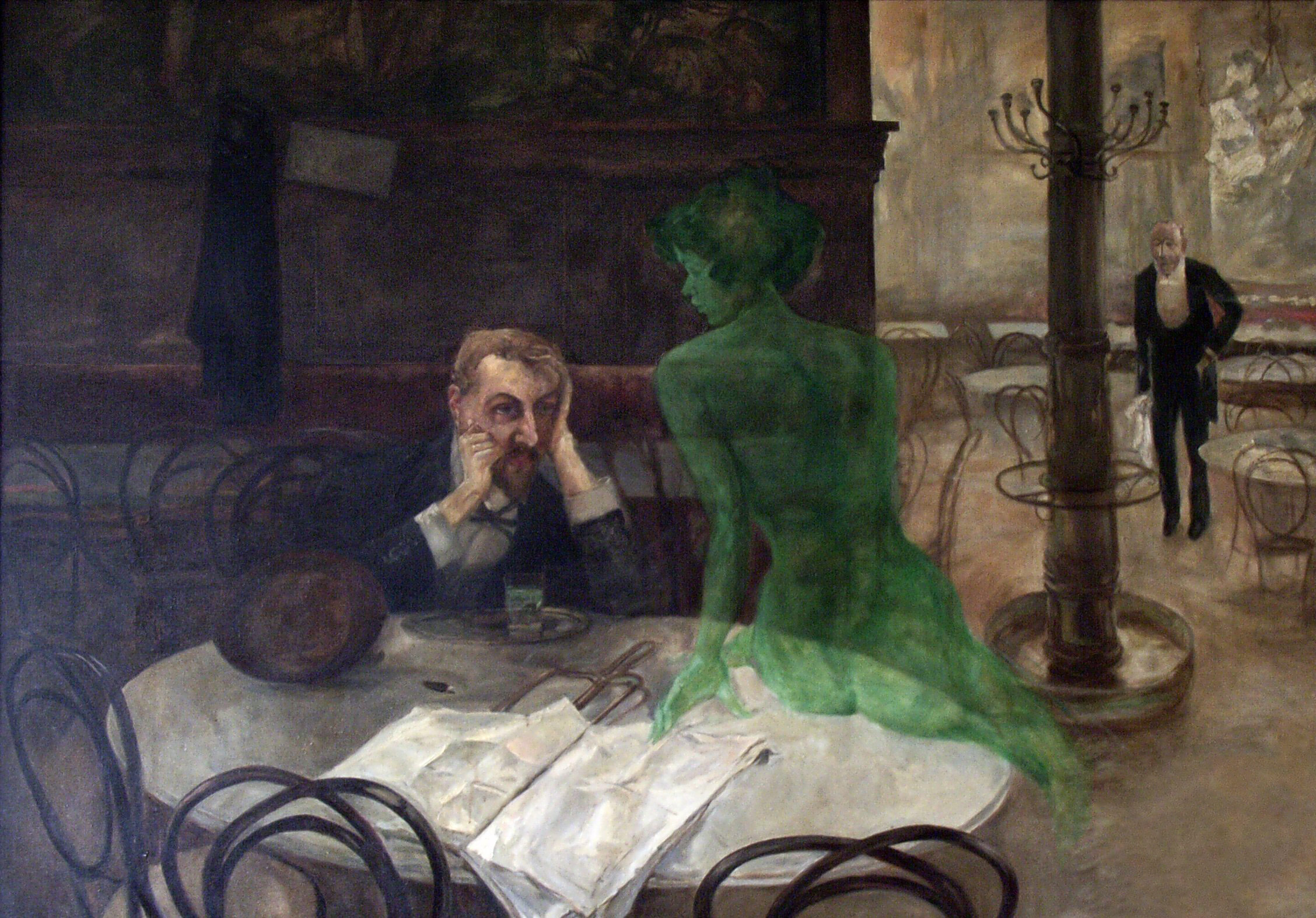
The Absinthe Drinker
by Viktor Oliva
One might say that Chartreuse is everything absinthe wants to be. I had the displeasure opportunity to taste absinthe last weekend. I am of the opinion that if something costing $70 a bottle is tasteless when taken straight, it is not worth buying. Absinthe is liquid licorice with the sugar missing (perhaps the bohemians should have spent less money on opium so they could afford to distill a drink properly). Despite the anise and fennel scent, it lacks any herbal flavors when consumed. On a hunch, I took a match to this 62% ABV creature and let it burn for a moment before snuffing it and tasting again. "It's much smoother now, less bitterness, too," I told my host. "Is it because you've burned out the alcohol?" he asked. "No," I responded. "I think the chemicals and sulfur in the match improved the flavor." I didn't even get to see the Green Lady.

Chartreuse needs no matches, no chemicals, no water, no sugar. It is perfect as the monks made it.

Chartreuse can be had for about $60 a bottle plus taxes Stateside. If news of Chartreuse's quality ever reached garrulous ears, I would expect a price increase. As is, Chartreuse is very affordable as a one time purchase for good occasions. It will be worth the money if you savor every sip, if you do not swallow it immediately, but instead let it dance on your tongue from front to back, let it roll under your tongue, sit, and trickle down your pipes. It sounds mad to drop $60 on a drink that is not wine, but this is worth it.

An entirely orthodox drink.