We now continue our probe of the longstanding allegations of Jansenism against the neo-Gallican liturgies of Paris and surrounding dioceses with a look into the Holy Week rites and the feast of the Resurrection as celebrated in the Parisian Missal. To reiterate from the previous
post on the subject, here are the criteria used for Jansenism, from New Advent's encyclopedia (precepts of Jansen condemned by Innocent X's bull
Cum occasione in 1653):
- Some of God's commandments are impossible to just men who wish and strive (to keep them) considering the powers they actually have, the grace by which these precepts may become possible is also wanting
- In the state of fallen nature no one ever resists interior grace
- To merit, or demerit, in the state of fallen nature we must be free from all external constraint, but not from interior necessity
- The Semipelagians admitted the necessity of interior preventing grace for all acts, even for the beginning of faith; but they fell into heresy in pretending that this grace is such that man may either follow or resist it
- To say that Christ died or shed His blood for all men, is Semipelagianism (it is condemned because Christ did die for the sake of all)
Palm Sunday
 |
St. Genevieve monastery
source: Wikipedia.org |
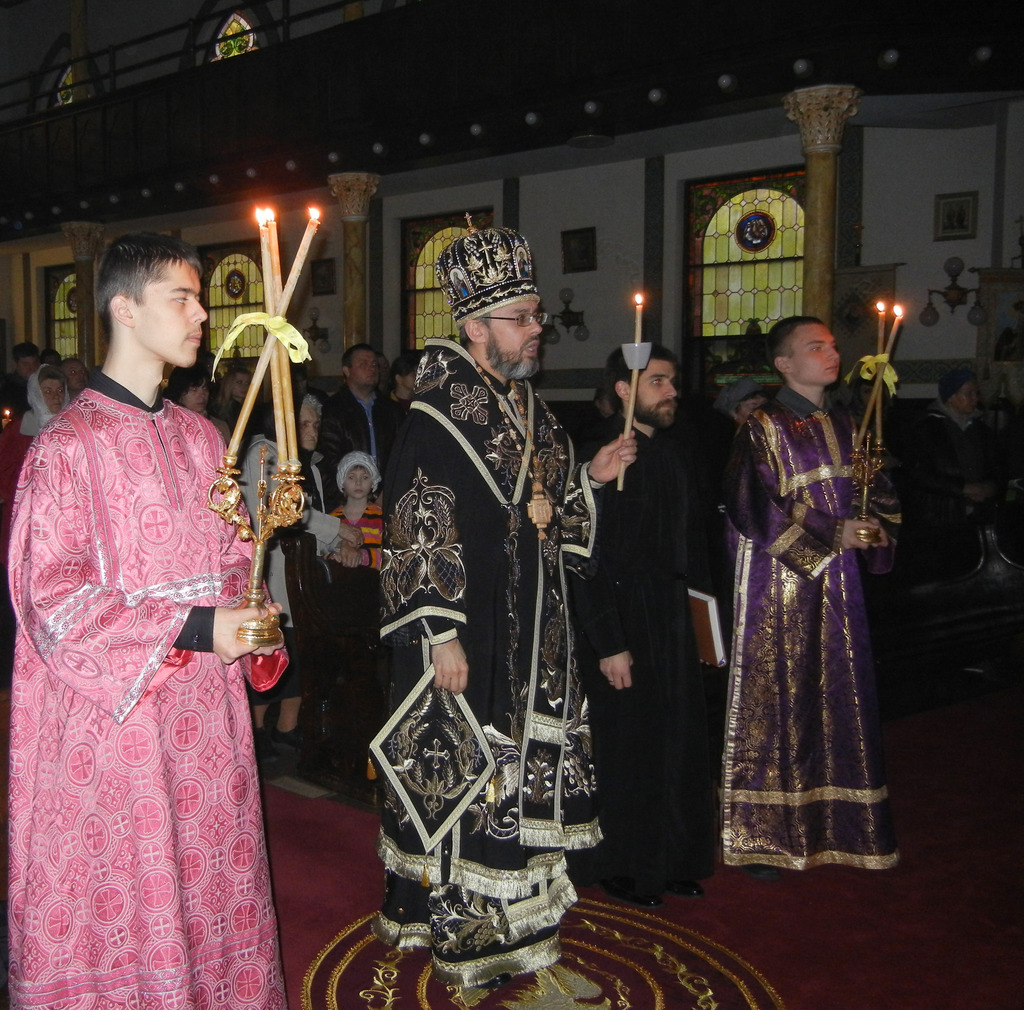
The rites of Palm Sunday begin prior to Terce, as the lord Archbishop of Paris blesses lustral water for use in the blessing of palms. The setting for the rites is the main altar of St. Geneveieve, a monastery founded for the saint's honor by King Clovis I and destroyed by the despicable anti-Christ Revolution. In some sense this parallels what was done in Rome in the first millennium, when the Pope would bless palms at St. Mary Major and then process with the Roman clergy and faithful to the Lateran Cathedral for Mass. The Archbishop blesses water wearing choir dress and a black stole. The proper blessing of the palms takes place from the epistle side of the altar. There are two short collects—far in beauty and didactic quality from the Tridentine Roman rite—for the blessing. The first addresses "God, Whose Son for the salvation of mankind descended to earth from heaven, and at the appointed hour of His Passion came to Jerusalem on an ass and was willing to be called and praised as King by the crowds, bless and make worthy the leaves of these palms, that all who bear them, by the gift of your blessing, overcome the temptation of the ancient foes in this age, and in the next may be worthy to appear to you with the palm of victory and the fruits of good works, through our Lord Jesus Christ etc...." The prayer, somewhat loquacious and banal, could not be more objectionable to Jansenism. They speak of good works, being made worthy of salvation, and participating in the Divine life. Hardly the makings of irresistible grace and the impossibility of keeping on the path to salvation. The second prayer appears to be a re-worded version of the prayer used in the Roman rite after the aspersion and incensation of the palms. The palms are distributed, with no music prescribed, and the Asperges me takes place as usual, with the celebrant in amice, alb, cincture, stole, and cope (if he is the Archbishop, maniple otherwise).
The procession leaves the church and, either at the Crucifix at the nearest cemetery or at the nearest public place, the deacon sings chapter 21 of St. Matthew with full Gospel ceremonies, recounting Our Lord's entrance into Jerusalem. The clergy and all in attendance venerate the Crucifix, if the ceremony takes place in a cemetery, and the procession continues with the singing of the hymn Ave Rex noster. The Archbishop or celebrating priest has the option of delivering his sermon after the Gospel rather than at Mass. The procession stops at the gates of the city of Paris (if the Archbishop celebrates) or at the doors to the church (if a priest celebrates with his parish) and the Gloria, laus, et honor tibi sit ceremony takes place as in the Roman rite. The Missal even gives advice on how to reduce the ceremonies of the day should the weather be prohibitive. The procession enters the church, presumed to be Notre Dame Cathedral, Terce is sung, the celebrant assumes the chasuble, and Mass begins.
 |
The Passion sung on Palm Sunday in the
old Roman rite |
The Introit, Collect, Epistle, and Tract are exactly as in the Roman Missal for Palm Sunday. The Gradual is taken from psalm 21, as opposed to 72 in the Roman rite. The Passion and Gospel from St. Matthew are exactly as in the Roman rite, but done with different ceremonies. In the Roman rite three deacons of the Passion—vested in amice, alb, cincture, stole, and maniple—sing the Passion until the burial, at which point the deacon of the Mass removes his folded chasuble, dons the broad stole, recites the Munda cor meum, and sings the burial as the Gospel of Mass with full ceremony. Here the deacon of the Mass does everything as a Gospel reading. Wearing his black dalmatic (no folded chasubles in this rite), he receives the celebrant's blessing, carries the Gospel book in a normal procession to the ambo, incenses the book, but does not sign himself or the book, nor does he greet the people with Dominus vobiscum. Instead he announces Passio Domini nostril Iesu Christi secundum Mattheum and sings the text straight through with a short pause for silence at Our Lord's death. One wonders if the reformers of the 1950s and 1960s were imitating this (minus the extra parts for lay lectors). The Creed is sung. The propers for the Mass of the faithful are different. The secret asks that the faithful "feel" with Christ, Who was "Humbled and made obedient even unto death." The Communion verse is the greeting from chapter 1 of the Apocalypse/Revelation of St. John. The post-Communion oration speaks of Christ's Passion as the "remedy You have provided" for our sins, so that we may not come to the judgment of suffering. If anything, this sort of language would disturb a Roman theologian not because the prayer is Jansenistic—for it certainly is not, but because it does not speak in basic, legalistic terms in vogue at the time.
Monday, Tuesday, and Wednesday
The Masses all differ somewhat from the Roman rite, but like the Roman rite they focus their attention on the coming Passion. The Spy Wednesday Mass has different readings (Wisdom 2 and Jeremiah 26) from the Roman rite (Isaiah 62/3 and 53), but the same unique, Ember Mass-like structure.
Mass of the Lord's Supper

Thursday's unique liturgical features begin after Lauds with the absolution of public penitents by the Archbishop of Paris. The choir, prostrated, sings the seven penitential psalms and then, with the Archbishop, who wears a red stole, makes its way to the Cemetery of the Holy Innocents. Apparently parish priests were capable of reconciling public penitents, too, as the Missal notes some might do the ceremony after
Sext or
None. Either way psalms 6, 31, 37, 50, 101, 129, and 142 are sung followed by some versicle prayers, five collects, and then the actual absolution. In the first collect the priest or Archbishop notes that he is "first in need" of the Lord's mercy; the second asks that those who have "deviated" from the Holy Church may receive the fruits of penance; the third is a simple prayer for forgiveness, as is the fourth; the fifth, and longest, addresses God as the maker and restorer of mankind and beseeches Him, in
so many words, not to let the souls of the penitent slip away to damnation. Then, mercifully, comes the overdue absolution. Again, the language differs from what the Roman mindset of the time expected, but nothing heterodox permeates the text. If anything the concept of God as the restorer of mankind should enjoy a prominent place in the family of rites within the Latin Church.
A note reminds the sacristan that at Mass two hosts are to be consecrated and that at the cathedral the chrism will be blessed. The liturgical color is red (white being a Roman quirk).
The Iudica me psalm is omitted from the prayers at the foot of the altar, even though the Gloria is sung, as in the Roman rite. The first half of the Mass emphasizes Christ's priesthood and relationship with His friends, the Apostles, whereas the Roman rite tends toward the betrayal and Passion in the Introit and Collect. The Introit in the Parisian rite borrows from the Epistle to the Hebrews (ch. 5) and the Collect asks for "an example of the humility and the mystery of His love" that we can follow, as He died for our sins and "rose for our justification." The word "justification" comes across as odd in this place, but the surrounding texts does not necessarily hint at unorthodoxy. Perhaps one may read that in saying the death of Christ gives us "justification," Christ covers for our sins as the Reformers believed. But the Catholic understanding of "justification" is holiness and sanctification, what the Greeks call theosis or deification. The constant talk of "restoration" of mankind in other texts for Holy Week suggest the more orthodox interpretation rings true.
The readings are the same as in the Roman rite. The Gradual, from Hebrew chapter 4, again emphasizes Christ's priesthood whereas the Roman Gradual borrows from Philippians. The Creed is sung, as in the Roman rite. The offertory verse is from Ephesians 5 ("Christ loved us and gave himself as an oblation and victim to God, in sweet fragrance"), as opposed to psalm 117 in the Roman rite. Here we see the theology of the Mass of the Lord's Supper in the Parisian rite developing. The Roman rite has a very diverse array of themes within its Mass, encompassing the entire day's role in salvation (the betrayal, the foreshadowing of the Sacrifice of the Cross, the Eucharist, the institution of the priesthood etc.). In contrast the Parisian rite has a narrow focus on Christ as a priest preparing to offer Himself for the sins of the people. This is an entirely orthodox concept, in line with St. Paul's epistles and the typology of the Old Testament temple system. If anything, it also reminds one of the sacrificial nature of the Passover meal Christ ate that night, which prefigures His own delivery of us from death.
The variations in the Canon of Mass are exactly as in the Roman Missal. After the Communion of the faithful and ablution of the vessels the Blessed Sacrament is incensed and carried in a "usual procession" to the altar of repose, placed on the altar, incensed again, and reposed in a place prepared (presumably some sort of receptacle). The procession returns to the sanctuary and completes the Mass with Vespers. Vespers here are done as in the Roman rite on Holy Saturday: psalms are sung with antiphons, followed by the Magnificat and the post-Communion prayer, which doubles as a Vespers collect. The psalms are 114, 115, 119, 120, and 127. The altar is not incensed during the Magnificat, but the clergy in choir are. The dismissal is Ite, missa est.
After Mass the acolytes strip the altar. Before Compline the celebrant washes the altar with wine and then immediately proceeds to the Mandatum. The Archbishop washes the feet of twelve clerics; the dean washes the feet of twelve boys; and the parish priest washed the feet of twelve paupers. With all the ceremonies of a Mass, the deacon sings the Gospel of the day and then the celebrant washes the feet of the appointed persons. The antiphons differ from those of Rome, but are Scriptural and pertinent. The collect at the end is the same as in the Roman rite. After the Mandatum the celebrant blessed bread and wine for the faithful using the same prayer most of us use before meals ("Bless us oh Lord, and these Thy gifts....); a lector sings chapter 13 of St. John's Gospel; finally comes Compline.
Good Friday
The little hours are not sung in choir, but are sung apparently. The Mass of the Pre-Sanctified takes place after None. A procession, without candles or incense or a cross, brings the ministers, vested in black, to the main altar. After a quiet prayer, as in the Roman rite, the ministers rise, ascend the altar, the celebrant kisses it, and the ministers move to the Epistle corner. As in the Roman rite a lector reads the lesson in the Epistle place (in this case Exodus chapter 12, the second lesson in the Roman rite). Psalm 108 follows as a tract and it all concludes with the same kneel-stand-pray structure as in the Roman rite, in this case with a rather banal collect. The second lesson is the suffering servant prophecy from Isaiah 53; the Missal instructs no title to be sung, which is fine because the printer forgot to put the title in anyway. Two cantors in albs sing psalm 139 as a tract, the same as in the Roman books. As on Palm Sunday, the deacon of the Mass prays the Munda cor meum and carries the Gospel book in procession, but goes to a lecturn in medio choro rather than to the ambo and sings the entire Passion, again combining the Passion and Gospel of the Roman rite into one text, without introduction or incense. Unlike on Palm Sunday, but like a Requiem Mass, the celebrant does not kiss the Gospel book at the end.
The solemn collects are nearly the same as in the Roman rite. Either anti-Roman hostility or printing error has omitted the "N" usually put as a placeholder for the Pope's name (it may well be a printing error given the mistaken omission of a Scriptural reference for the Isaiah prophecy). The prayer for the "Holy Roman" Emperor is changed to a prayer for the "Most Christian" King of France. As in the Roman rite, no genuflection is made in the prayer for the conversion of the Jews.

A more substantial, and beautiful, variation comes during the unveiling of the cross. The ministers and choir return to the sacristy and removed their outer vestments and all remove their shoes. The choir returns to the sanctuary. Two deacons (wearing amice, alb, cincture, red stole, and red maniple) carry a crucifix from the sacristy to the altar while four priests in copes (two in red and two in black) act as cantors. The cantors sing
Popule meus, and the Latin and Greek versions of the Trisagion in alteration with each other. Each time the Trisagion is sung all genuflect. The deacons hand the crucifix to the celebrant, who unveils it as in the Roman rite (
Ecce lignum cruces etc.). All make three genuflections and adore the crucifix. After the adoration, while the choir sings
Pange lingua, the cantors shed their copes. The subdeacon sings the verses found as responses to
Crux fidelis in the Roman rite in alteration with the choir, which sings the aforementioned
Pange lingua. Then the clerics stand before the crucifix and sing
Vexilla Regis in alteration with the choir, singing
Vexilla Regis prodeunt as a refrain while the choir sings the actual verses. Here we see that the choir element of the adoration of the cross was lost in the 1570 Roman Missal because that "Tridentine" rite was actually made for the Papal chapel and not for public churches or cathedrals. This set of ceremonies was, and is probably more in line with the Roman tradition that what one sees in any Roman Missal from 1474 through present day. The dramatic transfer of the crucifix from the sacristy to the altar, with the Trisagion sung, is lost because of the limited space in the Papal chapel; so the Roman (Papal) ceremony stuck the crucifix on the altar, making the Trisagion superfluous, so the hymn migrated to the reproaches. Much of this survived in the Dominican rite.
The faithful then adore the cross.
At the end of the adoration a short antiphon is sung ("Above all the woods of tree, you alone are high, on which the life of the world hung, on which Christ triumphed, and death conquered death forever"). The ministers resumes their outer vestments (chasuble, dalmatic, and tunicle), pray an abbreviated version of the prayers at the foot of the altar at the Epistle side, and a procession (with cross, candles, and two thurifers) heads to the altar of repose. The Blessed Sacrament is incensed, brought to the altar, and placed on a corporal. The deacon and subdeacon put water and wine into the chalice and the celebrant immediately sings the Pater noster. No offertory-like liturgy as in the Roman rite. The priest's communion follows the Roman rite exactly.
Again, after the ablutions Vespers follows immediately. Psalms 123, 128, 139, 140, and 141 are sung. The antiphon on the Magnificat recalls our Lord commending His spirit. When the Archbishop celebrates, for some reason, Vespers are sung from the altar and not in choir. Compline follows immediately.
Holy Saturday
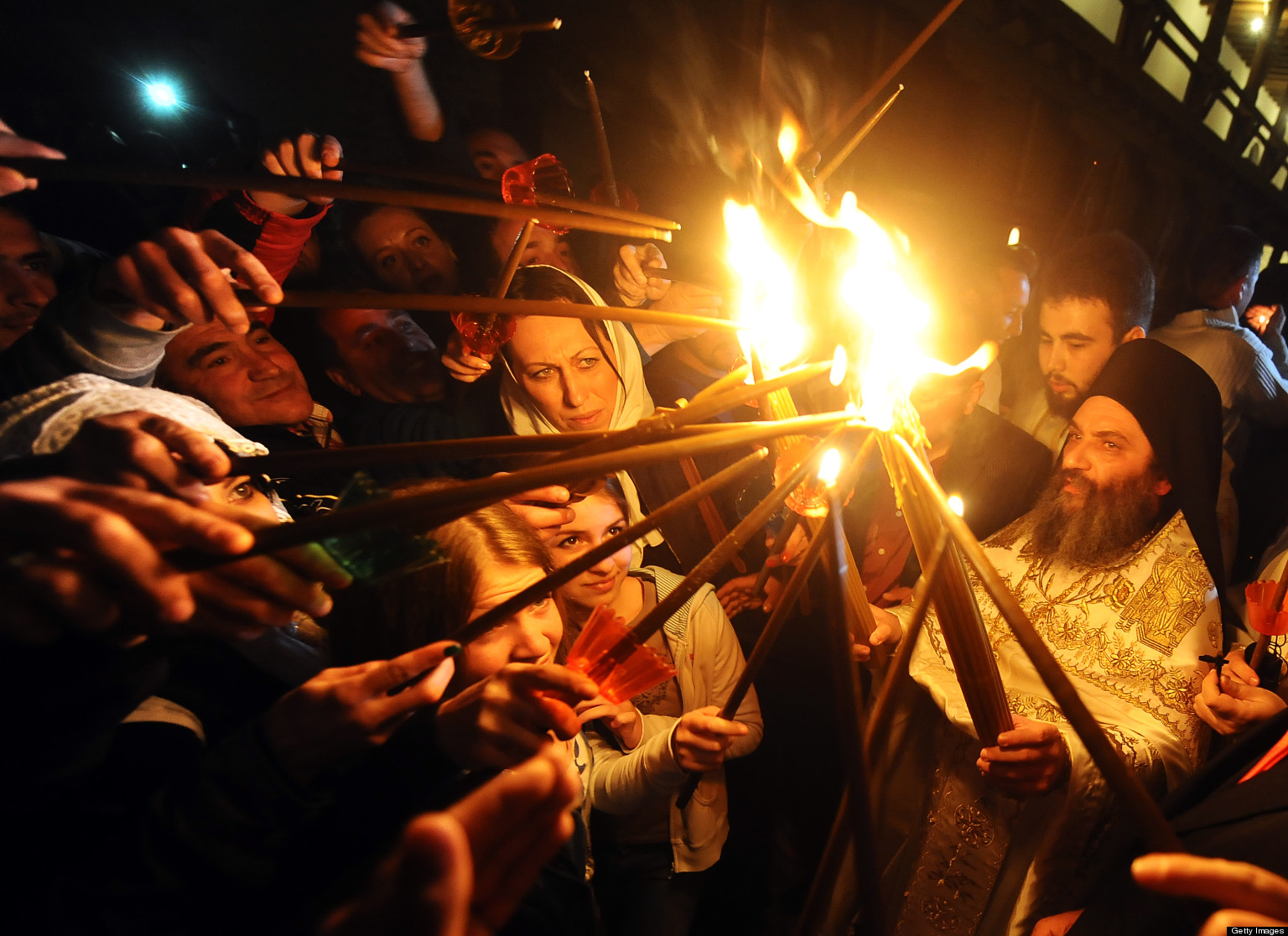
The little hours are sung today, after which the images and statues of the church are unveiled and a large candle is placed on a large stand in line with the center of the altar, but outside of the sanctuary area. A an abbreviated version of the Litany of the Saints is sung by six white-coped cantors using the processional ceremonies (ex. Cantors: Pater de caelis Deus, miserere nobis; Choir: Pater de caelis Deus, miserere nobis); the saints contained within the litany seem ad hoc. A fire is lit, either in the sacristy (had better be well ventilated) or (more likely) in the vestibule. The sacred ministers wear white, with stole and maniple, but no outer vestments (chasuble, dalmatic, or tunicle). The fire is blessed using the exact same three prayers as in the Roman rite. The grains of incense, held by a coped acolyte, are blessed with the Roman prayer as well. The fire is aspersed and incensed. There seems to be no triple candle or any unique way of bringing the fire to the Paschal candle.

The deacon asks the celebrant's blessing, as in the Roman rite, and, according to the Gospel ceremonies, sings the
Exsultet, although to a different melody than that of the Roman rite. Like in the old Roman rite, and unlike in the post-1955 Roman rite, the deacon actually carries out the actions mentioned within the texts of the prayers (lighting the candle, inserting the incense).
The Paschal Candle remains burning until Compline on Pascha the next day. It also burns at Mass and at Vespers throughout the Octave, from first Vespers until Compline on Ascension Thursday, and from the last prophecy at the Pentecost vigil until Compline on Pentecost Sunday. It should also be lit on great feasts that fall within Paschaltide.
After blessing the Paschap Candle the ministers return to the sacristy and assumed violet vestments, including chasuble, dalmatic, and tunicle. They return to the altar, the celebrant kisses the altar, they go to the Epistle corner, and read along as lectors read the prophecies aloud. The first prophecy is the account of Creation from Genesis, as in the Roman rite; it concludes with the genuflection and collect as in the Roman celebration. The second prophecy, Exodus 14, is comprised of the same text, tract, and collect as in the fourth lesson in the Roman rite. The third lesson, from Isaiah 4, has the same text and tract as the eighth Roman lesson, but the collect differs; its organic language recalls Christ's parable of the vineyard workers and of the concept of yielding "good fruit"; the prayer speaks of the faithful as "branches" of Christ "the true vine" who brought us out of Egypt "through the font of baptism" and asks that the "thorns of sins" do not prevail, but that we may be endowed "with good fruits perpetually." The collect is a bit wordy, but somewhat insightful and reminds one of the organic nature of the Church. The final prophecy is from Isaiah 55, save for the first sentence the same as prophecy five in the Roman liturgy. There is no tract and the collect at the end asks God to protect those whom He has called to the Church in the impending baptism.
The priest sings a prayer facing the people, that the Lord may look kindly upon the devotion of the people and sanctify the bodies and souls of those about to enter the mystery of baptism. The ministers assumed white vestments (maniples, stoles, and copes). Coped cantors begin another litany; this litany addresses the Holy Spirit (Spiritus Sancte Deus, miserere nobis), but not the Father and only the Son in the opening (Christe, audi nos); St. Genevieve is mentioned in the litany; the emphasis at the beginning on the Holy Spirit suggests that this litany calls down the Paraclete upon those about to be baptized. A procession forms and heads to the baptistery. The blessing of the font and water uses the exact same texts and ceremonies, and nearly the same melodies, as in the Roman rite. The one difference is that the holy oils are infused, then the catechumens baptized, then the altar, cross, clergy, and faithful are sprinkled with the water from the font. In the Roman rite the aspersion precedes the infusion of oils.
The procession returns to the sanctuary as the choir sings a third and final abbreviated litany, again distinct from the others. The ministers put on white Mass vestments and begin the prayers at the foot of the altar, with the Iudica me, while the litany functions as an Introit, as in the Roman rite. Textually the first half of the Mass is identical to the Roman liturgy. Two choir boys, not the celebrant, introduce the Alleluia. The secret is different, but it is a very simple prayer for the neophytes. The Paschal preface is sung and the variations in the Canon are the same as in the Roman books. As in the Roman rite the Agnus Dei is omitted and psalm 116, with a triple Alleluia antiphon, is sung as Vespers. However Gloria Patri et Filio etc is not sung in the psalm nor during the Lavabo at the offertory; the reason is that the Resurrection is anticipated, but has not yet happened! The antiphon on the Magnificat again varies from the Roman rite, but says the same general thing, recounting the women heading to the tomb. The post-Communion prayer is again for the newly baptized. The dismissal is Ite, missa est and the Last Gospel is read. There is no double Alleluia on the dismissal in the rite of Paris.
Pascha

The Mass of Pascha—or Easter Sunday—differs little from the Roman rite. The Introit is "Christ has risen from the dead, alleluia. Death is swallowed up in victory, alleluia. Oh death, where is your victory? Oh death, where is your sting? Alleluia." It is not quite as beautiful as the
Resurrexi Mass in the Roman rite, wherein the Lord speaks actively announcing His own resurrection, but there is a Byzantine quality to be loved in this variation. The theme of Christ conquering death is
the point of Pascha in the Greek tradition: "Christ is risen from the dead and by His death He has trampled upon death and given life to those who were in the tombs" is repeated constantly in the Divine Liturgy from Pascha until Pentecost.
The collect is the same, as is most of the Gradual. The verse in the Alleluia is different, coming from Roman rather than Corinthians. The sequence is the same, as is the Gospel. The offertory verse is taken from psalm 117: "I do not die, but live, and will speak of the works of the Lord." The Secret is different, but the rest of the Mass is, again, the same. The dismissal is Ite, missa est.
Quick Thoughts
The Parisian rite displays an emphasis on sin and God's remaking of us that is hard to reconcile with Jansenism, steeping the claims against its Missal by Dom Prosper Gueranger in great doubt. The dramatic and communally oriented language is one that perhaps made the Ultramontanists uncomfortable, but thus far little in the Parisian liturgy could be interpreted reasonably as heterodox. Despite the organic language in some of the prayers, the liturgy on the whole has a stronger emphasis on sacrifice and immolation than even the Roman rite. The logorrhea of the rite focuses on sacrificial language to the point of diminishing return. Some of the prayers are repetitive, while others are actually very insightful. The ceremonies of Holy Saturday are very brief in contrast to those of the Roman rite, yet the adoration of the cross on Good Friday reminds us of something lost to Rome. In short, whatever its defects, the Parisian rite, as we have known it thus far, had its own legitimate and distinct place in the Latin liturgical tradition and the evidence proffered to justify its suppression is not thus far compelling.
Although with the Pope's name omitted on Good Friday, one can see why some would take issue with the rite....


 Thursday's unique liturgical features begin after Lauds with the absolution of public penitents by the Archbishop of Paris. The choir, prostrated, sings the seven penitential psalms and then, with the Archbishop, who wears a red stole, makes its way to the Cemetery of the Holy Innocents. Apparently parish priests were capable of reconciling public penitents, too, as the Missal notes some might do the ceremony after Sext or None. Either way psalms 6, 31, 37, 50, 101, 129, and 142 are sung followed by some versicle prayers, five collects, and then the actual absolution. In the first collect the priest or Archbishop notes that he is "first in need" of the Lord's mercy; the second asks that those who have "deviated" from the Holy Church may receive the fruits of penance; the third is a simple prayer for forgiveness, as is the fourth; the fifth, and longest, addresses God as the maker and restorer of mankind and beseeches Him, in so many words, not to let the souls of the penitent slip away to damnation. Then, mercifully, comes the overdue absolution. Again, the language differs from what the Roman mindset of the time expected, but nothing heterodox permeates the text. If anything the concept of God as the restorer of mankind should enjoy a prominent place in the family of rites within the Latin Church.
 A more substantial, and beautiful, variation comes during the unveiling of the cross. The ministers and choir return to the sacristy and removed their outer vestments and all remove their shoes. The choir returns to the sanctuary. Two deacons (wearing amice, alb, cincture, red stole, and red maniple) carry a crucifix from the sacristy to the altar while four priests in copes (two in red and two in black) act as cantors. The cantors sing Popule meus, and the Latin and Greek versions of the Trisagion in alteration with each other. Each time the Trisagion is sung all genuflect. The deacons hand the crucifix to the celebrant, who unveils it as in the Roman rite (Ecce lignum cruces etc.). All make three genuflections and adore the crucifix. After the adoration, while the choir sings Pange lingua, the cantors shed their copes. The subdeacon sings the verses found as responses to Crux fidelis in the Roman rite in alteration with the choir, which sings the aforementioned Pange lingua. Then the clerics stand before the crucifix and sing Vexilla Regis in alteration with the choir, singing Vexilla Regis prodeunt as a refrain while the choir sings the actual verses. Here we see that the choir element of the adoration of the cross was lost in the 1570 Roman Missal because that "Tridentine" rite was actually made for the Papal chapel and not for public churches or cathedrals. This set of ceremonies was, and is probably more in line with the Roman tradition that what one sees in any Roman Missal from 1474 through present day. The dramatic transfer of the crucifix from the sacristy to the altar, with the Trisagion sung, is lost because of the limited space in the Papal chapel; so the Roman (Papal) ceremony stuck the crucifix on the altar, making the Trisagion superfluous, so the hymn migrated to the reproaches. Much of this survived in the Dominican rite.
 The deacon asks the celebrant's blessing, as in the Roman rite, and, according to the Gospel ceremonies, sings the Exsultet, although to a different melody than that of the Roman rite. Like in the old Roman rite, and unlike in the post-1955 Roman rite, the deacon actually carries out the actions mentioned within the texts of the prayers (lighting the candle, inserting the incense).
 The Mass of Pascha—or Easter Sunday—differs little from the Roman rite. The Introit is "Christ has risen from the dead, alleluia. Death is swallowed up in victory, alleluia. Oh death, where is your victory? Oh death, where is your sting? Alleluia." It is not quite as beautiful as the Resurrexi Mass in the Roman rite, wherein the Lord speaks actively announcing His own resurrection, but there is a Byzantine quality to be loved in this variation. The theme of Christ conquering death is the point of Pascha in the Greek tradition: "Christ is risen from the dead and by His death He has trampled upon death and given life to those who were in the tombs" is repeated constantly in the Divine Liturgy from Pascha until Pentecost.
 I found this especially jarring when I first realized it, as "restoration" to a more pristine liturgy, as supposedly exists in the East, was often presented as a premise for the Pian and Pauline reforms. It should not be so surprising. Rome and Constantinople are only a few hundred miles apart and were, until the papacy of St. Gregory the Great, under the same cultural and political body. Even after Rome's de facto separation from the Byzantine Empire Constantinopolitan liturgy came to Rome via Milan and via Europe (France and Spain picked up Eastern Roman traditions and practices from North African Christians). The Crusades would have a reciprocal effect centuries later. Contrary to our instinct to view the Rome-Constantinople schism as the compass for liturgy, the two cities probably have more in common than the Byzantine tradition has with the Thomistic Christians of India or the Nestorians or the other various non-Chalcedonian Churches we call "Oriental."

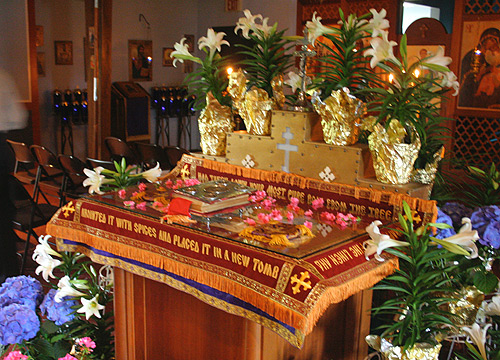
 In the Roman rite the day once again begins with Tenebrae and the exact same ceremonies as the previous Tenebrae on Mandy Thursday. The last nocturne of Mattins contained excerpts from St. Paul's Epistle to the Hebrews, wherein the Apostle describes the two-edged sword of faith, hopes he maintains his, and emphasizes that faith is a living thing. The versicle before the second Miserere at Lauds adds mortem autem crucis. On Friday, in the morning or around noon, the Mass of the Pre-Sanctified takes place. Structured like a Mass, the celebrant and his deacons wear their normal vestments, albeit the black of Masses of death, and take their places according to Mass ceremonial. A prophecy from Osee and from the book of Exodus are read. The Passion according to St. John is sung, followed by collects for the needs of the Church and then, in three successive and dramatic stages, a Cross is unveiled for public adoration. The clergy and the people "creep" to the Cross in three double-genuflections. A Blessed Sacrament procession brings the Host consecrated the previous day to the altar and a "Mass" begins with the offertory and incensing of the altar. The Host is elevated and a fragment is mixed with the wine in the chalice. The celebrant consumes the Host and the contents of the chalice and purifies his fingers and the vessels as usual. Vespers follows immediately, as yesterday. Compline is sung in the late afternoon. Around 3:00 PM a deposition service takes place, during which the corpus is removed from the Cross and "buried" in a sepulcher created in side chapel. Some churches in England and Northern Europe will put a crown of thorns and nails in the tomb.