Showing posts with label liberius. Show all posts

Monday, July 27, 2015

Roman Feasts

Interior of St. Lawrence by Francesco Diofebi
source: schwarzgallery.com
Each rite and usage has its own peculiar and particular feasts which characterize the diocese of that rite's origin, be it Greek, Latin, or Assyrian. The Greeks have their feasts, like "Mid-Pentecost" and the "Protection of the Theotokos." We Latins have a number, too, many of which are coming up next month.

The month begins with St. Peter in Chains, recalling the chains that held St. Peter while he was imprisoned under Herod and Nero, the Jewish and Gentile persecutors of the Church, as well as the cardinatial church that holds two links of those chains. Pope Julius II's tomb, bearing Michelangelo's Moses, resides in this church. The Greeks have a feast commemorating the chains in January, but Rome possesses the actual church with these relics. Rome held a unique place among the churches of Christendom in that it could claim the two foremost Apostles of Christ as its fathers in faith, prompting the city to do its best to multiply their presence throughout the seven hills for stational liturgies.

Next is the feast of the Dedication of Our Lady of the Snows—the "Liberian basilica" of St. Mary Major. The Constantinian basilicas of Rome were dedicated to Our Lord (Lateran cathedral) and Ss. Peter & Paul, but the Virgin had no church dedicated to her. Snow began to fall over one rectangular space in the city, which St. Liberius took as a sign. The saintly pope began construction on the basilica, which is the Roman stational church for the Nativity of Christ and Pascha.

Lastly, Rome enjoys a vigil and an octave for St. Lawrence, the deacon of Rome who teased his torturers and entered eternal life with true Christian joy (I imagine that were he a martyr, St. Philip Neri would have died in a similar manner). His octave and vigil remind us that prior to Pius XII, the local church occupied a place of liturgical prominence: a Double of the First Class with an octave was observed for both the dedication of a parish and its patron saint. St. Lawrence enjoyed a similar place as a foundational saint for the spirit of the Roman church. When the popes wore the maniple on their left arms, it always bore gold and red thread. Gold for the joy of the Byzantine Church, red for the martyrs of the Roman Church.

In the Apostle Peter, the Roman Church recalls the place given to her by the Prince of the Apostles. In the miracle of Our Lady, she recalls that Our Lady laid the cornerstone of her own enduring presence in the Eternal City. In St. Lawrence, she recalls her happy witness to Christ. These feasts do not celebrate Biblical events nor do they teach theological lessons. These feasts are acts of worshipping God for God's own sake, for thanking Him for counting the saints as the closest intimates of the city of Rome, for showing gratitude for His continuing presence in the Roman Church. August, as much as June 29, is an appropriate time to sing O felix Roma.

Wednesday, November 12, 2014

The Heretical Pope & Tradistan

The same church bearing this mosaic
puts an "S" before Liberius' name
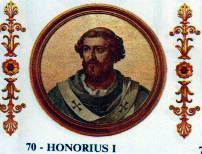
Here in Tradistan, we struggle with the concept of the heretical pope for some reason, probably the spirit of Vatican I—which is not what that Council's fathers enshrined in Pastor Aeternus. There are plenty of heterodox popes in history, among them the notorious John XXII and heresiarch Honorius I—whose papacy earned him the condemnation of an ecumenical council and of three succeeding centuries of popes. St. Marcellinus lapsed from the faith, although he did return. John XII invoked pagan gods during dice games and toasted the devil during feasts! With such a diverse cast of characters in the darker acts of the papacy's twenty century long drama, I continue to be incredulous that traditionalists keep focusing on that ridiculous myth about St. Liberius.

Here is an article from a leading trad blog which gives generally solid advice, but continues that old nonsense that Liberius was the first non-saint pope and that he, under duress, signed a heretical formula of Arianism. As I have recounted elsewhere, this line is complete rubbish and based on myopic scholarship. I will not review the entirety of the saintly pope's troubles, but it suffices to say that he held fast to the faith, he supported the patriarch of Alexandria (the Emperor said "You support Athanasius contra mundum"), was listed in all the martyrologies until the Counter-Reformation, was admired by St. Ambrose, and is described as "S. Liberius" in both the Pauline and Vatican Basilicas. For whatever reason, Bellarmine de facto un-canonized him when the liturgy was trimmed for popular use. Sixtus V and Benedict XIV would un-canonize other saints by removing them from popular devotion, including Origen's teacher, St. Clement of Alexandria. The libelous myth about St. Liberius begins in earnest when the patristic movement of the 19th and early 20th century began reading old texts through modern eyes and could find neither a problem with Liberius nor any devotion to him in modern day. They seem to have assumed that he must have been involved in some misdeed in order to have missed elevation to the altars. The problem may well relate to the perfect society view that prevailed until Pius XII, a view which held the pope to be the perfect leader of a perfect community. The unwillingly heterodox Liberius leaves the perfect society intact by means of legal gymnastics, but Honorius must be ignored entirely (or derided as a myth, as Anthony Cekada once suggested to me). 

I think early and medieval Christians, aware of the role of politics in the Church and for the most part under the rule of their local bishops, held a healthier view of the pope than their Counter-Reformation successors, who, we must not forget, were defending the papacy from protestants and not offerings a history exposition. Let us not be afraid of history, for we have nothing to fear from it. Let us confront it head on, suppress the libel around a great pope, and restore the reputation of the man who stood with St. Athanasius contra mundum.