Showing posts with label musings. Show all posts

Wednesday, April 19, 2017

Paschal Octave Musings: Feast and Fast

"That bread may be brought forth from the earth
and wine that gladdens the heart of man."
source: AZcentral
Wine is the most perfectly Christian potable. It begins as matter of the earth which, through crushing and fermentation, becomes something more perfect than its original state or original purpose. Once opened this imbibable type for Baptism breaths the air and changes for the better after turning over once. It matures in its "spirit" and delights those who participate in its fellowship. Yet, like the Christian life, it can be left out unconsumed and misused, attenuated until it becomes vinegar.

During the Paschal octave we should rejoice and feast after the fast, the nearest beverage to which is water: satisfying, cleansing, and yet some an occasion for joy unto its own; yet, water followed by wine is a pleasing contrast between nourishment and enrichment. No other substances, however delectable, offer what these two offer the believer.

To development my point and to amuse your minds I have reproduced Gilbert Keith Chesteron's The Song of Right and Wrong below. A blessed Pascha to all!
Feast on wine or fast on water
And your honour shall stand sure,
God Almighty’s son and daughter
He the valiant, she the pure;
If an angel out of heaven
Brings you other things to drink,
Thank him for his kind attentions,
Go and pour them down the sink.
Tea is like the East he grows in,
A great yellow Mandarin
With urbanity of manner
And unconsciousness of sin;
All the women, like a harem,
At his pig-tail troop along;
And, like all the East he grows in,
He is Poison when he’s strong.
Tea, although an Oriental,
Is a gentleman at least;
Cocoa is a cad and coward,
Cocoa is a vulgar beast,
Cocoa is a dull, disloyal,
Lying, crawling cad and clown,
And may very well be grateful
To the fool that takes him down. 
As for all the windy waters,
They were rained like tempests down
When good drink had been dishonoured
By the tipplers of the town;
When red wine had brought red ruin
And the death-dance of our times,
Heaven sent us Soda Water
As a torment for our crimes.

Sunday, May 29, 2016

Lost Octaves Series: Corpus Christi & Musings


A correspondent wrote to me confessing a slight faintness with the gravity of Catholic teaching on the Eucharist, that Christ is not merely present in a spiritual sense after Anglo-Catholic fashion, but is really present in His Flesh on the altar:
Verbum caro, panem verumverbo carnem efficit:fitque sanguis Christi merum,et si sensus deficit,ad firmandum cor sincerumsola fides sufficit. 
The choice of the word "flesh" comes to us from Holy Writ, not handmedown concepts of oblation inherited from Roman paganism or Judaic sacrifice. "Unless you eat the flesh of the Son of Man and drink His blood," Our Lord teaches, "you shall not have life within you" (John 6:54). A spiritual presence straddles a fine boundary between mystical and symbolic. A fleshly presence accepts a spiritual presence while adding a more immediate one to it. The Eucharist must be a physical and spiritual reality precisely because the Church is both a physical and spiritual reality, as a remarkably long and un-monitored comment box on EENS demonstrates. The Church is not bound by the sharing of the Eucharist among its numbered members, but in Christ absorbing the faithful into Himself by giving His flesh over to them ut unum sint. St. John Chrysostom says as much during Mattins for Saturday within the octave:
"Dearly beloved brethren, it behoveth us to learn the miracle of the Mysteries what the Gift is, and why It was given, and what is the use thereof. "We, being many, are one body," saith [the Apostle Paul, 1 Cor. x. 17, and again] "We are members of His Body, of His Flesh, and of His Bones." Eph. v. 30.Only the initiated will now understand what I say. That this union may take place, not by love only, but verily and indeed, we ought to mingle our own with His Flesh. And this is done by eating that Food Which He hath given unto us, being fain to manifest that exceeding great love which He beareth to us-ward. To this end He hath mingled Himself with us, and infused His Body into our bodies, that we may be one together, like as the limbs of a man and his head are all of one body. Such union do they long for that love much."
The Archbishop of Constantinople continues in Monday's Mattins:
"In this mysterious Sacrament Christ doth mingle Himself with all and each of His faithful ones. They are His children, and He nurseth them Himself, and giveth them not over unto another, herein again assuring us that the Flesh He hath taken unto Himself is ours. We then, who have been deemed meet to be treated with such love and such honour, let us be wakeful See ye not how eagerly the sucklings seize on the breasts, how readily they fix their mouths on the paps Let us, with like eagerness, draw nigh to that Table, and suck at that spiritual Cup. Yea, let us prize that gracious Food as the suckling doth its mother's breast, and hold it the great woe of life to be cut off from that Banquet. Here there are set before us no works of man's power He That worked at that Last Supper, the Same worketh the same here still. As for us Priests, we hold the place of His ministers, but He Which halloweth and changeth is He. Hither let there draw nigh no Judas, nor covetous one this is no Table for him. But he which is Christ's disciple, let him come for the Lord saith "I will keep the Passover with My disciples," Matth. xxvi. 18. This is that Passover Table, and it is all Christ's what is wrought there is not some of it Christ's work, and some of it man's work, but it is all His work and not another's." 
The eagerness of the faithful to "suck at that spiritual Cup" is obscured on our reformed 20th century rites. With very few exceptions anyone who attended a Latin rite parish today experienced an "external solemnity" of Corpus Christi Thursday Sunday. This is unfortunate and a consequence of the reduction of octaves under Pius XII and the availability of celebrating major feasts in place of the Sunday Mass. In the traditional Roman rite today would have been the Second Sunday after Pentecost, Sunday within the octave, complete with white vestments, commemorations at Mass and the office, and the preface of the Incarnation during the Mass. The gospel passage comes from Luke chapter 14, in which Our Lord makes a parable of a rich man who holds a banquet only to find that all the invited guests have made their polite excuses. The rich man then tells his servants to go into the streets and invite everyone they can find to the banquet. The Sacrament of the Lord, the glue of the Church, is open to all who do not reject it. The Jewish people were granted the revelation of God to man ("Salvation is from the Jews" John 4:22) and the unique place of being His "people" in the world; in declining Christ, to Whom the fullness of revelation was offered in Christ, the faith was then opened to the entirety of the world. The Temple sacrifices besought the forgiveness of the sins of the Jewish people and bound them under God's command. The Memoriale mortis Domini actually accomplishes the forgiveness of sins within the Church and binds the Church visibly under the Son of Man's own flesh.

Sunday Gospel as an antiphon

The feast of Corpus Christi is quintessentially Roman in its texts, direct yet with heuristic, subtle wordplay from St. Thomas Aquinas. The fleshly presence of Christ in the Eucharist finds itself expressed in many texts and actions throughout Eastern and Western liturgical history; long before monstrances the Sacrament was carried in a pyx by the celebrant and heralded by boys dressed in sack cloth as "prophets" in the Sarum form of Palm Sunday. The Sacrament extends Christ's presence on earth without dividing Him. 

And yet there is an odd extension of Eucharistic piety that personifies the Sacrament to a level that the Church has never traditionally understood. There have been some pious additions in Eucharistic devotion in the Latin Church that frankly give not a few of us the "heebie jeebies." I recall one fine Sunday morning breaking the fast at Brown's on Woodstock after the 8AM Mass at the Oxford Oratory. A gathering of us discussed the long road ahead to getting the old liturgy a permanent foothold in the mainstream Church. One of our number commented that one difficulty was the odd focus on the Blessed Sacrament itself outside of the liturgy, which distracts from the fact that the liturgy exists to confect the Sacrament. "What, pray tell, do you mean?" I asked. "Well, Rad Trad," he dilated, "I recently ran into a friend on his way to the Oxford chaplaincy to pay a 'visit' to the Sacrament. All well and fine to me, but when I asked why he did not just pop into the Oratory or Blackfriars, nearer his college, he gave me a queer reply. Do you know what he said? 'He's lonely.' Well, of course He's 'lonely'! He's God! He's the Only One!" 

A blessed continued octave of the Body of the Lord to all!


Saturday, August 9, 2014

Rise of the Technocrats


I recently came across this article in Forbes concerning another major retooling at my alma mater, my university in New York. Articles like this depress me as do most trends in the evolution and devolution of modern university education in the United States. While smaller liberal arts schools fill the void once occupied by the Ivy League in educational content, they lack the prestige and financial power to attract elite students. Conversely the Ivy League and similar schools like Stanford are committing academic suicide by loaning themselves out for a high escort fee like "ladies of ill repute" to major technology firms such as Microsoft and Google who in turn substitute these schools for career training and project development. What is lost in all this is education.

When I first saw my school's campus in 2006 its older structures, dating to the 19th century—infantile to my European readers, were undergoing major restorations, especially the residential West Campus below Libe Slope. Ivy still crawled up the sides of the Arts Quad buildings in spring time and the wild flowers and evergreens emitted sweet fragrances that permeated the summer humidity and carried throughout the 800 acre plantation. The buildings were a magnificent medley of neo-gothic, Beaux arts, neo-Romanesque, and Victorian/Edwardian English. Now much of that beauty and the symbolism beneath it has been drowned in an inundation of modernity.

Coming soon to Roosevelt Island, NYC!
source: blogs.cornell.edu
When I graduated in 2012 several new glass monstrosities masquerading as science laboratories—in part paid for by donor from major technology firms like Bill Gates of Microsoft (a Harvard drop out with no standing affiliation with my school)—popped up like pustules on the once immaculate grounds. The school president, popular with donors and unpopular with professors, students, and alumni, won a bid to build a special "tech campus" in New York City. Mayor Michael Bloomberg was given the opportunity to give our commencement address as his reward.

The university's entire focus has shifted towards technological development and giving science students practical experience in preparation for S&T, R&D careers. The Humanities and Social Sciences have been largely forgotten. The Cornell History department was the first in the United States to have a professor dedicated to colonial American History. Now it has none. The last colonialist left the year before I arrive and he has not been replaced. The Anthropology department holds a major collection of 20,000 pieces of archaeological history dating to the Lower Paleolithic age, including an Egyptian mummy. It receives $1,000 per annum in funding. I wonder, if a physicist wanted the latest IBM toy would the university hesitate?

Community and unquantifiable types of knowledge are on the downswing and will remain so for the near future. Having grown up in the northeast, where the towns were originally modeled on Congregationalist theology and the typical English village, I have found the utilitarianism of urban and suburban Texas startling. Up north every town, with few exceptions, had a green and a white First Congregational Church at the center, inevitably near the City Hall or Court House. Small shops and office buildings grew up around it a century ago. Larger industrial parks and office buildings would be at the outskirts of the town and people would live in rural settings 10-20 minutes away. Dallas has no center. It has a downtown with no distinction of zoning or districts. The suburbs are former farm towns, flat and open, with the occasional industrial park, glass office building, or gated McMansion community. Nearby my residence in the Dallas area is an outdoor shopping mall built to resemble the layout of a northeastern small city, replete with one-off restaurants and shops so as to counterfeit the organic feel while not taking the upper-middle class nouveau riche clientele out of their element. The shops are not an attempt to create a real town in northern Dallas. They are weekend entertainment for the efficiency minded men and their wives who built the stark work holes and McMansions that now blot out the Texan fields. No doubt their employers will benefit from Cornell's new "tech campus."

And at the town center was once the Congregational church. Then when all the Catholics came we built our churches at the center of residential areas, often with schools. Any kind of society needs an intelligentsia and the Church is no different. With Greek, Latin, History, Philosophy, and common sense debased in academic settings, the newly "educated"—would "processed" be a better word?—will move into their McMansions without the communal mindset that once existed through the Church. They will not be able to replace it with any effective substitute either.

The sole point of optimism one finds here is in the people who still do value community, the Humanities, history and the like. They value these fleeting things more than ever before and are willing to do something about it. In this article from the St. Louis Post-Dispatch covering the American ordinations for the ICRSS the journalist seems a bit surprised that a man who graduated from Harvard would be interested in being a priest dedicated to celebrating Mass in a dead tongue. Fr. Altiere said, "There is a saying that the priest does not go to heaven alone. My goal as a priest is simply to lead as many souls to heaven as possible."

Maybe he can find Cornell's soul, too!


Saturday, June 28, 2014

Learning Something New

Last night, after a wonderful excursion into the world of gastronomy, a friend and I were taking a stroll through a shopping district when we came up a fellow with quartercards who wanted "Just a minute of our time."

"Do you know Jesus?" he asked.
"Yes. Or at least we think so. Laudetur Iesus Christus!"
"Uh, oh. Cool! So do you guys go to church?" he continued.
"Yes," I replied. "A Greek Catholic church."
"Does that mean everything is in Greek?"
"No, my friend. In ancient times the Catholic Church had many places that gave rise to their own traditions of worship and theology. To be a 'Greek Catholic' just means following the way of worship that came out of Greek Christianity."
"Oh, well that's, uh, that's really cool."
"Thank you for your time and God bless," I closed.
"Yeah. Yeah, man thanks and have a good night."


Friday, May 30, 2014

Nostalgic Literature

My books are currently locked in a storage facility somewhere in Houston, 250 miles south of me, leaving me a dearth of reading material. By a stroke of luck I came across a sale of 19th century books in hardcover at the local library, eight or so works for $15. I imagine the library is trying to clear out room to expand their Blu Ray holdings.

The books I acquired are hardly the high brow literature of James Fenimore Cooper or Victor Hugo, but I think these works do at some level reflect the popular sentiment of the age. The novels Waverly by Walter Scott, The Scarlet Pimpernel by Baroness Orczy, and the D'Artagnan works of Dumas all yell "nostalgia" at the top of their parchment lined lungs.

Waverly describes the romantic folly of a young man named Edward Waverly, educated in many subjects and knowledgeable in none of them. He falls for the Jacobite cause and Bonnie Prince Charlie (whose father's perplexing tomb I saw at St. Peter's Basilica, Iacob III, Rex Anglorum). His venture with the band of Scottish usurpers was doomed from the start, but the charm of the undertaking clouded Edward's judgment. The Scarlet Pimpernel rescues French nobles from the guillotine during the Revolution and rescues the 19th century nobility from their declining relevance during the Baroness's time. And the D'Artagnan romances glorify a France and a chivalric spirit which Edmund Burke declared dead half a century earlier.

These novels are nostalgic lamentations for an era within living memory, but certainly gone and never returning. Gone were the days of treks and aimless adventures through the highlands. Gone were the days of noble patricians guiding society out of obligation and not self-interest. Gone were the days of impulsively gallant knights willing to sacrifice all for king and wenches.

Conversely, other writers attempted to compensate for the loss of old Europe by moving adventures to new settings amenable to the scientism of the age. My current book, Jules Vernes' remarkably dull Journey to the Center of the Earth, brims with optimism about the potential for science to pave the path of the coming age. The protagonist and his uncle engage of what we are supposed to believe is sophisticated debate over minutiae concerning minerology and geology. The impolite dullards are the norm people, such as the village priest and his housekeeper. H.G. Wells took scientism to an unhealthy level. Both authors wanted to move the conventional adventure story to a new setting and found moderate success.

Technology has not brought new platforms to traditional behavior, nor has it induced healthy new behavior. Submarines did not continue the swashbuckler. Some technology, if anything, has limited human behavior. Social networking, to my mind, is an unmitigated disaster. Almost everyone one knows via Facebook one knows in real life. Rather than meet in person for dinner once a week people swap mind numbing messages about mostly nothing. They exchange so much menial information so frequently that when two people do have the rare encounter they sit in silence with nothing to discuss. Email is far more tolerable to me, given that it does the same thing as a letter and in shorter time; I hardly think email, unlike the blue thing Facebook, substitutes for real human contact.

So many cheerleaders for science, particularly in biology, seem positively giddy about the potential to change human nature. Would we still be human at that point? Industry, modern democracy, and technology, although useful, have not so much changed human nature as much as they have curtailed it. I find myself sympathizing with those who yearn for "simpler" times not because I am a Luddite, but because those times were more humanly vibrant. Maybe I need to get out less....

Tuesday, February 4, 2014

You Must Be Joking

"I will crush the Index!"

JRR Tolkien, the Roman Catholic layman whose day job as a linguistics lecturer at Oxford was overshadowed by his brilliant books The Hobbit and The Lord of the Rings, was not sufficiently Catholic in his writings according to a few absurd traditionalists (here and here). Tolkien—who shouted Et cum spiritu tuo after the local bishops conferences translated the Roman Mass into vernacular—is apparently analogous to those teachers of false doctrine against whom St. Paul warns us in his first epistle to St. Timothy. Does anyone think Tolkien proffered a real pagan alternative to Christianity? Does anyone think the Fantasy genre (and Tolkien ought not be confined to it) is real? If Paul read and quoted pagan writers in the Scripture he wrote why can we not read the fiction of an entirely orthodox Catholic?

The Rad Trad suspects the dangers of emotionalism and brashness forewarned in these lectures are actually the Catholic spirit and religious instinct, not the preferred manual-based formal theology. Honestly, if a 5th century believer read Return of the King and Ludwig Ott's manual on dogma which would he find more Catholic in its totality, not just in what it says its outlook and how it speaks?

As an aside I met Tolkien's daughter Priscilla once in Oxford. She was leaving the Sheldonian with a friend of mine one night during Trinity term after a performance of Beethoven's Missa Solemnis. I greeted my friend, with no idea who the lady to his left was. He said, "Oh! [Rad Trad], this is Priscilla Tolkien!" We chatted for only a quick moment and my friend and I went on our way. My friend nearly died during the encounter. Why, you might ask? She is on the petite side and he could only think of hobbits....

Saturday, January 25, 2014

Attack of the Trads: What Catholic Liturgists and Laymen Can Learn from Star Wars


For some time I have searched in vain for some sort of cultural analogue that would assist advocates of traditional Roman liturgical praxis in explaining their objections to the 20th century reforms without delving too deeply into the obscure concerns of people with specialized knowledge (the pre-1911 psalter was a fact of life since the age of St Benedict, but no clergy alive have ever really known it). Last week my priest and I were chatting about my impending move. "Go to Texas you will," he said in his best Yoda voice. The other day I recalled this amusing imitation and the parallels between what happened to the Roman liturgy in the 20th century—all the reforms—and the Star Wars films is really uncanny.

I am 24 years old. I am just old enough to have clear memories of what the original Star Wars films were like in their theatrical releases (1977, 1980, and 1983). My father bought the first VHS package of the trilogy in 1992 and I watched the films regularly, a few times per year, until 1997. As a child I had fond memories of the films, sometimes wearing a Darth Vader costume while watching them and acting out the scenes during recess at school with the other boys. Then in 1997 George Lucas issued a "special edition" of the original films amid chatter that a new trilogy was immanent. Although 7 years old going on 8 and unable to grasp the general movement of the series, I could tell something was amiss in these modified films. I found some of the changes agreeable and even helpful: cleaned and digitized picture, the greater movement of the fighters during the Death Star battle, and the deeper look into Cloud City; Lucas could even have updated some of the technological aesthetics, such as the screens and buttons on the computers. Instead of focusing on updating in accordance with the latest technology Lucas focused on purifying perfectly fine films in order to align them with his newly invented vision, to put these films in line for the new movies.

Some scenes in the "special edition," particularly those in Return of the Jedi, have absolutely no significance and contribute nil to the story. Why did there have to be an inane alien band singing a pseudo-Jazz ditty? Why did the pit in which Han and Luke were to die require the addition of a bulbous worm? Why the hell did Jabba the Hutt need to repeat Greedo's lines in A New Hope? And why did Greedo now have to shoot first? In 1997 some of these scenes were technically impressive, but they added nothing to the plot and did not aid Lucas in telling the saga any better than the unmodified originals.

Yes, the 1977-1983 trilogy still existed, but something had cut into its heart, its integrity, its spirit. It was more or less the same story and same characters, but it was changing and anticipating something new. Then in 1999 "something new" finally came. The Phantom Menace.

The Phantom Menance had potential, unlike Attack of the Clones. The political subtext was brilliantly constructed throughout the new films and Ian McDiarmid played Palpatine quite well from the first movie onward. Liam Neeson's Jedi character very much captured the soul and spirit of the Jedi as portrayed by [Catholic convert] Alec Guinness in the first films. Lucas wasted these few positives and instead pursued an endless barrage of spectacular special effects of no teleological significance, countless menial minor characters, and stale dialogue that only functioned to move the films along so Lucas could collect his $1+ billion in box office receipts. And of course there was the disastrous cast, which included Hayden Christensen and Natalie Portman, two actors who would not have found set assembly work on a decent movie. The new films were "valid," but only did the bare minimum in satisfying audiences which expected movies in continuity with their predecessors.

Perhaps the greatest crime in the new movies is that Anakin Skywalker, lauded as a "cunning warrior" and a "good friend" in the original films, displays no warmth and kindness whatsoever. The father who saves his son in the original films attempts to kill his wife in the new ones. The man whose fall was a tragedy has absolutely no sense of goodness in the new films. And, worst of all, Darth Vader dropped from ultimate bad@$$ to hormonal, whiny teenager.

And yet did we not all see it coming in the "special edition?" Before Lucas made Darth Vader a wimp he made Han Solo one by having Greedo shoot first. Before Revenge of the Sith implemented meaningless special effects the improved Return of the Jedi did the same thing. Some time after he stopped the Star Wars and Indiana Jones films in the 1980s George Lucas' creative powers dried up and the reservoir has yet to be replenished. The same mind behind the new—and banal—films is the same which constructed the improved "special edition" films of 1997. Surely one who looks at the 1997 emendations and the timeline involved can deduce that they belong to the same forces as the new trilogy. 

And yet many younger fans, who grew up on the newer films and have no memory of the pristine older films in theaters or cassette do not question the changes. Their view of Star Wars is from the new films looking back. The changes to the older films must have made them more in line with Lucas' true vision of his created universe. And why should the younger generation question these changes and these new films? The series belongs to Lucas—or did before he cashed in with Di$ney. He is the man with all the authority over the films. Star Wars belongs to the Lucan magisterium.
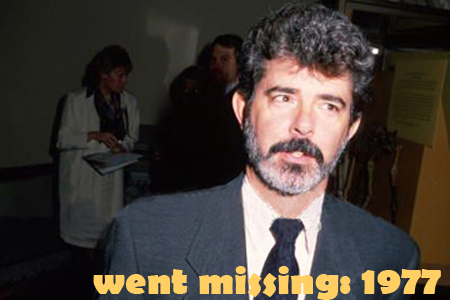
Seen this man?
source: omega-level.net
A friend of mine who had seen the new films confessed, years back, to having never seen the originals in any edition. We watched them over the course of a week or two. She found them enthralling: the epic, classical story told in a fresh environment; the creativity in making new worlds; the personality which emanated from the characters from their first introductions; the seamless use of effects in driving the story; and the enduring appeal of these films in their re-watching. Then there is also the uncomfortable implication that the new films lack a great many of these wonderful qualities.

Future generations of film viewers will have to deal with the reality that the new movies are now part of the saga and the story continuum, even if they lack the style, aura, appeal, personality, and depth of the films which preceded them. They are somehow "two forms of the same rite" even though those of us who recall the older films when they were the only films do not really buy into it. And while, as I said above, the older films could well have done with some aesthetic updates many of the changes were puzzling and clearly meant to transition into the newer films. 


Translation key:
  • Original version of original films: the old Roman liturgy
  • Possible updates of films: more popular singing, public Divine Office, fewer Double feasts, less bureaucratic management of liturgy
  • 1997 Special Edition: 1911 breviary reform, 1955 Holy Week reform, 1955 kalendar reform, 1960 rubrical reform
  • Post-1980s George Lucas: Popes Pius XII & Paul VI
  • New trilogy: Pauline Mass, Liturgy of the Hours, new Pontifical and Ritual Books, 1970 lectionary and Sacramentary
  • Hayden Christensen: Archbishop Annibale Bugnini/Masons—yes some find it fashionable to blame him rather than admit who is really responsible; his performance was bad, but ultimately he was not the one who behind the new trilogy


Sunday, December 8, 2013

New Dating Website

Single? Lonely? Dislike the Pope? Cannot seem to find the right lady with your unique theological outlook on matters? With you in mind the boys over at C.M.R.I. have come up with a solution! Introducing SedevacantistSingles.com! ChristianMingle.com will have nothing on this new site, which is dedicated to the dating prospects of those who believe the Pauline Mass invalid. If—and I doubt it—any of my readers are sedevacantists this may be the opportunity for you to find the un-reformed Catholic of your dreams. But if any of you marry, be careful with which sedevacantist community you join. You must not join any group condemned by the other sede's!

Friday, December 6, 2013

Quick Word on Suffering

source: standrewsayer.org
In Advent it is fruitful for us to consider the Second Coming as we prepare to celebrate the First Coming. "God became Man so that Man might become God," St. Athanasius wrote in De Incarnatione. Why? He was the Second Adam, the new Adam, the perfect Man, everything Adam was supposed to be and more, infused with the Divine life!
 
Much is made of Christ's parallels with Adam, His title "Son of Man," teaching us that He was fully human and that, by His humanity, we men benefit by His salvific work. Yet the most illustrating moment in Our Lord's life that proves He was the new Adam was in a moment when He did the opposite of Adam, the defining moment for the human race as I see it. In the Garden of Eden Satan, that lying rat serpent, tempts Eve into eating the fruit of the tree of the Knowledge of Good and Evil, going so far as to tell Even that she and Adam will be "like God." The serpent lied to Eve, but Adam knew better. Far from being like unto God, Man fell and became "human" as we know humans, creatures that die.
 
Our Lord, also in a garden—at Gethsemane, was tempted in His Agony to make full use of His Divinity and "let the cup pass" from Him. Yet in His moment of trial He did not. He embraced the purpose of His Incarnation and made full use of His humanity by dying in it and suffering greatly. Adam decided against his purpose and nature in favor of one he thought easier to live and superior in state, falling into death. Christ took up His purpose in His assumed humanity, taking on a world of suffering with Him, and, while dying, rose up to life.
 
This is suffering. Far from permitting pain with fists clenched and knuckle white, we should allow some degree of suffering where God offers it to us. He will never give us a cross we cannot bear, even if the burden seems tantalizingly brutal during the moments of pain. We must not be masochists and love suffering. We must embrace the Cross where we find it and make use of our redeemed nature, redeemed by the new Adam, He Who will be born in nineteen days.

Sunday, November 10, 2013

For Whom Shall I Vote?

I am happy to say that this blog attracts a very international readership, but this post will probably be most understood by my American compatriots.

Modern American conservatism has become an
irrelevant parody of itself.
source: tinypic.com
As a Catholic I am a registered and voting Republican with no delusions, illusions, or allusions about the Grand Old Party. It is not Catholic, it is not pro-Catholic, and it does not prioritize a restoration of long neglected Christian cultural mores. I am a Republican because being one allows me to influence the nomination of which candidates earn that dubious title "lesser of two evils."
 
And yet is it not now approaching a reductio ad absurdum? At what point must I stop voting? The Democrats essentially ceased to be a Catholic acceptable party in the 1970s when they embraced Second Wave Feminism, which, ironically, disdains the feminine. Republicans come in two camps these days: 1) cultural reactionaries in desperate search for the mythical era of the "Founding Fathers" and a "return to the Constitution" and "freedom" and then 2) the "establishment" Republicans afraid of saying the most remotely disagreeable thing to the general population's prejudices and which relies on poorly modeled "bipartisanship" and "fiscal conservatism." The first group is unable to have an impact because of the second's stranglehold on money. Yet the gridlock has no long term relevance because both of their positions are divorced from the political reality and ignore Christ, the King of All.
 
America's political dominance in the last half century and unprecedented material wealth birthed that most democratic of groups, the American middleclass: two Japanese cars, no more than two children, an annual seven day vacation in a tropical setting, a few credit cards (which pay for each other), 40+ hour work weeks, and a lot of television. There are, within the middleclass, two tendencies, one towards a mild nostalgia towards a more pristine American culture in the public sphere and in schools (although these people can hardly be bothered to take steps towards realizing this restoration) and a self-congratulating and passive progressivism. Rarely can those in either category be troubled to sacrifice any of their premier features for the public good. Consider, for instance, the sort of impact a big, happy family has on people; many are uncomfortable at first, but upon seeing a large family observers often are mesmerized by the love and support of the older brother for the young, of the mother for the daughters etc. Yet a third child might mean only one car, a modest vacation, and tracking the checking account rather than living on credit. In short, duty and obligation, not "freedom" and the "Constitution"—that shriveled piece of parchment long past expiration.

In short, given the pseudo-atavistic and material tendencies of modern Republicans and their political inefficacy, I am wonder if it is even worth voting for them any longer. Not only are their ideas less practical and distanced from the Moral Law, but their party base is collapsing under the economic and demographic trends which the current administration has accelerated. Do I feign supporting the "lesser of two evils" still or withhold my, likely menial, vote?

Sunday, July 14, 2013

A Prophet for Our Times

"The literary cabal had some years ago formed something like a regular plan for the destruction of the Christian religion. This object they pursued with a degree of zeal which hitherto had been discovered only in the propagators of some system of piety. They were possessed with a spirit of proselytism in the most fanatical degree; and from thence, by an easy progress, with the spirit of persecution according of their means. What was not to be done towards their great end by any direct or immediate act, might be wrought by a longer process through the medium of opinion. To command that opinion, the first step is to establish a dominion over those who direct it. They contrived to possess themselves, with great method and perseverance, of all the avenues to literary fame. Many of them indeed stood high in the ranks of literature and science. The world had done them justice; and in favour of general talents forgave the evil tendency of their peculiar principles. This was true liberality; which they returned by endeavouring to confine the reputation of sense, learning, and taste to themselves of their followers. I will venture to say that this narrow, exclusive spirit has not been less prejudicial to literate and to taste, than to morals and true philosophy. These Atheistical father have a bigotry of their own; and they have learnt to talk against monks with the spirit of a monk. But in some things they are men of the world. The resources of intrigue are called in to supply the defects of argument and wit. To this system of literary monopoly was joined an unremitting industry to blacken and discredit in every war, and every means, all those who did not hold to their faction. To those who have observed the spirit of their conduct, it has long been clear that nothing was wanted but the power of carrying the intolerance of the tongue and of the pen into a persecution which would strike at property, liberty, and life."—Edmund Burke, Reflections on the Revolution in France