Showing posts with label mystici corporis. Show all posts

Friday, July 11, 2014

Book Review: Undermining of the Catholic Church UPDATED

"There are only two books worth reading on the Traddie situation," a correspondent, who knows who he is, wrote me to over a year ago. "Dr. Hull's book and Undermining of the Catholic Church by Mary Ball Martinez."

Traditionalists and all stripes of Catholics have access to volumes upon volumes of material to read, published or online. The best sources are of course Scripture, the liturgical texts of the Church, and the Fathers. These sources tell us not just what to believe, but more importantly how to believe. And there are other useful books, works, and lecture series for understanding theology, liturgy, history, and philosophy. Many of these works have been reviewed on this blog, particularly ones pertaining to liturgy (Dr. Hull's book, Kavanagh's lectures, and Laurence Hemming's works among them). And yet after extensive reading and private research I must agree that, as far as the "Traddie situation" is concerned—the 20th century revolution in the liturgy and the political agenda of the Roman Church—The Banished Heart by Geoffrey Hull and Undermining of the Catholic Church by Mary Ball-Martinez are still the best books to read. Other books touch related material, but only these works address the matters at hand directly.

I have alluded to Martinez's first book, From Rome Urgently, which was a compilation of articles she wrote in the 1970s. Undermining is something of a sequel to From Rome, with greater and clearer rumination on the status of the traditionalist movement and limpid hindsight into the beginnings of the revolution in the late 19th century. 

Undermining, which can be read and downloaded free of cost here, has largely been ignored by all quarters of the Church because its thesis and narrative do not fit anyone's agenda. The liberal crowd may have agreed with its facts and found the result of the revolution positively delightful. The neo-Ultramontanists who we now identify colloquially as the "JP2 generation" would find the criticism of the renewal outright scandalous. And sedevacantists, FSSPX traditionalists, and "indult" traditionalists could not stomach that she exposed Pius XII and the early 20th century Vatican for what they really were. Consequently, her book enjoys a dedicated, narrow following like 1980s "B films."

The Thesis

Martinez's begins on the vigil of Pentecost in Rome in 1971. The Second Vatican Council closed six years earlier. Pope Paul was midway to the end of his tragic reign. Archbishop Lefebvre was not yet ready to declare himself publicly. And Catholics were gathered and praying the rosary by the thousands under the windows of the Apostolic Palace for the return of the old Mass. How did the Church arrive at this odd point? With Mystici Corporis, Martinez says. MC was the first and most vital step in dismantling the legalistic understanding of the Church that dominated the Counter-Reformation and replacing it with a model based on human beings, an opinion shared by Avery Dulles, the Jesuit Cardinal and theologian.  It was the first domino to fall, culminating in the long anticipated Council that would complete a revolution started in 1903.

In 1903, Martinez asserts, Cardinal Rampolla was elected or nearly elected Pope, only to be vetoed by the Polish cardinal under the auspices of an obscure and long forgotten treaty. The cardinals then flocked to the patriarch of Venice, whose first decision as Pope was to rescind all veto privileges. Rampolla, now saddled with the less glamorous position of Secretary of the Holy Office, spent his time training three proteges who would make his humanistic vision for the Church a reality: Giacomo della Chiesa, Pietro Gasparri, and Eugenio Pacelli. Della Chiesa had no sooner been made a cardinal than he was elected Pope Benedict XV and began to undo his predecessor's measures against modernizations, including the dissolution of Pius X's secret informant network. The First World War threw a wrench into the clique's immediate plans. When Benedict XV died prematurely the powers that were found themselves in a debacle. Pacelli was still too young and Gasparri was un-electable. As a solution they elected an aloof academic in Pius XI, hitherto the Vatican Archivist. It was during this papacy that things began to turn.

The Secretariat of State office, run by Gasparri and assisted by Pacelli, promoted policy antipodal to the teachings and desires of the Pope of the time, opposing and undermining Action Francaise and the Catholics in the Spanish Civil War in favor of French secularists at the same time the Pope was talking about the "social reign of Christ the King," a long favorite subject of traditionalists. The most reprehensible betrayal was that of the Christeros, wherein a civilian army fighting against a humanistic and even Masonic (?) president in Calles with no support from the upper clergy achieved absolute victory and were then convinced by Rome to make an un-conditional surrender and subject themselves to slaughter.

During this same period the paradigm shifted within academia and the religious orders, often with tension between the younger and older generations of priests. The Holy See, far from reigning in excesses and deviations from the accepted teachings and outlook, often aided and abetted these digressions. In the case of Teilhard de Chardin the Society of Jesus prohibited him from publishing and obstructed him from going on the speaking circuit. The Secretariat of State however, at the behest of Pius XII, arranged for him to give lectures in occupied France during the rule of the Vichy government. 

During the War Pius XII aided Jewish efforts to escape from the Holocaust and Hitler's death camps, but almost entirely ignored the political difficulties of the Church during this era. His foreign policy consistently stood against authoritarian governments that were either indifferent to Catholicism or in favor of it, but he sided with the humanists and Marxists. He permitted the Vatican to be used an an intermediary point in the War for discussions between the Allies. And he spent copious time during the War smuggling Jews from Italy into British Palestine on the eastern coast of the Mediterranean. After the War the early seeds of liberation theology and the Charismatic movement began to sprout above ground with the support of Countess Pacelli, the Pope's sister.

The time after the War was spent consolidating power and loosening discipline. The Biblicum was created in Rome to give a presence in Vatican academia to the progressive movement. The rules around the celebration of Mass and reception of Communion were relaxed to a point envied today, but risible to previous generations. And the promulgation of the dogma of the Assumption and the creation of a commission to reform the liturgy centralized spiritual authority around the Pope. Martinez at one point boldly asserts that the canonization of Pius X was part of a barter with the baroque-minded Vatican establishment to begin introducing the new liturgy, particularly the new rites of Holy Week.

Aware of his age, the Pope sent his protege to Milan, but died before making his successor a cardinal. The affable Angelo Roncalli took the papacy for a few years before Montini could become Pope in 1963. From that point on the narrative becomes familiar. We all know about the Council, the branching and flowers of the roots planted half a century earlier.

The middle section of Undermining is a series of vignettes, short biographies of the Popes from John XXIII until the then-incumbent John Paul II. Paul VI's segment is especially poignant. He was an early revolutionary, encouraging students in the Red Brigade to oppose Mussolini, who, although a bad man, was tolerant to the Church in ways unseen since before the 1840s. Later in life he may have lamented that the Red Brigade had killed his dear friend Aldo Moro, the product of the center-left political party his father had party and Pius XII advanced decades prior. He died a broken, unhappy man. Also interesting, if only for historical reasons, is her honest biography of John Paul II. She summarizes his education and seminary formation in Poland after the Russian invasion and his time at the Belgian college in Rome dispassionately and with concision. This was revolutionary in 1991 because most people were pretending he was an impoverished miner who studied at an underground seminary amid Soviet persecution. 

The last segment of the book contrasts sharply in certain aspects with From Rome Urgently. Previously she was brimming with excitement about Lefebvre, the militancy of the traditionalists, and the devotion of the faithful. She maintains these qualities in Undermining, but with considerable reservation. She wonders if Lefebvre missed his chance to make a difference in 1976 by obeying the Pope's command to bite his French tongue. The grassroots traditionalist movement collapsed and all that was left was the FSSPX and a few independents—something that will be explored in our upcoming series on the early traditionalists.

Short-Comings

Undermining is not a book without short-comings, the three greatest of which are: the lack of citations, the proclivity for conspiracy-theory language, and a lack of historical perspective.

The lack of citations is the most arrant deficiency in this work. Martinez was a journalist, writing for decades as the Vatican correspondent for National Review, the Wanderer, and other periodicals. She was not a professional historian and did not document her work very well. Much of what she learned could be documented with extensive and painful research though. I came to trust Undermining from personal experience. My first major university research project was on the role of the Holy See during the Second World War. What Martinez surmises about the Pope's efforts against the Nazis and Holocaust I corroborated independently years before encountering her book using primary information sources (journals, news articles, and records) as well as some scholarly polemics. That she recorded this information favorable to Pius XII during a time before a cottage industry for defending his War record emerged (Rabbi Dalin, Sr. Marchione etc) and given her un-favorable view of the man impressed me.

The second issue is also significant. She speaks of "the Masons" and like groups as though they are an organized secret government with a dedicated head—as though the cretins who mangled the Church in the 20th century and who are mangling Western governments and economic policy now are capable of such things. She does at points clarify what she means, but often lapses into conspiracy theories again. At one point she wrote that Pius XII, Paul VI, and Benedict XV should not be considered conspirators in the common understanding of the word. These men did not hold round tables discussions on how to undermine the Church deep within the walls of a lodge. These men acted in accordance with their rearing and education, which involved a different outlook on the Church than the one received. She does claim John XXIII and Pius IX (you read that right) were Masons, but does not expound upon the supposed significance of this too deeply.

The last pitfall is her lack of perspective. Mystici Corporis was a departure from the legalistic, cold understanding and corporate structure of the Catholic Church that emerged during the Counter-Reformation. Where she errs is in stating that the teaching was entirely novel. Indeed, it is well rooted in the letters of St. Paul, the sermons and treatises of the Cappadocian Fathers, and in the ecclesiology of Lateran IV. The footnotes and citations in MC easily verify this. Where she was right was in suggesting that the point of MC was to confuse theologians by introducing an understanding of the Church based on human beings and mysticism. Indeed, the idea of the Church as the Body of Christ bound up in the Sacraments is the teaching of the Church Fathers East and West as well as that of the Greek and Latin liturgies. The idea of the mystical Body of Christ was quite novel, and the focal point of this mystical body would be the Roman Pontiff. Martinez, with more familiarity with the deeper traditions of the Church, might have realized that MC was about spiritual centralization and taming precocious revolutionaries, not about introducing unheard of doctrines.

Final Words

Undermining of the Catholic Church by Mary Ball-Martinez is an essential work to study and parse for those who seek to understand the political changes in the Vatican that wrought decades of internal revolution in the Church of Rome. For all its problems, Undermining is the only book that connects the dots which have been hiding in the plain sight of traditionalists for years.


As an aside, if anyone wants to know how to access her first book, From Rome Urgently, email me.

UPDATE: My email address is theradtrad@gmail.com.

Wednesday, July 10, 2013

Pius XII Re-Considered UPDATED

source: sipastorangelicvs.blogspot.com
"He was glorious, ol' Pius was!" recalled the porter of the lodge of the Oxford Oratory to me one night several years back. Those who remember Eugenio Pacelli tend to think of him as either the last great pope before the cruel hammer of Vatican II smashed the glass Church into shards or as a spiritual jailer from whom the Council freed us. When one thinks of Pope Pius XII the mind naturally travels to images of the native Roman Pontiff waiving to enthralled crowds from the sedia gestatoria or him wearing the tiara with pious solemnity. What everyone often forgets is who he was and what he did. Perhaps no pope in centuries is as misunderstood and inaccurately remembered as Pope Pius XII. History may be very kind or very harsh to him, but that does not preclude our contemporary endeavor to evaluate his time atop the Petrine chair with greater scrutiny than previous generations.

First, we should get the Holocaust story out of the way. Pius XII was not Hitler's pope nor was he anti-Semitic. On the contrary, one would be hard pressed to find anyone since Moses who did as much for the Jews as Pius XII. Many compare his quiet approach to Nazism during World War II with his predecessor's more visible opposition to Nazism and Fascism, ignoring that Pacelli engineered Pius XI's foreign policy as Secretariat of State for the Vatican. As Pius XII Pacelli undercut Nazi deportation attempts in Poland, France, and Italy by delaying trains and applying pressure to local authorities through the Church's prestige. More locally he ordered the churches, monasteries, and convents of Rome to house whatever Jews approached seeking refuge. His very own Castel Gandolfo housed 3,000 Jews on the run from the Nazi occupants. Hitler found Pius so loathsome he at one point considered an assassination. Pius XII and the Church emerged from the Second World War with tremendous prestige and popular approval for combating Nazi efforts. The chief rabbi of Rome, Israel Zolli, converted to Catholicism and took Eugene as his baptismal name in honor of Papa Pacelli. Golda Meir and Leonard Bernstein (who as a secular Jewish bisexual would be as far from Catholicism as London from the ISS) expressed deep sorrow when Pius XII died in 1958. His reputation did not suffer until 1963 when playwright Rolf Hochhuth wrote The Deputy, a historically imaginative bit of nonsense wherein Pius XII daydreams about the Vatican's banking issues whilst his staff cry over the sufferings of the Jewish people of Europe. Without carrying on too much concerning Pius XII's efforts between 1939 and 1944, it suffices to say that his efforts saved many Jewish lives and the people of his time recognized this.

source: angeluspress.org
Yet we can say this was Pius XII the diplomat and Pius XII the humanitarian. What of Pius XII the pope? Again, many see Pius XII as a staunch conservative in all matters and the last pontiff of a particular age. Like him or not, little could be further from the truth. Pius XII was certainly not a liberal, but he was no staunch conservative either. The best term the Rad Trad can find to describe this pope is "modernizer." His papacy was a bridge between the declining ultramontanist mood after Vatican I and the budging urge to engage directly with the non-Catholic world which triumphed at Vatican II.

Consider his personality. The cult of personality that surrounds Pope Francis did not begin with John Paul II in 1979, when he first started to travel. It began during the reign of Pius XII, whose charisma and charm made him a powerful personality at a time when television and radio began to supplant newspapers as the primary means of transmitting information. His waves, smiles, rolling voice, and other dramatic gestures rival those of Churchill, Hitler, Mussolini, and Roosevelt. Outwardly he looked like everything an optimistic, post-War, Papa-centric Church could want in a leader. He was  the product they demanded.

Next, think about the influence of his pontificate on centralization. After his election, Pacelli appointed Luigi Cardinal Maglione as Secretariat of State. After Maglione's death, the Pope absorbed the secretary's duties into the Papacy, making the him both a spiritual leader and a visible political player in the new media age. It also meant that the Pope had very direct dealings with bishops throughout the world, who, though they had the right to meet with the Pope before Pius XII, would normally interact with the Vatican through the Secretariat's office. Consequentially, the Papacy, not just the Vatican, became an administrative, political, and spiritual center for governments and dioceses. The Pope, in Mystici Corporis in 1942, went as far as to state that bishops receive their power not from the Church, generally speaking, but from the Roman Pontiff (cf. Mystici Corporis, 42). Cardinal Ottaviani stated that this was infallible. Whether it is or not is not our purpose here. The point is that Pius XII centralized not just spiritual dignity, but political power around the Holy See.

Yet Papal prestige was not enough to efface the blossoming power of liberal factions, particularly in secular universities and in religious orders. Men like Jesuit Karl Rahner lost very little sympathy among his fan base after the publication of Mystici Corporis and perhaps even gained an excitement factor that made his ideas all the more potent two decades later.

Can you imagine the diffusion of the "Spirit of Vatican II" without the "Spirit of Pius XII?" I cannot. Pius XII's governing style was not an immediate cause of the "Spirit of Vatican II," but it was certainly a necessary cause. The cardinals and bishops who went along with the changes in liturgy, Church policies, and attitude did so because they thought Rome wanted it. Is it any coincidence that most of these cardinals and bishops were appointed by Pius XII, not Paul VI or John XXIII?

Pope Pius also re-introduced some Eastern elements of thought into Rome. First the de-Latinization process in Eastern Catholic Churches began not with the Conciliar document Orientalium Ecclesiarum, but a decade earlier. The aforementioned Mystici Corporis, although brimming with statements of Papal  supremacy (42, 44, 50, 69, 91), incorporates a very Eastern and organic approach to defining the Church, returning to St. Paul's statements that the Church is the "Body of Christ" (15) visible on earth, that Christ is the Head through which grace flows, that the Church is not entirely about hierarchy (17), that the Sacraments nourish the Body (18-19), that Baptism does not just wipe out Original Sin but actually incorporates one into the Body of Christ (26), and that the Holy Ghost is the soul of the Church (31). At one point Pius even quotes St. Gregory of Nyssa's Life of Moses in bluntly equating the Church with Christ (53). The Rad Trad can hardly imagine Pius IX referencing a then-obscure Eastern Father. The Western fascination with the East, seemingly in everything save liturgy, was just beginning when the Pope published this encyclical.

Lastly there was Pope Pacelli's novel liturgical moves. Saturday night Masses substituting for Sunday worship, lay people reading at Mass, shortened Eucharistic fasts, excessive singing of hymns, and lay people speaking the priest's parts did not begin in the 1960s, but under Pius XII in a series of liturgical innovations meant to make the liturgy more accessible. If the Rad Trad is forgetting something, perhaps the more knowledgeable Rubricarius can chime in below. Above all, Pius XII assembled the team of reformers that would make the liturgical overhaul of the 1960s happen. They began their work under Papa Pacelli's patronage in 1948. Some remove blame for the liturgical novelties of the 1950s from Pius XII for health reasons; his health declined quickly after the War. Still, Pius XII was, if anything, a powerful and competent administrator. Under Pius XII a new Common of Popes was introduced, as was a new Holy Saturday liturgy in 1951 and again in 1952, a brand new Holy Week came out in 1955—the same year most octaves were eliminated and semi-doubles merged with simples and doubles, and the commemoration system was reduced in 1958. The liturgy of Vatican II c.1965 only differed in the suppression of Prime and the introduction of more vernacular in Mass. Eugene Pacelli was, beyond dispute, a very progressive pope in liturgical matters. As Pope Paul VI wrote in his Constitution Missale Romanum: "The beginning of this renewal was the work of Our predecessor, this same Pius XII, in the restoration of the Paschal Vigil and of the Holy Week Rite, which formed the first stage of updating the Roman Missal for the present-day mentality."

The Rad Trad lacks a formal opinion on Pope Pius XII. He did a lot to save lives during World War II. He centralized power and set the scene for the big changes of the 1960s. His foreign policy against the Russians was vocal, yet forgettable. And his liturgical novelties put the key in the door and turned it, leaving the handle to Paul VI. Pius XII remains an anomaly. He was no liberal nor was he a traditionalist. For the time being the Rad Trad will consider him a "modernizer." What say ye?

Thursday, May 16, 2013

Seeking Continuity

 
A constant theme of Benedict XVI's papacy was that the teachings and practices of the Church after Vatican II are congruent in quality and meaning to those that preceded the Council. When this idea was first floated around 2005 many, myself included, assumed this meant a concerted effort to create some continuity between 2005 and 1905. Instead, it seems to be to assume continuity and move on to some other topic of discussion. That is fine for most things, but occasionally one finds points of inquiry that one cannot ignore.
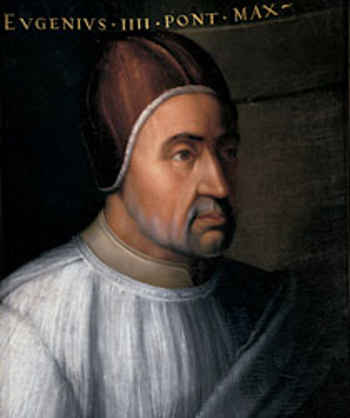
Pope Eugene IV, author of Cantate Domino
 
Recently I have been thinking about one in particular: the teaching "Outside the Church there is no salvation." No one is going to suggest for a moment that the Second Vatican Council, Paul VI, John Paul II, or Benedict XVI repudiated this doctrine. Indeed, many hold it to be still on the books. One only needs a particular understanding of what the Church is. Here is where my curiosity enters. We will quickly consider the Church's teaching in three eras:
  1. the high Middle Ages
  2. the 19th and early 20th centuries
  3. the pontificate of Pius XII through modern day
 
The first era's teachings are brutally clear, almost depressingly so. Boniface VIII's bull Unam Sanctam is a forthright contention that unless one is politically and religiously subject to the Roman See, then that soul is damned. Eugene IV's Cantate Domino speaks more generally about being in communion with the Apostolic See, in the context of attempted reunion with the Coptic Orthodox Church (non-Chalcedonian). Cantate Domino states that all Jews, pagans, heretics, schismatics, and un-baptized will go to hell, although with differing degrees of punishment. Limbo, in my opinion, was an emotional and intellectual hypothesis to fill the void created by this teaching. We can give political and era-based context to these bulls, but that cannot alter their meaning. Indeed, they use such unequivocal language that one cannot for a moment be confused as to what their writers intended to say:
"It firmly believes, professes, and proclaims that those not living within the Catholic Church, not only pagans, but also Jews and heretics and schismatics cannot become participants in eternal life, but will depart “into everlasting fire which was prepared for the devil and his angels” [Matt. 25:41], unless before the end of life the same have been added to the flock; and that the unity of the ecclesiastical body is so strong that only to those remaining in it are the sacraments of the Church of benefit for salvation, and do fastings, almsgiving, and other functions of piety and exercises of Christian service produce eternal reward, and that no one, whatever almsgiving he has practiced, even if he has shed blood for the name of Christ, can be saved, unless he has remained in the bosom and unity of the Catholic Church."—Cantate Domino, Eugene IV
Going forward several centuries, we enter the time of Pius IX and St. Pius X. These two pontiffs in particular stated that while the Catholic Church is the means of salvation, God could save a person living in ignorance of the Truth out of His kindness:
"If he is outside the Church through no fault of his, that is, if he is in good faith, and if he has received Baptism, or at least has the implicit desire of Baptism; and if, moreover, he sincerely seeks the truth and does God's will as best he can such a man is indeed separated from the body of the Church, but is united to the soul of the Church and consequently is on the way of salvation."—Catechism of Pius X, Question 29
I do not find this in conflict with the medieval teaching, as the discovery of the New World created a shock to the theological system. Surely God would not damn souls for not knowing of the Church? He could, in His kindness, save those who seek Him and who wish to live morally upstanding lives.
 
Pope Pius XII, who gave the world
Mystici Corporis
Just a few decades later, when Pius XII issues Mystici Corporis, things begin to take on a new light. Despite writing Humani Generis, which implicitly condemned some propositions of Fr. Karl Rahner SJ, Pius XII seems to have accepted the idea that one could be an anonymous Christian in some sense. The Church, suggests the encyclical, is not just the Body of Christ, but the Mystical Body of Christ. One could be a member of the Church without having been formally initiated, perhaps by baptism of desire or, imperfectly, by taking Sacraments from Orthodox or protestant churches. Many traditionalists are very fond of Pius XII and recall this elegant understanding of other religions with joy, but do they realize how new an idea it was? Pius X's concept involved God saving someone who could not access the Church. Pius XII's concept was that such a person could already be part of the Church! This teaching became the basis of the Second Vatican Council's Lumen Gentium, which dealt extensively with other religions.
 
Here we have three ideas:
  1. Anyone who is not a member of the institutional Church goes to hell
  2. God might save persons who are outside the institutional Church, if they are separated through no personal fault
  3. Those outside the institutional Church might already be part of the Mystical Body of Christ, the actual Church, and could possibly obtain salvation this way
Ideas one and two seem fairly consistent with each other. Number three is internally consistent, but does it "jive" with one and two? A quick Google search will bring the inquirer to a plethora of apologists who say the living Magisterium gets to decide and that, since Lumen Gentium, the Magisterium has decided the value of the medieval documents survives, but is modified and clarified based on one's understanding of the "Church" a la Pius XII. Was there even a formal field of ecclesiology before Pius XII? Probably, but Papa Pacelli's delineation would have been considered worthy of attention in earlier days. Most difficult, for a former student of medieval history, is that for this particular spin to be true, Boniface VIII and Eugene IV's bulls would have to mean something other than what they were clearly supposed to mean. Maybe a historical investigation would show "Outside the Roman communion there is no salvation" did not have much traction in earlier times, which would make such a teaching illegitimate and non-binding. Then again, could not the same be done for Mystici Corporis?
 
The purpose in asking these questions is not to publicly doubt the Church. On the contrary, the necessity of communion with the entire Church is a point in need of vital clarification, clarification that has been long overlooked. Perhaps a future Pontiff or movement of theologians will view this particular point as an opportunity to exercise Benedict XVI's hermeneutic of continuity in a lasting way.... Or maybe I am just way off track....
 
P/S: I am not a Feeneyite