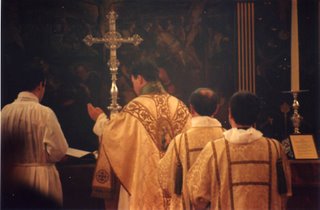
In his 2015 article The Silent Action of the Heart Cardinal
Sarah wrote in L'Osservatore Romano that
he would welcome a return to normative oriented worship in the fourth edition
of the Pauline Roman Missal. “Liturgists” decried the cardinal’s assertion of
orthopractic worship and let a more intriguing textual suggest slip by, that
is, the desirous return of the Roman offertory prayers. Unlike the Canon Missae, offertory prayers
originated in the Middle Ages and never enjoyed a universal text, so why reify such
a narrow restoration? The old Roman offertory is now the most commonly used
Sunday and festive option in the most recently approval Roman Mass books, the
Missals for the various Ordinariate communities whose worship descends from
Anglican rites. Has the Ordinariate Missal become a test run for the future of
the Latin liturgy? No, but the future itself is less certain than it was just a
few years ago.
The Ordinariate Liturgy
“Almighty God, unto Whom all hearts
be open” are the first distinctively Anglican words at the Ordinariate Mass to
an average Roman Catholic who attends either a Paul VI or pre-Conciliar Mass. In
fact this prayer is not Anglican at all. It originated in pre-Reformation
England and appears in several editions of the Sarum Missal’s prescribed clerical
vesting prayers.
The Ordinariate Missal is not the
Sarum Mass or the Tridentine Mass celebrated in English. It is an adaptation of
Paul VI’s Mass to a manner of liturgical worship that originated in
post-Reformation England and done in accordance to the Book of Common Prayer.
Several features of the Prayer Book rites of Eucharist are inserted into the
Mass at their appropriate times (the litany, the Comfortable Words, the Prayer
of Humble Access) and numerous Anglican formularies appear along Roman
greetings (“Christ our Passover is sacrificed”). The Missal renders the texts
in an early modern-style English rather than the literal translation now in
force for the Roman Missal and the heretical translation previously in force.
Paul VI’s Mass is more than a
palimpsest for Prayer Book texts in the Ordinariate rite. The eventual outcome
of the Ordinariate liturgy reflects Anglican tradition as much as it reflects
the sort of Anglicans who took advantage of Benedict XVI’s generous offerings
in Anglicanorum Coetibus. While many
who have come over to the Church do so from a “high” American Anglican
patrimony of sung Prayer Book Eucharist and Evensong services, a similar number
of English extraction converts come from an “Anglo-Catholic” background,
wherein some variation of the Tridentine Mass or English Missal was done in
fiddleback vestments and Benediction followed Vespers. These celebrants and
faithful come to the Ordinariate familiar with the prayers before the altar,
the priest offering “a flawless victim” for the benefit “of all Christians
living and dead,” the triple Domine non
sum dignus, and the Johannine prologue. These prayers are medieval Roman
prayers which are as proper to the spirituality of many in the Ordinariate as “Almighty
and everliving God….” While they do not belong to the patrimony of William Laud
they do belong to the patrimony of the Ordinariate.
Anyone who can attend an
Ordinariate Mass, even if infrequently, should do so. The Mass captures the
illative part of Catholic worship between reverent words spoken to God and the sweetness
needed to move a Christian to devotion without delving into profundity. The
parishes tend to exceed the average diocesan church in music; the propers are
almost always sung as are motets and hymns. The now-cathedral in Houston even
has a Rood Screen, an element of pre-Reformation liturgy if ever there was one.
The Divine Worship Missal transposes much of what was good in post-Reformation
Anglicanism into the contemporary Roman Mass for most excellent use by
Ordinariate parishes.
A
True Reform of the Pauline Mass?
Benedict XVI’s 2005 Christmas
address to the Roman Curia brought the impossibly post-modern academic phrase “hermeneutic
of continuity” into the vocabulary of liturgists and students of ecclesiology.
A small collective of critics of the modern Church arose from Benedict’s
pontificate. These men tended to have been ordained from the time of Paul VI
and John Paul II, too young to remember the days before the Council and too old
to be caught up in the post-Summorum
traditionalist movement; the outlook on what went wrong always included the
liturgy, although agreement on what was never universally agreed upon. The one
consensus of their liturgical critiques was that the Mass of Paul VI had been
misapplied, that those who brought “Pope Paul’s New Mass” into parishes did so
with the “hermeneutic of rupture” rather than continuity. In Work of Human Hands: A Theological Critique
of the Mass of Paul VI Anthony Cekada personifies this generation of
priests as “Fr. Retreaux,” who believes the reformed liturgy requires an ars celebrandi as buttoned up as an
Italian cassock.
During Benedict’s papacy a style of
Mass emerged in a handful of parishes in every diocese called “Reform of the
Reform.” Just as the hermeneuticists of continuity could not agree with what
was defective in modern liturgy, they could not agree on a consistent fix.
Several different reformed styles of celebrating the reformed Mass
proliferated. They included Latin chants for the ordo Missae, use of the Roman Canon, fiddleback vestments,
canonical digits, singing of the propers, male altar boys, birettas, six
candles around a central crucifix atop the altar, and, when possible, Mass versus Deum.
These applications of the
pre-Conciliar praxis to the new Mass reflect an outlook already held by English
Oratorians since the 1970s, although the Oratorians’ independence allowed them
to anticipate the Reform of the Reform more thoroughly than most diocesan
ordinaries will permit their pastors.
Even before the election of Jorge
Mario Bergoglio, interest in the Reform of the Reform waned. No one declared it
dead or read its obituary at a CMAA conference, but there was a subtle
realization that “Blessed are You, Lord God of the Universe” is a Seder Meal
prayer, whether in Latin or Latvian. Moreover, the assertion that Paul VI meant
for the reformed Missal to be celebrated like an Institute of Christ the King
Mass has no basis in the historical record. The three trial run demonstrations
put on for the 1967 synod of archbishops in the Sistine chapel were a low Mass,
a low Mass with hymns, and some sort of “high Mass”, all on a free standing
table. Paul VI celebrated a hybrid Mass in Italian and Latin versus populum the first day the law
permitted in 1964 following the changes of Inter
oecumenici.
The faithful welcomed or sought
improved celebrations of the Mass of Paul VI, but by 2013 few were still
extolling its inherently ceremonial character. If the election of Francis did
not end the Reform of the Reform, time would have. The Oratorian celebration of
the Pauline Mass can be an aesthetic apotheosis that few bishops would permit;
it was easier to celebrate a 3PM indult Mass for the hundred people who want it
than to celebrate an improved new Mass as the primary service of the day in
full view of a thousand donating parishioners. With the election of Francis to
the Petrine See and the conversion of several Reformers of the Reform (notably
Thomas Kocik) to the old Mass the movement to celebrate the new liturgy as if
it was the old lost momentum.
No broad movement has been born out
of the publication of the finalized Ordinariate Missal, but significant anecdotal
discussion has come out of it and what it might imply for the Roman rite said
in 99% of parishes throughout the world. A celebratory change in the new Mass
could only accomplish so much without becoming awkward and uncharacteristic of
its intent. The Ordinariate Missal offered something Benedict’s outlook did
not, the possibility of fundamental changes to the text in the post-Conciliar
Missal. Few if any are interested in the uniquely English flavor of the
translation, ceremonial movements, or the character of those for whom it was
ratified, merely how it might prove a useful precedent for improving what
people have to sit through one hour a week.
What did attract the attention of
post-Benedictine Catholics were the Anglo-Catholic features of the Missal,
namely the prayers before the altar with the double Confiteor, the Tridentine offertory, the restriction of Eucharistic
prayers with an explicit preference for the Roman Canon, and the Johannine
prologue at the end of the Mass. All traditional elements of Roman worship
present in a ritus for former Anglicans
and all absent in the Missal of Paul VI.
So the question arises, could the
Mass of Papa Montini effectively remain as is in its lectionary and
sacramentary, but find the eventual additions of certain elements from the old
Mass, saved only by the miracle of the Ordinariate? Or, put another way, could
the Ordinariate Mass, sans its many
Anglican texts imported from the Prayer Book, be a template for how the new
Mass might look in twenty or fifty years? Is the Ordinariate a typos of the general Roman Church’s
future?
No, it is not, but the future is
increasingly difficult to ascertain.
The
Road Ahead
There are a few hundred
traditionalist Mass centers, regular or irregular, in the United States. There
is a similar figure in France, which comprises a significantly higher
percentage of practicing Catholics in that country. Currently there are a
humble 43 Ordinariate parishes in North America with similarly modest figures
in England and Australia. Along the same vein various Oratories of Saint Philip
Neri have appeared regularly in the Anglophonic world, always styled after
their English counterparts rather than their Continental ancestors.
These groups collectively make up a
fraction of a percent of the Roman Church throughout the world, yet discussion
about the future of the Roman Church tangibly looks at little else if only
because there are few other places to look. Countries which once propagated
Catholic culture are now utterly bereft of it. The land of Ferdinand and
Isabela championed gay marriage long before most European nations would touch
the issue; 17% of Spaniards attend Mass. The Fraternity of St. Pius X has
served a few Mass centers in Portugal for nearly five decades and has never had
a vocation from that country; 19% of self-identified Catholics hear Mass on
Sundays. The most stunning collapse of Christianity has transpired in Ireland,
where, in the wake of institutional protection of pederast priests and an economic
boom in the years after the birth of the Common Market, Mass attendance has
dropped from 90% to below 30%; Maynooth seminary operates at 10% its intended
capacity. Hardly any of those who still attend Mass go parishes staffed by
Ordinariate priests, traditionalists, hermeneuticists of continuity, or
reformers of the reform. Yet this topic must necessarily revolve around those
very people.
The shortage of vocations to the
priesthood in more troubling that the decay of Mass attendance, if only because
it offers fewer opportunities for those weak in faith or who attend Mass for
habitual reasons to remain somewhere near the bosom of the Church. Jansenism is
for the devout, the Church is for all. While Rorate-Caeli could hardly suppress its Alleluias that every parish
in Limerick, save for the Institute of Christ the King, will be without Mass
every other Sunday, others understand that this marks the beginning of the end
for a highly structural, NGO institutional Church that emerged after the 19th
political revolutions and normalization of Catholicism in non-Catholic
countries. There are enough faithful to justify a few Sunday Masses, but fewer
and fewer priests to celebrate them.
Progressive relics from the ages of
Paul VI and John Paul II, who for years yearned that the laity might have
greater participation in the “ministries” of the Church, may finally get their
hearts’ desire, the priestless parish. Meanwhile, the real battle should be
over what emerges among those who do celebrate Mass, barring a drastic change
in paradigm such as the normative ordination of married men in the West.
Among priest-filled parishes will
emerge destination churches, the kinds of parishes people seek in preference to
the nearest convenience. Traditional forms of Catholicism are not merely the
fastest growing in vocational numbers, they are the only places where there is
growth. These various expressions of traditionalist or conservative parish life
invariably favor some brand of liturgical orthopraxy, numerous priests living
together under one roof, and offer more programs than the average parish. These
parishes appeal to a broad range of faithful, from aesthetes to families with
children, the simple and the over-educated. Parishes like this currently
struggle in bringing the middle of the Church through their doors, the weekly
Mass and little-catechized people in suspect marriages. However, as clergy fade
without replacement and the less anchored lamentably lapse, the “remnant” may
not have much choice but to embrace these destination churches.
In France there are already less
than a hundred priestly ordinations a year, between seventy and eighty when
excluding the archdiocese of Paris. Various purveyors of “destination parishes”—FSSPX,
FSSP, ICRSS, IBP, Communauté de Saint-Martin, the diocese of Fréjus-Toulon, and traditionalist
monasteries—gradually occupy a larger and larger percentage of the declining
total. A similar effect might eventually take root in less “integrist” lands
where one off communities like Oratories or canonries become thriving focal
points of dioceses, even if they do not make up a significant portion of
priests. Destination parishes will never make up the majority of the Roman
diocesan churches, but then again neither did the Dominicans, Franciscans, Oratorians,
or Augustinian Canons. Movements are never effected by majorities, but vocal
minorities whose vigor convinces a surplus to throw in with their cause or
become amenable to their view.
The
surplus in this case is whatever remains of the diocesan priesthood, men who
survive seminary formation and who are spread thin like butter over too much
bread in a cluster of parishes in France or alone in a rectory built for five
in Ireland. Diocesan formation is as mediocre as it has been since the 1970s,
save for a few reputable programs. The “JP2 generation”, however, does not
share the political views of its antecedents and often not its liturgical views
either. Anecdotally, diocesan seminarians are either friendly to traditional
liturgy or indifferent on the matter with the former more resolute in its
interest than the latter in its disinterest. This hardly constitutes a
movement, but it does constitute a group of people who can be moved, especially
if they already have something in common with more vibrant destination churches
than they do with those where the weak continue to lapse.
The Growing Rift
The
failure of the Reform of the Reform or improved celebrations of the Mass of
Paul VI to take root originate in two distinct places, the nature of the new
liturgy’s introduction and its regulation.
Conventionally,
attempts at Tridentinizing, medievalizing, or simply making more reverent the
common celebration of the Montinian Mass came from desire to continue a
pre-existing liturgical maximalism in an age where the ceremonies and texts did
not agree with symphonic Masses or Palestrina’s motets. This was certainly the
case with Msgr. Schuler or the Brompton Oratory. The purpose to prolong a
certain liturgical style characteristic to a parish did not apply to the
majority of churches after 1970. More relevant today is without formation in
the old liturgy few clerics feel compelled to sublimate its genius in the
context of the new liturgy.
The
other impediment to the various essays at “enriching” the new liturgy is that
organic development is both unknown and illegal in the modern liturgy. The new
Missal is without essential change since its introduction, not unlike the Roman
liturgy from the time of Trent until the nineteen regrettable years of Pius
XII. Celebrants follow an intuitive combination of what is in the book and what
they have watched since childhood. The ritual imitation of the old rite once
called Reform of the Reform comes across as stilted, misapplied, and out of
place. It is even more difficult to imagine a textual enrichment of the new
Mass from the old, or from other sources, in the current milieu. The books of
the reformed liturgy are regulated and published by the Congregation for Divine
Worship without the input or approval of local priests, who habitually follow
its familiar gestures.
While
the number of priests continues to contract and the number of more traditional
(broadly understood) Masses proliferate, the very barriers to the long desired “mutual
enrichment” remain, the barriers of inorganic formation and of the
centralization around the new rite. Diocesan clergy who wish for more to their
new rite Mass than the odd Latin Agnus
Dei at Christmas may find it easier to throw in their lot with the “stable
groups” who want an old Mass or with destination parish clergy who have adopted
a different outlook altogether.
One
might optimistically tend to think this would eventually effect a more
traditional version of the new liturgy. It will not. Unlike diocesan clergy,
bishops are selected abroad from among men whose dedication to the current
causes of national conferences and Rome outweigh their sympathy for the
interests of parish liturgy. As long as this remains true the new Missal will remain
as is, without any mutual enrichment, Tridentinisms, or new developments of its
own accord.
What
might this mean in a world of fewer priests and less ecclesiastical structure
to watch over those who remain in parishes rather than in the growing fraternal
communities? Diocesan clergy who were interested in the old liturgy, in part or
whole (a sizeable minority from purely anecdotal experience), but who were not
interested in leaving their hometowns for ‘50s-ism or Nerian spirituality, may
find themselves free to expand their offering of the old Missal rather than toy
with what they know they may not change. As peculiar as it sounded ten years
ago, traditionalist communities have expanded modestly, but diocesan Latin
Masses have grown by a multiple. Many remain at odd times for small groups, but
the growing normality of the [putative] 1962 Missal could well justify a
liturgically-minded pastor’s expansion of his Mass schedule to include a Latin
Mass at 11AM rather than at 2PM, especially if he is the only priest in a
parish.
The
danger in this emerging trend of traditionally minded seminarians, priests, and
priests of what we have termed destination parishes is that the Roman Church’s
internal divisions would become externally manifested by liturgical praxis. If
the French trend continues and diocesan interest in the Latin Mass increases, a
third of French clergy may be Tridentine Mass-saying integrists who support the
National Front while the other two thirds wear golf shirts around town between
celebrating one monthly Mass at each parish in their clusters. Bishops, again,
almost always strangers to their own flock, will have less and less in common
with a growing segment of their own clergy. What are they to do with such
priests? Ghettoize them? Leave them be? Promote them to larger parishes on
merit?
Reform or Return?
1982
might have been the optimal year to re-instate the pre-Conciliar Latin liturgy
as the normative Mass in the Roman Church. John Paul II re-established a
nominal orthodoxy regarding sex, the roles of the sexes, and basic doctrines
that were ignored during the stagnant post-Conciliar days of Papa Montini.
Regardless of his phenomenology the Polish Pope created an externally sound
perception to the Church that hid the liturgical abuse so arrant to those
inside. Liturgical experiment continued in some circles, but a general mediocrity,
born in suburban American parishes, became the international standard. So why
would 1982 have been the best year to return to the old Roman ways?
In
that same year The Tablet published
results of a poll of English Catholics concerning the liturgical reform. Over
40% desired a return to the old Mass; the next largest block were indifferent;
only a quarter preferred the new Mass to the old. The new liturgy’s novelty
factor had run its course during an age when the former ways were still within
living memory of most priests and laity. A return would have been difficult,
but far easier than either a return to the old rite or a revitalization of the
new rite has proven today.
There
also existed the issue of Archbishop Marcel Lefebvre, who, for what good he
did, missed a grand opportunity at this juncture. He founded the Seminary of
Saint Pius X in 1970 with permission of the diocesan bishop for the formation
and ordination of priests. Doctrine concerned the French archbishop as did
clerical education. Liturgy ranked lower on his list of priorities. Originally,
the Seminary of Saint Pius X, and the associated priestly fraternity that
governed it, was intended for the training of clergy who could return to their
home dioceses for regular parish work; Cardinal Siri sent men to Econe in the
early years and incardinated a few into his diocese, presumably celebrating the
“illegal” Latin Mass until Paul VI noticed. If he had qualms about the new
rite, then those qualms arose from what the new rite represented more than the
integrity of the rites themselves; how could he celebrate the 1962 rite
otherwise? After his 1976 suspension by Paul VI the “rebel archbishop” found
himself the subject of religion segments in the newspapers and the topic of
shorts in international news. During the same period a significant number of
clergy in the United States and Europe, some retired and some forced into “independent”
ministry, could have reverted to the old rite with the inspiration that a
charismatic, orthodox figure could imbue. As a former missionary who baptized
thousands of Africans, Msgr. Lefebvre should have been that very figure. The
requisite inspiration never came, and the old Mass remained a symbol of
opposition to Dignitatis humanae and
French democracy. At the peak of his potential influence Lefebvre quietly began
to work with the Vatican for a successor bishop and in the process forced the
entire non-Francophonic populace of his Fraternity into adopting the 1962
liturgy over the pre-Pius XII book in force; it seems “pre-Vatican II” and “Latin”
were more operative in the Fraternity’s liturgical outlook than “tradition.” Lefebvre
never lawfully received his successor bishop; the June 30, 1988 consecrations
and the following Vatican pseudo-liberation of the 1962 Mass in Ecclesia Dei adflicta all but ensured
the old liturgy would stay in the realm of ghettos for those who could not move
on.
Spiritual Health
While
a wholesale return to the old liturgy remains an elusive dream, the prominent
return of older rites in a larger portion of the Church remains more probable
than a reform of the Pauline Mass along the lines of the Ordinariate Missal or
a better practice of the current Novus
Ordo liturgy. On its own, diverse rites cause little trouble; Lebanese Catholics
attend rites based on whether they live in a Maronite village or Melkite
village. However, liturgical diversity within narrow geographies, when the
liturgical boundary is not also a national or cultural boundary, has a
checkered history on a larger scale. Melkite Christians lost their original
Antiochian liturgy and were compelled to adopt the Byzantine rite. Roman
missionaries in Ethiopia attempted to foist the Roman rite on the locals and
separate the priests from their wives. In a divided Church liturgy has
historically been used as a symbolic weapon against those with a different idea
of how to be a Catholic. Given the turbulence of the contemporary Roman Church
the Pauline Mass, old Mass, and reformed new Mass—if the latter two gain
sufficient “market share”—may provide visible markers of division between contrasting
opinions of what constitutes a Catholic.
In a
normatively Catholic world justice would demand those who believe themselves in
the right to combat those in the wrong at the parish level as Athanasius did
against the Arians and Augustine against the Donatists; even the Great Western
Schism, which controverted the legitimacy of the rival popes more than any
doctrine, was reduced to the local church with rival bishoprics. We do not live
in a normatively Catholic society anymore, any further diversity risks creating
an Anglican menagerie if the liturgy
merely becomes a banner for other causes.
The
broad mission of liturgical restoration must make inroads with seminarians and
celebrants for diocesan churches in order to be anything other than a sect
within a sect. Anything less than meeting Catholics where they are—poorly catechized,
in dubious marriages, and agnostic to Latin—will only succeed in creating more
minute groups dedicated to long dresses, home schooling, lace albs, and the
National Front. The new liturgy has too little history and too much
centralization to reform itself organically while the old is too different from
the new to be introduced in a broad stroke; with these challenges, champions of
reform—or, more accurately, restoration—would be wise to let reverent liturgy
inform the culture of a parish rather than force an arbitrary culture on those
who seek reverent liturgy.
Benedict Revisited: Felix Culpa?
Four
weeks ago more Roman Catholics celebrated the traditional rites of Holy Week
than at any other point since 1955. Deacons sanctified the Paschal candle by
inserting blessed incense into the torch that burns with the uncreated light.
During the blessing the Levite remembered God’s permitting the Fall of Adam: “O
felix culpa quae talem et tantem meruit habere redemptorem.” God, wrote Saint
Augustine when he coined the term felix
culpa, does not create evil, but he does allow it if a greater good might
prevail.
Never
before have the futures of both the liturgy and the institutional structures of
the Church been less certain. Past attempts to focus the reformed liturgy
through the lens of tradition belong to extenuating circumstances in an era
gone by, while current attempts, exemplified by the Ordinariate liturgy, are
bound to be thwarted by the bureaucratic root of the contemporary Mass. Groups
desiring more orthopractic liturgical forms have experienced modest growth, but
the most startling numbers lay in the growth of vocations in these “destination”
communities, which figure to make up a sizable minority of the shrinking
institutional Church within a few generations. Those favoring older rites have
a clearer path to influence than Reformers of the Reform, although they lack
any clear route to the restoration they so desire unless they are willing to
engage younger diocesan celebrants who are amenable to tradition and not
weighed down by the baggage of post-Vatican II Traditionalism.
In a
Church where some purport to speak for the Magisterium, some for God, some for
Kasper, and all for Bergoglio, any liturgical revival threatens to become a
battlefield for other conflicts that will make visible those divisions which
have already insinuated the subterranean structures of Western Catholicism. Yet
does not natural justice demand the right thing be done irrespective of
circumstance? It does, and targeting strife within the Church is far apart from
trying to survive it. Laity, unfortunately, suffer more than clergy amid
disputes between Churchmen and their causes, as happened during the Great
Western Schism, the Reformation, and the 20th century liturgical
revolt.
Benedict
XVI’s liberalization of the 1962 liturgy may well have been a felix culpa in clarifying competing
factions and the struggle for the Church’s temporal future. More importantly
Benedict’s motu proprio led to a dual
effort to revive the ’62 rite and improve the new rite using its existing text.
The abandonment of the Reform of the Reform and visible trend to pre-Pacellian
rites among diocesan Traditionalists can only mean people have looked at the
existing Roman liturgy in both “forms” and found it wanting. While the future
is less certain than ever the current revival of the old rite and trend towards
the un-revised Roman liturgy represent the first genuinely organic,
non-committee driven liturgical movement in the Roman Catholic Church since the
original Liturgical Movement a century and a half ago. A grassroots transition
through an Ordinariate-style Missal would benefit the faithful, but there
exists no viable channel for such a transition.