Showing posts with label painted churches. Show all posts
Tuesday, February 14, 2017
Painted Churches of Texas IV: Ss Cyril & Methodius
The last church we visited was the first with an explicitly Slavic name, named for Ss. Cyril and Methodius, the Byzantine missionaries who initiated the Easternization of Slavic Christianity and who wrote the Cyrillic alphabet. The church was locked when we arrived, but we were able to snap some shots of the nave and sanctuary from the narthex. We also found the bathroom horrific from our comfortable distance.
Monday, February 6, 2017
Painted Churches of Texas III: St. John the Baptist
The church of St. John the Baptist in Ammannsville, TX may have been the smallest temple of God we visited during our excursion. Once again, the building was completed in the early 20th century (1919) for Slavic Americans and it was not the first structure for the community, the first and second churches having been destroyed ten years earlier by a hurricane and fires respectively. It is as wide as the two St. Mary parishes, but was not divided into aisles, giving it a very baroque openness. The pale pink color gives the church a unique tint in contrast to the airy cheer of St. Mary of the Assumption and the seriousness of St. Mary's of High Hill.
We prayed Saturday Vespers (first Vespers of Sunday might be more appropriate) according to the Tridentine arrangement. Given the emptiness of the church after visiting hours, we decided to sing everything from the Magnificat onwards aloud and in Latin, quite an exuberant thing to do!
Friday, February 3, 2017
Painted Churches of Texas II: St. Mary's of High Hill
The next painted church from the rural ring around Austin, TX is Saint Mary's of High Hill, built to serve the German community. Like St. Mary of the Assumption, the community is 150 years old, but the current structure is a few decades newer. St. Mary's of High Hill is not on a high hill; rather the builders picked the name to recall the rolling topography of their native land.
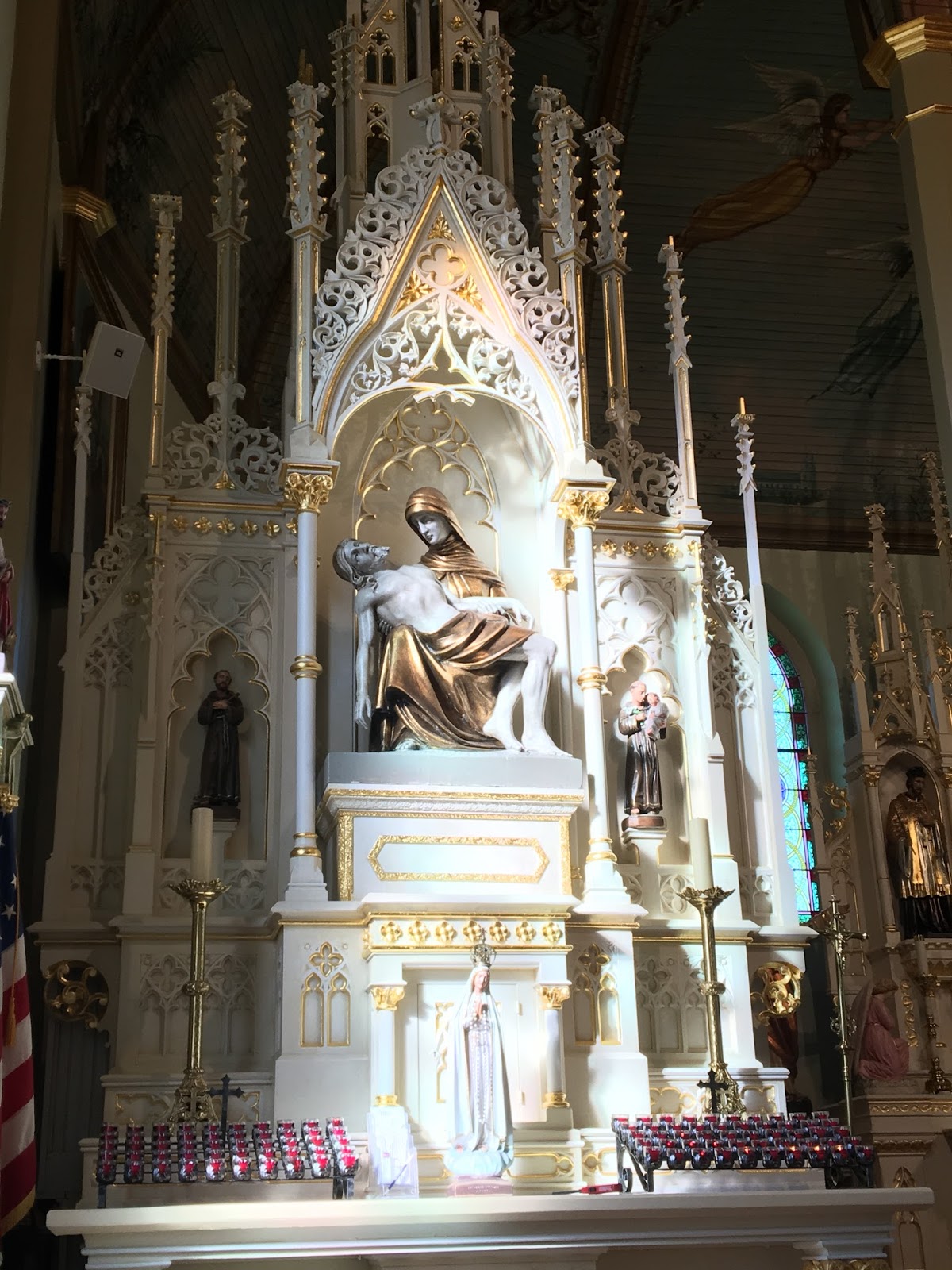
Locals call St. Mary's of High Hill the "Queen of Painted Churches" on account of its varied colors, considerable imagery, and slightly larger scale when contrasted with the neighboring parishes. Stained glass from the older, 1869 church adorns the current building. Unlike the gilded Czech church in Flatonia, the softer, darker wood create a more somber mood.
The style follows the 19th century fashion of Marian and Josephite altars with a Sacred Heart statue somewhere near the altar. The baptismal font has been relocated according to the Pian-Pauline novelties.
The greater size of the church permits a greater variety of statuary, images, and nook for devotion. Statues of Roman virgin martyrs (Cecilia and Agnes come to mind) grace the northern columns inside the church while medieval mendicants (Francis, Anthony) stand over the south pillars. Saints became more modern towards the front of the parish.
"I will go to the altar of God, God Who makes joyful my youth" was inscribed in the German tongue in the narthex of the church. One must not neglect to remember the role of Germany in vernacularizing the Roman Mass, originating the dialogue Mass and obtaining the first legal concession to read the lessons in the local tongue from the altar (the French had been doing it outside the rubrics for some time).
While a more impressive church than its cohort in Flatonia, this author prefers the cheery openness of St. Mary of the Assumption. Still, who knew Texas had such gems?
Locals call St. Mary's of High Hill the "Queen of Painted Churches" on account of its varied colors, considerable imagery, and slightly larger scale when contrasted with the neighboring parishes. Stained glass from the older, 1869 church adorns the current building. Unlike the gilded Czech church in Flatonia, the softer, darker wood create a more somber mood.
The style follows the 19th century fashion of Marian and Josephite altars with a Sacred Heart statue somewhere near the altar. The baptismal font has been relocated according to the Pian-Pauline novelties.
The greater size of the church permits a greater variety of statuary, images, and nook for devotion. Statues of Roman virgin martyrs (Cecilia and Agnes come to mind) grace the northern columns inside the church while medieval mendicants (Francis, Anthony) stand over the south pillars. Saints became more modern towards the front of the parish.
While a more impressive church than its cohort in Flatonia, this author prefers the cheery openness of St. Mary of the Assumption. Still, who knew Texas had such gems?
Tuesday, January 31, 2017
Painted Churches of Texas I: St. Mary of the Assumption
Ecce quam et quam iucundum habitare fratres in unum!
This past weekend a group of friends, His All Traddiness included, ventured down to something called Austin, TX, a town famous for drunk escapades on 6th street, Whole Foods, and for fifteen years the home of Rick Perry. Its rural surroundings—possibly the only hills in the barren state of Texas—quietly hold a treasure of delectable barbecues and painted churches.
Readers will recall J's post on St. Peter's, the "painted" church of Lindsay, TX. Painted churches are not an historical anomaly in central Texas, which saw a remarkable settlement of Slavic and German migrants from central and Eastern Europe. They built modestly sized parishes and furnished them in baroque fashion to the best of their ability. Statues and ornate reredros graze the sanctuaries, but when of the ceilings, walls, cornices, and other crevices that would be gilt and covered in 18th century masterpieces in the old world? These immigrants took brushes to the plain Texan wood and created something quite extraordinary in these little low Mass chapels.
The first church in this series is St. Mary of the Assumption in Flatonia, TX. The community dates to 1865, but the current edifice is a few decades newer. As with all the painted churches we saw, there is an adjacent cemetery; one would be baptized, married, communicated, and buried in the same tradition and among the same people, a contrast to our mobile society not lost on my cadre.
| A side altar. St. Joseph has some grey streaks. The Infant of Prague reflect the Czech origin of the parish. |
| The parish doors look to be candidates for "renewal." |
| The pulpit has a sounding board to carry the echo. |
Friday, February 5, 2016
The Painted Church of Lindsay, Texas
About an hour and a half north of Dallas sits St. Peter Catholic Church of Lindsay, Texas. It is one of the famous "painted churches" of Texas, a tradition thought up by German and Czech immigrants who wanted to lavishly decorate their parishes on a budget. Most of these churches can be found between Austin and Houston, but St. Peter's is very much in the opposite direction, closer to the Oklahoma border.
From the photos I've seen of the other painted churches, St. Peter's seems to be uniquely patterned with geometric shapes, and since its founding the parish has been able to afford a decent set of stained glass windows to add to the decor. The current building dates back to 1918 after it was rebuilt from a tornado strike.
St. Peter's was brought to Mr. Grump's attention when a priest wandered in to a cigar shop being frequented by His Traddiness and yours truly. Fr. Smokey was kind enough to regale us with tales and photographs of a few beautiful Texas churches. I decided to devote a Sunday morning for the road trip. A few of my own photos are below.
![]() |
| Parking lot entrance. St. Peregrine sits to the right. The church is easily the largest structure in the whole town. |
![]() |
| The main altar. Everything behind the altar (window excluded) is painted. |
![]() |
| A wider view of the sanctuary, including the pulpit and abat-voix. |
![]() |
| Mary's altar. At the far right, you can see a cylindrical speaker painted to match the wall. |
![]() |
| A rather strange interpretation of St. Joseph and the Christ Child. |
![]() |
| A bit of stained glass in the Marian altar corner. |
![]() |
| One of the colorful ceiling patterns. |
![]() |
| A side aisle. |
![]() |
| A view of the organ and choir loft. The choir was quite good. |
![]() |
| Above the sanctuary. |
![]() |
| The small but cozy baptistery. |
![]() |
| One of the Stations of the Cross. |
![]() |
| Part of a series of scenes from the life of St. Benedict. |
![]() |
| A view from the rear. |
![]() |
| Bell tower and front entrance. |
Subscribe to:
Posts (Atom)