Showing posts with label priesthood. Show all posts

Wednesday, April 26, 2017

In Persona Christi?

Maybe, maybe not.
The recent Good Friday article by His Traddiness reminded me of a theological question that has bothered me for a while. Namely, what is the history of the theology of Holy Orders in regards to the idea that the priest acts in persona Christi? (Of similar interest is the theology of the priest as alter Christus—"another Christ"—but this is more rarely found in writings on the priesthood.)

The phrase itself appears to be borrowed from St. Paul's second epistle to the Corinthians, wherein he writes, "I myself, wherever I have shewn indulgence, have done so in the person of Christ for your sakes" ("nam et ego quod donavi, si quid donavi, propter vos in persona Christi").

It appears in its more recognizable form in St. Thomas's Summa, where he distinguishes between Sacraments: some being effected in the person of the minister (e.g., "I baptize you..." or "I confirm you...") and others in the person of Christ (e.g., "I absolve you..." or "This is my Body..."). For Thomas, this appears to be a technical point concerning the meaning of the words effecting these Sacraments, rather than an observation on the effects of Holy Orders on ordained persons.

The Catechism of the Council of Trent (1566), though not quoting the council itself, says, "The priest is also one and the same, Christ the Lord; for the ministers who offer Sacrifice, consecrate the holy mysteries, not in their own person, but in that of Christ, as the words of consecration itself show, for the priest does not say: This is the body of Christ, but, This is my body; and thus, acting in the Person of Christ the Lord, he changes the substance of the bread and wine into the true substance of His body and blood." In this, the catechism is basically following Thomas.

Whereas previously the bishops held a special place as the ministers and missionaries of Christ, the Counter-Reformation seems to have gradually extended of this idea to all priests. St. Alphonsus Liguori (†1787), for instance, wrote tracts on the dignity of the priesthood, at one point opining, "For us it is enough to know that Jesus Christ has said that we should treat his priests as we would his own person."

Similarly, St. John Vianney (†1859) wrote, "After God, the priest is everything! Only in heaven will he fully realize what he is." Like sentiments are found in popular moral manuals and spiritual writings from the Counter-Reformation to the second Vatican Council.

The twentieth century saw an increase of exposition on the exaltation of priests. Even James Joyce's Portrait of the Artist as a Young Man (1916) famously depicts a priest trying to encourage the eponymous hero to pursue Holy Orders based on its magnificent dignity: "No angel or archangel in heaven, no saint, not even the Blessed Virgin herself, has the power of a priest of God: the power of the keys, the power to bind and to loose from sin, the power of exorcism, the power to cast out from the creatures of God the evil spirits that have power over them; the power, the authority, to make the great God of Heaven come down upon the altar and take the form of bread and wine."

P. Pius XII wrote in the encyclical Mediator Dei that "Christ is present at the august sacrifice of the altar both in the person of His minister and above all under the eucharistic species" and that priests "represent the person of Jesus Christ before their people."

The Vatican Council increased the danger of clericalism even while giving lip service to the importance of the laity. In Lumen Gentium, the council fathers wrote that the bishops "in an eminent and visible way sustain the roles of Christ Himself as Teacher, Shepherd and High Priest, and that they act in His person." Also that the priests "by reason of their sacred office represent the person of Christ."

In the recent Catechism of the Catholic Church, the phrase is mentioned three times (875, 1348, & 1548), albeit modified into, "in persona Christi capitis." The extension of the persona Christi theology goes even further in 1348: "It is in representing [Christ] that the bishop or priest acting in the person of Christ the head (in persona Christi capitis) presides over the assembly, speaks after the readings, receives the offerings, and says the Eucharistic Prayer." This is the first "official" suggestion that a Sunday sermon should be considered as being preached in the person of Christ.

In 2009, P. Benedict XVI issued a motu proprio in which he modified the Code of Canon Law to clarify that only bishops and priests act in the person of Christ, not deacons.

While I am no expert in the development of doctrine, it seems that the relatively modest proposal of Thomas Aquinas got quite out of hand by the 20th century. His theological writings on the words of consecration have also caused no end of consternation with the various eastern Churches. It seems clear at this point in time that they contributed very unfortunately to the culture of clericalism, the quasi-quietism that idolized obedience even for the common layman.

One might say that a bishop acts in the person of Christ much like an ambassador acts for his country: in an official capacity, but sometimes poorly representing the desires of his fatherland, and being occasionally the cause of international incidents. Indeed, the aforementioned Pauline epistle calls the apostles "ambassadors of Christ," but it seems that St. Thomas had a very different meaning in mind when opining on the effecting of Sacraments.

P. Benedict's legal clarification is welcome, but does little to undo the damage of excessive clericalist spirituality. The recent sex abuse crisis saw many priests manipulating young men by asserting their role as "another Christ," and by claiming that whatever they willed was therefore willed by God. This is an extreme example of clericalism gone wrong, but not an irrelevant one. When your local parish pastor starts asserting his authority as an alter Christus, even for silly things like liturgical preferences in the Pauline Novelty Mass, but especially for more serious matters like demanding complete obedience to all advice given in the confessional, one must wonder why.

Wednesday, August 10, 2016

Giving Priests New Purpose: A Few Suggestions

(source)

Back in January, His Traddiness argued that increasing the presence of priests and religious on college campuses could be a method of ensuring their continued social worth, a point brought up again recently in his “Unholy Writ.” I do not disagree, and I think placing religious figures in a place where people experience many major turning points in their lives is probably the only way the priesthood will regain any prominence in the public consciousness. One thinks of Fr. Leonard Feeney, who got himself in so much trouble for encouraging young people at Boston College to read patristic sources with his peculiar theological lens.

But there are other such turning points, other times of psychological plasticity when people are more capable of formation. Suicide rates in the United States have recently reached a thirty-year high, according to the National Center for Health Statistics. These rates seem to be going up around the globe, and there is as yet no major Catholic spiritual movement combatting the plague of self-murder or its causes. When suicides occur, the dead are spoken of in vaguely sentimental and pitying terms, neither condemning the act nor the malaise of despair that causes it.

Priests and religious would do well to organize and oppose suicide in all its forms. This means first and foremost being compassionate and proactively seeking out people of all ages who are lost in the mire of desperation. They must learn basic counseling skills, the essentials of the psychological sciences (modern and classic), and the ability to spot potential perpetrator-victims. Compassion is the honey needed to attract the bees, but the desperate cases will not respond without a strong demand for moral reorientation.

So, it would also mean preaching or otherwise publicly opposing suicide as a legitimate moral option in any circumstance. Those who legitimize the option as a noble exit from this life must be condemned as neo-pagans. (St. Augustine’s harsh words on the subject ought to become as familiar as rote.) Those Catholics who implicitly legitimize it by moral sophistry and by exaggerating the slightest argument for lack of culpability must be silenced. Bishops might consider reviving the ancient practice of refusing to bury suicides in sacred ground after this movement has gained some traction.


Another turning point is at conversion to the Catholic Faith. The Church receives many converts every year, but some estimates put the attrition rate of American converts at about 50% within the first year. Conversion is very much a time of psychological plasticity, when men and women are both emotionally vulnerable and capable of surprising alterations in their lives. The choice to leave behind their former beliefs and way of life also puts them at great risk if the following months and years go poorly.

I have described conversion before as a kind of psychological trauma, and I think that is important to bear in mind. The convert has become psychologically destabilized, intentionally, in his efforts to reorient his mind, body, and heart to the Catholic spirit. He is the recipient of many graces and movements of the Holy Ghost, but he is not capable of fully realizing those graces if he cannot find the proper help and formation on the other end.

The very people who are good at bringing people into the Church are terrible at keeping them here. The intellectual formation offered by apologetics is very different from the formation needed by the newly-confirmed Catholic. While the potential convert desires arguments, historical education, and an introduction to basic liturgical prayer, the recently-converted desires moral formation, spiritual practices (devotional or otherwise), the exploration of sacred art, the patronage of his chosen saint, and the discovery of his place in the Catholic social order.

While the aid of laymen (especially godparents and sponsors) is important in many respects, priests and religious ought to take the lead in offering this assistance to recent converts. Perhaps a five- or even ten-year plan could be developed, in which the infant Catholic is gradually guided into spiritual adulthood. As St. Paul once wrote, “You were little children in Christ’s nursery, and I gave you milk, not meat; you were not strong enough for it.” It is grossly unjust to allow converts to wander aimlessly after their conversion, as if assuming that the Spirit who moved them into the Church will infallibly lead them through all of its troubled waters. Clearly this is not the case, as proven by the apostates that commit spiritual suicide in droves.

Welcome to the Church! Prepare to be ignored. (source)
These two ministries—for the suicidal and for the convert—could even be grown out of His Traddiness’s proposed college ministries. Colleges and universities are common trouble spots for depression and self-hatred, but also fertile grounds for conversions when given the right professor or priest. I do not know if such ministrations would be effective towards strengthening the Church’s position in society and culture, but I do know that they are desperately needed, and would be greatly appreciated by the recipients thereof.

Sunday, April 28, 2013

Hilarious Article from Reuters

In an emotional ceremony filled with tears and applause, a 70-year-old Kentucky woman was ordained a priest on Saturday as part of a dissident group operating outside of official Roman Catholic Church authority.
Rosemarie Smead is one of about 150 women around the world who have decided not to wait for the Roman Catholic Church to lift its ban on women priests, but to be ordained and start their own congregations. [These people do not get it, nor do they want to. There is no "ban," just the statement that women cannot be priests. Nothing happened, they're still just ladies]
In an interview before the ceremony, Smead said she is not worried about being excommunicated from the Church - the fate of other women ordained outside of Vatican law.
"It has no sting for me," said Smead, a petite, gray-haired former Carmelite nun with a ready hug for strangers. "It is a Medieval bullying stick the bishops used to keep control over people and to keep the voices of women silent. I am way beyond letting octogenarian men tell us how to live our lives."
The ordination of women as priests, along with the issues of married priests and birth control, represents one of the big divides between U.S. Catholics and the Vatican hierarchy. Seventy percent of U.S. Catholics believe that women should be allowed to be priests, according to a New York Times/CBS News poll earlier this year.
The former pope, Benedict XVI, reaffirmed the Catholic Church's ban on women priests and warned that he would not tolerate disobedience by clerics on fundamental teachings. Male priests have been stripped of their holy orders for participating in ordination ceremonies for women.
In a statement last week, Louisville Archbishop Joseph E. Kurtz called the planned ceremony by the Association of Roman Catholic Women Priests a "simulated ordination" in opposition to Catholic teaching. 
"The simulation of a sacrament carries very serious penal sanctions in Church law, and Catholics should not support or participate in Saturday's event," Kurtz said.[Thank you, your excellency, for those very well-chosen words]
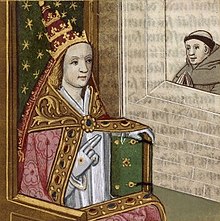
"Pope" Joan, the controversial, non-existent
eighth century female occupant of the Roman See
The Catholic Church teaches that it has no authority to allow women to be priests because Jesus Christ chose only men as his apostles. Proponents of a female priesthood said Jesus was acting only according to the customs of his time. [Do these people believe Jesus was God? Or that He was some guy bound by temporal Jewish customs?]
They also note that he chose women, like Mary Magdalene, as disciples, and that the early Church had women priests, deacons and bishops.[Don't forget Her Unholiness, Pope Joan!]
The ceremony, held at St. Andrew United Church of Christ in Louisville, was attended by about 200 men and women. Many identified themselves to a Reuters reporter as Catholics, but some declined to give their names or their churches.
'NEW ERA OF INCLUSIVITY'
The modern woman priest movement started in Austria in 2002, when seven women were ordained by the Danube River by an independent Catholic bishop. Other women were later ordained as bishops, who went on to ordain more women priests and deacons.
"As a woman priest, Rosemarie is leading, not leaving the Catholic Church, into a new era of inclusivity," said Bishop Bridget Mary Meehan during her sermon Saturday. "As the Irish writer James Joyce reminded us, the word 'Catholic' means 'Here comes everybody!'"
Smead had to leave the rigorous Carmelite life due to health reasons, and earned a bachelor's degree in theology and a doctorate in counseling psychology. She taught at Indiana University for 26 years, and works as a couples and family therapist. [So she left listening to God and is now a professional at charging other people to listen to her?]
During the ordination ceremony, Smead wept openly as nearly everyone in the audience came up and laid their hands on her head in blessing. Some whispered, "Thanks for doing this for us."During the communion service, Smead and other woman priests lifted the plates and cups containing the sacramental bread and wine to bless them. [And they were just that, bread and wine]
A woman [Wait for it....] in the audience murmured, [Wait for it....] "Girl, lift those plates. I've been waiting a long time for this."[!!!!]
One of those attending the service was Stewart Pawley, 32, of Louisville, who said he was raised Catholic and now only attends on Christmas and Easter. But he said he would attend services with Smead when she starts to offer them in Louisville. [These submarine Christians, who surface twice a year, supposedly constitute part of Church opinion in research polls.....]
"People like me know it's something the Catholic Church will have to do," said Pawley. [See previous comment](Editing by Tim Gaynor and Mohammad Zargham)