Having taken enough abuse from fellow lovers of Catholic tradition in the last few years—although the readers of this blog have been very well behaved and civilized until recently—I have decided to leave this little blog and spend my free time focusing on prayer and reading the Fathers.
I began this blog over a year ago at the urging of my closest friend, who suggested it might be an outlet for me to express my opinions and network with others who share them. In this the blog was a success, as I have made acquaintance with many of you and enjoyed our correspondence. In that, I hope to continue knowing many of you. If any of you wish to contact me and have not done so I can be reached at theradtrad@gmail.com.
The blog will remain up so readers can see prior posts.
I wish you all a very Merry Christmas. God be with you.
UPDATE: Alright, maybe I "jumped the gun" a bit soon, but I am certainly stepping away for a while. Perhaps I will return at some point in January (after the Octave of Epiphany at the earliest). In the mean time, thank you all very much for your support. Do say a pray for me at some point in the next month!
Many of you will be aware of a theory that posits the Apostolic See in Rome has not been occupied by a genuine incumbent since at least the mid-1960s (some think Paul VI may have been Pope and forfeited his office during Vatican II) while most agree that the seat has been vacant since the death of Pius XII in 1958. Adherents to this theory, called sedevacantism, are tiny in number, even among traditionalists, because the idea is understandably odd or unusual to Catholic ears. What are the origins of this movement? What are its merits? Does it have theological or historical precedent? In a short period of time we shall try to answer some of these questions.
Note to sedevacantists: I will be referring to John XXIII, Paul VI, the two John Pauls, Benedict XVI, and Francis as popes because—as National Review journalist and sedevacantist Mary Martinez pointed out—we ought to discuss these men as the world knows them.
Origins
At first sedevacantism was not so much a movement or group within the traditionalist Catholic world as much as it was a private opinion. In the early days of the Society of St. Pius X the fraternity's efforts incorporated their own clergy—some of whom were sedevacantists—and diocesan clergy willing to work for the older rites and traditional teaching methods. In France the SSPX used the 1962 Missal. At Econe, according to a former postulant, they used 1965 with some modifications. The United States used "pre-1955," suggesting big bad Bugnini was the turning point in the liturgy and not his employer. And the rest of the world, both SSPX and diocesan, used liturgies pre-dating the papacy of Pius XII. A general chapter of the SSPX, held in 1977, confirmed recognition of these local usages and resolved to leave them alone.
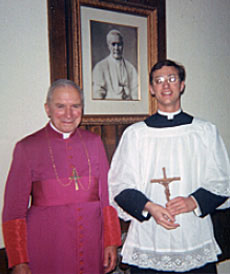
Newly cassock'd Anthony Cekada
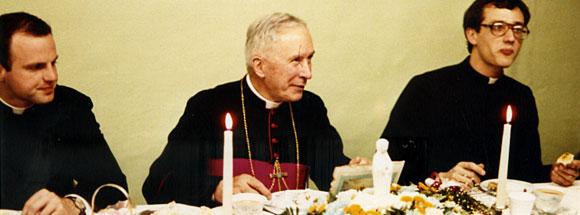
with Msgr. Lefebvre
All of this began to change in the early 1980s. The few sedevacantists in the SSPX, between nine and a dozen, held the Popes after Pius XII to be dubious in their authority and the 1968 rite of episcopal consecration to be outright invalid, consequently making ordinations of priests invalid. Around 1982, cognizant of his age and the growth of his canonically troubled apostolate, and desirous of legitimizing his work and consecrating a successor, Archbishop Marcel Lefebvre began a six year long process of normalizing his relationship with Rome and Pope John Paul II. In order to give a good report of himself to Rome Lefebvre imposed liturgical uniformity on his Society in the form of the 1962 Missal and 1961 Divine Office. Moreover, he accepted into his Society priests ordained in the new rite and by bishops consecrated in the new rite. He even made his priests accept the local diocesan tribunal's decisions with regard to annulments. His point? To operate as closely to canonical norms as possible.
For his sedevacantist clergy accepting supposed non-priests, flimsy annulments, and a Missal published by an anti-Pope would not be possible. Lefebvre himself, a man given to changing his mind, at first thought the new ordination rites invalid, but eventually revised his opinion. Nine firmly believing sedevacantists published a letter to Lefebvre denouncing his perceived misdeeds, a missive that was the straw that broke the camel's back. Depending on one's perspective, the nine either left on their own accord or suffered expulsion from the Society. The nine, almost entirely American, decided to hang onto the Society's real estate in the United States, resulting in a law suit which allowed the Society to keep about half of its holdings while the nine get out with the rest, giving the sedevacantists a platform to launch their activities and hitting the restart button for the SSPX in America.
"How about Oyster Bay and St. Gertrude's for the rest of the Midwest?
The salmon's great, by the way!"
The newly formed Society of St. Pius V eventually split, with Frs. Sanborn, Cekada, and Dolan heading out West while Fr. Kelly and his followers remained in the northeastern United States. Kelley obtained episcopal consecration from Alfredo Méndez-Gonzalez, retired from his see in Puerto Rico, while Sanborn and Dolan found episcopal orders from descendants of Archbishop Thuc, retired ordinary of Vietnam who consecrated anything with a pulse and who could never quite decided if he too was a sedevacantist. The SSPV is not officially sedevacantist and gives Communion to other hardline traditionalists such as laity who attend Mass with the SSPX (although the SSPX does not necessarily reciprocate). The Dolan/Sanborn/Cekada group, in union with the CMRI on the West coast, excludes non-sedevacantists from its Sacraments and is, generally, more in line with the sedevacantist mainstream. The SSPV, scandalized by some of Thuc's choices for consecration, holds the validity of Sacraments descended from Thuc-ite bishops and priests to be dubious and hence discourages its followers from attending CMRI chapels or churches run by the Sanborn/Dolan/Cekada apostolate.
Bishop Dolan begins to consecrated holy oils according to the
un-reformed rites on Mandy Thursday.
Liturgically they are a mixed bag. The SSPV and Sanborn/Dolan/Cekada use the mythical "pre-1955" rites while CMRI, holding Pius XII to be the last Pope and his laws still "on the books," uses the liturgy as it existed in 1958. St. Gertrude's in Ohio, the main church in bishop Dolan's network, is possibly the most liturgically competent community in the world which follows the older Roman liturgy.
Who Are They?
With no statistics on hand, and none likely recorded, the following will be entirely anecdotal, but honest from the Rad Trad's perspective.
Sedevacantism is more or less an American phenomenon with small pockets in the French speaking world and in Mexico. These tend to be places where Catholic culture was very strong prior to Vatican II. The Church in America was expanding like the rabbit population in the Spring. France, although beleaguered by the Revolution, still had a strong Catholic culture in the countryside. Mexico's Catholic culture went deeper than either. When the Masonic president of Mexico, Calles, imposed violent anti-Catholic regulations the laity, athwart the laxity of the clergy, rose up in armed revolt and achieved complete victory over army and Calles government before Cardinal Gasparri convinced Pius XI to sue for peace and have the "Cristeros" surrender un-conditionally. While the Rad Trad cannot speak of the specifics of Mexico and France he can say that the places where sedevacantism thrives in the United States, particularly in Long Island, NY and in West Chester county, Ohio are areas that remain demographically conservative, white, and wealthy. In short, they are well suited to maintain the America of 1958.
Their Claims
Sedevacantists claim that the documents of the Second Vatican Council contain heresies and deviations from the accepted teaching of the Catholic Church. Additionally they claim that the new ordination rites are invalid as well as the Mass Paul VI promulgated in 1969. The Rad Trad has already voiced his opinion on the validity and legality of the Pauline Missal here and will not rehash old material now. Because the Pope is infallible and because the Church cannot be defective these heresies and vain rites cannot be part of the Church, reasons the sedevacantist. Therefor the men who brought about these errors cannot be true Popes. Ergo, Paul VI, John Paul I, and John Paul II—despite being validly consecrated bishops by sedevacantist standards—never obtained the Papal Office. Similarly Josef Ratzinger is only a priest and Jorge Mario Bergoglio is perhaps not even a deacon.
They see the Second Vatican Council as the product of "modernism" which had crept about in obscure places for decades before finally manifesting itself in St. Peter's Basilica between 1962 and 1965 under the leadership of anti-Popes bent on creating a new and ecumenical religion. Because the Council was so arrantly un-Catholic and because the Pope cannot be wrong in matters of faith or morals, the Council is invalid and the Popes who put their seal on the Council were not Popes.
Bishop Rifan, ordinary of the Administration of
St. John Vianney in Campos, Brazil.
A secondary consequence of their view is that the Church hierarchy no longer exists. With no bishops outside of the Eastern Catholic and Orthodox Churches valid Holy Orders are only to be found in sedevacantist communities, the SSPX, and in Campos, Brazil. Eastern Catholics are in union with Rome, making them adherents to the new religion; the Orthodox are schismatic; the SSPX are schismatic from the sedevacantist perspective and exercise the detestable "recognize and resist" method; and the same problem with the Eastern Catholics applies to the priests under bishop Rifan. In short, it is sedevacantism or nothing. Authority has disappeared.
The last claim, and equally as serious as the others, is that the Popes after Pius XII could not possibly have been Popes because in his Cum ex apostolatus Paul IV forbade heretics, even furtive ones, from validly assuming ecclesiastical office. John XXIII and Paul Vi were obviously heretics and hence could not be elected to the Papacy.
Evaluating the Claims I: Validity of the New Ordination Rites
The central point of contention, before Cum ex apostolatus, is that the Pope cannot be the source of evil done to the faith. One would be hard pressed to find a graver evil than an absence of Sacraments, which is precisely what sedevacantists allege the Council and new liturgy accomplished. The new rite for ordaining priests, they argue, is doubtful and the new episcopal consecration is certainly invalid. Why? Because they fail the tests of Sacramentum Ordinis (Pius XII 1947) and Apostolicae Curae (Leo XIII 1896).
The first bull, by Pius XII, defines the exact formula for the consecration of a bishop according to the pre-1968 episcopal rites. He found the formula to be: "Perfect in Thy priest the fullness of thy ministry and, clothing him in all the ornaments of spiritual glorification, sanctify him with the Heavenly anointing" (S O 5). Of course were Paul VI not Pope the new rite could not be valid in contrast to the older rite merely because it is not the Roman rite. Then again neither is the Maronite rite. What would the new rite be to a sedevacantist? A schismatic rite of course. When was the last time a Pope judged the validity of a schismatic rite? When in 1896 Leo XIII declared ordinations done according to the ordinal of Edward VI invalid in his Apostolicae Curae. In this document Pope Leo determines that the form can be judged based upon what it means to say rather than its historical precedent. The intention of Anglican clergy was not to ordain priests and bishops in the Catholic sense, using the terms as euphemisms for other ideas and invalidating the rites on the grounds of form and intent (AC 33). More plainly: "A person who has correctly and seriously used the requisite matter and form to effect and confer a sacrament is presumed for that very reason to have intended to do (intendisse) what the Church does. On this principle rests the doctrine that a Sacrament is truly conferred by the ministry of one who is a heretic or unbaptized, provided the Catholic rite be employed. On the other hand, if the rite be changed, with the manifest intention of introducing another rite not approved by the Church and of rejecting what the Church does, and what, by the institution of Christ, belongs to the nature of the Sacrament, then it is clear that not only is the necessary intention wanting to the Sacrament, but that the intention is adverse to and destructive of the Sacrament."
What does the new rite of episcopal consecration say? "So now pour out upon this chosen one that power which is from you, the governing Spirit whom you gave to your beloved Son, Jesus Christ, the Spirit given by him to the holy apostles, who founded the Church in every place to be your temple for the unceasing glory and praise of your name." What is wrong with it? According to Fr. Cekada, working off of Pius XII directly and Leo XIII indirectly, a rite needs the explicit statement of what it confers and the grace of the Holy Spirit. Does the new rite have this? Fr. Cekada says no. The Rad Trad says yes!
Indeed, while the older rite is far more beautiful with its talk of perfection and fulfillment it is not on its own very clear and is given context by the examination before the Mass, by the anointing rites during the ceremony, by the enthronement, and by the blessing of the people (all things retained in revision in the new pontifical books). The newer rite is actually clearer on both counts. The much disputed "governing Spirit" term refers both to the Holy Spirit, Who came at Pentecost and is passed on in ordinations and consecrations, and the authority to teach and govern God's Church that He brings. Indeed, if Fr. Cekada is right and context does not save an iffy form then must we not conclude that the old rite, not the new, is invalid? This would be ridiculous of course, as would be declaring the new rite invalid.
Evaluating the Claims II: the Heresies of Vatican II
The Council is every traditional Catholic's compass for evaluating the state of the modern Roman Catholic Church. Religious liberty (Dignitatis Humanae), the relationship between the Church and non-Catholic religions (Lumen Gentium), and the relationship between the Church and the modern world (Gaudium et Spes) are the most controversial issues discussed at Vatican II and the most enduring problems flowing from the Council. Sedevacantists interpret these documents, or parts of them, to be a either a wholesale or subtle departure from the perennial "Magisterium" of the Church. This is far too great a claim to judge or consider in a single blog post, so we will only ask a few questions and consider a few items for readers' private reflection.
Was the Church's teaching on religious liberty—something condemned by Gregory XVI, Pii IX-XI, and Leo XIII—beyond reform or just the teachings of the 19th and 20th century Popes? This is a very serious question. The theology of "Christ the King" is certainly very important and Our Lord deserves public respect and His Church deserves public recognition. But is the extent of this, such as a Catholic state, an actual dogma or just the Church's historical experience integrated into her theology? One would be hard pressed to dogmatize an idea not explicitly discussed prior to the 19th century. There is really little on the topic at all, if anything, in the Church Fathers. After Christianity became the state religion of the Roman Empire the Byzantine Church developed a theology of the Emperor as the living icon of God, a theological tradition that endured until 1453. The Roman Church was far more practical. The Pope would favor whichever monarchs helped the Church and the Papal States. It was not until the Europe built by Ss. Benedict and Gregory the Great out of the broken foundations of the Roman Empire began to collapse that a stronger relationship between Church and State entered common and explicit teaching. Given the anti-clerical, revolutionary, and secular dreams of the new European governments the Papal reaction was understandable and even laudable. What do we make of Dignitatis Humanae then? When the Rad Trad first read this [very] short document he was struck not only by the vague and un-directed articles of the document, which call for nothing specific and define nothing in particular, he was also struck by the recurrence of the word "coercion." In context we understand that DH was directed against Spain, where dictator Francisco Franco used Catholicism as a means of cultural consolidation. The lack of any particular directives, probably intentionally, gave the impression of a new teaching. The Rad Trad, for one, thinks the writers of the document intended this while the bishops mostly thought about disestablishment in Spain. This makes the document a break with the teachings of the Popes from Gregory XVI until Pius XI, but not necessarily heretical.
Fr. John Courtney Murray, SJ
Patron saint of Americanism
Another point of contention is the belief proffered in Lumen Gentium that non-Catholic religions enjoy some degree of truth or communion with the Catholic Church. Is this not true with the Orthodox, who have valid Sacraments, a hierarchy dating to Apostolic times, and a genuine theological tradition dating back to the Desert Fathers, the Greek Fathers, and the Byzantine era? Sure, the separation from Rome is no small matter, but there is a world of difference between being Orthodox and being a lapsed Buddhist, is there not? This relationship breaks down greatly when discussing Protestantism; it breaks down even further in considering non-Christian groups; and entirely disappears in considering non-theistic religions.
Vatican II's great problem does not always seem to be ambiguity, but authority and ownership. What does Dignitatis Humanae really mean? What the periti wanted it to mean or what the bishops thought it meant at the time?—oddly John Paul II, Cardinal Dolan, and Archbishop Chaput all seem to favor the former. Does one have to believe in what was said in Lumen Gentium about non-Catholic religions? Is there any note binding Catholics to its words? This is especially troublesome because it departs from the approach of previous teaching, but in no part forces itself upon the faithful. And yet, despite its seemingly novel approach, does what it says not have some very narrow applicability? Questions, questions.
These questions could even be asked of Pope Pius XII's Mystici Corporis, a favorite of the FSSP/SSPX segment of the traditionalist world. MC, although it has good footnoting and is well grounded in the Fathers, promotes an organic and—dare we say—oriental view of the Church which at the time of its introduction was quite foreign. Readers of MC, mostly clergy, would have been accustomed to an organizational understanding of the Church or the "Church as a perfect society." While MC was not unprecedented it was certainly a break from the teachings of Pius XII's more immediate predecessors. Avery Dulles admitted as much.
Evaluating the Claims III: Cum ex apostolatus
Cum ex apostolatus by Pope Paul IV in article II excludes heretics and schismatics from obtaining office under the laws of the Church. It must be emphasized that this is a canonical pronouncement, not a religious one. The election of the Bishop of Rome is an act of business, not—as many wrongly believe—an act of God. People, according to the existing laws, vote for someone who, should he accept election and be a bishop, becomes the Pope of Rome. Cum ex apostolatus sets down administrative and canonical rules as to who can participate or be elected in that process.
There are three problems with using this criterion against the Popes from John XXIII onward:
Heresy and schism are public acts against the Church's authority and teachings. Article 5 suggests in its first line that such deviations must be publically known before a cleric can lose his standing. Angelo Roncalli, Giovanni Battista Montini, Albino Luciani, and the rest did not incur the public judgment of the Church prior to their elevations. Indeed they all advanced greatly at the behest of Pius XII, the last man sedevacantists accept as Pope.
When the law and the reality no longer agree the law is irrelevant. Did anyone really dispute the legitimacy of the Popes "elected" during the eras of Byzantine and Frankish dominion over the Papacy? No, even though, in principle, the people of Rome elected their bishop. A validly consecrated bishop was accepted by the laity and clergy of Rome, and by the Church abroad, as the Bishop of Rome and without any rival claimants. How could this man not be Pope?
Was the bull superseded or voided with the introduction of the 1917 Code of Canon Law by Benedict XV? Certainly Pius XII's alterations make the longevity of the Pauline bull doubtful (see AAS 1946, 36).
Contrary to the sedevacantist view the general outlook of those who considered the matter seems to favor the legitimacy of a given incumbent of the Petrine See, even if the incumbent is a spiritually dangerous figure. St. Robert Bellarmine and Cajetan pondered this issue. Cajetan did not believe a heretical Pope incurs ipso facto deposition. Nor did Bellarmine, although Bellarmine did believe that a Pope obdurate in heresy after being accosted by the Church twice would lose his office (De Romano Pontifice II). As a possible proof that a public heretic can be elected Pope, the Rad Trad offers the example of Vigilius who, as a deacon, furthered the aims and ambitions of monphysite aristocracy in Rome and in Constantinople. Although he reverted to the orthodox position after his elevation and suffered tremendously for it, here, if anywhere, is a historical example of a man who appears to be a public heretic assuming the highest office in Christendom.
Historical Experience of the Church
Despite what opponents of sedevacantism would like to think, there are actually many historical precedents for the position, all of them on the wrong side of history.
The most consistent place for judging a Pope, real or potential, is in the setting of an ecumenical Council. Honorius I, who may not have even been a heretic, was anathematized by an ecumenical council after he died for his word choices in a letter decades earlier. Pope Innocent III in De consuetudine states that a Pope opposed to the customs and teachings of the Church need not be followed, not that he is not Pope. The robber-Council of Pisa comes the closest to sedevacantism and occurred at a time when, by sedevacantist standards, valid Holy Orders and a hierarchy still existed. Pisa, through the inspiring words of Simon de Cramaud, who announced that Pope Gregory XII and rival Benedict XIII
"are recognised as schismatics, the approvers and makers of schism, notorious heretics, guilty of perjury and violation of solemn promises, and openly scandalising the universal Church. In consequence, they are declared unworthy of the Sovereign Pontificate, and are ipso facto deposed from their functions and dignities, and even driven out of the Church. It is forbidded to them henceforward to consider themselves to be Sovereign Pontiffs, and all proceedings and promotions made by them are annulled. The Holy See is declared vacant and the faithful are set free from their promise of obedience,"
proceeded to elect a credible anti-Pope named Alexander V, in turn succeeded by John XXIII. Pisa failed and the schism continued, but it did pave the way for a genuine Council at Constance a few years later, which deposed all three claimants to the Papacy and elected Martin V, a portly pontiff. Interestingly the Great Western Schism began after a dispute over the legality of a conclave's decision. Many holy men, including St. Vincent Ferrer, sided with the anti-Pope over the genuine one.
Where to Go from Here?
Sedevacantism, the theory's proponents will say, leaves one in mystery, but not in contradiction. Having spent the above words questioning whether recognition of Francis and his predecessors really does leave one in contradiction, the Rad Trad heartily agrees that the theory leaves one shrouded in mystery. Without cardinals, a hierarchy of bishops, diocesan clergy in Rome, a Frankish overlord, or a Byzantine emperor how can a new Pope be elected? A conclave is out. An ecumenical council is out. The only real options are a miracle from above or converting the people or Rome to sedevacantist Catholicism and having them elect a Pope as a mob, as was done in the first millennium. Given Europe's religious trends, Rome is more likely to embrace Jupiter or Saturn than it is to convert to sedevacantism.
Are They Catholic?
The Rad Trad, unlike other conservative or traditional persons, readily considers sedevacantists Catholics and not because he thinks their theory is a valid one. These men, like St. Vincent Ferrer, adhere in principle to the Apostolic See but make an error in judgment concerning the man who upon it. They do not deny the authority. They mistakenly deny the person who exercises it. This is not a minor error, yet it has precedent even among the saints.
Getting the Narrative Wrong
Conspiracy at work?
The most confusing point in the Rad Trad's mind is the choice of Pius XII as the last true Pope among sedevacantists. Pius XII, more than anyone, is responsible for the current state of the Catholic Church. It was during his Papacy that the new relationship between the Church and other religions and between Church and secular society was fostered. It was during his Papacy and under his very interested and watchful eye that the new liturgy was formulated and slowly introduced. It was during his Papacy that preliminary studies concerning an ecumenical Council were made. It was during his Papacy that the "Novus Ordo Popes" and their enablers rose through the hierarchy and gained positions of power. Paul VI was intended, if anything, to complete the work of Pius XII. In this he did not entirely succeed, but that was the goal, as Cardinal Heenan recounts in his autobiography.
So did not all these "errors" and "evils" really originate during the years of Pope Pius? Why not go after Benedict XV, who used very humanistic language in his writings about international affairs during World War I and who presided over a liberalization of the seminaries in Rome and Louvain which produced most of the world's bishops? John XXIII, a very quiet man who signed not one document of Vatican II, is an utterly absurd choice for an anti-Pope.
Understanding of Infallibility and Indefectibility
By conflating various issues—massive loss of faith, the introduction of new rites, instability, bad teaching—sedevacantists assume that should the recent Popes indeed be Popes then Our Lord Jesus Christ's promise that the "gates of hell would not prevail" against the Church would be violated. This is a narrow understanding of the Papacy grounded in the affairs and interests of the Popes in the 19th and early 20th century, an understanding which neglects the Church's historical experience in preserving her teaching and in judging its visible leaders. The decree Pastor Aeternus of Vatican I is far more conservative and light handed than most Ultramontanists, be they sedevacantists or Francis-ists, would like to admit. PA lays down the primacy of the Pope, the necessity of communion with him, and his infallibility when he defines a doctrine to be held by all Christians. In their eagerness to make infallible the encyclicals and decisions of the Popes from Gregory XVI until Pius XII sedevacantists lose sight of just how specific and limited infallibility really is. Too much infallibility, the kind Pius IX wanted to have, would logically lead one to sedevacantism. The promise of Christ to Peter and the teaching of Vatican I encompass very little. When viewed through the history of the Catholic Church and especially through the history of the Papacy one sees how little is actually promised to the Roman See, but also how firmly upheld that promise has been.
Quick Conclusion
Sedevacantism is a negative reaction to confuse and disorder that engulfed the Catholic Church in the 1960s and 1970s. As a theory it misses critical distinctions and a broad theological and historical view necessary to comprehend the current affairs in the Church, instead discounting and discarding them in favor of Catholicism as it was known at a certain point in the past.
The Rad Trad hopes he was able to provide some reflections and insights into this phenomenon that readers have not found in the conventional traditionalist tracts concerning this matter.
This fellow does not seem too on board with the previous pope's continuity program. About four minutes into the clip Fr. Ruff asks a question about Summorum, the response to which I find less that enlightening.
O Adonaï, et dux domus Israël, qui Moysi in igne flammae rubi apparuisti, et ei in Sina legem dedisti: veni ad redimendum nos in brachio extenso.
O Adonaï, and leader of the house of Israel! who appearedst to Moses in the fire of the flaming bush, and gavest him the law on Sinai; come and redeem us by thy outstretched arm.
O Sovereign Lord! O Adonaï! come and redeem us, not by thy power, but by thy humility. Heretofore, thou didst show thyself to Moses thy servant in the midst of a mysterious flame; thou didst give thy law to thy people amidst thunder and lightning; now, on the contrary, thou comest not to terrify, but to save us. Thy chaste Mother having heard the Emperor's edict, which obliges her and Joseph her Spouse to repair to Bethlehem, she prepares everything needed for thy divine Birth. She prepares for thee, O Sun of Justice! the humble swathing-bands, wherewith to cover thy nakedness, and protect thee, the Creator of the world, from the cold of that mid-night hour of thy Nativity! Thus it is that thou willest to deliver us from the slavery of our pride, and show man that thy divine arm is never stronger than when he thinks it powerless and still. Everything is prepared, then, dear Jesus! thy swathing-bands are ready for thy infant limbs! Come to Bethlehem, and redeem us from the hands of our enemies.
O Sapientia, quae ex ore Altissimi prodiisti, attingens a fine usque ad finem, fortiter, suaviterque disponens omnia; veni ad docendum nos viam prudentiae.
O Wisdom, that proceedest from the mouth of the Most High, reaching from end to end mightily, and disposing all things with strength and sweetness! come and teach us the way of prudence.
O Uncreated Wisdom! that art so soon to make thyself visible to thy creatures, truly thou disposest all things. It is by thy permission, that the Emperor Augustus issues a decree ordering the enrolment of the whole world. Each citizen of the vast Empire is to have his name enrolled in the city of his birth. This prince has no other object in this order, which sets the world in motion, but his own ambition. Men go to and fro by millions, and an unbroken procession traverses the immense Roman world; men think they are doing the bidding of man, and it is God whom they are obeying. This world-wide agitation has really but one object; it is, to bring to Bethlehem a man and woman who live at Nazareth in Galilee, in order that this woman, who is unknown to the world but dear to heaven, and is at the close of the ninth month since she conceived her child, may give birth to this Child in Bethlehem, for the Prophet has said of him: "His going forth is from the beginning, from the days of eternity. And thou, O Bethlehem I art not the least among the thousand cities of Juda, for out of thee He shall come." [Mich. v. 2; St Matth. ii. 6.]. O divine Wisdom! how strong art thou, in thus reaching Thine ends by means which are infallible, though hidden! and yet, how sweet, offering no constraint to man's free-will! and withal, how fatherly, in providing for our necessities! Thou choosest Bethlehem for thy birth-place, because Bethlehem signifies the House of Bread. In this, thou teachest us that thou art our Bread, the nourishment and support of our life. With God as our food, we cannot die. O Wisdom of the Father, Living Bread that hast descended from heaven, come speedily into us, that thus we may approach to thee and be enlightened [Ps. xxxiii. 6.] by thy light, and by that prudence which leads to salvation.
December 5th, 1958 (gratitude to Rubricarius for bringing this delicious tidbit to my attention). Let none doubt the continuity of the efforts of the 20th century pontiffs.
We are sinners. We are fallen. We often cannot control our bad habits and sinful tendencies. Conversely we often have difficulty doing the things we are supposed to do, even when those things would be good for us and to our benefit. We buy into the falsehood of the time-value theory of money, that it is worth paying more tomorrow for the convenience of doing something today. We pay spiritual interest on our souls, sinning becomes a moral credit card that we rarely pay off even though we know we ought to get out of debt and shred the plastic. Paying off the debt and shredding the card is the Confession of sins and the resolve to sin no more.
Troubled Catholics and former-Catholics (lapsed or otherwise) are the most difficult people in the world for me, and yet I love them all to bits. One such fellow I know—broken family, poorly catechized, went off to serve in the Army, and then had way too much "education" at Georgetown University—is a self-described "half Roman Catholic pro-Zionist Deist." He is a fan of "Yeshua Mashiach," Dick Cheney, and "believes in God for scientific reasons." And yet this same fellow is very much haunted by his own sins and his own understanding of the power of private reasoning. Constantly he asks about the faith, the teachings of the Church, the authority of the Church, and the meaning of the Sacraments. This is not a reaction of childhood conditioning to modernity, the poor fellow never really had a strong Catholic culture. The most telling moments of his struggle transpire whenever I visit him and, for whatever reason, find myself going to Confession.
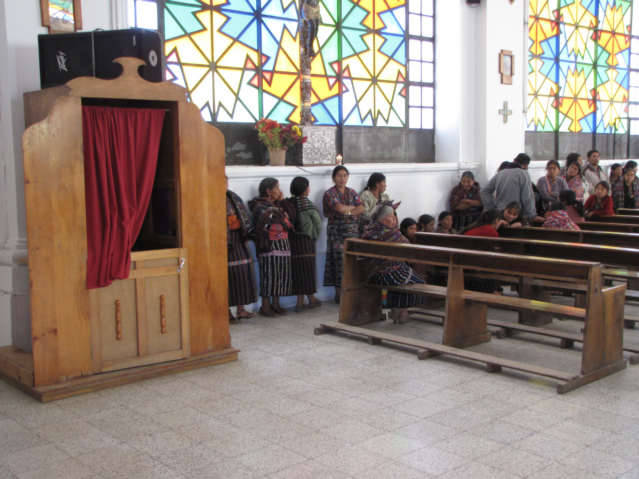
The last time I visited him I went to the basilica in his town, built by a Vincentian up for canonization. There were four confessionals open, each with an enormous line. I waited for about 30 minutes before my turn. I confessed, received from the priest Our Lord's forgiveness, and knelt in a pew near the altar to do penance and say my Rosary. I noticed my friend at the back of the Confession line. After some time he decided against it, saying "Nah, I've got too much. I would take too long." "It's his job to wait and listen to you," I replied. My protest was in vain. This was not the first, nor will it be the last, time I have seen him staring at the confessional. The mercy of God mesmerizes him as it does many other people who see it, but are afraid to touch it, much like Julia Flyte in Brideshead Revisited when Charles meets her during a transatlantic crossing.
People fall away from God, first and foremost, when they forget what it means to be a sinner. Before the Passion of the Lord most of the Apostles seemed utterly clueless, nigh stupid, until the Holy Spirit finally enlightened them. Judas was the exception. He was clueless, yet he thought he knew what he was doing. One might imagine the Apostles watching in confusion and unease as the sinful woman washed Our Lord Jesus' feet with the vial of perfume, but only Judas had the gall to speak up and suggest that he knew better than what pleased Christ. I have come to believe Judas was not a "bad guy." He was probably very pleasant and acceptable to people of many social circles: the Temple Jews, the Pharisees and Scribes, the revolutionaries, and the followers of Jesus. His betrayal of Our Lord was probably done under a troubled mind polluted by the lies of the evil one, but it was a betrayal all the same. Was St. Peter's betrayal any lesser? Denying Our Lord not once, as Judas did, but three times?
Herein is the difference. Peter sought forgiveness after the Resurrection. Peter, although confused, must have maintained some loving pity and sorrow, sorrow for one's sins rather than for one's self. This preserved him until he could see Jesus again. Judas however fell into despair immediately. Yes, he wanted to undo what he had done. He threw the silver coins at the Sanhedrin hoping they would accept the money, instead of making a property purchase, and return the Lord. They did not and his despair worsened. He hanged himself. Peter overextended his spiritual credit, but desired at some level to "pay it off" and turn himself around. Judas did, too, but for the wrong reasons. Peter was the rock of the Church, the Prince of the Apostles, a Saint to all Christians in every place, and the one honored with the grandest of all churches. Judas? Dante put him in the deepest part of Hell. St. Therese held out some hope for him and prayed for his soul. There is a world and an afterlife of difference between being great among the saints and, at best, a pessimistic literary subject remembered for the worst betrayal in history. What was that world and afterlife of difference? The nature of their contrition.
Confession keeps our contrition forthright and honest. Humility, not just habit, brings one to kneel in a dark, quiet cell once a week and say "I have sinned." Humility builds the habit, not the other way around. The less one makes this act of deprecation, of violence to the ego the more one drifts into private judgment, replacing the Revelation of God to Man with Man's Revelation of God to Himself. The most common consequence of this is the loss of faith, much as the most common consequence of excessive spending is a credit rating of zero. And yet there are some who still hear faint echoes of the voice of God in the backs of their minds and souls, telling them to repent. Best repent now, lest the ears and heart become too hard to listen. Confession is always available at a parish near you. Shred the "card" and the sins before you cannot keep up with the bills it brings. Then you may never come back.