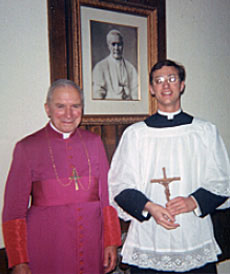
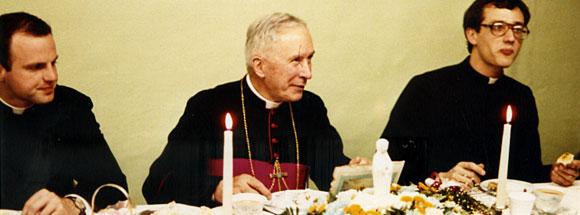
Upon Rorate's predictably sensationalistic report from Sandro Magister that Papa Peron will consider the "correction" of Summorum Pontificum and the 1962 liturgy, I thought immediately of a passing reference Fr. John Hunwicke made today to "Duffy's Parson Trichay" who "clung on" to older ways during the Edwardian and Elizabethian ages.
A suppression or limitation of the 1962 liturgy would cast a dubious shadow over much of the Church, at least in America, outside of parishes exclusively dedicated to the Rite of Econe. Supposedly there are 500 Pian-Johannine Masses, or Mass locations, in the United States every Sunday, the vast majority of them not under the Fraternity of St. Peter or the Institute of Christ the King; the text quotes figures for diocesan presence, so one may doubt the Fraternity of St. Pius X's considerable number of priories are included.
What would happen if Bishop Fellay signed the dotted line, Rome gave the Fraternity a personal prelature with immunity in their current locations, and Francis reconfigured Summorum back to Ecclesia Dei levels, when occasional Masses were permitted only with the expressed consent of the bishop? Surely the FSSP, FSSPX, Institute of Christ the King, and monasteries dedicated to the '62 rite would be left alone, but the majority of Masses would forcibly vanish. If a devout Catholic learned anything during the 1950s and 1960s he learned that the average cleric sees obedience to immediate, visible authority as the equivalent of right and wrong, even if the authority deems wrong what had once been right. Obedience is a means of preserving faith, not the actual faith.
Enter "Duffy's Parson Trichay," whose name was Sir Christopher Trychay (rhymes with "Dickey"). Sir Christopher—named when priests were called Sir or Mister—was ordained in 1515 and served the parish of St. George in Morebath, Devon from that year until his death in 1574. Early in priesthood, Trichay added statues and shrines to saints of popular devotion; Sir Christopher prayed frequently to St. Sidwell, a 6th century virgin martyred in the same county. The medievals sought the intercession of the saints for their common problems; their faith was casual, but that does not mean it was shallow or superficial. Townsfolk donated money at the shrines and bought candles from the St. George's to burn perpetually before the statues and icons of their favorite saints. Sir Christopher used the money from the "stores" to fund the parish's charitable functions, including the laudable participation of five men in the 1549 Prayer Book Rebellion. In 1538, amid Henry's dissolution and thievery among the English monasteries, Trychay gave his Missal, the relics of saints, holy images, and candles to various faithful so that when the authorities came to confiscate his Papist paraphernalia he could hold his hands up in innocence, all the while hoping he might one day call upon his parishioners to use the sacred objects and say the Mass again. In the mean time he used the Prayer Book and a wooden table and did not promote the veneration of saints. His patience was rewarded two years later when Mary assumed the throne and churches resumed the old ways. It was to be short lived. Mary died before the end of the decade with a considerable number of vacant episcopal sees for "Henry Tudor's bastard daughter" to fill. Sir Christopher again hid his Missal, relics, and images with the faithful and resumed the Prayer Book in hopes of another return to Catholicism. Alas, his patience protestantism would not be rewarded this time and the Mass never returned. Sir Christopher Trychay was buried under where the Catholic altar once stood.
He died obedient.
500 Mass locations is a drop in the water compared to the 18,000 (and shrinking) parishes in the United States, yet the opportunity to celebrate the odd 1962 Mass is a treat to most priests condemned to mundane parish life. Will they push back or be obedient as Sir Christopher if that day comes?
One remembers that after the introduction of the completely revamped liturgy in 1970 many priests chose retirement over the "Novus Ordo." Should their dichotomy have been "Will I say the new order or retire" or "Should I say the new order or refuse"? Many would-be opponents, like Cardinal Siri or the priests of the archdiocese of Baltimore, obeyed and left the few dissidents in a liturgical and spiritual ghetto where the FSSP and FSSPX now live. One wonders if Lefebvre would have gone as far as he did if a cardinal or archbishop somewhere not nearing retirement age had the fortitude to say "Not just no, but hell no" independently of the Gallican missionary.
In the mean time, Pre-Pius XII never looked so attractive, or at least so mute a point of contention by its opponents! Buy now while you have the chance!
The recent news that Cardinals Brandmüller, Burke, Caffarra, and Meisner have submitted a formal series of Dubia concerning the proper interpretation and implementation of Amoris Laetitia is causing a major stir in the traddy world and a minor shrug among the rest of the Catholic world. Nonetheless, this move has the potential to back a lot of powerful people into an uncomfortable corner, especially with the four cardinals going public and giving interviews.
Many people, myself included, have criticized clerics like Cdl. Burke for responding weakly or ambiguously to scandalous actions from within the Vatican. Laity who are willing to face the reality of Roman dissimulation often desperately need the solidarity of pastors who are willing to face and speak openly about these scandals. Otherwise, the average traddy layman is all too likely to “rad trad” all the way into sedevacantism or just into a perpetual state of anger. Sheep need good pastors, not hired hands who tell them that everything’s all right when it’s not.
The split between those who work on reform within the system and those who condemn the problems more or less from without is a cause of much vitriol. Abp. Lefebvre’s actions put him and his followers on the outside looking in, and his priests became more bold as a result. The expulsion of Bp. Williamson from the Society has pushed him outside the outsiders. The FSSP was heavily criticized by many traddy groups as being compromisers for refusing to operate without local episcopal approval. Indeed, this decision may have forced its priests to tone down their sermons, which, depending on your perspective, could be a good thing. Outsiders are accused also of prophetic pretensions, of claiming to be divine messengers when they may just be a bunch of cranky farts. Sometimes it is difficult to prove otherwise.
Recently I’ve been rewatching the old science fiction television series Babylon 5 (1993-98). The reasons for this indulgence are neither here nor there, but one aspect of the show’s plot is of some relevance. The command staff of the titular space station become more and more aggrieved at the actions of Earth’s rising totalitarian government, and finally decide to break away as an independent military force. After retaking Earth in a final showdown, the station’s captain is heavily criticized for going rogue, for refusing to work through proper channels from within, and for creating the seeds of a civil war in the wake of his actions. He is described as doing “the right thing in the wrong way,” and it’s not clear that he was indeed in the right.
Are the Society and similar groups doing the right thing in the wrong way? It is a complex movement of many parts and perhaps only a future generation can judge it with clarity. The four cardinals, though, are making the most of working within the system. One might say that their actions are more striking than melodramatic actions by outsiders, because they are refusing to break away unless they are pushed out. That four princes of the Church are making such a statement within the accepted channels, and after having first attempted to clarify matters privately, speaks a great deal to their resolve and restraint.
I have few predictions about how the publication of the Dubia will end. Ignoring the gauntlet they threw down in private has backfired quite badly for the pope and his entourage. Those with mere pretensions to humility cannot bear to be humiliated. Pray to the cardinals’ guardian angels. These four insiders may find themselves to be outsiders, soon.
"You do not make history. You can only hope to survive it." —Lizard Man
I am happy to see that the good folks over at The Remnant have taken my call for intra-traditionalist tolerance seriously and announced the 2016 Catholic Identity Conference. The panel of experts includes priests from both the FSSPX and the FSSP. Don't worry, though: Chris Ferrara will be there to drown out all other conversation that might get nasty.
I found this video on Fr. Ray Blake's website, a video I had sought for years and thought quite lost. The video is two separate features, one focused on the traditionalist movement in the wake of Msgr. Lefebvre's episcopal consecrations and the other a series of vignettes of Norman life called Fr. Quintin's Normandy.
This clip gives us some insight as to what life was like in good parishes "back in the day." Fr. Montgomery-Wright sought eccentricity at every step, but aside from wearing an unnecessary monocle he had a remarkable genteel pastoral demeanor, a kindred spirit for the farming community.
The Masses he celebrated were more elaborate and less ceremonial than today's traddy Masses: coped cantors, servers in tunics, a full choir, and the priest yelling the Gloria, laus, et honor tibi sit when no one else will. His movements are both reverent and not contrived. There is a holy informality which compliments country life and which I miss greatly in Dallas.
Montgomery-Wright cared for a disabled person named Christian and extended his caring outlook to the rest of his 1,000 faithful scattered across three parishes and the Mass center in another town he ran. Even at 75 he gave no thought to leaving what he was ordained to do.
The same person who posted the clips of Fr. Montgomery-Wright also has another video entitled "SSPX UK History", which is three hours long and only worth occasionally skipping through. It is presented by Fr. Edward Black, then district superior of the Fraternity. Around the 17 minute mark there are pictures of the real Roman Holy Week at St. Joseph's in London. A few minutes later comes footage taken by a local news crew of Palm Sunday, which shows the knocking at the door and the haunting Gospel tone as Fr. Black tells the interviewer about the dilution of rites. Later on bishop Richard Williamson is shown celebrating a pontifical Mass from the faldstool in a garden; evidently the Fraternity bishops had not yet abusively assumed the practice of celebrating Mass from the throne, which was a prerogative Lefebvre was granted by Pius XII as an apostolic delegate. Most Masses for pilgrimages and special events were sung and Tenebrae was observed during Holy Week. The crowd noticeably evolves from an older group dressed quite casually (women in trousers sometimes, not all the ladies veiled, not all the men in ties) to a younger, more formal set of congregants.
Seeing these two pieces makes one wish the old rite communities nowadays had the same pastoral zeal and familiarity that those groups had in their early days, as well as their desire to maximize their liturgical functions. Have we lost something of the way we were?
The official line some harsh critics of Msgr. Lefebvre's fraternity have held in recent years asserts that, by lack of jurisdiction, priests of the Fraternity of St. Pius X cannot absolve sins under normal circumstances. They also assert that the 1983 Codex's provisions for crises, cases of emergency, and common error do not apply—some in fidelity to John Paul II and some out of legal positivism.
The Fraternity has always held, to the contrary, that their absolutions hold valid because of common error, because the Law supplies the faculties where jurisdiction is lacking, and because the faithful supply jurisdiction (canon 1335 allows the faithful to request Sacraments of any priest not under latae sententiae excommunication for any reason whatsoever).
In short, it's all a mess, and Francis's latest letter does not clarify the matter. He grants that "those who during the Holy Year of Mercy approach these priests of the Fraternity of St Pius X to celebrate the Sacrament of Reconciliation shall validly and licitly receive the absolution of their sins." What he does not do is grant explicit faculties to the Fraternity, which would be necessary to fit this narrative, which posits that the FSSPX is being "given the faculty to hear confessions." The Pope is actually investing, in some rather ambiguous way, the power for the laity to give the Fraternity jurisdiction, which has been their claim all along. If the Pope does want to reconcile the followers of the man they call "the Archbishop," then it would only make sense that he ingratiate their claims a bit, ironically more diplomatic than Benedict XVI's approach—which many commentators at the time insisted was the Fraternity's last chance.
I have no vested interest in the outcome of this. I have attended one Fraternity Mass in my life and never confessed to one of their priests, but this does matter for the greater Church, for Vatican II's legacy, for the legitimacy of resistance to the new ways, and for the future of the papacy.
He's finally going to do it. Bishop Richard Williamson is going to consecrate two men to the episcopacy and I see no reason why. His All Traddiness does see why Williamson is doing this from a "Resistance" perspective: to perpetuate holy orders outside of the supposedly defective FSSPX and the canonical traditionalist groups. What his Traddiness does not understand is why Williamson has decided to lay hands on Frs. Innocent Marie and Jean-Michel Faure.
When Msgr. Lefebvre consecrated his four priests in 1988 he selected four men relatively young in age, in part because of the workload they would have to undertake and in part because of the prelate's plan. Bishops in their thirties could expect four decades or more of active ministry, during which time Rome could sort out its own messes. What is more, by ordaining young men Lefebvre ensured that the institution of the Fraternity of St. Pius X would remain relevant in Rome's eyes for years to come, and they did until the current pontificate. After Cardinal Ratzinger gave Brother Roger Holy Communion at John Paul II's funeral, a reporter asked him, "What was going through your mind?", no doubt eagerly awaiting an ecumenical breakthrough. Ratzinger replied, "What is bishop Fellay going to say?"
The always obstreperous Williamson is going to consecrate two men that are his age or older. At their advanced stages they cannot possibly hope to hold the "Resistance" together as a cohesive enterprise that will give either the FSSPX or Rome reason to think twice about anything. This sounds more than anything like a payoff for loyalty.
The only possible outcome of this is that these bishops, like some of the sedevacantist bishops scattered throughout America and the world at large, will diffuse and multiply their holy orders whenever they disagree with each other, yielding smaller and smaller sects. This might be the most fecund enterprise bishop Williamson has ever undertaken.
A friend of mine was right: Williamson missed his calling as an English teacher.
In other news, keep your eyes pealed for the beginning of a new series about St. Joseph on March 18th.
So what is the deal with traditionalists,
the new liturgy, and the "Paschal mystery?" Fr. Zed has recently
posted several things that indicate Cardinal Muller and Bishop Bernard Fellay
are still talking with some regularity and that hopes for
"reconciliation"—whatever that would mean—are not necessarily dashed
with Francis' papacy. One commenting reader said on several of these posts that
the FSSPX must accept something called "the Paschal mystery" in order
to be reconciled. What is the Paschal mystery?
To the best of my knowledge, Lefebvre's
Fraternity does observe the Resurrection on the Sunday after Holy Week. No
internet search yields clear results as to what the Paschal mystery is, but it
does reveal a few articles from the Fraternity's website and another elsewhere
by Fr Peter Scott about the problems of "Paschal mystery" theology in
the Pauline Mass. The objection seems to be that the "Paschal
mystery" is too focused on God's love and kindness, too little how
offended He is by sin and demanding of propitiatory sacrifice to placate Him.
The last part of this is a very sore spot for traditionalists whose view of
tradition narrowly corresponds 19th and early 20th century Catholicism. Session
22 of Trent was crystal clear that the Mass is a propitiatory sacrifice for the
living and the dead. People do seem to forget why. If the Mass is ananamnesisof Calvary, the same sacrifice of
the Cross is the sacrifice of the Mass. It was a sacrifice for our sins which
is made present again on numerous altars throughout the world daily. Calvary
was an act of love. We are not Puritans who are aroused by the likes of
Jonathan Edwards'Sinners in
the Hand of an Angry God, a God so offended by sin that He dangles over the
fires of hell as a spider dangles from his thread. The reduction of God's
hatred of sin to a debt repayment alone, ignoring the proactive love of God the
Father, gives one the impression that God is infinitely offended, that we have
an enormous debt to pay, and that Jesus was the only one who could pay it. Why
is the need to make reparation to the Father and to do penance in contradiction
to God's love? Why are the two exclusive to each other? While certain prayers
of the Mass do emphasize propitiation (the Roman offertory, thePlaceat tibi at the end of
Mass), a greater number of the orations emphasize love, teaching, and
forgiveness. Liturgically, the Church's mind is that the two are inseparable,
neither contradictory nor separate things.
The Eastern rites are far more Paschal
than the Latin rites. In the Byzantine tradition, the troparion and kantikon on
most Sundays is about the Resurrection. During the equivalent of the Preface,
the celebrant says "You brought us from nothingness into being, and when
we had fallen raised us up again, and left nothing undone until You brought us
to heaven and granted us Your future kingdom." The nearest thing to propitiation
in the Greek tradition might be "We offer You Your own from what is Your
own, from all and for the sake of all." If we are to apply St. Vincent of
Lerins' test that for something to be a teaching of the Church it must be
believed always, everywhere, and by everyone, the idea of the Eucharist as an
exclusively, or even primarily, act of propitiatory satisfaction fails. Canons
I and III of Trent, session 22, condemn the idea that the Mass is a human act
of praise that does not have sacrificial value to God, which is absolutely
heresy. To limit our understanding to a condemnation though is narrow if not
dangerous.
Again, not knowing much about the
"New Theology" in vogue during the Pius XII and Paul VI years, I
cannot comment of the "Paschal mystery," but as a Catholic I can say
something about the exclusion of love from the focus of the liturgy. Perhaps
this "Paschal mystery" idea was a Trojan horse to water down the
sacrificial aspects of the Roman Mass and the inconvenient difficulties of
judgment, sin, and hell. If so, commentators should write with more
perspective.
Today much of the Tradosphere celebrates the issuance of then-Pope Benedict XVI's Summorum Pontificum, which largely deregulated use of the 1962 Roman rite. What is really used is not 1962, I do not think anyone uses 1962 by the book, but what I call the "Rite of Econe," the result of tinkering during the formative years of the FSSPX.
Early on, outside of France, most everyone in the traditionalist movement used pre-Pius XII. Even in France St. Nicolas du Chardonnet used pre-Pacelli until 1984 when the priest in charge of that church died. For some reason 1962 caught on in France. Why? Perhaps during the 1960s priests became gradually more agitated and stopped accepting changes at a certain point. Rather than turning back the clock they refused to go forward. This was the case of Fr. Quintin Montgomery-Wright, who then Sarum-ized the Roman liturgy and recovered the Norman liturgical heritage of northern France. It may also have appealed because of its very sparse and simple Divine Office.*
A man who was a postulant with the FSSPX in Econe "back in the day" once told me that they did 1965—essentially 1962 with the popular parts in vernacular and options for lay people to do readings—with some modifications, among them the Ordinary of Mass in Latin and the Confiteor prior to Communion. At some point they switched to 1962 outright at Econe, meaning all Latin, no lay readers, and recovering the hour of prime. They continued to make alterations—such as the epistle in French, bows to the Cross, and no genuflection for the Jews on Good Friday—until arriving at their current praxis. Do any readers, particularly older ones, know additional details about this development? After all the rite of Econe is the Extraordinary Form.
* = for example yesterday would have been Sunday and the Octave day of Ss. Peter & Paul, warranting nine readings at Mattins (including three from the superseded octave day being read as one long ninth lesson), commemorations at Lauds, Mass, and Vespers. This Wednesday would see Vespers of St. Elizabeth of Portugal followed by Vespers of the Dead, as the Officium Defunctorum is prayed on the first free day of the month in addition to the Office of the season/sanctoral cycle. Lent and Advent are especially involved in the old Office, with the Officium Defunctorum and Requiem Masses in additional to the Lent and Advent liturgy on Mondays. In 1962 Sundays usually have three lessons as opposed to the traditional nine. The difference could be up to 30 minutes of time in private recitation during violet seasons.
Yesterday marked the one year anniversary of Benedict XVI's historic resignation of the Roman pontificate. I remember waking up unusually early that morning and deciding to check the Drudge Report on my iPhone before returning to sleep. When the first item was a picture of Benedict I read the headline "Pope Steps Aside" and jumped out of my bed.
Josef Ratzinger is a case study in Hegelian philosophy: he is the synthesis of many unusual contradictions. He rejects the concept of fabricated liturgy in favor of organic development, and yet always favored the entirely reformed liturgy on the grounds that it contributed to the Church as a whole. He advised Sigrid Spath against conversion, but made an exceptional vehicle for Anglicans to enter the Church with no questions. He insisted that the old liturgy was for the entire Church's use, but called it a pastoral accommodation in his book-length interview with Peter Seewald, Light of the World. He favored a "hermeneutic of continuity" between the "pre-Conciliar" and "Conciliar" Catholic Church, and yet never took any concrete steps to demonstrating this continuity; liberals, traditionalists, and practical people never signed on to this outlook, but many drew the ire of Ultramontanists who enforced it as an orthodoxy. Perhaps oddest is his Assisi gathering—admittedly far more tame than the previous two—after his predecessor's events in St. Francis' town irked him near resignation.
Much like his 1988 counter-part, Marcel Lefebvre, Benedict XVI is a quilt of unusual tiles which form a whole difficult to discern.
Offering the 1962 rite in Weimar.
Much like Lefebvre he revived use of the 1962 Missal, although, again like Lefebvre, he missed an opportunity to resuscitate a liturgy more reflective of the Roman tradition. Many traditionalists fawned over Benedict's acceptance of the FSSPX thesis that the "Traditional Latin Mass" was "never abrogated." As I have stated elsewhere here, it was never abrogated in the strict sense, but 1962 was certainly not usable after 1964. The result of Summorum Pontificum was two competing conservative elements, the "neo-conservative" Ultramontanists and the Traditionalists with some variation of the FSSPX agenda. The first group wanted to make 1969 and 2009 the same thing while the other wanted to banish anything beyond the halcyon year of 1962.
Still Summorum has its benefits. While SP proliferated occasional celebrations of the rite of Econe it also caused some circle to begin a serious re-evaluation of the liturgical trends of the last century. More priests celebrated the pre-Pius XII Holy Week last year than when Summorum came out of Rome in 2007. Gregory diPippo of New Liturgical Movement and Rubricarius of the St. Lawrence Press have contributed to the popular education of many in the liturgical reform process and, more importantly, in what treasures have been lost over the years. In a recent post Fr Richard Cipolla gloats over Fr Thomas Kocik's capitulation from "reform of the reform" to the "Traditional Latin Mass," assuming it must be the starting point of liturgical reform. Cipolla may think Kocik has had a breakthrough while I think he has only scratched the surface.
Years must pass before we can evaluate whether or not Summorum Pontificum was a net sum positive for the Catholic Church, and it may well be, but we could certainly say at this point that it did not succeed in meeting Pope Benedict's expectations. Personally I think Benedict wanted the revival of the 1962 rite to accomplish two objectives:
to create liturgical continuity between the immediately pre-Conciliar praxis and the current praxis
to offer a bridge for the Society of St Pius X to return to canonical standing
The continuity objective, the interest of a very narrow group of theologians heavily invested in the changes of the 1960s, ended the moment Ratzinger resigned. The second flopped when talks broke down in 2011, partly because of Rome's constantly changing criteria for re-integration and partly because the extreme elements of the FSSPX caused internal dissidence.
Pope Benedict looking very shiny.
More relevant to the average Church-goer are Benedict's efforts with the Pauline liturgy. This, more than anything else, illustrates his entire papacy: trying to lead by a few public and inconsistent examples and unwilling to back these efforts with legislation. Early in his papacy there had been some chatter of substantial changes to the Pauline Mass concerning the Offertory, the Sign of Peace, and the number of Eucharistic Prayers. In the end all we got was a new translation in one language. His second Master of Ceremonies, Msgr. Guido Marini, found some very shiny old vestments and paired them with enormous baroque mitres. They even put some extra candles on the altar and celebrated ad orientem in the Sistine Chapel once a year.
These gestures, particularly the ad orientem celebrations, garnered international and mainstream interest, but Benedict never took them any further. At his Masses in the Roman basilicas he still sat in a chair in front of the altar, closing it off from the circle of communication for the first half of Mass. He never celebrated ad orientem at World Youth Day or other major events and so people never became accustomed to it. The Sistine Masses encouraged some fellow reformers of the reform, but few else. The Pauline Mass, as practiced in 95% of parishes today, is the same in 2014 and it was in 1984. Even if legislation mandating ad orientem, Communion on the tongue, or the use of the Roman Canon had been ignored, it would still be on the books for a successor to enforce. Benedict made no such moves. Perhaps most maddening is that Benedict's continuity efforts focused on assimilating the 1962 aesthetic with the modern reality, not on assimilating the Roman tradition and the modern reality. Candles and vestments have a point, but would not a choir arrangement during Vespers send a stronger message than a Roman cope? Would not a real Kiss of Peace be more forceful than a fiddleback chasuble?
As the pope of my youth I will always have a soft spot for Benedict XVI. I attended my first papal audience and first Mass in St. Peter's during his pontificate and became familiar with the Roman liturgical tradition as a result of his work. And yet I cannot help but think that, like Marcel Lefebvre, he did some good yet missed the opportunity to do much.
Msgr. Marcel Lefebvre, archbishop of Dakar, superior of the Holy Ghost Fathers, Apostolic Delegate for French speaking Africa, participant in Vatican II, and founder of the FSSPX. source: dici.org
In 1970 a retired missionary Archbishop named Marcel Lefebvre founded a pious brotherhood in Econe, Switzerland under the jurisdiction of the local ordinary. Lefebvre reacted to the requests of French seminarians ostracized by the national seminary in Rome for wearing the cassock and praying the Rosary. Lefebvre eventually broke his silence in 1974, beginning a circuit of old rite Masses throughout Europe which eventually included St. Mary Major in Rome. During a Mass at Lille he attracted the attention of Rome for calling the 1969 Ordo Missae and other new rituals "sacrements bâtards" ("illegitimate Sacraments"). In 1975 the Seminary of St. Pius X, run by his brotherhood, ordained its first class of priests and gave them to dioceses for incardination, as was the original purpose of the Econe seminary.
Seminary of St. Pius X in Econe
source: sspx.org
All this changed in 1976 when Pope Paul VI, declining in age and increasingly isolated by the Vatican bureaucracy, upheld the dissolution of the brotherhood and seminary by the local ordinary. As the brotherhood, or FSSPX, had established canonical priories outside of Econe they protested that the local bishop could only remove their faculties within his diocese and had no authority over the organization as a whole. They may have been right, but Paul VI, as one can see in the correspondence recorded in Michael Davies' near hagiography of Lefebvre, really did not care. An interesting article on the matter can be found in the Catholic Herald's archives.
Consequently, Lefebvre found himself, canonically, a man without a diocese, religious order, honorary see, or place in another kind of fraternity. A cleric without an assignment is de facto suspended a divinis. Lefebvre pressed on and ordained a new set of priests in 1976 without permission, suspending the new priests as well. Every ordination class since then incurred canonical suspension at the laying of hands. The FSSPX makes the case that the suspension was unjust—and it may have been—and that the current state of the Church warrants their arrangement. All that is fine, but this post will not weigh their arguments.
Msgr. Lefebvre celebrates Mass in
the presence of Cardinal Gagnon
source: fsspx.org
Lefebvre quieted down and, although he continued ordaining priests, more or less accepted the wider results of his suspension. Many these days forget that numerous priests scattered throughout the world's dioceses initially resisted the liturgical changes and kept with conventional catechism. These men sometimes worked in unison with the FSSPX for the sake of networking, resource sharing, and keeping up moral, but they were still diocesan clergy. When Fr. Peter Morgan came to England from Econe most of his collaborators were diocesan priests still in good standing with their bishops, even if their bishops did not like it. In continental Europe, particularly in France, many practicing Catholics attended Lefebvre's "rally Masses" by the thousands—many with five digit attendance figures. Lefebvre could have been the visible figure who could lead the then-nascent traditionalist movement to keep traditional liturgical and catechetical practice within the Church's legal system and diocesan structure. When he withdrew from public sight to his seminary in Econe, Lefebvre let the traditionalist movement—which had the potential to attract a significant fraction of the Catholic world—whither and decay. A few odd cases in Evreux, Campos, and Gabon can be found where diocesan clergy continued the old liturgy, but generally any conservative tendencies died after losing their lifelines. From then on the FSSPX, as an organization, became almost exclusively identified with Catholic tradition.
At this point I would like to end the history, now that the familiar narrative begins: the three Roman visitors to Econe, the 1979 audience with John Paul II, the visit of Cardinal Gagnon, the Ratzingerian protocol, and the Econe consecrations. My private opinion is that, as pope, Benedict XVI de-restricted the 1962 rite and lifted the 1988 decree Ecclesia Dei because he felt the liturgical changes, although justified, happened too quickly and because he thought he played some role in the melt down of relations between Msgr. Lefebvre and the Vatican in 1987/1988.
Bishop Bernard Fellay after an ordination Mass
What concerns the Rad Trad about the FSSPX is not their past (far too young to care), but their future. The year is 2014. In another year the FSSPX will arrive at the 40th anniversary of its first and last canonically sanctioned ordination—which included bishop Tissier de Mallerais, the most radical of the four men Lefebvre consecrated to the episcopacy. The next class of seminarians to begin ordination studies with the FSSPX will commence the third generation of clergy within that organization that never knew a normal relationship with a bishop, either the bishop of Rome or the bishop of Rhode Island. Instead of tangible relations with other priests and with Rome or a canonical administration of the Sacraments (save the few cases when the Roman Penitentiary grants them absolution jurisdiction) forty years of priests will have known nothing but the "true Sacraments," "eternal Rome," and assumptions about Modernism. Amid their Platonic formation, would these men know the opportunity for a regularization if it came to them?
The former superior claimed forces within the Vatican derailed the regularization while the current superior, bishop Bernard Fellay, reported the Pope himself added new and more stringent criteria for reconciliation. More mainstream commentators suggested that the FSSPX missed the last boat to normality. Why did that ship sail in 2012? Could it not have sailed before then?
Bishop Fellay is a spry 55, but in a decade or so he will have to think concrete thoughts about the future of Msgr. Lefebvre's brotherhood. How could he normalize three generations of priests who have rarely had a positive thought about their local bishop or the neighboring parish in the last half century? Would the situation in 2024 justify consecrating another bishop or four? Will 2028 be like 1988 or will the situation have changed?
June 30, 1988 at Econe
Most problematic for a reconciliation is that time has accustomed the FSSPX to independence from canonical structures. Lefebvre expelled nine priests in 1983 for, among other things, rejecting diocesan tribunals' decisions on the nullity of certain marriages. Somehow the FSSPX now exercises, and has for some time, its own judgment on the validity of marriages done in the mainstream of the Church. Their bishops, who Lefebvre wished to function as auxiliaries, routinely substitute for the local bishop in signing the necessary paper to found monasteries and the like. For all practical purposes the FSSPX is an autocephalous body.
We cannot doubt Msgr. Lefebvre's intentions, but we can certainly doubt his wisdom. He rightly found the state of the Church in the 1970s appalling and, in his missionary instinct, sought to do something about it. Sadly he made many mistakes in decisions that required prudence and landed his pious brotherhood with its current debacle. They ignore the Pope, but do not deny him; hence one can call them disobedient, but they are not schismatic. They ignore a general council, but do not reject its legality; they are not heretical. They say that they were maltreated in 1976; but regardless of what was right then, they do not enjoy legal status. They are not outside the fold, nor are they exactly within it. Anyone interested in pre-1969 liturgy has them to thank, in part, for preserving older liturgical use. Cardinal Ratzinger among others have admitted that the FSSPX has forced Rome to re-evaluate the post-Conciliar period. And still does this warrant their current situation? Benedict XVI had "unfinished business" with the FSSPX after 1988 and still hoped to heal the wounds that opened after the Council which launched his ecclesiastical track. The Roman authorities circa 2009 saw the growth in the traditional seminaries and perhaps hoped to put all the traddy eggs in one basket. And bishop Fellay can remember, as a student, the days when the old Mass was the norm. With a new pope who has no demonstrable connection to the "Mass of the Ages" or the Second Vatican Council and a new generation of clergy with really no connection to him, bishop Fellay must ask himself "Quo vado?"
Many of you will be aware of a theory that posits the Apostolic See in Rome has not been occupied by a genuine incumbent since at least the mid-1960s (some think Paul VI may have been Pope and forfeited his office during Vatican II) while most agree that the seat has been vacant since the death of Pius XII in 1958. Adherents to this theory, called sedevacantism, are tiny in number, even among traditionalists, because the idea is understandably odd or unusual to Catholic ears. What are the origins of this movement? What are its merits? Does it have theological or historical precedent? In a short period of time we shall try to answer some of these questions.
Note to sedevacantists: I will be referring to John XXIII, Paul VI, the two John Pauls, Benedict XVI, and Francis as popes because—as National Review journalist and sedevacantist Mary Martinez pointed out—we ought to discuss these men as the world knows them.
Origins
At first sedevacantism was not so much a movement or group within the traditionalist Catholic world as much as it was a private opinion. In the early days of the Society of St. Pius X the fraternity's efforts incorporated their own clergy—some of whom were sedevacantists—and diocesan clergy willing to work for the older rites and traditional teaching methods. In France the SSPX used the 1962 Missal. At Econe, according to a former postulant, they used 1965 with some modifications. The United States used "pre-1955," suggesting big bad Bugnini was the turning point in the liturgy and not his employer. And the rest of the world, both SSPX and diocesan, used liturgies pre-dating the papacy of Pius XII. A general chapter of the SSPX, held in 1977, confirmed recognition of these local usages and resolved to leave them alone.
Newly cassock'd Anthony Cekada
with Msgr. Lefebvre
All of this began to change in the early 1980s. The few sedevacantists in the SSPX, between nine and a dozen, held the Popes after Pius XII to be dubious in their authority and the 1968 rite of episcopal consecration to be outright invalid, consequently making ordinations of priests invalid. Around 1982, cognizant of his age and the growth of his canonically troubled apostolate, and desirous of legitimizing his work and consecrating a successor, Archbishop Marcel Lefebvre began a six year long process of normalizing his relationship with Rome and Pope John Paul II. In order to give a good report of himself to Rome Lefebvre imposed liturgical uniformity on his Society in the form of the 1962 Missal and 1961 Divine Office. Moreover, he accepted into his Society priests ordained in the new rite and by bishops consecrated in the new rite. He even made his priests accept the local diocesan tribunal's decisions with regard to annulments. His point? To operate as closely to canonical norms as possible.
For his sedevacantist clergy accepting supposed non-priests, flimsy annulments, and a Missal published by an anti-Pope would not be possible. Lefebvre himself, a man given to changing his mind, at first thought the new ordination rites invalid, but eventually revised his opinion. Nine firmly believing sedevacantists published a letter to Lefebvre denouncing his perceived misdeeds, a missive that was the straw that broke the camel's back. Depending on one's perspective, the nine either left on their own accord or suffered expulsion from the Society. The nine, almost entirely American, decided to hang onto the Society's real estate in the United States, resulting in a law suit which allowed the Society to keep about half of its holdings while the nine get out with the rest, giving the sedevacantists a platform to launch their activities and hitting the restart button for the SSPX in America.
"How about Oyster Bay and St. Gertrude's for the rest of the Midwest?
The salmon's great, by the way!"
The newly formed Society of St. Pius V eventually split, with Frs. Sanborn, Cekada, and Dolan heading out West while Fr. Kelly and his followers remained in the northeastern United States. Kelley obtained episcopal consecration from Alfredo Méndez-Gonzalez, retired from his see in Puerto Rico, while Sanborn and Dolan found episcopal orders from descendants of Archbishop Thuc, retired ordinary of Vietnam who consecrated anything with a pulse and who could never quite decided if he too was a sedevacantist. The SSPV is not officially sedevacantist and gives Communion to other hardline traditionalists such as laity who attend Mass with the SSPX (although the SSPX does not necessarily reciprocate). The Dolan/Sanborn/Cekada group, in union with the CMRI on the West coast, excludes non-sedevacantists from its Sacraments and is, generally, more in line with the sedevacantist mainstream. The SSPV, scandalized by some of Thuc's choices for consecration, holds the validity of Sacraments descended from Thuc-ite bishops and priests to be dubious and hence discourages its followers from attending CMRI chapels or churches run by the Sanborn/Dolan/Cekada apostolate.
Bishop Dolan begins to consecrated holy oils according to the
un-reformed rites on Mandy Thursday.
Liturgically they are a mixed bag. The SSPV and Sanborn/Dolan/Cekada use the mythical "pre-1955" rites while CMRI, holding Pius XII to be the last Pope and his laws still "on the books," uses the liturgy as it existed in 1958. St. Gertrude's in Ohio, the main church in bishop Dolan's network, is possibly the most liturgically competent community in the world which follows the older Roman liturgy.
Who Are They?
With no statistics on hand, and none likely recorded, the following will be entirely anecdotal, but honest from the Rad Trad's perspective.
Sedevacantism is more or less an American phenomenon with small pockets in the French speaking world and in Mexico. These tend to be places where Catholic culture was very strong prior to Vatican II. The Church in America was expanding like the rabbit population in the Spring. France, although beleaguered by the Revolution, still had a strong Catholic culture in the countryside. Mexico's Catholic culture went deeper than either. When the Masonic president of Mexico, Calles, imposed violent anti-Catholic regulations the laity, athwart the laxity of the clergy, rose up in armed revolt and achieved complete victory over army and Calles government before Cardinal Gasparri convinced Pius XI to sue for peace and have the "Cristeros" surrender un-conditionally. While the Rad Trad cannot speak of the specifics of Mexico and France he can say that the places where sedevacantism thrives in the United States, particularly in Long Island, NY and in West Chester county, Ohio are areas that remain demographically conservative, white, and wealthy. In short, they are well suited to maintain the America of 1958.
Their Claims
Sedevacantists claim that the documents of the Second Vatican Council contain heresies and deviations from the accepted teaching of the Catholic Church. Additionally they claim that the new ordination rites are invalid as well as the Mass Paul VI promulgated in 1969. The Rad Trad has already voiced his opinion on the validity and legality of the Pauline Missal here and will not rehash old material now. Because the Pope is infallible and because the Church cannot be defective these heresies and vain rites cannot be part of the Church, reasons the sedevacantist. Therefor the men who brought about these errors cannot be true Popes. Ergo, Paul VI, John Paul I, and John Paul II—despite being validly consecrated bishops by sedevacantist standards—never obtained the Papal Office. Similarly Josef Ratzinger is only a priest and Jorge Mario Bergoglio is perhaps not even a deacon.
They see the Second Vatican Council as the product of "modernism" which had crept about in obscure places for decades before finally manifesting itself in St. Peter's Basilica between 1962 and 1965 under the leadership of anti-Popes bent on creating a new and ecumenical religion. Because the Council was so arrantly un-Catholic and because the Pope cannot be wrong in matters of faith or morals, the Council is invalid and the Popes who put their seal on the Council were not Popes.
Bishop Rifan, ordinary of the Administration of
St. John Vianney in Campos, Brazil.
A secondary consequence of their view is that the Church hierarchy no longer exists. With no bishops outside of the Eastern Catholic and Orthodox Churches valid Holy Orders are only to be found in sedevacantist communities, the SSPX, and in Campos, Brazil. Eastern Catholics are in union with Rome, making them adherents to the new religion; the Orthodox are schismatic; the SSPX are schismatic from the sedevacantist perspective and exercise the detestable "recognize and resist" method; and the same problem with the Eastern Catholics applies to the priests under bishop Rifan. In short, it is sedevacantism or nothing. Authority has disappeared.
The last claim, and equally as serious as the others, is that the Popes after Pius XII could not possibly have been Popes because in his Cum ex apostolatus Paul IV forbade heretics, even furtive ones, from validly assuming ecclesiastical office. John XXIII and Paul Vi were obviously heretics and hence could not be elected to the Papacy.
Evaluating the Claims I: Validity of the New Ordination Rites
The central point of contention, before Cum ex apostolatus, is that the Pope cannot be the source of evil done to the faith. One would be hard pressed to find a graver evil than an absence of Sacraments, which is precisely what sedevacantists allege the Council and new liturgy accomplished. The new rite for ordaining priests, they argue, is doubtful and the new episcopal consecration is certainly invalid. Why? Because they fail the tests of Sacramentum Ordinis (Pius XII 1947) and Apostolicae Curae (Leo XIII 1896).
The first bull, by Pius XII, defines the exact formula for the consecration of a bishop according to the pre-1968 episcopal rites. He found the formula to be: "Perfect in Thy priest the fullness of thy ministry and, clothing him in all the ornaments of spiritual glorification, sanctify him with the Heavenly anointing" (S O 5). Of course were Paul VI not Pope the new rite could not be valid in contrast to the older rite merely because it is not the Roman rite. Then again neither is the Maronite rite. What would the new rite be to a sedevacantist? A schismatic rite of course. When was the last time a Pope judged the validity of a schismatic rite? When in 1896 Leo XIII declared ordinations done according to the ordinal of Edward VI invalid in his Apostolicae Curae. In this document Pope Leo determines that the form can be judged based upon what it means to say rather than its historical precedent. The intention of Anglican clergy was not to ordain priests and bishops in the Catholic sense, using the terms as euphemisms for other ideas and invalidating the rites on the grounds of form and intent (AC 33). More plainly: "A person who has correctly and seriously used the requisite matter and form to effect and confer a sacrament is presumed for that very reason to have intended to do (intendisse) what the Church does. On this principle rests the doctrine that a Sacrament is truly conferred by the ministry of one who is a heretic or unbaptized, provided the Catholic rite be employed. On the other hand, if the rite be changed, with the manifest intention of introducing another rite not approved by the Church and of rejecting what the Church does, and what, by the institution of Christ, belongs to the nature of the Sacrament, then it is clear that not only is the necessary intention wanting to the Sacrament, but that the intention is adverse to and destructive of the Sacrament."
What does the new rite of episcopal consecration say? "So now pour out upon this chosen one that power which is from you, the governing Spirit whom you gave to your beloved Son, Jesus Christ, the Spirit given by him to the holy apostles, who founded the Church in every place to be your temple for the unceasing glory and praise of your name." What is wrong with it? According to Fr. Cekada, working off of Pius XII directly and Leo XIII indirectly, a rite needs the explicit statement of what it confers and the grace of the Holy Spirit. Does the new rite have this? Fr. Cekada says no. The Rad Trad says yes!
Indeed, while the older rite is far more beautiful with its talk of perfection and fulfillment it is not on its own very clear and is given context by the examination before the Mass, by the anointing rites during the ceremony, by the enthronement, and by the blessing of the people (all things retained in revision in the new pontifical books). The newer rite is actually clearer on both counts. The much disputed "governing Spirit" term refers both to the Holy Spirit, Who came at Pentecost and is passed on in ordinations and consecrations, and the authority to teach and govern God's Church that He brings. Indeed, if Fr. Cekada is right and context does not save an iffy form then must we not conclude that the old rite, not the new, is invalid? This would be ridiculous of course, as would be declaring the new rite invalid.
Evaluating the Claims II: the Heresies of Vatican II
The Council is every traditional Catholic's compass for evaluating the state of the modern Roman Catholic Church. Religious liberty (Dignitatis Humanae), the relationship between the Church and non-Catholic religions (Lumen Gentium), and the relationship between the Church and the modern world (Gaudium et Spes) are the most controversial issues discussed at Vatican II and the most enduring problems flowing from the Council. Sedevacantists interpret these documents, or parts of them, to be a either a wholesale or subtle departure from the perennial "Magisterium" of the Church. This is far too great a claim to judge or consider in a single blog post, so we will only ask a few questions and consider a few items for readers' private reflection.
Was the Church's teaching on religious liberty—something condemned by Gregory XVI, Pii IX-XI, and Leo XIII—beyond reform or just the teachings of the 19th and 20th century Popes? This is a very serious question. The theology of "Christ the King" is certainly very important and Our Lord deserves public respect and His Church deserves public recognition. But is the extent of this, such as a Catholic state, an actual dogma or just the Church's historical experience integrated into her theology? One would be hard pressed to dogmatize an idea not explicitly discussed prior to the 19th century. There is really little on the topic at all, if anything, in the Church Fathers. After Christianity became the state religion of the Roman Empire the Byzantine Church developed a theology of the Emperor as the living icon of God, a theological tradition that endured until 1453. The Roman Church was far more practical. The Pope would favor whichever monarchs helped the Church and the Papal States. It was not until the Europe built by Ss. Benedict and Gregory the Great out of the broken foundations of the Roman Empire began to collapse that a stronger relationship between Church and State entered common and explicit teaching. Given the anti-clerical, revolutionary, and secular dreams of the new European governments the Papal reaction was understandable and even laudable. What do we make of Dignitatis Humanae then? When the Rad Trad first read this [very] short document he was struck not only by the vague and un-directed articles of the document, which call for nothing specific and define nothing in particular, he was also struck by the recurrence of the word "coercion." In context we understand that DH was directed against Spain, where dictator Francisco Franco used Catholicism as a means of cultural consolidation. The lack of any particular directives, probably intentionally, gave the impression of a new teaching. The Rad Trad, for one, thinks the writers of the document intended this while the bishops mostly thought about disestablishment in Spain. This makes the document a break with the teachings of the Popes from Gregory XVI until Pius XI, but not necessarily heretical.
Fr. John Courtney Murray, SJ
Patron saint of Americanism
Another point of contention is the belief proffered in Lumen Gentium that non-Catholic religions enjoy some degree of truth or communion with the Catholic Church. Is this not true with the Orthodox, who have valid Sacraments, a hierarchy dating to Apostolic times, and a genuine theological tradition dating back to the Desert Fathers, the Greek Fathers, and the Byzantine era? Sure, the separation from Rome is no small matter, but there is a world of difference between being Orthodox and being a lapsed Buddhist, is there not? This relationship breaks down greatly when discussing Protestantism; it breaks down even further in considering non-Christian groups; and entirely disappears in considering non-theistic religions.
Vatican II's great problem does not always seem to be ambiguity, but authority and ownership. What does Dignitatis Humanae really mean? What the periti wanted it to mean or what the bishops thought it meant at the time?—oddly John Paul II, Cardinal Dolan, and Archbishop Chaput all seem to favor the former. Does one have to believe in what was said in Lumen Gentium about non-Catholic religions? Is there any note binding Catholics to its words? This is especially troublesome because it departs from the approach of previous teaching, but in no part forces itself upon the faithful. And yet, despite its seemingly novel approach, does what it says not have some very narrow applicability? Questions, questions.
These questions could even be asked of Pope Pius XII's Mystici Corporis, a favorite of the FSSP/SSPX segment of the traditionalist world. MC, although it has good footnoting and is well grounded in the Fathers, promotes an organic and—dare we say—oriental view of the Church which at the time of its introduction was quite foreign. Readers of MC, mostly clergy, would have been accustomed to an organizational understanding of the Church or the "Church as a perfect society." While MC was not unprecedented it was certainly a break from the teachings of Pius XII's more immediate predecessors. Avery Dulles admitted as much.
Evaluating the Claims III: Cum ex apostolatus
Cum ex apostolatus by Pope Paul IV in article II excludes heretics and schismatics from obtaining office under the laws of the Church. It must be emphasized that this is a canonical pronouncement, not a religious one. The election of the Bishop of Rome is an act of business, not—as many wrongly believe—an act of God. People, according to the existing laws, vote for someone who, should he accept election and be a bishop, becomes the Pope of Rome. Cum ex apostolatus sets down administrative and canonical rules as to who can participate or be elected in that process.
There are three problems with using this criterion against the Popes from John XXIII onward:
Heresy and schism are public acts against the Church's authority and teachings. Article 5 suggests in its first line that such deviations must be publically known before a cleric can lose his standing. Angelo Roncalli, Giovanni Battista Montini, Albino Luciani, and the rest did not incur the public judgment of the Church prior to their elevations. Indeed they all advanced greatly at the behest of Pius XII, the last man sedevacantists accept as Pope.
When the law and the reality no longer agree the law is irrelevant. Did anyone really dispute the legitimacy of the Popes "elected" during the eras of Byzantine and Frankish dominion over the Papacy? No, even though, in principle, the people of Rome elected their bishop. A validly consecrated bishop was accepted by the laity and clergy of Rome, and by the Church abroad, as the Bishop of Rome and without any rival claimants. How could this man not be Pope?
Was the bull superseded or voided with the introduction of the 1917 Code of Canon Law by Benedict XV? Certainly Pius XII's alterations make the longevity of the Pauline bull doubtful (see AAS 1946, 36).
Contrary to the sedevacantist view the general outlook of those who considered the matter seems to favor the legitimacy of a given incumbent of the Petrine See, even if the incumbent is a spiritually dangerous figure. St. Robert Bellarmine and Cajetan pondered this issue. Cajetan did not believe a heretical Pope incurs ipso facto deposition. Nor did Bellarmine, although Bellarmine did believe that a Pope obdurate in heresy after being accosted by the Church twice would lose his office (De Romano Pontifice II). As a possible proof that a public heretic can be elected Pope, the Rad Trad offers the example of Vigilius who, as a deacon, furthered the aims and ambitions of monphysite aristocracy in Rome and in Constantinople. Although he reverted to the orthodox position after his elevation and suffered tremendously for it, here, if anywhere, is a historical example of a man who appears to be a public heretic assuming the highest office in Christendom.
Historical Experience of the Church
Despite what opponents of sedevacantism would like to think, there are actually many historical precedents for the position, all of them on the wrong side of history.
The most consistent place for judging a Pope, real or potential, is in the setting of an ecumenical Council. Honorius I, who may not have even been a heretic, was anathematized by an ecumenical council after he died for his word choices in a letter decades earlier. Pope Innocent III in De consuetudine states that a Pope opposed to the customs and teachings of the Church need not be followed, not that he is not Pope. The robber-Council of Pisa comes the closest to sedevacantism and occurred at a time when, by sedevacantist standards, valid Holy Orders and a hierarchy still existed. Pisa, through the inspiring words of Simon de Cramaud, who announced that Pope Gregory XII and rival Benedict XIII
"are recognised as schismatics, the approvers and makers of schism, notorious heretics, guilty of perjury and violation of solemn promises, and openly scandalising the universal Church. In consequence, they are declared unworthy of the Sovereign Pontificate, and are ipso facto deposed from their functions and dignities, and even driven out of the Church. It is forbidded to them henceforward to consider themselves to be Sovereign Pontiffs, and all proceedings and promotions made by them are annulled. The Holy See is declared vacant and the faithful are set free from their promise of obedience,"
proceeded to elect a credible anti-Pope named Alexander V, in turn succeeded by John XXIII. Pisa failed and the schism continued, but it did pave the way for a genuine Council at Constance a few years later, which deposed all three claimants to the Papacy and elected Martin V, a portly pontiff. Interestingly the Great Western Schism began after a dispute over the legality of a conclave's decision. Many holy men, including St. Vincent Ferrer, sided with the anti-Pope over the genuine one.
Where to Go from Here?
Sedevacantism, the theory's proponents will say, leaves one in mystery, but not in contradiction. Having spent the above words questioning whether recognition of Francis and his predecessors really does leave one in contradiction, the Rad Trad heartily agrees that the theory leaves one shrouded in mystery. Without cardinals, a hierarchy of bishops, diocesan clergy in Rome, a Frankish overlord, or a Byzantine emperor how can a new Pope be elected? A conclave is out. An ecumenical council is out. The only real options are a miracle from above or converting the people or Rome to sedevacantist Catholicism and having them elect a Pope as a mob, as was done in the first millennium. Given Europe's religious trends, Rome is more likely to embrace Jupiter or Saturn than it is to convert to sedevacantism.
Are They Catholic?
The Rad Trad, unlike other conservative or traditional persons, readily considers sedevacantists Catholics and not because he thinks their theory is a valid one. These men, like St. Vincent Ferrer, adhere in principle to the Apostolic See but make an error in judgment concerning the man who upon it. They do not deny the authority. They mistakenly deny the person who exercises it. This is not a minor error, yet it has precedent even among the saints.
Getting the Narrative Wrong
Conspiracy at work?
The most confusing point in the Rad Trad's mind is the choice of Pius XII as the last true Pope among sedevacantists. Pius XII, more than anyone, is responsible for the current state of the Catholic Church. It was during his Papacy that the new relationship between the Church and other religions and between Church and secular society was fostered. It was during his Papacy and under his very interested and watchful eye that the new liturgy was formulated and slowly introduced. It was during his Papacy that preliminary studies concerning an ecumenical Council were made. It was during his Papacy that the "Novus Ordo Popes" and their enablers rose through the hierarchy and gained positions of power. Paul VI was intended, if anything, to complete the work of Pius XII. In this he did not entirely succeed, but that was the goal, as Cardinal Heenan recounts in his autobiography.
So did not all these "errors" and "evils" really originate during the years of Pope Pius? Why not go after Benedict XV, who used very humanistic language in his writings about international affairs during World War I and who presided over a liberalization of the seminaries in Rome and Louvain which produced most of the world's bishops? John XXIII, a very quiet man who signed not one document of Vatican II, is an utterly absurd choice for an anti-Pope.
Understanding of Infallibility and Indefectibility
By conflating various issues—massive loss of faith, the introduction of new rites, instability, bad teaching—sedevacantists assume that should the recent Popes indeed be Popes then Our Lord Jesus Christ's promise that the "gates of hell would not prevail" against the Church would be violated. This is a narrow understanding of the Papacy grounded in the affairs and interests of the Popes in the 19th and early 20th century, an understanding which neglects the Church's historical experience in preserving her teaching and in judging its visible leaders. The decree Pastor Aeternus of Vatican I is far more conservative and light handed than most Ultramontanists, be they sedevacantists or Francis-ists, would like to admit. PA lays down the primacy of the Pope, the necessity of communion with him, and his infallibility when he defines a doctrine to be held by all Christians. In their eagerness to make infallible the encyclicals and decisions of the Popes from Gregory XVI until Pius XII sedevacantists lose sight of just how specific and limited infallibility really is. Too much infallibility, the kind Pius IX wanted to have, would logically lead one to sedevacantism. The promise of Christ to Peter and the teaching of Vatican I encompass very little. When viewed through the history of the Catholic Church and especially through the history of the Papacy one sees how little is actually promised to the Roman See, but also how firmly upheld that promise has been.
Quick Conclusion
Sedevacantism is a negative reaction to confuse and disorder that engulfed the Catholic Church in the 1960s and 1970s. As a theory it misses critical distinctions and a broad theological and historical view necessary to comprehend the current affairs in the Church, instead discounting and discarding them in favor of Catholicism as it was known at a certain point in the past.
The Rad Trad hopes he was able to provide some reflections and insights into this phenomenon that readers have not found in the conventional traditionalist tracts concerning this matter.