Showing posts with label 1962 Missal. Show all posts

Wednesday, December 27, 2017

Ordo for the Ordinary Old Rite, Not the Extraordinary New Rite


How is the 1962 liturgy different than what preceded it? For one, Pius XII “renewed” Holy Week by tossing it asunder and concocting something else. There are also fewer commemorations than the one to six one could feasibly observe on most days in the old rite. Is that it? A few less prayers and one week of the year a bit wonky? What if I were to tell you every day of the year is different in 1962 from what came before it. While some days, like the Sunday of Our Lord’s Resurrection, only vary minutely, large swatches of the year are quite different from the traditional Roman liturgy.


Enter exhibit A, the days preceding Palm Sunday during Passiontide. The most obvious difference is that the 1962 liturgy admits no such thing as Palm Sunday other than as an alternative name, curiously calling the day the “Second Sunday in Passion Time.” What about the days before the Second Sunday in Passion Time? Wednesday calls for Saint Benedict’s three nocturne Office and a Mass with a commemoration and proper Last Gospel of the feria. Friday anticipates the suffering of Christ in one week by contemplating the suffering of His Immaculate Mother now, again commemorating the feria. And Saturday is the feast of Saint Gabriel the Archangel. Both of these feasts would treat the season just like Saint Benedict’s feast, a full liturgy with proper and thorough commemoration of the season, so as not to omit it.


Why, surely the 1962 liturgy, which—unlike the big, bad “Novus Ordo”—has feasts of saints plentifully and commemorations, does this right? No. In fact it disregards most of it out of hand. You see, Carissime, the old rite does not permit saints to replace Sundays of penitential seasons, but it will permit them to replace weekdays under certain conditions. Perhaps saints ought not make such a splash during a time of fasting and prayers. Or perhaps Saint Benedict is not a minor saint, but the father of Western monasticism and the man whose legacy saved Europe for Christ’s sake. Perhaps the feast of the Seven Dolors of the Blessed Virgin is not a lollipop Marian devotion, but a preparation for the Passion of Christ and the antecedent to the surviving September feast, which is centuries newer. And perhaps Saint Gabriel is celebrated on the 24th of March because the following day is ordinarily the Annunciation, when God firmly entered into the fullness of time for our salvation by the fiat of the Virgin and the words of the same archangel.


These differences, sometimes subtle and sometimes broad, are exactly why every traditionalist, cleric or lay liturgy-ophile, should be armed with the 2018 edition of the St. Lawrence Press Ordo Recitandi Officii Divini Sacrique Peragendi. This Ordo, unlike those of Ecclesia Dei, the British Latin Mass Society, the FSSPX, or FSSP, follows the liturgy as it existed before the gears of change that brought about the liturgical revolution began to churn. It is the last Office, Missal, Gradual, and Ritual that Montini, Pacelli, Braga, and Bugnini did not touch, and is consequently the last calendar that a saint from 1900 and 900 would recognize, especially during major liturgical seasons. Ought it be used to its full extent?—i.e. the use of the Roman liturgy prior to the “extraordinary form”? It is really not much of a moral dilemma. One should follow the tradition of the Church and her mens of worship, which, come to think of it, precluded committee fabrications until quite recently. There really is not much dilemma as to what one should do on May 1st, when one can either follow the 7th/8th century feast of Ss. Philip & James or celebrate the [rather dated] political outreach to communists called Joe the Worker, which includes texts about construction workers joyously listening to Pius XII talk in St. Peter’s square.


Not only is the St. Lawrence Press Ordo valuable to a full-on traditionalist parish, but also to those who are searching for enough bottle to take the final plunge; it is good for those getting a feel for tradition and looking to filter good practices, like commemorations or Monday Requiem Masses during Lent, into the current extraordinary form of the Pauline Mass, the 1962 Missal. One could, for instance, celebrate a votive Mass of the Holy Name of Mary on the Sunday after her September Nativity or that of St. Joachim on the Sunday after her Assumption. One can introduce the proper Last Gospel, as we recently had at the third Mass of Christmas day.

Lastly, the St. Lawrence Press Ordo is worth buying because of the increasing popularity of the old rites of Holy Week and the traditional rubrics (both ritual and textual) for Sunday Masses. Not only does the Ordo help with such work, but it made these modern efforts possible in the first place by preserving and promoting liturgical orthopraxis after Archbishop Marcel Lefebvre acquiesced to the Vatican’s 1983 request that he switch to 1962 precisely because it was published during Vatican II. Without preserving knowledge of the rubrics and keeping the old rite as a real, living tradition it is doubtful we would be seeing the resurgence of the genuine old rite that we do today. If anyone has doubts, look at the Holy Week pictures on New Liturgical Movement. I never thought I’d see a Presanctified Mass at Holy Innocents in New York, but I have.


Friday, February 17, 2017

1967 Revisions: Back to the Future

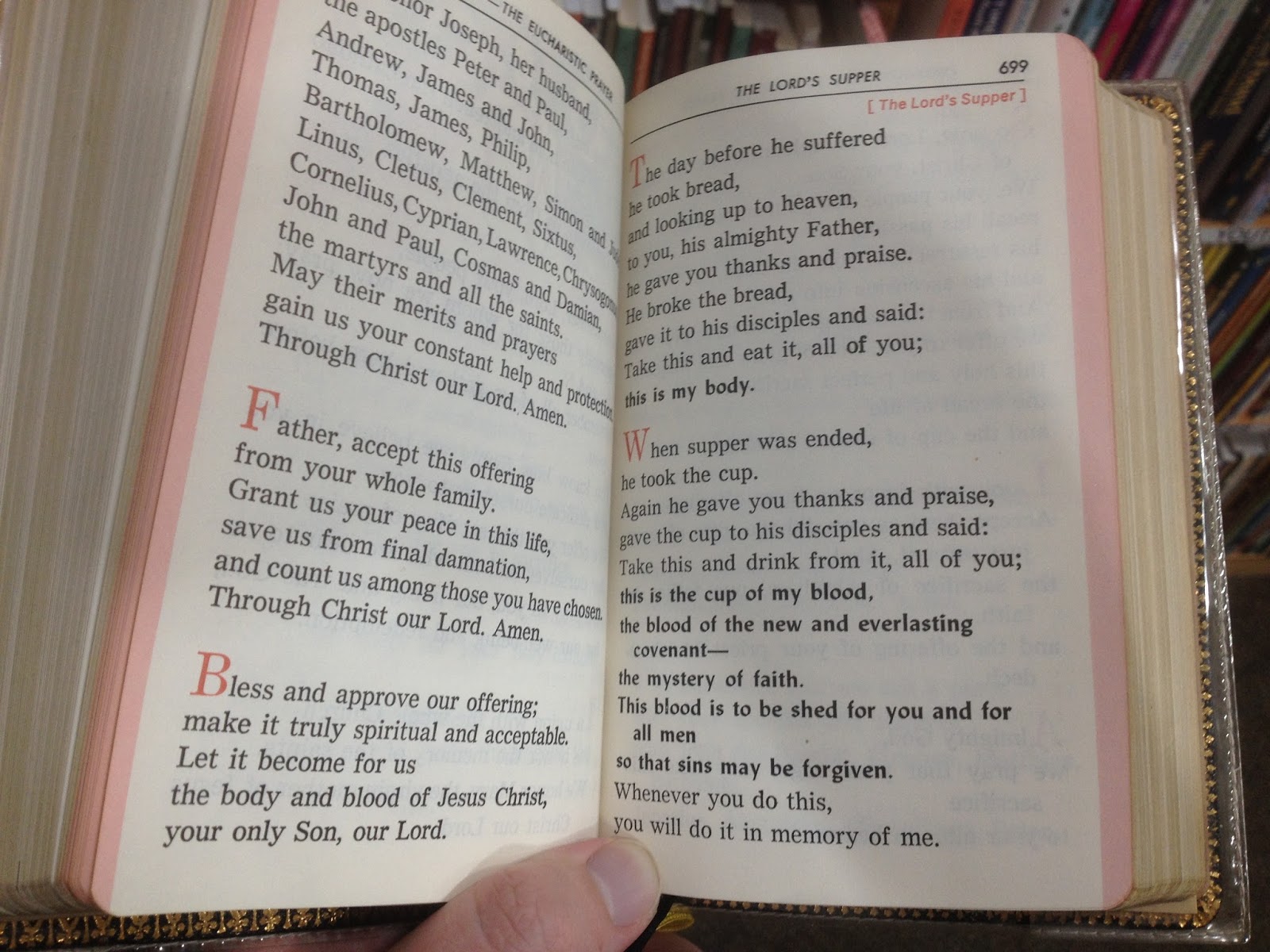
Bill Riccio's poignant reaction to recent proposals to modify the "liturgical books of 1962" (aka the "Mass of the Ages") brought to my mind the parallels with the reforms of the 1960s. It seems in the "liturgist" crowd reform can really be reduced to just a few unique features of Paul VI's new Mass and nothing else. Still, the proposals really are a flashback to the halcyon days just after Vatican II, when no one knew what the hell was going on. It instantly brought to mind a little hand Missal I saw in a used bookstore for a mere $6.00; I was tempted to buy the item for its historical value, not for actual use; the lack of any markings or wear shows just how useless this book was, of value for only two full liturgical years before the Pacelli-Montini revolution was brought to completion.


Popular participation, the be all and end all of worthy latria.


The reduced preparatory prayers, still with the double-Confiteor.
At first glance I wondered if the phonetic Latin text below the English
might be useful, but if one knows Latin is phonetic one need not
separate each syllable. The Fore-Mass has been rebranded "Liturgy of the Word of God"
and Mass is now assumed to be versus populum according to the decorative "art."


The newly translated Canon of the Mass, in direct contradiction
to the last vote of Vatican II. The translation, aside from being inferior
to those of many hand missals from the prior thirty years, looks remarkably like
what the Anglophonic world was given until 2011, and this two years before
the introduction of the new Ordo.


"I never knew a translation could be heretical." -Alexander Schmemann

Sunday, August 28, 2016

The Transitional Missal, Revisited

The MR 1965 restricted concelebration to as many ministers as could
reasonably surround the altar.
During Benedict XVI's interesting pontificate liturgical dilettantes began clamoring for a merger of the 1962 Roman rite (which rite that is) with the rite of Paul VI. "Mutual enrichment" and "organic development", they called it, all the while condemning any interest in inserting old prayers into the new Mass, aside from a few unspecified rubrics like the "canonical fingers" and maniples. Some wanted the Vatican to publish a reformed novus ordo with the old offertory prayers; others, like Scott "Alcuin" Reid, championed the transitional rites of the 1950s and mid-1960s as the true reflection of whatever Sancrosanctum Concilium demanded. Most recently, Fr. Hunwicke has expressed admiration for the Communion and concelebration guidelines of the "1965" Missal. What was the "1965 Missal"?

As far as I can tell it never existed, but there was a modified Missal of 1964. I have seen several Missals that were published in 1964 and would parse their variety during downtime in the religion section of Olin Library at Cornell University years back. Before I knew much about what Pius XII did to the liturgy I assumed it was generally unchanged since the Tridentine Council until Vatican II. Instead of researching the pre-Conciliar liturgy I researched the transitional rites, which were endlessly confusing. I could not for the life of me find a genuine 1964 Missal, only 1962 Missals published in 1964 with alterations. In fact the 1964/5 Missal is nothing more than a tweaked 1962 editio typica, with no major variances in the propers or ordinary of the Mass. The textual differences were restricted to vernacularization of parts of the ordo Missae, the new Communion formula, the suppression of the Johannine prologue, and the reversal of the dismissal and blessing. The vernacularization scheme might be the weakest point of the 1964 liturgy and is a sore spot for those who wish to personify that "rite" as a balance between tradition and novelty.

Episcopal conferences introduced vernacular at their own discretion, allowing them to translate more than the Congregation of Rites would on its own initiative. The American bishops, peace be upon them, translated the ordinary chants of the Mass (rendering centuries of music useless with only garbage to replace it), the dialogues, and the readings. The variable prayers people were less apt to know by heart remained in Latin. The Kyrie is recited at every Mass and could easily be learned with instruction, but a variable Latin collect could only be known to either those equipped with a Missal or training in Classical languages. One can reasonably assume that the standard parts were vernacularized first because Rome did not want to venture into the time consuming endeavor of standardizing translations across several langues before the end of the Council; they wanted to see results immediately.

source: rorate-caeli.blogspot.com
The caeremoniale of the transitional rite is the most difficult organic square to circle in the transitional rite, more so than the minor textual differences. Modestly, it asks that freestanding altars be constructed in the style of the ancient Roman basilicas (enter decades of wreckovation). Without the slightest hint that the Mass of the Faithful should be celebrated versus populum, everyone began a forward celebration of Mass. Paul VI himself promoted this trend by inaugurating the Inter oecumenici period with a versus populum Mass in the Parrochia di Ognissanti in Rome. Was anything about the revised liturgy more jarring to the man in the pew than what Geoffrey Hull called the "great narcissism, Mass facing the people"?

Among other strange features of the 1964/5 rite are the offertory procession and the option of performing the Fore-Mass from the chair. The offertory procession must have seemed every bit like the play acting it in fact is. The 1474 Roman Curial Missal speaks of an offertory procession with no indication as to what that was. The medieval rites prescribed a procession with torches during the Gradual in which the acolyte or subdeacon would solemnly bring the gifts from their place of preparation, often an altar in another chapel, to the priests, who would bless the water and wine before the minister would repose them on the altar of sacrifice. In the late first and early second millennium Roman liturgy, lay people would present the gifts to the celebrant during Mass, but only because they had fermented the wine and baked the bread themselves and at the beckoning of the Bishop of Rome. The Byzantine Great Procession is a relic of the Hagia Sophia, where the bishop and deacons would celebrate the first half of the Divine Liturgy while the priests in the skeuphlakion prepared the bread and wine in the ceremony now known as the proskomedia; the Great Procession brought those gifts to the altar and announced the intentions associated with them. The 1964/5 procession has no foundation in liturgical history, unless one considers that at some point a sacred minister had at some prior point taken bread and wine from a table to the altar.

The celebration of the Fore-Mass at the sedilia would not be as unwelcomed as it is if not for the enormous thrones, inevitably stationed at an angle, priests make for themselves. The real trouble with this is that celebration from the chair is traditionally associated with the teaching authority of the bishop, hence why Mass at the Throne and Mass at the Faldstool are considered fuller celebrations of the Roman Mass.

The Agatha Christie Indult and the foundational documents of the Institute of Christ the King (according to one ex-priest I knew) respectively directed the 1967 and 1965 liturgies. Both were summarily ignored for variations of the 1962 and pre-Pius XII liturgies. The FSSPX used the 1964/5 caeremoniale, but entirely in Latin for the sake of international students, until the French branch settled on 1962 and the rest of the Fraternity adopted pre-Pius XII. Putatively, the monasteries of le Barroux and the Fontgombault line use 1964/5, but it seems more likely that they use 1962 without the prayers before the altar (1964/5 had them), without the last Gospel, vernacular readings, and some new prefaces (taken from Paul VI's Missal); they did not adopt the ambitious range of vernacular texts nor all the ritual changes.

Given Cardinal Sarah's interest in the Ordinariate Missal and the Pope's lack of interest in anything in the Missal, one would be hard pressed to recognize this true Mass of Vatican II as anything other than a historical road sign, a point of passing.

As an aside, something does need to be done about the abusive levels of concelebration in the Roman Church today. It is an inherently good thing, well rooted in the Eastern and Western traditions, and a sign of communion between a priest and his bishop, but I remember once speaking with a visiting Dominican friar who told me that he had to look in the Missal and read up on how to celebrate Mass for our community. Why? "I concelebrate daily Mass at the priory, so I don't do this too often."

Sunday, December 27, 2015

'62ville: Losing the Apostles


One of the few things this blog unambiguously advocates is a widespread reform of the Roman liturgy that involves recovering essential elements of the Latin tradition conspicuously absent in the "extraordinary form" Office and Mass of 1962. These elements include the psalter (lost to Pius X), Holy Week (lost to Pius XII), decent vestments (lost to the Italians), and decent taste (lost to kitsch).

Serious discussion of the Roman liturgical reforms in traditionalist circles, at least until respectable scholars like Laurence Hemming questioned the 1911 breviary reforms, usually contrasted "pre-1955" with 1962 and highlighted glaring differences such as what Pius XII did to Holy Week as a test run for the reformed liturgy. Something less noticeable is what differs on a more regular basis.

Today, until 1955, would have been the feast of St. John the Evangelist, Our Lord's favorite Apostle. One correspondent, who has successfully implemented proper Last Gospels, public horae minores, and some pre-reform Holy Week days at his parish, lamented that his pastor would be observing Sunday within the octave of the Nativity rather than St. John. Offhandedly, I asked how many Apostles had the 1962 liturgy entirely disregarded in the last year; unexpectedly, he told me five. In another conversation a while back I was speaking with an ordo compiler who offhandedly remarked "Nothing for St Andrew this year. He was only the first Apostle."

I am unsure how strictly the Roman liturgy ranked the Apostles before St Pius V's revisions in 1568-1570. Most local European rites give the Apostles, even Peter & Paul, a semi-double rank. Pius V upgraded many feasts to double rank, which allowed them to outrank Sunday. This does not, however, put the pre-Pius V system on par with 1962. Although a semi-double did not outrank Sunday, it was not discarded. Semi-double feasts impeded by Sunday were transferred to the next ferial day. Under St Pius X's system Apostles' Double of the Second Class feasts continued to outrank Sundays, even though lesser feasts could not (they did, however, warrant commemorations at Mass and in the Office). Even under Pius XII's 1955 revisions there were provisions for commemorating the now lessened feasts of the Apostles. The simplification of commemorations in 1962 breaks with all tradition in completely and utterly doing nothing for Apostles not named Peter & Paul when their feasts fall on Sunday. 

Wholesale liturgical restoration is not feasible at this point, even within traditionalist communities, which are quite happy just to get their Mass once a week and have a place at the local parish. We cannot begrudge Catholics gratitude for this. We can, however, push for some provision to be made for such boisterous flaws in a liturgy that purports to be the "Mass of all times." Would it be too much for Fr. Tradman to do a commemoration and proper ultimum evangelium for St. John tomorrow? He only wrote a Gospel.

Wednesday, July 16, 2014

Interesting Re-Post By Fr. Hunwicke

We boutique liturgical fetishists have long pondered a minor question which, I think, illustrates the liturgical mish-mash discussed earlier in Summorum Pontificum & the Rite of Econe. Is St. Joseph in the Canon of the Mass in the books as SP and the Ecclesia Dei commission want us to use them or is he not?

Fr. Hunwicke mentions the matter a bit and his readers in the comment box below debate the issue of dates. The 1962 Missal was issued mid-year and the addition of St. Joseph, issued in November that year, did not take effect until December 8th. So do those who celebrate under the aegis of SP use the 1962 typical edition or the books that existed by December 31st, 1962?

The video referenced is a Mass demonstration created by a FSSP priest in their church in Rome, where I have had the privilege of hearing Mass. The celebrant does not say St. Joseph's name in the Canon, nor does he observe many other oddities in the 1962 Missal (bowing to the book and not the Cross at per Dominum nostrum, the Holy Name etc., not that anyone observed the suppression of these gestures in 1962 either). Yet there is no Confiteor at Communion nor votive orations and the Gloria is said (the Mass in question is a votive Mass of the Holy Cross). See below around 1:20:


Monday, July 7, 2014

Summorum Pontificum & the Rite of Econe


Today much of the Tradosphere celebrates the issuance of then-Pope Benedict XVI's Summorum Pontificum, which largely deregulated use of the 1962 Roman rite. What is really used is not 1962, I do not think anyone uses 1962 by the book, but what I call the "Rite of Econe," the result of tinkering during the formative years of the FSSPX.

Early on, outside of France, most everyone in the traditionalist movement used pre-Pius XII. Even in France St. Nicolas du Chardonnet used pre-Pacelli until 1984 when the priest in charge of that church died. For some reason 1962 caught on in France. Why? Perhaps during the 1960s priests became gradually more agitated and stopped accepting changes at a certain point. Rather than turning back the clock they refused to go forward. This was the case of Fr. Quintin Montgomery-Wright, who then Sarum-ized the Roman liturgy and recovered the Norman liturgical heritage of northern France. It may also have appealed because of its very sparse and simple Divine Office.*

A man who was a postulant with the FSSPX in Econe "back in the day" once told me that they did 1965—essentially 1962 with the popular parts in vernacular and options for lay people to do readings—with some modifications, among them the Ordinary of Mass in Latin and the Confiteor prior to Communion. At some point they switched to 1962 outright at Econe, meaning all Latin, no lay readers, and recovering the hour of prime. They continued to make alterations—such as the epistle in French, bows to the Cross, and no genuflection for the Jews on Good Friday—until arriving at their current praxis. Do any readers, particularly older ones, know additional details about this development? After all the rite of Econe is the Extraordinary Form.

* = for example yesterday would have been Sunday and the Octave day of Ss. Peter & Paul, warranting nine readings at Mattins (including three from the superseded octave day being read as one long ninth lesson), commemorations at Lauds, Mass, and Vespers. This Wednesday would see Vespers of St. Elizabeth of Portugal followed by Vespers of the Dead, as the Officium Defunctorum is prayed on the first free day of the month in addition to the Office of the season/sanctoral cycle. Lent and Advent are especially involved in the old Office, with the Officium Defunctorum and Requiem Masses in additional to the Lent and Advent liturgy on Mondays. In 1962 Sundays usually have three lessons as opposed to the traditional nine. The difference could be up to 30 minutes of time in private recitation during violet seasons.

Friday, June 13, 2014

Pentecost: Old Rite, EF & OF

A correspondent and I were recently musing over the abolition of the vivacious, rich, and Paschal-like Roman vigil Mass of Pentecost in the "EF" rite, the 1962 liturgy. As one familiar with both the Pauline and the Pian/Johannine books will know, the 1970 books removed much ancient material and yet, in a twist of irony, re-inserted some other texts and rites that were cast aside under Pius XII. Pentecost exemplifies this queer phenomenon.

In 1951 Pius XII created the Easter Vigil as we know it today. He and his commission revised it the following year. Originally the Easter Vigil eliminated Vespers entirely in favor of a Communion verse. The renovators put psalm 116 back into the rite in 1952, but turned it into Lauds (????) and scrapped Compline, Mattins, and [real] Lauds. Also in 1952 celebration of the Pentecost vigil was automatically suppressed whenever the Easter Vigil had been celebrated, likely to avert Catholics from the fact that the sacred rites of Pentecost resembled most closely the sacred rites of Holy Saturday. Everyone would favor the shorter, easier Pian novelty, making the elimination of the old rite's unique ceremonies seamless.

Now the Pauline Missal allowed for an "extended" Pentecost vigil Mass with four Old Testament prophecies, something of a restoration in principle, although given the very different Ordo Missae one can hardly call it a complete restoration. Buyer's remorse?

Then there is the elimination of the octave in the Pauline rite, preserved in the 1962 rite. It was the second most important, and certainly the most beautiful, octave after that of Pascha. My correspondent did note the logic in axing the octave, that Pentecost is the 50th day and not the 51st, 52nd, 53rd etc. I would respond by noting that an octave is an extended celebration of one feast and that Pentecost, above any other feast, deserves an octave celebration. It is the Holy Spirit creating and re-creating for the first time since the creation of the world. The Resurrection happened on the eighth day of the week and Pentecost, as I said two posts ago, makes the Resurrection permanent in the world. The plunging of the Paschal fire into the Baptismal font means all who bath in the waters of regeneration are plunged into the Resurrection. We eventually agreed upon the matter.

Why does it have to be one or the other? Why must we have either the old Ordo and octave with no vigil or the new Ordo with a vigil and no octave? Were I a parish priest, and I am certainly not, I would not have the slightest hesitation about observing the un-reformed vigil and the full octave!

Saturday, November 16, 2013

Liturgy and the Eighth Day

Discussion about the Roman liturgy varies in Catholic circles. For most liturgically interested Catholics the debate is between the "EF" and the "OF," or how the "reverence" of the "EF" might improve the "OF," or even how an amalgamated rite could be fostered. Others, the SSPX/FSSP type traditionalists who attend churches not staffed by diocesan priests, contrast the "theology" of the "Traditional Latin Mass" with that of the Mass of Paul VI, praising the emphasis on sacrifice in the former and criticizing the excessive focus on the meal elements of the Eucharist in the latter. Even more radical traditionalists focus on the "pre-1955" Missal, which is most typical editions published, versus the 1962 rite; people in this crowd inevitably dwell on Annibale Bugnini's role in crafting Pius XII's dodgy new Holy Week rites, in some sense inferior to those in the Pauline Missal (regardless of what one may think of the Ordo Missae in the Pauline books). Something neglected in all these discussions is the liturgical year itself and its contributions.

It is safe to say that the older rites, 1962 or 1474, have a more involved liturgical year, with more vigils, the ember days, and richer texts in the Office and at Mass for Advent and Lent than the modern books. But what of another long neglected aspect of the kalendar: octaves.

Octaves merit little attention these day, aside from discussion of the Octave of Pentecost in the 1962 rite, because both the Pauline kalendar and the Johannine kalendar have so few, two and three respectively. Prior to 1955 octaves occupied a very prominent place in the liturgical year of the Roman Church. For well over a thousand years the Church set aside eight day periods for the observation and re-visitation of the mysteries and salvific action of God in His works and in His saints. Most recently we would have finished the octave of All Saints, one of the most recent octaves, on November 8th. So what is an octave and what does it matter?

"In the beginning God created heaven and earth," thus begins the Holy Scripture in the Book of Genesis. On the first day gave began creation, a gradual effort in which He fashioned everything for six days and then, on the seventh day, left it as it was. In light of the Resurrection, which occurred the day after the day of the rest, the Christian sees the eighth day as the beginning of a new creation, which is, in effect, a renewal and a re-vivification of the old creation. As Christ rose from the dead with the same body, but glorified and transformed (Philippians 3:21), so the Christian will at the end of time at the Last Judgment. But this process is not so removed from our current time and current needs.

In Greek, so the Byzantines tell me, the phrase the "Kingdom of God is at hand" (Mark 1:14, Matthew 3:2, Matthew 10:7) does not mean that the end of the world is immanent, but that the Kingdom of God, which was formerly inaccessible, is now immediately accessible, although in a less tangible form than what will be found at the end of time. Christianity, which is a fundamentally liturgical religion, is a fundamentally eschatological religion. What will happen in the end happens to the Christian now. He is joined to events that have happened, such as the Resurrection or the descent of the Holy Spirit at Pentecost, and to things yet to come. In short, the Christian's baptism binds him to mysteries of God that exist outside of time and which will transform the world at the end, at the eschaton. Our participation in the eschaton through baptism on earth necessitates our observation of God's creation and recreation, of the Son's Life and Resurrection in this time. This is what was foreshadowed in the Old Testament for us and what was done in the Roman liturgy in a very complete way until 1955, and in a very reduced way after 1955.

In chapter 23 of Leviticus the Lord establishes the Day of Atonement, the beginning of a seven day cycle of sacrifices for the sins of the people called the "Feast of Tabernacles" or the "Feast of Booths"—called such because the Jews would build booths out of palm branches in which they would live during those seven days. On the eighth day the offering of sacrifices was renewed with greater solemnity (Leviticus 23:36), forming the first octave, a foreshadowing of what was to come on the eighth day many years later. Not only did the Feast of Tabernacles begin on the Sabbath, a day of rest, and end on the Sabbath, a day of rest, but God prohibited servile work on the days between (Leviticus 23:35), extending the penance—or celebration for the Christian—for eighth days.
source: modeoflife.wordpress.com
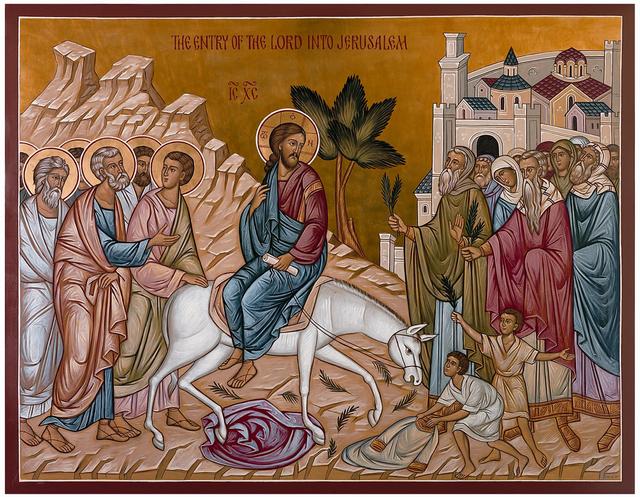
On Palm Sunday, to my view, Christ began the first Christian octave. The Jews often enthroned their king during the Feast of Tabernacles (Danielou Bible and the Liturgy 335). On this day the Jews sang psalm 117, a psalm the Byzantine rite still sings during Communion and which the Roman Mass utilizes on Pascha, which includes that renown word "Hosanna." What did the Jews sing on Palm Sunday? "Hosanna to the Son of David" (Matthew 21:9). What were they doing? Holding branches of palms, as they would during the Feast of Tabernacles (Ibid 21:8). The narrative draws a clear parallel between the coronation of the king and the entrance of Jesus into Jerusalem. The inhabitants were enthroning Him as their new king, Why was the Feast of Tabernacles observed? To remind the Jews of their deliverance. Why did Christ enter Jerusalem? To observe the Passover and to fulfill the true deliverance, deliverance from sin and death. He would "rest" on the seventh day and rise again, in a renewed body, on the eighth day.

In some sense, although not strictly part of the liturgy, the period from Palm Sunday to Low Sunday forms consecutive octaves, the first ending with the new Creation and the second concluding with a greater clarity and invigorated spirit which only adds to that new Creation (Christ giving the Holy Spirit and power to forgive sins to His Apostles in the Upper Room).

As God made the Jewish people do penance and offer sacrifice for their sins for seven days,  creation lasted seven days, and as they redoubled their efforts on the eighth, He renewed creation on the eighth in His Son's Resurrection from the dead. This process of creation, exploration, growth, and renewal is at the heart of Christ's work and, as it exists in time, makes His work accessible to us on earth, for us living in the eschaton terrestrially. The Church observes octaves—and observed even more—precisely for this point.

Many readers will know that Pascha, Christmas, and, in the older rites, Pentecost mandate octave length celebrations. Formerly well over a dozen occasions did so. Among them we see great evidence for the above analysis. St. John the Baptist's Nativity took an octave, the only Saint other than Our Lady whose birthday rather than death day is observed as a feast, suggesting that St. John was born without sin. If so, his own conception, birth, and life are a great act of God's restoration of human nature into its holier form. The same can be said of the Octave of All Saints.

source: glory2godforallthings.com
A more startling example might be Epiphany, a feast of greater importance than Christmas if we are to be theologically honest with ourselves. Why was Epiphany observed as an octave until the last years of Pius XII? What renewal or improvement did it offer on the eighth day? "Epiphany" literally means a "showing" of something, in this case the showing of God in the flesh to Gentiles, a revelation that this Child's work would benefit all men, not exclusively Jewish people. On the eighth day, the octave day of Epiphany, an even greater revelation is shown to us, that of the Holy Trinity. The octave day of Epiphany is the Baptism of the Lord in the Jordan by St. John, wherein the Holy Spirit descended upon the Son and the Father said He was "well pleased" with the Son (John 1:29-34). This was the first direct revelation of the Holy Trinity to mankind, an even greater, but not segregated, revelation than that of Epiphany.

Octaves did not regularly appear during Paschaltide (except for the 19th century feast of St. Joseph), owing to the already Paschal nature of the season, and of course not during Lent. Instead the Church of Rome gave her faithful octaves to observe throughout the rest of the year, particularly during the time after Pentecost, during which the faithful might always recall how the Saints were in themselves new creations (Ss. Peter & Paul, John the Baptist, Lawrence of Rome, the Assumption of Our Lady, the Nativity of Our Lady, and All Saints all occur during the "green" Sunday season).

Yet does not the evidence oppose my eschatological hypothesis? Were these octaves so important and were the eighth day so relevant in liturgical theology surely the Church of Rome would have devised unique Masses for the days within the octaves, as she did for Pascha and Pentecost, rather than repeat the festive Mass again and again. Not so! In older times, outside of monasteries and collegiate churches, Mass would only be observed on Holy Days and Sundays. The repetition of Masses is the consequence of filling in the days between the feast and the nearest Sunday or Sunday and the octave day. Where octaves are truly to be observed is in the Divine Office. The lessons at Mattins would progress through didactic material germane to the mystery at hand for eight days and the antiphons repeated at the major hours would do much the same.  Gregory DiPippo has been doing a fascinating series on the Mattins lessons for the Octave of All Saints in the Roman Curial Breviary which can be read here. The use of the festive office, with shorter psalms and no penitential prayers as would be found on ferial or simple days, contrasted starkly with the almost brutal daily cycle of prayers found in the ferial psalter. Octaves were clearly a time of joy, a period of living out some holy mystery in the present (although some of this was lost in the 1911 re-distribution of the psalter).

Liturgical octaves observe the eighth day of creation, the renewal of creation in the Resurrection of Christ. They make what is distant to us immanent and accessible as Christ's own salvific work made it immanent and accessible to those who had longed for it and observed it in its type for so long. We, on the other end of salvation history, observe its anti-type, its eschaton. For this reason, and for reasons better stated by those more liturgically learned than myself, we should push to re-introduce octaves into the Roman rite for feasts of saints and for feasts of Our Lord's work.

God bless!

Wednesday, September 18, 2013

The Parisian Missal I: Ordinary of Mass & Prefaces

As part of our endeavor to "test" Dom Prosper Gueranger's thesis that the liturgical books of France, particularly the "neo-Gallican" books like those used in Paris, were rife with Jansenism, we shall examine the Parisian rite Missal and the Lyonese rite Missal in depth, parsing the rubrics, Ordo Missae, prefaces, Holy Week rites, votive orations, and 10 random Masses (5 will be from Sunday). The series commences with the Parisian Missal. Our source is the 1766 Missale Parisiense found here. Given that it was in use a century before Gueranger's influence and a century after the death of Cornelius Jansen, any un-purified Jansenist detriti should be visible.

For the sake of simplicity we shall say the Cornelius Jansen was bishop and theologian in the 17th century who held ideas on free will and grace which he believed reflected those of St. Augustine. His views, which minimized free will and man's relationship to grace to a near-Calvinistic level, inevitably brought his followers into an exclusivistic, communitarian mindset, one which often sought to minimize Papal authority. From New Advent's encyclopedia, here are the precepts of Jansen condemned by Innocent X's bull Cum occasione in 1653:
  • Some of God's commandments are impossible to just men who wish and strive (to keep them) considering the powers they actually have, the grace by which these precepts may become possible is also wanting
  • In the state of fallen nature no one ever resists interior grace
  • To merit, or demerit, in the state of fallen nature we must be free from all external constraint, but not from interior necessity
  • The Semipelagians admitted the necessity of interior preventing grace for all acts, even for the beginning of faith; but they fell into heresy in pretending that this grace is such that man may either follow or resist it
  • To say that Christ died or shed His blood for all men, is Semipelagianism (it is condemned because Christ did die for the sake of all)
We shall use these condemned statements as criteria for Jansenism throughout our investigation into the French local rites.

Part I: Rubrics


The rubrics of the Missal are very much like the Missale Romanum as it existed before the pontificates of Pius XII and John XXIII. There are some notable exceptions. V.3 mandates commemorations of ferial days when a votive Mass is celebrated. V.2 also seems to mandate proper last Gospels for ferial days (wonder how that worked). A marvelous local custom, in Advent feriae orations for the Incarnation were sung (VI.16). In Masses for the dead Requiem aeternam.... is prayed in place of Gloria Patri.... as in the Roman rite. As one reads through the rubrics one understands that this Missal, unlike the Roman Missal of the same time, was intended to be used at sung liturgies in communal settings. The instructions on how many Masses are to be sung on overlapping days and why they do not have commemorations is very clear. The instructions also dictate that lessons, for instance, on certain feriae are to be sung at the normal place. The Roman Missal of the same period, descended from the 1474 Curial Missal, envisioned a lone priest as the norm, likely due to the setting and needs of the celebrants of the 1474 rite. The Parisian Missal was meant for canons of Notre Dame and of other collegiate churches. For instance, when a votive Requiem Mass is sung, it is sung after Prime, is to be followed by Terce and the festive Mass of the day, and then by Sext and the ferial Mass of the preceding Sunday (VIII). The men who used this rite were busy bees.

A classically Norman Lenten array at
St. Birinus in Dorchester on Thames.
White is used as a liturgical color on the same major feasts as in the Roman rite, but also throughout the Paschal and Pentecost Vigils. Red gets the nod on Mandy Thursday, Trinity Sunday, Corpus Christi and its octave, and Sundays throughout the year, as well as on many Roman feasts. Green is used for the consecration of bishops and for the anniversaries of such events. Violet is used in Advent and Septuagesima, but "ash" is used from Ash Wednesday until Passion Sunday, wherein black invades until the Paschal vigil Mass (and black is also used for the blessing of ashes on Ash Wednesday). "Ash" probably has its roots in the dull greyish white used in the Norman rites (from which Sarum is descended and which many parishes in England still use); the point was to make Lent colorless, a departure from the visual overload of the older rites per annum. Substitutions for different colors are allowed—for instance, blue for violet—probably as a pastoral provision for parishes without much means. Such was life before mechanized weaving and sewing. Thus far, no heresy!

For those who like the "big six" on your altar, you may not like the Parisian rite. The number of candles prescribed are as follows:
  • Feriae and Simples: two
  • Semi-doubles: four
  • Lesser Doubles: six
  • Greater Doubles: eight
  • Solemnities: ten
  • Great Solemnities: twelve (!!!!)

There is a rubric stating two is the norm for private Masses, however. One wonders what the Parisians thought of Rome's modest six on all semi-doubles or higher and Sarum's constant two! Who said the Latin liturgy was always sparse?

On feasts the priest carries a cross with him on his way to the altar, which the deacon places upon the altar and toward which the ministers pray the Confiteor. Instructions for the Mass proper dictate that incense is to be used at the beginning of Mass only at "great" (solemn) Masses. The ceremonies of the first half of Mass are like those of the Roman rite. The subdeacon sings the epistle while the celebrant and deacon read it and the gradual from the Missal. There is an interesting provision in section VI (on serving the Mass, not the general rubrics) that permit a lector vested in alb, amice, and cincture to sing the epistle without a maniple if there is no subdeacon. Perhaps outside of Rome there were more gradations of Mass than just Low, Sung, and Solemn as we have them today. Either way, the epistle is sung from an ambo or in medio choro, but facing the altar. Another oddity, at least from the Roman view, is that the choristers who sang the Alleluia needed the celebrant's permission when the setting was the archbishop singing Mass from the throne. The Gospel is also read from an ambo. If there are two ambos, then the epistle and Gospel are sung from different ones. At the Gospel an acolyte carries the same cross the celebrant brought to the altar at the beginning of Mass. At solemn Mass the acolyte holds the paten in a veil, receiving it from the subdeacon with a kiss. The Canon is basically done as it is in the Roman rite. The fraction precedes the Agnus Dei as in the Roman rite, in contrast to the older rites of the area. At the Pax the celebrant says to the deacon "Peace to you brother, and to the Holy Church of God."

Communion is given after the ablutions, but not after Mass. The rubrics outright state "the priest does not delay [the communicants] until after Mass without necessity." Was this a hint of Jansenism? Perhaps in the eyes of some the idea of making Communion of the Faithful a prescribed part of Mass was Jansenism. Devotion to the Blessed Sacrament and fear of unworthy communication became so strong during the Middle Ages that Communion of the Faithful ceased because so few received. Priests and deacons would administer Holy Communion after Mass. Yet here it is near-demanded as a part of the Mass for those who wish to receive. Perhaps this was a Jansenist influence. Or perhaps it was just common sense returning. Communion is given the medieval way. The subdeacon holds the paten while the deacon carries a chalice of unconsecrated wine and water as a chaser to make sure everything goes down. When you think about it this made our current fears of people taking the Blessed Sacrament and doing horrible things to Our Lord impossible.

The acolyte holds the paten under the veil at a Sarum rite Mass
source: newliturgicalmovement.org
Another rubrical feature that may have disturbed the Roman establishment is the prominence of the acolyte, de facto irrelevant in the Roman rite. He carries a cross at the Gospel, can sing the epistle under the right conditions, holds the paten during the Canon, and gives the Pax to the choir. In short, he is a minister of the Mass and not just a man with a candle! This was, again, the medieval praxis!

The rest of the Mass continues as in the Roman form.

The rubrics are followed by prayers for before and after Mass, many of which are found in the Roman Missal. The tones for the various chants of Mass are also found in this section. Singing them to myself, even with my own voice, I notice that while they differ from the ancient tone in the Roman rite, they are not unpleasant.

Part II: Ordo Missae


The Ordo Missae of the Parisian rite is very similar to the Roman form. Stunningly similar actually. The first half of Mass, the "Fore Mass" or "Mass of the Catechumens," is word-for-word the same as in the "Tridentine" Roman form. At the offertory, the prayers and actions (including the incensing of the gifts and altar) are exactly the same as in the Roman rite with one exception. The priest, before offering the bread with the Suscipe Sancte Pater blesses it with the words: "Lord Jesus Christ, Bread of Angels, Living Bread of Eternal Life, bless worthily this bread [these breads], as You blest the five breads in the desert, that all who taste of it [them] may receive health of soul and body." This one deviation is as orthodox a prayer about the Eucharist as there is. Perhaps its lack of exclusive focus on sacrifice worried those who favored the Roman liturgy's narrowly sacrificial language, which many regarded as a fortress against the insistence of Protestants that the Eucharist is a meal's food. Would the same also apply to the communitarian approach of the Jansenists? Possibly, but it seems a tenuous connection.

The text of the Canon is precisely that of the Roman Canon. At pontifical Mass sung by the Archbishop after the fraction and the Per Omnia saecula saeculorum but before the mingling of the Host and the Precious Blood the deacon announces a blessing ("Bow yourselves for the blessing"). The archbishop then sings "May his peace with you always" as he mingles the Sacred Elements, in place of the conventional "May the peace of the Lord be with you always."

The rest of the Mass is, word-for-word, the same as in the Roman Mass. Again, no heresy.

Part III: Prefaces


The Parisian Missal contains almost all the Gallican prefaces added to the Roman Missal by Pope John XXIII in 1962, except the Preface of St. Joseph. There are also three additional prefaces not in any post-1570 (and pre-1970) edition of the Roman Missal:
  1. Preface for Mandy Thursday and Votive Masses of the Blessed Sacrament: calls Our Lord the "True and Eternal Priest" and "the only Priest without the stain of sin" Who instituted the Holy Sacrifice for our benefit.
  2. Preface for the feast of Ss. Dionysius, Rusticus, and Eleutherius: a wordy preface that asks the Lord to strengthen us, who He assumed from darkness in His mercy, and to keep the work He has done in us, particularly through his martyrs, who are not even named in the preface.
  3. Preface for Nuptial Masses: speaks of the bonds of marriage and asks that God, in His Providence, may grant the renewal of the Church. The exclusion of this preface from the 1962 Missal, at a time when the reformers were adding prefaces and tinkering with the rubrics of the Nuptial Mass, speaks volumes for its literary and theological value.
In short, nothing out of the ordinary other than Gallican literary eccentricity and some dull prefaces.

Conclusion

Thus far the Parisian rite appears to be a descendant from the Norman liturgical family which adopted the Ordo Missae of the Roman Missal, albeit with a few local tweaks. The unique prefaces reflect the loquaciousness of French devotion, but are doctrinally sound. As of post one, the Parisian rite withstands Dom Gueranger's condemnation.

Tuesday, September 10, 2013

Anti-Semitism in Traddieland?

The Rad Trad somehow stumbled upon this passive-aggressive hit piece on concerns some Catholics, often nervous residents of Traddieland, expressed upon the election of Cardinal Bergoglio as the new Roman Pontiff. One such area of concern was that as Archbishop of Buenos Aires, Jorge Bergoglio resisted a forthright implementation of Benedict XVI's motu proprio on the 1962 rite. In our age of Ultramontanism, the idea that the Pope was not entirely lock-in-step with the Pope was unthinkable! There were several 1962 Masses in neighboring dioceses, but there was only one in the archdiocese of Buenos Aires. The Mass was a once-a-month affair and a hybrid with the Mass of Paul VI: the 1970 kalendar, the 1970 lectionary, vernacular, and lay readers were employed for the Fore-Mass (or should it be called "Liturgy of the Word"?). The laity became frustrated, according to eyewitness accounts, and attendance dwindled to the point that the Mass was cancelled. So what is the point of the title of this post?
 
Many bloggers exhibited an understandably uncomfortable reaction to this news. The idea that one Pope did not follow the other's program perfectly was problem of which even the greatest Scholastics could not understand in the modern day. Celebrity bloggers suggested that the 1962 Masses in neighboring dioceses should be counted among those in Cardinal Bergoglio's archdiocese, a factually strained attempt at re-constituting continuity between the incoming Pope and his predecessor's liturgical program. For some this was not enough. Enter the above article.
 
Pope John XII: not a pleasant fellow
Many comments about the [no longer] new Pope have been quite distasteful. That said no Catholic is obliged to like the Pope, only to acknowledge his authority. Were John XII still Pope the Rad Trad would become a hermit in order to avoid that scoundrel's scandalous activity. Some bloggers, such as the writer of the first article linked above, did not wish to consider this vital distinction and took the acerbic comments flowing from Traddieland River very personally. Unable to dispute the facts surrounding the 1962 rite within the Archdiocese of Buenos Aires with a higher level of respect than that which was perceived among traddies, the writer basically called the source of the information in the Rorate Caeli piece a Holocaust denier. The evidence? A piece written by Marcelo González in Panorama Católico Internacional. From a cursory glance Panorama seems like a run-of-the-mill traddie blog, only in Spanish. The article referenced by the reactionary blogger, Ms. Eden, is of course in Spanish. Ms. Eden, it seems, does not speak Spanish:
Five months ago, Marcelo Gonzalez announced he had reached the “fixed position” that the “so-called ‘holocaust’” is a media exaggeration. If Google’s translation is correct, he wrote that he prefers to call it “the so-called ‘holocaust’” or, alternatively, the “hollowcaust.”  You can read for yourself his blog entry “Holocaust and Hollowcaust” via Google Translate (or read it here in the original Spanish). It’s disgusting, and as a fellow member of the Mystical Body, I am ashamed.
Fortunately for us, and unfortunately for Ms. Eden, the Rad Trad does speak Spanish, and her borrowing from Google Translate does not help her case, even with the shoddy translation. The actual word used "Holocuento" literally means "Holo-story." The premise of the article is that many people, Catholics included, died as a result of Nazism, but people tend to focus primarily on the plight of European Jews. The suffering of the Jewish people was then utilized politically, the author contends, as a pretext for the foundation of the Jewish state of Israel. I do not think any historian would factually deny these claims, even the latter of them. The Holocaust was certainly the reason the United Nations chartered the state of Israel. If not for the great violence they suffered, why would Jewish people want to leave Europe? González continues in lamenting that political correction, particularly in Catholic-Jewish relations, has become something of a doctrine in the modern day, given once-Pope Benedict XVI's statement that one cannot be Catholic and deny the Holocaust (which a historically insane position anyway). This last point is the crux of the article. No where in it does the author deny the Holocaust or even question death tolls as former FSSPX bishop Richard Williamson infamously did in 2009. The author makes one statement that, when a biased person utilizing an electronic translation encounters it, lends itself to corruption:
"Sabemos que hay intereses políticos, económicos y propagandísticos en esto de fijar cifras millonarias de víctimas y sobre todo en ignorar a las otras víctimas que no fueron judíos."
Ms. Eden
It means "We know there are political, economic, and propaganda interests in fixing the numbers of millions of victims and, above all, in the ignoring of the other victims who were not Jewish." Half the people who died in World War II were not Jewish. Many people, often Catholic political prisoners, found themselves dying in concentration camps prior to the commencement of the Holocaust, which was a systematic extermination process directed against a demographic, not a political party. The shortcoming of this article is that it used the term "Holocaust" to denote anyone who died during World War II in Europe when most are accustomed to hearing it used specifically to denote the 1942-1945 actions against the Jewish populace.
 
Why does all this matter? Catholics attached to the older liturgy have, sometimes by their own faults and sometimes by the faults of others, found themselves isolated from the mainstream. This can lead to internal paranoia and external caricatures. The article suggesting Mr. González is a Holocaust denier fits into the second of these. Ms. Eden approaches the finale in her assault on this maligned Latino with a furious parade of suggestions that traddies ought to speak up now, or forever be put on the Southern Poverty Law Center's hate group list:
UPDATE #3: Rorate Caeli commenters have shown their true colors with viciously antisemitic comments to this post. I have allowed some to appear in the comments section here for the record, but the more vicious ones I have forwarded to other concerned bloggers, as I am occupied with schoolwork and do not wish to continue to engage the soft white underbelly of the rad-trad world. You may look for them on Mary Victrix, the blog of Father Angelo Mary Geiger, F.I., who has already written about this post.
UPDATE #4, 4/9/13: Closing comments so that I can get some schoolwork done today and not have to sift through hateful words against my Jewish ancestors and relatives and against those who think the Church has, in fact, continued past 1965. Many more viciously antisemitic comments have come in. I am sending the rest to Mark Shea, who has told me he will have something to say on the matter—oh, I see he just put up a post.
Thanks to the relatively few lovers of the Extraordinary Form who have written with their support. [As of 4/10/13, many more have written. Thank you!] To those who love the traditional Mass and have not commented: If you don’t want the Extraordinary Form community to be dismissed as a bunch of hate-filled, antisemitic cranks, you need to raise your voice in the public square, and not be afraid of what the veils-and-brocade police say about you.
After Mr. González issued a clarification in Spanish and English, explaining what anyone who bothered to read the Spanish version with care or find someone with proficiency in the tongue, would have already known: the article is not about the Holocaust. It is about political correctness and the Catholic Church. Ms. Eden still insists the man is a Holocaust denier:
Gonzalez says in his non-apology apology, “For this reason, I clarify, or rather I reiterate that I am convinced that the Holocaust (that is, the death of millions of Jews in concentration camps or on their way to them during the Second World War) is a fact of uncontested historicity. Other aspects – of which I cannot speak, because I am no historian – remain in the academic sphere.”
Note what he is not saying–that there was a systematic, state-sponsored plan of extermination. In his article, he in fact denies such a plan, offers other reasons why Jews died, and claims that one who accepts that there was a Holocaust “may incur in an historical error of judgment.”
So he is a Holocaust denier–because the Holocaust was nothing if not “a program of systematic state-sponsored murder” of Jews, to use Wikipedia’s current and very apt wording. It is true that the Nazis also targeted millions of others for extermination because of their race, Catholic or Orthodox religion, disability, homosexual behavior, or political affiliation, and it may be legitimately argued that the killing of these populations should be included in the term “Holocaust.” But to cast doubt in any way upon the Nazis’ systematically murdering Jews is outrageous.
Does any of this have to do with the implementation of Summorum Pontificum in Brazil? No, but the Rad Trad does not want to see a man lose his reputation because of a petty political dispute within the Church either. 

Sometimes I think about getting rid of the internet and becoming a monk....


Monday, August 19, 2013

"EF" Mass in 1964

from: Wikipedia.org
A while back, perhaps over a year, New Liturgical Movement published a video of a 1962-Missal solemn Mass sung at St. Louis Abbey in St. Louis, Missouri. The celebrant was Fr. Edward Bunn, S.J., then-president of Georgetown University. The church of the abbey, a hideous house of heteropraxis, is entirely round inside and positions its altar at the center nave. Every Mass therefore would be versus populum, but the low candle sticks and thin, insipid crucifix dissuade one from entertaining the possibility that this is also meant to be ad orientem, in imitation of the ancient Roman basilicas. The tabernacle is directly behind the main—and the Rad Trad thinks, only—altar in the church. This novelty presented a difficulty for the servers and ministers, who at times seemed unsure as to whether they ought to genuflect before the altar or just bow, and whether or not they ought to genuflect before the tabernacle when passing it.
 
Things being done the rite way at St. Mary and the Martyrs (aka the Pantheon)
in Rome, c. 2008
credit: orbiscatholic.blogspot.com
In some ways they did the 1962 Mass differently from today. Note that the missal is transferred to the Gospel (really to the Offertory) position after the celebrant reads the gradual but before the ministers sit down. Today the book is moved when the celebrant rises to give the deacon the blessing for the Gospel reading. It would really be easier to return to the older practice of the celebrant remaining at the altar and reading along himself, but that can be a moot point in 1962-ville outside of some parishes, such as one where the Rad Trad once worshipped, that were doing the Latin Mass before the canonization of 1962 under Summorum Pontificum.
 
Archbishop Edwin O'Hara celebrating Mass at the consecration
of Christ the King parish in Kansas City, Missouri in 1954.
Construction on the parish, and its forward altar, began
in 1952, presumably with episcopal approbation.
From this we can see that the Liturgical Movement had a very powerful presence in the Church before vernacular and versus populum were explicitly expected by Rome or by national episcopal conferences. St. Louis Abbey was founded in 1955 by monks from Ampleforth Abbey in England. In nearby Kansas City Archbishop O'Hara had already celebrated pontifical Mass versus populum. The Jesuits entertained the Liturgical Movement long before it ever came to America, but the Society of Jesus must have felt very confident in the direction of things to have put the president of a major university on television to celebrate Mass facing the people. Although 51 years later we often tell ourselves it was a better time, this era's practices were directed toward the type of liturgy and ars celebrandi we have today. The use of Latin bound the celebrant to the text, but did not bind the architects of the church of the masters of liturgical ceremonies. Without any further delay, the Mass (starts around 18:00):


Friday, August 9, 2013

On the Validity and Legality of the Mass of Paul VI

JohnR, a friend of this blog, recently alluded to something in a comment on the previous post concerning Fr. Anthony Cekada's thesis in The Work of the Human Hands: A Theological Critique of the Mass of Paul VI that the new Mass is invalid. His opinion is ubiquitous in sedevacantist-ville while the opinion that the new Mass is likely valid but certainly illegal was, at least once, popular in SSPX-land. The premises for both these opinions are utterly banal and without theological, historical, or legal merit, yet they exist and the Rad Trad, being in a devious mood, would like to look into them a bit more.

Validity

Fr. Anthony Cekada celebrating Mass very Romanly
Toward the end of Work of Human Hands Fr. Cekada argues on Thomistic grounds that the Order of Mass promulgated in 1969 is absolutely invalid in Latin or vernacular. Some hardline SSPXers used to argue that the common mistranslation of pro multis invalidated the consecration of the chalice; taken to its logical conclusion, there would be no Mass in that case and the consecration of the bread, since the Church does not consecrate outside of Mass, would also be invalid. But back to the more general validity issue. The reason Fr. Cekada gives is that the institution narrative in the new rite is treated as just that: a narrative, as opposed to a consecration formula. The words in the new rite, he says, do not contain the intention to consecrate and hence no consecration is possible, even if a validly ordained priest who intends to consecrate speaks the narrative words with the proper intention. Your eyes are not under the spell of glaucoma. You read it correctly. A validly ordained priest with the right intention speaking the words of consecration, which are the same in the new and old rites, cannot consecrate validly. So, is Fr. Cekada right?
 
His invalidity stance rests on intention within the "form" of the consecration. The old rite gradually builds up the priest's intention, from the sacrificial offertory prayers, through the thanksgiving prayers early in the Canon, transitioning into prayers for the living and dead, and concluding the Canon with an act of offering the Victim to God (Per ipsum....). The new rite certainly lacks this continuous flow, but I think Fr. Cekada would concede that it is not absolutely necessary. His position is specifically concerned with the consecration itself. At this point a little bit of history goes a long way.
 
When does the consecration happen? At Hoc est enim corpus meum and Hic est enim calix sanguinis mei? That has certainly been the prevailing teaching since the Scholastic era in the high Middle Ages, but it is not as clear cut as one may think. Around the 11th or 12th century priests, at the behest of the faithful often yelling from the nave, elevated the host and chalice during the Canon for their benefit and view. Some say this form of piety was a soft substitution for actual reception of the Blessed Sacrament, owing to the infrequency of reception that arose in the Dark Ages and which continued for centuries afterward. It is also at this point when scholars and theologians begin to question the specific moment of the "change." We are so accustomed to seeing those specific words of the priest as the formulation for the change that we read the rest of the Canon of Mass around it. But consider this: five centuries earlier the same Canon was sung, without pause, aloud in the tone of a preface in its entirety. A preface tone indicates that the prayer is concerned with blessing or consecrating something. The various signs of the cross and gestures made throughout the Canon differed diocese to diocese, sometimes greatly. Sarum, for example, has very few reverences (later genuflections) and a very different series of actions at the Per ipsum. For whatever reason at the end of the first millennium priests began to recite the Canon rather than sing it aloud and the gestures flourished as private signs of devotion in a private prayer. A consequence of these gestures was the partitioning of the Canon, in the priest's experience, into varying parts. The institution of the elevation of the elements had the same consequence, making the institution narratives a unique segment of the Canon.
 
Yet, without these gestures and motions we could read the Canon's text straight through and see that that institution narrative may well have been seen in earlier times as just that, a narrative. It is the justification, within the text of the prayer, for why the Church celebrates the Mass. It is hardly a story time, but rather is a public supplication to God on the grounds that we are obeying His Only Begotten Son's precepts. In those days one would of course agree that the change had taken place by the end of the Canon, although today we pinpoint it at the institution narrative. Months ago the Rad Trad published an appendix from an English translation of the Ordo Romanus Primus which contains a replication of what a Paschal Mass celebrated by the Pope may have looked like around the year 800 here. As readers will see the celebrant continues through the Canon unabated, without any special notice.
 
How does this influence our view of Fr. Cekada's thesis? The Rad Trad readily acknowledges that the change, the transubstantiation, happens at the narrative. Why? Two reasons: (1) the priest is given the power to consecrate and he intends to consecrate at this moment and (2) because the Church has agreed for a millennium to treat this particular point as the moment of transubstantiation. What the Rad Trad cannot do, and what the sedevacantist theory does do, is ignore the first ten or eleven centuries when the moment of change is at best vague or a little iffy. The Church, in her kindness and respect for tradition, cannot and does not uproot and ignore the prayers, beliefs, or intentions of previous generations of the faithful. It is for this reason that the Addai and Mari rite is valid. Liturgical historicity takes precedent over, admittedly Church sanctioned, Scholastic theology concerning forms. By ignoring this principle and by ignoring the history of the Canon itself one looks away from a legitimate reading of the narrative as a narrative. Hence the idea that somehow treating this part of the Canon as what it originally was invalidates it on defect of form is myopic.  Also, need the function of the institution words as a narrative and as consecration formula clash?
 
I have never met a priest or lay person who has read the narrative and thought any other intention other than consecration is latent in the words contained therein. One would think someone other than Fr. Cekada had caught on to the structural defects supposedly present in the altered Canon or new Eucharistic prayers.
 
Yes, it is very valid.

Licit?

St. Pius V, Pope of Quo Primum
Part of the fallout within the Society of St. Pius X over Bishop Fellay's failed attempt to give his institution canonical standing was Rome's demand that the Society sign on to the "legitimacy" of the new rite. This sounds odd, but it really just means the legality. In short, was the "new Mass" promulgated in a valid, legal action by the proper authority? Some apparently say no. Others, like one Paul Kramer in his article Legal Status of the Tridentine Mass, argue that since Quo Primum is a dogma of the faith Paul VI avoided going into schism by merely publishing, rather than promulgating, the new Mass.
 
First, we will discuss Quo Primum. Both of these positions are really variations of each other and they rest on the principle that St. Pius V's bull Quo Primum made the 1570 Missal, or at least the Ordo Missae within it, a dogma of the faith that cannot be violated and which guaranteed that it could never be taken away. This is wrong at two levels:
  1. Quo Primum is primarily a legal document promulgating use of a certain liturgical book within the Latin Church. As a legal and administrative act it cannot bind a successor of equal status should he take the proper steps to depart from it.
  2. Neither Pius V, nor any following pope, thought it was such. Two years earlier the same Pius V published Quod a nobis promulgating a Roman Breviary for general use which contains the same rules of use and prohibitions against alterations and threats of Divine retribution as Quo Primum. Urban VIII did not go into schism or heresy by changing the hymns and no one has suggested the 1911 breviary changes were illegal or invalid (although they were unwise).
Confusion over this point may have been compounded when Benedict XVI wrote that the 1962 Missal was never abrogated, which begs the question: how is any following liturgy legal? Were priests who held out in the 1970s and onward justified in their use of 1962? The Rad Trad, no canonist, does know of one distinction in Canon Law that could serve us well here and which may not, legally at least, justify those who adhered to 1962 after the promulgation of the 1969 Ordo. In Canon Law there is a taxonomy of "derogation" and "abrogation." The former is the partial removal or replacement of the existing law while the latter is its outright suppression. To abrogate the 1962 Missal, Paul VI would have had to issue some sort of legal document explicitly prohibiting use of that Missal. This was clearly never done. The "extraordinary" rite was never abrogated. All well and good? New Mass illegal? Not so fast.
 
The Pauline liturgy was not introduced to the Latin Church by the abrogation of the "traditional" liturgy. For example, John XXIII compressed festal categories into Class I, Class II, and Class III, not abrogating the old calendar entirely, but derogating the ranking system within it in his Rubricarum Instructum. The same holds true for his changes to the breviary lessons, not abrogating the [not so] old Mattins, but derogating the particular way of picking lessons in place in 1955 (both changes were ultimately made by Pius XII, although John XXIII pulled the trigger on the 1960 set). Similarly the 1962 Missal was not abrogated with the publication of the 1965 Missal, but anything in it that differed from 1965 was derogated (use of Latin in readings, the Introibo prayers, the "doubling" of certain texts, ordinary of the first half of Mass in Latin, the communion formula, the Last Gospel, and some other details). 1962 was not strictly "abrogated" but it was by no means usable. The 1967 document Tres abhinc annos introduced further changes by derogating what was different in the 1965 Missal: optional use of a weekday lectionary, optional use of different orations, the Canon was not abrogated but the rubrics governing the priest's actions during it were derogated and replaced, the entire Canon is said aloud, and other alterations; interestingly, IV.17 in that document is the first official instance, to the Rad Trad's knowledge, of a rubric that assumes Mass facing the people could be ordinary and normal outside of a few Roman parishes. On the feast of the Assumption in 1968 the new Eucharistic prayers (2-4) were introduced, again not replacing the entire existing liturgy, but replacing and derogating certain rules and rubrics, this time governing the Canon, therein. A new Pontificale came about that same year.
 
Here comes the 1969 change. Paul VI did not introduce a new Missal or a new Mass in 1969. He introduced what was mostly a new text for the ordinary of the Mass. The Canon and Eucharistic prayers, lectionary, rubrics, calendar, and Divine Office remained unchanged from the previous year. Even some parts of the ordinary itself were unchanged, given the significant alterations in 1964-8. Perhaps the most dramatic different between 1968 and 1969 is the contrasting offertory prayers, but most everything else matches. The Missal introduced by Paul VI in 1970 again did not "abrogate" 1962 or even whatever was used in 1969, but de facto derogated whatever differed from it: the old sacramentary and [again, no so] old lectionary was replaced. Otherwise, 1970 and 1969 match up very closely.
 
The idea that the new liturgy is somehow canonically illegal or that the 1962 liturgy was abrogated relies on the view that the Pauline rites were introduced and imposed instantaneously rather than gradually and under transitional, derogation-based legal auspices.
 
Thank you for reading a such dry and disinteresting post,
The Rad Trad