Showing posts with label Traditional Latin Mass. Show all posts

Thursday, January 9, 2020

Familiarity Breeds Contempt

In recent weeks people have brought multiple anti-traditionalist pieces to my attention, which have been written by commentators who piously wring their hands about a lack of good manners and welcoming committees among Tradistani communities. These writers seem to be of the “I love the Latin Mass but I wish I didn’t have to deal with all those pesky people” type, and who proceed to hammer down a list of poor behavioral patterns which must be corrected before they will again grace traddy parishes with their presence.

I am no stranger to the difficulties of adjusting to new social groups; nor are most people, in my experience. The problem of alienation is common across group and personality types, even among the extraverts who try to be friends with everyone. Men form deep friendships in their formative years among compatriots in school, church, and political causes. Apart from the natural growth of families, most find it difficult to form deep or even lasting connections after their mid-twenties. Marriages too are increasingly unlikely to last in our monadic anti-culture.

Traditionalist communities after the last council were forged in fire. Reacting against the ill-will and deception of clerics of all ranks, these Catholics formed miniature societies which were still brittle from the abuse they were fleeing. They were refugees with little in common except abuse, and while the pre-Pauline form of the Mass was a symbol to rally around, it was still insufficient to cover over the deep differences of those who suddenly found themselves with strange bedfellows. In some cases, this ended in the further splintering of loosely confederated Catholic groups, but those who had fewer options attempted to make the best of a bad situation and get on as well as possible with their neighbors.

Normal diocesan parishes had historically constituted a greater cross-section of social strata, temperaments, and experiences. Except when catering to a very specific neighborhood or rural space with its accompanying demographic, they more often housed a comfortable variety of cliques and opinions than do the refugee communities of the Tradistan Archipelago. Yet even these territorial parishes today have a tendency towards cultural crystallization depending on the strength of a pastor’s personality and the busybodyness of a parish council. The abolition of the requirement to be registered in one’s territorial parish has encouraged a general grouping of like-minded Catholics into their preferred parish, and we lose the opportunity to learn the virtue of toleration.

The obvious difficulties the Church has with showing compassion to abuse victims extends to those scarred by all manner of abuse. Doctrinal abuse is a mockery of the Truth, asking afresh Pilate’s sneering question. Slander from pastors against the sheep in their flock is nearly the worst thing one can endure from a trusted leader. Traditionalists have suffered these and even the insult of their fellow laymen who blind themselves to the incontrovertible evidence of abuse out of flattery. Perhaps it is not correct to say that traditionalists have a right to bitterness and isolation, but their reaction is at least comprehensible from a psychological point of view.

Those who write these new think-pieces are not without some merit when they call for reform and a societal shift, but they do not truly know what to recommend because they do not acknowledge the roots of the problem. Even today, traditionalists are regularly carpet-bombed by pesky bishops looking for a scapegoat to distract the laity from financial and sexual corruption, but disillusioned neo-traddies who want the old Mass without the people insist that the problem is a mere lack of friendliness and smiling. It is a terrible thing to tell a sufferer of PTSD to be cheerful and outgoing, even if their trauma is “merely” that the sitting pope has once again insulted them in front of the whole world. People are similarly intolerant of the failings of their own family members, as when they impatiently tell the drunk younger brother to just get over his divorce already. Familiarity breeds contempt. Those who cry for more human friendliness are rarely willing to be the friendly and outgoing face for newcomers that they demand. They are more likely to complain to a sympathetic public ear than they are to embody this kindness, but true charity goes both ways.

This short essay is no apologetic for every traditionalist excess nor an excuse for rudeness, but a call for a bit of realism. If you are outside looking in at the unhappy Latin Mass-ers, make some effort to take their experiences seriously before dismissing them as a load of cranks. You are not going to talk them down by insulting them further, and a sympathetic ear can go a long way toward smoothing rough edges.

(Hermann Kern)

Friday, July 8, 2016

Traditionalist Identity Politics

Don't tread on my lace!

“I love Catholic tradition, but I’m not a traditionalist,” goes one common complaint of the modern-day Latin Mass attendee. I’m reminded of a recent headline on a Christian parody site that reports on a man who does not want to be labelled a “Christian pastor,” but as a “pastor who happens to be Christian.” We worry constantly about self-identification, about perfecting the definitions of our selves, and trying desperately not to be misunderstood.

At any Latin Mass community one will find a wide variety of types: die-hard 1962ers, high-minded pre-1955ites, those who will defend the FSSP against the FSSPX to the death, those who will do the opposite, and “Novus Ordo babes” (true story) who think the Latin Mass is pretty keen but not an all-consuming passion.

Identity politics is a kind of vanity, worrying endlessly about being perceived correctly by others, and an unwillingness to suffer the minor injustice of misunderstanding. Some are attracted to traddy parishes, but will assure all his worrying non-traddy Catholic brethren that he’s not a weirdo Creationist like the priest in charge. Another will attend the old Mass for its beauty, but will whine constantly about the bad attitudes of his fellow attendees. I’m often surprised they don’t pull out a series of ready-made Venn diagrams to prove they aren’t too strange.

One of the notable vices of our time is the obsession with identity. In its most extreme forms we see people surgically modifying their bodies to conform with their desired shapes. In less extreme forms we see Republicans who complain about every kind of Republican they are not, or Texans who apologize profusely for their fellow statesmen. But our real identities have far more to do with the natures God gave us, our decisions regarding vice and virtue, and our choices of state in life. Anything beyond those tend towards vanity and an excess of eccentricity.

The bothersome part is not so much the appropriation of some particular ecclesiastical identity, but the hatred tossed at others who are actually most similar to the offended party. Nobody is pickier about the way a Novus Ordo Mass should be celebrated in Latin than another priest who does it his own way. No one will complain about an Eastern Rite liturgy like someone from another rite. No two people think of themselves as more radically different from one another than traddies sitting in the same pew.

See how these Christians love one another.

Some small touches of eccentricity are good for the soul and for society, of course, but real individuality comes as a result of spiritual growth. One of the maxims of the spiritual life is that one should not be concerned with imitating one single saint but with following the commandments, because the saints are already so individualized that they cannot be fruitfully mimicked in their unique personalities. The closer we come to God, the more we become “ourselves.” Outwardly we may appear more eccentric, but there is a great chasm between the mere eccentric and the man who is becoming more truly himself, the perfect Idea of himself that God always had in mind.

Communities need group identities in order to survive, be they large immigrant clans or liturgical ghettoes. A certain amount of conformity should be expected from those who are a part of such communities, and nothing tears them apart faster than petty rebelliousness in nonessential areas. If we lack the humility to conform to the broader cultural ideals of a community, then we aren’t truly a part of those communities, any more. We are simply visitors passing through.

Saturday, January 25, 2014

Attack of the Trads: What Catholic Liturgists and Laymen Can Learn from Star Wars


For some time I have searched in vain for some sort of cultural analogue that would assist advocates of traditional Roman liturgical praxis in explaining their objections to the 20th century reforms without delving too deeply into the obscure concerns of people with specialized knowledge (the pre-1911 psalter was a fact of life since the age of St Benedict, but no clergy alive have ever really known it). Last week my priest and I were chatting about my impending move. "Go to Texas you will," he said in his best Yoda voice. The other day I recalled this amusing imitation and the parallels between what happened to the Roman liturgy in the 20th century—all the reforms—and the Star Wars films is really uncanny.

I am 24 years old. I am just old enough to have clear memories of what the original Star Wars films were like in their theatrical releases (1977, 1980, and 1983). My father bought the first VHS package of the trilogy in 1992 and I watched the films regularly, a few times per year, until 1997. As a child I had fond memories of the films, sometimes wearing a Darth Vader costume while watching them and acting out the scenes during recess at school with the other boys. Then in 1997 George Lucas issued a "special edition" of the original films amid chatter that a new trilogy was immanent. Although 7 years old going on 8 and unable to grasp the general movement of the series, I could tell something was amiss in these modified films. I found some of the changes agreeable and even helpful: cleaned and digitized picture, the greater movement of the fighters during the Death Star battle, and the deeper look into Cloud City; Lucas could even have updated some of the technological aesthetics, such as the screens and buttons on the computers. Instead of focusing on updating in accordance with the latest technology Lucas focused on purifying perfectly fine films in order to align them with his newly invented vision, to put these films in line for the new movies.

Some scenes in the "special edition," particularly those in Return of the Jedi, have absolutely no significance and contribute nil to the story. Why did there have to be an inane alien band singing a pseudo-Jazz ditty? Why did the pit in which Han and Luke were to die require the addition of a bulbous worm? Why the hell did Jabba the Hutt need to repeat Greedo's lines in A New Hope? And why did Greedo now have to shoot first? In 1997 some of these scenes were technically impressive, but they added nothing to the plot and did not aid Lucas in telling the saga any better than the unmodified originals.

Yes, the 1977-1983 trilogy still existed, but something had cut into its heart, its integrity, its spirit. It was more or less the same story and same characters, but it was changing and anticipating something new. Then in 1999 "something new" finally came. The Phantom Menace.

The Phantom Menance had potential, unlike Attack of the Clones. The political subtext was brilliantly constructed throughout the new films and Ian McDiarmid played Palpatine quite well from the first movie onward. Liam Neeson's Jedi character very much captured the soul and spirit of the Jedi as portrayed by [Catholic convert] Alec Guinness in the first films. Lucas wasted these few positives and instead pursued an endless barrage of spectacular special effects of no teleological significance, countless menial minor characters, and stale dialogue that only functioned to move the films along so Lucas could collect his $1+ billion in box office receipts. And of course there was the disastrous cast, which included Hayden Christensen and Natalie Portman, two actors who would not have found set assembly work on a decent movie. The new films were "valid," but only did the bare minimum in satisfying audiences which expected movies in continuity with their predecessors.

Perhaps the greatest crime in the new movies is that Anakin Skywalker, lauded as a "cunning warrior" and a "good friend" in the original films, displays no warmth and kindness whatsoever. The father who saves his son in the original films attempts to kill his wife in the new ones. The man whose fall was a tragedy has absolutely no sense of goodness in the new films. And, worst of all, Darth Vader dropped from ultimate bad@$$ to hormonal, whiny teenager.

And yet did we not all see it coming in the "special edition?" Before Lucas made Darth Vader a wimp he made Han Solo one by having Greedo shoot first. Before Revenge of the Sith implemented meaningless special effects the improved Return of the Jedi did the same thing. Some time after he stopped the Star Wars and Indiana Jones films in the 1980s George Lucas' creative powers dried up and the reservoir has yet to be replenished. The same mind behind the new—and banal—films is the same which constructed the improved "special edition" films of 1997. Surely one who looks at the 1997 emendations and the timeline involved can deduce that they belong to the same forces as the new trilogy. 

And yet many younger fans, who grew up on the newer films and have no memory of the pristine older films in theaters or cassette do not question the changes. Their view of Star Wars is from the new films looking back. The changes to the older films must have made them more in line with Lucas' true vision of his created universe. And why should the younger generation question these changes and these new films? The series belongs to Lucas—or did before he cashed in with Di$ney. He is the man with all the authority over the films. Star Wars belongs to the Lucan magisterium.

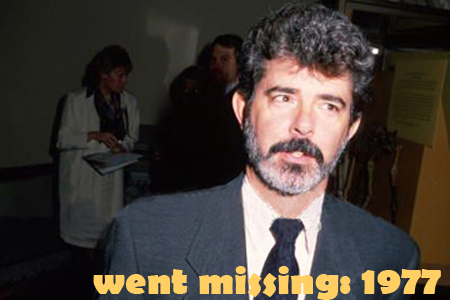
Seen this man?
source: omega-level.net
A friend of mine who had seen the new films confessed, years back, to having never seen the originals in any edition. We watched them over the course of a week or two. She found them enthralling: the epic, classical story told in a fresh environment; the creativity in making new worlds; the personality which emanated from the characters from their first introductions; the seamless use of effects in driving the story; and the enduring appeal of these films in their re-watching. Then there is also the uncomfortable implication that the new films lack a great many of these wonderful qualities.

Future generations of film viewers will have to deal with the reality that the new movies are now part of the saga and the story continuum, even if they lack the style, aura, appeal, personality, and depth of the films which preceded them. They are somehow "two forms of the same rite" even though those of us who recall the older films when they were the only films do not really buy into it. And while, as I said above, the older films could well have done with some aesthetic updates many of the changes were puzzling and clearly meant to transition into the newer films. 


Translation key:
  • Original version of original films: the old Roman liturgy
  • Possible updates of films: more popular singing, public Divine Office, fewer Double feasts, less bureaucratic management of liturgy
  • 1997 Special Edition: 1911 breviary reform, 1955 Holy Week reform, 1955 kalendar reform, 1960 rubrical reform
  • Post-1980s George Lucas: Popes Pius XII & Paul VI
  • New trilogy: Pauline Mass, Liturgy of the Hours, new Pontifical and Ritual Books, 1970 lectionary and Sacramentary
  • Hayden Christensen: Archbishop Annibale Bugnini/Masons—yes some find it fashionable to blame him rather than admit who is really responsible; his performance was bad, but ultimately he was not the one who behind the new trilogy


Wednesday, August 21, 2013

Epistle and Gospel at Solemn Mass

 
In a previous post, "EF" Mass in 1964, we saw that the orientation and ceremonies of the traditional rites were already in a state of flux. Marko asked what traditional practice is supposed to be with regards to transferring the altar missal prior to the Gospel. The Rad Trad thinks this is a good opportunity to discuss the reading of the Epistle and Gospel at solemn Mass in the pre-Conciliar rites more generally.
 
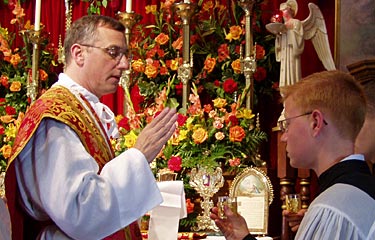
The 1962 praxis for the Epistle, from the FSSP in Scotland
In the 1962 practice the celebrant and deacon, after the singing of the first—and usually only—collect, sit down and listen to the subdeacon chant the Epistle or lesson of the day. After he finishes the celebrant and deacon return to the missal, the celebrant blesses the subdeacon, reads the gradual, alleluia, and/or tract, and then sits again. At some point, normally at the beginning, of the alleluia the sacred ministers rise and return to the altar the "long" way (genuflecting before the altar rather than just walking up the side). The subdeacon moves the missal from the Epistle side to the "offertory" position (where the missal is from the Offertory through Communion) and the deacon receives the book of the Gospels from the M.C., places it on the altar, and assists the thurifer with the incense boat as the celebrant imposes, then blesses, incense. The deacon kneels, prays the Munda cor meum, rises, receives the celebrant's blessing, and joins the Gospel procession. We saw a variation in the 1964 Mass celebrated in the video earlier, in which the missal is transferred after the celebrant reads the gradual, alleluia, and/or tract and then everyone sits.

Fr. Wach reads the Gospel privately on Mandy Thursday.
Note that the Mass is during the day time. Source: icrsp.org
This stream of ceremony is actually a departure from the older, medieval way of doing the Fore-Mass, in which the celebrant reads all of the texts. Mozarabic rite of Toledo aside, the celebrant's reading of the Epistle and Gospel was very standard in the Latin Church by the time the Council of Trent convened. In the Roman rite as it has existed since the issuing of the 1570 Missal by St. Pius V the celebrant remains at the altar after the collects and, with the deacon by his side, reads the Epistle quietly as the subdeacon sings the text aloud. At the end of the celebrant's reading the deacon responds Deo gratias. The subdeacon then receives the celebrant's blessing. The sacred ministers return to the Introit position and the celebrant reads the gradual, alleluia and/or tract. Depending on the length of these texts the ministers may sit before taking the next step. If there is a sequence they will always sit and rise as some given verse (ex. at Requiem Masses the ministers rise at Qui Mariam absolvisti). The celebrant prays the Munda cor meum and the Jube, Domine benedicere at the center of the altar with the deacon to his right. The subdeacon moves the missal to the Gospel position, as at a low Mass or a sung Mass, and then the celebrant quietly reads the text with the subdeacon next to him. During all this the deacon is given the book of the Gospels by the M.C. and places said book on the altar. At the end of the celebrant's reading the subdeacon says Laus tibi, Christe and the celebrant imposes and blesses incense as normal. The subdeacon may move the missal to the offertory/Canon position or the deacon may do it himself during the Credo after bringing the burse to the altar. The deacon prays the Munda cor meum and the priest blesses him. Everything follows as normal.

Reading the gradual in the Dominican rite
One may wonder why this was once done. John XXIII eliminated the practice in 1960, a practice many saw as a useless repetition. "Doubling," the reading of texts by the celebrant that were sung by other ministers or the choir, was the bugaboo of many reformers. Yet doubling had its reasons. The celebrant is the one who celebrates the Mass and, although the deacon is the one charged with reading the Gospel, the celebrant, out of devotion, would read the Gospel himself. Ditto for the Epistle and other texts. It was a way for the celebrant to remain engaged with the liturgy even when he was not strictly doing his part. The Rad Trad once thought that the pre-1960 Roman practice was a low Mass intrusion because the celebrant does exactly the same things in the exact same places he would at low Mass. After some research into other rites the Rad Trad and gradations of Mass the Rad Trad has changed his mind about this opinion. In the various local rites of the Middle Ages, outside of Rome and similarly ancient rites like Milan, the wine and water were put into the chalice after the Epistle and during the gradual. These liturgies were also sung in large cathedrals and collegiate churches where the exact words of the subdeacon or deacon might be lost. Celebrants would therefor read the texts from the Epistle through the Gospel privately in order to be "up to date" on what was happening at Mass, after having performed other duties and perhaps having had difficulty paying attention to the exact words sung. In the Norman family of uses (which includes the Dominican and Sarum liturgies) the celebrant would read these texts at the sedilia. The celebrant might have read the Introit and Kyrie for the same reason, that he had been occupied with the prayers before the altar and the incensation when these prayer were initially sung by the choir. At a pontifical Mass, which is rooted in Papal Mass, the bishop reads these texts from the throne or faldstool. At Papal Mass there would be any number of interruptions which might require the celebrating Pope to read the texts he had missed; for instance, the Pope would say a certain prayer for himself in silence after the collect while the subdeacon had already gone on to the Epistle. The low Mass-like pre-1960 Roman practice may have been the result of, again, the fact that it is rooted in the 1474 curial Missal, which was used by bureaucratic officials in chapels rather than by diocesan clergy in cathedrals. The chapels of the Lateran Cathedral, St. Peter's Basilica, the Vatican, and the Sistine chapel do not have a sedilia, so the sacred ministers remained at the altar and read the related texts there. The Rad Trad sees no reason why this practice had to get axed, other than that it conflicted with the uber-communitarian approach of the reformers. Otherwise there is nothing harmful in it.

source: FSSP Roma
There was even a seasonal variation to the Roman practice. During Lent and Advent, as well as on Ember Days, the deacon and subdeacon wore vestments called "folded" chasubles, a very old custom descended directly from ancient times. When performing one's role the minister would remove his folded chasuble. In the above image the subdeacon has removed his to sing the Epistle (you can see it on his stool, along with the celebrant and deacon's birettas). After the Epistle the subdeacon resumes his folded chasuble for the gradual. While the celebrant reads the Gospel the deacon removes his folded chasuble and re-arranges it into a large stole called a "broad" stole and then gets the book of the Gospels as normal. He keeps the chasuble this way until the ablutions, at which point he returns it to its normal position. An excellent example of how this practice looked can be seen below, in a Mass from the first Sunday of Lent, 2008. The Mass was celebrated by Msgr. Angelo Amodeo (RIP), a liturgically-minded canon of the Milanese cathedral ordained by Archbishop Montini. Along with the "doubling" of the Epistle and Gospel, the folded chasuble, dating to a time before St. Gregory the Great, was axed in 1960.
 
source: orbiscatholicus.blogspot.com
 

Tuesday, August 20, 2013

Pontifical Mass Now Online

Many will remember that on April 24th, 2010 Bishop Slattery of Tulsa sang Pontifical Mass from the throne at the Basilica of the Immaculate Conception in Washington, DC. Hitherto only some video snippets from phone cameras have been available on Youtube. A week and a half ago some good soul put the entire television broadcast online for all to view. Given that the footage of Pope John XXIII's coronation Mass is in a fuzzy black and white, I would not hesitate to call this the best looking Roman liturgy available online. The bishop enters this enormous, Byzantine-styled temple in the cappa magna and vests during terce and some hymns. Full ceremonies were observed, given that the planned celebrant was actually Cardinal Castrillon-Hoyos, who had to cancel due to political backlash. It is a truly beautiful celebration and one can see why it ought to be the standard of the Roman rite.


Friday, August 9, 2013

On the Validity and Legality of the Mass of Paul VI

JohnR, a friend of this blog, recently alluded to something in a comment on the previous post concerning Fr. Anthony Cekada's thesis in The Work of the Human Hands: A Theological Critique of the Mass of Paul VI that the new Mass is invalid. His opinion is ubiquitous in sedevacantist-ville while the opinion that the new Mass is likely valid but certainly illegal was, at least once, popular in SSPX-land. The premises for both these opinions are utterly banal and without theological, historical, or legal merit, yet they exist and the Rad Trad, being in a devious mood, would like to look into them a bit more.

Validity

Fr. Anthony Cekada celebrating Mass very Romanly
Toward the end of Work of Human Hands Fr. Cekada argues on Thomistic grounds that the Order of Mass promulgated in 1969 is absolutely invalid in Latin or vernacular. Some hardline SSPXers used to argue that the common mistranslation of pro multis invalidated the consecration of the chalice; taken to its logical conclusion, there would be no Mass in that case and the consecration of the bread, since the Church does not consecrate outside of Mass, would also be invalid. But back to the more general validity issue. The reason Fr. Cekada gives is that the institution narrative in the new rite is treated as just that: a narrative, as opposed to a consecration formula. The words in the new rite, he says, do not contain the intention to consecrate and hence no consecration is possible, even if a validly ordained priest who intends to consecrate speaks the narrative words with the proper intention. Your eyes are not under the spell of glaucoma. You read it correctly. A validly ordained priest with the right intention speaking the words of consecration, which are the same in the new and old rites, cannot consecrate validly. So, is Fr. Cekada right?
 
His invalidity stance rests on intention within the "form" of the consecration. The old rite gradually builds up the priest's intention, from the sacrificial offertory prayers, through the thanksgiving prayers early in the Canon, transitioning into prayers for the living and dead, and concluding the Canon with an act of offering the Victim to God (Per ipsum....). The new rite certainly lacks this continuous flow, but I think Fr. Cekada would concede that it is not absolutely necessary. His position is specifically concerned with the consecration itself. At this point a little bit of history goes a long way.
 
When does the consecration happen? At Hoc est enim corpus meum and Hic est enim calix sanguinis mei? That has certainly been the prevailing teaching since the Scholastic era in the high Middle Ages, but it is not as clear cut as one may think. Around the 11th or 12th century priests, at the behest of the faithful often yelling from the nave, elevated the host and chalice during the Canon for their benefit and view. Some say this form of piety was a soft substitution for actual reception of the Blessed Sacrament, owing to the infrequency of reception that arose in the Dark Ages and which continued for centuries afterward. It is also at this point when scholars and theologians begin to question the specific moment of the "change." We are so accustomed to seeing those specific words of the priest as the formulation for the change that we read the rest of the Canon of Mass around it. But consider this: five centuries earlier the same Canon was sung, without pause, aloud in the tone of a preface in its entirety. A preface tone indicates that the prayer is concerned with blessing or consecrating something. The various signs of the cross and gestures made throughout the Canon differed diocese to diocese, sometimes greatly. Sarum, for example, has very few reverences (later genuflections) and a very different series of actions at the Per ipsum. For whatever reason at the end of the first millennium priests began to recite the Canon rather than sing it aloud and the gestures flourished as private signs of devotion in a private prayer. A consequence of these gestures was the partitioning of the Canon, in the priest's experience, into varying parts. The institution of the elevation of the elements had the same consequence, making the institution narratives a unique segment of the Canon.
 
Yet, without these gestures and motions we could read the Canon's text straight through and see that that institution narrative may well have been seen in earlier times as just that, a narrative. It is the justification, within the text of the prayer, for why the Church celebrates the Mass. It is hardly a story time, but rather is a public supplication to God on the grounds that we are obeying His Only Begotten Son's precepts. In those days one would of course agree that the change had taken place by the end of the Canon, although today we pinpoint it at the institution narrative. Months ago the Rad Trad published an appendix from an English translation of the Ordo Romanus Primus which contains a replication of what a Paschal Mass celebrated by the Pope may have looked like around the year 800 here. As readers will see the celebrant continues through the Canon unabated, without any special notice.
 
How does this influence our view of Fr. Cekada's thesis? The Rad Trad readily acknowledges that the change, the transubstantiation, happens at the narrative. Why? Two reasons: (1) the priest is given the power to consecrate and he intends to consecrate at this moment and (2) because the Church has agreed for a millennium to treat this particular point as the moment of transubstantiation. What the Rad Trad cannot do, and what the sedevacantist theory does do, is ignore the first ten or eleven centuries when the moment of change is at best vague or a little iffy. The Church, in her kindness and respect for tradition, cannot and does not uproot and ignore the prayers, beliefs, or intentions of previous generations of the faithful. It is for this reason that the Addai and Mari rite is valid. Liturgical historicity takes precedent over, admittedly Church sanctioned, Scholastic theology concerning forms. By ignoring this principle and by ignoring the history of the Canon itself one looks away from a legitimate reading of the narrative as a narrative. Hence the idea that somehow treating this part of the Canon as what it originally was invalidates it on defect of form is myopic.  Also, need the function of the institution words as a narrative and as consecration formula clash?
 
I have never met a priest or lay person who has read the narrative and thought any other intention other than consecration is latent in the words contained therein. One would think someone other than Fr. Cekada had caught on to the structural defects supposedly present in the altered Canon or new Eucharistic prayers.
 
Yes, it is very valid.

Licit?

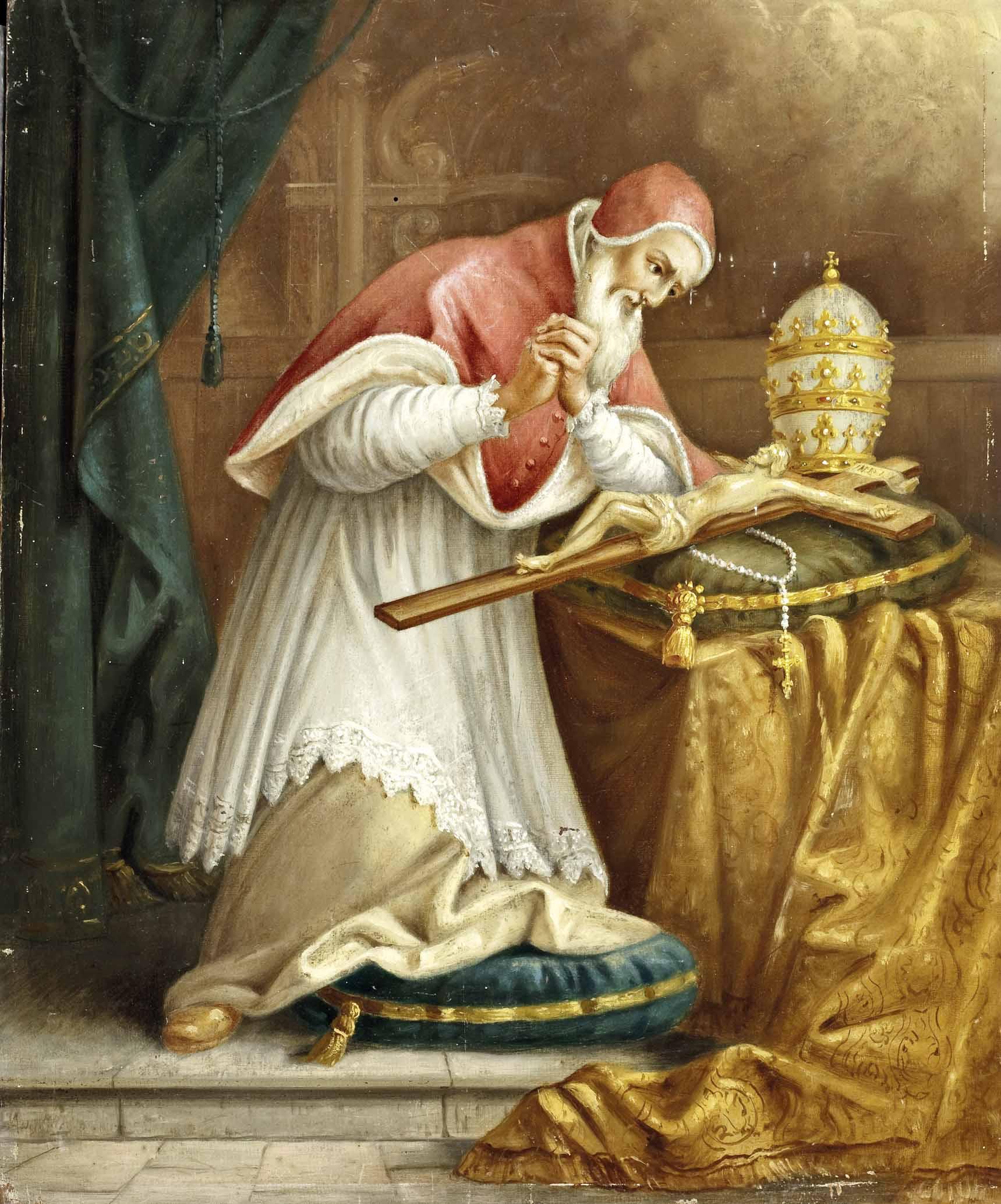
St. Pius V, Pope of Quo Primum
Part of the fallout within the Society of St. Pius X over Bishop Fellay's failed attempt to give his institution canonical standing was Rome's demand that the Society sign on to the "legitimacy" of the new rite. This sounds odd, but it really just means the legality. In short, was the "new Mass" promulgated in a valid, legal action by the proper authority? Some apparently say no. Others, like one Paul Kramer in his article Legal Status of the Tridentine Mass, argue that since Quo Primum is a dogma of the faith Paul VI avoided going into schism by merely publishing, rather than promulgating, the new Mass.
 
First, we will discuss Quo Primum. Both of these positions are really variations of each other and they rest on the principle that St. Pius V's bull Quo Primum made the 1570 Missal, or at least the Ordo Missae within it, a dogma of the faith that cannot be violated and which guaranteed that it could never be taken away. This is wrong at two levels:
  1. Quo Primum is primarily a legal document promulgating use of a certain liturgical book within the Latin Church. As a legal and administrative act it cannot bind a successor of equal status should he take the proper steps to depart from it.
  2. Neither Pius V, nor any following pope, thought it was such. Two years earlier the same Pius V published Quod a nobis promulgating a Roman Breviary for general use which contains the same rules of use and prohibitions against alterations and threats of Divine retribution as Quo Primum. Urban VIII did not go into schism or heresy by changing the hymns and no one has suggested the 1911 breviary changes were illegal or invalid (although they were unwise).
Confusion over this point may have been compounded when Benedict XVI wrote that the 1962 Missal was never abrogated, which begs the question: how is any following liturgy legal? Were priests who held out in the 1970s and onward justified in their use of 1962? The Rad Trad, no canonist, does know of one distinction in Canon Law that could serve us well here and which may not, legally at least, justify those who adhered to 1962 after the promulgation of the 1969 Ordo. In Canon Law there is a taxonomy of "derogation" and "abrogation." The former is the partial removal or replacement of the existing law while the latter is its outright suppression. To abrogate the 1962 Missal, Paul VI would have had to issue some sort of legal document explicitly prohibiting use of that Missal. This was clearly never done. The "extraordinary" rite was never abrogated. All well and good? New Mass illegal? Not so fast.
 
The Pauline liturgy was not introduced to the Latin Church by the abrogation of the "traditional" liturgy. For example, John XXIII compressed festal categories into Class I, Class II, and Class III, not abrogating the old calendar entirely, but derogating the ranking system within it in his Rubricarum Instructum. The same holds true for his changes to the breviary lessons, not abrogating the [not so] old Mattins, but derogating the particular way of picking lessons in place in 1955 (both changes were ultimately made by Pius XII, although John XXIII pulled the trigger on the 1960 set). Similarly the 1962 Missal was not abrogated with the publication of the 1965 Missal, but anything in it that differed from 1965 was derogated (use of Latin in readings, the Introibo prayers, the "doubling" of certain texts, ordinary of the first half of Mass in Latin, the communion formula, the Last Gospel, and some other details). 1962 was not strictly "abrogated" but it was by no means usable. The 1967 document Tres abhinc annos introduced further changes by derogating what was different in the 1965 Missal: optional use of a weekday lectionary, optional use of different orations, the Canon was not abrogated but the rubrics governing the priest's actions during it were derogated and replaced, the entire Canon is said aloud, and other alterations; interestingly, IV.17 in that document is the first official instance, to the Rad Trad's knowledge, of a rubric that assumes Mass facing the people could be ordinary and normal outside of a few Roman parishes. On the feast of the Assumption in 1968 the new Eucharistic prayers (2-4) were introduced, again not replacing the entire existing liturgy, but replacing and derogating certain rules and rubrics, this time governing the Canon, therein. A new Pontificale came about that same year.
 
Here comes the 1969 change. Paul VI did not introduce a new Missal or a new Mass in 1969. He introduced what was mostly a new text for the ordinary of the Mass. The Canon and Eucharistic prayers, lectionary, rubrics, calendar, and Divine Office remained unchanged from the previous year. Even some parts of the ordinary itself were unchanged, given the significant alterations in 1964-8. Perhaps the most dramatic different between 1968 and 1969 is the contrasting offertory prayers, but most everything else matches. The Missal introduced by Paul VI in 1970 again did not "abrogate" 1962 or even whatever was used in 1969, but de facto derogated whatever differed from it: the old sacramentary and [again, no so] old lectionary was replaced. Otherwise, 1970 and 1969 match up very closely.
 
The idea that the new liturgy is somehow canonically illegal or that the 1962 liturgy was abrogated relies on the view that the Pauline rites were introduced and imposed instantaneously rather than gradually and under transitional, derogation-based legal auspices.
 
Thank you for reading a such dry and disinteresting post,
The Rad Trad

Sunday, July 21, 2013

Re-Visiting the Mass of Paul VI

The Rad Trad has two cars: let us call the newer one the Radmobile and the older one the Crapmobile. The Radmobile is only a year old but in fifth gear makes a high hissing noise. The dealer told the Rad Trad that the Radmobile needs a new transmission, which is fine with his Tradiness because the car is still under warrantee. On the down side, he is stuck with the Crapmobile, a ten year old junker with such bad brakes the Rad Trad dare not take it on the highway. This meant the Rad Trad was unable to attend the Melkite Divine Liturgy and instead had to attend a Pauline Roman Mass 15 minutes away.
 
The parish has a reputation for doing the Mass "reverently," the common term both "conservatives" and "traditionalists" were using five or so years ago. Discussion has evolved (progressed?) to consideration of the ceremonies and texts and chants of the old rite, the 1962 rite, and the new rite. Yet this parish, with all respect for the very kind priest, seems indicative of what a slow, half-interest reform of the reform might look like. The Mass was certainly not an "Oratorian high Mass"—with 19th century polyphony, priests dressed as deacons, Roman vestments, large chunks of Latin, and an ad orientem consecration. No, it was a low Mass celebrated versus me, polyester vestments, and lay ministers of communion.
 
So why the reputation for reverence? Well there was no sign of peace. No music at all is probably better than what the neighboring parishes do, where you will hear such hits like "Lord of the Dance." The readings were the ones assigned. Between the readings, psalms, alleluia, Gospel, and sermon the lector sat down for a minute or more of silence (the Rad Trad fought hard to remain awake). The purpose of this is almost certainly to foster reflection and meditation on the readings of the Mass, to allow the faithful to commune with God in some quiet. Yet, is this not an arbitrary way of effecting reverence or peace during the Pauline liturgy? To "build in" periods of reverence? The Canon in the old rite, even at a solemn high Mass (provided it was not an obnoxious polyphonic piece with a 3 minute Sanctus and 5 minute Benedictus) was more or less quiet. What strikes the Rad Trad as qualitatively different here is that in the old rite the silence was the culmination of a single action, the various parts and prayers of which are bound by song and chant. At this Mass it was action, break, action, break, action, break, sermon, break, offertory, break, Eucharist Prayer > 1, break.... To create reverence in the Pauline liturgy without resorting to old music can be futile because most of the Mass is talking, not singing. Disrupting the talk makes the Mass all the more fractious than it ceremonially already is.
 
At a parish with only 200 in attendance and 3 persons—2 lay—distributing Communion under one kind, communion still took ten minutes or so. The entire low Mass, low attended, took 55 minutes. An old rite low Mass is about 40 minutes, a high Mass 70, and a Divine Liturgy 75 minutes. Yet all three of those feel much quicker and more expedient because the mind and soul are immediately enveloped in prayer (though that is often difficult at the old low Mass depending on the setting).
 
The practical implications of this are astounding. When this parish has its 1962 Missa Cantata one Sunday a month they usually pick up 50 or so faithful, but the demographics shift dramatically. At the Pauline liturgy half the congregation could immediately collect social security and the young(ish) half is a mixed bag: many come well-dressed, some do not, some are little children, a few families, and many are middle aged. At the 1962 Mass I would guess 75% of the congregation is under 50, most under 40. There are many enormous families (3+ kids, some with 5+). Young men and women come from neighboring towns and schools on their own initiative, too. I do not know what the difference is in the collection plate, but the parish priest ought to realize where the future of his church lays.

Sunday, May 12, 2013

Reaction to Fr. Sven Conrad's "Renewal of the Liturgy in the Spirit of Tradition"

I recently had time to read Fr. Sven Conrad, FSSP's article Renewal of the Liturgy in the Spirit of Tradition: Perspectives Towards the Liturgical Development of the West and will give a quick review of it here. Before making any comments, I would like to thank our resuscitated cardinal, Désiré, for linking me to this article some time ago. You may find the article here.
Fr. Sven Conrad, FSSP
source: newliturgicalmovement.org
Renewal of the Liturgy is essentially comprised of three sections: the first considering the development of the Roman rite over the last millennium, the second tracing the outlook of the reformers of the 1950s and 1960s, and the last segment provides some outlook in thinking about future reforms. Although quoted sparingly, Joseph Ratzinger's liturgy perspective provides the framework for Fr. Conrad to construct a conservative take on Ratzinger's concept of "organic" liturgy development. Implicit in Conrad's article is the thesis that the reforms of the 1950s and 1960s were less than organic in their nature.
Conrad creates a thesis of liturgical development in the first section, broken into three subsections—covering some basic history, hypothesized rules of development, and the Tridentine Council. Conrad establishes the variability of certain prayers of the Mass during the Middle Ages and traces the development of the Curial Missal to St. Gregory VII and Innocent III. The Curial Missal would eventually become the basis of the "Tridentine" Mass of 1570, used in various incarnations until 1969.
More importantly, Conrad sets down two rules of liturgical progression. The first is a historical remark: that local variations in the Latin rite are not matters of chance or corruption, but legitimate variations of the Roman rite, which is of Apostolic origin. The second rule, more Ratzingerian than the first, is that liturgical change and progression is small and most visible in secondary customs (the prayers at the foot of the altar would likely be an example of this). The Carolingian reforms, claims the author, solidified the basic form and orations of the Roman rite, leaving the details to local custom. Liturgical practices in cathedrals and monasteries enriched the spiritual life of Europe. The proper place for development of legislation was in tempering excesses and possible abuses, such as the restrictions the Council of Trent imposed on votive Masses of the Dead.
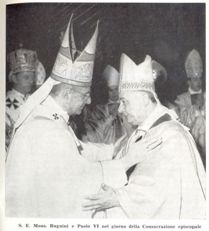
Archbishop Annibale Bugnini with Pope Paul VI
source: doctrinaliturgica.com
With these assumptions in mind, Conrad takes us to Pius XII and Vatican II. Conrad spends a lot of ink of the Memoria of Pius XII's commission for liturgical reform, which the author interprets as a very conservative document, mainly concerned with sorting out the bloated sanctoral cycle in the extant calendar. Although the portion on Vatican II is called the Vatican II Connection, it ought to be titled the Bugnini Connection. An entire subsection is, deservedly, devoted to Archbishop Annibale Bugnini's thought and opinions, as illustrated in his own memoirs. Here Conrad educates the reader with Bugnini's theology of liturgical reform, which assumes the liturgy to be an extension of the ministry of Christ, but then proceeds to devalue the external and the private in favor of the Archbishop's communitarian approach. I spent a good deal of time trying to convince people that the liturgical reform did not appear out of thin air, yet did not approach the theology of the reformers. Conrad gives us some insight I intentionally omitted. Our author then dedicates considerable time to the short-comings of the new rite's premises, like taking parish Mass rather than Pontifical Mass as the presumed liturgical norm, and the blurring of the lines between the lay and ordained that resulted from this idea. The result is a debased, de-ritualized, and un-concentrated liturgy. In many ways, says Conrad, this was the result of the subordination of liturgy to theological pre-conceptions:
"With all respect to the experts and, above all, to the authority of the Church, one cannot avoid the impression that this reform followed fundamentally different guidelines than every preceding liturgical development.... At the same time, we must emphasize a decisive aspect: The Second Vatican Council for the first time in history subordinated the assessment of established rites to a theological premise."

 In his last segment, Conrad turns our attention to the ever-enduring question of liturgical reform. He sides with Msgr. Klaus Gamber in wishing that the new and old rites might co-exist for some period of time for the benefit of the new rite:
"The new form should be linked up with it own tradition. In which the old form is a living point of reference and both should reciprocally enrich each other."
Perhaps Fr. Conrad is actually a certain priest whose last name starts with the last letter of the English alphabet....
Moreover, Conrad is optimistic that a more positive view of the Middle Ages will ensure more qualitative reform. In the Middle Ages liturgy was not just a part of life, but it was life.
In the last section, Is Reform Necessary?, Fr. Conrad touches on many points of contention among traditionalists and the reform-of-the-reform movement. Are there too few readings in the 1962 Missal? Should certain things, like the door ceremony on Palm Sunday, be restored? Should the liturgy be a matter of canon law at all? How can the ceremonies of the old rite inspire the Pauline liturgy?
Conrad, understandably, avoids concrete suggestions, but illuminates the wisdom of the eastern rites, which retain the form of their liturgical usages while adapting to the needs of the age, avoiding revolution at the same time.
On to my reaction:
Pros:
  • Establishes a thorough framework and retains his principles while considering both the Pian and Pauline attempts at reform.
  • Invaluable insight into the mind and fundamental assumptions of Archbishop Annibale Bugnini. At least read the article for this insight.
  • Makes a convincing case that the liturgy is neither a matter for theological subjugation nor of positive legislation.
  • Admits there are some serious problems in the 1962 liturgy, but did the Pauline reform solve these defects or not?
Cons:
  • Is the author genuinely Ratzingerian, or was Benedict XVI just popular when this was written? The theme of organic development, although trendy, may not stand up to historical scrutiny.
  • Quiet on the many drastic reforms in the Roman rite that pre-dated the Pauline revision, and which set the stage for it. Perhaps the author wishes to concentrate on the Pauline rite only?
  • The last section of the article fell flat when it failed to find anything the Pauline rite could learn from 1962 other than some ceremonial.
Conclusion: this exposition ought to convince any reader of serious flaws in the assumptions of those who instituted the new rites, assumptions which differ in principle from those of previous liturgical reformers and practitioners. The author shies from more exacting analyses or concrete suggestions, either intentionally or because he has constrained himself to Joseph Ratzinger's liturgical ideas. On the whole, a very informative article worth reading, and one that suggests liturgical theology is slowly returning to its proper place after a long exile.

Thursday, April 4, 2013

Reasons for the Reform of the Roman Rite Part II: Low Mass Culture (UPDATED)


Today I will treat the second of my six proposed causes of the reform of the Roman Rite in the 1950s and 1960s, the excessive usage of the low Mass at the cost of sung Masses or public celebration of the Divine Office.

Again, a little history goes a long way in understanding this phenomenon. Mass, and the Divine Office, is supposed to be sung using the chants given in the liturgical books of a given rite, be it Roman, Byzantine, Armenian, Milanese, or Japanese. High Mass is the presumed norm. Indeed, until, but not including, 1960 there was no formal distinction made in the liturgical texts of the Roman rite between sung Mass and low Mass, only between private and public Masses. Public Mass was presumed to be sung in a communal or conventual setting, such as the Mass sung by all the monks of a monastery in a given day or the main Mass on a Sunday or Holy Day in a parish church.
A monk of Clear Creek Abbey reads his private daily Mass

Private Mass developed in the late first or early second millennium. There were two motivations for its development: the first, and main, was so that priests who were monks and canons of collegiate churches could celebrate the Eucharist on days which they were not assigned roles at the main Mass; the second, so that numerous Masses for the Dead might be prayed. To put it succinctly, the purpose of the low Mass is so that a priest could live a full sacramental life under circumstances which would normally reduce him to spectator. This is a good reason on its own, but not one which makes low Mass suitable for public liturgy.

Originally the low Mass simply lacked a deacon, subdeacon, and incense. At first it was sung, although texts describing how are no longer extant. As late as the eighteenth century in France low Mass was sung in a monotone, except for the Canon, which was recited as it is at any type of Mass.

During the Middle Ages laity would frequently attend private low Masses, hoping to see as many elevations of the Blessed Sacrament as possible, asking for prayers to be said for their deceased loved ones. These are private devotional motives, and ones clearly supplemental to public worship. Private Masses did not stop rural parish churches from offering high Masses on Sundays and Holy Days, nor did they impede urban churches and monasteries from singing the Divine Office in choir. Indeed, private Masses were initially votive Masses and not part of the liturgy prescribed in the calendar. What happened?

In short, the model for sacramental life underwent a drastic change during the centuries that followed the Council of Trent, which did very little to change the presumed setting of the liturgy. First to note is the two major religious communities that the Counter-Reformation birthed: the Jesuits and the Oratorians. Ignatian spirituality is famously individualistic, focusing on private reflection and efficient meditation conducive to the life of a missionary priest. Although Jesuits operated in large communities their charism did not call for communal gatherings. Therefore Mass was often read in private and the Divine Office, the public prayer of the Roman Church, was recited in private.

"First Mass in Florida"
source: State Archives of Florida
This same analysis applies to the Oratorians, although I will readily concede that they do make an effort to have sung Masses and Vespers on Holy Days and Sundays. St Philip Neri said nearly every Mass in private and emphasized individual relationships with his parishioners. Neither of these things are bad. Indeed, the latter of these is a pastoral necessity. Still, given the size of Oratory communities, surely sung Offices were plausible?

The missionary needs of the Church also expanded the use of the low Mass and put it at the center of public liturgy. The discovery of the Americas by Christopher Columbus sent Spanish and Portuguese missionaries everywhere from Florida to south of modern-day Brazil. Priests often had better things to do than teach the locals how to sing in a language that used a different alphabet, such as build churches, create schools, and foster relationships. But when missionary communities expanded, high Masses did not follow.

A typical post-Tridentine country church
England and Ireland, although not part of the New World, were seen as missionary countries, as the faith was effectively suppressed on those islands for several centuries. Mass had to celebrated as privately and as quietly as possible. Low Mass was really the only option, if the priest wished to remain a free man.

As a result, outside of Western Europe, by the nineteenth century the faith was well-established in North and South America, growing in Africa and Asia, re-established in Ireland, and returning in England. Yet high Mass was very rare in these places and celebration of the Divine Office even rarer (although Vespers were popular in London until World War II). The revolutions of the nineteenth century and the two world wars of the twentieth century forced parish priests doing temporary duty as chaplains recite the Office in private and read Mass as quickly as possible. Sermons disappeared for practical reasons.

Yet I think I am blaming the nineteenth and twentieth centuries too much here. How do we explain this chapel, shown on the right?—a site so common throughout rural Europe? It is clearly built for low Mass and also for public viewing.

The Counter-Reformation defense of the priesthood, of the Real Presence, and of private devotion put an over-emphasis on all of these things, the "Spirit of Trent" if there ever was one. Various saints like Louis de Montfort, Francis de Sales, and Peter Julian Eymard devised methods by which the pious soul might hear Mass. These included, but were not limited to, meditating on the Passion, meditating on the Marian mysteries, and praying the Rosary. There is nothing wrong with any of these things, but none of them involve directly considering the Mass of the day. Easter Sunday and a votive Mass of St. Joseph vary minimally with this sort of devotion.

I will treat what I call "Devotionalism" in a separate post, but I think it suffices to say that regardless of what one thinks of these various spiritual devotions, they do not require one to engage the Mass of the day. The proper texts carry minimal importance.

This problem was compounded by the introduction of the layman's missal, first published in English by Bishop John England of South Carolina. Personally, I find the layman's missal very beneficial at high Mass, where I can glance at the Introit or Gradual, close the book, and spend some time in meditation whilst the choir circulates these words slowly through my mind. At low Mass this is not possible. One can only read the text and, as the priest too is reading, one feels compelled to keep pace with the priest. This means that, inevitably, one races through the missal throughout most of Mass, clinging on the priest's every word, trying to understand it. It seems one can either neglect the propers of the Mass in private devotion or cling to every word in a translation frenzy. There has to be a better way of praying than this. The hand missal has potential, but this potential is not tapped at private Mass.

Moreover, the focus on the propitiatory effect of the Sacrifice of the Mass gave people the impression that they only had to attend the Mass and not engage it. I shy of using the word "participating," as this word reminds most traditionalists of some layperson reading the book of Numbers from a lectern for five long minutes. Still, I maintain that a lay person can be very engaged in the old rite high Mass.

As someone who attended private old rite low Masses three or four times a week for a considerable period of time, I can say that I found little in life as rewarding or as spiritually uplifting as serving private Mass. Yet I find little disengaging as hearing a public low Mass. My Latin is decent and I know the liturgy. The close quarters allow these skills to take over my faculties and have an intimacy with the mysteries of the day. This is not possible for the average layperson listening to the priest's voice muddle through the walls of the church. One loses sight of Mass as an action.

This effectually divided the priest and the person in the pew (pews are a damned problem on their own) to the point that people viewed themselves as spectators. What the reformers got [very] wrong was the loss of a critical distinction: there is a difference between making the Mass accessible to a lay person and focusing the Mass on the laity. Sung liturgy makes the former possible while what happened was the latter.

Sung Vespers
source: newliturgicalmovement.org
Given this stark liturgical praxis, one could hardly expect public recitation of the Divine Office. It fell out of use in most churches. The reason hymns like Ave Maris Stella repeat so often in the Office and that most of the Sunday psalms were used on major feasts is because in ancient days parish churches in Rome determined their own Office and the clergy made an effort to use the most familiar material. In short, the old, pre-Pius X Office, was well-built for popular use owing to its repetition of hymns and utilization of psalms. This system became mundane by the end of the nineteenth century, as I said in my previous post, but an abuse ought not render the entire system dead.

Yet the prevalence of low Mass culture meant that liturgical texts were the jurisdiction of the priest, not the laity or even a collegiate community. Laszlo Dobszay in his The Bugnini Liturgy estimated that by the mid-twentieth century 95% of priests had no experience singing the Office in choir. I cannot verify this figure, but even 2% would be an appalling figure! What the hell were these people doing in their seminaries? A priest can hardly be blamed for not holding Terce before Mass or Vespers in the evening. These sung Offices were foreign nationals speaking an alien tongue to the clergy!

By the time Vatican II issued its liturgical constitution virtually all Sunday Masses were low Masses, with the rare sung Mass or low Mass with vernacular hymns for special occasions, like Confirmations or Christmas. People were used to Mass being their private, quiet time. Indeed, several years ago I took my father to a Latin Mass for the first time since 1965. He could not bear the 75 minute duration of the Mass. Afterward, I learned not only had he never attended a sung Mass in the old rite before, he was unaware such a thing existed! Vernacular, aside from being a change on its own, disturbed the person in the pew from his private prayers. The priest and lay person were talking to each other, although not necessarily praying. With sung prayer a long-gone concept, this vernacular exchange naturally became a conversation, not a liturgy.

What began as the priest's private devotion became the priest's sole function and the laity's private devotion. The reformers saw the problem, but not its cause or better solutions.

Am I blaming low Mass too much? Maybe. Or perhaps we are too accustomed to low Mass to see the problems its use as the norm creates.

UPDATE:

First I would like to thank Marko and Désiré for their input, which has given me some cause to update and clarify what I am trying to say here. I would maintain that the majority of Sunday Masses throughout the world were low Masses. In certain European cities—mainly London and Paris—one could easily find a Missa Cantata as the main Mass in most parishes and in other cities—particularly Rome and Cracow—solemn Mass. Still, in the Americas and elsewhere there was a proliferation in the number of Masses, but not necessarily high Masses. If a parish in 1820 had two Sunday Masses—one high and one low—it likely had three or four Masses in 1920—one high and the rest low.

Diaconal ordinations at the FSSP seminary in Denton, Nebraska
source: FSSP
Moreover, by "low Mass culture" I do not simply mean the number of low Masses, but the effect this new liturgical norm had on the liturgical praxis and formation of clergy. High Mass, outside of some European cities, had become so rare that seminarians routinely only spent a few days or weeks in the subdiaconate and diaconate. This contributed to a depleted understanding of the sacramental role of each level of Holy Orders, as well as a de facto ignorance of the qualitative difference between solemn and low Mass.

The restoration of the "permanent" diaconate is an amusing illustration of this problem. There was never a "permanent" diaconate, just deacons who did not have the vocation to become priests. Popes Innocent III, Leo X, and St. Gregory the Great were all deacons when elected and probably had no intention of becoming priests. The restoration of the "permanent" diaconate is an ill reaction to the loss of solemn Masses. The emphasis on the priesthood and also the "low Mass culture" meant most deacons only remained so for a short time until they became priests. The reformers assumed this "transitional" diaconate suppressed a phantom "permanent" one. The truth is that one simply accepted the call of the Church through the discretion of the local bishop, whenever that time came. My theory is that the "low Mass culture" contracted the number of deacons who did not immediately anticipate a priestly ordination and resulted in the short-lived diaconate of seminarians.

Lastly, I would like to say something about the dialogue Mass, an idea that came to me while gleaning Fr. Conrad's article. Although the reformers like Archbishop Bugnini wished to return to sung Mass, they still initiated many of their early attempted alterations on low Mass, such as the "dialogue" Mass. For those readers unfamiliar with this practice, the "dialogue" Mass was a set of rubrics for private Mass issued by Pius XI in 1922 that allows for the faithful to recite any number of things normally said by the server. Some parishes, under dubious legality, extended this participation to many other parts of the Ordinary of the Mass.

Yet the "dialogue" Mass, which I find can be done well, reveals the dynamic of "low Mass culture." In countries where sung Masses were still common, such as France or urban Italy, the "dialogue" Mass was successful and is still practiced to this day. Indeed the FSSPX church in Paris and FSSP church in Rome demonstrate a very impressive degree of participatio actuosa. Those who learned the responses and Ordinary by singing the Mass had no problem when the time came to recite the Mass. Yet in  many countries that I mentioned, mainly the Anglophonic world, missionary countries, and the Americas, the "dialogue" Mass never caught on. Indeed, many parishioners still find the idea awkward. Englishmen are distinctly allergic to the faithful saying anything. During the first time I attended Mass at the Oxford Oratory I began to say the Domine non sum dignus and promptly stopped, horrified that my voice and the priest's were the only noises audible in the entire church.

Lastly, I would like to share a brief anecdote. I once asked my priest, a Melkite Catholic formerly of the Roman Church, why the East had retained communal singing of the Office while Rome had not; we have two weekday Divine Liturgies, one weekday Vespers, and Compline during Great Lent. He ruminated and said "Where two or three are gathered in My Presence, someone has to say Mass."

Understand I actually do like low Mass as long as it used responsibly, yet I think the above quote speaks volumes.

I will read Fr. Sven Conrad's article and publish some sort of review either in my conclusion to this series or afterwards.

Sunday, March 10, 2013

Papal Coronation Part I: The Entrance, Terce, and Vesting


Given that the Sacred College of Cardinals is to convene next Tuesday to begin the process of electing the new Bishop of Rome, I thought it prudent to start our own series on the traditional rites of Papal Coronation, last used in variation by Paul VI in 1963 and last used in their full integrity by John XXIII in 1958.

The ceremonies are a magnificent display and series of prayers which blend the norms of a Pontifical Mass (Mass celebrated by a bishop) with elements which emphasize and explain the role of the Papacy. Some of these rites are very ancient, as are many of the vestments used, while some are baroque innovations which reflect the political and devotional moods of the Counter-Reformation, a defining era in Catholic history.

Pope Innocent III
The Papal Coronation Office and Mass are votive liturgies, doubles of the first class. This rite may be celebrated on any day outside of the Sundays of Advent, of Lent, the first three days of Pentecost and Easter, Holy Week, Christmas Eve, and Christmas Day. This liturgy may even supersede most holy days. In fact the rubrics demand the Mass and coronation be celebrated on the nearest Sunday or Holy Day. Innocent III was crowned on February 22, the feast of St. Peter's Chair in Antioch, and Paul VI on June 30th, the commemoration of St. Paul. No commemoration is made of the replaced day.

The coronation takes place in St. Peter's basilica. Before the Italian revolution the newly elected Pope would be escorted to the Lateran Cathedral and enthroned immediately, and his coronation would take place at St. Peter's on a different date. This emphasized the two pronged nature of the Petrine ministry: Bishop of Rome and successor of Peter as Prince of the Apostles. If the elected candidate was not yet a bishop, the Cardinal-Bishop of Ostia would consecrate him immediately, in the Sistine Chapel. In some cases though, like Innocent III and many first millennium Popes, the enthronement would take place before the consecration, as bishops would have to be brought to Rome from outside the city. The account of Innocent III's coronation given by Achille Luchaire in Innocent III: Vicar of Christ or Lord of the World? suggests that the consecration occurred at St. Peter's but, in a breach of what we would now consider normal, the Pope said Mass and not the consecrating bishop.

A Greek deacon sings the Gospel at Papal Mass on Mandy
Thursday. Source: newliturgicalmovement.org

The procession into St. Peter's is preceded by the standard servers of Mass, who, when the Pope says Mass, are members of the Papal Household, since abolished by Paul VI. Then follow the Canons of St. Peter's Basilica, then the attending bishops, followed by cardinals in choir dress, then the ministers of the Mass, and finally the Pope, carried on the sedia gestatoria, flanked by two large fans made of ostrich feathers, and surrounded by members of the various Roman honor guards for security. 

John XXIII is carried through St. Peter's Basilica
after Papal Mass
The ministers of Mass are: the Latin and Greek subdeacons, the Latin and Greek deacons—all fully vested according to to their rites, the deacons of honor, the assistant priest, the chaplains, the masters of ceremony, and the celebrant—the Pope. These roles, except for the Greek ministers, would be filled according to one's place in the Roman Curia: remember, this is a Mass said by the Pope and served accordingly by his brethren. The Greek ministers would typically be conscripted from the Byzantine monastery in Rome, which exists to this day.

The Pope, carried on a portal throne called the sedia gestatoria, is vested in alb, amice, stole, cross, cincture, mantum (a very long cope), and mitre. The procession begins in the sacristy, where St. Pius X would have just finished a long drag on his last cigarette, winds down the Scala Regia, and enters the narthex of the Basilica. Here the Pope is set down and the Canons (permanently stationed priests) of St. Peter's Basilica offer obeisance and fidelity to the Pope by kissing his feet.

Blessed Sacrament Chapel of St. Peter's Basilica
source: overheardinthesacristy.net

The procession then enters the Basilica to the blasts of trumpets, a baroque vulgarity if I may say. Although liturgical piety would seem to demand some solemnity, in practice the more recent coronations began and ended with booming applause.

Midway through the Basilica the procession would halt again and the Pope would go to the Blessed Sacrament chapel on the North side for a few minutes of quiet prayer. There are no specific prayers prescribed. This is likely a private practice of the Popes, a moment to ask humbly for Divine guidance, and perhaps some help enduring the long, grueling ceremonies about to ensue.

In the image below you can see just how big and long the mantum, that large cope, actually is. So large that it must be draped over that kneeler, called a faldstool.

Paul VI, wearing the mantum, kneels with Msgr. Enrico Dante during
the Second Vatican Council
source: Washington Times

Traditionally, as this was the first time the Pope appeared to the masses gathered within the Basilica, the choir, more recently called the Sistine Screamers, would sing Tu es Petrus to some polyphonic setting. In the video of John XXIII's coronation the setting was written by Perosi and, as one blogger put it, "massacred" by Msgr. Bartolucci's Sistine Shriekers.

The Pope returns to the sedia gestatoria and is carried, with more vulgar horns set to something masquerading as music, to the altar of St. Gregory the Great in the south transept of the Basilica, to the right of the high altar if one were to look at it oriented.

Altar of St. Gregory the Great, taken by yours' truly
At this altar the Pope once again prays at a faldstool for guidance and then assumes a small throne constructed for Terce and vesting, which at any non-Roman church would have been done in the Lady Chapel. St. Peter's does not have chapels as much as it has an endless maze of altars.

Cardinal Burke in a cappa magna with the Institute of Christ the King
Here the cardinals greet the Pope, kneeling before his throne until the Pope tells them to stands. Eastern Catholic Patriarchs were often allowed to simply genuflect, so as to preserve some level of respect for their offices. The cardinals would be in choir dress, which, before Paul VI's reforms of ecclesiastical dress, meant wearing a long, hooded silk cape called a cappa magna. These were usually twenty feet long. Pius XII shortened them in length by over half and John XXIII promptly undid this policy. The Institute of Christ King seems to prefer for their celebrants' cappae magnae to spread from Tuscany through Sicily.

The chaplain holding the liturgical texts and the candle-bearer approach the Pope who, reading the chants from the book, intones Deus in adiutorium meum intende, the beginning of the third hour of the Divine Office, Terce. The hymn is St. Ambrose's Nunc Sancte nobis Spiritus, of which I have lifted a translation by John henry Cardinal Newman from Wikipedia for your perusal below.

Come, Holy Ghost, Who ever One
Art with the Father and the Son;
Come, Holy Ghost, our souls possess
With Thy full flood of holiness.
In will and deed, by heart and tongue,
With all our powers, Thy praise be sung;
And love light up our mortal frame,
Till others catch the living flame.
Almighty Father, hear our cry
Through Jesus Christ our Lord most high,
Who with the Holy Ghost and Thee
Doth live and reign eternally.

The psalms are festive (excerpts from psalm 118), or, before St. Pius X, normal! The cantors give the dismissal, Benedicamus Domino, as normal, but there is no versicle prayer for the dead, as Mass follows. The Terce from John XXIII's coronation is below. One will note that while Msgr. Bartolucci had laid waste to the instrumental and polyphonic music after just two years as choir director, he had not yet harmed their marvelous singing of plainsong chant.


As always at pontifical Masses, the bishop, or Pope in this case, vests for Mass following the singing of Terce. John XXIII's vesting is not really shown in the video series from which I have taken an extract above. This is likely a courtesy matter. I remember at one of then-Pope Benedict XVI's audiences his assistants would always surround him so as to block him from view whenever he drank water or ate something. I was close enough to see what was happening, though.

The vestments of the Pope are mostly those of a bishop, but with some exceptions and additions. In addition to the alb, that white robe underneath the main vestments, the Pope wears a maddeningly long second alb, or skirt, called a falda,  so as to outdo the cardinals' cappae magnae. The Pope vests with the tunicle and dalmatic, vestments of subdeacon and deacon, then the chasuble, the vestment of the priest. He ties a cincture, a rope, around his waste under the chasuble, to which is attached an odd wad of loose material called a subcinctorum, the significance of which is lost on me even though it dates to the eleventh century or earlier.

Papal vestments of Pius XII. Note the falda rolled into like
a canvas sail, the fanon at the bottom, and the tiara at the top right.
from: Life Magazine
Over his chasuble the Pope puts the fanon, a gold and silver striped shoulder cape which was the forerunner to the amice but, like the maniple, retained use after its practical purpose was adopted by other devices. Originally used to simply cover the neck, the fanon, recently returned to use by Benedict XVI, holds the pallium, in place without damaging the chasuble. While one may say even that practical use is gone, it is a unique vestment to the Papacy and reminds us that the Pope has a unique role in the Church distinct from other bishops. The Pope does not yet assume the pallium, nor does he assume the maniple, that towel-like vestment that goes on the left arm. The Pope's maniple is traditionally embroidered with red and gold threads: red for the blood of the Roman martyrs and gold for the heavenly theology of the Eastern Churches.
The flax torch used during the admonition
to the Pope
The Pope returns to the sedia gestatoria again, imparting his blessing as he passes the congregated faithful, to make the slow move 100 feet northward to the high altar. A lantern burning flax is carried immediately in front of the Pope, symbolizing the evanescence of things in this world. Three times the procession stops and the torchbearer exclaims to the Pope "Pater Sancte, sic transit gloria mundi" ("Holy Father, thus passes the glory of the world"). The last of these addresses would take place before the confessio, the entrance from the ground floor of the Basilica into St. Peter's tomb.
The procession would finally reach the steps leading to the high altar of St. Peter's basilica, where we will leave off for now, as the Mass is about to begin....