Showing posts with label St Pius X. Show all posts

Monday, January 29, 2018

Pius XI Reconsidered


Pius XI, Papa Ratti, was the last pope following traditional models of the papacy much like how his name predecessor, Pius X, was the first pope in the modern mold of the papacy. Some will blithely point their fingers to Pius IX and Vatican I saying "When the Council made the pope infallible we have the modern, constantly inerrant vision of the pope." That Council forms a simple demarcation if we do not think about what the modern papacy really is and why Pius XI did not fit into it.

What better defines modern government, religious or secular, than what Nisbet called that great vacuum of buffer between the governing and the governed? Whereas traditions, institutions, places, and customs once gave the individual identity and gave authority a measure of guidance, modern government gives the individual all his rights, privileges, prerogatives, and policies that govern his life. In light of this, the modern papacy really begins with Pius X and the tradition papacy ends with Pius XI. Papa Sarto began his reign following a controversial conclave, when the metropolitan cardinal of Poland vetoed the election of Mariano Rampolla for any number of speculated reasons. Initially interested in seemingly harmless subjects like ensuring only men sang Gregorian plainsong or giving chant a place of prominence again, but soon interests, either Papa Sarto's own or those of the Vatican bureaucracy around him, began to stick their tentacles into common Christian life. His re-introduction of Communion for the young confused the order of sacramental initiation in most of, but not all of, the Western Church, a mistake some bishops have slowly remedied without a universal correction. His re-jiggering of the Office kalendar and psalter effectively tossed out the Divine Office as Saint Benedict, Saint Bernard, Saint Pius V, and the pope himself knew it, paving the way for the "restoration" of the other unchangeable part of the Latin liturgy, the anaphora. Most notably, he enabled Umberto Benigni to hunt anyone whose opinions differed from his own, be they true heretics or simply those in need of correction. While modest by today's standards, Saint Pius began a practice of the papacy that dictates how one enters the Sacramental life, how Mass is said, what prayers a priest prays daily, and that the priest is someone whose ideas must actively correlate with those of the Roman Bishop's. By contrast, Pius XI had little to do with these things.

In his Phoenix from the Ashes HJA Sire observes that many traditionalists "regard popes Pius IX, Pius X, and Pius XII as models of what a pope ought to be, but (with due respect for their sacred office) really look upon Leo XIII and Pius XI as rather letting down the standards of papal authority. They show little sympathy with social and political pragmatism in the framing of religious policy" (Sire 139). In Pius XI was a resolute orthodoxy tempered by a cautious, healthy distance from the impractical excess condign to arbitrary use of power.

Papa Ratti's foreign policy is the most memorable and mixed aspect of his pontificate. He had the good sense to end the "Roman question", which had been answered since the Italian unification ended the Papal States in the prior century. With traditional monarchies and temporal rule gone, the pope could now, ironically, speak on matters of foreign policy with an authoritative detachment and lack of personal interest that gave moral strength to his statements. History perceives Pius as friendly, or at least amenable, to Fascistic movements in Spain and elsewhere in Europe because he was. While horrifying to post-modern liberals, the only options most had in revolutionary countries were atheistic, class warfare Communism or Fascism—understood as a glorification of the state and its cultural history along with public-private cooperation with major corporations (Nazism was not Fascism, it was something more unique). Because Fascism takes the state as its alpha and omega, Fascism is not Catholicism, but it can tolerate Catholicism and even give a place of respect to Catholic culture; Communism cannot, and as ruthless as the Fascists were in the Spanish Civil War, the Communists matches or exceeded them in brutality, something anti-Fascist adventurer and author Ernest Hemingway begrudgingly depicts in For Whom the Bell Tolls. The pope's vociferous denunciation of Hitler and his deranged racialistic theories of state and expansion redeem the pope to historians; Mit brennender Sorge had to be smuggled into Germany to be read from the pulpit during Passiontide in 1937, and since his Secretary of State, Eugenio Pacelli, succeeded him as pope, one might reasonably assume the swift reaction of the Nazis against the Church was a lesson learned by Pacelli in his more cautious War-time administration. Post-War Europe's coziness with socialism has cooled Pius's legacy, but we must admit given his choices he could have done far worse.

Pope Ratti's most enduring success and failure could both be summed up in three word: Christ the King. In an age when nation or class or race ruled men's hearts, Papa Ratti reminded Christians eager to embrace political movements that Christ must be king both of the individual and all of society. Yet when the Freemasonic president of Mexico, Plutarco Calles, enforced the existing anti-clerical laws in that country and the Catholics in the populace effected an outright rebellion without episcopal support, they won near-total victory in the Cristiada only to be told by Rome to sue for peace and return a near-unconditional surrender. The enforcement of the anti-clerical laws lessened after Calles, doubtless inspired by Henry VIII's reaction to the Pilgrimage of Grace, reprised the favor with some indiscriminate slaughter. A shining moment for the Secretariat of State under Gasparri and Pacelli. Viva Cristo Rey.

Despite my education being partially in Economics, I have not read the pope's encyclicals on the subject in depth with supplementary resources. And yet I feel familiar enough to say he wrote in continuity with the social teachings of Leo XIII, reflecting Pius XI's pervading theme of upholding doctrine fully with some awareness of his times. The times asked different questions under Leo XIII than under Pius XI, not just in social questions, but the state of the Western economies and of economic literature. Leo wrote during the Industrial Revolution, the abuse of child-workers, new money capitalists, economists writing about rational self-interest as an inherently moral act, displacement from traditional settings of living into atomistic city life, and the like. By contrast, these phenomena were three decades old when Ratti took the tiara. The new concerns were political cults, collectivism's many forms, atheism, interventionist economics, and secular utopianism. In this regard, the pope was quite adroit in keeping up with the signs of the times; would that our modern popes be interested in any issue more current than 1978.

Pius XI was a good pope. He was, in no sense, a great pope. He made any significant contributions to the Church while not entirely succeeding in making lasting changes that he successors felt obliged to keep. Perhaps he never saw himself as a reformer, merely a traditionalist, that is, one handing on the Church as he knew in the best way he could. He was not a modern pope, reforming the Church according to his own ideas. HJA Sire notes that if not for his boundless optimism, John XXIII could have returned the Church to the paternal, familiar style of government Pius XI and Leo XIII personified, gentle, firm, practical, and respectful of tradition. Vatican II was supposed to rubber stamp some very unimaginative documents and move on in eight weeks; what ensued was something quite different, a parliamentary hijacking by bureaucrats whose power derived from a more modern practice of the papacy. John XXIII died and "blessed" Paul VI took his place, succeeding Pius XII more than John XXIII or Pius XI.

Pope Ratti was a good pope, perhaps the most recent thoroughly traditional pope we have seen.

Tuesday, January 17, 2017

A Reading from the Book of Numbers (against the Variable Lectionary) UPDATED

I read them the Numbers....
source: Cornell Catholic Community's Facebook page
"Oh, Rad Trad! How are you today, Rad Trad?"

A doey, dopey eyed student asked me as I walked into the chapel for a weekday Mass during my student days. This shorts-wearing man was the perfect JP2 Catholic: young, pro-life, liturgically liberal, Ultramontane in all matters, and he read the new Catechism every night before going to sleep. A kind, simple soul of exceptional devotion whose capacity for creative thought had been circumscribed by too many sports related concussions.

"Would you like to prepare a reading today, Rad Trad?"
"If it will make you feel better, alright," I acquiesced.

I reviewed the material in the lectionary for any Hebraic words or turns of phrase that might rattle my dyslexic eyes and found none. After the Collect Opening Prayer I assumed my place at the ambo and began with the immemorial words, "A reading from the book of Numbers."

A rare thought, gentle and fleeting, like a dandelion petal, that comes to a man only a few times in his life if he is careful enough to nurture it, came to me: "What the hell am I doing?"

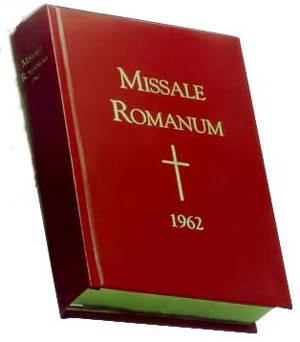
The year was 2011, the apogee of Benedict XVI's pontificate, which in retrospect shared much with Pius XII's in looking much better on the outside than on the inside. We were reviving the "never abrogated" 1962 Missal and calling it the "extraordinary form," sticking the Big Six on the altar of Pauline Masses, and telling ourselves that the average parish Mass is not how Paul VI really wanted it. Liturgical conferences with Scott Alcuin Reid abounded and "mutual enrichment" was the defining phrase of obedient clergy. The new Mass could learn much from the old form's prolix reverence, mystery, orientation, and sense of the sacred. But, so the other side of the enrichment went, the old Mass could be inferior to the new in any number of ways, not least of which was the expanded lectionary. As I read figures for building dimensions and storage capacity to the JP2 generation and some paid staff, I concluded the benefits of the expanded lectionary were doubtful.

Peter Kwasniewski rightly points out that the expanded lectionary has allowed grave passages of Holy Writ to be omitted or relegated to obscure times of the year so that they do not appear whenever the church is full; most infamously, St. Paul's admonition against unworthy participation in the Lord's Supper never made it into the lectionary of Paul VI. Dr. K likens the new lectionary to a Cliff Notes version of Shakespeare that includes a large quantity of material, but which censors any passages unsavory to modern ears and modern morals. Quantity over quality.

Another, less often considered problem of the new lectionary is that it drowns any sense of rhythm and thematic continuity with its "Scripture for Scripture's sake" methodology. Keeping with the motif of the Bard, Shakespeare's sonnets are best understood when read aloud so that the pattern of speech and repeated images may mature line to line. The old lectionary used a few sonnets in whole; the new lectionary reads them all in sequence, but never more than five or six of the fourteen lines at a time.

Criticism of the older lectionary and support for the pedantic three year cycle of Paul VI rest on the ahistorical assumption that the Eucharistic sacrifice is the appropriate place for ad libitum readings of Scripture. The original setting for Scriptural lessons, East and West, was the Mattins of the all-night vigil, from which only the Roman rite retained consistent readings; the Byzantine rite does maintain extensive pericopes during Vespers of Great Lent and major feasts. As with the Mass, Romans initially observed the vigil only for Sundays and great feasts, which is reflected in the coherence of the passages for the most ancient feasts (Pascha, Pentecost, Theophany, Christmas, Peter & Paul, Andrew, John the Baptist, and the like). Rome eventually followed the Constantinopolitan custom of observing the vigil every night and began to read Scriptures sequentially through different books each month. Mass, with its instructive lessons geared toward the solemnization of a particular mystery celebrated on a given day, remained unique to feasts, Sundays, and days of penance; there was no daily Mass in St. Peter's Basilica, but there was a daily Office. Local churches had particular Masses for saints more often than the Roman Church, which contented itself with Common Mass formularies for martyrs, bishops, and virgins; by the time of St. Pius V's Missal, half the days of the year were still of either Simplex of Ferial rank, so the repetition of the numerous Commons was hardly as dull and numbing as it was by the time of Papa Sarto's reforms and the rite of Iste Confessor. The considerable number of Ferial and Simplex days also permitted votive Masses of Saints and of Requiem when appropriate, providing a variety of Mass options with unified Scriptural lessons concerning the saint or mystery observed. All of this would gradually change, and perspective with it, in the years after Trent.

The Tridentine Council required the Breviary of every ordained cleric in the Latin Church. Pius V's breviary lessons are similar to those in medieval books, but subsequent popes shortened many readings to lessen priests' burden; contrary to the curt Roman Office, Cluny covered such extensive passages of Holy Writ that a monk with a bat would roam the choir during Mattins to tap anyone who had fallen asleep during the daily reading of many chapters. Mass replaced the Office as the daily observance of parishes and cathedrals, especially Mass in the spoken form, wherein words are less audible to the faithful, faithful who were often speakers of Romance tongues descended from Latin. Similarly, the number of saints multiplied and their feasts were almost always assigned a Duplex rank with a Common Mass, compelling priests to recite the same Masses week after week. By the time of Vatican I one could hardly go a week without a Mass or two that began Os iusti. Vatican I considered a two year lectionary, yet nothing came of it. The 19th and early 20th century Liturgical Movement and Ressourcement revived chatter about the limited use of Scripture in the Roman liturgy, especially when contrasted with the supposedly more Biblical protestant churches. A more tempered perspective might have led these reform-minded gentlemen to realize the Roman liturgy utilized Scripture very effectively in its structures, just not in its contemporary incarnation.

There are a few possible solutions for the limited use of Scripture in the old liturgy, at least in its various forms since the 20th century began. First and foremost would be to reduce the rank of feasts so as to allow the Ferial Mass to be repeated or a votive Mass to be said; the occurring Scripture, at least in the genuine old rite, could also be said in the Office under this scheme. Second, if Ferial Masses can be repeated provide alternative, cogent readings on the same mystery or event from other parts of Scripture, as was the Norman praxis in the middle ages; were the Roman rite to revive the octaves Pacelli removed, different readings pertaining to the feast could also be read during the eight days. Third and finally, Mattins needs to return to cathedrals, collegiate churches, and parishes, even in a reduced form for non-obligatory settings that would permit just one nocturne with the assigned readings; the rhythm of the liturgy is not in the Mass, it is in the Office, which Byzantine churches have managed to keep while Roman counterparts have to bribe the faithful with Communion to get anyone interested in a service.

One must also consider that a practicing Roman Catholic need only attend Mass on Sundays and Holy Days. Not even the most devout are able to attend Mass on a daily basis. The average Roman Christian who does what is required of him will likely hear different lessons at each Mass. Just before Pius X's changes about half of "green Sundays" would have been exceeded by feasts, often from Commons, but not the same Commons. From 1911-1955 feasts of Our Lady, St. Lawrence, the parish patron, and the Apostles could still be celebrated on Sundays, but in practice this only happened a few times a year. Since 1962 only half a dozen feasts can replace the Sunday Mass and none of them probably use Commons. The issue of a limited lectionary was belonged to a narrow segment of the Mass going population from the beginning.

If a Catholic wants to hear a variety of Scripture in a Church, would he not have been better off attending the Office all along?

Update: I seem to have neglected one other possibility for expanded, reasonable use of Scripture at Mass. What of the unique Masses for dioceses and congregations for Counter-Reformation saints that did not make it into the Roman Missal after the saints' canonization? And what of the unique Masses for pope saints suppressed by Papa Pacelli in 1942? Both could be revived without disturbing ancient texts (in the former case) and would even revive some (in the latter case).

Friday, January 15, 2016

HJA Sire on the Recent Church

Bookends of an era look at each other.
Fr. Hunwicke continues to plug for H.J.A. Sire's Phoenix from the Ashes, a book about the decline and aspiring restoration of Western Catholic culture. While the book begins very factually and Eurocentric, it develops a broader and spiritual view of the Church and her influence on the West. I have only recently begun the book, but Sire's comments on the Church's last 120 years demand some reflection:
"When Leo XIII died in 1903, distinct progress had taken place in the intellectual life of the Church. Nevertheless, the revival of Thomism had among some an unintended consequence. These fell into treating St. Thomas's work not as a philosophical system but as a store from which infallible answers were to be extracted on any subject. While some were thus making Thomism the basis for innovative thought, others made it into a system that was unlikely to convince minds not predisposed to accept it. Partly for that reason, the extension of the Thomist approach beyond seminaries and its acquisition of a real influence on contemporary thought was not achieved." (137)
"The integrist frame of mind, now as a hundred years ago, may be defined as follows: its exponents are clericalist in their sympathies, and they were also strongly papalist until events since the 1960s forced them to shift their position. Their outlook is distinctly Western and relatively modern, tending to see the period from 1850 to 1958 as the norm of Catholic practice. They regard popes Pius IX, Pius X, and Pius XII as the models of what a pope ought to be, but (with due respect for their sacred office) really look upon Leo XIII and Pius XI as rather letting down the standards of papal authority. They show little sympathy with political and social pragmatism in the framing of religious policy. In philosophy, they hold to Thomism as the bastion of orthodoxy, to the extent of considering any lapse from the pure word of St. Thomas as inherently unsound." (139)
 "What can be said, however, was that [Pius X's] measures [against Modernism] were over-influenced by conditions in Italy, where Modernism was a pretentious, elusive, and even underhand phenomenon, and where there was, in parallel, a strong need to tighten standards in seminary training. In Italy, his measures may have been successful, but in the world as a whole they must be considered to have had a narrowing effect on the clerical intellect. Theologians need to be lean greyhounds, seeking out heresy and hunting it down; instead they became fat lap dogs, yapping foolishly at the enemy beyond the window. The results of Pius X's policy were seen in the Second Vatican Council, when two thousand bishops who had solemnly taken the anti-Modernist oath at their ordination were unable to recognize Modernism when it jumped up and bit them" (140)
"Journalistic opinion, remembering as always nothing beyond last week, worked to give [John XXIII's] reign the appearance of a new era, a distortion that has imposed itself ever since; but at the time those who remembered Pius XI and Leo XIII would have regarded his pontificate, apart from a certain naive optimism that distinguished it, as a return to a familiar style. Essentially, the reign of John XXIII is in the tradition of the period since 1814." (145)
"Linked with this clericalism was the dominance of a seminary-bound school of theology, losing something of the human fullness of earlier centuries. Thus, in natural theology there was a certain over-intellectualisation of the understanding of God, which lost sight of the potency of love as a divine attribute; akin to it, an over-spiritualisation of the doctrine of the Eucharist, obscuring the reality of physical union with Christ." (147)
Sire is fond of the post-Napoleonic period and even equates it with the revivals of the Middle Ages and Counter-Reformation, but also readily acknowledges that its limitations and drawbacks impeded it from influencing society and the Church in the same way.

The below documentary could be a primary source document for Sire's last observation. Ushaw, sadly, had to close a few years ago for lack of students. It had over 400 when this footage was filmed.


Sunday, December 27, 2015

'62ville: Losing the Apostles


One of the few things this blog unambiguously advocates is a widespread reform of the Roman liturgy that involves recovering essential elements of the Latin tradition conspicuously absent in the "extraordinary form" Office and Mass of 1962. These elements include the psalter (lost to Pius X), Holy Week (lost to Pius XII), decent vestments (lost to the Italians), and decent taste (lost to kitsch).

Serious discussion of the Roman liturgical reforms in traditionalist circles, at least until respectable scholars like Laurence Hemming questioned the 1911 breviary reforms, usually contrasted "pre-1955" with 1962 and highlighted glaring differences such as what Pius XII did to Holy Week as a test run for the reformed liturgy. Something less noticeable is what differs on a more regular basis.

Today, until 1955, would have been the feast of St. John the Evangelist, Our Lord's favorite Apostle. One correspondent, who has successfully implemented proper Last Gospels, public horae minores, and some pre-reform Holy Week days at his parish, lamented that his pastor would be observing Sunday within the octave of the Nativity rather than St. John. Offhandedly, I asked how many Apostles had the 1962 liturgy entirely disregarded in the last year; unexpectedly, he told me five. In another conversation a while back I was speaking with an ordo compiler who offhandedly remarked "Nothing for St Andrew this year. He was only the first Apostle."

I am unsure how strictly the Roman liturgy ranked the Apostles before St Pius V's revisions in 1568-1570. Most local European rites give the Apostles, even Peter & Paul, a semi-double rank. Pius V upgraded many feasts to double rank, which allowed them to outrank Sunday. This does not, however, put the pre-Pius V system on par with 1962. Although a semi-double did not outrank Sunday, it was not discarded. Semi-double feasts impeded by Sunday were transferred to the next ferial day. Under St Pius X's system Apostles' Double of the Second Class feasts continued to outrank Sundays, even though lesser feasts could not (they did, however, warrant commemorations at Mass and in the Office). Even under Pius XII's 1955 revisions there were provisions for commemorating the now lessened feasts of the Apostles. The simplification of commemorations in 1962 breaks with all tradition in completely and utterly doing nothing for Apostles not named Peter & Paul when their feasts fall on Sunday. 

Wholesale liturgical restoration is not feasible at this point, even within traditionalist communities, which are quite happy just to get their Mass once a week and have a place at the local parish. We cannot begrudge Catholics gratitude for this. We can, however, push for some provision to be made for such boisterous flaws in a liturgy that purports to be the "Mass of all times." Would it be too much for Fr. Tradman to do a commemoration and proper ultimum evangelium for St. John tomorrow? He only wrote a Gospel.

Saturday, November 28, 2015

Who Was Papa Sarto?

Looking toward the future
Hammer of the modernists. A great liturgical reformer. A stodgy dinosaur. A chain cigarette smoker. A pastoral pope with the mind of a parish priest. Pope Pius X, who occupied the Petrine See from 1903 until his death in 1914, has been called all of these things by various factions. All these labels bear a small amount of truth to them, but ignore the fact that precious little is actually remembered about the man. Traditionalists have made him into their favorite pope—although all rad trads know Gregory the Great owns the top place, that is, until the election of Sixtus VI—without much consideration of his real legacy and the Vatican that created it.

J's latest offering on modern Catholic blogosphere vocabulary has generated copious comments on the liturgical changes that Pius X put into force, changes which were just as radical as those effected by Pius XII to Holy Week and Paul VI to the Ordo of Mass, although they were less distasteful in their result. This same who tossed out the psalter used by the ancient Church of Rome since probably the fourth century and which St. Benedict of Nursia proactively sought to imitate in his Rule also went on a zealous hunt against theological and disciplinary dissidents in an effort to preserve what I have termed the "Perfect Society" model of the Church. What could be more modernistic than discarding a fifteen century old liturgical tradition?

Guiseppe Sarto was not the College of Cardinals' first choice for the Apostolic See. An often reliable and much condemned correspondent for National Review, Mary Ball-Martinez, wrote in her Undermining of the Catholic Church that Mariano Cardinal Rampolla del Tindaro, Secretariat of State, was originally elected only to be vetoed by the Archbishop of Krakow on charges of Freemasonry. Mainstream thought, whenever it heard this far-fetched claim, quickly dismissed it. Recent research and leaked papers from the 1903 conclave now validate at least part of Martinez's claim. Sarto assigned the dubious Rampolla to the Holy Office and gave the Secretariat of State to the conclave secretary, Msgr. Merry del Val. A parish priest and unlikely patriarch now found himself at the center of a political institution that had hardly moved since the the Peace of Westphalia.

What differentiates the pontificates of Pius X and Pius XII, at least in this observer's view, is that Pius XII displayed a unified program of policies which he indefatigably followed. Consider, for example, the concerted effort to save Jewish lives during the Second World War, the various offices involved in implementing the new Holy Week, the general concordance of his encyclicals, and the movement towards new methods of communication. Pacelli's Vatican modernized and dealt with the prevailing issues of the time with a somewhat uniform mind, athwart the baroque remnants of prior pontiffs. Pius X's Vatican seems much less unified. Rampolla promoted the careers of his three prized students (della Chiesa, Gasparri, and Pacelli). Benigni hunted dissidents with his own home-grown intelligence network and ghost wrote official documents. Liturgical reformers reformed the Divine Office along the lines of the Jansenist breviaries on vogue in France. Everyone seemingly followed his own desires and none the pope's, which early in his papacy were a return to chant and more frequent Communion.

Was Pius X in complete control of his Vatican or was he, like Leo XIII at the end of his life, a functionary for the larger factions? His inexperience in playing politics and possibly apolitical nature (coming from peasant stock, not a noble) could very well have disincentivized Sarto from favoring or suppressing the urges of any one group. He let them do as they please, or by consent or by surrender. Pius XII had firm control. Did Pius X? If not, it would be difficult to ascribe to him any specific legacy, much less the proto-Lefebvrian image so many assign the parish priest turned pope.

Sarto and his second successor, Pius XI, may have been relatively inactive personally as pontiffs because they were compromise candidates between the reactionary political forces, liberal reformers, and the Rampolla clique, the most powerful of them all. The Rampolla clique eventually got their own Pope in Benedict XV, who died after having expended almost all his effort on preserving the Church through the First World War. Gasparri had already made a bad name for himself and Pacelli was too young to elect in 1922, so another Sarto, another compromise came about in the form of Achille Ratti. The only remaining mystery, if we are right thus far, is why did Pius XII canonize the nominal obstruction of his mentor's program? Was Pius XII above politicking? Was it a humble concession to the miracles attributed to Papa Sarto? Was it a nod to conservative elements in the Curia, to re-boot the liturgical reform program? We may never know. What can be known is this: Pius X, the great reactionary pope of the 20th century, may have been less a reactor than a spectator in his own see.

Passing the baton

Saturday, November 8, 2014

The Pre-Conciliar Church

source: ctu.ed

We spend so much time talking about the “Conciliar Church” that we often forget what the “pre-Conciliar Church” was. Indeed, the Catholic Church has been the “Conciliar Church” since the Council of Jerusalem recounted in the Acts of the Apostles or, at least, since the Nicene Council convoked by Emperor Constantine in 325. The Second Vatican Council was the latest council in the long history of the Church, but not the only. For all intents and purposes, it is the only Council that matters to most modern Latin Churchmen. They, wrongly, see it as the birth of their own incarnation of Catholicism. In this they are wrong. Their variation of Catholicism was born long before the Second Vatican Council and only was brought to full maturity during the 1950s and 1960s. The grapes had long been crushed, the juice bottled, and the product fermented. The Council only opened the cork. What was that process?

Such a question is too intimidating to answer, but hopefully we can get a head start here. It all began, of course, with the Reformation and, later, the French Revolution. We often think of these twin revolts as revolts first against the Church and then against God Himself. The Reformation and French Revolution were these things, but they were also so much more. From the Edict of Milan until 1517, the Church built a distinctly Catholic culture in Europe on the ashes of the Roman legal system and Greek philosophy, baptizing them into herself and allowing them to flourish in a renewed set of political structures. The emergent Catholic Europe was multi-lingual, multi-cultural, multi-governmental, but united by the faith, a remarkable feature the Greek and various Oriental Churches did not enjoy.

After the Reformation, and especially the French Revolution, there was no longer a Catholic Europe, only a Europe in which the majority of inhabitants were Catholics. The faith was undermined for political reasons. Few large blocks of territory signed onto the Augsburg Confession for reasons of belief. In the various north German states as in Henry VIII’s England, Protestantism offered a chance to break away from the Pope, the Holy Roman Emperor, and Spanish politics. In the case of England, the “stripping of the altars” was not so easy and required considerable bloodshed to eventuate. Catholic culture died a heroic death, but it died nonetheless.

A new Catholic culture emerged which separated itself from secular society. This was a culture to which one could belong if one was a Catholic, not necessarily if one were only European. European intellectual thought, particularly in Germanic states and France, began with anti-clerical cynicism, but Spinoza and Voltaire it radicalized into open anti-clericalism, anti-popery, and anti-monarchism. Lockean concepts about freedom, the blank slate man receives at birth, and economics insinuated academia everywhere. America’s revolution encouraged the seeds of France’s revolution. Everywhere the former conduits of Catholic education and intellectual thought were undermined and replaced by the Enlightened. More and more Catholics began to emphasize the Church as a “perfect society,” something akin to St. Augustine’s City of God, which exists on earth, but is beyond earthly criticism. The “perfect society” nearly received explicit expression in the First Vatican Council in the documents Tametsi Deus and Supremi Pastoris. This “perfect society” was not celestial as was St. Augustine’s. It was a society parallel to the secular one, running on even plane with it, never touching it. This perfect society, bereft now of major universities and academic credibility, but still enjoying a place in most royal courts, took the apologetics and theology of the baroque doctors as well as the art of that period and called them its own. This 16th to early 20th century synthesis of the baroque political establishment with the privatized Catholic faith would be the irreproachable idea of the Catholic faith that survived until World War I. The perfect society could never question itself, nor its head, the Pope. This escapism was fine while popular, but when it declined, many lapsed. Novelist Umberto Eco lost his faith during university when he discovered, to his shock, that the Church had done wrong during the Spanish Inquisition—semantics about the true nature of the Inquisition aside.

The French Revolution ended a few years and untold thousands of deaths after it had begun, yet its spirit did not subside. Despite the ascendance of the diminutive despot Napoleon, the Revolution would continue to spread. Napoleon himself spread it. He had no interest in the “rights of man” or public use of the guillotine, but he did promote liberation from ancient governments, demonstrated that one could oppose the Church publicly, and inculcated French intellectual culture wherever he held influence in Europe. The 1815 Peace of Paris nominally restored the ancient order after Bonaparte’s defeat at Waterloo, but the damage had been done over the preceding decades. The revolutionary spirit was there to stay.

The perfect society proved ill-equipped to deal with Bonaparte, the revolutionary culture he created, or with shifts in 19th century academia. A revival in Biblical scholarship in Germany fell early to protestants and disbelievers with linguistic talents who taught that the Gospels were, at best, penned a century or so after Christ. Educated people could no longer take the Scriptures seriously despite complaints from clergy that the first century origin of the Gospels was the Church’s teaching. The beliefs of the perfect society were self-evidently true to believers and required no explanation, only instruction. To those outside the Church, the teachings looked like circular logic.

Another shock to the system was Charles Darwin’s publication of Origin of Species, in which he, perhaps with borrowed material, sought to explain variations in bird beaks in the Galapagos through evolution of creatures. "Mutability" replaced "cause" as the truth of the learned.

The perfect society, as with any subgroup within a larger society, developed what Richard Hofstadter would call “paranoid style” when describing American politics. “Paranoid style” happens when a large minority, convinced of its own value, resorts to conspiracy theories and accusations of wrong doing to explain its own futility. These theories intermingle with the facts, but do not accurately reflect them. In the 19th century, some Catholics became enamored with what later conspiracy theorists would call the “Judeo-Masonic conspiracy,” which states that the Jews and Freemasons of Europe had united to deceive and destroy the Catholic Church from within; in some variations of this theory, the Freemasons are Satanists who knowingly attempt to invalidate the Sacraments and change fundamental teachings.

As with most examples of Hofstadter’s “paranoid style,” there are facts mixed with fiction. The Jews of Europe did support the various revolutions of 1848, including the revolt against the Pope in Rome. In the next century, Jews would support socialist and communist parties, too. Modern people looking through modern lenses lose sight of why. Prior to Pius IX, Jews were forced to live in a walled ghetto within Rome, a fetid place with limited access to infrastructure and a proclivity to disease. Marriage laws forced more recessive genes which, ironically, raised both the average IQ of European Jews and their susceptibility to certain sicknesses. Jews could hold few good jobs. Among the few lucrative positions Jews could hold was money lending, since Catholics were forbidden to lend money at interest. This had the compounding consequence of making some Jewish families, like the Rothschilds, very wealthy, while making Jewish stereotypes all the more prevalent; no one likes his debt-holder. Jewish people grew tired of their inability to participate in the now-secular society growing throughout Europe. Some progressive politicians, like Pope Pius IX, tried granting rights in moderation and removing the ghetto walls. Pius IX felt betrayed then when the Roman Jews supported the failed revolution and erected a new wall around the Jewish quarter.

Similarly, one faces difficulty in separating Freemasonic facts from Freemasonic fiction. Blaming the Freemasons for what happened in the 1960s, or 1860s, is humanly understandable. How else could the perfect society have collapsed in the years after the Second Vatican Council? A closer look reveals that, from what outsiders can know about them, they may not be all some traditionalists believe them to have been. The Masons are a cellular brotherhood, not a single organization. Fairly independent lodge systems associate with one another, but do not necessarily answer to one overarching figure. This means the Freemasons are united in their vague pseudo-religious beliefs, although not in agenda or organization. The Freemasons in France played a considerable role in the blood bath Revolution. Their evil Italian twins, the Carbonari, aided the revolts of 1820 in Rome, Naples, and Sicily. By contrast, their English and American brethren were quite well behaved. This may have been because England and America were not Catholic countries or because the communitarian character of those joining the lodges in the Anglophonic world differed from the revolutionary character of those joining Continental lodges.

The Freemasons were a force in 18th and 19th century politics, organizing revolts and coups in a grassroots fashion, achieving goals through networking and making the right friends. Their goals could be vaguely characterized as progress, fraternity of man, enlightened thought, and liberty. If understood loosely enough, some progressive Churchmen could join the right lodge in good conscience despite condemnations of the Craft by the Apostolic See. Several people over the years even accused Pius IX himself of having joined a lodge during his liberal years as Msgr. Mastai-Ferretti, delegate to Peru. Some lodges and Mason James Marples support this claim, while others like Jesuit Fr. Herbert Thurston denounce it in great detail. While the idea may seem outlandish—and it certainly is—it is not impossible: Mastai-Ferretti was a liberal, the John Paul II of his day, until the 1848 sent him into exile, an exile form which he returned an archconservative. Regardless, the Freemasons’ goals were to spread their secular-progressive ideas. The method of doing this was left to local discretion. Some aimed at infiltrating the State and Church. Others organized revolts. Others attended town hall meetings. And others yet did nothing other than share ideas and operate fraternal functions. To assume a concentrated effort reveals some ignorance of 19th century European politics and of the Craft itself.

During the latter part of the 19th century and early part of the 20th century, the perfect society of the Church found herself shaken by vitiating movements of liberalism and liturgical reform. The liturgical reform movement, the Liturgical Movement, sought to revitalize Catholic life through the liturgy in places ravaged by the preceding century of revolutions and destruction of culture. It also offered an alternative to the Romantic movement, which rejected the excesses of rationalism, but still replaced Revelation with nature, as is evident in 19th century artwork. This movement was also characterized by an indifference to the clericalism—a reaction to the existing anti-clericalism—of Pius IX’s long reign.

The other movement was the Modernist movement. Modernism was not, contrary to the teaching of Pascendi, the “synthesis of all heresies.” “Modernism” is a term applied too broadly to too many people. Some supposed Modernists, like Adrian Fortescue, were simply good Catholics who did not fit into the perfect society’s mold. Others, like Loisy, were outright apostates. And many others, like Tyrrell and Duchesne, fell somewhere in the murky middle. Pascendi and the anti-Modernist oath given by Papa Sarto forced all non-conformists underground and, effectively, synthesized the various dissidents and disgruntled clerics into one identity, the Modernist. Pascendi was a self-fulfilling prophecy. The Modernists stayed out of the spot-light until the coast was clear after the Second World War, bidding their time by studying seemingly benign subjects such as liturgy and coopting those subjects to their cause.

Msgr. Umberto Benigni assumed that the Modernists were an organized clan intent on infiltrating the hierarchy. Benigni organized the Sodalitium Pianium to counter the Modernists. The Sodalitium was a loose network of fifty to one hundred people, mostly laymen, who never spoke to each other. They only answered to a single contact in Rome. The agents would spy on potential Modernists by reading their articles or book, sometimes by opening their mail, and even by looking up their receipts in bookstores. Once a potential Modernist had been confirmed, Benigni would either use the pope’s authority against the person or condemn said Modernist in the press. All this kept the perfect society safe from those assaulting it from the outside.

The more liberal Benedict XV succeeded the to-be-canonized Pius X in 1914 and, after the War to End All Wars, dissolved the Sodalitium, an organization which Pietro Gasparri—Pius XII’s mentor and Pius XI’s first Secretary of State—called “occult.” The perfect society was gone. The Church from Benedict XV onward would live in the world and work with the means available to her.

The Church struggled working within secular politics for the coming decades. The Integrist movement and Action Francaise was met with some measure of success in advocating a Church-friendly right-wing agenda that would be the first breath of fresh air for the French Church in nearly a century and a half. The Cristero movement opposed Calles’ openly secular aims and desire to suppress any public expression of religion. The Church, although effectively disestablished, still possessed enough popularity and prestige to wield political power that would ensure her longevity in Europe. “The faith is Europe and Europe is the faith,” Hillaire Belloc wrote. It was not to be. While Pius XI was writing about the “social reign of Christ the King,” his Secretary of State and Under-Secretary were suppressing the Cristeros and the Action Francaise movements. This did not mean the Church was out of politics, only that the Vatican and the “Rampolla clique” were out of right-wing politics. Newspaper editor turned activist Giorgio Montini’s Popular Party, a center-left Christian democrat faction, enjoyed the patronage of Cardinal Gasparri and Eugenio Pacelli. The Vatican often supported or did not obstruct worker organizations or other types of granges formerly associated with working class collectivism. The Vatican was discreetly pandering to yesterday’s liberal causes while the contemporary forces surged faster towards a new wave of revolutions and political disruptions, namely the rise of Nazism, Fascism, and Communism. The Second World War destroyed the first two of these, leaving the third untouched until the joint efforts of Reagan, Thatcher, and John Paul II accelerated the Soviet Union’s internal decay. The Second World War not only destroyed Germany, but also the remaining relics of the perfect society incarnation of the Church. The emerging materialist and existentialist Europe would have little use even for the vestiges of its Catholic heritage.

Pius XII’s papacy marked a transition period between the perfect society and the “Conciliar Church.” The perfect society—entered by Baptism and juridically governed in a visible way by the Roman Pontiff—replaced the temporal Catholicism of pre-Revolutionary Europe. Now the Church of the “Mystical Body” would supplant the perfect society. For several centuries now, Catholics in the Latin Church assumed the Church was a self-contained society with its own intellectual and inerrant theological systems, ruled by the Pope. Then, in 1943, Pius XII wrote that he could find no description of the Church to be “more sublime” than “Mystical Body.” The new paradigm of the Church as a mystical union with the person of the Pope was certainly a shock to theologians and a departure from the spirit of Vatican I—Vatican II was not the first Council with a spirit which departed from the letter. The liturgical revolution was revived in 1948 and began in earnest with the new Holy Saturday in 1951 and a new Holy Week as well as radical changes to the calendar in 1955. Progressives looking to foster good relations with other religions or seeking to create new interpretations of older teachings thrived on the lecture circuit and in conferences. Many conservatives were irate that when the Society of Jesus suppressed Pierre Teilhard de Chardin’s works the Vatican seemed indifferent. Above all, the Vatican seemed to share in the United States’s post-War optimism about the future. The perfect society and the Europe of ideology were both dead. A renewal was both necessary and inevitable.

At this point, the familiar story begins. Religious forces long simmering under the lid blew the top off the pot between 1962 and 1965. German theologians and ecumenists used their influence in the schema committees and in parliamentary proceedings to interpolate controversial statements at the choke points of several documents. The justification for the long-planned new liturgy is finally given. While those following the Vatican since Pius XI’s reign were hardly surprised, the faithful still operating on the perfect society model were throw into paralysis and, often, disbelief.

The point of this article is to give readers an understanding of the political and social place of the Roman Church and the forces pushing her in the years prior to the Second Vatican Council, not to summarize the Vatican’s politics or the reform movement itself, a loaded topic for another time. If context is key, we must know why so many reform movements arose and why the Council played out the way it did.

Perhaps the mistakes of the Vatican in politics were a felix culpa? The perfect society was going to collapse eventually. Nothing could survive the Second World War intact, not even, as the bombs dropped on Japan in 1945 proved, the planet itself. The traditionalist movement originates in the French countryside, a place which had enough Gallican common sense to ignore the problems in Rome and to continue what had been done for centuries. The French traditionalist movement was a strange mix of bedfellows: Ultramontane doctrine, Gallican action, and quasi-Jansenistic moral rigidity. This odd blend ensured some semblance of tradition survived for us today in the mainstream. Perhaps one day we will have them to thank within a smaller, more vibrant Church, one dissolved from concerns about the City of Man and focused narrowly on the City of God.

Tuesday, October 28, 2014

Perpetuis Futuris

John R and the Maestro have offered two articles on the bull Quo primum tempore well worth reading here and here. What they write is a liturgically driven objection to the reason most traditionalists given for opposing the Pauline liturgy, that it violates the Pian bull, and instead they make the case that the older liturgy more perfectly reflects the Catholic tradition and the Catholic concept of tradition. 

Like John R and the Maestro, I rather doubt anyone really thinks Quo primum tempore is an inviolable dogma or irreformable act of legislation that no future pontiff can change. The liturgy has always and everywhere been subject to variation and the pope, as the bishop of Rome, can alter the Roman liturgy. Some other influence must dissuade a pope from fiddling with the Church's worship than a pseudo-dogmatic bull. Does anyone doubt Guiseppe Sarto was pope? He violated the bull Quod a nobis, issued by the same St Pius V two years before Quo primum tempore and which uses the exact same language in restricting alteration and threatening punishment upon agents of change. Every kind of traditionalist from the "continuity" crowd to the sedevacantists accept the 1911 reform and the papacy of Papa Sarto. It would be intellectually inconsistent to reject the Pauline liturgy while accepting the Pian reforms. 

Another issue is that of language. Phrases in Quo primum tempore like "we declare and ordain" are often associated with the language of papal definitions and have been since Vatican I. This is understandable now that such language is restricted to binding pronouncements, but it was not always such. This kind of language can be found in any number of papal and conciliar documents from past times whenever a pope, bishop, or council wanted people to follow a given idea or program. It was not necessarily dogmatic teaching. How can a document publishing a book be dogmatic? Also, phrases such as perpetuis futuris and ad perpetuam are often translated as "forever" and "in perpetuity," which carry a strong weight in English. Could the actual use of these phrases not mean something more like "indefinitely" or "on-going"? Urban VIII, S Pius X, and Pius XII seem to have felt no scruple about making changes to the existing liturgy and often supplemented their changes with additional documents (OK, Pius X tossed Quo primum tempore equivalent Quod a nobis and outright replaced it). The behavior of the popes seems to confirm a weaker understanding of the original text.

Quo primum tempore and Quod a nobis reflect a larger pattern of centralization that I have discussed in my Reform of the Roman Rite series here and in a post reacting to some of Fr Cekada's ideas here. The real reason to support the old rite, of whatever vintage, is that it is tradition. It is a traditio, a passed-on thing from our ancestors in faith. Local rites arose because our fathers in faith received what the Church had given them and they allowed it to flourish within their own culture and with their own enthusiasm for the faith. They took the Roman seed, planted it everywhere, and watered it until a great tree of tradition grew, with the Roman trunk and many unique branches. The horticulturist managing the greenhouse of the Church can erect a sign reading "No one may ever touch this tree ever", but he has no way of ensuring the next person with his job follows suit. 

Saturday, August 23, 2014

Variation of St. Bartholomew's Day (Double Repost)

From my 1911 Missale Romanum
You will recall a few days ago a post displaying a photo of my 1911 Missale Romanum, which indicates that within the city of Rome St. Bartholomew's feast is to be celebrated on August 25th, as opposed to the broader celebration on August 24th. The other day, at Sunday Divine Liturgy, we commemorated the Saint, which I assumed to be a lingering Latinization that had not yet been discarded. A quick look revealed that the Antiochian Orthodox and the Greek Orthodox also observe St. Bartholomew on the Roman day. According to Rubricarius of the St. Lawrence Press the differing dates have to do with the transfer of the Apostle's relics the date of which was observed as the feast in Rome and in the Eastern rites. Gregory DiPippo relates that while the Latin Church observed the feast on the 24th a major celebration would take place at the Basilica of St. Bartholomew on Tiber Island with the help of Rome's Greek community. The Sacred Congregation for Rites, not always a historically informed committee, axed this variation on October 28th, 1913 in accordance with the reforms Divino Afflatu began two years prior. The record of the relevant decree can be found here on page 463, section V, item d.

Sunday, August 17, 2014

Let's Compare!

source: latin-liturgy.org

As a follow up to this post on the Liturgy of the Hours, I would like to share this brief comparison of the Roman rite as various stages in the last four a half centuries.

Liturgy & Feast
I Vespers
Mattins/Lauds
Mass
II Vespers
1570: Octave day of St. Lawrence
Vespers of St. Lawrence; comm. X Sun. after Pentecost and oct. of Assmpt.
Festive. Three nocturnes of three psalms and three lessons; last lesson concatenates dominical readings. Comm. of Sunday and Marian oct. at Lauds
Of St Lawrence. Comm. of Sunday and oct. of Assmpt. Last Gospel from Sunday
Vespers of St. Lawrence; comm. X Sun. after Pentecost and oct. of Assmpt.
1910: St. Joachim
Vespers of St. Joachim; comm. X Sunday after Pentecost, oct. day of St. Lawrence, oct. of Assmpt., and of St Hyacinth
Festive. Three nocturnes of three psalms and three lessons; last lesson concatenates dominical readings. Comm. of Sunday, St. Lawrence oct. day, Marian oct. and St. Hyacinth at Lauds
Of St Joachim. Comm. of Sunday, St. Lawrence oct. day, Marian oct. and St. Hyacinth at Lauds. Last Gospel from Sunday
Vespers of St. Joachim; comm. X Sunday after Pentecost, oct. day of St. Lawrence, oct. of Assmpt., and of St Hyacinth
St Pius X: X Sunday after Pentecost
Vespers of St. Joachim, comm. of oct. day of St Lawrence, X Sunday after Pentecost, St. Hyacinth, and oct. of Assmpt.
Of Sunday, three nocturnes of three psalms and three lessons; comm. of St. Hyacinth, oct. day of St. Lawrence and Marian. Oct. at Lauds
Of Sunday. Comm. of oct. day of St. Lawrence, St Hyacinth, and oct. of Assmpt.

Optional private Mass of St.. Joachim with comm. of Sunday and proper Last Gospel
Of Sunday. Comm. of oct. day of St. Lawrence, St Hyacinth, and oct. of Assmpt.

1962: X Sunday after Pentecost
Vespers of St. Joachim, comm. of X Sunday after Pentecost
Of Sunday. One nocturne of nine psalms and three lessons.
Of Sunday.
Of Sunday.
Paul VI: XXth Sunday of “Ordinary Time”
Evening Prayer scheme I for Sundays of Ordinary Time
Of Sunday. Three psalms and two [very long] readings
Of Sunday. Readings of year A
Of Sunday.


I am sure some of this is wrong, so JohnR and Rubricarius can disabuse me of my errors. The Rad Trad advocates no specific year here, although he would not mind the 1570 scheme with St. Joachim permanently fixed for August 16.

Thursday, April 3, 2014

Divinum Officium et Liturgia Horarum


Let me begin with a clarification concerning my most recent post: it was an April Fools joke, clearly visible at the bottom of the page, and not a serious posture concerning the liturgy, papacy, Ultramontanism, or general Catholic life. Private correspondence has shewn not a little confusion over this post. Next time, just scroll....

Now let us consider one of the most and least discussed aspects of the new liturgy, the transitional liturgy, and the old liturgy: the Office. We talk about the Office often on this blog, particularly as it existed prior to the 1911 reforms. John R and Rubricarius are among those who promote the older Office in some form or another, but discussion of the unreformed Office on this blog usually contrasts it with the Divine Office of Pius XII/John XXIII (same commission made alterations of both popes). The 1961 Office used as the "extraordinary form" is based on the Pian psalter of 1911, a heavily reduced kalendar, fewer patristic readings, and the Missal used at the same time. And the 1961 is very reduced when compared to the 1911 Office, which is itself reduced from the 1570-1910 Office. Consider that this past Monday one using the Tridentine Office would have prayed:
  • 12 psalms at Mattins with 3 readings
  • 8 psalms at Lauds with the preces and psalm 129 and then the Suffrages
  • Mattins and Lauds of the Dead
  • the full little hours
  • 5 psalms at Vespers with the preces and psalm 50 and then the Suffrages
  • Compline with the preces
  • Were one at a collegiate church he would have seen a Lenten ferial Mass and a Mass of the Dead
In the 1961 scheme the preces and Suffrages are gone, 12 full psalms at Mattins and 8 at Lauds are reduced to 9 and 5 fragments respectively. Ditto for Vespers. The Office of the Dead is axed. Previously a private recitation of the Office on a Lenten feria—with the Office of the Dead—would take upward of 90 minutes. The 1961 Office could be prayed in about 45 minutes. Quantity does not equate with quality, but we must admit something has been lost.

This we all know. Let us turn our attention to the Office of Paul VI, the Liturgia Horarum.

The name Liturgia Horarum seems ill-suited for the Office of Pope Paul VI given that it does very little to follow any concept of time. There are comparatively few first Vespers when considered with the ancient Roman Office. Indeed, feasts are rather un-festive and undistinguished from normal days. The ancient Office, and even the Pian Office until 1955, especially emphasized time and creation by extending the great feasts of the Church year for eight days periods called "octaves", signifying the eighth day of creation, the Resurrection, the aeon, the last day of the world. If one were to rank the most important feasts of the older Office theologically and liturgy the top four results in order would likely be:
  1. Pascha
  2. Pentecost
  3. Epiphany/Theophany
  4. Nativity
source: newliturgicalmovement.org
Other great feasts—the Nativity of St. John the Baptist, Ss. Peter & Paul, Assumption of the Blessed Virgin, Corpus Christi, All Saints and more—similarly broke from the brutal ferial psalter to celebrate the work of Christ through these persons and events for eight days, enlightening every mystery by the Resurrection.

The Liturgia Horarum does none of this, reducing the number of octaves to two (!). The 1961 Office has three octaves, including Pentecost. The LH has just two, the two that the secular world often perceives as the most important Christian holy days: "Easter" and the Nativity.

Perhaps the most apparent and arbitrary feature of the LH is its structure of hours, times, and psalms. Whereas the old Office descended from public prayer vigils prior to great feasts and Sundays, replete with psalms and Scripture readings in alternation, the LH, although in theory a restoration, is actual something meant to be read at a desk or in a chair. The old Office of course was usually said privately by clergy outside of monasteries as was the Pian Office, but both retained the structure and concepts of time latent in the Roman tradition. Moreover both the Pian and ancient Offices are singable because of their psalms and hymns. The LH, with its turgid passages and misuse of non-musical texts, is exclusively readable.

The hourly structure of the Pauline Office reveals the rational attitude towards prayer and religious supplication held by its creators. In the older Office(s) the majors and minors hours varied considerably in their character and purpose, and so their formatting both reflected those causes and effected a uniqueness to those hours which the person praying them could anticipate. For example Mattins begins with psalm 94, a hymn, then between three and twelve psalms followed by scriptural pericopes. The other majors hours were structured to have five "psalms", followed by a hymn, a canticle, and the orations of the day. The minor hours held the same structure except for Compline, which is again unique. With the lonely exception of Mattins, rebranded the "Office of Readings"—again betraying its new essence, every hour of the Pauline LH has the exact same structure: opening rites, a hymn, three fragments of psalms, a short reading, another canticle, some responsory prayers, and an Our Father. The hours must be prayed in order, except for the Office of Readings, but not in entirety. One can pray just one of the three daytime hours, the estranged riche nouveau cousins of the little hours of the Roman Office. The psalms themselves are read in fragments of ten to fifteen lines over the course of four weeks rather than one week. Of course the praying of all the psalms is a Roman practice and not a universal one (psalms in the Byzantine Office hardly ever change), but it is Roman. It is our tradition. It is part of our liturgical mind. The LH, by eviscerating any distinction between the hours and by trekking through bits of the psalms at a time, enters time rather than sanctifying it. What distinguishes "Evening Prayer" from "mid-morning prayer?" The title. Psalm 143 was prayed today at Evening Prayer and will not be prayed again for a month, ensuring very little familiarity with it among those who pray it.

One may be tempted to protest these observations and demonstrate the virtues of the LH by highlighting the increased number of laypersons now praying the Office. Surely this is an improvement over the older state of affairs, is it not? No, it is not. The Divine Office is a public prayer, not a private one. Would one be happy if an increased number of priests were celebrating Masses which no one ever attended? Surely not. "Liturgy" comes to us from a Greek word meaning "public service." The service is one provided by God for us and not the other way around. And never before has the Office been celebrated so sparingly in public. Prior to the 1960s one could certainly find Vespers at some church on a Sunday night in a city or major town. Most well staffed churches had Tenebrae during the Triduum. In the local rites Vespers would be interpolated into the Communion rites for the Triduum. Even today in Oxford one could have a pick of Vespers on a Sunday night (Oratory, Blackfriars, Ordinariate). The average parish today however never so much as considers a public celebration of the Office, and why should it? The same things the Rad Trad finds troublesome about recited Mass hold true for the LH: its spoken nature makes following it and praying it exceedingly difficult.

There are some things in the LH which are [mild] restorations. Clement VIII reduced the length of many Mattins lessons in the ancient Office for the convenience of priests. The LH revives the idea of long readings, but not necessarily the longer readings themselves. On the whole, not an inspiring liturgy.

I have prayed the LH on maybe four occasions in my life, all of them times when a friend of mine happened to have his hard copy LH and would not listen to reason. What is your experience?

P/S - for a detailed illustration of the Roman Office in different stages of its existence look here.

Saturday, January 25, 2014

Attack of the Trads: What Catholic Liturgists and Laymen Can Learn from Star Wars


For some time I have searched in vain for some sort of cultural analogue that would assist advocates of traditional Roman liturgical praxis in explaining their objections to the 20th century reforms without delving too deeply into the obscure concerns of people with specialized knowledge (the pre-1911 psalter was a fact of life since the age of St Benedict, but no clergy alive have ever really known it). Last week my priest and I were chatting about my impending move. "Go to Texas you will," he said in his best Yoda voice. The other day I recalled this amusing imitation and the parallels between what happened to the Roman liturgy in the 20th century—all the reforms—and the Star Wars films is really uncanny.

I am 24 years old. I am just old enough to have clear memories of what the original Star Wars films were like in their theatrical releases (1977, 1980, and 1983). My father bought the first VHS package of the trilogy in 1992 and I watched the films regularly, a few times per year, until 1997. As a child I had fond memories of the films, sometimes wearing a Darth Vader costume while watching them and acting out the scenes during recess at school with the other boys. Then in 1997 George Lucas issued a "special edition" of the original films amid chatter that a new trilogy was immanent. Although 7 years old going on 8 and unable to grasp the general movement of the series, I could tell something was amiss in these modified films. I found some of the changes agreeable and even helpful: cleaned and digitized picture, the greater movement of the fighters during the Death Star battle, and the deeper look into Cloud City; Lucas could even have updated some of the technological aesthetics, such as the screens and buttons on the computers. Instead of focusing on updating in accordance with the latest technology Lucas focused on purifying perfectly fine films in order to align them with his newly invented vision, to put these films in line for the new movies.

Some scenes in the "special edition," particularly those in Return of the Jedi, have absolutely no significance and contribute nil to the story. Why did there have to be an inane alien band singing a pseudo-Jazz ditty? Why did the pit in which Han and Luke were to die require the addition of a bulbous worm? Why the hell did Jabba the Hutt need to repeat Greedo's lines in A New Hope? And why did Greedo now have to shoot first? In 1997 some of these scenes were technically impressive, but they added nothing to the plot and did not aid Lucas in telling the saga any better than the unmodified originals.

Yes, the 1977-1983 trilogy still existed, but something had cut into its heart, its integrity, its spirit. It was more or less the same story and same characters, but it was changing and anticipating something new. Then in 1999 "something new" finally came. The Phantom Menace.

The Phantom Menance had potential, unlike Attack of the Clones. The political subtext was brilliantly constructed throughout the new films and Ian McDiarmid played Palpatine quite well from the first movie onward. Liam Neeson's Jedi character very much captured the soul and spirit of the Jedi as portrayed by [Catholic convert] Alec Guinness in the first films. Lucas wasted these few positives and instead pursued an endless barrage of spectacular special effects of no teleological significance, countless menial minor characters, and stale dialogue that only functioned to move the films along so Lucas could collect his $1+ billion in box office receipts. And of course there was the disastrous cast, which included Hayden Christensen and Natalie Portman, two actors who would not have found set assembly work on a decent movie. The new films were "valid," but only did the bare minimum in satisfying audiences which expected movies in continuity with their predecessors.

Perhaps the greatest crime in the new movies is that Anakin Skywalker, lauded as a "cunning warrior" and a "good friend" in the original films, displays no warmth and kindness whatsoever. The father who saves his son in the original films attempts to kill his wife in the new ones. The man whose fall was a tragedy has absolutely no sense of goodness in the new films. And, worst of all, Darth Vader dropped from ultimate bad@$$ to hormonal, whiny teenager.

And yet did we not all see it coming in the "special edition?" Before Lucas made Darth Vader a wimp he made Han Solo one by having Greedo shoot first. Before Revenge of the Sith implemented meaningless special effects the improved Return of the Jedi did the same thing. Some time after he stopped the Star Wars and Indiana Jones films in the 1980s George Lucas' creative powers dried up and the reservoir has yet to be replenished. The same mind behind the new—and banal—films is the same which constructed the improved "special edition" films of 1997. Surely one who looks at the 1997 emendations and the timeline involved can deduce that they belong to the same forces as the new trilogy. 

And yet many younger fans, who grew up on the newer films and have no memory of the pristine older films in theaters or cassette do not question the changes. Their view of Star Wars is from the new films looking back. The changes to the older films must have made them more in line with Lucas' true vision of his created universe. And why should the younger generation question these changes and these new films? The series belongs to Lucas—or did before he cashed in with Di$ney. He is the man with all the authority over the films. Star Wars belongs to the Lucan magisterium.

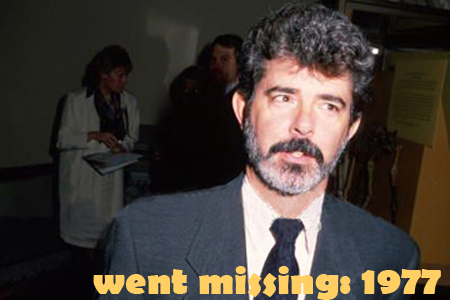
Seen this man?
source: omega-level.net
A friend of mine who had seen the new films confessed, years back, to having never seen the originals in any edition. We watched them over the course of a week or two. She found them enthralling: the epic, classical story told in a fresh environment; the creativity in making new worlds; the personality which emanated from the characters from their first introductions; the seamless use of effects in driving the story; and the enduring appeal of these films in their re-watching. Then there is also the uncomfortable implication that the new films lack a great many of these wonderful qualities.

Future generations of film viewers will have to deal with the reality that the new movies are now part of the saga and the story continuum, even if they lack the style, aura, appeal, personality, and depth of the films which preceded them. They are somehow "two forms of the same rite" even though those of us who recall the older films when they were the only films do not really buy into it. And while, as I said above, the older films could well have done with some aesthetic updates many of the changes were puzzling and clearly meant to transition into the newer films. 


Translation key:
  • Original version of original films: the old Roman liturgy
  • Possible updates of films: more popular singing, public Divine Office, fewer Double feasts, less bureaucratic management of liturgy
  • 1997 Special Edition: 1911 breviary reform, 1955 Holy Week reform, 1955 kalendar reform, 1960 rubrical reform
  • Post-1980s George Lucas: Popes Pius XII & Paul VI
  • New trilogy: Pauline Mass, Liturgy of the Hours, new Pontifical and Ritual Books, 1970 lectionary and Sacramentary
  • Hayden Christensen: Archbishop Annibale Bugnini/Masons—yes some find it fashionable to blame him rather than admit who is really responsible; his performance was bad, but ultimately he was not the one who behind the new trilogy