Showing posts with label Divino Afflatu. Show all posts

Saturday, July 13, 2019

Office of Prime (II): How to Say It


Using the rubrics that were in force from time immemorial until 1911 and Divino Afflatu, the Office of Prime mirrors the movements and variations of Lauds. The Roman Office has much variation, but essentially there are three types of days:
  • Duplex feasts
  • Simplex feasts
  • Feriae
A Semi-Double is celebrated in much the same manner as a Double, but with a lesser ranking and some additional prayers. A day within an octave is similar, although without additional prayers. The psalms at Vespers and Mattins are from the common and the Lauds and Prime are sung using the Dominical psalms. The Little Hours never change.

A feria simply observed the Office of the day with no note of any feasts, unless they warrant a commemoration of a superseded Lenten or Advent Simplex feast. Simple feasts use the psalter of the day for Vespers and Mattins, but follow the Dominical psalms for Lauds and an abbreviation of Prime. At first this seems a strange and arbitrary shift away from the purpose of the Office, the recitation of 150 psalms of David every week spread through the day for its sanctification. In fact, Lauds and Prime before S Pius X had very little daily variation. The first psalm of Lauds would be either 50 (Miserere mei Deus) or 92 (Dominus regnavit), the second psalm varied every non-festive day of the week, and the canticle could be one of seven possibilities unless a feast occurred, in which case the Benedicite would be sung. Two psalms varied daily, one conditionally, and five remained constant. 

At Prime, the psalter was as follows:
  • Sunday: 53, 117, 118i (1-16), 118ii (17-32)
  • Monday: 53, 23, 118i, 118ii
  • Tuesday: 53, 24, 118i, 118ii
  • Wednesday: 53, 25, 118i, 118ii
  • Thursday: 53, 22, 118i, 118ii
  • Friday: 53, 21, 118i, 118ii
  • Saturday: 53, 118i, 118ii
The entirety of the psalmody would be wrapped under one antiphon, either from the Office of the day or the first Lauds antiphon of the occurring feast. Like the other Horae Minores, the antiphon on Prime is semi-doubled, that is, read as far as the asterisk before the psalms and read in full after. On a feast, the psalms were always the three of Saturday not not the longer Prime of Sunday. Sunday Prime, before the full antiphon, also includes the Athanasian Creed. On feriae of Paschaltide, the psalms are always festive just as the Lauds are always Dominical.

If the Office is of Sunday, any feast, within an octave, or a weekday of Paschaltide, the chapter is from Timothy; otherwise, it is from Zachariah. Then follows the responsory Christe Fili Dei vivi. On festive days, the collect Domine Deus omnipotens immediately follows. Under any other circumstance the responsory and collect are separated by a series of versicle preces and the Confiteor said as at Mass and Compline. During penitential seasons the preces are expanded, although they do not include an additional psalm as they do at Vespers and Lauds during those seasons. 

Should the Martyrology be read it comes after the collect. The Roman Martyrology for the current day is always that of tomorrow's saints, usually with a word or two about them. At the end, thanksgiving is made and Our Lady and the rest of the saints are invoked for protection. Another comes another responsory, Deus in adiutorium, Gloria Patri, Kyrie eleison, Christe eleison, Kyrie eleison, the Lord's Prayer, another set of versicles, and the collect Dirigere:
O Lord, Almighty God, King of heaven and earth, Savior of the world, bless, lead, rule and govern our hearts and bodies, our senses, words and deeds today, following thy law and commandments, that here and for eternity with thy help we shall be saved in freedom. Who lives and reigns for ever and ever. 
If the Office of the Blessed Virgin Mary is to be sung this day, it begins at once. Otherwise, as with the beginning of Compline, a lector asks the celebrant for a blessing and reads a short lesson varying with the season. On feasts, however, the lesson is the same as the chapter sung at None.

After Adiutorium nostrum the dismissal is sung: Benedicite / Deus followed by the blessing:
May the Lord bless us, protect us from all evil and bring us to everlasting life. And may the souls of the faithful, through the mercy of God, rest in peace.  
Again, Prime resembles Compline in how it contrasts the other Hours, this time with its own dismissal (not the usual Benedicamus Domino) and blessing (not the usual Fidelium animae).

Divino Afflatu reordered the entire psalter to revive the de facto recitation of the 150 psalms daily. The better solution would either have been to reduce the number of Duplex feasts or lessen clerical obligations, but instead Papa Sarto initiated a radical overhaul of the Office. To the layman, the only arrant changes may have been more green vestments on Sundays and a strange new antiphon at Sunday Vespers for no apparent reason. In fact, most of the old antiphons of the Roman Office had to be discarded and replaced due to the fragmented psalter introduced in place of the full psalms of the Roman rite. Between its psalms and antiphons, the Little Hours are nigh unrecognizable. Some of the psalter remains unchanged for the great feasts of Our Lord and Our Lady, aside from the reduction of Lauds and the loss of ps. 53 at Prime on Sundays. The rest of it differs greatly every single day. The psalter became as follows:

  • Sunday: 117, 118i, 118ii
  • Monday: 23, 18 (in halves)
  • Tuesday: 24 (in thirds)
  • Wednesday: 25, 51, 52
  • Thursday: 22, 71 (in halves)
  • Friday: 21 (in thirds)
  • Saturday: 93 (in halves), 107
If these psalms look familiar it is because most of them belong to Mattins, not Prime, in the classical forms of the Roman Office. Additionally, the Pian Lauds and Prime represent the first time psalms in the Roman rite would be said out of order. The Byzantine rite Vespers sings some psalms out of order, but following a theme of persecution, deliverance, and thanksgiving. The Pian rite, by contrast, was formed with uniformity and a side glance to Tradition in mind. Its intentions were rational and yet, unlike the preceding Gregorian/medieval and Tridentine iterations, the psalms are printed on the page out of order because they must present the remaining psalm from S Pius V's Office first.

The rules for how to recite Prime are otherwise the same under Pius X as they were under Pius V with the caveat that, again, Prime's variability tracks Lauds. Divino Afflatu limited the potential for proper psalms and texts on feasts below Duplex of the II Class to a handful of ancient Roman feasts, meaning festive Prime (still 53, 118i, and 118ii) would now be said rarely. This system would continue until 1964.

Tuesday, September 25, 2018

Prelatial Vindication: The Pian Revolutions


Msgr. Athanasius Schneider, an auxiliary bishop from Kazakhstan and traditionalist luminary, has recently aired some fresh episcopal opinions about both the 1911-3 and 1955-6 alterations to the Roman liturgy. The old Holy Week was a mere wish list item and the Divino Afflatu changes were absolutely off limits. Now a canonically regular bishop and genuine friend to tradition can look at these changes and clearly see them as a modern frame of thinking filtered into the old rite; much was lost and comparatively little was gained.

This blog has written extensively in advocacy of not only the old Holy Week but also the entire old Office, perhaps with a refreshed kalendar more balanced than those which post-date Trent, so there is little new to say here, but perhaps readers have some ideas.
Kazakhstan Bishop Athanasius Schneider has criticised two liturgical “revolutions” which preceded Paul VI's 1970 disastrous Novus Ordo reform.
Talking to OnePeterFive.com (September 21), Schneider pointed to Pius X's 1911 reform of the breviary. For Schneider it is “an enigma how he could do this”.
Pius X radically changed the distribution of the psalms. The Roman Church had kept this order almost unchanged since or even before Pope Gregory I (+604).
For Schneider it is “reasonable” to return to the former breviary which he calls “the breviary of all ages”.
The second revolution Schneider localises in Pius XII's 1955 failed reform of the rite of Holy Week. According to Schneider a similar thing has "never happened in the entire history of the Church”.
Pius XII replace "the beautiful rites of Holy Week" with a “manufactured” construct, Schneider adds.

Thursday, January 26, 2017

Te lucis ante terminum

Through the miracle of time I have rediscovered the office of Compline. Although it was the first hour I really learned to say on my own accord I fell out of the practice of saying it in the years since finishing school and finding my life regulated by the daily and monthly pulse of American corporate finance, month end close, and quarterly reports to the Street. I began Vespers several years ago and anticipate Mattins and Lauds for Sundays and major feasts, but the non-major hours (horae minores are during the day???) rarely appear in my life, save Sundays and long vacations.

I was introduced to the old Latin liturgy long ago in the form of the "Traditional Latin Mass," but did not discover the Divine Office until 2011, when I went to Oxford and found the Office to be the pulse of St. Aldate Street. The Dominicans said the full Liturgy of the Hours in English daily while the Oratorians, where my shadow haunted for latria, used the 1962 Vespers for Sundays and the eve of major feasts. At some level I grew to love the Office more than the Mass if only because the Mass is required out of obligation, whereas a layman only attends the Hours out of devotion. Upon return to the States I began saying Compline according to the Tridentine form before going to bed. For a tired mind looking for an evening blessing, Compline is more focused than "Bless mommy, bless daddy, good night, Lord."

Compline is an altogether different sort of Office, both in structure and purpose, from the rest of the hours in the Roman breviary. The major hours (Vespers, Mattins, Lauds) descend from the vigil of psalms and readings that took place at night before the Eucharistic sacrifice in ancient days and which solidified in their extant, pre-1911 form by the age of St. Benedict, if not earlier. The daytime hours (Terce, Sext, None) grew out of non-cleric devotion in the major Roman basilicas by those who wished to pray and sanctify the entire day; because those who sang it were commoners unable to print book on demand, the psalter remained fixed for these hours. Prime and Compline have their origin in the monasteries around Jerusalem and functioned as "fillers" for gaps in the day when a monk might lapse in his prayer. St. John Cassian remarked during his 382 AD visit to Bethlehem that Prime had not yet been adopted everywhere in the East. Similarly, he knows nothing of the tradition already practiced by St. Basil of reciting psalm 90 (Qui habitat in adiutorio) before bed. When Benedict left Rome and brought the basilica psalter with him, he may have brought a newly settled custom of praying other psalms with psalm 90 before sleep.

Compline's distinction in structure and repetition in text makes it an easy hour to commit to memory and hence very suitable for those tiresome moments before bed when creative thought and reflection fail. The words themselves carry a weight of reassurance and tenderness:
Procul recedant somnia,
Et noctium phantasmata;
Hostemque nostrum comprime,
Ne polluantur corpora.
For a brief while I attempted the Divino Afflatu rendition of this hour, but found the variable psalms and antiphons antithetical to the very purpose of this Office. Indeed, Compline helped me realize that Pius X and Paul VI's overhaul of the Roman Office was far more radical than what the latter did to the Missal.

Compline represents a marvelous entry point into the Roman Office and deeper liturgical prayer. This prayer for a safe rest under Our Lord's watch, like an "apple to His eye", is approachable in its brevity and constancy while being less mundane than the horae minores of the day: a Confession, a few psalms, a short hymn, a canticle, and a prayer to Our Lady; most remarkable to me, at least in the Tridentine Office, is that the last words on the Christian's lips before sleep are the Pater, the Ave, and the Apostles' Creed. Seven Office sanctify the day, but only one the night!

Wednesday, July 13, 2016

Local Flavors & Savors

July is a brutally 1570 sort of month, but August is a very 1910ish month, with the ferial office hardly appearing between the octaves of St. Lawrence and the Assumption as well as a number of very Roman double feasts. The General Roman Calendar created by the Consilium—nominally administered by Cardinal Lercarco, in fact run by the man Louis Bouyer described as the "despicable Bugnini", a "man as bereft of culture as he was basic honesty"—is quite modern and quite general, but in very few ways is it Roman.

August begins with the very Roman feast of St. Peter's Chains, which is also the name of an ancient Roman church that holds the reputed link of chain which held the Prince of the Apostles while he await execution. Peter went to Antioch, where the various Catholic and Orthodox descendants remember him in their own way, and then to Rome, where he acted as bishop before his inverted crucifixion. To Felix Roma was given the privilege of claiming the two greatest as its patrons and fathers in faith. Christians in Jerusalem held the holy places in high esteem and continued their devotion to them between the time of the Ascension and the edict of Milan, so much so that when St. Helen came to the holy city seeking relics she found consistent narratives of the Crucifixion's site and the True Cross. Roman Christians followed this instinct in venerating the ossuaries and objects associated with its saints, as did Christian of every church. Jerusalem's devotion effected the received practices of Holy Week, Rome's created the phenomena of local feasts and stational Masses. Throughout August, the old rite presents the feasts of St. Peter's Chains, the Dedication of Our Lady of Snows (St. Mary Major), the feast of St. Lawrence (with a vigil and octave of proper Mattins), and a unique date for St. Bartholomew's day. Notably all these feasts could supersede a Sunday Mass. Additionally, the Latin Church celebrated the Finding of St. Stephen, a Gallican feast imported as part of the medieval synthesis of the Frankish and first millennium Roman traditions. The significance granted to these feasts is remarkable by our post-Divino Afflatu standards, but hardly surprising to the Romans: they were feasts concerning the character and encounters with the Divine of the Roman Church. Every rite has Pascha, Theophany, and Epiphany; only the Latin rite has "St. John at the Latin Gate."

What came out of the Consilium's conference rooms and reserved trattoria seats reflects the view that the Roman rite is the rite of the Latin Church rather than a template for the Roman Church. St. Bartholomew is not celebrated on the Roman day (!), gone is St. Stephen, and while St. Lawrence and Our Lady of Snows remain, their festive rankings have been stripped such that they do not appear on Sundays, even if once every seven years. Above all, the feast of the Apostle of gone without a trace. The revised calendar's inorganic nature betrays the centralizing mindset of its creators, who must have known that they were creating ex nihilo a calendar for the entire Latin Church. Local additions, with regulatory approval, would be exceptions rather than the norm. Rome was not alone in having local feasts. Sarum's calendar is replete with saints whose names are almost forgotten after the Reformation: Edmund of Abindgon, Kenelm, Osmund of Salisbury to name a few; also, many particular devotions to the Holy Name and Five Wounds found their way into the English liturgy. The neo-Gallican French rites reflected similarly local saints like Genevieve as well as contemporary [and unhealthy] interest in St. Augustine. While the revised liturgy allows approved local additions, the locale implicit in the Roman rite lacks the gravitas of Romanitas. Our Lady of the Apparition type feasts carried over from before the reforms, but what of the Commemoration of St. Paul, St. Peter's Chair, or St. John at the Gate?

Interestingly, many local "dialects" of the Roman rite, Sarum among them, have those distinctly Roman feasts. Ancient and medieval churches sought to imitate Roman practices while allowing for their own saints and miracles, too, which proved that the Church was quite alive in those days. A medieval diet was about 3,000-4,000 calories daily depending on one's social class; the proliferation of holy men in diverse places aided in the multiplication of feasts which would "gladden the heart of man" (ps. 103). The revised calendar is more a novelty diet which allows a few "cheats" per year.

I, for one, would like to see the delicious return of some savory local feasts.

Saturday, August 23, 2014

Variation of St. Bartholomew's Day (Double Repost)

From my 1911 Missale Romanum
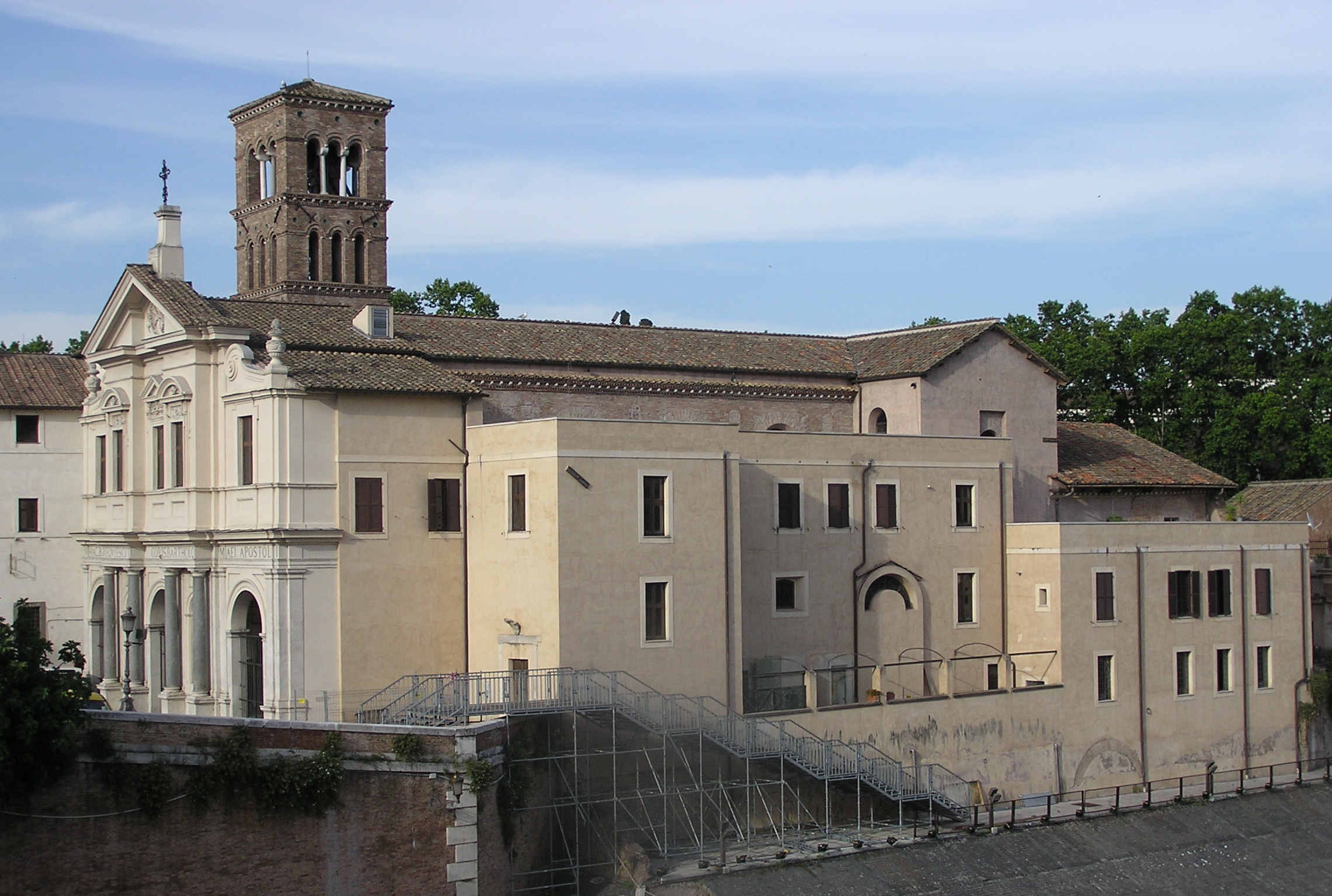
You will recall a few days ago a post displaying a photo of my 1911 Missale Romanum, which indicates that within the city of Rome St. Bartholomew's feast is to be celebrated on August 25th, as opposed to the broader celebration on August 24th. The other day, at Sunday Divine Liturgy, we commemorated the Saint, which I assumed to be a lingering Latinization that had not yet been discarded. A quick look revealed that the Antiochian Orthodox and the Greek Orthodox also observe St. Bartholomew on the Roman day. According to Rubricarius of the St. Lawrence Press the differing dates have to do with the transfer of the Apostle's relics the date of which was observed as the feast in Rome and in the Eastern rites. Gregory DiPippo relates that while the Latin Church observed the feast on the 24th a major celebration would take place at the Basilica of St. Bartholomew on Tiber Island with the help of Rome's Greek community. The Sacred Congregation for Rites, not always a historically informed committee, axed this variation on October 28th, 1913 in accordance with the reforms Divino Afflatu began two years prior. The record of the relevant decree can be found here on page 463, section V, item d.

Sunday, August 17, 2014

Let's Compare!

source: latin-liturgy.org

As a follow up to this post on the Liturgy of the Hours, I would like to share this brief comparison of the Roman rite as various stages in the last four a half centuries.

Liturgy & Feast
I Vespers
Mattins/Lauds
Mass
II Vespers
1570: Octave day of St. Lawrence
Vespers of St. Lawrence; comm. X Sun. after Pentecost and oct. of Assmpt.
Festive. Three nocturnes of three psalms and three lessons; last lesson concatenates dominical readings. Comm. of Sunday and Marian oct. at Lauds
Of St Lawrence. Comm. of Sunday and oct. of Assmpt. Last Gospel from Sunday
Vespers of St. Lawrence; comm. X Sun. after Pentecost and oct. of Assmpt.
1910: St. Joachim
Vespers of St. Joachim; comm. X Sunday after Pentecost, oct. day of St. Lawrence, oct. of Assmpt., and of St Hyacinth
Festive. Three nocturnes of three psalms and three lessons; last lesson concatenates dominical readings. Comm. of Sunday, St. Lawrence oct. day, Marian oct. and St. Hyacinth at Lauds
Of St Joachim. Comm. of Sunday, St. Lawrence oct. day, Marian oct. and St. Hyacinth at Lauds. Last Gospel from Sunday
Vespers of St. Joachim; comm. X Sunday after Pentecost, oct. day of St. Lawrence, oct. of Assmpt., and of St Hyacinth
St Pius X: X Sunday after Pentecost
Vespers of St. Joachim, comm. of oct. day of St Lawrence, X Sunday after Pentecost, St. Hyacinth, and oct. of Assmpt.
Of Sunday, three nocturnes of three psalms and three lessons; comm. of St. Hyacinth, oct. day of St. Lawrence and Marian. Oct. at Lauds
Of Sunday. Comm. of oct. day of St. Lawrence, St Hyacinth, and oct. of Assmpt.

Optional private Mass of St.. Joachim with comm. of Sunday and proper Last Gospel
Of Sunday. Comm. of oct. day of St. Lawrence, St Hyacinth, and oct. of Assmpt.

1962: X Sunday after Pentecost
Vespers of St. Joachim, comm. of X Sunday after Pentecost
Of Sunday. One nocturne of nine psalms and three lessons.
Of Sunday.
Of Sunday.
Paul VI: XXth Sunday of “Ordinary Time”
Evening Prayer scheme I for Sundays of Ordinary Time
Of Sunday. Three psalms and two [very long] readings
Of Sunday. Readings of year A
Of Sunday.


I am sure some of this is wrong, so JohnR and Rubricarius can disabuse me of my errors. The Rad Trad advocates no specific year here, although he would not mind the 1570 scheme with St. Joachim permanently fixed for August 16.

Monday, August 26, 2013

More of St. Bartholomew's Day

Basilica of St. Bartholomew on Tiber Island, Rome
source: Wikipedia.org
You will recall a few days ago a post displaying a photo of my 1913 Missale Romanum, which indicates that within the city of Rome St. Bartholomew's feast is to be celebrated on August 25th, as opposed to the broader celebration on August 24th. The other day, at Sunday Divine Liturgy, we commemorated the Saint, which I assumed to be a lingering Latinization that had not yet been discarded. A quick look revealed that the Antiochian Orthodox and the Greek Orthodox also observe St. Bartholomew on the Roman day. According to Rubricarius of the St. Lawrence Press the differing dates have to do with the transfer of the Apostle's relics the date of which was observed as the feast in Rome and in the Eastern rites. Gregory DiPippo relates that while the Latin Church observed the feast on the 24th a major celebration would take place at the Basilica of St. Bartholomew on Tiber Island with the help of Rome's Greek community. The Sacred Congregation for Rites, not always a historically informed committee, axed this variation on October 28th, 1913 in accordance with the reforms Divino Afflatu began two years prior. The record of the relevant decree can be found here on page 463, section V, item d.

Tuesday, July 23, 2013

Coming Soon: Ancient Roman Office

In the not-so-distant future the Rad Trad will give a very brief, one post overview of the development of the ancient Roman psalter and the Office surrounding it. The ancient psalter survived Pope Nicholas III's imposition of the Franciscan Breviary secundum usum Curiae Romanae, but the rest of the Office was not so lucky. Yet some of the ancient Office continues in the pre-1911 Tenebrae offices, as well as Vespers and Compline of the Triduum, Mattins and Lauds of Pascha and Pentecost, and Mattins of Epiphany. Structural hints also survive in the Officium Defunctorum.
 
Many readers are aware that St. Pius X re-distributed the psalms in a seemingly unprecedented move with the Apostolic Constitution Divino Afflatu. What some may not know is that the rest of the Office (the translation of the psalms, the antiphons, the use of hymns, the introductory rites etc.) underwent a similar revolution in the high Middle Ages. The more ancient Roman Office had survived in the major basilicas of Rome into the twelfth century. By the early thirteenth Innocent III lamented that the ancient Office and Mass were only used by the Papal Court on feast of St. Peter's Chair in Rome! More on how the transition happened later. Still, at least in some capacity, the ancient Office survives!

Monday, May 27, 2013

Picking a Year....

...In praying the Divine Office!

Many readers probably pray all or part of the Divine Office. I myself pray Vespers and Compline daily, with Mattins and Lauds on, or the evening before, the majors feasts. For those not bound to praying a particular version it is good to be aware of what options are available and what differentiates certain versions. The major differences between versions will be:
  • The arrangement of the psalms: the older psalter was modified, or outright suppressed, by Papa Sarto in 1911. The psalter from 1911-1965, when the office of Prime was suppressed, is theoretically the same throughout, but other changes by Pius XII and John XXIII means it differs in practice. The pre-Pius X psalter prescribed 12 Mattins psalms on ferial days and 9 on feasts, using a consistent repertoire on feasts for Mattins, Lauds, and Vespers. The "little hours" would be the same daily. After Pius X the offices remained the same, but the psalter changed drastically, chopping psalms into roughly equal 15-verse bits and distributing them in order throughout the week. The little hours became fungible at this point.
  • The rubrics: the post-Pius X office has the odd practice of splitting semi-double and double feasts into halves, using the ferial psalms and antiphons, but with the festal hymns, collects, and canticle antiphons. Given the number of feasts in any calendar after the 17th century, this makes a daily difference.
  • Preces/suffrages: these delightful and moving intercessory prayers are prayed on semi-double, simple, and ferial days outside of octaves. They are most notable by their absence on feasts, reminding us that we are to rejoice on feasts, but most of our time ought to be spent in prayers for mercy and in penance. The Advent/Lenten Vespers suffrage is particularly powerful. The 1911-1913 reforms reduced the suffrages to one antiphon and collect, but on the whole kept the idea. At some point between 1955 and 1960 they went extinct.
  • The calendar: the ranking system was in principle the same from time immemorial through 1955, when Pius XII eliminated semi-double days and when John XXIII tossed the entire thing in favor of a numerical system, but the number of feasts in the calendar by 1910 and the rubrics governing Sundays and other special days in the post-1911 Office make each version substantially different in practice. Even 1568 and 1910, which use the same psalter and mostly the same rubrics are very different in practice due to the proliferation of double feasts. The Johannine calendar is very simple, but also has a narrower experience with its compressed rankings and commemoration system. Most noticeable, aside from feasts, is the disappearance of most octaves and vigils in 1955, a sad loss.
  • Assorted matter: many other things changed between 1568 and the mid-twentieth century. The scriptural readings at Mattins were altered and shortened a bit by Clement VIII. Pius IX introduced a new, and improved in my opinion, feast of the Immaculate Conception. Pius XII introduced a new Assumption feast. Urban VIII toyed with the hymns. There was the 1942 Common for Popes. A lot differs that is not structural, but I do not think these matters are as substantial as the structural differences.
The choices for praying the Divine Office have proliferated thanks to the internet, which has given us both resources to pray from online editions of the Roman Office or to purchase used copies on sites like Abe Books or eBay. I will narrow my comments on what one can pray from Divinum Officium, a very nice and informative website that allows one to pray any number of editions of the Office, more or less, including a theoretical reconstruction of a medieval monastic Office—which I will actually be ignoring in my comments along with the 1960 Office according to the Pauline calendar.
 
Here we go:
  • 1570: actually 1568, but it's "Tridentine" either way. Uses the original Roman psalter, including full-length psalms aside from the little hours. Over half the days are ferial, lending a strong awareness of the temporal cycle. The limited number of psalms used for festal offices and for octaves actually makes the feasts more special. I entered a state of shock by praying ferial Vespers tonight for the first time in a very long time, after having prayed the octaves the Ascension and Pentecost, followed by the Feast of the Holy Trinity. Simple feasts have the "splitting" structure I mentioned for most feasts in the Pian Office, but I do not mind it here, as most all the saints under the Simple category were local saints of the diocese of Rome, giving those offices a special and familiar character. My only real cavil with this edition is that St. Pius V eliminated the feasts of Ss. Joachim and Ann, the ancestors of our Lord. It has the suffrages and preces, which can be time consuming, particularly during Advent and Lent, but are very rich in their content during those seasons. This year is the most difficult, and in some sense the most brutal, to pray, but I find also the most rewarding. Saints feasts can supersede Sundays, but there are comparatively so few double feasts that one does not mind the break from the green days. Twelve psalms at ferial Mattins!
  • 1910: theoretically the same as above, but the multiplication of doubles severely curtails the praying of the psalter, especially considering that any feast with the word "double" in it has first Vespers. For instance next month, June, has four ferial days—two of them Saturdays of Our Lay—and three Simple days that will be observed. At none of them will the ferial Vespers be prayed, and at some of them there preces and suffrages will be omitted because of tomorrow's feast. In practice, this is a very different Office from 1570. Feasts replace the Sunday Office very often.
  • Divino Afflatu: while the name might give one the impression that this is the 1911 Office, it is not. It is basically 1954, meaning the Pian psalter, but with fewer psalms at ferial Mattins, the "splitting" of most feasts, and the ranking of octaves to clear up any ambiguity. If one had to read the rubrics of a breviary and decide how to pray the Office for the day, this would be the most confusing edition of all mentioned by far. The calendar is very balanced in this edition, but there is the reduced length of the psalms. Each major office and minor office, and even each nocturn at Mattins, is roughly the same size—very streamlined. This edition does have some pluses: octaves are observed, preces and suffrages are still there but curtailed, one goes through the entire psalter, full range of Mattins lessons, and not too time consuming if one wants to have a fuller experience of the Office in limited time. One should note that the little hours during Holy Week and Tenebrae during the Triduum will differ from the ancient version. Feasts replace the Sunday Office about as often as they do in 1570.
  • 1955: much of what I wrote above from Divino Afflatu still applies, but without most octaves (only Pascha, Pentecost, and Christmas live), with modifications to the Triduum per Pius XII's reforms, and the mixing of most semi-double days into Simples. Also, the antiphons, I believe, are now entirely doubled on every day, discarding the partial singing of the psalm antiphons to begin a psalm on ferias, Simples, and semi-doubles, consistent with their character. The effect is the blurring of feast days.
  • 1960: calendar is mostly third class days. Very few days have first Vespers. On all but a few days there is one nocturne a Mattins, and those days are almost never Sundays. First class feasts can still take precedence over Sunday, as can second class feasts of our Lord, but these occasions are rarer than ever. The overall use of patristic texts is lacking in this Office, as is the means of commemorating superseded offices. The ancient character of feasts of ancient Roman saints or ancient saints of universal fame is gone. First class days are mostly the same, as are some second class feasts of our Lord and Lady. On the whole, this is the least time-consuming Office, but also the oddest structurally and most impoverished textually.
I would first recommend the 1570 if one has the time, and then the Divino Afflatu edition. Why Divino Afflatu over 1910? Purists may disagree with me, but I hold the 1910 Office does not fully accomplish the purpose of the Office: to pray the psalms. Yes, everything else is intact, but in this sense everything else is less important. Was the reform of 1911 wise? I would respectfully say it was very unnecessary, as some calendar changes would have solved the problem. Still, I would prefer Divino Afflatu over 1910 if those were my two choices because one can pray the psalter and still go through the entire calendar. 1960 is very barren to me and 1955, while fuller in content, is clearly a transition.
 
My advice is to take things easy and begin by praying a little hour. I started with Compline in the Divino Afflatu form and soon adapted the older version, then took on Vespers. One advantage to starting with a minor hour like Compline or Sext or whatever in the 1570-1910 form is that it is more or less the same daily, but one finds small variations like the preces from day to day, allowing both familiarity with the calendar and stability with the general structure of that particular office. Perhaps something like Vespers of Lauds on Sundays and feasts could be added later.
 
Of course this is just my suggestion. Pray whatever you like and however you find your prayer effective. The purpose of this post was to help anyone praying the Office who is confused about versions clarify those matters and to aid anyone considering praying the Office in making an informed decision, given that person's time and desire to be immersed in the ancient prayer of the Church.
 
God bless,
The Rad Trad

Saturday, January 12, 2013

My New Missal


A friend recently gave me a copy of a Missale Romanum which was published in 1913, after St Pius X's bull Divino Afflatu, reforming the breviary and the calendar for the Mass. Although the bull is published in the front, after Quo Primum and all the usual documents, this missal has none of the mandates changes, as the reformed missal was not published until 1920, according to Rubricarius of the St Lawrence Press blog. So, the feast of St. Thomas Becket had commemorations of four octaves rather than just one! The ancient, unreformed Holy Week is also published herein.


This is clearly an altar missal that would have been used on the more important feasts of the year. The gilding is in excellent condition, as is the paper. One of the locks on the side is in working order, while the other must be replaced.


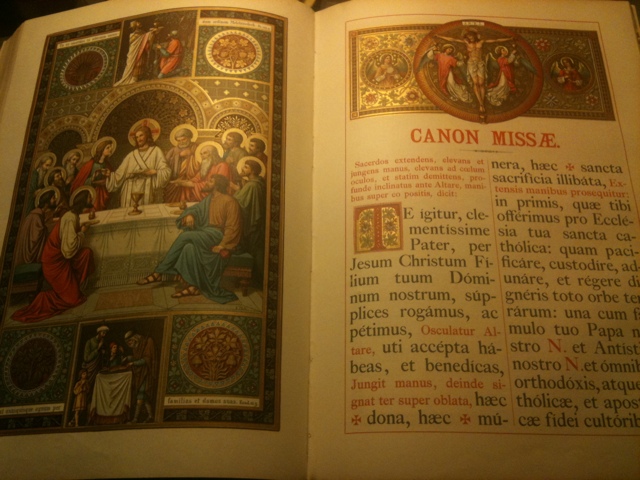
The Canon of the Mass. The artwork is quite detailed. One can feel the ink-print when touching the images and print.


The opening pages.


The backside of the missal. The leather should be clean and some of the gilding ought to be re-finished, but it is in working condition. This book was built to last for a very long time.


The texts for the first Mass of Christmas day. Note the lovely woodblock-printed images above the more important feasts.


"Resurrexi et adhuc tecum sum," the opening words of the Easter Sunday Mass: "I have risen, and I am still with you." I am 6'2", have very large hands, and can mostly encompass an NFL sized football with my fingers; this should give you an idea as to how large this missal is. Also, the paper quality is outstanding, something missing in today's liturgical books. The pages for the Ordo Missae and Canon Missae are so thick that one can see the weaving pattern.

Happy Feast of the Holy Family—which is not in this book! Perhaps I should wish you a happy octave day of Epiphany!